
AI for Sustainable Packaging with BLE
AI-Powered BLE Tracking for Sustainable Packaging Operations
AI is changing sustainable packaging by making packaging materials, reusable containers, pallets, totes, and finished packaging units more measurable, traceable, and operationally manageable. When AI is combined with BLE beacons, BLE sensors, and BLE gateways, packaging organizations can capture location, environmental, handling, and utilization data and turn it into actionable decisions. AI models can identify abnormal storage conditions, predict packaging-related losses, optimize reusable packaging cycles, and support quality and sustainability programs.
For sustainable packaging operations, the value comes from connecting physical packaging assets with software that can interpret their condition and movement. BLE provides a practical wireless data layer for collecting information from packaging facilities, warehouses, production areas, distribution points, and return locations. GAO supplies BLE, RFID, and IoT hardware products and systems that can support these deployments, including solutions designed for organizations requiring reliable asset visibility and industrial data collection.
AI-Enabled Sustainable Packaging Architecture
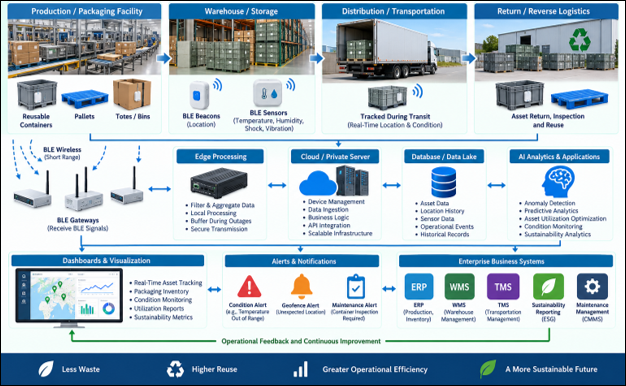
The diagram illustrates how BLE beacons and sensors collect sustainable packaging data through BLE gateways and edge processing. The data is analyzed using AI and connected to dashboards, alerts, and business systems to improve packaging tracking, reuse, condition monitoring, and operational efficiency.
How AI Improves Sustainable Packaging Operations
Sustainable packaging involves more than selecting recyclable or reusable materials. Packaging organizations must also manage material consumption, packaging quality, reusable container circulation, return rates, storage conditions, transportation, inventory accuracy, and end-of-life processes. These activities create large quantities of operational data that can be difficult to interpret manually.
AI can analyze this information to identify patterns that are difficult to detect through conventional reporting. For example, an AI model can evaluate BLE-generated location histories to determine where reusable packaging spends excessive time, identify recurring loss points, or estimate when packaging assets are likely to require inspection.
BLE is particularly useful when packaging assets need low-power wireless identification or sensing without the infrastructure requirements associated with more complex wireless technologies. BLE beacons can provide persistent asset identity and location signals, while BLE sensors can capture parameters such as temperature, humidity, shock, vibration, or other relevant environmental conditions. BLE gateways collect these signals and forward the information to processing software.
The resulting system can support applications such as:
- Reusable packaging tracking across manufacturing, warehouse, distribution, and return operations
- Packaging inventory visibility
- Returnable transport packaging monitoring
- Environmental condition monitoring
- Packaging loss and shrinkage analysis
- AI-assisted packaging utilization analysis
- Predictive maintenance of reusable containers
- Packaging cycle-time optimization
- Identification of excessive dwell time
- Packaging quality monitoring
- Sustainability reporting based on operational data
Sustainable Packaging Applications for AI and BLE
Reusable Packaging Tracking
Reusable packaging creates a circular operating process in which containers, totes, pallets, bins, racks, and other packaging assets move repeatedly between facilities and supply-chain locations.
A BLE beacon attached to each reusable asset can provide a unique digital identity. BLE gateways installed at strategically selected locations detect the beacon and transmit location events to the software system. Instead of relying solely on manual scans, organizations can build a continuous history of packaging movement.
AI can analyze these movement histories to identify:
- Packaging assets with unusually long circulation cycles
- Locations where reusable packaging accumulates
- Assets that frequently disappear from expected routes
- Packaging shortages at production or distribution facilities
- Repeated transportation delays
- Underutilized packaging inventory
This information can help operations teams increase packaging utilization and reduce unnecessary purchases of replacement containers.
Packaging Condition Monitoring
Reusable packaging may be exposed to temperature fluctuations, humidity, impact, vibration, contamination, and rough handling. The acceptable conditions depend on the packaging type and the products it carries.
BLE sensors can collect relevant environmental or physical measurements and transmit them through nearby BLE gateways. AI software can then evaluate historical and real-time readings rather than relying only on fixed threshold alarms.
For example, an AI model can distinguish between a short abnormal reading and a recurring environmental pattern. This enables maintenance or quality personnel to prioritize packaging assets that exhibit meaningful deterioration or repeated exposure to undesirable conditions.
Packaging Inventory Optimization
Packaging inventory is often distributed across manufacturing facilities, warehouses, logistics locations, customers, and return points. This makes conventional inventory counts difficult to maintain.
BLE-based asset visibility can provide more frequent information about where packaging units are located. AI can combine this information with historical consumption, return rates, production schedules, and packaging demand to identify potential shortages or excess inventory.
The objective is not simply to know how many containers exist. The more useful question is whether the right packaging is available at the right location when required.
Packaging Loss and Shrinkage Detection
Reusable packaging can become an operational expense when assets fail to return, remain at customer locations, or become misplaced within large facilities.
BLE location data creates a history of asset movement that can be analyzed for unusual behavior. AI models can identify locations, routes, or process stages associated with higher-than-normal loss rates.
Operations teams can then investigate specific process bottlenecks instead of conducting broad manual searches.
From BLE Data Capture to AI-Driven Packaging Decisions
A sustainable packaging AI solution normally begins with physical data acquisition.
BLE sensors and beacons are attached to or associated with packaging assets. Their placement should consider packaging material, enclosure design, radio propagation, expected operating environment, battery life, and the possibility of mechanical damage.
BLE gateways are then positioned where packaging movement or environmental measurements need to be captured. Gateway density depends on facility size, wall construction, metal structures, interference, required location accuracy, and the operational process being monitored.
The gateway forwards collected information to edge or centralized software. Depending on the deployment requirements, processing can occur locally, on a customer-managed server, or through cloud-hosted software.
A typical data flow is:
- BLE beacon or sensor generates an asset or measurement event
- BLE gateway receives the wireless transmission
- Gateway filters, buffers, or forwards collected data
- Edge or server software processes the incoming events
- Middleware connects operational data with business applications
- Database stores asset, location, sensor, and event history
- AI models evaluate patterns and generate predictions or classifications
- Analytics software presents operational insights
- Alerts are delivered when defined conditions or AI-detected anomalies occur
- Packaging, warehouse, logistics, quality, or sustainability teams take corrective action
This approach allows the physical packaging lifecycle to become a source of operational intelligence rather than an isolated tracking process.
AI-Enabled Sustainable Packaging Workflow
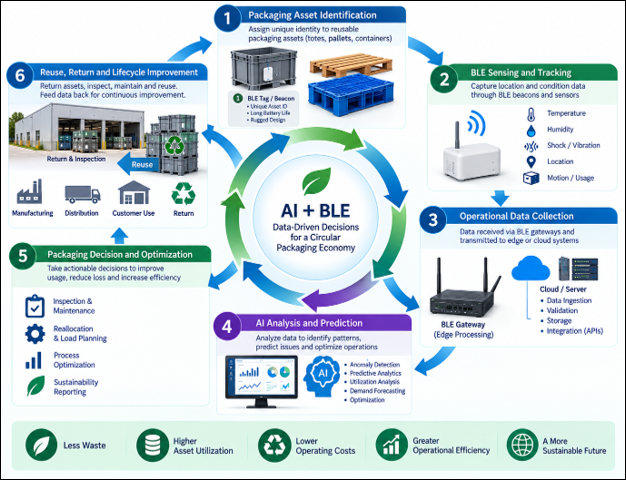
This workflow illustrates how reusable packaging data moves from BLE beacons and sensors through BLE gateways, processing, databases, and AI analytics to dashboards, alerts, and operational actions. The feedback loop supports continuous improvement, waste reduction, and increased packaging reuse.
BLE Hardware for Sustainable Packaging
BLE Beacons
BLE beacons provide an identifiable wireless signal that can be associated with a reusable packaging asset. Their low-power characteristics make them suitable for applications where packaging units must remain identifiable over extended operating cycles.
Beacon selection should consider:
- Battery life
- Transmission interval
- Mounting method
- Physical protection
- Operating temperature
- Radio range
- Environmental exposure
- Maintenance requirements
- Asset replacement cycle
For reusable packaging, mechanical attachment is particularly important. A beacon that is technically capable but easily detached during handling may undermine asset visibility.
BLE Sensors
BLE sensors extend asset identification into condition monitoring. Depending on the application, sensors can capture environmental or physical parameters relevant to packaging operations.
Potential measurements include:
- Temperature
- Humidity
- Shock
- Vibration
- Motion
- Light exposure
- Door or lid status where applicable
Sensor selection should be based on the actual packaging process rather than simply the availability of a particular sensor type. Measurement range, sampling interval, accuracy, battery consumption, enclosure rating, and calibration requirements all affect system performance.
BLE Gateways
BLE gateways form the connection between wireless packaging assets and the organization’s software infrastructure.
Gateway placement is one of the most important engineering considerations. Metal racks, machinery, walls, liquid-filled containers, and dense packaging materials can affect radio propagation. A gateway layout should therefore be validated through an on-site RF survey or pilot deployment before large-scale commissioning.
Gateways can also provide local processing functions such as filtering duplicate events, buffering data during network interruptions, and forwarding only relevant records to upstream software.
GAO’s experience supplying BLE and IoT hardware products and systems can help organizations evaluate gateway, beacon, and sensor requirements according to their packaging environment and operational objectives.
AI Methods for Sustainable Packaging Intelligence
Different sustainable packaging applications require different AI approaches. A single model should not automatically be applied to every operational problem.
Anomaly Detection
Anomaly detection can identify packaging behavior that differs significantly from established operational patterns.
Examples include unusually long dwell times, unexpected movement between locations, abnormal sensor readings, or repeated exposure to undesirable conditions.
Predictive Analytics
Predictive models can use historical packaging movement and utilization information to estimate future requirements.
For example, packaging demand forecasting can help determine whether existing reusable container inventory is sufficient for expected production or distribution volumes.
Classification Models
Classification can help categorize packaging conditions or operational events. A system might classify assets according to normal operation, inspection required, delayed return, or potential loss.
Optimization Models
Optimization techniques can evaluate packaging allocation, return cycles, inventory distribution, and utilization patterns to identify more efficient operating decisions.
The quality of these AI applications depends heavily on the quality of the underlying data. Incorrect asset identities, poorly positioned gateways, missing events, inconsistent timestamps, and sensor calibration problems can produce misleading AI results.
Cloud and Server Deployment for Sustainable Packaging
Sustainable packaging organizations can select a cloud-hosted or privately managed deployment depending on operational, security, connectivity, and integration requirements.
Cloud Version
A cloud-hosted deployment can be appropriate when packaging operations span multiple facilities or when centralized analytics are required across geographically distributed locations.
Cloud deployment can simplify centralized data storage, software updates, multi-site analytics, and remote access. It can also make it easier to consolidate packaging movement data from multiple facilities into common reporting and AI models.
However, connectivity requirements should be considered carefully. Facilities with unreliable network connectivity may require gateway-side buffering or local processing so that temporary network interruptions do not result in permanent data loss.
Server Version
A server deployment can run on customer-managed servers, factory servers, private data centers, or other privately hosted infrastructure.
This model can be appropriate when packaging data must remain within controlled infrastructure, when integration with existing manufacturing systems requires local connectivity, or when operational environments have strict cybersecurity and data-governance requirements.
A hybrid arrangement can also be used, with local processing handling time-sensitive functions while selected information is transferred to centralized systems for broader analytics.
Integrating AI and BLE with Packaging Software
A BLE-based sustainable packaging solution becomes substantially more useful when its data is connected with existing business software.
Potential integration targets include:
- Warehouse management systems
- Manufacturing execution systems
- Enterprise resource planning systems
- Transportation management systems
- Inventory management software
- Quality management systems
- Maintenance management systems
- Sustainability reporting systems
- Business intelligence tools
Middleware can normalize asset identifiers, timestamps, gateway information, sensor readings, and location events before transferring information into enterprise applications.
APIs can support application-to-application communication, while databases can retain historical packaging events required for AI model development and operational analysis.
For large packaging operations, data governance should be established early. Each physical packaging asset should have a consistent identifier, ownership or responsibility information, packaging type, lifecycle status, and relevant operational attributes.
This foundation makes it possible to connect BLE observations with actual business processes rather than maintaining an isolated tracking database.
Engineering Considerations Before Deployment
A successful sustainable packaging deployment requires more than installing BLE hardware.
Important engineering considerations include:
- Define the packaging assets that require visibility
- Determine whether tracking, condition monitoring, or both are required
- Establish acceptable location accuracy
- Identify critical packaging movement points
- Evaluate RF propagation and interference
- Select beacon and sensor mounting methods
- Estimate battery replacement intervals
- Determine gateway density
- Validate network connectivity
- Define data retention requirements
- Establish cybersecurity controls
- Select cloud, server, or hybrid processing
- Identify required software integrations
- Establish baseline KPIs before AI deployment
- Conduct a pilot before expanding across facilities
A pilot should test the complete operational chain, including hardware installation, BLE detection, gateway connectivity, data processing, software integration, AI analysis, alerts, and the resulting human action. Measuring only radio performance is insufficient because the objective is to improve sustainable packaging operations.
GAO supports organizations by providing BLE, RFID, and IoT hardware products and systems together with engineering-oriented technical support. Its work with customers in the U.S. and Canada, including Fortune 500 companies, R&D organizations, universities, and government agencies, provides a foundation for evaluating practical deployment requirements.
AI-Driven Benefits for Sustainable Packaging
Combining AI with BLE-generated packaging data can improve both operational efficiency and sustainability performance. The main advantage is the ability to move from periodic manual observations toward continuous, data-driven decision-making.
Higher Reusable Packaging Utilization
AI can analyze how frequently reusable containers, totes, pallets, and other packaging assets are used, where they remain idle, and how long each circulation cycle takes.
This allows packaging managers to identify assets that are underutilized while other facilities experience shortages. Better allocation can increase the number of productive cycles obtained from existing packaging inventory and reduce unnecessary purchases.
Reduced Packaging Loss
BLE-based location histories can help determine where packaging assets were last detected and identify unusual movement patterns.
AI can go further by learning normal circulation behavior and highlighting assets that deviate from expected routes or return schedules. This provides operations teams with earlier opportunities to investigate potential losses.
Lower Packaging Waste
Sustainable packaging programs depend on minimizing unnecessary material consumption and avoiding premature disposal of reusable packaging.
Condition-monitoring data can help distinguish packaging that requires inspection or maintenance from packaging that has genuinely reached the end of its useful operating life. AI-based analysis can therefore support more informed replacement decisions.
Better Packaging Availability
Production and distribution operations can be disrupted when the required reusable packaging is unavailable.
AI can combine packaging inventory, historical usage, return cycles, and operational schedules to identify likely shortages before they affect production or shipping activities.
Improved Sustainability Measurement
BLE-generated operational data can provide supporting evidence for sustainability metrics related to reusable packaging utilization, asset circulation, return performance, and packaging lifecycle management.
Rather than relying entirely on estimates, organizations can build sustainability analysis around actual operational events captured from physical packaging assets.
Key KPIs for AI-Enabled Sustainable Packaging
Organizations should establish measurable KPIs before implementing AI. This provides a baseline against which operational improvements can be evaluated.
Relevant KPIs include:
- Reusable packaging utilization rate
- Average packaging cycle time
- Packaging return rate
- Packaging loss rate
- Average dwell time
- Packaging inventory accuracy
- Packaging availability
- Asset recovery time
- Number of packaging cycles per asset
- Packaging inspection frequency
- Packaging damage rate
- Sensor exception rate
- Gateway data capture rate
- Percentage of assets with known locations
- Packaging replacement frequency
These KPIs can be analyzed by facility, packaging type, customer, route, production line, or time period.
AI can then identify correlations and recurring patterns that conventional KPI dashboards may not reveal. For example, a high packaging loss rate may correlate with particular transfer points, extended dwell periods, or specific operating processes.
Security and Reliability Considerations
BLE deployments for sustainable packaging should be designed with security and operational reliability in mind.
Asset identifiers, gateway communications, databases, APIs, and enterprise integrations should be protected against unauthorized access. Authentication and authorization should restrict access according to operational responsibilities.
Data transmitted from gateways should use appropriate secure communication mechanisms when traveling across IP networks. Server and cloud environments should also follow the organization’s established cybersecurity policies.
Operational reliability requires attention to more than cybersecurity. BLE systems should account for:
- Temporary network outages
- Gateway power interruptions
- Battery depletion
- Sensor malfunction
- Incorrect asset association
- Duplicate events
- Missing data
- Clock or timestamp inconsistencies
- Physical damage to BLE devices
- RF interference
Gateway-side buffering can reduce the impact of temporary network failures. Health monitoring can also identify gateways or sensors that stop reporting.
Data validation is particularly important for AI applications. An AI model trained on corrupted or incomplete packaging data can produce misleading results even when the model itself is technically sound.
Deployment, Testing, and Commissioning
A practical deployment should progress from a controlled pilot toward broader facility coverage.
The first stage is requirements definition. Packaging managers, warehouse personnel, logistics teams, quality personnel, IT staff, and sustainability teams should agree on the assets and processes to be monitored.
The next stage is hardware selection. Beacon and sensor specifications should match packaging construction, operating conditions, expected battery life, mounting requirements, and measurement requirements.
A site survey should then identify appropriate gateway locations. Testing should consider walls, metal racks, machinery, packaging density, radio interference, and areas where packaging frequently accumulates.
Commissioning should verify the complete chain:
- Correct beacon or sensor identity
- Reliable BLE detection
- Appropriate gateway coverage
- Accurate timestamps
- Correct asset-to-location association
- Reliable network transmission
- Correct database records
- Successful API or middleware integration
- Accurate analytics
- Appropriate AI alerts
- Correct response by operational personnel
Acceptance testing should use actual packaging workflows rather than laboratory conditions alone.
For example, a reusable tote should be followed through its normal movement from packaging preparation to storage, shipment, customer use, return, inspection, and reuse. This exposes practical issues that may not appear during stationary testing.
Scaling from Pilot to Multi-Site Packaging Operations
Once the pilot demonstrates reliable data capture and measurable operational value, the system can be expanded.
Multi-site deployments require consistent asset identifiers, device-management procedures, gateway configuration, software versions, security policies, and reporting definitions.
The organization should also establish a standardized process for replacing BLE devices, managing batteries, adding new packaging types, and handling retired assets.
AI models may require site-specific calibration because packaging flows can differ significantly between facilities. A model trained using one warehouse’s movement patterns may not automatically perform equally well in another location.
For this reason, organizations should distinguish between globally reusable AI logic and site-specific operational parameters.
Data collected across multiple facilities can nevertheless create opportunities for broader analysis. Organizations can compare packaging cycle times, return performance, utilization, and loss patterns across facilities and identify processes that consistently perform better.
Practical Implementation Recommendations
A successful AI-enabled sustainable packaging program should begin with a clearly defined operational problem rather than technology selection alone.
Recommended practices include:
- Start with a packaging process where measurable inefficiency already exists
- Select a limited set of high-value reusable packaging assets for the pilot
- Establish baseline KPIs before installing AI analytics
- Perform RF coverage testing before finalizing gateway locations
- Select BLE hardware according to actual environmental conditions
- Define asset identity and lifecycle rules before collecting large datasets
- Design gateway buffering for temporary connectivity failures
- Validate sensor accuracy and calibration requirements
- Integrate BLE data with existing packaging and logistics software
- Protect device, network, API, and server access
- Test the entire operational workflow before production rollout
- Measure business outcomes rather than device counts
- Retrain or recalibrate AI models when packaging processes materially change
- Establish procedures for device maintenance and battery replacement
- Expand deployment only after the pilot demonstrates reliable operational value
GAO can support this process through BLE, RFID, and IoT hardware products and systems designed for asset identification, sensing, monitoring, and data collection. GAO’s R&D investment and quality assurance processes are particularly relevant where packaging organizations require dependable hardware and technical support for multi-stage deployments.
Why AI and BLE Matter for the Future of Sustainable Packaging
Sustainable packaging is increasingly becoming a measurable operational discipline rather than a material-selection issue alone. Reusable packaging programs must account for utilization, movement, condition, return cycles, inventory requirements, and lifecycle performance.
AI provides the analytical capability needed to turn these operational records into predictions and decisions. BLE provides a practical method for collecting data from physical packaging assets and connecting those assets to software systems.
The combination can support a continuous improvement cycle:
Measure → Connect → Analyze → Predict → Act → Measure Again
This approach allows packaging organizations to identify operational waste, improve reusable asset circulation, reduce avoidable losses, and make better use of existing packaging resources.
The strongest implementations will not treat AI as an isolated analytics project. Instead, AI should be connected to the actual packaging workflows where operational teams can act on its recommendations.
AI-Enabled Sustainable Packaging Lifecycle
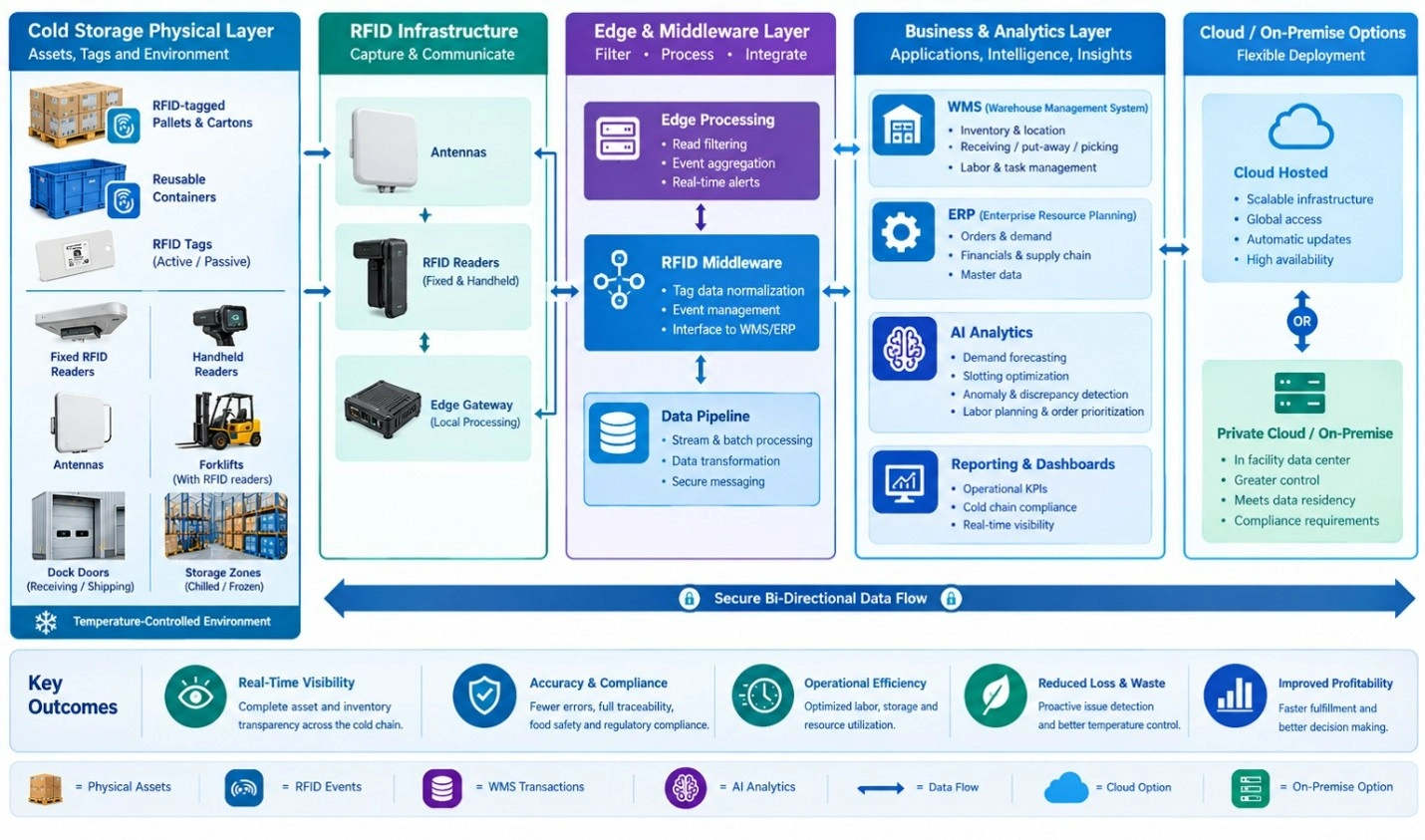
The diagram shows a circular sustainable packaging process connecting asset identification, BLE sensing, data collection, AI analysis, operational optimization, and packaging reuse and return.
Key Takeaways for Sustainable Packaging Decision-Makers
AI for sustainable packaging becomes most valuable when it is connected to measurable operational processes.
BLE beacons can establish persistent identities for reusable packaging assets, BLE sensors can provide condition information, and BLE gateways can collect wireless data at relevant operational locations.
AI can then use this information to identify abnormal behavior, forecast packaging requirements, optimize asset circulation, and support condition-based decisions.
The technical priorities are reliable data capture, appropriate RF coverage, secure communications, accurate asset identity, strong software integration, and well-defined KPIs.
Organizations should begin with a focused operational use case, validate the complete system through a pilot, measure improvements against baseline performance, and then scale the solution across additional packaging assets and facilities.
GAO provides BLE, RFID, and IoT hardware products and systems for organizations requiring practical technologies for asset tracking, sensing, monitoring, and industrial data collection. Headquartered in New York City and Toronto, Canada, GAO is positioned among the leading B2B and B2G BLE and RFID suppliers and has served customers across the U.S. and Canada for three decades.
Building the Future of Industrial AI and IoT with Aperture Venture Studio and GAO RFID Inc.
For more than three decades, GAO Group of Companies has invested heavily in R&D for industrial BLE, RFID, and IoT technologies. As generative AI became increasingly useful for industrial applications, we expanded our work in AI-enabled IoT systems, including solutions relevant to sustainable packaging, asset tracking, sensing, and operational analytics.
We have also founded Aperture Venture Studio to support the development and scaling of AI and IoT technologies for applications such as sustainable packaging and other industrial domains.
Aperture has attracted AI and IoT technical experts, entrepreneurial and operational executives, investors, and leading companies. Through Aperture Ventures Summit and TekSummit, we also facilitate discussion around advanced AI and IoT topics.
GAO Group includes GAO, GAO Research Inc., and GAO Tek Inc., with operations based in New York City and Toronto. Our customers include Fortune 500 companies, leading R&D organizations, prestigious universities, and U.S. and Canadian government agencies.
We welcome participation from:
- Advisors, co-founders, or employees
- Investors
- Customers