
AI and BLE for Timber Operations
AI-Driven Timber Operations with BLE Asset Visibility
Artificial intelligence is changing timber operations by turning data from log yards, sawmills, kilns, material-handling equipment, mobile assets, and production areas into actionable operating information. AI for timber operations can help identify equipment and material movement patterns, detect abnormal operating conditions, improve maintenance decisions, optimize yard activities, and support safer movement of people and mobile machinery. BLE beacons, BLE sensors, and BLE gateways provide a practical wireless data layer for capturing the location, status, and operating conditions of tagged assets across timber facilities.
A typical AI and BLE solution combines BLE-enabled identification and sensing with gateway infrastructure, edge computing, databases, analytics software, and existing mill management systems. Data can be associated with log inventory, forklifts, loaders, conveyors, sawmill equipment, kiln operations, maintenance assets, and work areas. AI models can then identify patterns that are difficult to detect through manual observation alone.
For timber operators, the value is not simply knowing where an asset is. The objective is to connect location, equipment condition, production activity, maintenance history, and operational events so supervisors and engineers can make better decisions. GAO provides BLE, RFID, and IoT hardware products and systems that can support these deployments across demanding industrial environments.
AI-Driven Timber Operations with BLE and Industrial IoT
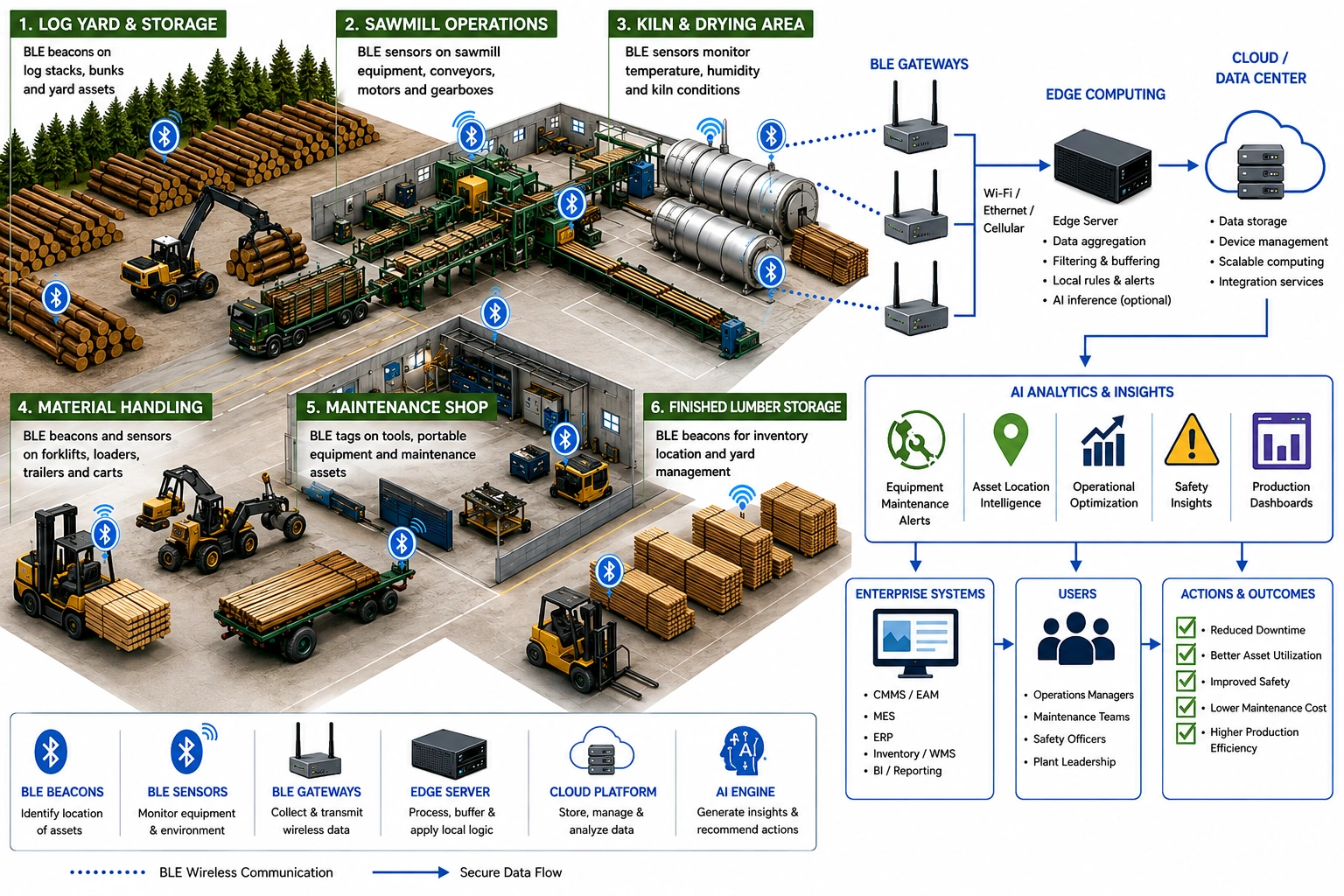
The completed diagram illustrates how BLE beacons and sensors across log yards, sawmills, kiln areas, maintenance shops, material-handling zones, and finished lumber storage connect through BLE gateways, edge computing, and cloud systems. AI analytics transform this operational data into equipment maintenance alerts, asset-location intelligence, optimization insights, safety information, and production dashboards.
What AI Means for Modern Timber Operations
AI for timber operations refers to the use of machine learning, anomaly detection, predictive analytics, computer vision where appropriate, optimization algorithms, and other data-driven methods to improve decisions throughout timber handling and processing. The quality of an AI system depends heavily on the quality, continuity, and context of the operational data it receives.
BLE contributes to this data foundation by providing low-power wireless identification and sensing. BLE beacons can identify the presence or approximate location of mobile assets, while BLE sensors can capture parameters such as temperature, vibration, motion, humidity, or other measurements depending on the selected device. BLE gateways receive these transmissions and forward data to edge or server software for processing.
Timber operations present several conditions that make this combination useful:
- Large outdoor log yards can contain extensive numbers of mobile assets, storage areas, equipment, and material-handling activities.
- Sawmill operations include high-speed mechanical equipment where downtime can affect production throughput.
- Forklifts, loaders, trailers, carts, maintenance tools, and other mobile assets can move between operational zones.
- Kilns and drying processes require careful monitoring of environmental and process conditions.
- Wood dust, vibration, temperature variation, moisture, metal structures, and equipment movement can affect wireless and sensor deployments.
- Maintenance teams need reliable operating history to distinguish normal equipment behavior from developing faults.
- Supervisors need timely information about equipment utilization, asset movement, production bottlenecks, and operational exceptions.
The engineering objective is therefore to design a sensing and communications system that produces sufficiently reliable data for AI analysis while fitting the physical realities of timber facilities.
GAO’s BLE hardware can be used as part of a broader industrial IoT solution where wireless identification, sensor data acquisition, gateway communications, and software integration are required.
Key AI Applications Across Timber Operations
AI Asset Tracking for Logs, Equipment, and Mobile Resources
Asset visibility is one of the most practical starting points for AI-enabled timber operations. BLE tags can be associated with selected mobile assets, equipment, containers, tools, trailers, carts, or other resources. BLE gateways positioned at defined facility zones can detect tagged devices and provide location or zone-presence information.
AI software can analyze movement histories to identify:
- Equipment utilization patterns
- Excessive idle time
- Repeated movement between operational zones
- Congested material-handling routes
- Underutilized equipment
- Unexpected asset movement
- Long dwell times
- Equipment availability patterns
- Maintenance-related movement behavior
For log yards, BLE should normally complement rather than replace established inventory identification methods where precise log-level identification is required. RFID, barcode systems, machine vision, yard management software, and other technologies may provide more appropriate identification depending on the operating process.
Predictive Maintenance for Sawmill and Material-Handling Equipment
Predictive maintenance uses equipment data to identify abnormal behavior before a failure causes an unplanned production interruption. BLE sensors can contribute vibration, temperature, motion, or other measurements from selected equipment and mobile assets.
Potential equipment targets include:
- Conveyors
- Motors
- Pumps
- Fans
- Bearings
- Material-handling equipment
- Forklifts
- Loaders
- Compressors
- Selected sawmill machinery
AI models can establish expected operating behavior and compare incoming measurements against historical patterns. A sustained deviation can generate an inspection recommendation rather than waiting for a component to fail.
A practical implementation should not treat an AI prediction as an automatic diagnosis. Maintenance personnel should validate the alert against equipment history, operating conditions, inspection results, and manufacturer recommendations. This approach reduces the risk of unnecessary maintenance caused by sensor noise or unusual but acceptable operating conditions.
AI-Powered Equipment Utilization and Yard Optimization
Timber facilities frequently operate multiple forklifts, loaders, trailers, and other mobile resources. BLE location data can provide the operational history needed to evaluate how these assets are actually used.
AI analytics can compare:
- Operating time versus idle time
- Travel between zones
- Loading and unloading activity
- Equipment availability
- Queue duration
- Repeated routes
- Shift-level utilization
- Maintenance downtime
- Asset demand by operating area
This information can support better equipment allocation and help identify process bottlenecks. For example, repeated queueing near a transfer area may indicate that the constraint is not the number of forklifts but the capacity or timing of a downstream process.
Environmental and Process Monitoring
BLE sensors can provide wireless measurements from selected timber-processing environments. Depending on sensor design and application requirements, measurements may include temperature, humidity, vibration, motion, and other physical conditions.
AI can use these measurements to detect abnormal trends rather than relying only on fixed alarm thresholds. This is particularly useful where conditions vary according to production schedules, equipment states, weather, or operating modes.
For kiln-related applications, sensor selection and installation require special consideration because temperature, humidity, enclosure requirements, and measurement accuracy can vary substantially from ordinary indoor industrial environments. A BLE device should be selected according to the actual environmental specification rather than simply its wireless capability.
AI for Safety and Operational Exception Detection
BLE-based location information can support safety-oriented applications by identifying the presence of tagged equipment or personnel in defined areas. Depending on the selected tags and facility design, the system can support zone-based alerts for situations such as equipment entering restricted areas or unexpected movement through controlled zones.
AI can further analyze recurring patterns to identify operational conditions associated with near misses, congestion, or unsafe movement.
Safety systems should remain appropriately engineered and should not rely on BLE location alone for safety-critical interlocking or emergency functions. BLE can provide useful operational intelligence, while dedicated safety-rated controls should remain responsible for functions requiring deterministic safety performance.
AI Use-Case Map for Timber Operations with BLE
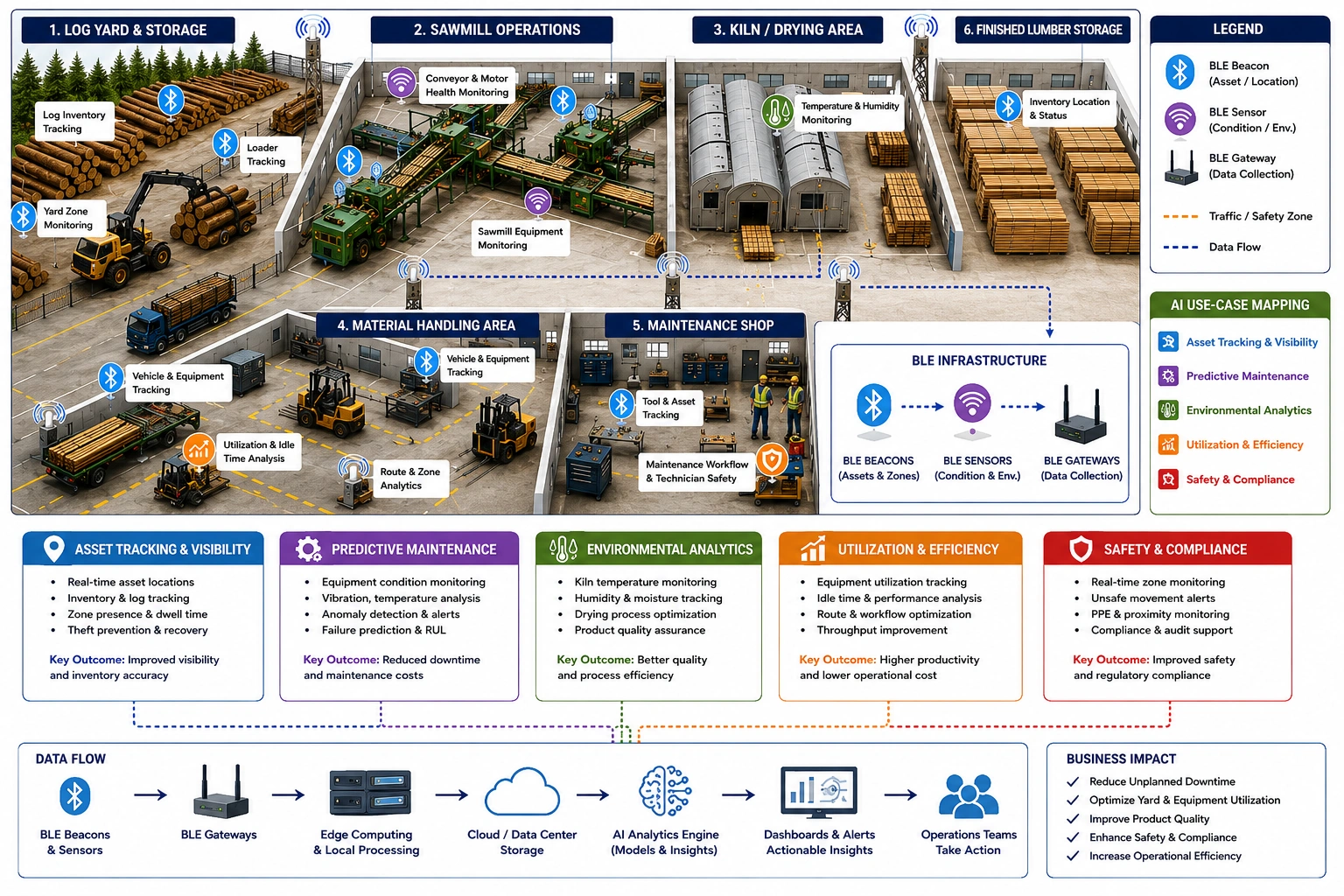
This infographic maps key AI applications across timber operations, including asset tracking, predictive maintenance, environmental monitoring, equipment utilization, and safety analytics. It shows how BLE beacons, sensors, and gateways collect operational data for AI analysis and actionable insights.
From Timber-Facility Data to AI Decisions
A production-ready AI and BLE system should be designed as a complete operational workflow rather than as an isolated collection of wireless devices.
Data Acquisition
The process begins with BLE sensors and beacons installed on appropriate assets or positioned in defined operational areas. Sensor configuration should reflect the actual question the timber operator needs to answer.
For example, a predictive-maintenance application may require vibration measurements from a bearing or motor, while an asset-location application may only require periodic beacon transmissions. Increasing sensor frequency can improve temporal resolution but may also increase wireless traffic, device power consumption, and downstream data volume.
BLE Communication and Gateway Collection
BLE gateways receive advertisements or sensor messages within their effective radio range. Gateway placement should be based on the physical facility rather than a theoretical indoor range specification.
Metal structures, machinery, racks, vehicles, walls, moisture, and other obstructions can influence radio propagation. Timber yards also introduce outdoor coverage considerations that differ from enclosed production areas.
A commissioning survey should therefore validate actual detection performance at representative locations and operating conditions.
Edge Processing
Edge processing can filter, normalize, buffer, and enrich incoming BLE data before forwarding it to centralized software. This is particularly useful when connectivity to cloud services is intermittent or when the operation requires local processing.
An edge server can retain data temporarily during network interruptions and forward it when connectivity is restored. It can also perform local rules, threshold checks, device-health monitoring, and selected AI inference functions.
Server or Cloud Processing
Central software can combine BLE data with maintenance records, production information, asset registers, work orders, environmental measurements, and other operational data.
AI processing can then identify relationships that are not visible in individual sensor streams. A maintenance alert, for example, becomes more useful when associated with the affected asset, its operating hours, previous work orders, recent sensor behavior, and current production status.
Enterprise Software Integration
The final value of AI analytics comes from connecting insights to operational action. Depending on the timber operation, integration targets can include:
- Computerized maintenance management systems
- Enterprise asset management software
- Manufacturing execution systems
- Warehouse or yard management software
- Production databases
- Inventory systems
- ERP software
- Business intelligence software
- Maintenance dashboards
- Notification and alerting systems
A useful integration should preserve the identity of the asset across systems. Asset IDs, equipment IDs, BLE device IDs, work-order identifiers, production records, and location zones should use consistent mappings so that AI results can be traced back to operational records.
AI and BLE Timber Operations Data-to-Decision Workflow
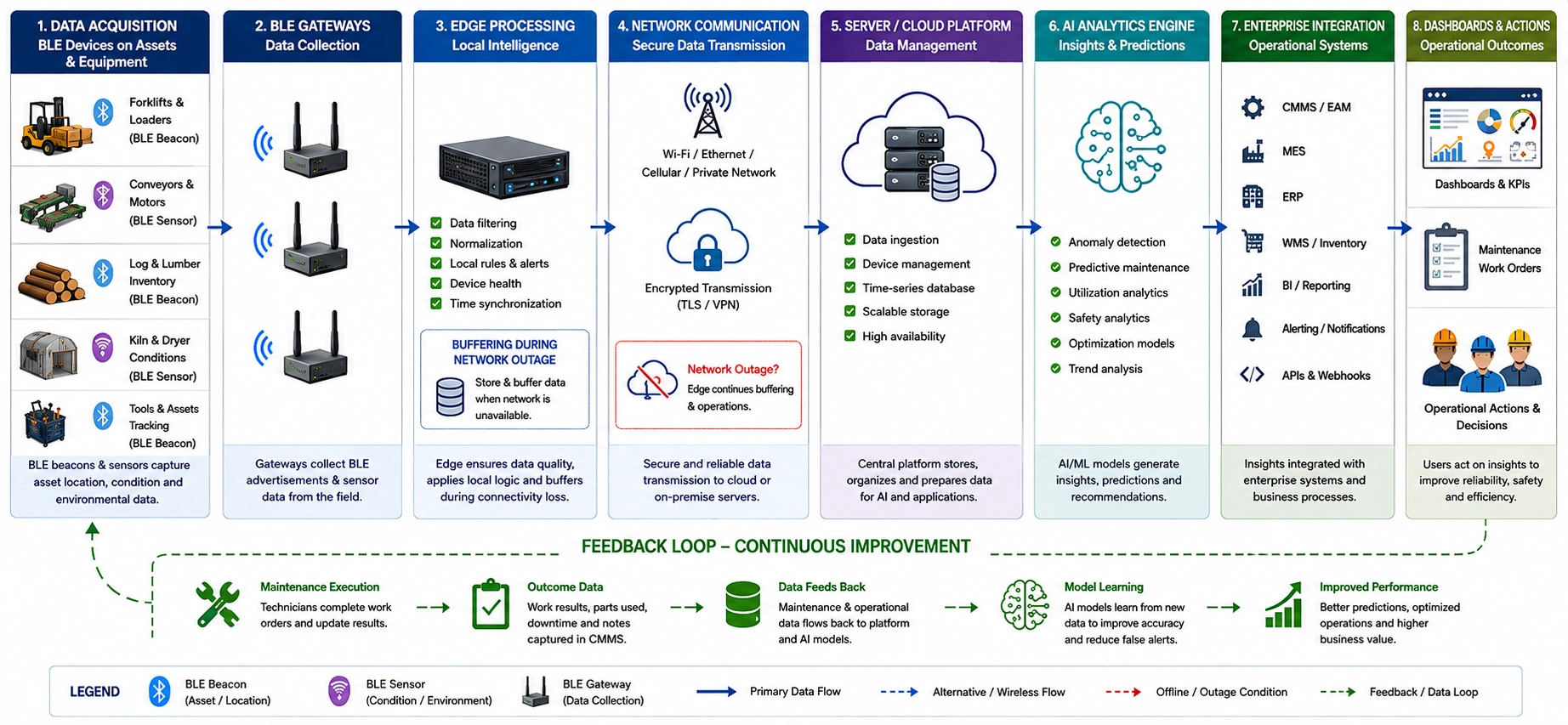
This workflow diagram shows how BLE beacons and sensors capture timber equipment and asset data, which is collected by BLE gateways and processed through edge computing, secure networks, server or cloud software, and AI analytics. The resulting insights integrate with CMMS, MES, ERP, inventory, and reporting systems to support maintenance work orders and operational decisions, with feedback data supporting continuous AI improvement.
Engineering Design Priorities for Timber BLE Deployments
BLE deployments in timber operations require more engineering consideration than simply attaching tags and installing gateways. The radio environment, equipment movement, environmental conditions, data requirements, maintenance practices, and software integration all affect system performance.
Device Selection
BLE beacons should be selected according to the required battery life, transmission interval, mounting method, enclosure requirements, operating temperature, and expected physical environment.
BLE sensors require additional consideration of measurement accuracy, sensor range, calibration, sampling rate, battery consumption, and installation location.
A sensor intended for a relatively clean maintenance area should not automatically be deployed in a dusty, wet, high-vibration, or high-temperature process zone without confirming its environmental specifications.
Gateway Placement
Gateway locations should be established through a site survey and validated through commissioning tests. Timber facilities can contain long metal structures, large machinery, dense equipment areas, and outdoor zones that produce uneven radio coverage.
The design should account for:
- Required detection zones
- Gateway density
- Antenna orientation
- Physical obstructions
- RF interference
- Equipment movement
- Outdoor versus indoor coverage
- Network availability
- Power availability
- Maintenance accessibility
Data Quality and AI Model Reliability
AI models cannot compensate indefinitely for poor sensor data. Missing measurements, inconsistent timestamps, incorrect asset mappings, duplicate device identifiers, and poorly calibrated sensors can create misleading results.
A practical deployment should therefore monitor data quality alongside operational KPIs. The system should identify devices that stop transmitting, gateways that lose connectivity, sensors with abnormal measurement patterns, and assets whose identifiers no longer correspond correctly to the enterprise asset register.
GAO’s experience supplying industrial BLE, RFID, and IoT hardware supports the importance of matching device specifications and system design to the actual operating environment rather than selecting wireless hardware independently of the deployment requirements.
AI and BLE Timber Operations Commissioning Checklist
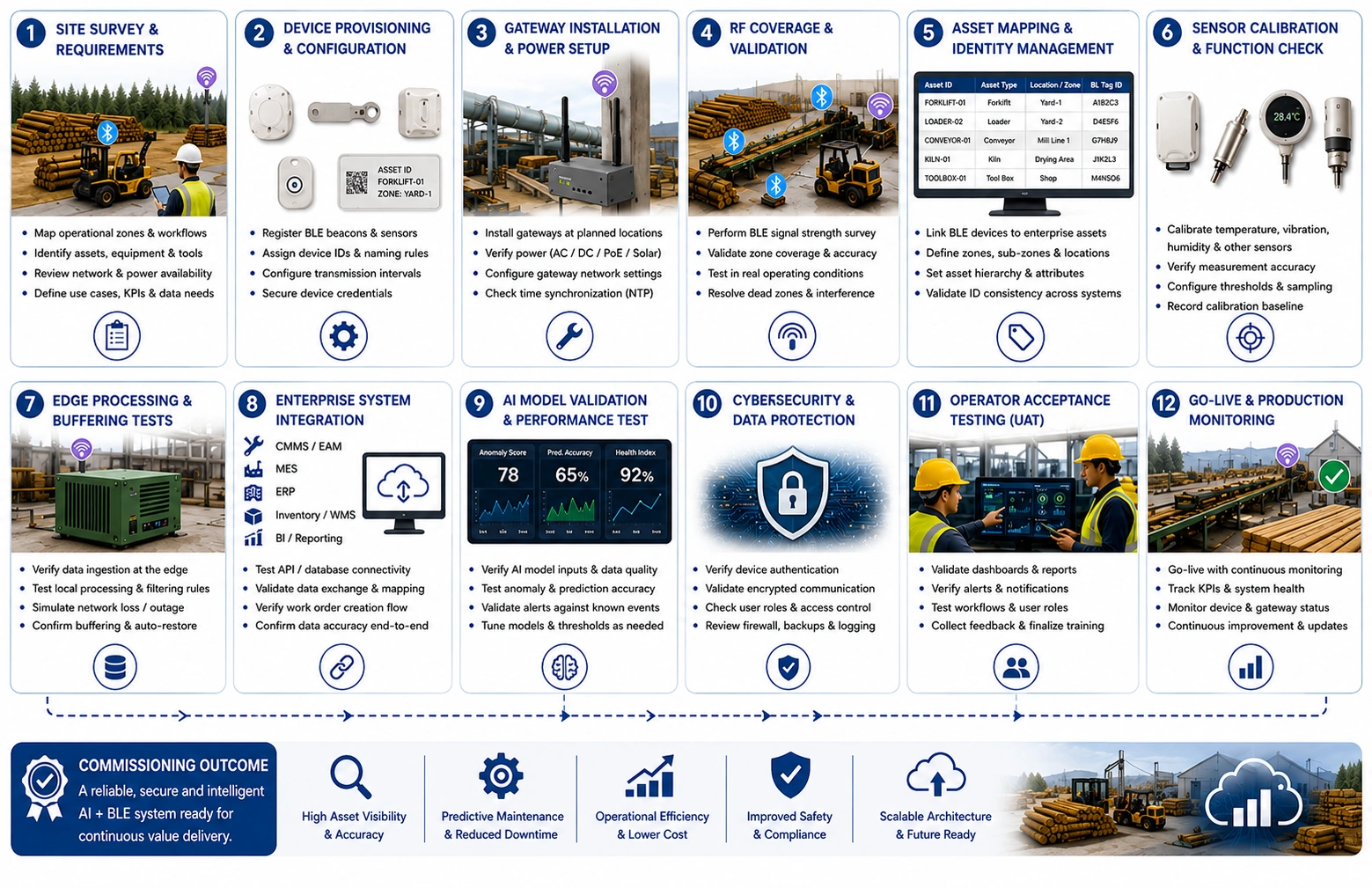
This infographic presents 12 technical commissioning stages for an AI and BLE Timber Operations system, from site surveying, device provisioning, gateway installation, RF validation, and sensor calibration through enterprise integration, AI model validation, cybersecurity, operator acceptance testing, and production monitoring. It emphasizes the engineering checks required for a reliable, secure, and production-ready deployment.
Cloud and Server Deployment for Timber Operations
AI and BLE systems for timber operations can be deployed using cloud-hosted software, privately hosted servers, or a combination of edge and centralized computing. The appropriate model depends on connectivity, cybersecurity requirements, data governance, latency requirements, existing IT infrastructure, and the operating conditions of the timber facility.
Cloud Version
A cloud-hosted deployment can centralize BLE gateway data, asset information, analytics, dashboards, AI models, and system administration across multiple timber facilities.
Cloud deployment is particularly appropriate when:
- Multiple sawmills or timber yards need centralized visibility.
- Corporate engineering teams require access to operational data from different locations.
- AI models need centralized training or continuous improvement.
- IT teams prefer managed infrastructure rather than maintaining application servers locally.
- The facility has reliable internet connectivity.
- Long-term historical data needs to be consolidated for cross-site analysis.
Cloud software can also simplify centralized reporting and provide a common data environment for comparing equipment utilization, maintenance trends, and operational KPIs between facilities.
However, cloud connectivity should not be treated as a substitute for local operational resilience. Critical data acquisition should continue during temporary network interruptions through gateway or edge buffering.
Server Version
A server deployment places application software and databases on customer-managed infrastructure. This may include a mill server room, private data center, edge server, or other privately hosted enterprise computing environment.
A server version may be preferable when:
- Timber facilities have restricted external network connectivity.
- Operational data must remain within private infrastructure.
- Corporate IT policies require customer-managed servers.
- Existing manufacturing systems are already hosted locally.
- Low-latency local processing is important.
- The organization has an established server administration team.
A hybrid model can combine local edge processing with centralized private or cloud infrastructure. For example, BLE gateways can send data to an edge server for buffering and local processing while selected historical data and analytics are transferred to centralized software.
The important engineering principle is to separate operational continuity from external connectivity. If an internet connection fails, the BLE sensing and data-collection process should not unnecessarily stop.
Cybersecurity and Data Integrity for BLE Timber Systems
Cybersecurity should be considered from device provisioning through application integration and maintenance. BLE wireless communication is only one component of the overall security boundary.
A timber operations deployment should consider:
- Device identity and provisioning
- Gateway authentication
- Secure network communication
- User authentication
- Role-based access control
- Server hardening
- Software patching
- Database protection
- Backup and recovery
- Audit logging
- API security
- Device replacement procedures
- Credential rotation
- Network segmentation
BLE device identifiers should also be managed carefully. A physical asset may have an equipment ID in a maintenance system, a BLE identifier in the wireless system, and potentially an inventory identifier in another system. The mapping between these identifiers should be controlled so that a reassigned or replaced BLE device does not create incorrect maintenance or location records.
For systems connected to mill production networks, network segmentation can reduce the risk that a compromised IoT device becomes a pathway into unrelated operational systems. Gateways and servers should be deployed according to the organization’s IT and operational technology security policies.
GAO supplies industrial BLE, RFID, and IoT technologies for applications where reliable hardware, system integration, and technical support are important parts of the deployment lifecycle.
Cybersecurity Controls for AI and BLE Timber Operations
This infographic illustrates a layered OT cybersecurity approach for AI and BLE timber operations, covering BLE devices, gateways, edge computing, segmented networks, applications, and authorized users. It highlights controls such as authentication, encryption, network segmentation, least-privilege access, patch management, logging, backup and recovery, incident response, and continuous security monitoring.
AI Models and Analytics for Timber Equipment
AI methods should be selected according to the operational question rather than chosen because a particular model is fashionable.
Anomaly Detection
Anomaly detection is useful when the objective is to identify equipment behavior that differs from its established operating pattern.
For example, vibration and temperature data from a conveyor motor may normally remain within a characteristic range during specific production states. A persistent change in that pattern can trigger an inspection recommendation.
The model should account for operating context. A vibration measurement taken during startup may naturally differ from a measurement taken during steady-state operation. AI analysis that ignores these states can generate excessive false alarms.
Predictive Maintenance Models
Predictive-maintenance models can estimate the likelihood of developing equipment problems using historical sensor measurements, maintenance records, operating hours, environmental conditions, and failure history.
Useful data can include:
- Vibration trends
- Temperature trends
- Motor operating conditions
- Equipment runtime
- Maintenance history
- Component replacement history
- Alarm history
- Production state
- Inspection results
The quality of predictions improves when sensor data is linked to accurate asset and maintenance records.
Optimization Models
Optimization techniques can support decisions involving equipment allocation, material movement, maintenance scheduling, and operating sequences.
For example, historical BLE movement data can reveal that certain mobile assets spend substantial time traveling between distant operating zones. Combining this information with production schedules and equipment availability can help supervisors evaluate alternative equipment assignments or routing practices.
AI should support rather than obscure operational decisions. A useful system should provide enough context for an engineer or supervisor to understand why a recommendation was generated.
Integration with Timber Maintenance and Production Systems
AI and BLE systems become more valuable when they exchange information with the software already used by timber operations.
CMMS and EAM Integration
A BLE-enabled equipment system can associate sensor alerts and asset-location information with maintenance records.
A typical workflow may involve:
- BLE sensor detects abnormal vibration.
- Gateway receives the measurement.
- Edge software validates the data.
- AI analytics identifies a persistent abnormal pattern.
- The system identifies the affected equipment.
- Maintenance history is retrieved.
- A maintenance recommendation is generated.
- A technician receives an inspection task or work-order suggestion.
- Inspection results are returned to the maintenance system.
- The confirmed result becomes training or reference data for future analytics.
This closed feedback cycle is important because maintenance personnel can confirm whether an AI alert represented a genuine equipment issue.
MES and Production Integration
Production context can substantially improve AI analysis. Equipment behavior may change according to product type, production rate, operating mode, or shift.
Connecting AI analytics with manufacturing execution information can help distinguish normal production-related changes from abnormal conditions.
For example, a motor operating under a higher production load may produce different vibration and temperature characteristics than during a lower-load period. The AI system should understand this context where the data is available.
ERP and Inventory Integration
ERP integration can connect equipment and production information with procurement, inventory, spare-parts management, and business processes.
A predictive-maintenance recommendation becomes more actionable when maintenance teams can determine whether the required replacement component is already available and whether the equipment can be removed from production according to the current operating schedule.
KPIs for AI-Enabled Timber Operations
AI and BLE projects should be measured using operational outcomes rather than device counts alone. Useful KPIs can include:
- Unplanned equipment downtime
- Mean time between failures
- Mean time to repair
- Preventive-maintenance compliance
- Predictive-alert precision
- False-alert rate
- Equipment utilization
- Equipment idle time
- Asset search time
- Material-handling cycle time
- Yard dwell time
- Equipment availability
- Production throughput
- Maintenance backlog
- Sensor availability
- Gateway availability
- Data completeness
- Wireless detection reliability
- Network uptime
- Energy consumption where relevant
- Safety-related exceptions
- Operator response time
- Maintenance response time
- Spare-parts availability
- AI model performance over time
The most appropriate KPIs depend on the original business problem. A timber operation focused on predictive maintenance should not evaluate success primarily by the number of BLE devices deployed. A yard-visibility project may instead prioritize asset search time, equipment utilization, movement efficiency, and data completeness.
Scaling AI and BLE Across Timber Facilities
A pilot should be designed so that successful applications can expand without requiring a complete redesign.
A scalable deployment should establish common conventions for:
- Asset identifiers
- BLE device identifiers
- Gateway naming
- Location zones
- Sensor data formats
- Timestamp handling
- User roles
- Alert severity
- Maintenance classifications
- API interfaces
- Data retention
- Device provisioning
- Firmware management
- System monitoring
The first deployment should normally focus on a clearly defined operational problem rather than attempting to instrument every machine and asset.
For example, a timber operator could begin with predictive monitoring for selected conveyor motors or visibility for forklifts operating in a high-congestion area. Once the data quality, gateway coverage, integration workflow, and operational response process are proven, the solution can expand to additional equipment or facilities.
This phased approach also provides an opportunity to establish realistic baseline measurements before introducing AI recommendations.
Deployment and Commissioning Best Practices
A production deployment should progress through controlled engineering stages.
Site Survey and Requirements Definition
Document the facility layout, operating zones, equipment locations, network availability, power sources, environmental conditions, and intended data flows.
Define what the system must accomplish before selecting devices. A requirement such as “track forklifts” is incomplete without specifying the required location granularity, update frequency, operating zones, acceptable latency, and expected data retention.
Hardware Installation and Provisioning
Install BLE sensors, beacons, and gateways according to the validated deployment design. Record device IDs, asset associations, mounting locations, firmware versions, and installation dates.
Provisioning should include controlled naming and identity management so that replacement devices can be introduced without corrupting historical records.
RF Validation
Test wireless detection under realistic operating conditions. Equipment, vehicles, personnel, and production machinery should be present during representative tests where possible.
Measure detection consistency rather than relying only on a single successful communication event.
Data and AI Validation
Before using AI recommendations operationally, verify:
- Sensor timestamps
- Asset mappings
- Measurement units
- Missing-data behavior
- Gateway connectivity
- Historical data quality
- Alert thresholds
- Model outputs
- False-positive behavior
- Maintenance-system integration
AI predictions should be evaluated against known maintenance events or controlled validation data before being used to influence production decisions.
Operator Acceptance Testing
Operators, maintenance personnel, supervisors, and IT teams should participate in acceptance testing because each group interacts with different parts of the solution.
The final system should fit existing workflows rather than requiring personnel to manually maintain duplicate records.
Practical Value of AI and BLE for Timber Operations
The combination of AI analytics and BLE sensing can provide timber operators with a more complete view of how equipment, people, materials, and operating conditions interact.
The strongest applications generally share several characteristics:
- The business problem is clearly defined.
- BLE devices provide data that was previously unavailable or difficult to collect.
- Asset identities remain consistent across systems.
- Data quality is continuously monitored.
- AI models account for operating context.
- Maintenance and production personnel can validate recommendations.
- The deployment continues functioning during temporary connectivity interruptions.
- Cybersecurity is incorporated from the beginning.
- KPIs measure operational outcomes rather than technology deployment volume.
GAO’s industrial BLE, RFID, and IoT hardware can form part of these solutions where organizations require wireless asset identification, sensing, gateway connectivity, and related industrial hardware. GAO has supplied hardware products and systems to organizations in the United States and Canada, including Fortune 500 companies, research and development organizations, universities, and government agencies, supported by extensive investment in product research and development and quality assurance.
Building the Future of Industrial AI and IoT with Aperture Venture Studio and GAO RFID Inc.
For more than three decades, GAO Group of Companies has invested heavily in research and development of industrial BLE, RFID, and IoT technologies. As generative AI became increasingly useful for industrial applications, the group expanded its work in AI-enabled IoT solutions, including BLE and RFID, and founded Aperture Venture Studio to build and scale technology initiatives relevant to industrial applications such as timber operations.
Aperture brings together AI and IoT technical expertise, operational experience, investors, and industry participants. GAO also supports technical discussion through initiatives such as Aperture Ventures Summit and TekSummit, helping advance practical conversations around AI and IoT.
Headquartered in New York City and Toronto, Canada, GAO is recognized among leading global B2B and B2G suppliers of BLE and RFID technologies. GAO and its sister companies, GAO Research Inc. and GAO Tek Inc., form GAO Group and serve customers throughout the United States and Canada.
Organizations evaluating AI for timber operations can engage GAO to explore suitable BLE, RFID, IoT hardware, system integration approaches, deployment requirements, and technical support for their specific operating environments.