
AI and BLE for Tunnel Engineering
AI-Powered Tunnel Monitoring and Intelligent Infrastructure Management
Tunnel engineering projects require continuous monitoring of structural integrity, environmental conditions, worker safety, construction progress, and long-term operational performance. AI-driven tunnel monitoring solutions supported by BLE gateways, BLE beacons, and BLE sensors help engineering teams transform tunnel data into actionable intelligence for safer and more efficient tunnel construction and operations.
Artificial Intelligence of Things (AIoT) combines artificial intelligence with connected sensing devices, infrastructure assets, and engineering systems. Within tunnel engineering, AI software analyzes data collected from tunnel linings, ventilation systems, drainage networks, geotechnical monitoring systems, construction equipment, and worker safety devices. The result is improved situational awareness, predictive maintenance capabilities, enhanced safety management, and more informed decision-making.
As transportation agencies, civil engineering firms, mining contractors, rail operators, and infrastructure owners modernize tunnel operations, AI-supported monitoring solutions are becoming an important component of tunnel lifecycle management. GAO has supplied BLE and IoT hardware products that support monitoring, tracking, and operational visibility across infrastructure projects throughout North America.
Comprehensive Tunnel Engineering AI and BLE Operational Ecosystem Diagram
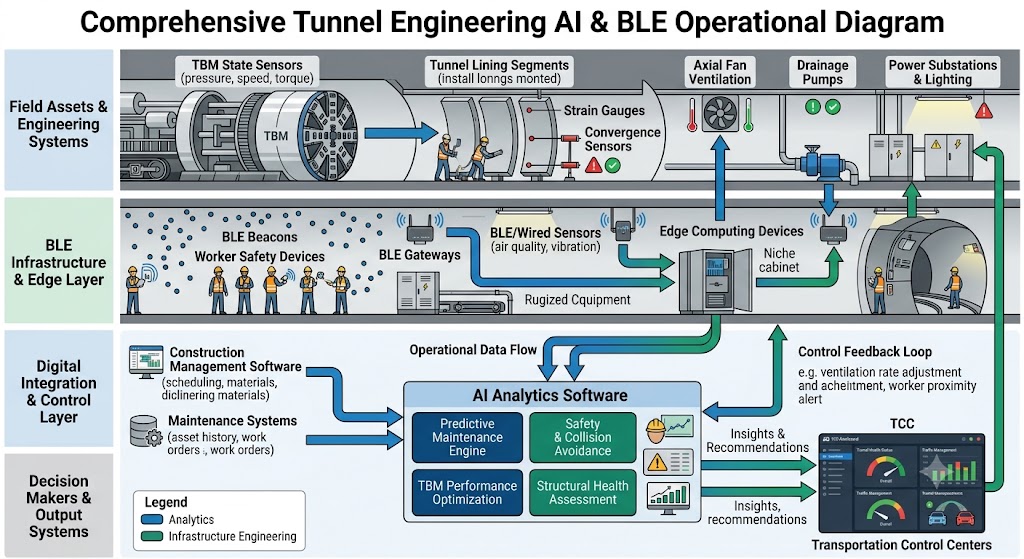
A detailed infographic illustrating the integration of tunnel assets, BLE infrastructure, and AI analytics for advanced operational control.
Core Concepts of AI-Driven Tunnel Engineering
Tunnel engineering involves complex interactions among geotechnical conditions, structural systems, construction equipment, environmental controls, transportation operations, and public safety requirements. AI enhances these processes by continuously evaluating operational and engineering data that would be difficult to analyze manually.
Key tunnel engineering objectives supported by AI include:
- Structural health monitoring
- Geotechnical risk assessment
- Tunnel deformation analysis
- Ventilation optimization
- Asset condition monitoring
- Worker safety management
- Construction progress tracking
- Emergency response support
- Predictive maintenance planning
- Infrastructure resilience improvement
BLE technology supports these objectives by enabling localized data collection, asset identification, personnel tracking, and environmental sensing throughout tunnel networks where GPS signals are often unavailable.
Tunnel Engineering Applications for AI and BLE Solutions
Tunnel Construction Monitoring
Tunnel construction projects generate large volumes of operational data from excavation equipment, ground support systems, lining installation activities, and environmental monitoring devices.
AI assists construction teams by:
- Monitoring excavation progress
- Tracking tunnel boring machine performance
- Identifying abnormal ground behavior
- Detecting construction delays
- Optimizing equipment utilization
- Evaluating worker productivity
- Supporting quality assurance processes
- Improving construction scheduling
Engineering managers can make more informed decisions based on real-time project conditions.
Structural Health Monitoring
Tunnel structures experience continuous stresses caused by ground movement, traffic loads, temperature fluctuations, water ingress, and material aging.
AI-supported monitoring systems analyze:
- Convergence measurements
- Tunnel lining deformation
- Crack propagation
- Joint displacement
- Vibration patterns
- Settlement behavior
- Groundwater pressure
- Structural strain measurements
These insights help identify developing structural issues before they become significant safety concerns.
Ventilation and Environmental Management
Ventilation systems are critical components of road tunnels, railway tunnels, metro tunnels, and utility tunnels.
AI software evaluates:
- Air quality measurements
- Carbon monoxide concentrations
- Nitrogen oxide levels
- Airflow performance
- Temperature conditions
- Smoke detection data
- Dust concentration levels
- Ventilation equipment health
This enables more efficient environmental control while reducing energy consumption.
Worker Safety and Personnel Management
Tunnel environments present unique occupational safety challenges.
AI-supported safety systems help monitor:
- Worker locations
- Restricted area access
- Evacuation readiness
- Hazard exposure
- Lone worker activity
- Emergency response coordination
- Safety compliance
- Equipment proximity risks
BLE-enabled location awareness improves visibility throughout complex underground environments.
Enterprise Tunnel Engineering Application and Performance Matrix
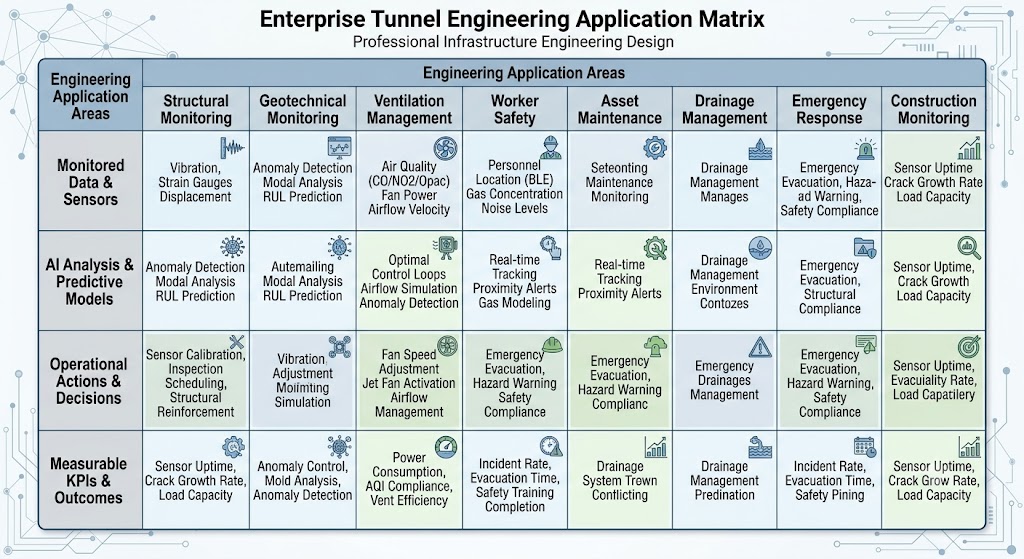
A structured matrix comparing various tunnel engineering applications with their monitored data, AI analysis, operational actions, and measurable performance outcomes.
Tunnel Engineering Operational Workflow from Data Collection to AI Decision-Making
AI-enabled tunnel engineering systems operate through a structured workflow that converts raw infrastructure data into engineering actions.
Data Acquisition Layer
Data originates from multiple tunnel assets and monitoring systems including:
- Structural sensors
- Deformation monitoring devices
- BLE beacons
- BLE gateways
- Environmental sensors
- Air quality sensors
- Water level monitoring systems
- Vibration sensors
- Tunnel boring machines
- Ventilation equipment
- Pump stations
- Electrical systems
- CCTV systems
- Emergency communication systems
Communication and Data Transport
Collected data is transmitted through:
- BLE communication networks
- Fiber-optic networks
- Ethernet infrastructure
- Industrial wireless systems
- SCADA communications
- Remote telemetry systems
Reliable communication is particularly important because tunnel environments can present signal propagation challenges and complex physical conditions.
Edge Processing and Event Normalization
Edge computing devices positioned throughout tunnel systems perform:
- Data filtering
- Signal validation
- Event correlation
- Local anomaly detection
- Device health monitoring
- Alert prioritization
This reduces communication overhead and enables faster response times.
Enterprise Software Integration
Tunnel engineering monitoring systems frequently integrate with:
- Asset management software
- Maintenance management systems
- SCADA software
- Building management systems
- Transportation management systems
- Geographic information systems
- Construction management software
- Safety management systems
This integration ensures operational data supports engineering and maintenance workflows.
Technical Capabilities and Business Value of AI-Driven Tunnel Engineering Systems
Modern tunnel engineering projects generate enormous volumes of data from geotechnical investigations, tunnel boring machine operations, ventilation systems, electrical infrastructure, drainage networks, fire safety equipment, structural monitoring instruments, and operational maintenance activities. AI transforms these data streams into actionable engineering intelligence that improves safety, construction efficiency, and long-term tunnel reliability.
AI-Powered Structural Health Monitoring
Structural health monitoring is among the most valuable applications in tunnel engineering.
AI systems continuously analyze:
- Tunnel lining stress measurements
- Concrete strain data
- Ground settlement readings
- Convergence monitoring results
- Crack progression trends
- Segment joint displacement
- Water ingress patterns
- Vibration signatures
Instead of relying solely on periodic inspections, AI models identify deterioration patterns long before visible defects appear.
Benefits include:
- Earlier defect detection
- Reduced emergency repairs
- Improved tunnel safety
- Extended infrastructure lifespan
- Better maintenance planning
- Lower lifecycle costs
Organizations using intelligent monitoring systems can prioritize maintenance activities according to actual structural conditions rather than fixed inspection schedules.
Predictive Maintenance for Tunnel Assets
Tunnel facilities contain thousands of operational assets requiring maintenance.
Examples include:
- Jet fans
- Axial ventilation systems
- Variable message signs
- CCTV cameras
- Emergency telephones
- Pump stations
- Power distribution equipment
- Lighting systems
- Fire suppression systems
- Access control equipment
AI evaluates operational trends, environmental conditions, vibration patterns, electrical signatures, and historical maintenance records to predict equipment failures.
Operational advantages include:
- Reduced equipment downtime
- Improved maintenance scheduling
- Lower spare parts inventory
- Better workforce utilization
- Reduced emergency interventions
- Increased system availability
GAO has supported organizations by supplying BLE-based monitoring hardware that enables predictive maintenance initiatives across critical infrastructure environments.
AI-Based Construction Progress Intelligence
Tunnel construction schedules are influenced by numerous dynamic variables.
AI systems evaluate:
- TBM advance rates
- Excavation volumes
- Segment installation progress
- Grouting operations
- Ground condition variations
- Equipment utilization
- Workforce productivity
- Material deliveries
Project managers receive predictive insights regarding:
- Schedule delays
- Productivity bottlenecks
- Resource shortages
- Equipment constraints
- Geotechnical risks
Construction teams can implement corrective actions before schedule impacts become significant.
Worker Safety Monitoring and Risk Prevention
Tunnel construction environments present significant safety challenges.
AI-enhanced monitoring systems support:
- Personnel tracking
- Restricted zone management
- Emergency mustering
- Lone worker protection
- Hazard exposure monitoring
- Evacuation management
- Equipment proximity detection
- Incident investigation
BLE-enabled location intelligence provides visibility into workforce movements throughout excavation zones, shafts, cross passages, and service areas.
AI software evaluates:
- Unsafe movement patterns
- Congestion zones
- Hazard exposure duration
- Emergency response readiness
- Worker density levels
These capabilities improve compliance with occupational safety requirements while supporting proactive risk management.
Environmental and Geotechnical Intelligence
Tunnel performance is highly dependent on environmental and geotechnical conditions.
AI models analyze:
- Groundwater variations
- Seepage rates
- Geological transitions
- Soil movement
- Rock deformation
- Air quality measurements
- Temperature changes
- Humidity conditions
Engineering teams gain earlier awareness of conditions that may affect:
- Tunnel stability
- Worker safety
- Equipment performance
- Operational reliability
- Maintenance requirements
Deployment Considerations and Engineering Best Practices
Successful implementation requires careful planning throughout the tunnel lifecycle.
Site Survey and Planning
Deployment planning should include:
- Tunnel geometry analysis
- Signal propagation assessment
- Communication coverage mapping
- Environmental condition evaluation
- Power availability review
- Existing system integration assessment
- Cybersecurity requirements analysis
Signal coverage validation is especially important because tunnel geometry, reinforced concrete, metallic equipment, and underground conditions can affect wireless communications.
Hardware Selection Considerations
Tunnel engineering environments often require industrial-grade equipment with:
- IP-rated enclosures
- Corrosion resistance
- Dust protection
- Water resistance
- Extended operating temperature ranges
- Long operational life
- Remote management capability
GAO helps organizations select BLE gateways, beacons, and sensors suitable for harsh tunnel construction and operational environments.
Cybersecurity and Data Protection
Critical infrastructure systems require strong security controls.
Recommended measures include:
- Device authentication
- Encryption of communications
- Secure software updates
- Identity management
- Network segmentation
- Continuous security monitoring
- Access control enforcement
- Audit logging
Security strategies should align with transportation authority, infrastructure operator, and government cybersecurity requirements.
Scalability Planning
Large tunnel programs often expand over time.
System design should support:
- Additional tunnel sections
- New monitoring points
- Expanded sensor deployments
- Additional software integrations
- Future AI capabilities
- Increased user populations
- Long-term data retention
Proper planning prevents costly redesigns as infrastructure programs grow.
Strategic Recommendations for AI-Enabled Tunnel Engineering
Organizations pursuing intelligent tunnel engineering initiatives should focus on measurable operational objectives and phased deployment strategies.
Recommended priorities include:
- Begin with high-value structural monitoring use cases
- Integrate monitoring data with existing asset management software
- Establish clear KPIs before deployment
- Implement predictive maintenance workflows
- Standardize data governance procedures
- Develop cybersecurity requirements early
- Validate communication coverage through field testing
- Expand AI capabilities incrementally
- Incorporate digital twin initiatives where appropriate
- Continuously evaluate model performance
Many successful tunnel programs begin with structural health monitoring and asset condition monitoring before expanding into advanced predictive analytics and autonomous operational support functions.
Conclusion
AI-driven tunnel engineering solutions supported by BLE-enabled sensing and communication technologies are transforming how tunnels are designed, constructed, monitored, and maintained. Through continuous condition monitoring, predictive maintenance, worker safety management, geotechnical intelligence, and operational optimization, tunnel operators gain deeper visibility into infrastructure performance throughout the asset lifecycle.
As tunnel networks become increasingly complex, AI-powered decision support systems help engineering teams improve safety, reliability, efficiency, and long-term infrastructure sustainability. Organizations implementing these solutions benefit from earlier risk detection, improved maintenance planning, better resource utilization, and enhanced operational resilience.
GAO has extensive experience supplying BLE, RFID, and IoT hardware products and systems that support intelligent infrastructure monitoring initiatives. Our engineering teams help organizations deploy practical solutions that align with operational objectives, regulatory requirements, and long-term infrastructure modernization strategies.
Building the Future of Industrial AI and IoT with Aperture Venture Studio and GAO RFID Inc.
For more than three decades, GAO has invested heavily in the research and development of industrial BLE, RFID, and IoT technologies supporting infrastructure development, transportation systems, and tunnel engineering operations. As AI became increasingly valuable for infrastructure monitoring and predictive maintenance, we expanded our focus on AIoT solutions that combine intelligent analytics with connected sensing technologies. We have established Aperture Venture Studio to accelerate the advancement of AI and IoT solutions for critical infrastructure and industrial applications.
Aperture attracts leading AI and IoT experts, operational leaders, investors, and technology innovators. Through initiatives such as Aperture Ventures Summit and TekSummit, we facilitate technical discussions on emerging AI and IoT developments.
We welcome participation from:
- Advisors, co-founders, and employees
- Investors
- Customers