
AI and BLE for Underground Resource Mining
Underground resource mining requires continuous visibility into people, mobile equipment, production assets, environmental conditions, and material movement across complex mine workings. AI can turn this operational data into predictive maintenance alerts, equipment utilization insights, personnel-location intelligence, safety warnings, and production decisions. BLE gateways, BLE beacons, and BLE sensors provide a practical data-acquisition layer for tracking equipment and personnel, monitoring conditions, and identifying movement patterns in drifts, declines, shafts, stopes, workshops, and underground infrastructure. The combination is particularly useful where GPS is unavailable and conventional wireless coverage is constrained by rock, tunnel geometry, equipment, and changing mine layouts. AI models can correlate BLE observations with fleet, maintenance, ventilation, production, and safety data to identify anomalies and recommend actions. GAO supplies BLE, RFID, and IoT hardware products and systems that can support these connected underground mining applications.
BLE and AI Architecture for Underground Mining Operations
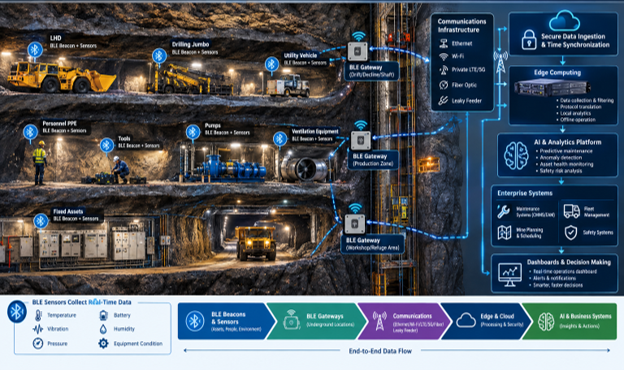
This visual illustrates how BLE beacons and sensors attached to underground mining assets collect real-time operational data. The data flows through BLE gateways, communications infrastructure, edge computing, AI analytics, enterprise systems, and operational dashboards to support safer, more productive, and data-driven mining operations.
AI-Driven Underground Mining Operations with BLE Visibility
AI and BLE address a specific problem in underground resource mining: critical information is often distributed across machines, workers, sensors, maintenance records, control systems, and disconnected operational processes.
BLE beacons can provide persistent digital identities for mobile and fixed mining assets. BLE sensors can add condition or environmental measurements, while BLE gateways collect observations and forward them to edge or server-based software. AI then converts these observations into operational information such as asset location, abnormal equipment behavior, utilization patterns, dwell time, movement history, maintenance risk, and potential process bottlenecks.
The value is not simply knowing where an LHD or maintenance technician is located. The more useful objective is correlating location and condition data with mining activities. For example, an AI model can examine the movement history of a load-haul-dump vehicle together with engine or hydraulic measurements, maintenance history, operating hours, loading cycles, and production schedules. The resulting analysis can support maintenance planning and reduce avoidable equipment downtime.
Underground mines also present unusual wireless engineering conditions. Tunnel geometry, rock properties, cross-cuts, bends, equipment obstruction, water, electromagnetic interference, and changing production areas can influence radio performance. Research into underground wireless networking has found that propagation characteristics differ substantially from open environments, with line-of-sight and tunnel geometry playing important roles in performance.
BLE should therefore be designed as part of a larger communications solution rather than treated as a standalone underground mine network.
Where AI Creates Operational Value
- AI asset tracking can identify equipment movement, utilization, dwell time, staging behavior, and location exceptions.
- AI predictive maintenance can combine BLE sensor observations with machine telemetry, maintenance history, operating hours, and failure records.
- AI personnel-location analytics can identify movement patterns, restricted-zone entry, prolonged inactivity, and potential emergency-response requirements.
- AI safety analytics can correlate personnel and equipment proximity with operating conditions and designated exclusion zones.
- AI production analytics can relate equipment movements to loading, hauling, drilling, blasting, mucking, and material-handling cycles.
- AI environmental analytics can combine BLE-enabled sensing with mine ventilation, temperature, humidity, air-quality, and other environmental measurements where suitable sensors and approved communications equipment are deployed.
- AI anomaly detection can identify changes in vibration, temperature, pressure, battery behavior, or asset movement before conventional threshold alarms become useful.
- AI workflow optimization can identify repeated waiting, queuing, travel, and equipment handoff patterns that reduce productive operating time.
Underground Resource Mining Applications for AI and BLE
AI Asset Tracking for Underground Mobile Equipment
Underground mines depend on mobile equipment including LHDs, haul trucks, drilling jumbos, bolters, scalers, utility vehicles, shotcrete equipment, personnel carriers, service vehicles, and battery-electric equipment.
BLE beacons can provide an equipment identity while gateways provide location observations. AI software can then construct a historical movement record and compare it with production schedules, maintenance requirements, and expected operating zones.
This enables use cases such as:
- LHD location and utilization monitoring
- Drill-jumbo movement tracking
- Mobile equipment dispatch support
- Service-vehicle visibility
- Battery-electric equipment location and charging workflow monitoring
- Equipment idle-time analysis
- Maintenance-bay utilization analysis
- Restricted-zone equipment alerts
- Asset recovery and lost-equipment identification
- Equipment movement history for operational investigations
A key engineering consideration is that BLE RSSI-based positioning can be affected by reflections, attenuation, antenna orientation, machinery, and tunnel geometry. Where tighter location accuracy is required, Bluetooth direction finding or newer ranging capabilities can be evaluated. Bluetooth direction finding supports Angle of Arrival and Angle of Departure methods, while Bluetooth Core 6.0 introduced Channel Sounding for standards-based distance measurement capabilities.
AI Personnel Location and Safety Intelligence
Personnel tracking is particularly important in underground workings where workers can move between production faces, development headings, maintenance areas, workshops, shafts, refuge chambers, and travelways.
BLE beacons can be incorporated into personnel tags, cap lamps, wearable devices, access credentials, or dedicated location tags. Gateways placed at decision points and underground zones can collect beacon observations.
AI can use this information to identify:
- Unauthorized entry into designated areas
- Unexpected personnel presence near operating equipment
- Prolonged presence in isolated areas
- Abnormal movement patterns
- Muster and evacuation status
- Worker travel-time patterns
- Congestion around shafts, workshops, and production zones
- Personnel proximity to selected mobile assets
- Movement history during incident investigations
These functions should be treated as decision-support capabilities unless the complete safety system has been engineered, validated, and approved for the applicable safety function. AI predictions should not automatically replace certified mine safety controls, machine interlocks, emergency-stop systems, gas detection systems, or other safety-critical mechanisms.
AI Predictive Maintenance for Underground Mining Equipment
Predictive maintenance is one of the strongest opportunities for combining BLE sensors with existing mine equipment data.
BLE sensors can collect selected measurements from equipment and infrastructure where the sensing hardware is technically suitable for the environment. Potential measurements include vibration, temperature, pressure, humidity, current, battery condition, and operating-state indicators.
AI models can then compare current measurements against historical operating behavior.
For underground mining equipment, relevant targets include:
- Hydraulic pumps
- Electric motors
- Gearboxes
- Conveyor drives
- Ventilation fans
- Dewatering pumps
- Compressors
- Battery systems
- Charging equipment
- Drilling equipment
- Material-handling systems
- Workshop equipment
The objective is not merely to generate another alarm. A useful predictive-maintenance system should identify abnormal behavior early enough for maintenance planners to schedule inspection, parts, labor, and equipment availability around production requirements.
Underground Mining Workflow from BLE Data to AI Decisions
The complete operational workflow normally begins with physical observations and ends with a maintenance, safety, production, or asset-management action.
Data Acquisition
BLE beacons establish machine, tool, worker, container, or infrastructure identities. BLE sensors provide selected condition measurements. Fixed BLE gateways observe nearby devices and transmit collected information.
Potential data fields include:
- Asset ID
- Personnel or device ID
- Gateway ID
- Timestamp
- RSSI
- Battery level
- Sensor measurement
- Zone or location
- Equipment operating state
- Movement event
- Alarm condition
- Maintenance state
Data quality is critical. Incorrect gateway locations, poorly calibrated RSSI thresholds, inconsistent timestamps, dead batteries, duplicated identifiers, and missing observations can undermine downstream AI results.
Underground Communications
BLE gateways can forward data through the mine’s existing communications infrastructure where technically appropriate. Depending on the mine, this may involve industrial Ethernet, fiber optic backbone networks, Wi-Fi, private LTE/5G, leaky-feeder systems, or other underground communications technologies.
A leaky-feeder system can be particularly relevant to underground mine communications because the coaxial cable functions as a distributed radio antenna along underground routes. RFC 8578 describes leaky-feeder communications as an underground mining communications approach, while also distinguishing wireless requirements for mobile assets and backbone connectivity.
BLE should generally operate at the local sensing and identification layer, while the mine’s broader communications network carries aggregated information toward edge servers or other processing systems.
Edge Processing
An edge computer or industrial server can filter and normalize BLE observations before transmitting them to centralized software.
Edge processing is useful when:
- Underground connectivity is intermittent.
- Immediate local decisions are required.
- Large volumes of raw observations should not traverse the backbone.
- The mine requires local operation during external network outages.
- Sensitive operational data should remain within controlled infrastructure.
Typical edge functions include signal filtering, device deduplication, timestamp normalization, zone determination, event generation, buffering, protocol conversion, and local anomaly detection.
AI Analytics and Enterprise Integration
After normalization, the data can be correlated with existing mine systems.
Relevant software can include:
- Computerized maintenance management systems
- Enterprise asset management systems
- Fleet management systems
- Mine production systems
- Mine planning software
- SCADA and industrial control systems
- Environmental monitoring systems
- Safety management software
- Laboratory and geological information systems
- ERP systems
- Workforce management systems
- Data historians
- Operational dashboards
AI can combine BLE observations with these sources to establish context. A machine that appears stationary for two hours might indicate normal maintenance, unexpected downtime, queuing, or a communication failure. BLE location alone cannot determine which explanation is correct. Correlation with maintenance work orders, machine telemetry, production schedules, and operator records makes the analysis more useful.
Underground Mining Workflow: BLE Data to AI-Powered Operational Decisions
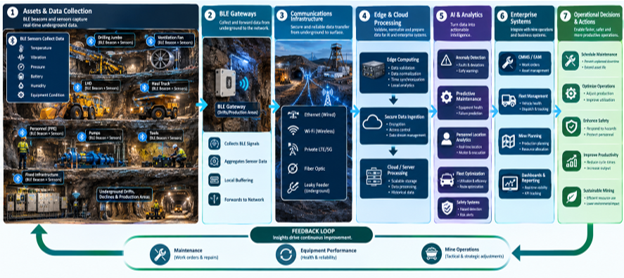
This visual illustrates a seven-stage underground mining workflow, from BLE-enabled equipment and sensor data collection through gateways, communications, edge and cloud processing, AI analytics, and enterprise systems. It shows how analyzed data supports maintenance, personnel-location analytics, fleet optimization, safety, mine planning, and operational actions, with a feedback loop for continuous improvement.
BLE Hardware and Technical Design for Underground Resource Mining
BLE technology consists of several distinct components rather than a single device category.
BLE Beacons
BLE beacons are low-power radio devices that transmit an identifier or other application data. Underground mining applications can use them to identify:
- Mobile equipment
- Workers
- Tools
- Spare parts
- Containers
- Charging stations
- Maintenance assets
- Underground zones
- Emergency equipment
Beacon selection should consider battery life, enclosure design, mounting method, operating temperature, vibration, moisture, dust, maintenance accessibility, and applicable hazardous-location requirements.
BLE Sensors
BLE sensors add physical measurements to identification and location information. Depending on the mining application, sensors may monitor temperature, vibration, humidity, pressure, battery condition, or other parameters.
Sensor selection must be based on the actual measurement requirement. A vibration sensor intended for predictive maintenance should be selected according to frequency range, sampling requirements, mounting method, signal quality, environmental conditions, and the mechanical characteristics of the target equipment.
BLE Gateways
BLE gateways provide the connection between local BLE devices and the mine’s broader data network.
Gateway deployment should consider:
- Tunnel geometry
- Gateway mounting height
- Antenna characteristics
- Coverage overlap
- Cross-cuts and intersections
- Equipment obstruction
- Water and dust exposure
- Maintenance access
- Network backhaul
- Power availability
- Redundancy requirements
- Zone-level location accuracy
Gateway density should be determined through an underground radio survey rather than simply applying an above-ground spacing rule.
Bluetooth LE supports several capabilities relevant to location applications, including RSSI-based proximity methods and direction finding. Bluetooth Core 6.1 and 6.2 are current adopted specifications, while Bluetooth Core 6.3 was introduced in 2026 with additional feature enhancements.
AI Methods for Underground Mining Data
AI selection should follow the operational problem rather than begin with a particular model.
Anomaly Detection
Unsupervised or semi-supervised anomaly detection can identify behavior that differs from established operating patterns.
Examples include:
- Unexpected equipment inactivity
- Unusual movement duration
- Abnormal vibration
- Temperature deviations
- Repeated equipment-zone transitions
- Unexpected personnel movement
- Abnormal charging behavior
Predictive Maintenance Models
Supervised learning, time-series models, survival analysis, and remaining-useful-life techniques can estimate failure risk when sufficient historical maintenance and sensor data exist.
A practical implementation should include maintenance work orders and failure labels where available. Without reliable historical failure data, a system may be better suited to anomaly detection than precise failure prediction.
Location and Movement Analytics
AI can analyze sequential BLE observations to infer patterns such as:
- Typical equipment routes
- Repeated congestion points
- Average travel times
- Excessive idle periods
- Unusual movement sequences
- Equipment-zone utilization
- Personnel flow patterns
This information can support mine operations without requiring every decision to be automated.
Computer Vision and Multimodal AI
BLE can also provide contextual information for AI systems using cameras, machine telemetry, environmental sensors, or other data sources. For example, BLE can identify the equipment or zone associated with an event while another sensing system provides visual or machine-condition evidence.
The combination can improve contextualization without forcing BLE to perform functions for which it is not technically suited.
Cloud Version and Server Version for Underground Mining
Two deployment models can be considered for AI and BLE software.
Cloud Version
A cloud-hosted SaaS deployment can be appropriate when the mining organization has reliable external connectivity and permits operational data to be processed in a managed cloud environment.
Potential advantages include:
- Centralized management across multiple mines
- Elastic computing resources
- Remote software administration
- Easier multi-site analytics
- Centralized AI model management
- Integration with corporate data systems
The main limitation is dependency on reliable connectivity between underground operations, mine networks, and the cloud environment. Critical underground workflows should therefore have appropriate buffering or local processing when connectivity is intermittent.
Server Version
A server deployment places the software on edge servers, customer-managed servers, private data centers, mine-site servers, or other privately hosted infrastructure.
This approach can be appropriate when:
- Mine operations require local processing.
- Connectivity to external cloud services is restricted.
- Operational data must remain within controlled infrastructure.
- Existing mine IT/OT infrastructure favors private deployment.
- Low-latency local analytics are required.
- Multiple underground systems need to continue operating during external network outages.
A hybrid arrangement can also place BLE ingestion and immediate analytics at the mine while forwarding selected historical data to centralized infrastructure for longer-term analysis.
Engineering and Cybersecurity Considerations
Underground mining deployments must account for more than radio coverage.
The physical design should address vibration, moisture, dust, temperature, impact, equipment movement, battery replacement, maintenance access, and the classification requirements of the specific mine environment.
Cybersecurity should also extend from BLE devices through gateways, edge computers, servers, APIs, databases, and enterprise integrations. Industrial cybersecurity practices can draw on IEC 62443 concepts for industrial automation and control system security. IEC describes IEC 62443-1-1 as establishing terminology, concepts, and models for IACS security, while newer IEC 62443 work addresses security protection schemes and lifecycle measures.
Important controls include:
- Device identity management
- Secure gateway configuration
- Encrypted communications where supported and appropriate
- Network segmentation
- Least-privilege access
- Credential rotation
- Secure software updates
- Audit logging
- API authentication
- Server hardening
- Backup and recovery procedures
- Monitoring for anomalous network behavior
AI should also be protected against poor data quality and model drift. Changes to mine layouts, equipment fleets, production methods, gateway positions, or operating procedures can change the statistical patterns learned by an AI model.
For autonomous and semi-autonomous mining systems, safety engineering requires additional consideration. ISO 17757:2019 covers safety requirements for autonomous and semi-autonomous machine systems used in mining, including underground applications, and addresses associated hardware, software, infrastructure, and lifecycle considerations.
GAO’s Role in Underground AI and BLE Deployment
GAO provides BLE, RFID, and IoT hardware products and systems that can support data acquisition, asset identification, condition monitoring, and location-aware applications. Headquartered in New York City and Toronto, Canada, GAO is ranked among the top 10 leading B2B and B2G BLE and RFID suppliers globally.
GAO’s broader product and engineering experience is relevant when underground mining organizations need to connect physical equipment and operational assets with software-based monitoring and analytics. The practical focus should be on selecting suitable tags, sensors, gateways, communication methods, installation approaches, and software integration for the mine’s actual operating environment rather than treating BLE as an isolated technology.
GAO RFID Inc., GAO Research Inc., and GAO Tek Inc. form GAO Group, with operations based in New York City and Toronto, Canada. For three decades, GAO Group has served organizations in the United States and Canada, including Fortune 500 companies, R&D organizations, universities, and government agencies, supported by substantial R&D investment, quality assurance processes, and remote or onsite technical support.
Underground Mining Deployment Lifecycle
Successful AI-enabled BLE deployment begins with the mining workflow rather than with hardware selection. The engineering team should first identify the operational decisions that require better data, then determine what information is necessary to support those decisions.
Planning and Site Assessment
A mine survey should document underground levels, declines, shafts, cross-cuts, stopes, workshops, charging areas, maintenance bays, refuge chambers, ventilation infrastructure, and major travel routes.
The assessment should also identify:
- Existing mine-wide communications
- Available Ethernet and fiber connections
- Wi-Fi or private cellular coverage
- Power availability
- Existing tracking systems
- Mine management software
- Fleet management systems
- CMMS or EAM software
- SCADA and telemetry systems
- Environmental monitoring equipment
- Hazardous-area classifications
- Areas with high equipment density
- Locations where radio propagation may be obstructed
A radio survey and pilot installation should precede a large-scale deployment. Underground conditions can vary significantly between development headings, production areas, workshops, and shafts.
Hardware Selection and Installation
BLE beacon and sensor selection should reflect the asset and measurement requirement.
A beacon mounted on an LHD may experience substantially more vibration, dust, water exposure, impact, and temperature variation than a beacon mounted inside an underground office or control room. Mounting location also affects radio performance.
Sensors should be installed where their measurements have engineering meaning. For vibration monitoring, mechanical coupling and sensor orientation can be more important than simply increasing the number of sensors.
Gateways should be positioned to provide appropriate coverage and redundancy while minimizing installation and maintenance costs.
Underground BLE Gateway Deployment Map for Mine Connectivity
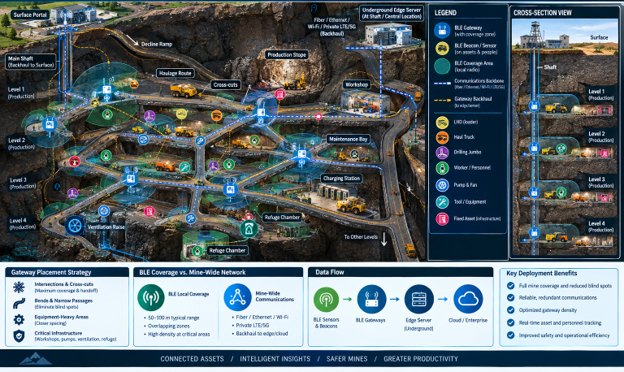
This visual illustrates strategic BLE gateway placement across underground mine levels, including production zones, haulage routes, workshops, maintenance bays, charging stations, and refuge chambers. It shows overlapping BLE coverage zones and communications backhaul through fiber, Ethernet, Wi-Fi, and private LTE/5G to underground edge servers and enterprise systems.
Commissioning and Testing
Commissioning should verify both the physical BLE system and the resulting operational data.
Testing should include:
- Beacon detection range
- Gateway coverage
- Location accuracy
- Battery performance
- Sensor measurement quality
- Gateway-to-server connectivity
- Data buffering during network outages
- Timestamp consistency
- Device identity management
- API integration
- Alarm generation
- AI model input quality
- Dashboard accuracy
- Recovery following gateway or server failure
Test scenarios should be conducted while mining equipment is moving, parked, operating, entering workshops, and passing through congested areas. Static testing alone can produce misleading results because moving machinery changes the radio environment.
Integrating AI and BLE with Mine Management Systems
BLE data becomes considerably more valuable when integrated with existing mining software.
Fleet Management Integration
Fleet management systems can provide machine status, operating hours, engine information, production cycles, fuel or battery information, and operator assignments.
BLE can complement those systems by supplying location observations and proximity information.
AI can correlate both data sources to identify:
- Excessive idle time
- Unexpected machine movement
- Underutilized equipment
- Long travel paths
- Repeated waiting locations
- Maintenance-related downtime
- Charging delays
- Production-zone congestion
The result is a more contextual representation of underground equipment utilization.
CMMS and EAM Integration
Maintenance systems contain information about work orders, inspections, spare parts, technicians, failure codes, maintenance intervals, and equipment history.
AI can combine that information with BLE sensor and location data.
For example, if a pump repeatedly develops abnormal vibration before a maintenance event, historical BLE sensor data can be associated with the relevant work order. Over time, those observations can become training data for anomaly detection or predictive maintenance.
BLE location data can also show whether equipment has actually arrived at a maintenance area, whether a technician is near the assigned asset, and how long equipment remains unavailable.
SCADA and Environmental Monitoring
Underground mining operations frequently rely on SCADA and specialized environmental monitoring for infrastructure and process conditions.
BLE should not be considered a replacement for dedicated mine safety monitoring. Instead, BLE can provide supplementary identification, location, or condition information that can be correlated with existing systems.
For example, an AI system could correlate equipment location with ventilation conditions, temperature, maintenance activity, or production state to provide more meaningful operational context.
AI and BLE Performance Metrics for Underground Mining
KPIs should measure operational outcomes rather than simply the number of BLE devices installed.
Useful measurements include:
| KPI | Underground Mining Relevance |
|---|---|
| Asset location accuracy | Measures whether equipment can be associated with the correct underground zone |
| BLE gateway availability | Indicates continuity of location and sensor data collection |
| Beacon battery life | Determines maintenance requirements for mobile tags |
| Equipment utilization | Measures productive operating time versus idle or unavailable time |
| Equipment idle duration | Identifies avoidable waiting and staging |
| Mean time between failures | Tracks equipment reliability |
| Mean time to repair | Measures maintenance responsiveness |
| Predictive alert precision | Indicates the usefulness of AI-generated maintenance alerts |
| False-alert rate | Measures unnecessary maintenance investigations |
| Sensor data completeness | Identifies missing observations |
| Personnel location coverage | Measures visibility across designated underground areas |
| Emergency muster visibility | Indicates availability of personnel-location information |
| Gateway communication latency | Measures speed of data delivery |
| Data synchronization accuracy | Ensures reliable event sequencing |
| Maintenance downtime | Measures equipment availability impact |
| Travel time | Identifies equipment and personnel movement inefficiencies |
| Charging turnaround time | Relevant to battery-electric mining fleets |
| Production cycle time | Measures loading, hauling, dumping, and return cycles |
| Unplanned downtime | Tracks operational disruption |
| AI model drift | Identifies deterioration in model performance |
The correct KPI set depends on the mine’s production method, equipment fleet, safety requirements, and existing operational systems.
Common Underground Mining Challenges and Engineering Responses
Difficult Radio Propagation
Rock, tunnel bends, machinery, water, and changing mine geometry can affect BLE signal behavior.
A practical response is to use site surveys, gateway redundancy, appropriate mounting positions, and zone-based positioning where sub-meter precision is not necessary.
Changing Mine Layouts
Development work constantly changes underground routes. A gateway that provides excellent coverage today may become less useful after headings advance or equipment routes change.
Gateway installation should therefore support relocation and expansion. Asset configuration should be software-defined wherever practical so that new zones and gateways can be added without redesigning the entire system.
Battery Maintenance
Thousands of mobile beacons can create a significant maintenance burden.
Battery strategy should include expected transmission frequency, sensor sampling frequency, temperature, battery chemistry, replacement intervals, spare inventory, and maintenance labor.
Low-power event-driven sensing can often be more appropriate than continuous high-frequency transmission when the operational requirement does not justify the additional energy consumption.
Data Quality
AI cannot compensate indefinitely for poor source data.
Common problems include:
- Duplicate asset identifiers
- Incorrect asset assignments
- Missing timestamps
- Gateway outages
- Sensor calibration problems
- Battery depletion
- Inconsistent naming conventions
- Unlabeled maintenance failures
- Incorrect zone definitions
Data-quality monitoring should therefore be part of the solution rather than an afterthought.
AI Model Drift
Mining operations change. New equipment, different ore bodies, revised production schedules, relocated gateways, altered ventilation conditions, and changing maintenance practices can alter data patterns.
AI models should be periodically evaluated against current operational data. Model performance should be monitored using measurable criteria rather than assuming that an initially successful model will remain accurate indefinitely.
Scalability Across Underground Mining Operations
A scalable implementation should begin with a defined operational area rather than attempting to instrument every underground asset simultaneously.
A practical expansion sequence can involve:
- Pilot one underground production zone
- Validate BLE coverage and location accuracy
- Instrument a defined equipment group
- Establish reliable gateway backhaul
- Integrate asset identities with existing mine software
- Validate data quality
- Introduce one or two AI use cases
- Measure operational KPIs
- Refine device placement and data models
- Expand to additional levels and equipment classes
This approach allows engineering teams to identify radio, battery, data, integration, and workflow problems before they become mine-wide issues.
For multi-site mining organizations, common asset identifiers, consistent data models, standardized gateway configurations, and centralized AI model governance can simplify deployment across mines while allowing local engineering teams to adapt installations to site-specific conditions.
GAO can support organizations evaluating BLE, RFID, and IoT hardware requirements for these staged deployments, including applications where identification, sensing, and location information must be connected to existing operational software.
Security, Interoperability, and Lifecycle Management
Underground mining systems increasingly connect operational technology with IT systems. That increases the importance of controlling interfaces between BLE gateways, edge computers, servers, databases, APIs, and mine-management software.
Security measures should include:
- Unique device identities
- Controlled administrator access
- Network segmentation
- Gateway configuration management
- Secure credential storage
- Encryption where appropriate
- Software patch management
- Audit logging
- Backup procedures
- Incident-response procedures
- Controlled API access
- Asset inventory
- Firmware lifecycle management
Interoperability is equally important. BLE data may need to coexist with Ethernet, IP networks, Wi-Fi, private LTE/5G, industrial protocols, MQTT, REST APIs, OPC UA, databases, and existing mine software.
The integration layer should normalize identifiers, timestamps, units, locations, and event definitions before AI processing. This reduces the risk that different systems interpret the same asset or event differently.
Business Benefits of AI-Enabled BLE Visibility in Underground Mines
Combining AI with BLE can create value across several operational dimensions.
Higher Equipment Availability
Condition information and equipment location can help maintenance teams identify abnormal behavior earlier and plan interventions around production requirements. The potential benefit comes from improving the timing and context of maintenance decisions rather than simply adding more alarms.
Better Fleet Utilization
Movement and location histories provide evidence of how long equipment spends hauling, loading, waiting, traveling, charging, or undergoing maintenance. AI can identify patterns that are difficult to detect from isolated machine records.
Improved Personnel Visibility
BLE-enabled personnel identification can provide additional visibility into underground zones and support emergency-response coordination, subject to the mine’s safety-system requirements and approved procedures.
More Effective Maintenance Planning
Combining equipment location, sensor observations, operating hours, and maintenance records helps maintenance planners determine which asset requires attention, where it is located, what condition it is in, and whether an intervention is already scheduled.
Reduced Data Fragmentation
AI can contextualize information that previously existed in separate systems. A location event can be associated with an equipment record, maintenance event, operator assignment, production activity, or environmental condition.
Operational Scalability
BLE devices can be added incrementally as additional assets, levels, workshops, and production zones become priorities. This makes the technology suitable for phased underground mining deployments where mine development continuously changes operational requirements.
Implementation Recommendations for Underground Resource Mining
A technically sound implementation should focus on measurable mining problems rather than deploying BLE solely because the technology is available.
Recommended practices include:
- Define the operational decision that each AI use case must improve.
- Start with a controlled underground pilot.
- Perform radio surveys before fixing gateway locations.
- Select beacon and sensor hardware according to the physical mining environment.
- Establish unique identities for equipment, personnel devices, gateways, and sensors.
- Design data buffering for intermittent connectivity.
- Use edge processing when local continuity or low latency is important.
- Integrate BLE data with fleet, maintenance, production, and safety-related systems where appropriate.
- Establish data-quality monitoring before training complex AI models.
- Begin predictive maintenance with anomaly detection when historical failure data is insufficient.
- Validate AI alerts with maintenance engineers and equipment specialists.
- Track false positives and false negatives.
- Reassess models after mine-layout or equipment changes.
- Design gateway installations for relocation as mine workings develop.
- Apply network segmentation and controlled access between IT and OT environments.
- Maintain a complete device and software inventory.
- Document commissioning tests and acceptance criteria.
- Measure operational KPIs before and after deployment.
- Expand only after the pilot demonstrates reliable technical and operational performance.
Key Takeaways for AI and BLE in Underground Resource Mining
AI-enabled underground mining is most effective when location, condition, equipment, personnel, and operational data are brought together around specific mining decisions.
BLE beacons provide persistent asset and personnel identities. BLE sensors add condition and environmental observations. BLE gateways collect those observations and connect them to the mine’s wider communications infrastructure. Edge or server-based software can normalize and contextualize the data, while AI can identify anomalies, predict maintenance needs, analyze equipment utilization, and support operational decisions.
The engineering challenge is not simply achieving BLE coverage. A successful deployment requires appropriate radio planning, ruggedized hardware, reliable backhaul, accurate asset identities, cybersecurity, integration with existing mine systems, data-quality controls, and continuous AI validation.
GAO’s experience supplying BLE, RFID, and IoT hardware products and systems can help organizations evaluate the physical sensing and identification requirements that form the foundation of these applications. GAO also provides expert support remotely or onsite, supported by the R&D and quality-assurance capabilities developed across three decades of serving organizations in the United States and Canada.
Organizations planning underground asset tracking, equipment monitoring, personnel visibility, predictive maintenance, or AI-assisted mine operations can learn more about GAO’s BLE, RFID, IoT hardware products, systems, and engineering support for application-specific requirements.
Building the Future of Industrial AI and IoT with Aperture Venture Studio and GAO RFID Inc.
For underground resource mining, our work with AI and IoT technologies focuses on practical applications such as equipment visibility, predictive maintenance, personnel location, condition monitoring, and connected mine operations. For more than three decades, GAO Group of Companies has invested heavily in R&D of industrial BLE, RFID, and IoT. As generative AI became useful for industrial applications, we expanded our development work around AI-connected sensing and identification technologies, and founded Aperture Venture Studio to build, launch, and scale AI and IoT companies addressing industrial needs such as mining. Aperture has attracted AI and IoT technical experts, executives, investors, and leading companies. Our Aperture Ventures Summit and TekSummit further support technical discussion and professional communities. We welcome you to join us as Advisors, Co-founders or Employees, Investors, or Customers.