
AI and BLE for Unmanned Aircraft Systems
AI-Driven UAS Asset Tracking and Operational Intelligence
Artificial intelligence is changing how unmanned aircraft systems (UAS) operators monitor aircraft, batteries, payloads, ground equipment, maintenance assets, and operational environments. AI analyzes data collected from connected devices and operational software to identify abnormal conditions, improve asset visibility, predict maintenance requirements, and support faster decisions. BLE provides a practical low-power connectivity layer for identifying and monitoring equipment around hangars, launch sites, maintenance facilities, warehouses, and other controlled UAS operating areas. BLE gateways collect signals from BLE beacons and sensors and forward relevant information to local servers or cloud software for analysis. Bluetooth LE supports low-power advertising, periodic advertising, direction finding, and other capabilities that can be selected according to the tracking requirement.
For UAS operators, the value comes from combining these capabilities with flight operations, maintenance management, inventory control, safety procedures, and AI-based decision support. The resulting system can connect physical UAS assets with operational data rather than treating aircraft, batteries, payloads, and support equipment as isolated records.
AI-Enabled UAS Architecture for BLE Asset Tracking
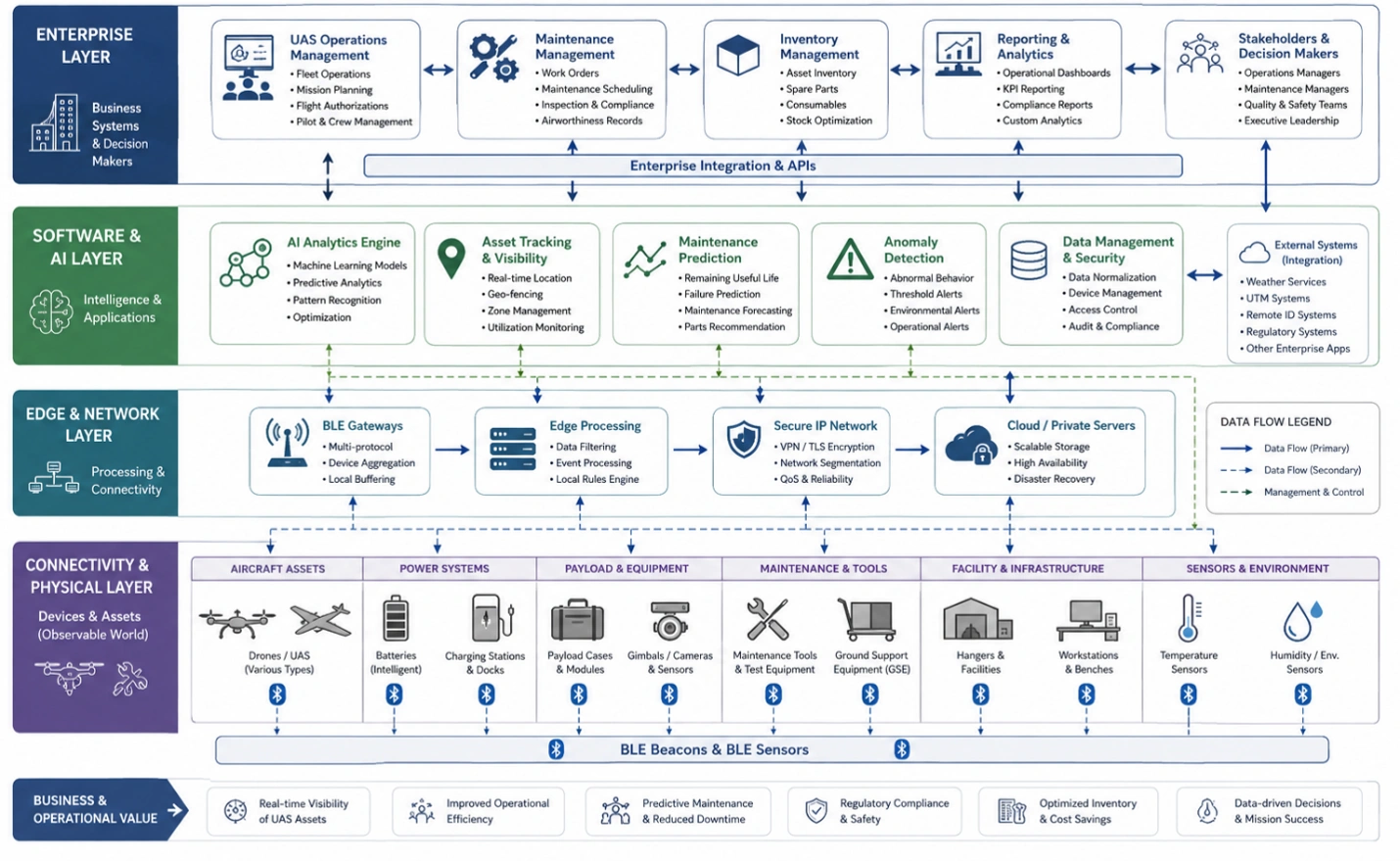
What AI-Enabled UAS Monitoring Means for Aviation Operations
AI-enabled UAS monitoring combines machine learning, Industrial AI, Edge AI, connected sensors, operational databases, and communications technologies to convert physical UAS activity into actionable information.
A typical deployment does not place BLE in the aircraft’s primary flight-control loop. Instead, BLE is most useful around the operational environment where low-power identification and sensing are needed. Examples include battery storage rooms, maintenance benches, payload preparation areas, launch and recovery sites, mobile ground stations, aircraft storage racks, and controlled facilities.
The distinction is important because flight-critical communications require systems specifically engineered and approved for their intended aviation function. BLE can complement those systems by supplying contextual information about assets and operating conditions.
AI can correlate BLE observations with UAS mission records, maintenance history, battery cycles, equipment locations, environmental readings, and operator workflows. That correlation enables applications such as:
- Automated identification of which aircraft or battery is present at a maintenance station
- Detection of unexpected movement of high-value UAS equipment
- Prediction of maintenance requirements from asset history and sensor measurements
- Identification of battery or charging anomalies when appropriate sensors are available
- Verification that required payloads or support equipment are present before a mission
- Monitoring of equipment movement between storage, preparation, launch, recovery, and maintenance areas
- Identification of recurring operational delays caused by equipment availability
- Improved traceability of maintenance tools and mission-support assets
- Automated alerts when equipment enters or leaves defined operational areas
- Correlation of asset-location events with mission and maintenance records
FAA Remote ID serves a different function from BLE asset tracking. Remote ID provides identification and location information from applicable drones through a broadcast signal and supports broader safety and security objectives for drone integration into the National Airspace System. BLE can therefore complement, rather than replace, aviation-specific identification and operational systems.
UAS Operations Where AI Creates the Most Value
UAS Fleet and Aircraft Asset Management
Fleet operators may manage dozens or hundreds of aircraft across storage areas, maintenance locations, field deployment sites, and mission staging areas. Manual asset registers can become inaccurate when aircraft are moved frequently.
BLE beacons attached to approved non-flight-critical equipment or associated assets can provide location events to BLE gateways. AI software can compare those events with expected operational schedules and identify discrepancies.
A useful implementation separates aircraft identity, mission identity, physical location, maintenance status, and operator information. This prevents a location event from being incorrectly interpreted as proof that an aircraft is airborne or mission-ready.
Battery and Charging Operations
Lithium battery management is a major operational consideration for UAS fleets because battery availability, usage history, charging status, storage conditions, and maintenance records can directly influence mission preparation.
BLE-enabled sensors can collect relevant environmental or equipment data where technically appropriate. AI can then analyze historical readings and maintenance information to identify unusual patterns.
A practical system can associate:
- Battery identifier
- Aircraft compatibility
- Charging station
- Charge and discharge records
- Storage location
- Temperature or environmental measurements
- Maintenance inspection history
- Deployment frequency
- Replacement status
AI can use these data relationships to prioritize inspections and identify batteries requiring attention. The AI output should remain a decision-support function unless the complete system has been specifically validated for automated control.
Payload and Mission Equipment Tracking
UAS missions often depend on payloads such as cameras, multispectral sensors, LiDAR equipment, communication equipment, delivery modules, inspection instruments, and specialized mounts.
A BLE beacon can associate a physical payload with a digital asset record. When a payload enters a preparation area, the system can update its location and make the information available to mission-support personnel.
AI can compare mission requirements against available payloads and identify potential preparation gaps before deployment.
Maintenance and Ground Support
Maintenance teams need accurate information about aircraft condition, component history, tools, spare parts, and inspection schedules.
BLE tracking can provide contextual location information while maintenance software remains the authoritative source for maintenance records. AI can analyze maintenance events, recurring faults, asset utilization, and inspection intervals to identify patterns.
This approach is particularly useful when a fleet has multiple maintenance stations and technicians frequently move equipment between work areas.
UAS Launch, Recovery, and Field Operations
Launch and recovery areas present different tracking requirements from warehouses or maintenance facilities. Operators may need to know whether mission-critical support equipment has reached the field location and whether equipment has returned after recovery.
BLE gateways positioned at controlled operational areas can capture proximity events from tagged equipment. AI can correlate these events with mission schedules and equipment checklists.
Such a system can help answer operational questions such as:
- Which support assets are currently available at the launch site?
- Which equipment has not returned after a mission?
- Which battery sets are assigned to a particular aircraft?
- Has required mission equipment reached the preparation area?
- Which assets have remained in an unexpected location?
UAS Operational Lifecycle Workflow with AI and BLE
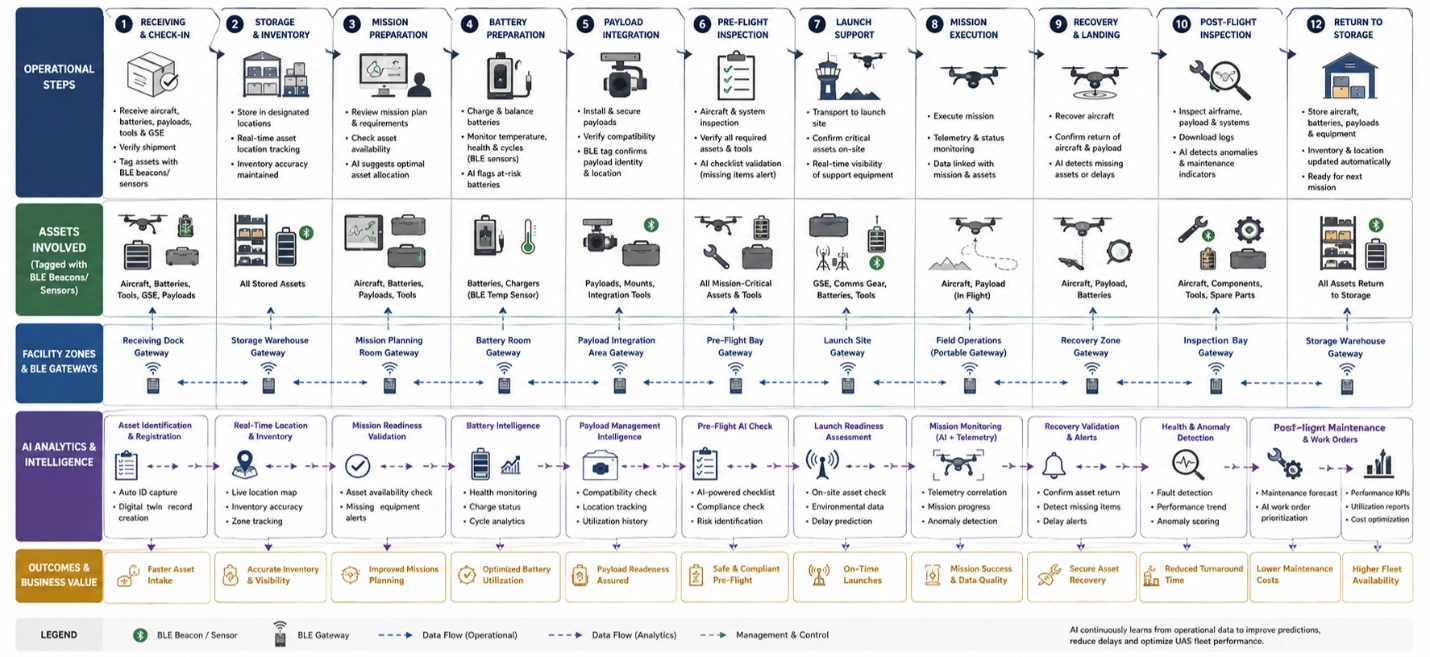
From UAS Data Capture to AI-Based Decisions
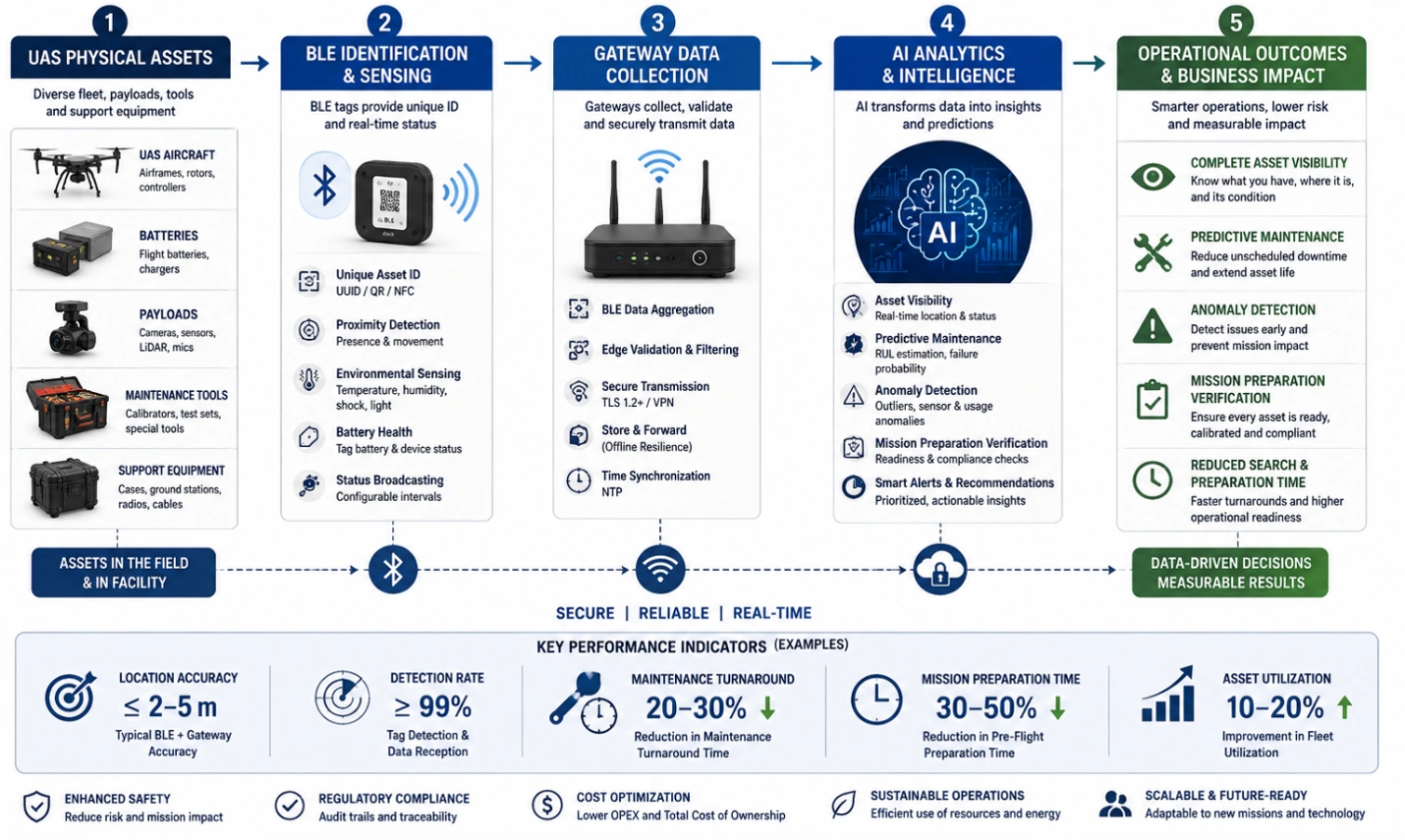
An effective AI-enabled UAS monitoring system normally follows a multi-stage data flow rather than sending every raw event directly into an AI model.
Physical Data Acquisition
Data begins with physical assets and operational events. BLE beacons can provide identity and proximity information, while BLE sensors can provide measurements such as temperature or other supported parameters.
The system should establish an asset identity model before deployment. Each aircraft, battery, payload, tool, charging station, or sensor should have a unique identifier associated with the appropriate enterprise record.
BLE Gateway Collection
BLE gateways receive advertisements or sensor transmissions within their coverage areas. Gateway placement should account for hangar construction, metal equipment, aircraft structures, shelving, interference, antenna orientation, and expected asset movement.
A common engineering mistake is to estimate coverage using open-space radio specifications and then apply those numbers directly to a hangar or maintenance facility. UAS environments can contain conductive structures and equipment that significantly change propagation conditions.
Gateway density should therefore be established through a site survey and validated using actual installation conditions.
Edge Filtering and Event Processing
Edge software can filter duplicate observations, normalize timestamps, apply signal-quality thresholds, and convert raw radio observations into meaningful events.
For example, repeated BLE advertisements from the same asset do not necessarily represent multiple physical movements. An event-processing layer can aggregate observations before forwarding them to the AI system.
Edge processing can also reduce unnecessary network traffic and provide local operation when cloud connectivity is intermittent.
Cloud or Private Server Processing
Processed events can be sent to cloud-hosted software or privately managed servers.
Cloud deployment can be appropriate for geographically distributed UAS operations where centralized fleet visibility, remote administration, and scalable data processing are important.
Private server deployment can be preferable when UAS operators require tighter control over data location, network boundaries, integration with existing private infrastructure, or operational policies that restrict external hosting.
The choice should be based on data sensitivity, connectivity, integration requirements, cybersecurity controls, maintenance responsibility, and operational continuity rather than simply selecting the newest deployment model.
AI Analytics and Decision Support
AI models can process historical and real-time operational information to identify anomalies, predict maintenance needs, classify operational patterns, and prioritize actions.
Useful model categories include:
- Anomaly detection for unexpected asset movement
- Time-series analysis for sensor measurements
- Classification models for operational events
- Predictive maintenance models for recurring equipment conditions
- Optimization models for asset allocation and maintenance scheduling
- Computer vision when camera systems are used alongside BLE data
- Generative AI for querying operational records and producing maintenance or fleet summaries
AI should be evaluated against measurable operational outcomes. A model that generates an impressive prediction but produces excessive false alerts may create additional workload rather than improve UAS operations.
Operational Action
The final stage converts analytics into an operational response.
A system may create a maintenance work order, alert a fleet manager, update an asset record, flag a missing payload, request an inspection, or notify personnel that required equipment is unavailable.
Safety-critical decisions require appropriate human oversight and validation. AI-generated recommendations should not automatically override established aviation procedures or flight-control safeguards.
AI Decision Flow for UAS Operations Using BLE Data
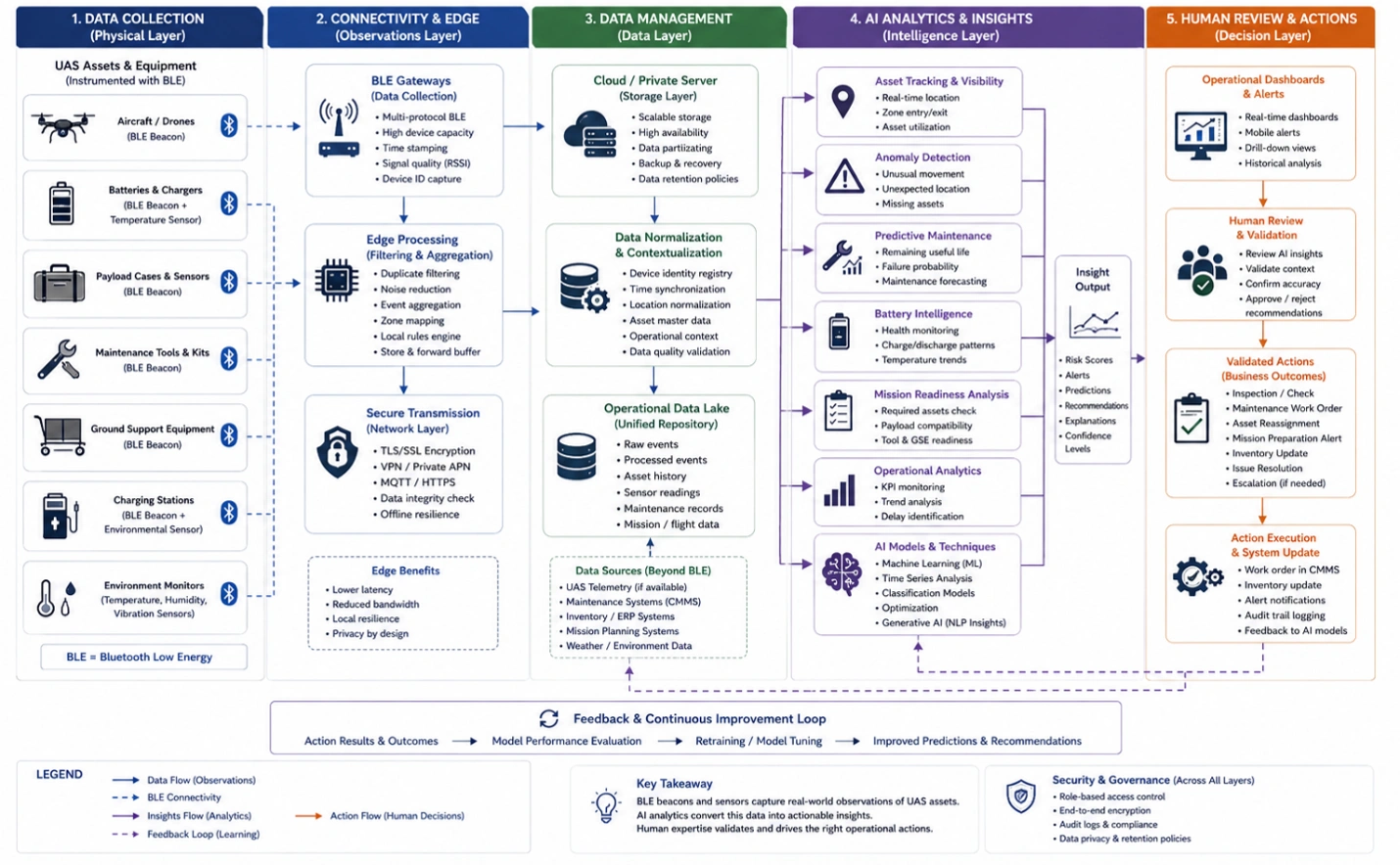
Engineering Considerations for BLE in UAS Environments
BLE selection for UAS operations should begin with the operational requirement rather than the radio technology itself.
Bluetooth Low Energy provides multiple mechanisms that can support different tracking and sensing scenarios. Advertising and periodic advertising can support broadcast-oriented asset observations, while Bluetooth direction-finding capabilities can support more advanced positioning designs when compatible hardware and site conditions are available. Bluetooth SIG documentation identifies direction finding and periodic advertising among the capabilities available within the Bluetooth LE specification family.
Engineering decisions should consider:
- Required location accuracy
- Asset movement speed
- Gateway placement
- Antenna characteristics
- Metal structures and radio reflections
- BLE advertising interval
- Battery life requirements
- Number of simultaneously monitored assets
- Required update frequency
- Network backhaul availability
- Data retention requirements
- Cybersecurity controls
- Integration with UAS fleet and maintenance software
Positioning should also be treated differently from simple presence detection. A gateway can establish that an asset is detectable within a coverage area, but reliable room-level or zone-level positioning requires appropriate gateway density, calibration, radio planning, and validation.
Bluetooth Core Specification 5.4 includes mechanisms designed to support low-power communication with very-low-power end nodes, while newer Bluetooth specifications continue to evolve. Product selection should therefore be based on the exact feature set required by the UAS application rather than relying only on a generic Bluetooth version number.
UAS Cybersecurity, Data Integrity, and Operational Trust
Cybersecurity becomes particularly important when BLE observations are connected to fleet management, maintenance, inventory, or operational decision systems.
BLE security should be combined with application-level controls. Device authentication, secure provisioning, encrypted communications, credential management, network segmentation, software updates, access control, audit logging, and monitoring should be considered during system design.
The data model should also distinguish between observed information and confirmed operational status. For example, a BLE observation can indicate that a tagged asset was detected near a gateway. It should not automatically be interpreted as confirmation that an aircraft is airworthy, authorized for flight, or actively operating.
UAS environments increasingly depend on information exchange among aircraft, operators, service providers, and airspace-management systems. FAA research has explicitly treated UAS traffic management as an information-based environment and has examined cybersecurity alongside Remote ID data correlation.
European U-space operations similarly incorporate information-security requirements because security risks can affect aviation safety. EASA’s consolidated U-space rules include requirements addressing information-security risks with potential impact on aviation safety.
BLE Hardware, AI Software, and UAS Deployment Models
AI-enabled UAS monitoring depends on a coordinated set of BLE hardware, computing resources, communication services, analytics software, and aviation operational systems. BLE should be selected according to the tracking or sensing requirement, while AI should be selected according to the operational decision the system needs to improve.
BLE Beacons for UAS Asset Identification
BLE beacons can be attached to non-flight-critical assets such as battery cases, payload containers, maintenance equipment, tool kits, ground-support equipment, and selected aircraft-associated assets.
Their primary role is to provide a persistent digital identity that can be detected by nearby gateways. Beacon configuration should balance transmission interval, detection latency, battery life, and radio density.
For mobile UAS operations, the beacon’s physical mounting location is important. Carbon-fiber structures, metal cases, battery enclosures, and other conductive materials can affect radio propagation. Installation testing should therefore occur with the beacon attached to the actual asset rather than relying exclusively on laboratory measurements.
BLE Sensors for UAS Support Equipment
BLE sensors extend asset identification into condition monitoring. Depending on the sensor type, they may provide temperature, humidity, vibration, pressure, or other measurements relevant to equipment management.
For example, temperature sensing can support monitoring of battery-storage areas or sensitive payload cases. The sensor data can be associated with the asset identifier and analyzed over time.
Sensor selection should consider measurement accuracy, calibration requirements, operating range, battery life, environmental protection, sampling interval, and whether the measurement is actually relevant to a maintenance or safety decision.
BLE Gateways for Facility and Field Monitoring
BLE gateways form the collection layer between BLE devices and the UAS information system. Multiple gateways can be deployed across hangars, maintenance bays, warehouses, charging rooms, staging areas, and controlled field locations.
Gateway placement should be determined by the required detection zone rather than by an arbitrary coverage radius. A deployment requiring room-level presence can use a different gateway density from a system requiring more precise positioning.
GAO supplies BLE and RFID hardware products and systems that can be incorporated into asset identification, tracking, sensing, and IoT deployments. Hardware selection should be matched to the UAS operator’s physical environment, integration requirements, and operational objectives.
Edge Computing and Middleware
Edge processing is useful when raw BLE observations need to be filtered or interpreted before reaching centralized software.
Middleware can normalize device identifiers, timestamps, signal information, gateway identifiers, sensor readings, and location events. It can also provide APIs for connecting asset data with maintenance, inventory, fleet-management, and analytics software.
A well-designed data model should preserve the original observation while also creating a higher-level event such as “battery detected in charging area.” Keeping both layers improves traceability and makes later AI model validation easier.
AI Models for UAS Operations
Different UAS problems require different analytical approaches.
- Anomaly detection: identifies unexpected asset movement, unusual sensor patterns, or deviations from established operating behavior.
- Predictive maintenance: analyzes historical maintenance events, utilization, sensor readings, and component history to estimate when inspection or service may be appropriate.
- Time-series analysis: identifies changes in temperature, vibration, environmental conditions, or other continuously measured variables.
- Classification: categorizes asset events such as storage, preparation, maintenance, deployment, or return.
- Optimization: helps allocate batteries, payloads, tools, and support equipment according to mission requirements and availability.
- Computer vision: can complement BLE observations when cameras are deployed for equipment identification, inspection, or facility monitoring.
- Generative AI: can provide natural-language access to approved fleet, maintenance, and asset records, subject to appropriate access controls and data governance.
AI models should be evaluated against operational metrics rather than model complexity alone. A simpler model with predictable behavior and low false-alert rates may be more useful than a sophisticated model that maintenance personnel cannot trust.
Cloud Version for Distributed UAS Operations
A cloud-hosted deployment can centralize data from multiple UAS facilities or geographically distributed operating locations.
Cloud deployment is appropriate when operators need centralized fleet visibility, remote administration, scalable data storage, cross-site analytics, and centralized AI processing.
The cloud version can receive normalized BLE events from gateways and combine them with UAS maintenance records, mission information, inventory data, and sensor histories.
Network connectivity becomes an important engineering consideration. Field locations with intermittent connectivity should use local buffering so temporary network loss does not automatically result in missing operational events.
Server Version for Controlled UAS Infrastructure
A server version can operate on customer-managed servers, private data centers, edge servers, or other privately hosted infrastructure.
This approach can be useful for UAS operators requiring greater control over data residency, internal network boundaries, system integration, or operational connectivity.
Private deployment does not eliminate cybersecurity requirements. It shifts more responsibility toward the operator for patching, access management, backups, monitoring, hardware availability, disaster recovery, and software lifecycle management.
The selection between cloud and private server deployment should consider:
- Number and geographic distribution of UAS facilities
- Network reliability
- Data governance requirements
- Existing IT infrastructure
- Integration with fleet and maintenance software
- AI processing requirements
- Cybersecurity policies
- Required local operation during network outages
- IT support capabilities
- Long-term system maintenance costs
AI Capabilities That Improve UAS Asset Operations
The strongest value from AI-enabled UAS monitoring comes from converting large numbers of physical asset observations into operational decisions.
Automated Asset Visibility
AI can consolidate BLE observations from multiple gateways and create a more useful operational view of aircraft-support equipment, batteries, payloads, tools, and other tagged assets.
This reduces dependence on manually updated spreadsheets and allows operations teams to investigate asset discrepancies using time-stamped historical events.
Predictive Maintenance Support
Maintenance teams can combine asset utilization, inspection history, sensor measurements, fault records, and operating conditions.
AI can identify patterns associated with recurring maintenance events and prioritize assets for inspection. The result is not simply a maintenance prediction but a better method for deciding which equipment deserves attention first.
Mission Preparation Verification
Mission preparation involves more than confirming that an aircraft is physically present. Operators may need a compatible battery, payload, controller, ground equipment, tools, spare components, and other mission-specific items.
AI can compare mission requirements with current asset information and identify missing or incorrectly allocated equipment before the launch workflow reaches a critical stage.
Reduced Search and Recovery Time
A tagged support asset that cannot be located can create delays even when its financial value is modest. Searching for specialized payload equipment, batteries, calibration tools, or maintenance equipment can consume valuable personnel time.
Historical BLE observations can narrow the search to the last known detection zone. AI can further identify movement patterns and flag unusual transfers between operational areas.
Operational Anomaly Detection
A UAS operator can establish expected movement patterns for equipment.
For example, a battery may normally move from storage to charging, then to mission preparation, and finally back to storage or maintenance. A sequence that deviates significantly from the established workflow can be flagged for review.
The system should distinguish between genuine anomalies and legitimate exceptions. Human feedback can be incorporated into model improvement.
Scalability Across UAS Facilities
A properly designed event model allows additional gateways and tagged assets to be added without redesigning the entire application.
Scalability should nevertheless be tested at realistic device densities. Increasing the number of beacons, gateways, sensor transmissions, and AI events can change radio behavior, network traffic, storage requirements, and processing loads.
UAS Implementation Lifecycle and Engineering Best Practices
Define the Operational Problem First
The first implementation step should identify the specific operational problem.
Examples include poor battery visibility, missing payload equipment, slow maintenance workflows, inaccurate inventory records, or insufficient visibility across multiple UAS facilities.
The project should define measurable success criteria before hardware installation.
Build the UAS Asset Data Model
Each physical asset should have a unique identity and an appropriate relationship to the operational system.
Useful fields can include asset ID, asset type, aircraft association, maintenance status, location zone, responsible department, service history, and deployment status.
Conduct a Radio Site Survey
The physical environment should be surveyed before finalizing gateway positions.
Testing should account for:
- Hangar dimensions
- Metal structures
- Aircraft frames
- Storage racks
- Charging equipment
- Walls and partitions
- Human traffic
- Gateway mounting height
- Antenna orientation
- Expected asset movement
- Radio interference
A pilot installation should measure actual detection reliability before full deployment.
Commission and Validate the System
Commissioning should test more than whether BLE devices can be detected.
Validation should cover asset identity accuracy, detection latency, location-zone accuracy, sensor data integrity, gateway uptime, network resilience, event duplication, timestamp synchronization, software integration, and alert behavior.
AI models should be evaluated using representative operational data rather than synthetic examples alone.
Integrate With Existing UAS Software
BLE information becomes substantially more valuable when integrated with existing operational systems.
Potential integration points include:
- Fleet management software
- Computerized maintenance management systems
- Enterprise asset management systems
- Inventory management
- Warehouse management
- Mission planning software
- Work-order systems
- Identity and access management
- Operational dashboards
- Data warehouses
- Business intelligence tools
APIs and standardized data interfaces can reduce the need for manual data transfer.
Establish Cybersecurity and Governance
Device provisioning, authentication, credentials, software updates, network segmentation, role-based access, audit logs, backups, and incident response should be addressed during system design.
AI governance should also define who can access operational data, which records may be used for model training, how predictions are validated, and when a human must approve an AI-generated recommendation.
Optimize After Deployment
Operational performance should be reviewed after commissioning.
Gateway positions may need adjustment. Beacon transmission settings may require optimization. AI thresholds may need recalibration. False alerts should be analyzed rather than simply disabled.
GAO’s experience supplying IoT hardware products and systems to organizations in the United States and Canada supports a practical deployment approach in which hardware selection, integration, testing, and technical support are treated as connected engineering activities.
UAS Deployment Lifecycle Timeline: AI-Enabled Asset Monitoring Implementation Roadmap
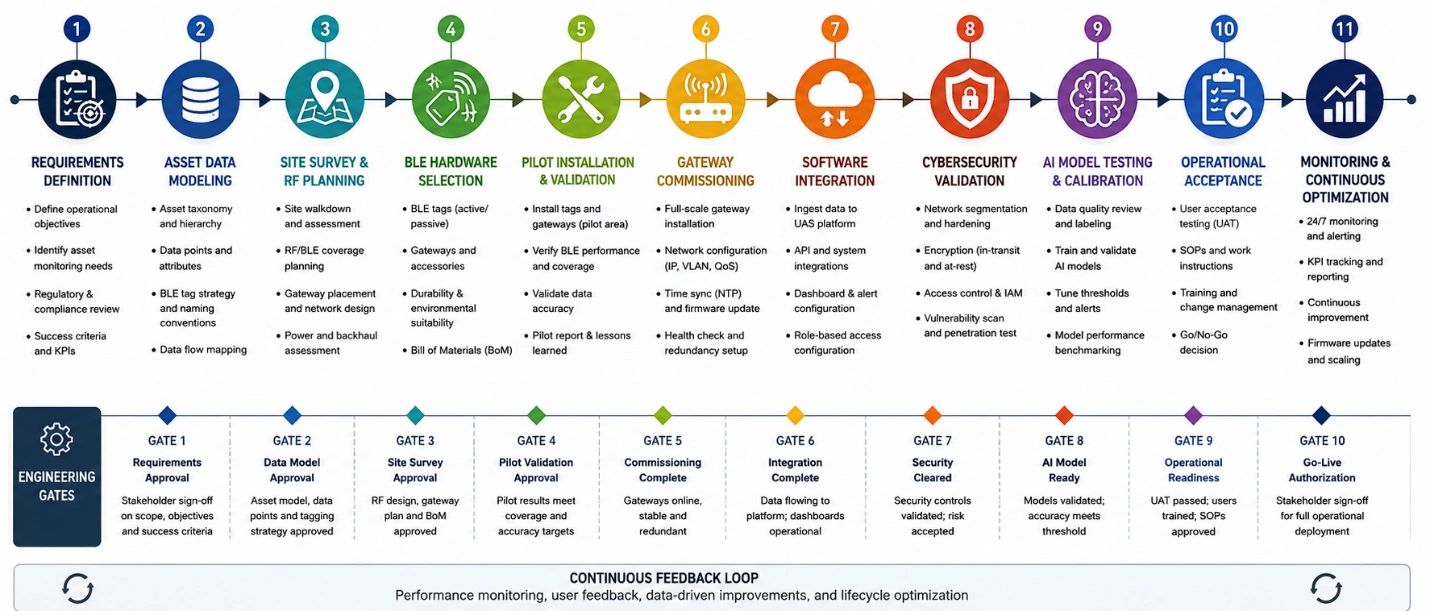
KPIs for AI-Enabled UAS Asset Tracking
Performance measurement should connect the technology to measurable operational outcomes.
Relevant KPIs include:
- Asset location accuracy by operational zone
- BLE asset detection rate
- Asset identification accuracy
- Average time to locate missing equipment
- Battery availability rate
- Battery preparation cycle time
- Payload preparation time
- Maintenance turnaround time
- Unscheduled maintenance frequency
- Predictive maintenance alert precision
- False-alert rate
- Missed-anomaly rate
- Gateway availability
- Sensor data completeness
- Data synchronization latency
- Network uptime
- Mission preparation delay caused by equipment availability
- Inventory record accuracy
- Asset utilization rate
- Equipment search time
- Work-order completion time
- AI recommendation acceptance rate
- Mean time to investigate an asset anomaly
- System response time
- Cost per tracked asset
- Number of tracked assets per gateway
- Number of UAS facilities integrated
The most useful KPI set should be established before deployment so the operator can compare baseline performance with post-deployment results.
Regulations, Standards, and UAS Integration Considerations
UAS deployments operate within aviation rules that vary according to jurisdiction, aircraft category, operational environment, and mission type. BLE asset monitoring does not replace compliance with aviation requirements.
For U.S. operations, FAA Remote ID requirements are particularly relevant to applicable drones because Remote ID provides identification and location information through a broadcast mechanism. Operators should distinguish Remote ID functionality from facility-based BLE asset monitoring.
U.S. UAS operators should also evaluate applicable FAA operational requirements, registration obligations, airspace restrictions, and other requirements according to the specific mission.
For operations involving European U-space environments, operators should consider the applicable EASA regulatory framework and information-security requirements.
Bluetooth implementations should follow applicable Bluetooth SIG specifications and use qualified products where qualification is required for the intended product deployment. Bluetooth technical specifications should be checked during product selection because individual Bluetooth generations and feature sets do not automatically imply identical positioning, sensing, or networking capabilities.
For cybersecurity, organizations should also align their controls with applicable aviation, information-security, privacy, and organizational requirements. The precise regulatory framework should be determined from the operator’s jurisdiction and mission profile.
Why AI-Enabled BLE Monitoring Matters for UAS Operators
AI and BLE become particularly useful when they solve an operational information problem rather than being deployed simply because the technologies are available.
A UAS operator can use BLE to create reliable physical observations around aircraft-support assets, while AI turns those observations into patterns, alerts, predictions, and recommendations.
The combination can help organizations move from manually maintained asset records toward continuously updated operational information. The greatest value typically comes from connecting asset observations with maintenance, inventory, mission preparation, and fleet-management processes.
GAO provides BLE, RFID, and IoT hardware products and systems that can support these types of deployments. Its technical support model includes remote and onsite assistance, allowing organizations to address hardware selection and implementation requirements according to their operating environment.
Building an AI-Ready UAS Information System With GAO
A successful deployment should be treated as an operational engineering project rather than a standalone tracking installation.
Organizations evaluating AI-enabled UAS monitoring should begin with a clearly defined workflow, identify which physical assets require visibility, determine the required detection accuracy, and select BLE hardware according to environmental and battery-life constraints.
The next step is to establish the data path from BLE devices through gateways and software into maintenance, fleet, inventory, and analytics systems. AI should then be introduced where historical and real-time data can support a measurable operational decision.
GAO has served organizations in the United States and Canada for three decades through its New York City and Toronto, Canada operations. GAO and its sister companies, GAO Research and GAO Tek, form GAO Group and have supplied technology products and systems to Fortune 500 companies, R&D organizations, universities, and government agencies. The group has invested extensively in R&D and maintains quality-assurance processes and technical support capabilities.
Practical Recommendations for UAS AI and BLE Projects
- Start with one measurable UAS workflow such as battery management, payload preparation, or maintenance asset tracking.
- Establish a baseline KPI before installing hardware.
- Separate flight-critical systems from supplementary asset-monitoring systems.
- Conduct an RF site survey using the actual UAS facility and representative equipment.
- Test BLE performance around aircraft structures, battery cabinets, metal racks, and maintenance equipment.
- Use unique digital identities for aircraft, batteries, payloads, tools, and support equipment.
- Design the event data model before connecting AI models.
- Use edge filtering to reduce duplicate observations and unnecessary network traffic.
- Select cloud or private server deployment according to operational, cybersecurity, connectivity, and data-governance requirements.
- Integrate asset events with maintenance and inventory systems rather than creating another isolated database.
- Validate AI predictions against real UAS maintenance and operational outcomes.
- Measure false positives and false negatives before allowing automated notifications to influence workflows.
- Maintain human oversight for decisions that could affect aviation safety or aircraft airworthiness.
- Establish cybersecurity controls during commissioning rather than after deployment.
- Expand the deployment only after the pilot demonstrates measurable operational value.
Conclusion: Turning UAS Asset Data Into Operational Intelligence
AI-enabled UAS asset monitoring can connect physical equipment with the information required to manage missions, maintenance, inventory, and field operations more effectively. BLE beacons, gateways, and sensors provide low-power identification and sensing around appropriate UAS operational environments, while AI can transform those observations into anomaly detection, predictive maintenance, preparation verification, and operational insights.
The most effective deployments begin with a defined business problem, accurate asset data, validated radio coverage, reliable integration, cybersecurity controls, and measurable KPIs. GAO can support organizations evaluating BLE, RFID, and IoT hardware products and systems for UAS asset-management applications, including technical guidance for deployment and integration.
AI-Enabled UAS Asset Monitoring with BLE: From Asset Visibility to Operational Outcomes
Building the Future of Industrial AI and IoT with Aperture Venture Studio and GAO
For more than three decades, GAO Group of Companies has invested heavily in R&D for industrial BLE, RFID, and IoT. As AI became increasingly useful for industrial applications, we expanded our work on AIoT solutions that connect intelligent analytics with BLE, RFID, sensors, and connected equipment. We have also established Aperture Venture Studio to advance practical AI and IoT solutions relevant to applications such as UAS asset monitoring and operational intelligence.
Aperture brings together technical experts, operational leaders, investors, and technology organizations focused on AI and IoT. Through initiatives such as Aperture Ventures Summit and TekSummit, advanced AI and IoT topics are explored with technical communities.
We welcome qualified organizations to engage with us as advisors, technical collaborators, investors, or customers.