
AI for Vehicle Connectivity Systems Manufacturing with BLE
AI-Driven Vehicle Connectivity Systems Manufacturing with BLE
AI is changing how vehicle connectivity systems are manufactured by turning production, testing, material movement, and equipment data into actionable manufacturing intelligence. In this environment, BLE beacons, gateways, and sensors provide localized identification and operational data for components, work-in-progress assemblies, tools, test equipment, and production assets. AIoT combines these connected devices and industrial systems with artificial intelligence, machine learning, Edge AI, computer vision, and related analytics to identify production anomalies, predict equipment issues, improve traceability, and support faster decisions. For manufacturers of telematics control units, vehicle communication modules, antenna systems, wireless gateways, connectivity harnesses, and related electronics, the combination can improve line visibility without requiring every process to be manually monitored. GAO supplies BLE, RFID, and IoT hardware products and systems that can support these manufacturing and tracking requirements.
AI-Enabled BLE Architecture for Vehicle Connectivity Systems Manufacturing
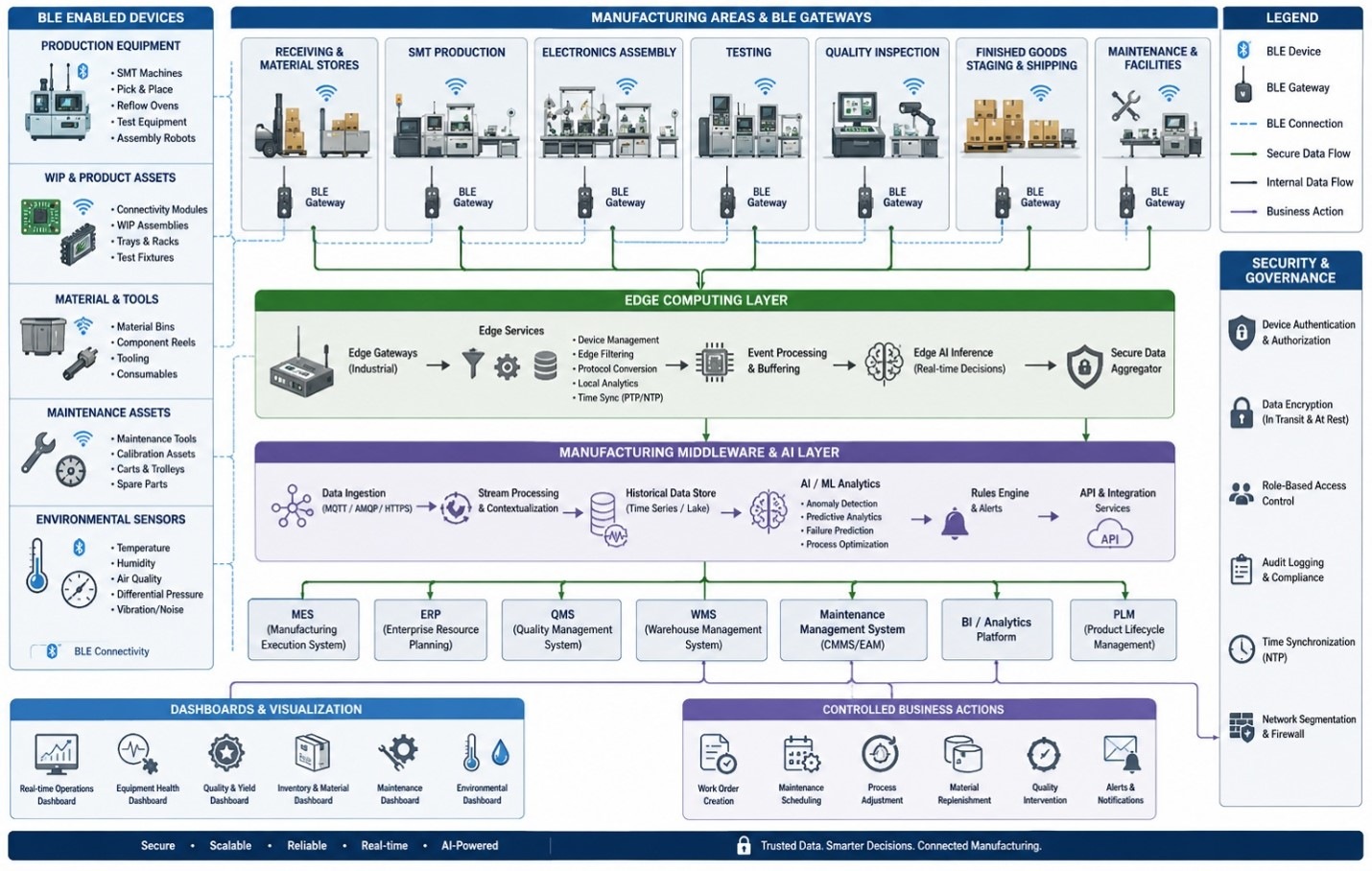
This enterprise architecture diagram illustrates how BLE sensors, beacons, gateways, and connected manufacturing assets feed secure edge computing, middleware, and AI/ML analytics across vehicle connectivity systems production. It shows integration with MES, ERP, QMS, WMS, maintenance, BI, and PLM platforms, enabling real-time monitoring, predictive insights, and controlled operational actions.
Why AI Matters in Vehicle Connectivity Systems Manufacturing
Vehicle connectivity systems manufacturing involves tightly controlled electronics processes where product quality depends on component traceability, process consistency, equipment condition, test results, environmental conditions, and accurate configuration management. Products can include telematics control units, vehicle communication modules, cellular connectivity units, GNSS modules, wireless communication assemblies, antennas, connectivity gateways, electronic control assemblies, and related subassemblies.
AI becomes valuable when manufacturing data is collected continuously rather than only during periodic inspections. A machine-learning model can correlate equipment conditions with defects, test failures, cycle-time changes, or maintenance events. Computer vision can inspect connectors, solder joints, component placement, markings, housings, and assembly characteristics. Edge AI can analyze time-sensitive signals close to the production line, while centralized analytics can identify longer-term trends across production cells.
BLE contributes localized identification and sensing. A beacon can identify a tagged material carrier, test fixture, tool, or work-in-progress unit. A BLE sensor can report temperature, humidity, vibration, motion, or other relevant conditions. Gateways receive these transmissions and forward useful events to manufacturing software. AI then converts these observations into predictions, classifications, anomaly alerts, and recommended actions.
The engineering value comes from combining where, when, what, and condition data. For example, if a test fixture repeatedly produces failures after prolonged vibration exposure, historical BLE sensor data can be correlated with test records and maintenance history. The result is more useful than simply knowing that a test failed.
Core AIoT Concepts for Vehicle Connectivity Systems Manufacturing
Artificial Intelligence of Things, commonly called AIoT or AI and IoT, combines artificial intelligence with connected devices, sensors, equipment, and industrial systems. For vehicle connectivity systems manufacturing, AIoT connects physical production activities with software-based analysis and decision support.
AI-Based Production Monitoring
Production monitoring can combine equipment signals, work-order information, operator events, test results, environmental readings, and location events. Machine-learning models can identify deviations from normal production patterns and prioritize issues for manufacturing engineers or maintenance teams.
AI-Based Quality Inspection
Connectivity modules contain electronic and mechanical features that must meet defined specifications. AI-based computer vision can assist with inspection of component placement, connector orientation, labels, housings, solder-related features, and assembly characteristics. Vision results can be combined with manufacturing test data to improve defect classification and root-cause analysis.
Predictive Maintenance for Manufacturing Equipment
Pick-and-place machines, reflow ovens, automated optical inspection equipment, functional testers, environmental chambers, conveyors, torque-controlled tools, fixtures, and other equipment generate operational data. AI can analyze historical patterns to identify conditions associated with abnormal operation or impending maintenance requirements.
BLE sensors can add localized condition information where existing machine interfaces do not provide sufficient coverage. This can be particularly useful for portable fixtures, tooling, mobile carts, storage equipment, and assets distributed across production areas.
AI-Enabled Traceability
Traceability is important when connectivity systems contain numerous electronic components, subassemblies, firmware versions, test configurations, and production records. AI can help identify unusual material movements, inconsistent process sequences, repeated test failures, or relationships between manufacturing conditions and field-relevant quality indicators.
BLE identification can supplement barcode, RFID, PLC, MES, and other existing identification mechanisms when real-time proximity or location information is useful.
Vehicle Connectivity Systems Manufacturing Applications
Work-in-Progress and Assembly Tracking
Work-in-progress units can move through receiving, kitting, SMT production, PCB assembly, enclosure integration, programming, functional testing, quality inspection, rework, and finished-goods staging. BLE beacons can provide an electronic identity for selected assemblies or carriers, while gateways positioned at controlled areas can capture location events.
AI software can use these events to identify unusual dwell times, skipped process areas, unexpected movement, or congestion around critical workstations.
The objective is not simply to locate an assembly. The more valuable outcome is understanding whether its movement through the manufacturing process matches the expected production sequence.
Electronic Component and Material Movement
Vehicle connectivity products depend on electronic components, PCBs, connectors, cables, housings, antennas, semiconductors, memory devices, communication modules, and other materials. BLE can supplement existing inventory-control methods by providing proximity and movement information for selected containers, kits, carts, and material-handling assets.
AI-based inventory analytics can detect unusual movement patterns, identify material shortages earlier, and support production scheduling by combining material status with work-order requirements.
Test Fixture and Tool Management
Functional testers, programming fixtures, RF test equipment, calibration tools, torque tools, diagnostic equipment, and assembly fixtures can become bottlenecks when they are misplaced, unavailable, incorrectly configured, or overdue for maintenance or calibration.
BLE beacons can identify individual tools and fixtures, while BLE gateways can detect their presence in designated manufacturing areas. AI analytics can evaluate utilization, movement frequency, downtime, and recurring production interruptions.
A useful implementation should associate the physical asset identity with authoritative maintenance and calibration records rather than creating a separate uncontrolled database.
Environmental Monitoring Around Electronics Production
Temperature and humidity can affect electronics storage, assembly processes, materials, and selected test conditions. BLE sensors can provide additional environmental observations in material storage areas, electronics assembly zones, test laboratories, controlled rooms, and finished-goods areas.
AI can establish normal environmental profiles and flag abnormal conditions. Rather than generating alerts for every small fluctuation, models can consider duration, severity, location, product sensitivity, and historical patterns to prioritize events.
Production Equipment Condition Monitoring
Production equipment can be monitored using machine interfaces where available and supplementary sensors where required. BLE vibration or condition sensors can be deployed on selected equipment or mobile assets when wireless sensing is appropriate.
AI models can compare vibration, temperature, utilization, cycle time, and failure history to identify developing equipment anomalies. Maintenance teams can then investigate before a failure causes an extended production interruption.
AI-Enabled Condition Monitoring Workflow for Vehicle Connectivity Systems Manufacturing
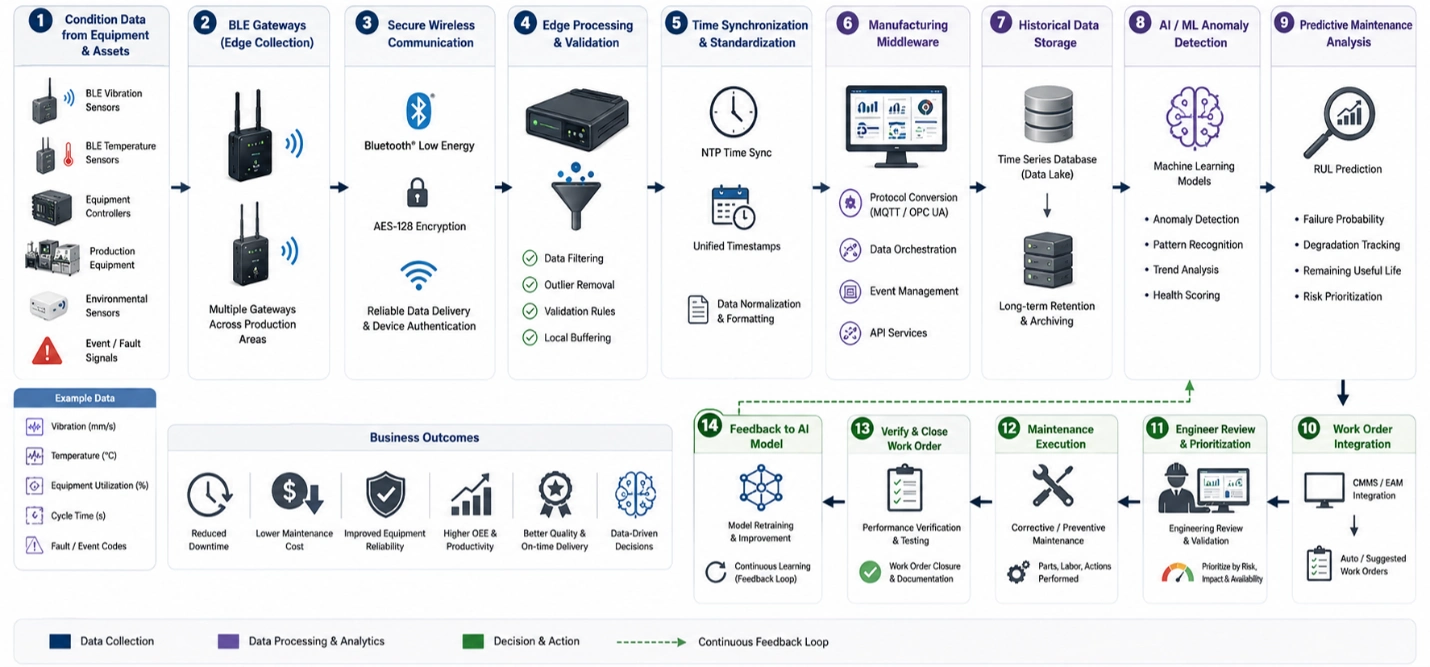
This detailed workflow illustrates the complete data-to-decision lifecycle for AI-enabled equipment condition monitoring. It follows vibration, temperature, utilization, cycle-time, and fault data from BLE sensors through gateways, secure communication, edge validation, middleware, AI analytics, predictive maintenance, work-order execution, and feedback-driven model improvement.
Manufacturing Workflow from BLE Data to AI Decisions
A practical AIoT deployment for vehicle connectivity systems manufacturing should follow the physical production process rather than treating data collection as an isolated IT project.
Data Acquisition at Production Points
Data originates from BLE beacons, BLE sensors, manufacturing equipment, testers, PLCs, barcode systems, RFID readers where deployed, environmental sensors, computer-vision systems, and existing production software.
BLE devices are particularly useful where an asset requires wireless identification, proximity detection, or sensor measurements without extensive new cabling. Device selection should consider battery life, transmission interval, mounting location, electromagnetic conditions, temperature range, enclosure requirements, and maintenance access.
BLE Gateway Collection
BLE gateways receive transmissions from nearby beacons and sensors. Gateway placement should be determined through an RF site survey rather than simply installing units at arbitrary intervals.
Vehicle connectivity manufacturing areas can contain metal production equipment, cabinets, racks, conveyors, test enclosures, and other structures that influence radio propagation. Gateway density should therefore be validated under actual operating conditions.
Edge Processing and Data Validation
An edge processing layer can filter duplicate events, validate sensor readings, normalize timestamps, remove obviously invalid measurements, and reduce unnecessary upstream traffic.
This is important for production environments where connectivity interruptions should not automatically result in lost operational context. Local buffering can preserve events until communication with centralized software is restored.
Manufacturing Middleware and Software Integration
Validated events can be forwarded to middleware and integrated with systems such as:
- Manufacturing execution systems for work orders, routing, process status, and production records
- Enterprise resource planning systems for material planning, purchasing, and inventory
- Warehouse management systems for material movement and storage operations
- Quality management systems for nonconformance, inspection, corrective action, and quality records
- Computerized maintenance management systems for equipment maintenance and work orders
- Laboratory information or test-management systems where appropriate for specialized testing
- Asset-management software for tooling, fixtures, and mobile production assets
- Data historians and industrial databases for time-series analysis
- Business intelligence software for production and management reporting
Integration should use controlled interfaces such as REST APIs, MQTT, OPC UA, database connectors, message brokers, or other interfaces supported by the existing manufacturing environment.
AI Analytics and Decision Support
AI models can process the combined data to identify anomalies, classify events, forecast equipment conditions, estimate process risks, and prioritize investigations.
A manufacturing engineer might receive an alert that a particular test fixture is associated with an increasing failure rate and abnormal vibration readings. A maintenance technician can then inspect the fixture before it causes additional rejected units.
The AI should support the manufacturing decision rather than automatically changing safety-critical or quality-critical process parameters without appropriate validation and authorization.
Operational Action and Feedback
The final stage is a controlled business or manufacturing action. Depending on the use case, this may involve creating a maintenance work order, escalating a quality investigation, holding a material batch, requesting inspection, notifying a supervisor, adjusting production scheduling, or initiating an engineering review.
Completed actions should feed back into the data record. This allows future AI models to learn from confirmed failures, maintenance outcomes, quality dispositions, and production changes.
Vehicle Connectivity Systems Manufacturing Data Lifecycle: From BLE Capture to AI-Driven Business Action
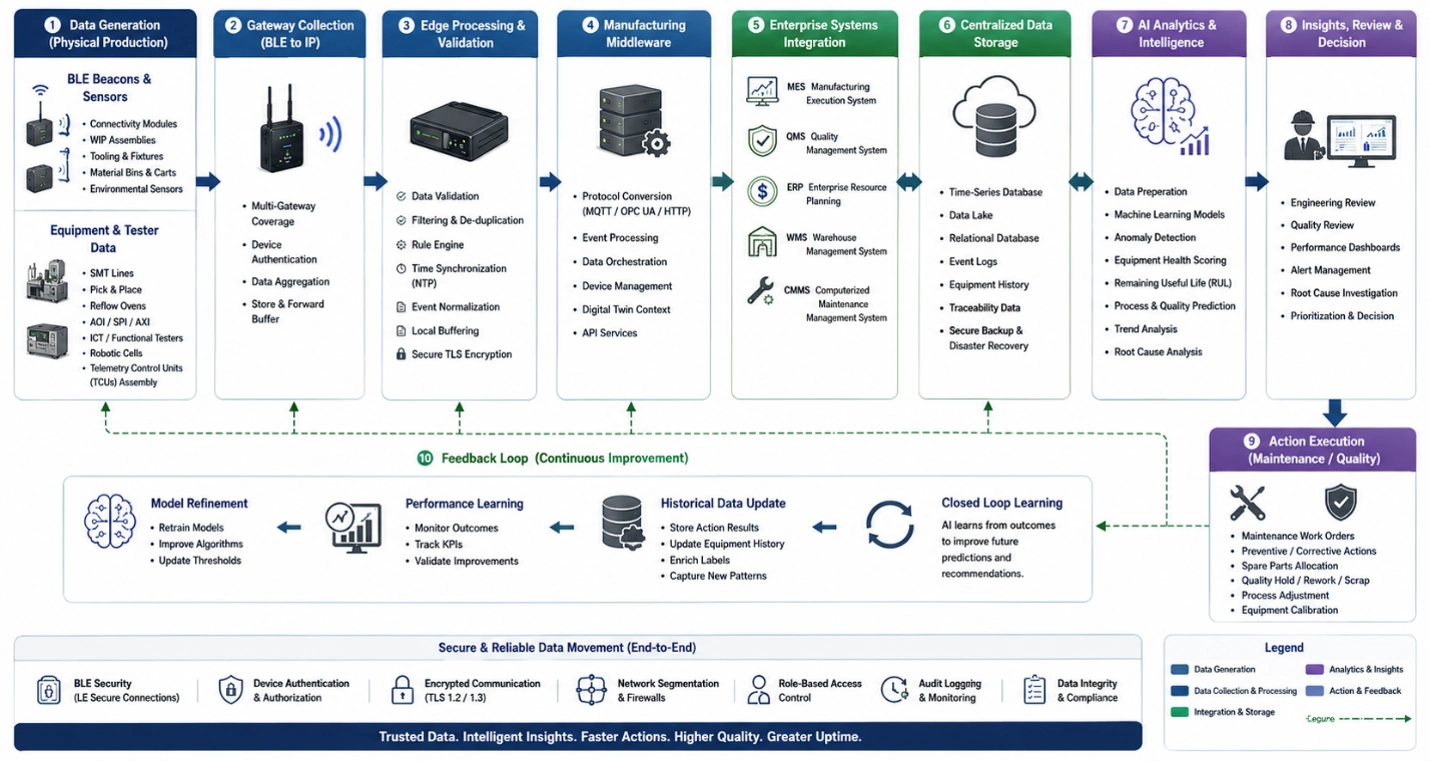
This process flow shows how manufacturing data moves from BLE beacons, sensors, equipment, and testers through gateway collection, edge validation, middleware, enterprise systems, centralized storage, and AI analytics. It highlights engineering review, maintenance and quality actions, and a continuous feedback loop that improves future AI predictions and operational decisions.
BLE Hardware, AI Software, and Deployment Models
A vehicle connectivity systems manufacturing solution typically combines BLE hardware with edge computing, industrial communications, databases, AI software, manufacturing applications, and security controls. The correct design depends on the required location accuracy, sensor frequency, production environment, data volume, latency, cybersecurity requirements, and existing manufacturing systems.
BLE Beacons for Manufacturing Identification
BLE beacons can be assigned to work-in-progress carriers, selected connectivity assemblies, fixtures, tools, carts, material containers, and other mobile assets. Their purpose is to provide an identifiable wireless signal that can be detected by gateways at defined production locations.
Beacon configuration should account for transmission power, advertising interval, battery life, mounting method, and RF conditions. Higher transmission frequency may improve event responsiveness but can increase battery consumption and wireless traffic.
BLE Sensors for Production Conditions
BLE sensors can measure parameters such as temperature, humidity, vibration, motion, or other supported conditions. Their value is strongest when the measured condition can be connected to a manufacturing decision.
For example, a vibration sensor on a mobile test fixture becomes more useful when its readings can be correlated with fixture utilization, functional-test failures, maintenance records, and production schedules.
BLE Gateways for Data Collection
BLE gateways provide the communication bridge between local wireless devices and manufacturing software. Depending on the deployment, gateways can forward information through Ethernet, Wi-Fi, cellular connectivity, or other supported communications.
Gateway selection should consider RF coverage, concurrent device count, network availability, protocol support, enclosure requirements, power availability, and the required level of local processing.
AI and Machine-Learning Software
AI software can include anomaly-detection models, predictive-maintenance models, classification algorithms, time-series analysis, computer-vision models, and statistical process monitoring.
A useful implementation begins with a defined manufacturing problem and measurable outcome. Collecting large quantities of sensor data without identifying the decision it should improve often produces data volume without corresponding operational value.
Cloud Version
A cloud-hosted deployment is appropriate when vehicle connectivity manufacturing operations require centralized analytics across multiple facilities, remote engineering access, centralized model management, or scalable historical data storage.
Cloud software can receive normalized manufacturing events from factory locations while maintaining local processing for latency-sensitive operations. Security should include encrypted communications, identity management, role-based access, device authentication, network segmentation, logging, and controlled API access.
Server Version
A Server Version can operate on customer-managed factory servers, private data centers, edge servers, or other privately hosted infrastructure. This approach can be appropriate where manufacturing data must remain within controlled infrastructure, network connectivity to external services is restricted, or production systems require localized processing.
Private server deployment does not eliminate cybersecurity requirements. Patch management, access control, certificate management, backups, network segmentation, logging, vulnerability management, and incident-response procedures remain necessary.
Choosing Between Cloud and Server Deployment
The decision should be based on manufacturing requirements rather than a generic preference for one deployment model.
- Cloud deployment can simplify centralized analytics across multiple vehicle connectivity manufacturing facilities and support centralized model operations.
- Server deployment can provide greater control over where manufacturing and quality data is processed and stored.
- Edge processing is useful when production decisions require low latency or continued operation during upstream network interruptions.
- Hybrid deployments can combine local event processing with centralized historical analytics and reporting.
- Sensitive manufacturing systems should be isolated through appropriate network segmentation and access controls regardless of deployment model.
GAO’s experience supplying BLE, RFID, and IoT hardware products and systems can support organizations evaluating device selection and deployment requirements for manufacturing applications.
Engineering Considerations for Vehicle Connectivity Manufacturing
Successful deployment requires more than placing BLE devices around a production facility. RF behavior, manufacturing processes, data quality, integration, cybersecurity, maintenance, and operational ownership all affect system performance.
RF Planning and Gateway Placement
Metal racks, electronic test equipment, production machinery, enclosures, and moving vehicles or carts can affect BLE signal behavior. A site survey should therefore evaluate coverage during actual production conditions.
Gateway placement should prioritize meaningful manufacturing zones such as production cells, test areas, controlled storage locations, maintenance areas, and material staging points rather than attempting to produce unnecessary continuous location data.
Data Quality and Event Reliability
AI predictions are only as useful as the underlying manufacturing data. Missing timestamps, duplicate BLE events, incorrectly assigned asset IDs, sensor drift, inconsistent equipment identifiers, and incomplete maintenance records can reduce model reliability.
Data validation should therefore be designed into the system from commissioning rather than added after AI models have already been deployed.
Integration with Existing Manufacturing Controls
BLE should normally complement existing manufacturing technologies rather than replacing every identification or control mechanism.
For example, MES can remain the authoritative source for production routing, while BLE provides supplementary location and asset-presence events. Similarly, a QMS can remain authoritative for nonconformance records while AI analytics identifies patterns that warrant investigation.
Cybersecurity
Connected manufacturing systems should use device identity management, encrypted communications, network segmentation, least-privilege access, secure credential handling, logging, firmware-management procedures, and controlled software interfaces.
Security design should cover BLE endpoints, gateways, edge servers, application interfaces, databases, cloud services where applicable, and connections to MES, ERP, QMS, WMS, and maintenance systems.
Cybersecurity Architecture for AI-Enabled Vehicle Connectivity Systems Manufacturing
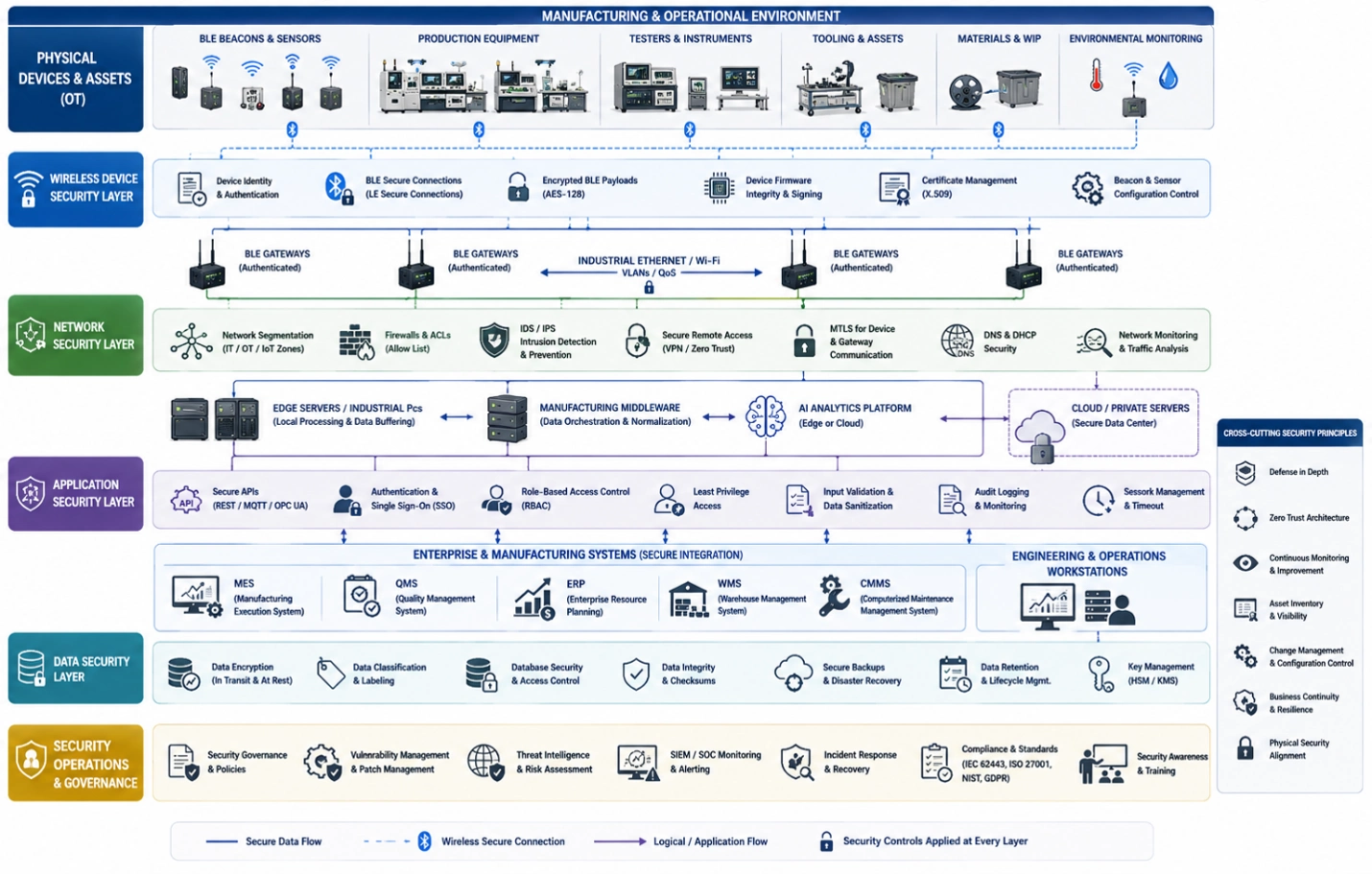
This layered cybersecurity diagram shows how security controls protect BLE-enabled manufacturing assets from the physical device layer through wireless communications, industrial networks, edge computing, applications, enterprise systems, data, and security operations. It highlights authentication, encryption, segmentation, firewalls, RBAC, secure APIs, monitoring, patch management, backups, incident response, and governance.
AI Capabilities for Vehicle Connectivity Systems Manufacturing
AI delivers the greatest value when it connects manufacturing observations to a defined engineering or operational decision. For vehicle connectivity systems manufacturing, relevant capabilities include anomaly detection, predictive analytics, computer vision, process optimization, intelligent traceability, and production forecasting.
AI-Based Anomaly Detection
Anomaly detection can establish normal operating patterns for assembly equipment, test fixtures, environmental conditions, production cycle times, and material movement. The model can then identify deviations that may indicate equipment degradation, abnormal process behavior, or an emerging quality problem.
A practical deployment should distinguish between a statistical deviation and an actionable manufacturing anomaly. Thresholds can be combined with production context, product type, work order, equipment state, and historical quality records to reduce unnecessary alerts.
Predictive Maintenance for Electronics Manufacturing
Predictive maintenance models can combine vibration, temperature, operating hours, cycle counts, fault codes, maintenance history, and production utilization. For vehicle connectivity systems manufacturing, this can apply to production machinery, automated inspection equipment, functional testers, environmental chambers, conveyors, fixtures, and selected tooling.
BLE condition sensors can supplement existing equipment data when the required measurement is not available from the machine controller. AI can then estimate abnormal-condition risk and help maintenance teams prioritize inspections.
AI-Assisted Quality Management
Quality teams can combine AI analytics with inspection results, functional-test outcomes, component information, process parameters, environmental readings, and production history.
This can help identify relationships such as:
- A recurring functional-test failure associated with a particular fixture
- A defect pattern concentrated within a specific production cell
- Increased failures following changes in process conditions
- Abnormal test results associated with a particular component lot
- Repeated quality events following extended equipment utilization
The resulting analysis can support root-cause investigations without replacing formal quality procedures or engineering validation.
AI-Based Production Optimization
Production optimization can use historical cycle times, equipment availability, material status, test capacity, work-in-progress location, and quality information to identify bottlenecks.
For example, if several connectivity module variants require the same functional-test equipment, AI can analyze queue lengths and historical test duration to help production planners sequence work more effectively.
BLE location events can provide additional information about where selected work-in-progress carriers or test fixtures are located, helping production software distinguish between a delayed process and an item that has physically moved to another manufacturing area.
Intelligent Asset Utilization
Manufacturing organizations often maintain expensive test fixtures, programming equipment, calibration tools, mobile carts, and specialized production assets. AI can analyze asset location and usage patterns to identify underutilized resources, excessive movement, recurring shortages, and potential scheduling improvements.
The objective is to connect asset utilization with production requirements rather than simply producing a location map.
Technical and Business Benefits for Connectivity Systems Manufacturing
Combining AI with connected manufacturing data can improve several measurable areas of vehicle connectivity systems production.
Better Production Visibility
Location and condition events can provide additional visibility into work-in-progress carriers, fixtures, tooling, and selected production assets. AI can turn those observations into production-status insights rather than requiring supervisors to manually locate equipment or reconcile records.
Reduced Unplanned Equipment Downtime
Predictive maintenance can identify abnormal equipment behavior before a failure becomes a production interruption. The greatest value is achieved when predictions are connected to maintenance scheduling, spare-parts availability, technician workload, and production planning.
Faster Quality Investigation
AI can correlate test failures with production conditions, equipment identifiers, work orders, material information, and historical quality records. This reduces the amount of manual data reconciliation required during root-cause analysis.
Improved Traceability
A connectivity module may pass through multiple manufacturing stages before becoming a finished product. Combining existing serialized manufacturing records with selected BLE location events can create a stronger chronological record of where an asset or carrier was detected during production.
More Efficient Tool and Fixture Management
AI analytics can reveal where fixtures and tools spend most of their time, which production cells experience shortages, and which assets have unusually low utilization. Maintenance and calibration information can be incorporated to prevent unsuitable equipment from being returned to production.
Scalable Multi-Line Monitoring
Once device identities, manufacturing data structures, interfaces, and security controls are standardized, additional production cells can be added without redesigning every software component. The deployment should still be validated cell by cell because RF behavior, equipment interfaces, and process requirements can vary significantly.
KPIs for AI-Enabled Vehicle Connectivity Systems Manufacturing
AI and IoT initiatives should be evaluated against manufacturing KPIs rather than device counts. Suitable measurements include:
- Overall equipment effectiveness
- Unplanned equipment downtime
- Mean time between failures
- Mean time to repair
- First-pass yield
- Production cycle time
- Work-in-progress dwell time
- Test-station utilization
- Functional-test failure rate
- Defects per unit
- Scrap and rework rate
- Manufacturing throughput
- Production schedule adherence
- Tool and fixture utilization
- Calibration compliance
- Material availability
- Material-search time
- Inventory accuracy
- Quality investigation duration
- Mean time to detect production anomalies
- Mean time to respond to equipment alerts
- Environmental-condition excursion duration
- AI alert precision
- AI false-positive rate
- Asset-location event reliability
- BLE gateway availability
- Sensor data completeness
- Manufacturing-system integration availability
- Maintenance prediction accuracy
- Production interruption frequency
The baseline should be recorded before deployment. Otherwise, an organization may know that the AI system generates alerts without knowing whether those alerts improve production performance.
Security and Interoperability Considerations
Vehicle connectivity systems manufacturing can contain valuable intellectual property, product configurations, firmware information, engineering data, supplier information, and quality records. AIoT deployments should therefore be designed as part of the organization’s broader industrial cybersecurity program.
Relevant considerations include:
- Unique device identities for BLE gateways and managed endpoints
- Strong authentication for administrative interfaces
- Encryption for data transported between gateways, edge systems, and centralized software
- Network segmentation between production equipment and general business networks
- Role-based access for manufacturing, maintenance, quality, IT, and engineering personnel
- Secure API authentication for MES, ERP, QMS, WMS, and maintenance integrations
- Centralized logging and security-event monitoring
- Controlled firmware and software updates
- Vulnerability assessment and patch management
- Backup and recovery procedures
- Time synchronization for reliable event correlation
- Data-retention policies appropriate to manufacturing and quality requirements
- Controlled access to AI models and manufacturing datasets
Interoperability is equally important. A BLE solution should fit into existing manufacturing systems through supported interfaces instead of creating a parallel information silo. MQTT, OPC UA, REST APIs, message brokers, industrial Ethernet, databases, and other established interfaces may be appropriate depending on the equipment and software involved.
Relevant Standards and Regulatory Considerations
Standards and regulations should be evaluated according to the products manufactured, geographic markets served, facility requirements, wireless equipment, cybersecurity program, and quality-management obligations.
Relevant frameworks and standards may include:
- ISO 9001 for quality management systems
- IATF 16949 where applicable to automotive quality management
- ISO/IEC 27001 for information-security management
- IEC 62443 for industrial automation and control-system cybersecurity
- ISO/SAE 21434 for cybersecurity engineering where applicable to automotive products and development activities
- UNECE WP.29 cybersecurity requirements where applicable to vehicle-related products and regulatory programs
- ISO 26262 where functional-safety requirements apply
- Bluetooth SIG specifications relevant to BLE implementations
- FCC requirements for applicable wireless devices operating in the United States
- Innovation, Science and Economic Development Canada requirements for applicable Canadian wireless equipment
- Applicable environmental, electromagnetic compatibility, electrical-safety, and product-compliance requirements
The specific compliance obligations should be confirmed by the manufacturer’s regulatory, quality, legal, and engineering teams for each product and market. A BLE tracking system used for internal manufacturing visibility should not automatically be treated as part of the safety-critical vehicle communication function.
Implementation Roadmap for Vehicle Connectivity Systems Manufacturing
Define the Manufacturing Problem
Start with a measurable problem such as excessive test-fixture search time, unplanned equipment downtime, poor work-in-progress visibility, recurring quality failures, or environmental monitoring gaps.
Avoid beginning with a general objective such as “deploy AI.” The manufacturing outcome should determine what data is required.
Map the Production Process
Document the movement of materials, PCBs, assemblies, fixtures, tools, and finished products through receiving, kitting, SMT, assembly, programming, testing, inspection, rework, staging, and shipping.
Identify authoritative systems and existing identifiers at each step.
Select the Appropriate Hardware
Determine which assets require BLE beacons, which require BLE sensors, and where gateways should be installed. Battery requirements, RF conditions, environmental exposure, mounting method, device density, and maintenance access should influence the selection.
Existing barcode, RFID, PLC, machine-vision, and industrial-network technologies should be retained where they already perform the required function effectively.
Establish the Data Model
Create consistent identifiers for products, carriers, fixtures, tools, production cells, gateways, sensors, work orders, equipment, and manufacturing events.
This step is essential because AI models cannot reliably correlate information when the same physical asset appears under multiple inconsistent identifiers.
Pilot One Manufacturing Process
A pilot should use a defined production area and measurable baseline. For example, an organization could begin with test-fixture management or equipment-condition monitoring before expanding into broader work-in-progress tracking.
The pilot should evaluate RF coverage, data completeness, gateway reliability, integration behavior, user acceptance, and KPI improvement.
Commission and Validate
Commissioning should include device installation verification, RF testing, gateway connectivity checks, timestamp validation, sensor calibration checks, software-interface testing, cybersecurity verification, and failure-mode testing.
Production personnel should participate in acceptance testing because a technically functional system can still fail operationally if its alerts do not match actual manufacturing workflows.
Scale with Governance
After successful validation, additional production cells can be added using standardized device configurations, data models, security controls, integration methods, and maintenance procedures.
AI models should be monitored after deployment because production conditions, equipment, product variants, and manufacturing processes change over time.
AI-Enabled Vehicle Connectivity Systems Manufacturing Implementation Timeline
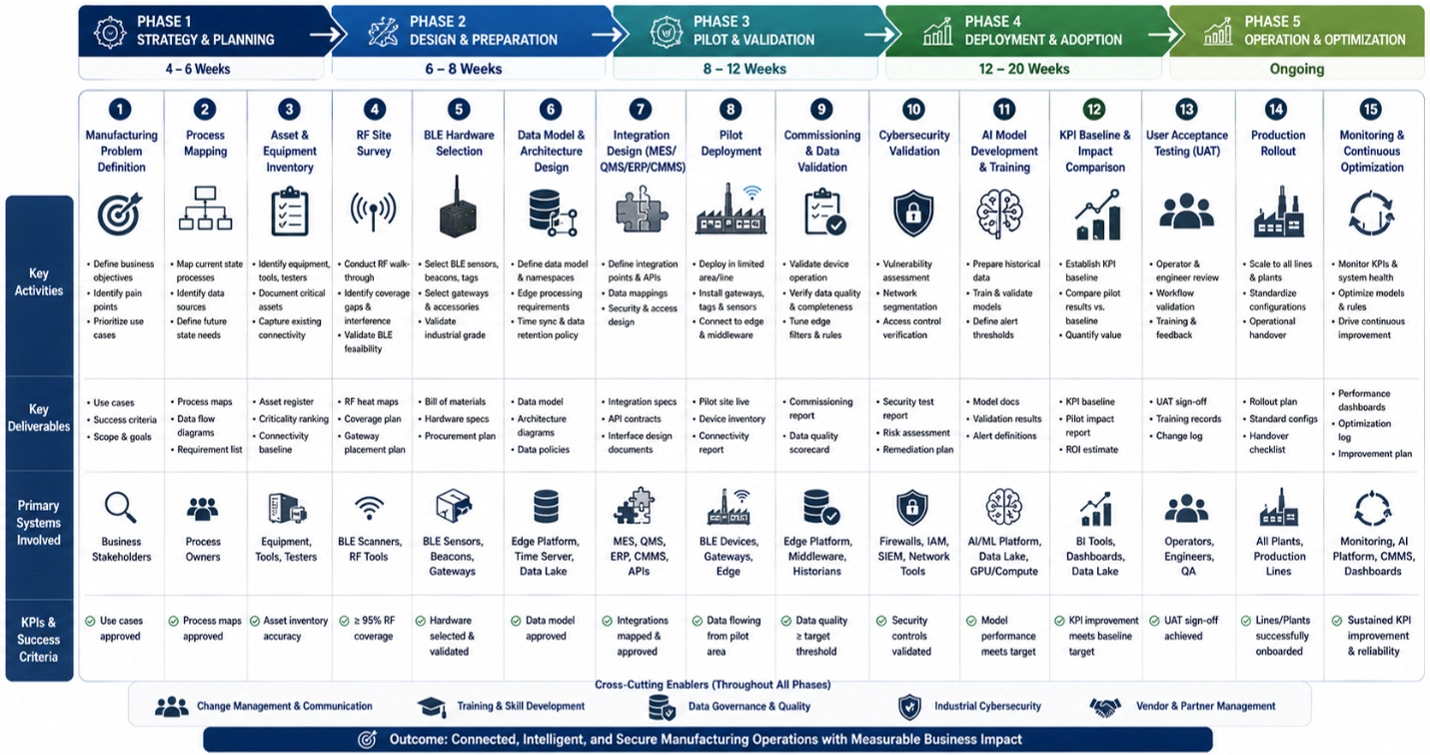
This five-phase implementation timeline maps the deployment of AI and BLE capabilities from strategy and planning through design, pilot validation, production rollout, and continuous optimization. It details 15 practical activities, including RF surveying, hardware selection, MES/QMS/ERP/CMMS integration, cybersecurity validation, AI model development, KPI benchmarking, UAT, and production scaling.
How GAO Supports Vehicle Connectivity Systems Manufacturing
GAO provides BLE, RFID, and IoT hardware products and systems that can be incorporated into manufacturing applications such as asset identification, condition monitoring, material tracking, equipment visibility, and connected operational workflows.
Headquartered in New York City and Toronto, Canada, GAO is ranked among the top 10 leading B2B and B2G BLE and RFID suppliers globally. Its related companies, GAO Research and GAO Tek, form GAO Group, with operations based in New York City and Toronto.
For three decades, GAO Group has served organizations across the United States and Canada, including Fortune 500 companies, leading research and development organizations, universities, and government agencies. Its experience includes substantial investment in research and development, stringent quality-assurance processes, and technical support delivered remotely or onsite.
For vehicle connectivity systems manufacturers, this background is relevant when selecting physical BLE and RFID equipment that must operate alongside existing production, quality, maintenance, inventory, and IT systems. The engineering objective is to select hardware and software according to the actual manufacturing workflow, environmental conditions, integration requirements, and measurable production objectives.
Key Takeaways for AI-Enabled Vehicle Connectivity Systems Manufacturing
AI-enabled manufacturing is most effective when artificial intelligence is connected to reliable production data and a clearly defined operational decision. For vehicle connectivity systems manufacturing, BLE beacons, sensors, and gateways can provide useful identification, proximity, movement, and condition data for selected manufacturing assets.
The strongest implementations combine these observations with MES, QMS, ERP, WMS, maintenance systems, equipment data, testing records, and computer vision. AI can then support predictive maintenance, anomaly detection, quality analysis, production optimization, asset utilization, and traceability.
Implementation should begin with a measurable manufacturing problem, establish a reliable data model, validate RF performance, integrate with authoritative systems, protect connected devices and data, and measure results against production KPIs.
GAO can provide BLE, RFID, and IoT hardware products and systems together with technical expertise to help organizations evaluate suitable approaches for connected vehicle electronics manufacturing. Readers planning an AIoT deployment can learn more about GAO’s relevant technologies, engineering support, and manufacturing-oriented solutions.
AI-Enabled Vehicle Connectivity Systems Manufacturing: End-to-End Intelligent Manufacturing Architecture
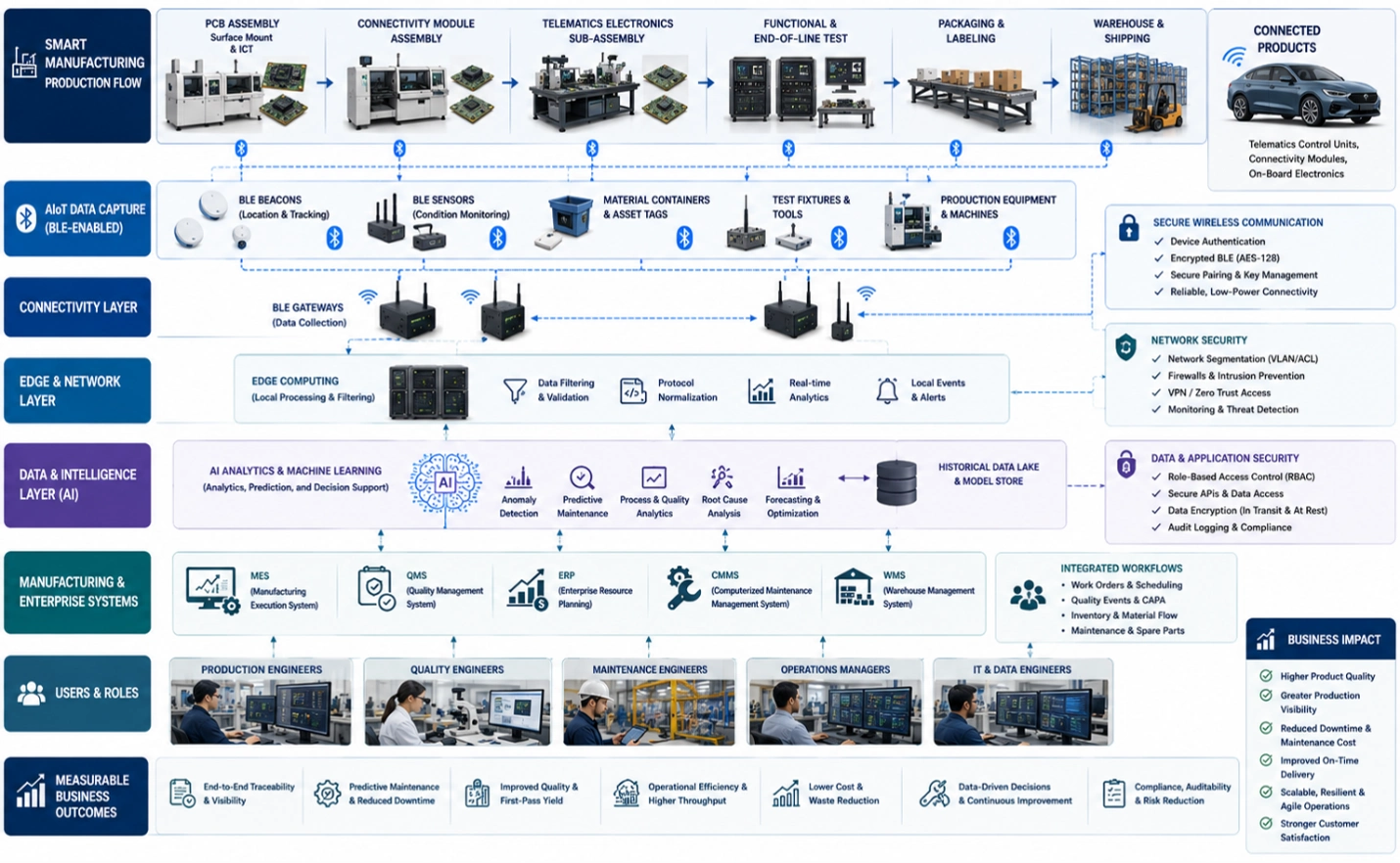
This enterprise illustration maps the complete manufacturing ecosystem from PCB assembly, connectivity modules, telematics electronics, functional testing, packaging, and warehousing to BLE-enabled data capture and connected products. It shows BLE gateways, edge computing, AI analytics, MES/QMS/ERP/CMMS/WMS integration, engineering users, security controls, and measurable outcomes including traceability, predictive maintenance, improved quality, greater visibility, and reduced downtime.
Building the Future of Industrial AI and IoT with Aperture Venture Studio and GAO RFID Inc.
For more than three decades, GAO Group of Companies has invested heavily in R&D for industrial BLE, RFID, and IoT. As generative AI became useful for industrial applications, we expanded our work in AIoT, including BLE and RFID technologies, and founded Aperture Venture Studio to support the development and scaling of AI and IoT solutions relevant to areas such as vehicle connectivity systems manufacturing.
Aperture brings together AI and IoT technical experts, operational leaders, investors, and technology companies. Through initiatives such as the Aperture Ventures Summit and TekSummit, we also support discussion of advanced AI and IoT applications. We welcome professionals to engage with us as advisors, co-founders or employees, investors, or customers.