
AI and BLE for Waste Collection
AI-Powered Waste Collection Using BLE-Enabled Intelligent Monitoring
Municipal and commercial waste collection is evolving from schedule-based operations toward intelligent, data-driven collection systems that continuously monitor waste containers, vehicles, personnel, and field activities. Artificial Intelligence (AI), supported by Bluetooth Low Energy (BLE) gateways, BLE beacons, and BLE sensors, enables waste collection organizations to improve service reliability, optimize fleet utilization, reduce fuel consumption, minimize overflow incidents, and enhance workforce safety.
Within waste collection operations, BLE provides highly efficient short-range sensing and location awareness while AI converts collected operational data into predictive insights and automated recommendations. Together, these technologies support dynamic route planning, container utilization analysis, predictive maintenance, contamination detection, workforce productivity monitoring, and service-level optimization.
Waste collection organizations increasingly require real-time operational visibility across thousands of distributed assets including dumpsters, roll-off containers, compactors, recycling bins, transfer stations, collection trucks, maintenance equipment, and mobile workforces. AI supported by BLE sensing enables these assets to become continuously monitored operational resources rather than isolated physical equipment.
GAO has helped organizations deploy BLE-based sensing hardware and intelligent IoT systems that improve operational visibility across environmental operations. Headquartered in New York City and Toronto, GAO has spent more than three decades supplying industrial BLE, RFID, and IoT technologies to organizations throughout the United States and Canada, including Fortune 500 companies, government agencies, universities, and research institutions.
AI-Enabled BLE Smart Waste Collection System with Real-Time Monitoring and Route Optimization
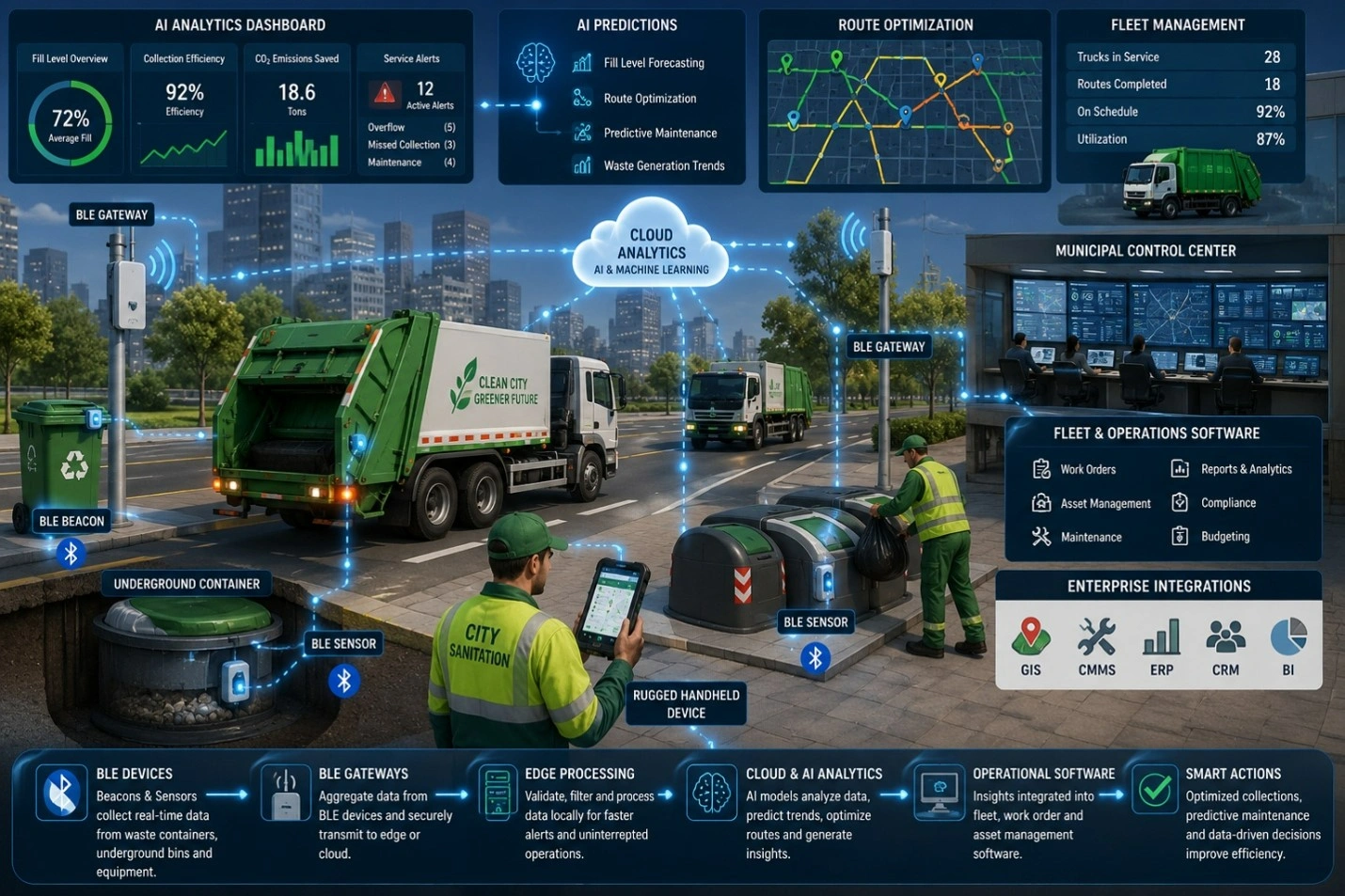
This hero illustration depicts a modern AI-enabled BLE waste collection solution for municipal environmental operations. BLE beacons, BLE sensors, and BLE gateways collect real-time data from waste containers, collection vehicles, and field personnel, while AI analytics optimize collection routes, predict fill levels, monitor fleet performance, and integrate with municipal management software. The visual highlights the end-to-end flow of operational data from field devices to intelligent decision-making, improving efficiency, sustainability, and service quality.
Understanding AI-Powered BLE Waste Collection Systems
Waste collection consists of multiple interconnected operational processes including waste generation, bin monitoring, collection scheduling, fleet dispatching, route execution, transfer station operations, recycling processing, maintenance activities, and regulatory reporting.
Historically, many collection schedules have been based on fixed routes rather than actual container fill levels or service demand. This often results in:
- Partially empty bins being serviced unnecessarily.
- Overflowing containers remaining unattended.
- Inefficient vehicle routing.
- Excessive fuel consumption.
- Increased greenhouse gas emissions.
- Higher vehicle wear.
- Poor labor utilization.
- Limited operational visibility.
BLE technology addresses the field-level sensing challenge by enabling compact, battery-efficient wireless devices to identify, monitor, and communicate the status of waste collection assets. AI extends these capabilities by continuously learning operational patterns and recommending optimal collection actions.
Rather than merely displaying sensor readings, AI evaluates multiple operational variables simultaneously, including:
- Container fill trends.
- Waste generation patterns.
- Seasonal demand fluctuations.
- Weather forecasts.
- Traffic congestion.
- Fleet availability.
- Driver schedules.
- Vehicle capacity.
- Maintenance requirements.
- Municipal service-level agreements.
- Recycling contamination risks.
The resulting system supports operational decision-making based on actual conditions instead of static schedules.
Why AI is Transforming Waste Collection Operations
Waste collection organizations manage geographically dispersed assets operating under strict cost, environmental, and public health requirements. AI enables these organizations to move beyond reactive waste collection by continuously analyzing operational data and identifying opportunities for optimization.
Key transformation areas include:
- Dynamic collection scheduling.
- Overflow prevention.
- Fleet optimization.
- Recycling quality improvement.
- Fuel reduction.
- Driver productivity.
- Predictive maintenance.
- Environmental compliance.
- Citizen service improvement.
- Carbon emission reduction.
BLE contributes by supplying highly granular location, proximity, occupancy, environmental, and equipment status information that AI continuously analyzes.
Waste Collection Applications Best Suited for BLE-Enabled AI
BLE technology is particularly effective across distributed municipal environments where assets require low-power wireless monitoring.
Smart Waste Bin Monitoring
BLE sensors monitor:
- Fill level
- Internal temperature
- Lid status
- Vibration
- Tilt
- Unauthorized movement
- Fire risk
- Battery health
AI predicts collection timing based on historical filling behavior.
Commercial Dumpster Monitoring
Commercial facilities often generate irregular waste volumes.
BLE-enabled dumpsters provide continuous utilization data that AI uses to recommend optimized collection frequencies.
Recycling Container Intelligence
BLE sensors help monitor recycling bins for:
- Fill percentage
- Collection frequency
- Contamination indicators
- Overflow risk
AI identifies neighborhoods requiring educational outreach due to repeated contamination trends.
Collection Vehicle Monitoring
BLE beacons installed throughout refuse trucks identify:
- Hydraulic system activity
- Lift cycles
- Hopper utilization
- Engine operating hours
- Compactor usage
- Driver presence
- Equipment status
AI correlates operational performance with maintenance history.
Workforce Safety Monitoring
BLE wearable beacons improve worker safety by monitoring:
- Worker location
- Lone worker status
- Restricted area entry
- Emergency alerts
- Proximity to heavy equipment
AI identifies hazardous operational behaviors before incidents occur.
Transfer Station Operations
BLE sensors improve visibility into:
- Queue lengths
- Equipment utilization
- Container availability
- Material flow
- Processing delays
AI predicts congestion before operational bottlenecks occur.
AI-Enabled BLE Applications for Smart Waste Collection and Municipal Operations
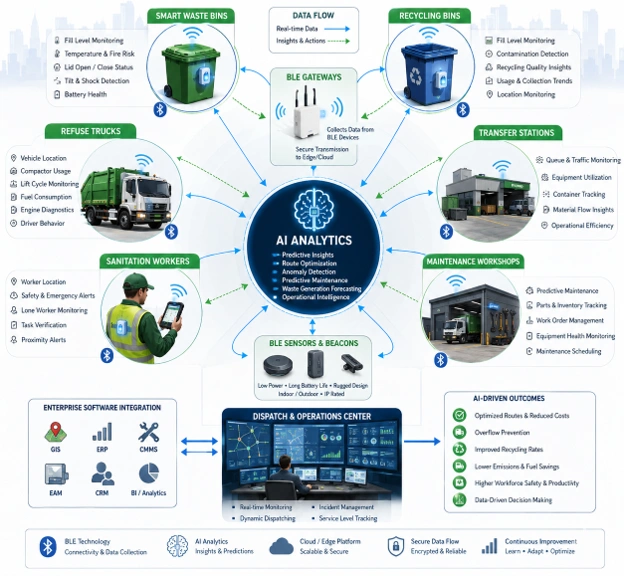
This application infographic illustrates how AI analytics serves as the intelligence hub for a BLE-enabled waste collection system. It shows real-time data flowing between smart waste bins, recycling bins, refuse trucks, transfer stations, sanitation workers, BLE gateways, BLE sensors, and enterprise software to support predictive maintenance, route optimization, asset monitoring, and operational decision-making. The visual demonstrates how AI transforms BLE sensor data into actionable insights that improve collection efficiency, sustainability, workforce safety, and municipal service performance.
Operational Challenges Solved by AI-Driven BLE Waste Collection
Environmental operations teams routinely encounter operational challenges that reduce collection efficiency and increase operating costs.
Common challenges include:
- Overflowing containers.
- Inefficient fixed collection schedules.
- Low fleet utilization.
- Fuel waste.
- Driver overtime.
- Equipment failures.
- Illegal dumping.
- Recycling contamination.
- Limited visibility across distributed assets.
- Manual inspections.
- Poor asset utilization.
- Vehicle breakdowns.
- Missed service-level targets.
- Rising labor costs.
- Carbon reduction initiatives.
- Regulatory reporting complexity.
AI continuously analyzes BLE-generated operational information to prioritize corrective actions before these issues escalate into service disruptions.
End-to-End Operational Workflow for AI-Enabled BLE Waste Collection
An intelligent waste collection solution consists of multiple coordinated operational stages.
Asset Identification
BLE beacons uniquely identify:
- Waste containers
- Roll-off bins
- Recycling stations
- Collection vehicles
- Portable compactors
- Maintenance equipment
- Personnel assets
Each asset maintains a persistent digital identity.
Data Acquisition
BLE sensors continuously capture:
- Fill level
- Temperature
- Humidity
- Motion
- Tilt
- Shock
- Door events
- Battery status
- Location proximity
Measurements occur according to configurable advertising intervals that balance responsiveness with battery life.
Local BLE Communication
BLE advertising packets are received by:
- BLE gateways
- Vehicle-mounted gateways
- Mobile tablets
- Driver smartphones
- Industrial handheld terminals
Edge software filters duplicate advertisements and validates device health before forwarding operational data.
Edge Processing
Edge servers perform:
- Device authentication.
- Sensor validation.
- Event filtering.
- Temporary buffering.
- Threshold detection.
- Local alert generation.
Critical events such as fire detection or illegal container movement can generate immediate notifications without requiring cloud connectivity.
Enterprise Data Integration
Validated operational information integrates with:
- Fleet management software.
- Computerized Maintenance Management Systems (CMMS).
- Enterprise Asset Management (EAM).
- Geographic Information Systems (GIS).
- Route optimization software.
- Municipal ERP systems.
- Customer service systems.
- Environmental reporting software.
This integration enables AI models to correlate field observations with operational and business records.
AI-Enabled BLE Waste Collection Workflow from Smart Sensing to Intelligent Municipal Operations
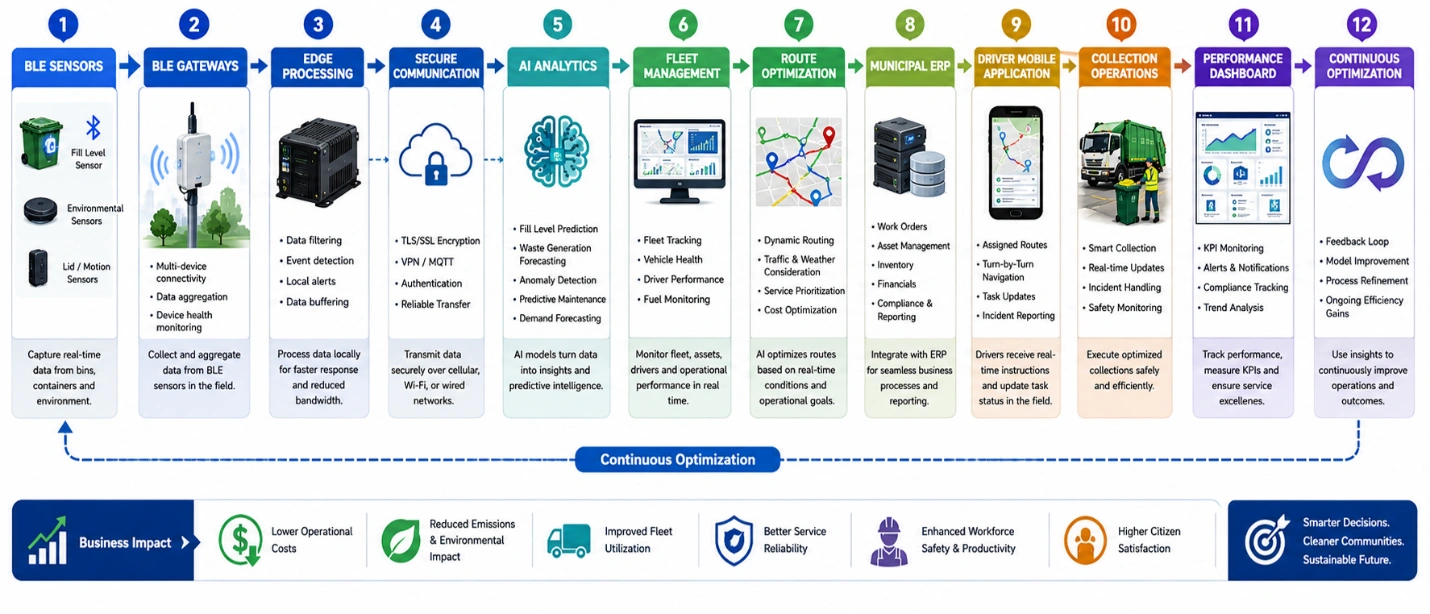
This workflow diagram illustrates the complete AI-enabled BLE waste collection process, beginning with BLE sensors that capture real-time operational data and continuing through BLE gateways, edge processing, secure communications, AI analytics, fleet management, route optimization, municipal ERP integration, driver mobile applications, and collection operations. It concludes with performance dashboards and continuous optimization, demonstrating how operational data is transformed into actionable insights that improve efficiency, sustainability, asset utilization, and municipal service delivery.
Technical Components Supporting AI-Powered Waste Collection
Successful intelligent waste collection systems combine BLE hardware, AI software, communications infrastructure, enterprise software integration, cybersecurity controls, and scalable deployment models. Each component performs a distinct operational role to ensure accurate sensing, reliable communications, and actionable intelligence.
BLE Hardware Components
BLE hardware forms the sensing layer of the waste collection solution.
BLE Beacons
BLE beacons provide unique identifiers for waste bins, recycling containers, roll-off dumpsters, compactors, transfer station equipment, vehicle assets, and mobile workforce resources. Their ultra-low power operation enables multi-year battery life, making them suitable for outdoor municipal deployments with minimal maintenance. Beacons support proximity detection, asset identification, and location-aware workflows used by AI models to analyze collection patterns and asset utilization.
BLE Sensors
BLE sensors extend asset intelligence by measuring operational conditions including fill level, internal temperature, humidity, vibration, tilt, shock, lid status, and battery health. Ruggedized sensor designs with IP-rated enclosures withstand harsh outdoor environments, moisture, dust, and vibration commonly encountered in waste collection operations. AI models use these measurements to forecast fill rates, detect abnormal conditions such as fire risk or unauthorized movement, and prioritize collection activities based on real-time operational status.
AI-Enabled BLE Waste Collection System Block Diagram for Smart Municipal Operations
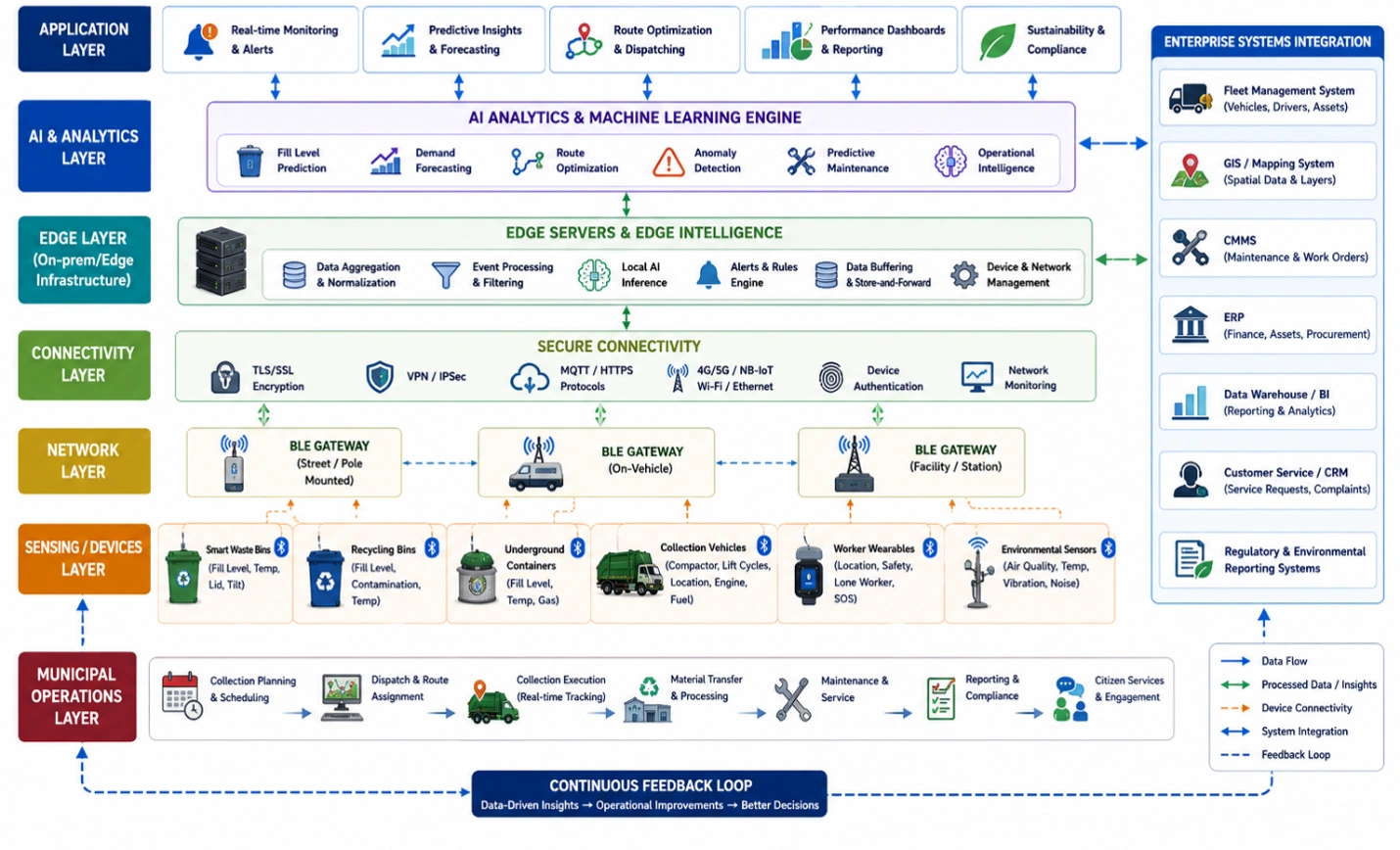
This layered block diagram illustrates the technical components of an AI-enabled BLE waste collection system, showing how BLE beacons and sensors communicate with BLE gateways, edge servers, and AI analytics to generate actionable operational insights. The diagram also demonstrates integration with fleet management, GIS, CMMS, ERP, and municipal dashboards through secure data flows and continuous feedback loops. It highlights how real-time monitoring, predictive analytics, and enterprise software integration improve collection efficiency, asset management, maintenance planning, and municipal decision-making.
BLE Gateways
BLE gateways aggregate wireless data from hundreds or thousands of nearby BLE devices and securely forward validated information to edge servers or cloud-hosted software. Depending on deployment requirements, gateways may be mounted on collection vehicles, transfer stations, recycling facilities, utility poles, streetlights, municipal buildings, or fixed infrastructure located throughout collection districts.
Key gateway capabilities include:
- Continuous BLE scanning
- Device authentication
- Data filtering
- Time synchronization
- Local buffering during communication outages
- Secure data forwarding
- Remote firmware updates
- Device health monitoring
Vehicle-mounted BLE gateways provide additional operational value by collecting sensor information while refuse trucks travel their routes, reducing the need for dedicated communication infrastructure.
Artificial Intelligence Software
Artificial intelligence transforms operational sensor data into actionable recommendations rather than simply displaying measurements.
Common AI methods include:
- Machine learning regression models for fill-level forecasting
- Time-series forecasting for waste generation prediction
- Clustering algorithms for neighborhood waste behavior analysis
- Reinforcement learning for adaptive route optimization
- Computer vision for contamination detection where cameras are deployed
- Predictive maintenance models for hydraulic equipment
- Anomaly detection for illegal dumping
- Classification models for service prioritization
- Optimization algorithms for vehicle scheduling
- Generative AI assistants for operational reporting and maintenance guidance
Rather than relying on predefined thresholds alone, AI continuously learns changing waste generation patterns influenced by weather, holidays, special events, commercial activity, tourism, construction projects, and seasonal population changes.
Edge Computing Software
Edge computing software processes operational information close to the point of collection, reducing communication latency while improving resilience.
Typical edge processing functions include:
- Sensor validation
- Event correlation
- Duplicate removal
- Local alert generation
- Device diagnostics
- Temporary data storage
- Network health monitoring
- AI inference for urgent operational events
Edge processing is especially valuable when cellular connectivity is intermittent or when municipalities require immediate responses to overflowing containers, fire hazards, or unauthorized container movement.
Cloud Version
Cloud-hosted deployment centralizes operational software within managed cloud infrastructure.
Typical characteristics include:
- Centralized AI model management
- Multi-region scalability
- Automatic software updates
- Centralized reporting
- Disaster recovery
- Secure API integration
- Multi-municipality management
- Long-term historical analytics
Cloud deployments are particularly appropriate for:
- National waste management companies
- Municipal service providers operating multiple cities
- Commercial waste operators
- Regional recycling organizations
- Organizations requiring centralized operational oversight
Cloud software also simplifies integration with external mapping services, weather forecasting providers, and enterprise reporting systems.
Server Version
Server deployments place software on customer-managed infrastructure such as private data centers, municipal IT facilities, regional operations centers, or edge servers.
Typical advantages include:
- Full control over operational data
- Local cybersecurity governance
- Compliance with municipal data residency requirements
- Reduced external connectivity dependence
- Custom integration with legacy operational systems
- Lower latency for local decision making
Server deployments are commonly selected by municipalities, government agencies, defense installations, airports, ports, and organizations operating under strict cybersecurity or regulatory requirements.
Enterprise Software Integration
Operational intelligence becomes significantly more valuable when integrated with existing business software.
Typical integrations include:
- Enterprise Resource Planning (ERP)
- Enterprise Asset Management (EAM)
- Computerized Maintenance Management Systems (CMMS)
- Geographic Information Systems (GIS)
- Fleet Management Systems
- Vehicle Telematics Software
- Dispatch Software
- Customer Relationship Management (CRM)
- Environmental Reporting Systems
- Business Intelligence Software
- Data Warehouses
- Financial Management Systems
These integrations enable AI to correlate operational events with work orders, maintenance history, fuel consumption, labor costs, customer complaints, recycling performance, and financial metrics.
GAO regularly supplies BLE hardware that integrates with existing municipal software environments, helping organizations extend the value of their existing operational investments instead of replacing proven systems.
Communication Technologies
BLE operates as the local sensing technology while complementary communication technologies transport operational data across larger geographic areas.
Frequently used communication technologies include:
- Ethernet
- Wi-Fi
- Cellular LTE
- 5G
- NB-IoT
- LTE-M
- Fiber optic networks
- VPN connections
- MQTT
- HTTPS
- REST APIs
- OPC UA where industrial processing equipment is involved
Protocol selection depends upon municipal infrastructure, communication costs, latency requirements, and operational resilience objectives.
Security Mechanisms
Waste collection systems increasingly form part of municipal critical infrastructure, making cybersecurity an essential engineering consideration.
Recommended security measures include:
- BLE Secure Connections
- Device identity management
- Mutual authentication
- TLS encryption
- Certificate management
- Secure boot
- Firmware signing
- Role-based access control
- Multi-factor authentication
- API authentication
- Continuous vulnerability assessment
- Security logging
- SIEM integration
- Network segmentation
- Zero Trust security principles
Security planning should begin during solution design rather than after deployment to reduce operational and regulatory risks.
Technical Capabilities and Business Value of AI-Driven BLE Waste Collection
Combining AI with BLE technology provides measurable improvements across operational efficiency, environmental performance, workforce productivity, and service quality.
Dynamic Route Optimization
AI continuously evaluates:
- Container fill levels
- Vehicle capacities
- Driver availability
- Road congestion
- Weather conditions
- Service priorities
Collection routes are recalculated to reduce unnecessary trips while preventing container overflows.
Predictive Collection Scheduling
Historical waste generation patterns enable AI to forecast future collection demand.
Benefits include:
- Fewer unnecessary pickups
- Reduced fleet mileage
- Improved labor planning
- Better vehicle utilization
- Reduced operating expenses
Predictive Maintenance
BLE sensors monitoring refuse trucks and compactors identify abnormal vibration, temperature changes, excessive operating hours, and unusual hydraulic behavior.
AI predicts equipment failures before breakdowns occur, reducing emergency repairs and increasing fleet availability.
Asset Utilization Analysis
BLE beacons allow municipalities to understand how frequently containers, compactors, recycling assets, and specialty equipment are actually used.
AI identifies:
- Underutilized assets
- Overloaded locations
- Relocation opportunities
- Seasonal demand changes
Recycling Quality Improvement
AI combines sensor information with inspection data to identify contamination trends.
Operational teams can target specific neighborhoods, commercial districts, or facilities where contamination repeatedly exceeds acceptable thresholds.
Environmental Sustainability
Optimized routing and collection scheduling contribute to:
- Lower diesel consumption
- Reduced greenhouse gas emissions
- Lower vehicle idle time
- Reduced maintenance emissions
- Improved recycling efficiency
- Better resource utilization
These improvements support municipal sustainability initiatives and environmental reporting requirements.
Workforce Safety
BLE-enabled wearable devices improve worker protection through:
- Emergency alerts
- Geofencing
- Proximity awareness
- Lone worker monitoring
- Restricted area notifications
AI analyzes incident trends to recommend procedural improvements and targeted safety training.
Operational Visibility
Managers gain real-time insight into:
- Vehicle status
- Collection progress
- Container conditions
- Driver productivity
- Equipment availability
- Route completion
- Maintenance schedules
- Service-level performance
These insights enable faster operational decisions and more accurate planning.
Engineering Considerations and Deployment Best Practices
Successful deployments require careful engineering planning beyond device installation.
Recommended practices include:
- Perform RF site surveys before gateway installation.
- Select industrial-grade BLE hardware with appropriate IP ratings.
- Optimize beacon advertising intervals to balance responsiveness and battery life.
- Validate sensor calibration before production deployment.
- Design for redundant communication paths where service continuity is critical.
- Implement staged pilot deployments before city-wide rollout.
- Monitor battery health and firmware versions remotely.
- Integrate AI recommendations into dispatcher workflows instead of creating isolated dashboards.
- Define measurable KPIs before deployment.
- Conduct periodic cybersecurity assessments and penetration testing.
- Establish preventive maintenance schedules for gateways and sensors.
- Develop governance policies for AI model validation and retraining.
AI-Enabled BLE Waste Collection Implementation Roadmap for Smart Municipal Operations
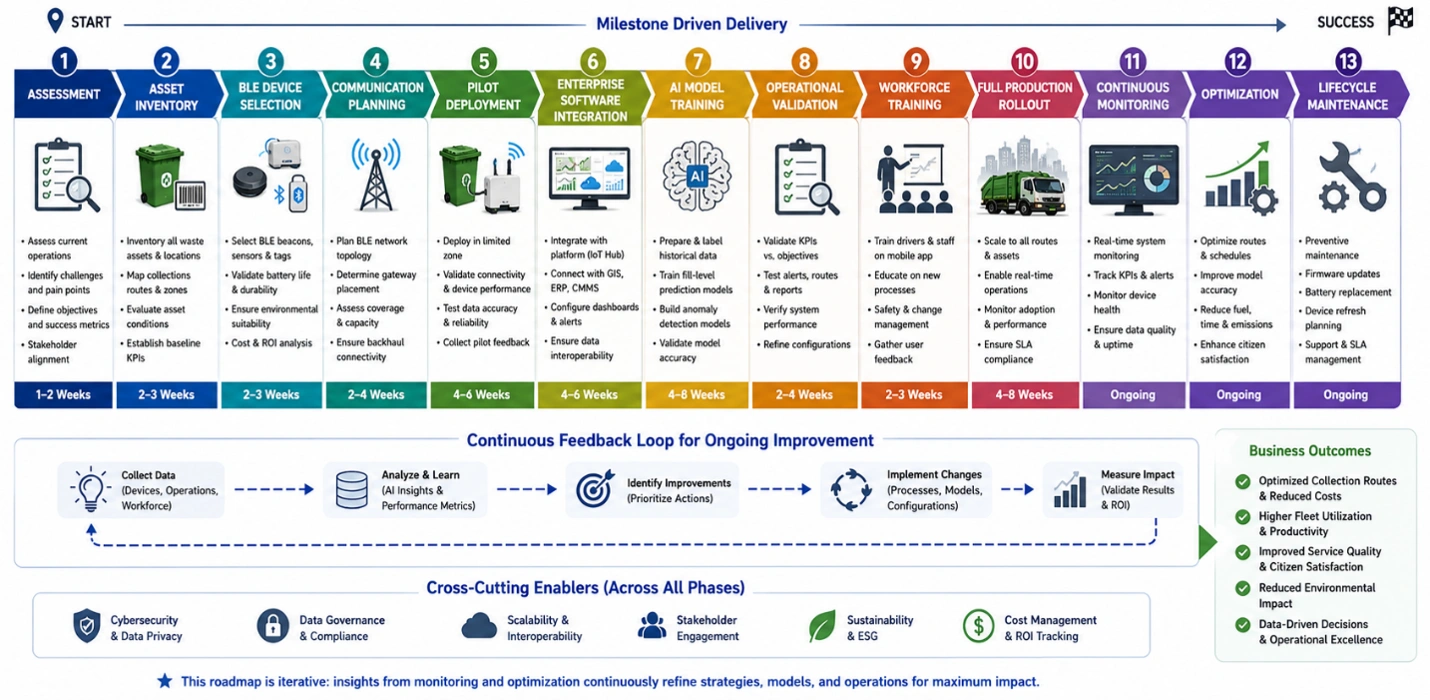
This implementation roadmap illustrates the complete deployment lifecycle of an AI-enabled BLE waste collection solution, from initial assessment and asset inventory through BLE device selection, communication planning, pilot deployment, enterprise software integration, AI model training, operational validation, workforce training, and full production rollout. It also highlights continuous monitoring, optimization, and lifecycle maintenance supported by feedback loops to ensure long-term operational efficiency, system reliability, and continuous improvement across municipal waste collection operations.
Advancing Intelligent Waste Collection with BLE and AI
AI-enabled waste collection supported by BLE gateways, BLE beacons, and BLE sensors allows environmental operations organizations to replace static collection schedules with intelligent, data-driven decision making. Continuous sensing, predictive analytics, optimized routing, proactive maintenance, and integrated operational intelligence improve service reliability while reducing operational costs and environmental impact.
Successful implementations require thoughtful hardware selection, reliable communication infrastructure, secure system design, software integration, AI governance, and long-term operational planning. Organizations that invest in these capabilities gain greater visibility into assets, vehicles, personnel, and collection performance while improving sustainability, regulatory compliance, and customer satisfaction.
For more than three decades, GAO has supplied BLE, RFID, and industrial IoT hardware and systems that support demanding municipal and commercial applications. Ranked among the world’s leading B2B and B2G suppliers of BLE and RFID technologies, with headquarters in New York City and Toronto, GAO combines extensive research and development, stringent quality assurance, and expert remote and onsite technical support to help organizations deploy reliable intelligent sensing solutions.
Building the Future of Industrial AI and IoT with Aperture Venture Studio and GAO RFID Inc.
For more than three decades, GAO Group of Companies has invested extensively in research and development for industrial BLE, RFID, and IoT technologies. As generative AI has matured into a practical tool for environmental operations, we have expanded our work in AI-enabled BLE and IoT solutions for applications such as intelligent waste collection, asset monitoring, and operational optimization. To accelerate innovation in these areas, we founded Aperture Venture Studio to help develop and grow advanced AI and IoT solutions that address real-world operational challenges across multiple industries.
Aperture has attracted leading AI and IoT technical experts, experienced operational executives, respected investors, and prominent technology organizations. We have also established the successful Aperture Ventures Summit and TekSummit to foster collaboration and knowledge sharing on advanced AI and IoT topics. These initiatives have helped create diverse technical communities focused on industrial innovation.