
AI and BLE for Wastewater Operations
AI-Driven Wastewater Operations with BLE and IoT
AI-enabled wastewater operations combine artificial intelligence with connected equipment, sensors, BLE beacons, BLE gateways, and operational software to improve how treatment facilities monitor assets, detect abnormal conditions, manage maintenance, and analyze plant performance. For wastewater utilities, the practical value comes from connecting field information such as pump condition, motor vibration, equipment temperature, chemical-system status, worker or asset location, and inspection observations with AI-based analysis.
BLE provides a practical short-range connectivity layer for selected sensors, beacons, and mobile assets, while gateways collect and forward field data to edge computers, local servers, or cloud systems. AI can then identify abnormal operating patterns, support predictive maintenance, analyze inspection information, and provide decision support for wastewater operators and maintenance teams.
For wastewater treatment plants, lift stations, pumping stations, collection-system facilities, and related utility assets, this approach can improve visibility into distributed equipment while supporting maintenance planning, operational reliability, regulatory recordkeeping, and resource management.
AI-Driven Wastewater Operations and Asset Management
Wastewater facilities operate continuously across processes such as influent pumping, screening, grit removal, primary treatment, biological treatment, clarification, filtration, disinfection, sludge handling, aeration, chemical dosing, and effluent monitoring. These processes depend on pumps, blowers, motors, valves, mixers, compressors, chemical-feed equipment, instrumentation, and electrical systems.
Failures in critical equipment can interrupt treatment processes and increase maintenance requirements. AI can help wastewater utilities analyze operational information before these problems become major failures.
GAO provides BLE, RFID, and IoT hardware products and systems that can support connected monitoring and asset-identification requirements. The appropriate combination depends on the wastewater facility’s physical environment, equipment types, data requirements, network availability, and existing control systems.
AI Applications for Wastewater Treatment and Collection Systems
AI applications should be selected around specific operational problems rather than deployed simply to collect additional data.
Predictive Maintenance for Pumps and Motors
Pumps and motors are among the most important mechanical assets in wastewater operations. Submersible pumps, influent pumps, lift-station pumps, return activated sludge pumps, waste activated sludge pumps, and sludge-transfer pumps can experience mechanical or electrical problems that affect plant operation.
Vibration, temperature, motor current, pressure, runtime, and operating-state information can provide useful indicators of equipment condition. AI models can establish normal operating patterns and identify deviations that warrant maintenance inspection.
A practical workflow can be:
- Pump or motor operating data is collected from sensors and existing control systems.
- BLE sensors can provide supplementary condition information where suitable.
- A BLE gateway aggregates nearby sensor data.
- An edge computer or server processes time-series information.
- An AI model identifies abnormal operating behavior.
- The system generates a maintenance alert or recommendation.
- Maintenance personnel inspect the equipment.
- Confirmed findings are recorded in the maintenance system.
This approach does not eliminate the need for engineering inspection. Instead, it helps maintenance teams prioritize equipment that requires attention.
AI-Based Equipment Anomaly Detection
Wastewater equipment frequently operates under changing hydraulic and process conditions. A pump drawing different current at different flow rates, for example, should not automatically be treated as faulty.
AI anomaly detection can therefore consider multiple variables together rather than relying on a single fixed threshold. Pump current, discharge pressure, vibration, temperature, flow, runtime, and operating state can be analyzed as a combined pattern.
This can help distinguish normal process variation from potentially abnormal equipment behavior.
AI for Aeration and Blower Operations
Aeration systems can represent a significant portion of energy consumption at biological wastewater treatment facilities. Blowers, aeration equipment, dissolved oxygen instrumentation, valves, and related controls must work together to maintain appropriate biological treatment conditions.
AI analytics can evaluate relationships among dissolved oxygen, airflow, blower operation, process conditions, and historical performance. Operators can use the resulting analysis to investigate inefficient operating conditions and support process optimization.
BLE sensors may supplement existing instrumentation for selected equipment-condition measurements, but process-critical measurements should continue to use appropriately specified industrial instrumentation and control systems.
AI-Based Inspection and Condition Monitoring
Wastewater facilities contain equipment that requires regular visual inspection, including pumps, motors, electrical cabinets, valves, chemical systems, pipes, tanks, screens, conveyors, and sludge-handling equipment.
Computer vision can analyze inspection images for selected visual conditions, while AI can combine image results with equipment history and sensor information.
For example, an inspection system could associate an observed equipment condition with:
- Equipment identification
- Location
- Inspection date and time
- Previous maintenance activity
- Sensor measurements
- Operating hours
- Previous inspection results
This creates a more useful maintenance history than an isolated image or manual note.
AI for Chemical and Process Monitoring
Chemical dosing systems can involve pumps, storage tanks, valves, flow instrumentation, level sensors, and chemical-feed equipment. AI can analyze dosing behavior together with process measurements to identify unusual consumption patterns or operating conditions.
Such systems should be designed with appropriate engineering controls because chemical handling and treatment-process decisions can have safety and regulatory implications. AI-generated recommendations should be validated against established process-control requirements.
BLE-Enabled Monitoring Across Wastewater Facilities
BLE is particularly useful where low-power wireless sensing or identification is appropriate and where short-range communication can be reliably maintained.
BLE beacons can identify equipment, tools, containers, inspection points, or other tagged assets. BLE sensors can collect selected condition measurements, while BLE gateways receive information from nearby devices and transfer it into the wastewater facility’s wider data environment.
Potential applications include:
- Monitoring vibration on selected pump and motor assemblies
- Recording temperature around mechanical equipment
- Tracking maintenance tools and mobile equipment
- Identifying assets during inspection rounds
- Monitoring selected storage or environmental conditions
- Associating inspection activity with specific equipment
- Providing location information for tagged utility assets
Wastewater facilities require careful BLE deployment because concrete structures, metal equipment, tanks, pipes, electrical equipment, wet environments, and underground areas can affect radio propagation. Gateway placement should therefore be based on an actual site survey rather than theoretical coverage alone.
Wastewater Operations Data Flow from Sensors to AI Decisions
A complete solution should connect field equipment with the systems already used by wastewater operators and maintenance teams.
The operational data flow can be represented as:
Field Equipment → Sensors and Existing Instrumentation → BLE Gateway → Edge Processing → Local Server or Cloud → Data Processing → AI Models → Operational System → Human or Automated Action
Field data can originate from pumps, motors, blowers, compressors, valves, chemical systems, flow meters, level instruments, vibration sensors, temperature sensors, and inspection equipment.
BLE gateways can collect data from compatible BLE sensors and beacons. The gateway can then communicate with an edge computer or local network using appropriate industrial or enterprise networking methods.
At the edge, data can be filtered, validated, timestamped, buffered, and prepared for further processing. This is useful when connectivity to a central server is intermittent or when rapid local processing is required.
AI processing can then include anomaly detection, predictive maintenance, classification, forecasting, condition assessment, and operational analytics.
The final output should be an actionable event rather than simply another data record. Examples include a maintenance work request, inspection priority, equipment-condition alert, abnormal energy-use notification, production or treatment report, or engineering investigation.
Technical Components for AI-Enabled Wastewater Operations
A wastewater AI solution normally combines field sensing, BLE connectivity, computing infrastructure, AI software, databases, and integration with existing utility systems.
BLE Sensors and Beacons
BLE sensors can measure selected parameters such as temperature, vibration, humidity, or other supported equipment conditions. BLE beacons primarily provide identification or location-related information.
Sensor selection should consider measurement range, accuracy, battery life, enclosure requirements, environmental exposure, mounting method, communication range, and maintenance requirements.
For wastewater facilities, enclosure protection and installation location are particularly important because equipment may be exposed to moisture, condensation, washdown activity, corrosive atmospheres, and outdoor conditions.
Industrial IoT Gateways
BLE gateways receive wireless information from nearby BLE devices and transfer it into the facility’s data network.
A gateway can provide functions such as:
- BLE device communication
- Data aggregation
- Protocol conversion where supported
- Local buffering
- Device management
- Secure data transmission
Gateway placement should account for radio range, physical obstructions, electrical equipment, facility layout, and network availability.
Edge Computing
Edge computers can process wastewater equipment data close to its source. This can reduce unnecessary data transmission and support low-latency analysis.
Typical edge functions include data filtering, validation, local analytics, temporary storage, alert generation, and communication with local control or monitoring systems.
Edge processing is particularly useful at remote lift stations or facilities where network connectivity to a central data center may not always be available.
AI and Machine Learning Models
Different wastewater applications require different AI methods.
Possible approaches include:
- Time-series anomaly detection for pumps and motors
- Machine-learning models for equipment failure prediction
- Classification models for equipment-condition assessment
- Forecasting models for selected operational variables
- Computer vision for visual inspection
- Pattern recognition for energy and equipment performance analysis
Model selection should be based on the available data, failure history, operating conditions, required response time, and consequences of incorrect alerts.
Cloud and Server Deployment
A Cloud Version places data processing, storage, dashboards, and AI services within cloud-hosted infrastructure. This can be useful for wastewater utilities managing multiple geographically distributed treatment plants, pumping stations, and collection-system assets. Centralized analytics can make it easier to compare equipment performance across locations.
A Server Version places the required software on customer-managed edge servers, facility servers, private data centers, or other privately hosted infrastructure. This can be appropriate where utilities require greater direct control over operational data, have limited external connectivity, or need local processing for critical monitoring workflows.
A hybrid deployment can also combine local edge or server processing with centralized cloud analytics. For example, a lift station can continue collecting and processing equipment data locally while summarized information is transferred to a central utility system when connectivity is available.
Wastewater Operations Integration with Utility Software
AI and BLE data become more useful when connected to existing wastewater operational systems.
Common integration points include:
- SCADA for operational monitoring and control
- PLC systems for equipment control
- Historian databases for time-series process data
- CMMS for maintenance work orders
- EAM systems for asset lifecycle management
- GIS for spatial asset information
- WMS for relevant warehouse and spare-parts activities
- Laboratory information systems for laboratory results
- ERP systems for purchasing, resources, and financial information
- Quality and compliance systems for operational records
GAO’s connected hardware can form part of the data-collection layer, while integration with existing wastewater software should be designed according to the utility’s control, cybersecurity, interoperability, and data-governance requirements.
AI and BLE Wastewater Operations Workflow
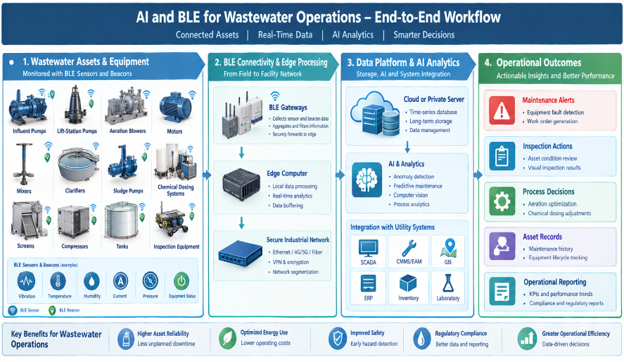
The completed workflow illustrates wastewater equipment connected through BLE sensors and gateways to edge processing, AI analytics, utility systems, and operational actions.
Operational Benefits of AI for Wastewater Operations
AI-enabled wastewater operations can provide value when analytics are connected to specific treatment, maintenance, asset-management, and compliance workflows. The objective is not simply to collect more information, but to convert field data into timely operational decisions.
Improved Pump and Motor Reliability
Predictive maintenance can help identify changes in vibration, temperature, current, pressure, and runtime before equipment develops a major fault. Maintenance teams can use these indicators to prioritize inspections and schedule work around operational requirements.
For lift stations and treatment plants, earlier identification of abnormal pump or motor behavior can help reduce unexpected service interruptions and improve maintenance planning.
Better Visibility Across Distributed Assets
Wastewater utilities may operate assets across treatment plants, lift stations, pumping stations, reservoirs, collection-system locations, and remote facilities. BLE beacons and connected sensors can provide additional identification and condition information for selected assets.
Combining this information with GIS, CMMS/EAM, and SCADA records can provide maintenance personnel with a more complete view of where equipment is located, what condition it is in, and what work has previously been performed.
Faster Detection of Abnormal Conditions
AI-based anomaly detection can continuously evaluate equipment and process information and identify patterns that differ from established operating behavior.
Examples include:
- Unusual pump vibration
- Increasing motor temperature
- Abnormal motor-current behavior
- Unexpected pressure changes
- Repeated equipment starts and stops
- Unusual blower operating patterns
- Abnormal chemical consumption
- Unexpected energy consumption
- Repeated alarms associated with the same asset
Alerts should be prioritized according to operational criticality so that maintenance teams are not overwhelmed by low-value notifications.
More Efficient Maintenance Planning
AI-generated condition information can be combined with equipment age, runtime, maintenance history, spare-parts availability, and asset criticality.
A CMMS or EAM system can then remain the system of record for maintenance activities while AI provides additional decision-support information.
This distinction is important because an AI alert should not automatically be treated as a confirmed equipment failure. A qualified maintenance or engineering process should validate the condition.
Better Process and Energy Analysis
AI can analyze historical operating information from pumps, blowers, aeration systems, motors, and other equipment to identify recurring performance patterns.
For example, wastewater engineers can compare equipment operation against flow conditions, operating schedules, energy consumption, and process measurements. This can help identify opportunities for investigation and optimization without replacing established process-control procedures.
Key KPIs for AI-Enabled Wastewater Operations
A wastewater AI and BLE deployment should have measurable performance indicators established before implementation. Useful KPIs include:
| KPI | Wastewater Operations Purpose |
|---|---|
| Pump Availability | Measures availability of critical pumping equipment |
| Equipment Availability | Measures operational readiness of monitored assets |
| MTBF | Measures average operating time between equipment failures |
| MTTR | Measures average time required to restore equipment |
| Unplanned Downtime | Measures unexpected equipment interruptions |
| Preventive Maintenance Compliance | Measures completion of scheduled maintenance |
| Predictive Alert Accuracy | Measures how often useful alerts correspond to verified conditions |
| False Alert Rate | Measures unnecessary maintenance or operational alerts |
| Pump Energy Consumption | Tracks energy used by pumping operations |
| Blower Energy Consumption | Tracks aeration-related energy use |
| Equipment Runtime | Measures operating hours for selected assets |
| Alarm Frequency | Tracks recurring equipment or process alarms |
| Sensor Availability | Measures availability of connected sensor data |
| BLE Gateway Availability | Measures reliability of gateway connectivity |
| Data Completeness | Measures the percentage of expected data successfully collected |
| Inspection Completion Rate | Measures completion of scheduled equipment inspections |
| Work-Order Response Time | Measures response to maintenance events |
| Spare-Part Availability | Measures availability of required maintenance components |
| Process Variable Stability | Tracks consistency of important treatment variables |
| Chemical Consumption | Tracks chemical usage against operational requirements |
| Sludge Handling Performance | Measures selected sludge-process indicators |
| Effluent Quality | Tracks applicable treatment-quality measurements |
| Compliance Event Frequency | Tracks operational events requiring investigation or reporting |
KPI definitions should match the utility’s existing reporting practices. AI-generated measurements should not replace regulatory measurements or legally required monitoring systems.
Cybersecurity and Data Governance for Wastewater Operations
Wastewater facilities contain operational technology that can include PLCs, SCADA systems, remote terminal units, industrial networks, historians, engineering workstations, and safety-related equipment. Connecting additional IoT devices therefore requires a deliberate cybersecurity approach.
BLE sensors should be isolated or controlled according to the utility’s network design. Gateways should use authenticated connections and appropriate access controls. Data moving from gateways to servers or cloud systems should use secure communication methods suitable for the deployment.
Important controls include:
- Unique device identification
- Strong authentication
- Role-based access control
- Network segmentation
- Encrypted communication
- Secure gateway configuration
- Controlled remote access
- Software and firmware update procedures
- Backup and recovery procedures
- Audit logging
- Asset inventories
- Security monitoring
- Incident-response procedures
Data Quality and Governance
AI models require consistent and trustworthy data. Wastewater facilities should therefore establish data-quality checks before relying on AI outputs.
Sensor data should be evaluated for:
- Missing measurements
- Incorrect timestamps
- Communication interruptions
- Sensor drift
- Calibration problems
- Duplicate records
- Unrealistic values
- Incorrect equipment identifiers
- Gaps caused by gateway outages
Data should also retain sufficient context to identify the equipment, location, timestamp, measurement unit, operating state, and source device.
GAO’s connected hardware can support field-level data collection, while the utility remains responsible for defining its data governance, cybersecurity, retention, and operational policies.
Integration with Wastewater Management Software
AI and BLE systems should integrate with existing operational software rather than creating isolated data repositories.
SCADA and PLC Integration
SCADA systems provide operators with real-time information about pumps, valves, levels, flows, alarms, and treatment processes. PLCs execute programmed control functions.
BLE condition-monitoring data can supplement these systems where existing instrumentation does not provide the required information. Critical control functions should continue to use appropriately engineered control systems.
CMMS and EAM Integration
CMMS and EAM systems manage maintenance activities and asset histories. AI alerts can provide additional information for maintenance prioritization.
A typical workflow is:
AI Alert → Asset Identification → Maintenance Review → Physical Inspection → Work Order → Repair → Verification → Maintenance Record
This creates a feedback loop that can also provide historical data for future predictive-maintenance models.
GIS Integration
GIS can associate wastewater assets with geographic locations. This is especially useful for distributed lift stations, pipelines, pumping stations, treatment facilities, and remote equipment.
Combining GIS asset information with BLE identification and maintenance data can help field personnel locate and verify assets during inspection and service activities.
ERP, Inventory, and Laboratory Systems
ERP systems can provide purchasing and resource information, while inventory systems can track spare parts and operational materials. Laboratory systems can contain water-quality and treatment-related measurements.
Connecting relevant information can allow AI analytics to consider equipment condition alongside operational and resource requirements.
Deployment Lifecycle for Wastewater AI
A structured deployment process reduces technical and operational risks.
Planning and Site Assessment
Start by identifying a measurable wastewater operational problem.
The assessment should cover:
- Treatment processes
- Pumping stations
- Lift stations
- Critical equipment
- Existing instrumentation
- SCADA and PLC systems
- Network availability
- BLE coverage requirements
- Environmental conditions
- Maintenance workflows
- Cybersecurity requirements
- Existing databases and software
A radio survey is particularly important before installing BLE gateways because tanks, concrete structures, metal equipment, underground chambers, and mechanical rooms can affect wireless performance.
Hardware Selection
Select BLE sensors, beacons, and gateways according to the actual measurement and environmental requirements.
Consider:
- Measurement accuracy
- Required sampling rate
- Battery requirements
- Enclosure protection
- Temperature and humidity exposure
- Corrosive environments
- Mounting method
- BLE communication range
- Gateway placement
- Network connectivity
- Maintenance accessibility
Not every wastewater measurement should be converted to BLE. Existing wired industrial instrumentation may remain more appropriate for critical process variables.
Pilot Deployment
A pilot can focus on a limited set of high-value assets, such as lift-station pumps, critical motors, or selected blower equipment.
The pilot should measure sensor reliability, gateway connectivity, data quality, AI alert performance, maintenance response, and operational usefulness.
Commissioning and Testing
Commissioning should verify the complete data path:
Sensor → BLE Gateway → Network → Edge/Server → Database → AI Processing → Alert → Operational Workflow
Engineers should test normal operating conditions, communication failures, sensor failures, gateway interruptions, and appropriate abnormal equipment conditions.
Optimization and Maintenance
After commissioning, review AI alerts against actual maintenance findings.
Model thresholds and detection methods may need adjustment to account for seasonal changes, process variations, equipment loading, and differences between facilities.
Sensor batteries, gateway health, communication quality, software updates, and calibration requirements should become part of the ongoing maintenance program.
Multi-Facility Expansion
After a successful pilot, the solution can be extended to additional treatment plants, pumping stations, and lift stations.
Standardized equipment identifiers, data formats, gateway configurations, cybersecurity controls, and KPI definitions make multi-site expansion easier to manage.
Integrated Smart Wastewater Treatment Plant Operational Block Diagram
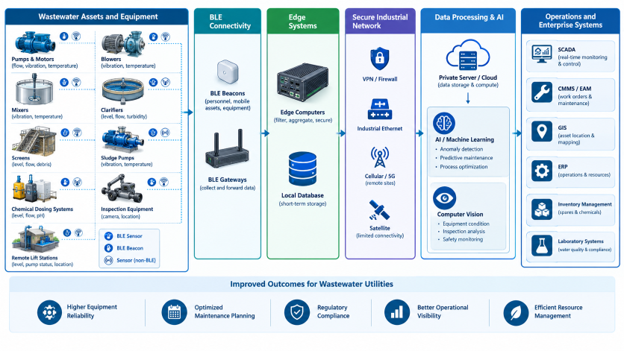
An engineering-grade process flow diagram detailing a modern wastewater treatment plant. It visually connects physical treatment stages—from influent pumping and primary clarification through aeration and sludge handling—to an Industrial Internet of Things (IIoT) and Data Analytics platform. The diagram uses standard wastewater symbology and arrows to show the flow of water, sludge, and digital data.
Cloud, Server, and Hybrid Deployment for Wastewater Facilities
Deployment selection should reflect facility connectivity, cybersecurity requirements, operational criticality, and the geographic distribution of assets.
A hybrid design can be useful where remote facilities need local operation during network interruptions while utility management requires centralized reporting across multiple locations.
Practical Engineering Recommendations for Wastewater Operations
Organizations implementing AI-enabled wastewater monitoring should prioritize operational reliability and data quality.
- Start with critical assets where failures have measurable operational consequences.
- Establish baseline maintenance and performance KPIs before deployment.
- Conduct BLE coverage surveys before final gateway placement.
- Use appropriately protected sensors for wet, corrosive, or outdoor environments.
- Avoid replacing critical wired process instrumentation without a documented engineering reason.
- Keep SCADA and PLC control functions appropriately separated from non-critical analytics systems.
- Validate AI alerts against actual inspection and maintenance findings.
- Integrate useful alerts with CMMS or EAM workflows.
- Maintain accurate asset identifiers across BLE, SCADA, GIS, and maintenance systems.
- Monitor sensor battery condition and gateway connectivity.
- Establish cybersecurity controls before connecting field devices.
- Use edge processing where remote sites require local data handling.
- Compare cloud, server, and hybrid deployment according to actual utility requirements.
- Expand to additional facilities only after pilot performance has been validated.
GAO Support for Wastewater BLE and IoT Solutions
GAO supplies BLE, RFID, and IoT hardware products and systems that can support connected asset monitoring, identification, sensing, and data-collection requirements. For wastewater operations, these technologies can be evaluated for applications involving pumps, motors, maintenance assets, inspection activities, remote equipment, and selected environmental or equipment-condition measurements.
GAO is headquartered in New York City and Toronto, Canada. GAO, together with GAO Research and GAO Tek, forms GAO Group, with operations based in New York City and Toronto. GAO Group has served customers across the United States and Canada for three decades, including Fortune 500 companies, R&D organizations, universities, and government agencies.
The group has invested substantially in product and systems R&D and maintains quality-assurance processes with technical support available remotely or onsite. Wastewater utilities can evaluate GAO technologies according to their specific sensing, connectivity, asset-management, and integration requirements.
Key Takeaways for AI-Enabled Wastewater Operations
AI can help wastewater utilities move from reactive equipment management toward more data-driven maintenance and operational decision support. Predictive maintenance, anomaly detection, equipment-condition monitoring, inspection analytics, and energy analysis are among the practical applications.
BLE sensors and beacons can supplement existing wastewater instrumentation by providing selected condition-monitoring and asset-identification information. BLE gateways then connect this field information with edge computers, local servers, or cloud systems.
The strongest implementations connect AI outputs to existing SCADA, CMMS/EAM, GIS, ERP, inventory, and laboratory workflows rather than creating isolated applications.
Successful deployment depends on accurate data, appropriate sensor selection, reliable gateway placement, cybersecurity, validated AI models, and measurable KPIs. A focused pilot followed by controlled expansion provides a practical way to evaluate operational value before broader deployment.
GAO provides BLE, RFID, and IoT hardware and technical support for organizations evaluating these connected-system requirements. Readers can explore GAO’s technology solutions and technical resources to identify hardware and system approaches suitable for their wastewater operations.
Building the Future of Industrial AI and IoT with Aperture Venture Studio and GAO
For more than three decades, GAO Group of Companies has invested heavily in R&D covering industrial BLE, RFID, and IoT technologies. As AI became increasingly applicable to industrial operations, the group expanded its work around AI-enabled connected systems. Aperture Venture Studio supports this direction by bringing together technical expertise, operational knowledge, investors, and industry participants focused on practical AI and IoT applications. Its activities include technical discussions and industry events covering emerging AI and IoT technologies. For wastewater operations, these capabilities can contribute to practical approaches for intelligent asset monitoring, predictive maintenance, connected sensing, and data-driven utility management.