
AI and BLE for Wind Energy Facilities
Intelligent Wind Energy Operations with AI, BLE, and RFID Systems
Modern wind energy facilities generate enormous volumes of operational data from turbines, substations, condition monitoring systems, maintenance activities, inspection workflows, environmental sensors, and field personnel. Artificial Intelligence (AI) enables this information to be transformed into actionable operational intelligence by detecting anomalies, predicting equipment failures, optimizing maintenance schedules, improving technician safety, and increasing power generation efficiency. BLE provides continuous location awareness for personnel, mobile tools, and temporary assets, while RFID supports automated identification of critical components, spare parts, maintenance records, and inventory throughout turbine lifecycles.
Together, AI, BLE, RFID, industrial IoT sensors, and edge computing create intelligent wind farm management solutions capable of supporting predictive maintenance, digital inspections, workforce safety, logistics optimization, and operational decision-making across both onshore and offshore wind energy facilities. Organizations deploying these technologies improve turbine availability, reduce unplanned downtime, extend equipment life, strengthen regulatory compliance, and optimize maintenance resources.
GAO has supported organizations throughout North America by supplying industrial RFID, BLE, and IoT hardware systems that enable reliable data collection across demanding industrial environments including renewable energy operations.
AI-Enabled Smart Wind Farm Operations with BLE, RFID, Edge AI, and Predictive Maintenance
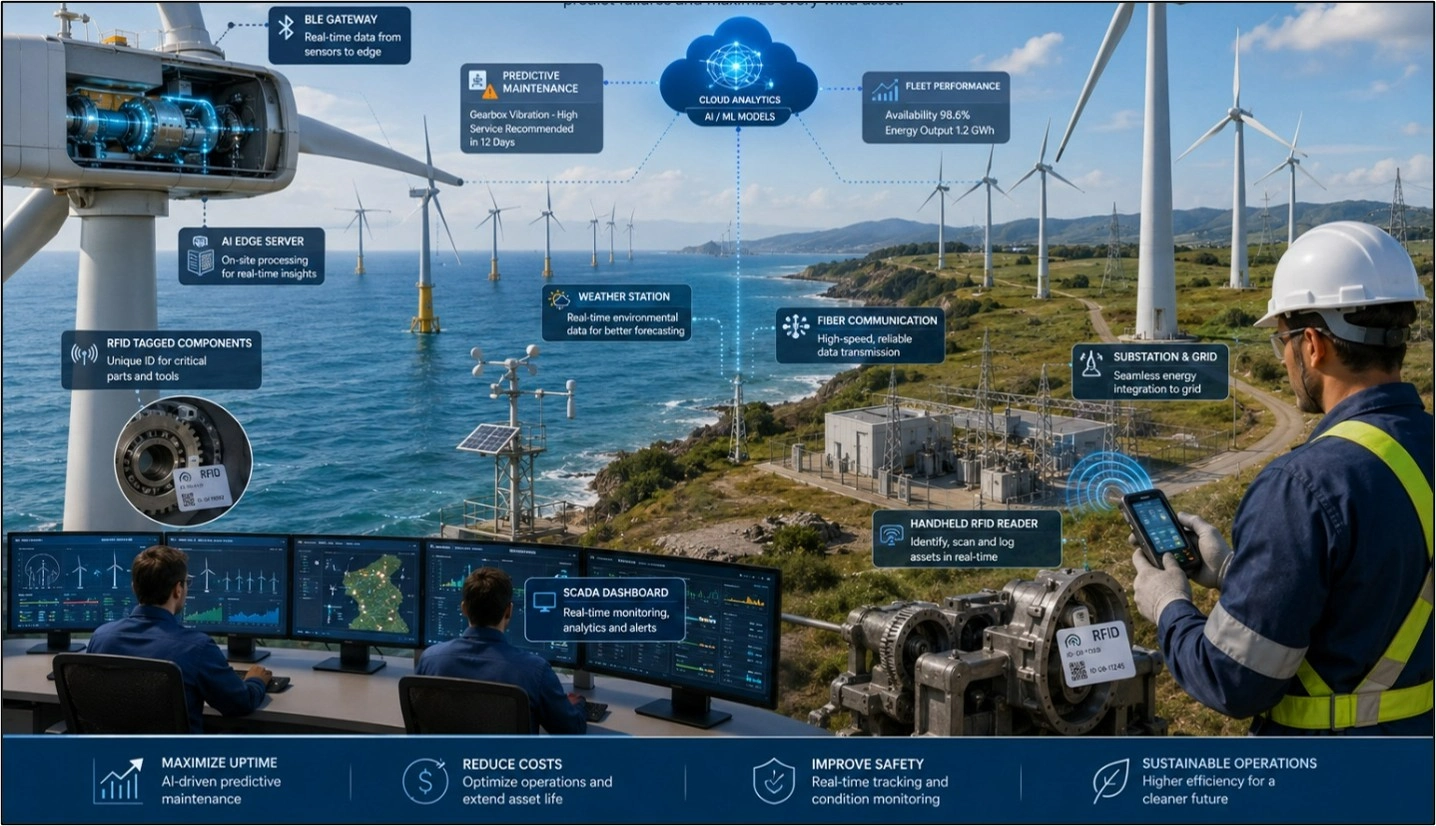
This illustration showcases a modern offshore and onshore wind farm powered by AI-driven technologies, including BLE gateways, RFID-tagged components, edge computing, SCADA systems, and cloud analytics. It demonstrates how real-time asset monitoring, predictive maintenance, and intelligent connectivity enable higher turbine availability, improved operational efficiency, enhanced safety, and sustainable energy generation. The visual highlights the convergence of digital technologies transforming wind farm operations into intelligent, data-driven ecosystems.
Understanding AI-Driven Wind Energy Management
Wind energy facilities consist of highly distributed electrical and mechanical assets operating under continuously changing environmental conditions. Wind speed, turbulence intensity, blade loading, gearbox vibration, generator temperature, lubrication quality, yaw alignment, pitch control, converter performance, transformer health, and grid conditions all influence turbine productivity.
Traditional maintenance programs rely heavily on periodic inspections and reactive repairs. AI introduces continuous operational intelligence by analyzing historical and real-time operational data collected from industrial sensors, SCADA systems, vibration monitoring equipment, weather stations, thermal imaging devices, drones, BLE beacons, RFID-tagged assets, and enterprise maintenance software.
Rather than replacing existing operational technology, AI complements existing supervisory control systems by identifying hidden patterns that indicate future failures long before conventional alarms are triggered.
Examples include:
- Predicting gearbox bearing degradation
- Detecting blade erosion through computer vision
- Forecasting inverter failures
- Identifying abnormal generator temperature trends
- Optimizing yaw control using historical wind behavior
- Forecasting maintenance windows based on weather conditions
- Identifying technician safety risks using BLE location data
- Optimizing spare parts inventory using RFID tracking
Because wind farms typically operate across large geographic regions, AI significantly reduces unnecessary site visits while enabling maintenance teams to focus on equipment requiring immediate attention.
Why AI Is Transforming Wind Energy Facilities
Renewable energy operators face increasing pressure to maximize energy production while reducing operating expenses.
Common operational challenges include:
- Gearbox failures
- Blade leading-edge erosion
- Lightning damage
- Hydraulic leaks
- High crane mobilization costs
- Offshore accessibility constraints
- Extreme weather interruptions
- Aging turbine fleets
- Skilled technician shortages
- Grid balancing requirements
- Spare parts shortages
- Regulatory documentation
- Environmental compliance
AI helps address these challenges by enabling:
- Continuous condition monitoring
- Predictive maintenance
- Remaining useful life estimation
- Automated inspection analysis
- Intelligent workforce scheduling
- Energy production forecasting
- Weather-aware maintenance planning
- Automated maintenance documentation
- Fleet-wide operational optimization
- AI-assisted root cause analysis
Rather than responding after failures occur, maintenance teams receive early recommendations supported by continuously updated operational data.
AI-Driven Predictive Maintenance vs Traditional Wind Farm Maintenance: Operational Challenges and Business Impact
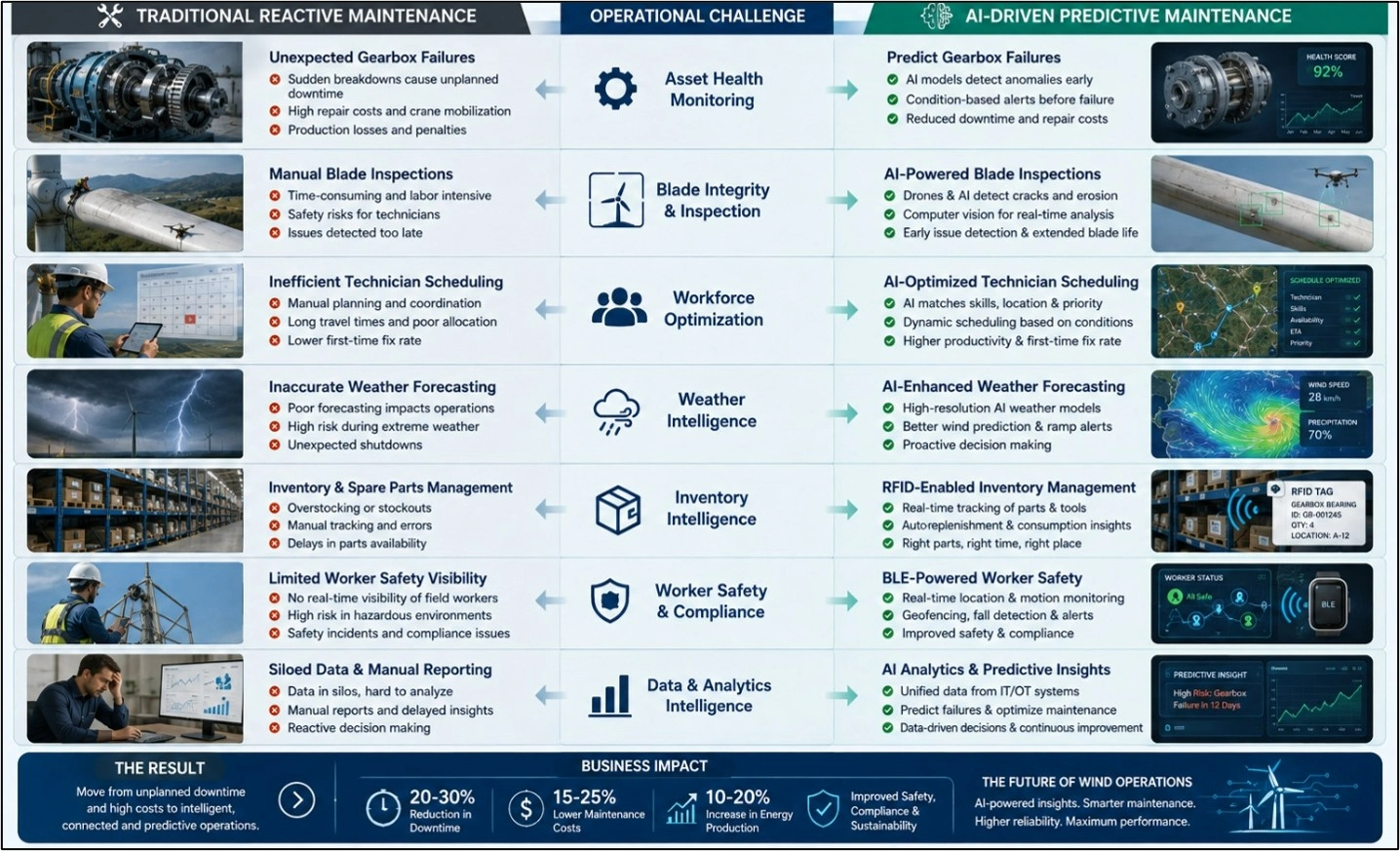
This infographic compares traditional reactive wind farm maintenance with AI-driven predictive maintenance across key operational areas, including asset health monitoring, blade inspections, technician scheduling, weather forecasting, inventory management, worker safety, and analytics. It demonstrates how AI, BLE, RFID, IoT, and advanced analytics transform maintenance from reactive to proactive, reducing downtime, optimizing costs, improving safety, and increasing energy production. The visual highlights the measurable business benefits of adopting intelligent, data-driven wind farm operations.
Relationship Between AI, BLE, RFID, and Industrial IoT in Wind Energy Facilities
Artificial Intelligence of Things (AIoT) combines artificial intelligence with industrial IoT devices, connected equipment, BLE devices, RFID technologies, industrial sensors, edge computing, and cloud software.
Within wind energy facilities, each technology contributes distinct capabilities.
Artificial Intelligence
AI processes operational data to identify patterns that improve equipment reliability, maintenance planning, energy generation, and workforce productivity.
Typical AI methods include:
- Machine learning
- Deep learning
- Time-series forecasting
- Computer vision
- Predictive analytics
- Reinforcement learning
- Anomaly detection
- Large language models for maintenance documentation
BLE
BLE supports:
- Technician positioning
- Lone worker monitoring
- Emergency evacuation
- Mobile equipment tracking
- Temporary tool identification
- Safety zone monitoring
- Asset proximity detection
BLE gateways installed throughout substations, warehouses, maintenance buildings, and turbine access areas provide continuous location visibility without requiring high power consumption.
RFID
RFID provides automatic identification of:
- Gearboxes
- Pitch motors
- Brake assemblies
- Power converters
- Transformers
- Blade sections
- Maintenance tools
- Hydraulic components
- Lubrication containers
- Safety harnesses
- Personal protective equipment
- Spare parts
- Inspection records
Typical RFID technologies include:
- UHF RFID for long-range inventory and logistics
- HF RFID for maintenance records and technician authentication
- LF RFID for specialized industrial identification where metal interference must be minimized
RFID reduces manual documentation while improving lifecycle traceability across wind farm assets.
Industrial IoT Sensors
Common industrial sensors include:
- Accelerometers
- Vibration sensors
- Oil particle counters
- Temperature sensors
- Acoustic emission sensors
- Humidity sensors
- Strain gauges
- Wind sensors
- Rotor speed encoders
- Electrical current sensors
- Power quality analyzers
Collected data feeds AI models operating on edge servers or centralized analytical software.
Wind Energy Applications for AI-Driven Asset Intelligence
AI supports virtually every operational area across wind farms.
Predictive Gearbox Maintenance
Machine learning continuously analyzes:
- Bearing vibration
- Oil contamination
- Torque fluctuations
- Rotational imbalance
- Gear mesh frequencies
Maintenance teams receive degradation predictions weeks before catastrophic failures occur.
Blade Inspection Automation
Computer vision processes drone imagery to identify:
- Leading edge erosion
- Cracks
- Lightning strikes
- Surface contamination
- Delamination
- Ice accumulation
Inspection time decreases significantly while maintaining consistent defect detection.
Generator Health Monitoring
AI evaluates:
- Stator temperature
- Rotor imbalance
- Electrical harmonics
- Insulation degradation
- Bearing wear
Maintenance can be scheduled before production losses occur.
Transformer Monitoring
Continuous monitoring includes:
- Oil quality
- Dissolved gas analysis
- Temperature
- Moisture
- Load cycles
AI predicts transformer degradation trends across entire wind farms.
Workforce Safety
BLE devices monitor technician movement throughout:
- Turbine towers
- Nacelles
- Electrical rooms
- Offshore transfer vessels
- Confined spaces
AI identifies abnormal worker behavior, prolonged inactivity, or unauthorized access.
AI-Powered Wind Farm Deployment Architecture with BLE, RFID, Edge AI, and Enterprise Integration
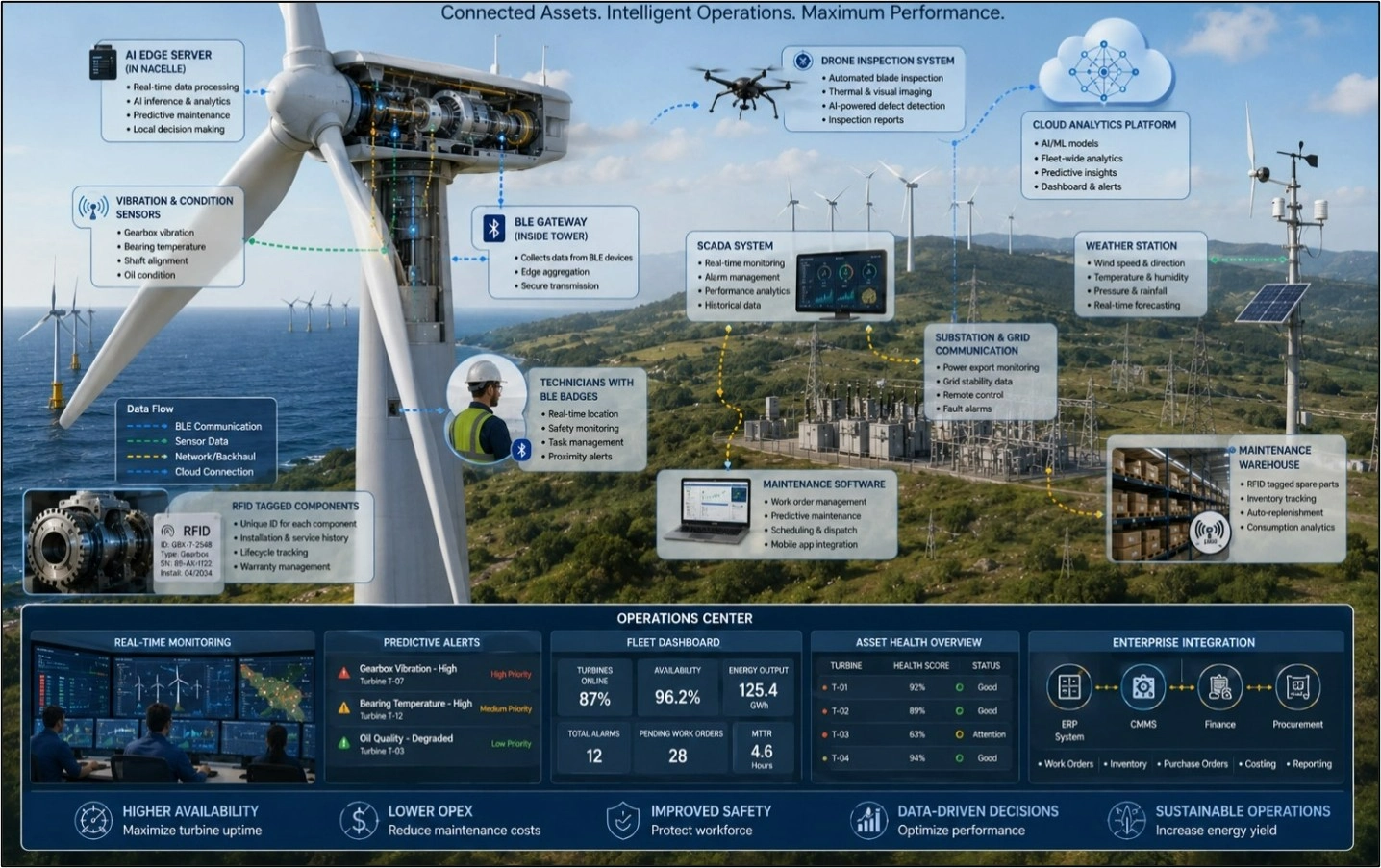
This deployment scenario diagram illustrates the end-to-end architecture of an AI-enabled wind farm, connecting RFID-tagged assets, BLE-enabled technicians, edge AI, SCADA systems, weather stations, drone inspections, cloud analytics, and enterprise applications. It demonstrates how real-time data flows seamlessly from field devices to operations centers, enabling predictive maintenance, intelligent asset management, improved workforce safety, and optimized wind farm performance. The visual highlights a practical deployment model for digitally connected and data-driven renewable energy operations.
Operational Workflow for AI-Enabled Wind Energy Facilities
Modern AI-enabled wind farms rely on continuous operational intelligence flowing through multiple engineering systems.
Asset Identification
Critical equipment receives RFID identification during manufacturing, commissioning, or maintenance.
Examples include:
- Main bearings
- Gearboxes
- Generators
- Pitch actuators
- Hydraulic pumps
- Transformers
- High-voltage switchgear
- Spare components
- Mobile maintenance equipment
Each asset receives a unique digital identity linked to maintenance history.
Data Acquisition
Operational information is collected from:
- SCADA systems
- Condition monitoring systems
- RFID readers
- BLE gateways
- Drone inspections
- Thermal cameras
- Weather stations
- Power quality meters
- Environmental monitoring systems
- Mobile inspection applications
Communication Infrastructure
Operational data is transported through combinations of:
- Industrial Ethernet
- Fiber optic networks
- Private LTE
- 5G
- Wi-Fi
- BLE mesh
- OPC UA
- MQTT
- Modbus TCP
- IEC 61850
- DNP3
Communication redundancy is particularly important for offshore wind farms where network interruptions may delay maintenance decisions.
Edge Processing
Edge servers located within substations or turbine clusters perform:
- Signal filtering
- Sensor validation
- Initial anomaly detection
- Compression
- Local inference
- Event prioritization
Processing information near turbines minimizes latency while reducing bandwidth requirements.
AI Analytics
Central AI software combines operational history with live sensor information to generate:
- Remaining useful life estimates
- Predictive maintenance recommendations
- Failure probability scores
- Production optimization recommendations
- Weather-aware maintenance scheduling
- Spare parts forecasting
- Technician dispatch prioritization
AI-Enabled Wind Farm Operational Workflow: From Asset Identification to Continuous Optimization
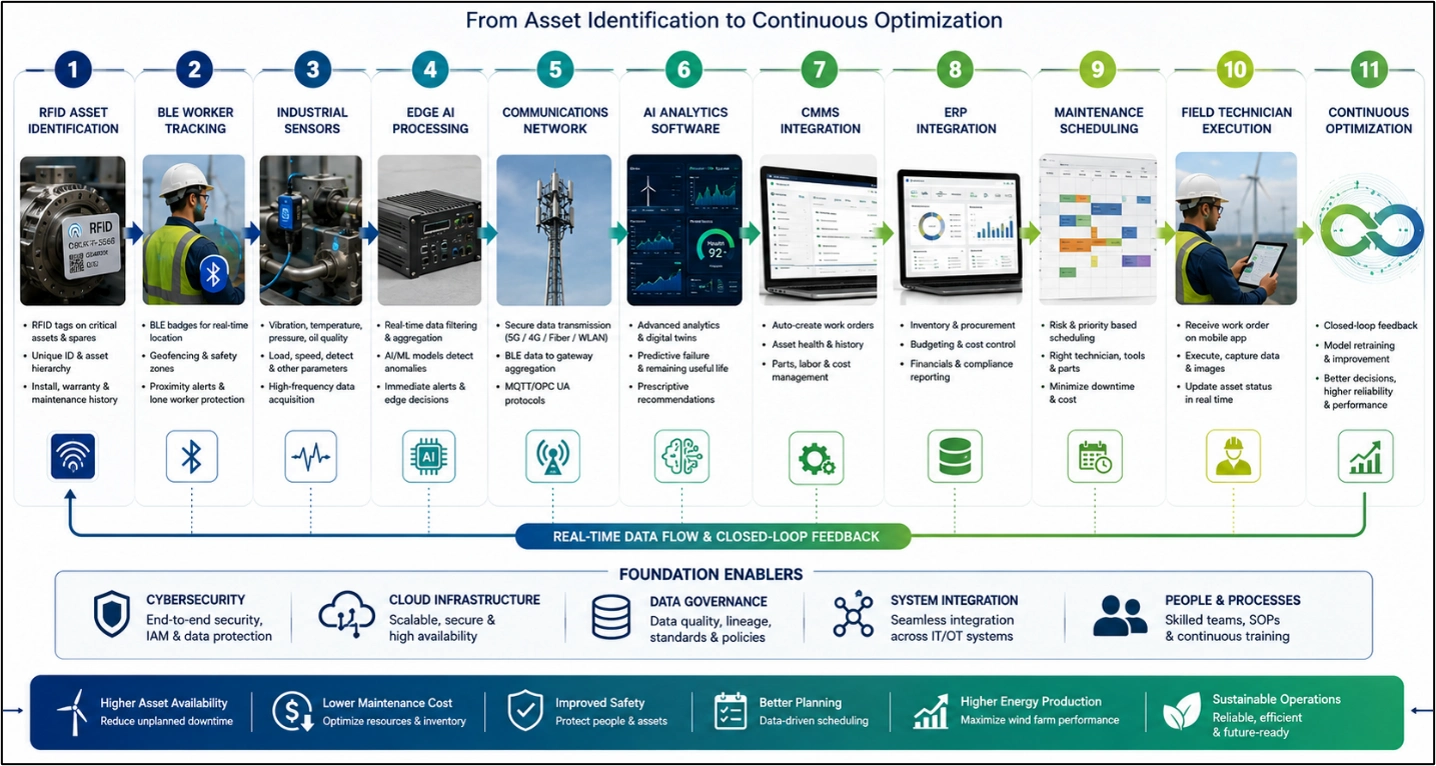
This workflow diagram illustrates the complete operational lifecycle of an AI-enabled wind farm, beginning with RFID-based asset identification and BLE-enabled workforce tracking, and progressing through industrial sensors, edge AI, communications, analytics, CMMS, ERP, maintenance scheduling, and field execution. It demonstrates how real-time data flows across connected systems to enable predictive maintenance, intelligent decision-making, and continuous operational improvement. The visual emphasizes a closed-loop, data-driven approach that enhances asset reliability, workforce safety, operational efficiency, and sustainable energy production.
Technology Components Supporting AI-Driven Wind Energy Operations
Successful AI deployments within wind energy facilities depend on carefully integrated hardware, industrial communications, software, security controls, and enterprise business systems. Each component contributes to reliable operational intelligence rather than functioning independently.
RFID Hardware
RFID hardware is typically selected according to the physical operating environment and identification requirements.
Common components include:
- Fixed UHF RFID readers installed in maintenance warehouses and logistics areas
- Handheld RFID readers used during turbine inspections
- Rugged industrial RFID antennas
- Metal-mount RFID tags for generators, gearboxes, and transformers
- HF RFID cards supporting technician authentication
- RFID-enabled tool management cabinets
Wind energy facilities present challenging conditions including metallic structures, electromagnetic interference, vibration, moisture, salt spray in offshore installations, and wide temperature variations. Rugged industrial RFID hardware designed for these environments provides higher read reliability and longer service life.
BLE Infrastructure
BLE complements RFID by providing continuous visibility of mobile people and assets that cannot be practically tracked through fixed RFID checkpoints.
Typical BLE infrastructure deployed within wind energy facilities includes:
- BLE beacons attached to maintenance equipment
- Wearable BLE safety badges for technicians
- BLE gateways installed inside turbine towers, nacelles, substations, warehouses, maintenance vehicles, and operation centers
- BLE-enabled emergency call devices
- Environmental BLE sensors
- Mobile applications supporting technician navigation and work order execution
BLE location data allows AI software to understand workforce movement, verify work completion, improve emergency response, and optimize maintenance scheduling.
Industrial Sensors and Data Collection
High-quality AI predictions depend on reliable operational data. Wind energy facilities typically collect information from:
- Vibration monitoring sensors
- Accelerometers
- Oil particle counters
- Lubrication monitoring sensors
- Acoustic emission sensors
- Blade strain sensors
- Temperature probes
- Humidity sensors
- Wind speed and direction sensors
- Rotor speed encoders
- Generator current sensors
- Voltage and power quality analyzers
- Lightning detection systems
- Ice detection sensors
- Thermal imaging cameras
- Drone inspection cameras
Sensor calibration, synchronization, and timestamp consistency are critical because inaccurate data directly affects AI model performance.
AI Software
Wind energy AI solutions commonly combine multiple analytical techniques rather than relying on a single model.
Typical AI capabilities include:
- Predictive maintenance models
- Time-series forecasting
- Computer vision for blade inspections
- Remaining Useful Life (RUL) estimation
- Failure classification
- Root cause analysis
- Load forecasting
- Maintenance optimization
- Natural language processing for maintenance documentation
- AI-assisted engineering knowledge search
Many organizations deploy multiple specialized AI models, each optimized for gearbox health, blade inspection, electrical equipment, weather prediction, or maintenance planning.
Enterprise Software Integration
AI becomes significantly more valuable when connected with operational business software.
Common integrations include:
- SCADA systems
- Condition Monitoring Systems (CMS)
- Computerized Maintenance Management Systems (CMMS)
- Enterprise Asset Management (EAM)
- Enterprise Resource Planning (ERP)
- Geographic Information Systems (GIS)
- Digital twin software
- Maintenance mobility applications
- Inventory management software
- Procurement systems
- Workforce management software
- Business intelligence dashboards
Integration eliminates duplicate data entry while enabling AI recommendations to automatically generate maintenance work orders, update inventory records, or notify field teams.
Cloud Version
Cloud-hosted AI deployments are appropriate when organizations require centralized management across geographically dispersed wind farms.
Typical advantages include:
- Centralized fleet analytics
- Elastic computing resources for AI model training
- Multi-site reporting
- Central software updates
- Simplified disaster recovery
- Cross-farm benchmarking
- Remote collaboration
Cloud deployments are often preferred by renewable energy operators managing multiple wind farms distributed across regions or countries.
Server Version
Some wind energy operators require privately managed server deployments because of cybersecurity policies, operational continuity requirements, or limited network connectivity.
Privately hosted server deployments are commonly installed within:
- Wind farm control centers
- Regional operations centers
- Utility-owned data centers
- Offshore operation facilities
- Utility private cloud environments
Benefits include:
- Reduced network dependency
- Local AI inference
- Greater control over operational data
- Integration with existing utility infrastructure
- Lower latency for operational decision-making
Many organizations adopt hybrid deployments where edge servers perform real-time inference while cloud software manages long-term analytics and fleet optimization.
Cybersecurity Considerations
Because wind farms form part of critical energy infrastructure, cybersecurity is integrated throughout the solution.
Recommended practices include:
- Zero Trust access controls
- Multi-factor authentication
- Device identity management
- Secure RFID credential management
- BLE authentication
- TLS encryption
- VPN connectivity
- Network segmentation
- IEC 62443 aligned industrial security practices
- Continuous vulnerability monitoring
- Secure firmware updates
- Security Information and Event Management (SIEM) integration
AI can further enhance cybersecurity by detecting abnormal network behavior, unauthorized access attempts, and unusual equipment communication patterns.
GAO has invested in industrial RFID, BLE, and IoT research for more than three decades, enabling customers to deploy secure identification and sensing technologies across demanding operational environments while supporting stringent quality assurance processes and expert remote or onsite technical assistance.
AI-Enabled Wind Farm Technology Architecture: End-to-End Integration of RFID, BLE, Edge AI, SCADA, CMMS, ERP, and Cloud Systems
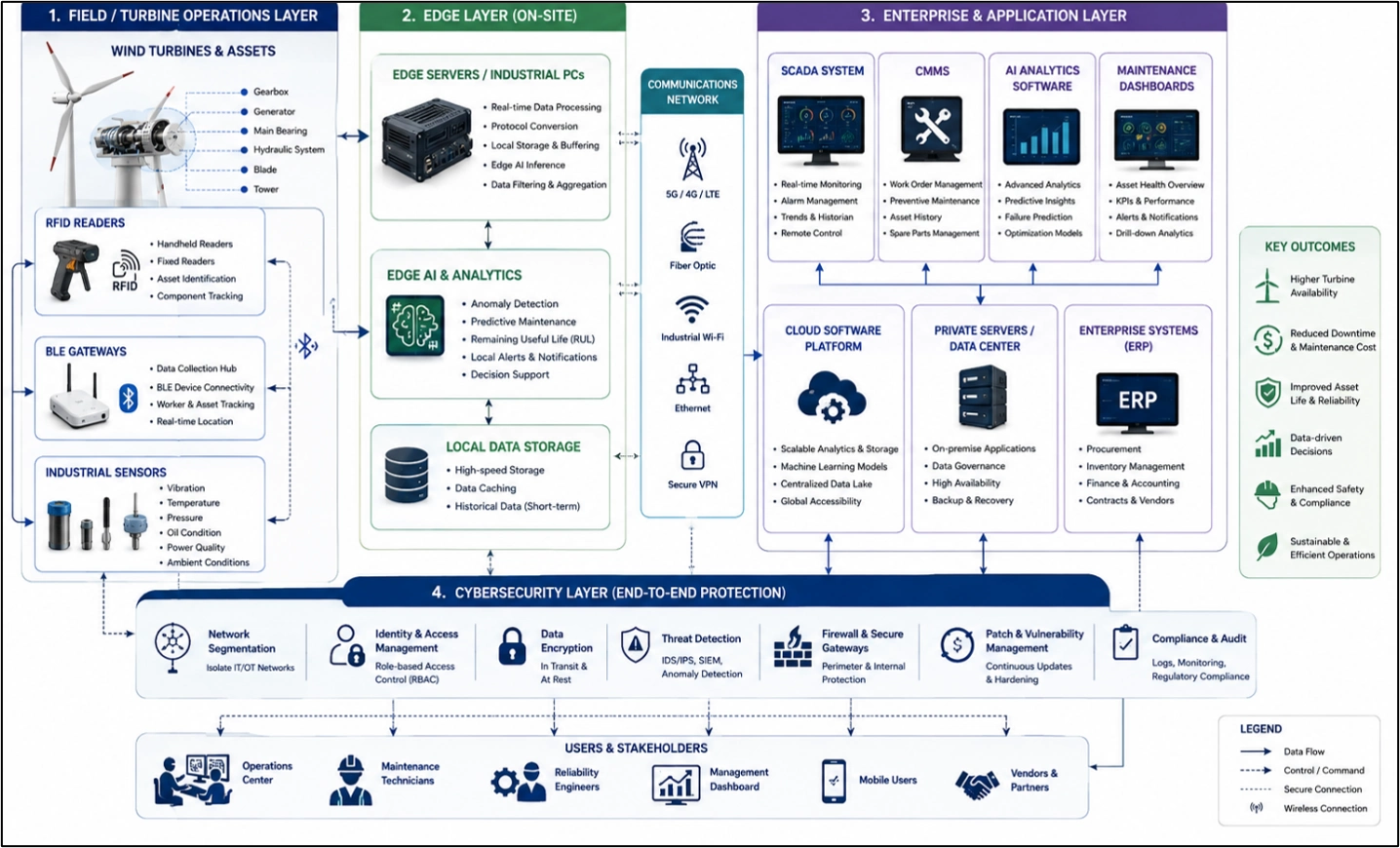
This block diagram illustrates the complete technology architecture of an AI-enabled wind farm, integrating field devices, edge computing, enterprise applications, cloud platforms, and cybersecurity into a unified operational ecosystem. It shows how RFID readers, BLE gateways, industrial sensors, edge AI, SCADA, CMMS, ERP, private servers, and maintenance dashboards exchange real-time data to enable predictive maintenance, intelligent asset management, and secure operations. The visual highlights a scalable, interconnected digital infrastructure that improves turbine reliability, operational efficiency, workforce safety, and renewable energy performance.
Key Technical Capabilities and Operational Benefits
Combining AI with BLE, RFID, and industrial IoT technologies delivers measurable improvements across the lifecycle of wind energy assets.
Improved Turbine Availability
AI continuously evaluates operating conditions to identify degradation trends before they result in turbine shutdowns. Predictive recommendations allow maintenance teams to intervene during planned service windows rather than responding to unexpected failures.
Reduced Maintenance Costs
Predictive maintenance reduces unnecessary preventive servicing while minimizing emergency repairs, crane mobilization, vessel scheduling, and replacement of healthy components.
Enhanced Asset Traceability
RFID enables complete lifecycle visibility for high-value assets, including gearboxes, generators, transformers, blade sections, lubrication components, and specialized maintenance tools. Maintenance history remains linked to the physical asset throughout commissioning, servicing, refurbishment, and replacement.
Workforce Safety Improvements
BLE-enabled personnel monitoring provides greater visibility into technician locations during tower climbs, confined-space work, offshore transfers, and emergency situations. AI can recognize abnormal inactivity, unauthorized entry into hazardous zones, or delayed evacuation during severe weather events.
Better Spare Parts Management
AI forecasting combined with RFID inventory visibility helps maintenance planners maintain optimal stock levels for critical replacement components while reducing excess inventory and minimizing delays caused by unavailable spare parts.
Faster Inspection Workflows
Computer vision accelerates drone-based blade inspections by automatically identifying erosion, cracking, lightning damage, and contamination. Engineers spend less time reviewing imagery while improving inspection consistency.
Higher Energy Production
AI optimizes maintenance timing, turbine availability, and operational settings using historical production data, weather forecasts, and equipment health information, contributing to improved annual energy production.
Scalability Across Wind Farms
Because AI software, BLE infrastructure, and RFID systems can be deployed incrementally, organizations can begin with individual wind farms and expand across regional or national fleets without redesigning the entire solution.
Improved Regulatory Compliance
Automated identification, digital maintenance records, inspection traceability, and AI-assisted reporting simplify compliance with renewable energy regulations, environmental requirements, and utility audit processes.
Engineering Considerations and Implementation Best Practices
Successful AI-enabled wind energy projects depend on careful engineering planning as much as software selection.
Recommended practices include:
- Define measurable business objectives before selecting AI models.
- Identify high-value assets such as gearboxes, generators, blades, and transformers for initial deployment.
- Validate sensor quality and communication reliability before AI model training.
- Standardize RFID tagging strategies across maintenance and inventory processes.
- Deploy BLE coverage based on technician workflows rather than only building layouts.
- Integrate AI recommendations with CMMS and EAM software to automate work order generation.
- Establish governance for AI model validation, retraining, and performance monitoring.
- Implement cybersecurity controls for industrial networks from the beginning of the project.
- Plan for scalability by using standardized communication protocols and interoperable hardware.
- Continuously compare AI predictions against actual maintenance outcomes to improve model accuracy.
A phased implementation generally delivers better long-term results than attempting a full-scale deployment across every turbine simultaneously.
AI-Enabled Wind Energy Deployment Decision Tree for Infrastructure, RFID, BLE, and Analytics
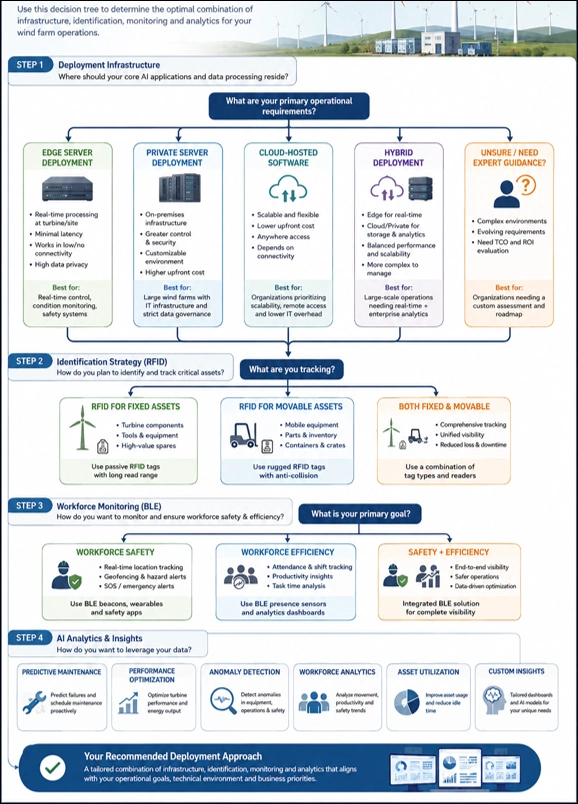
This decision tree infographic helps organizations determine the most suitable AI deployment strategy for wind energy facilities based on operational requirements. It compares edge, private, cloud, and hybrid deployment models while guiding decisions on RFID asset identification, BLE workforce monitoring, and AI analytics capabilities. The visual enables stakeholders to align technology architecture with operational efficiency, scalability, and predictive maintenance goals.
Key Performance Indicators for AI-Enabled Wind Energy Facilities
Organizations commonly evaluate project success using operational and business metrics such as:
- Turbine availability
- Capacity factor
- Mean Time Between Failures (MTBF)
- Mean Time To Repair (MTTR)
- Unplanned downtime
- Predictive maintenance accuracy
- Remaining Useful Life prediction accuracy
- Spare parts inventory turnover
- Blade inspection completion time
- Maintenance response time
- Technician productivity
- Safety incident rate
- Lost time incidents
- Asset utilization
- Crane mobilization frequency
- Offshore vessel utilization
- Energy production losses
- Grid availability compliance
- Maintenance cost per turbine
- Return on maintenance investment
These KPIs allow engineering teams to quantify operational improvements while continuously refining AI models and maintenance strategies.
Why Organizations Choose GAO
Organizations implementing intelligent wind energy solutions require reliable hardware, experienced technical guidance, and long-term operational support.
Headquartered in New York City and Toronto, Canada, GAO is recognized among the world’s leading B2B suppliers of RFID and BLE technologies. Together with its sister companies, GAO Research and GAO Tek, GAO has served Fortune 500 companies, leading research organizations, universities, and government agencies throughout the United States and Canada for more than three decades.
Our experience supplying industrial RFID, BLE, and IoT hardware enables customers to build dependable data acquisition systems that support AI-driven maintenance, asset identification, workforce safety, inventory management, and operational optimization across demanding wind energy environments. Our engineering teams assist customers with hardware selection, deployment planning, interoperability, integration, commissioning, and ongoing technical support.
Building the Future of Industrial AI and IoT with Aperture Venture Studio and GAO
For more than three decades, GAO Group of Companies has invested extensively in research and development of industrial RFID, BLE, and IoT technologies supporting critical infrastructure and renewable energy operations. As generative AI has matured for industrial applications, we have expanded our work in AI-enabled IoT solutions for wind energy facilities and established Aperture Venture Studio to accelerate the development and adoption of advanced AI and IoT technologies across industrial sectors. Aperture has attracted leading AI researchers, IoT specialists, experienced executives, investors, and industry collaborators. Through initiatives such as the Aperture Ventures Summit and TekSummit, we continue fostering technical collaboration and knowledge sharing within the AI and IoT community. We welcome participation from advisors, technical professionals, investors, and organizations seeking trusted AI, RFID, BLE, and industrial IoT solutions from GAO.