
AI and BLE for Wood Processing
AI and BLE Transform Wood Processing Operations
AI and BLE can help wood-processing facilities connect physical production assets with continuous operational data and AI-driven analysis. BLE gateways, beacons, and sensors can monitor lumber packages, forklifts, mobile equipment, production areas, temperature, humidity, vibration, and other operating conditions without requiring every asset to be hardwired. AI software can then analyze these data streams to identify abnormal equipment behavior, improve material flow, support predictive maintenance, and assist production decisions.
For sawmills, lumber mills, secondary wood-processing plants, kiln operations, and engineered wood facilities, the combination is particularly useful where materials and mobile assets move through large, distributed production areas. BLE provides relatively low-cost wireless data capture, while AI converts that data into operational recommendations. GAO supplies BLE, RFID, and IoT hardware products and systems that can support these industrial deployments, including solutions designed for integration with existing operational and information systems.
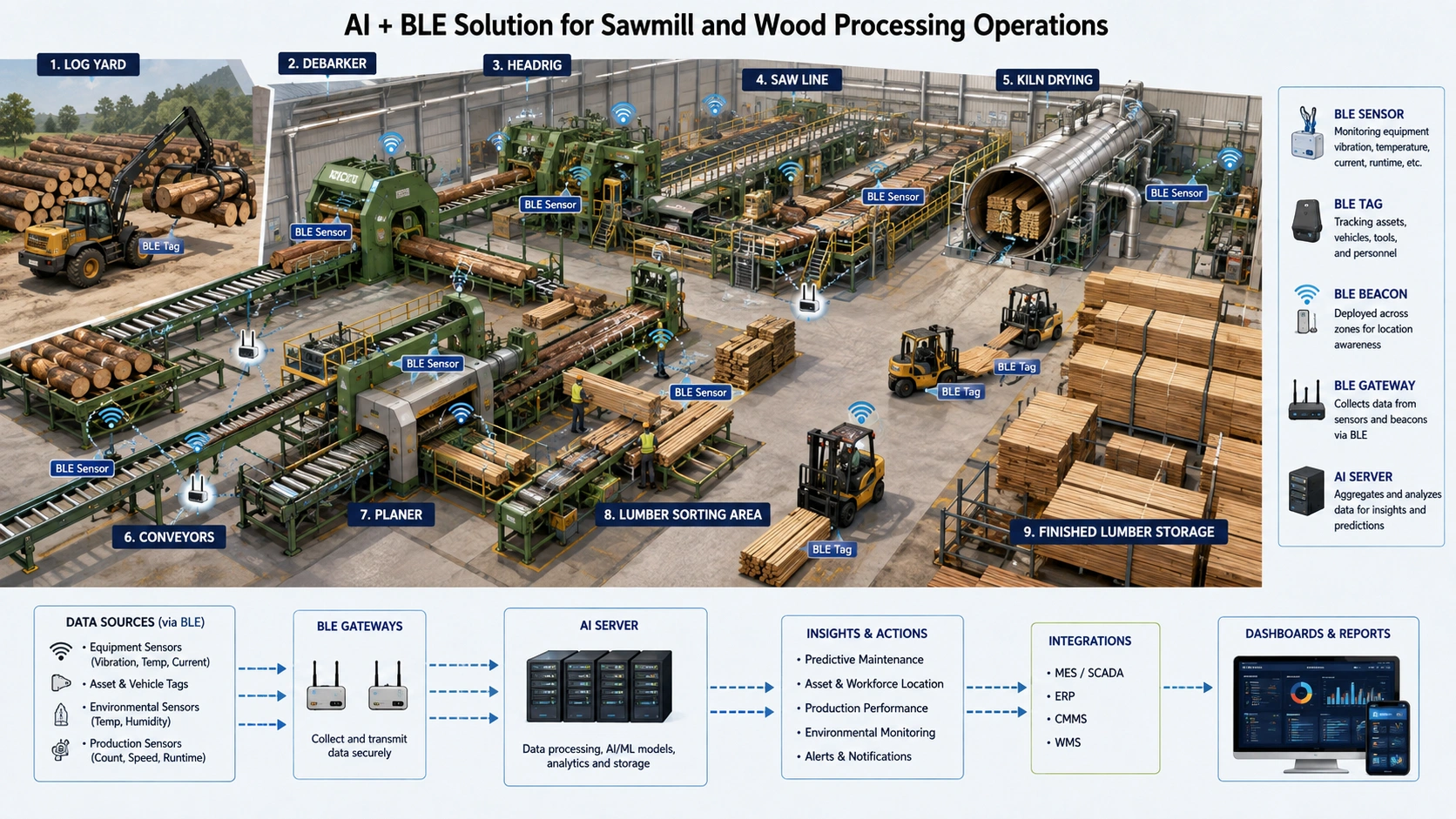
AI + BLE for Sawmill and Wood Processing Operations
Technical illustration showing how BLE sensors, tags, beacons, and gateways connect sawmill equipment, mobile assets, production zones, and environmental data to AI analytics for operational visibility.
What AI and BLE Mean for Wood Processing
Wood processing produces operational data at many stages, but the data is often fragmented among PLCs, machine controllers, maintenance records, environmental sensors, warehouse systems, and manually recorded observations. BLE can add wireless sensing and identification where fixed industrial instrumentation is impractical or where mobile assets need to be monitored.
A BLE-based solution can include:
- BLE beacons installed at production zones, storage locations, loading areas, or equipment checkpoints.
- BLE sensors measuring variables such as temperature, humidity, vibration, acceleration, or equipment operating conditions.
- BLE gateways positioned throughout production buildings, kiln areas, warehouses, and yards to collect nearby BLE transmissions.
- Edge computers or industrial servers that normalize and process sensor information before forwarding selected data to enterprise software.
- AI models that detect anomalies, classify operating conditions, forecast maintenance requirements, or identify relationships between process conditions and production outcomes.
- Dashboards and alerts that present actionable information to maintenance, production, quality, logistics, and plant-management personnel.
The technical value comes from combining wireless data acquisition with contextual information. A vibration reading becomes more useful when the system knows which conveyor, fan, saw, motor, pump, or dust-collection component generated it. A temperature reading becomes more useful when it can be associated with a kiln zone, lumber batch, storage area, or equipment state.
AI can also combine BLE information with existing PLC, SCADA, MES, CMMS, ERP, machine-vision, and environmental data. This allows wood-processing organizations to use BLE as an additional data source rather than replacing established industrial controls.
Wood Processing Applications for AI and BLE
Equipment Condition Monitoring
Sawmills contain numerous rotating and mechanically loaded components, including saws, bearings, motors, gearboxes, conveyors, fans, pumps, hydraulic systems, debarkers, chippers, and material-handling equipment. Unexpected failure of one component can interrupt upstream and downstream production.
BLE vibration and temperature sensors can provide supplementary condition data for assets where installing new wired instrumentation would be expensive or operationally disruptive. AI models can establish normal operating patterns and identify deviations associated with bearing wear, imbalance, overheating, abnormal vibration, or changing mechanical loads.
BLE should not be treated as a replacement for safety-critical control instrumentation. Rather, it can provide an additional condition-monitoring layer that feeds maintenance analysis and decision support.
Lumber, Package, and Material Tracking
Finished lumber and work-in-process material frequently moves between sorting, stacking, kiln drying, planing, grading, storage, and shipping areas. BLE beacons can associate movable assets or material-handling equipment with defined locations, while gateways can provide location observations across production and warehouse zones.
AI can use these observations to identify recurring movement patterns, congestion, excessive travel, staging delays, or abnormal dwell times. For forklift fleets, BLE location data can also support utilization analysis and help supervisors understand where material-handling capacity is being consumed.
Kiln and Environmental Monitoring
Kiln drying is highly dependent on temperature, humidity, airflow, wood species, lumber dimensions, moisture conditions, and drying schedules. BLE environmental sensors can supplement existing kiln instrumentation in suitable non-critical monitoring applications.
AI can compare historical environmental conditions with drying outcomes to identify patterns associated with excessive drying time, uneven moisture content, or process deviations. The resulting analysis can support kiln operators and process engineers without bypassing established kiln controls.
Predictive Maintenance for Conveyors and Material Handling
Conveyor systems are critical to continuous wood-processing operations. A failed bearing, motor, gearbox, belt, or drive can create production interruptions that propagate through multiple process stages.
BLE sensors can collect vibration and temperature observations from selected conveyor components. AI-based anomaly detection can compare current measurements against historical operating behavior and generate maintenance indicators before a developing problem becomes an obvious production failure.
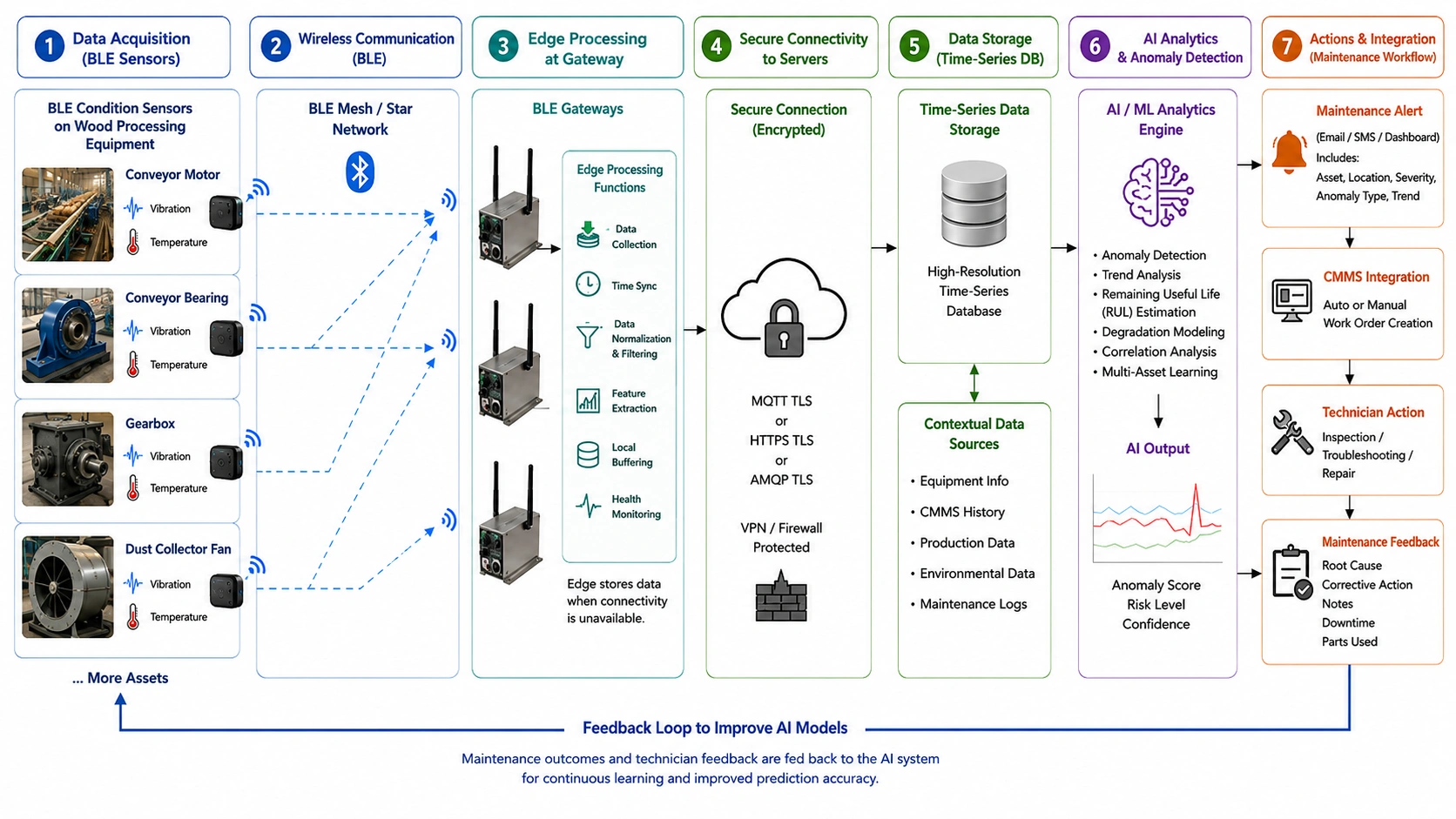
AI and BLE Predictive Maintenance Workflow for Wood Processing
This workflow illustrates how BLE vibration and temperature sensors on wood-processing equipment send condition data through BLE gateways, secure connectivity, and time-series storage to AI anomaly detection. The process ends with maintenance alerts, CMMS work orders, technician actions, and maintenance feedback that can improve future AI analysis.
AI-Assisted Lumber Quality and Process Analysis
AI can also support wood-quality operations through computer vision, statistical analysis, and process-data correlation. Machine-vision systems can inspect lumber surfaces for characteristics such as knots, cracks, discoloration, splits, or other visible defects, depending on the application and imaging configuration.
BLE contributes contextual information rather than replacing machine vision. For example, wireless identification and location observations can associate a lumber package, production batch, or handling event with specific processing conditions. Combining this information with production records can help engineers investigate relationships between raw-material characteristics, machine settings, drying conditions, and finished-lumber quality.
From BLE Data Capture to AI-Based Decisions
A practical AI and BLE deployment for wood processing begins with identifying operational questions rather than installing sensors indiscriminately. The engineering team should determine which assets, process stages, and KPIs require additional data.
A typical data flow is:
- BLE sensors and beacons capture measurements or identification signals.
- BLE gateways receive nearby transmissions from equipment, material, and environmental sensors.
- Gateway software filters duplicate, incomplete, or obviously invalid observations.
- Edge software can timestamp, normalize, buffer, and locally process data.
- Secure network services transfer relevant data to a private server or cloud environment.
- Middleware connects BLE information with PLC, SCADA, MES, CMMS, WMS, ERP, and other systems where required.
- Time-series and operational databases retain sensor and event history.
- AI models analyze equipment behavior, movement, environmental conditions, production events, or quality-related patterns.
- Analytics software converts model results into alerts, maintenance recommendations, process indicators, or operational reports.
- Production, maintenance, quality, and logistics personnel act on the resulting information.
- Confirmed maintenance outcomes and operational feedback can be retained for model evaluation and improvement.
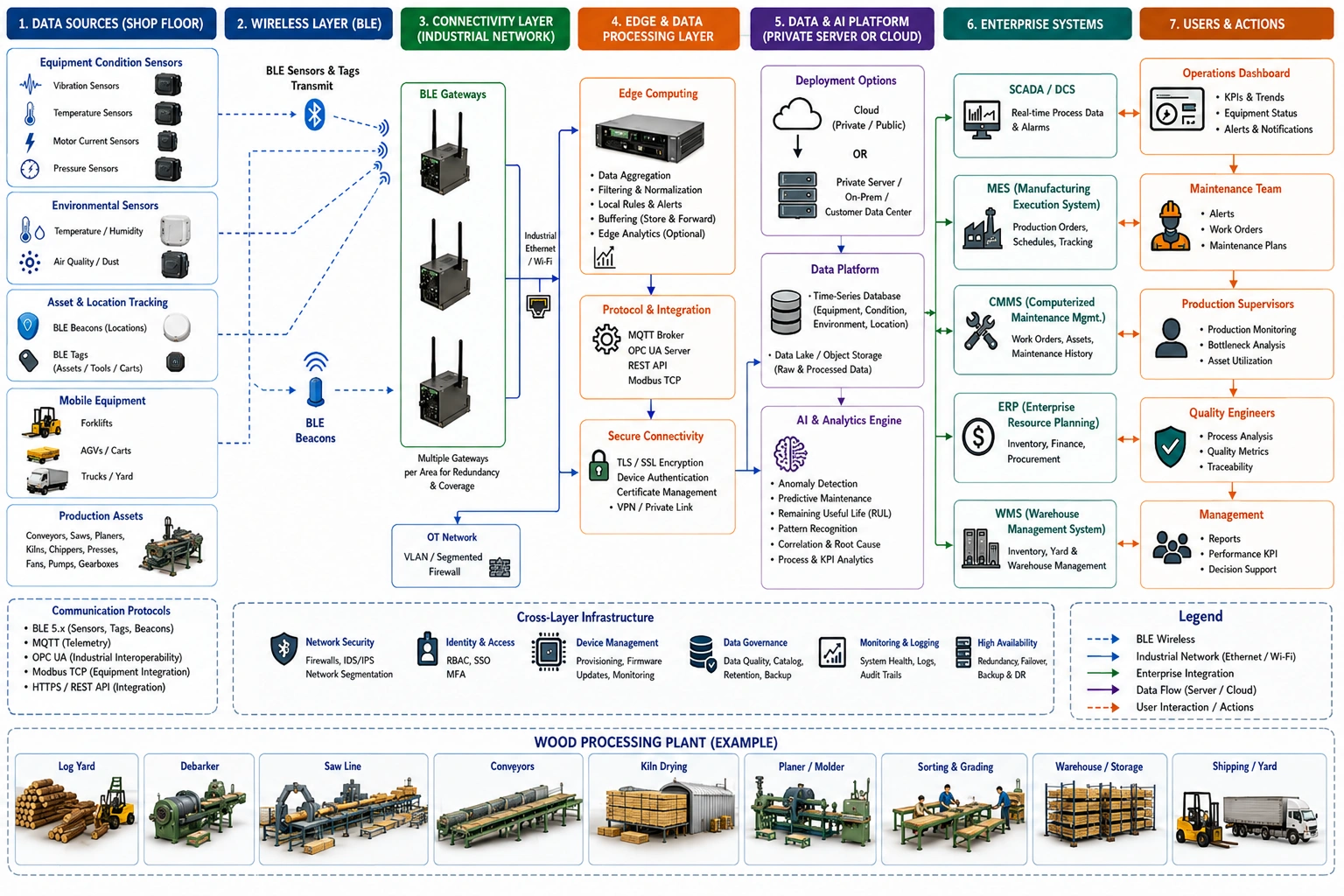
AI and BLE System Architecture for Wood Processing
This completed diagram illustrates the end-to-end technical data path in a wood-processing facility, from BLE sensors, beacons, and gateways through industrial networking, edge processing, secure server or cloud deployment, AI analytics, and enterprise systems. It highlights how production, maintenance, warehouse, and quality data can support operational decision-making.
BLE Hardware, AI Software, and Industrial Connectivity
BLE Gateways, Beacons, and Sensors
BLE gateways form the connection between wireless field devices and the plant’s data-processing environment. Gateway placement should account for building construction, equipment obstructions, metal surfaces, radio interference, required coverage, gateway density, and the physical movement of forklifts and lumber packages.
BLE beacons are useful for transmitting identifiers from fixed zones or mobile assets. BLE sensors provide measured data and are particularly relevant for condition monitoring and environmental observations.
Wood-processing facilities should perform a site survey before deployment. Large machinery, metal structures, dust-control equipment, enclosed rooms, kiln structures, and warehouse racks can influence radio propagation. Gateway locations should therefore be validated using actual plant conditions rather than relying only on theoretical coverage.
Industrial Protocols and Integration
BLE normally operates as the wireless field communication layer rather than the complete industrial communication system. A gateway can forward normalized information through Ethernet or Wi-Fi to plant software, depending on the facility’s network design.
Common integration technologies can include MQTT for lightweight telemetry exchange, OPC UA for industrial interoperability, REST APIs for software integration, and Modbus TCP where appropriate for industrial equipment and control environments. Existing PLC and SCADA systems should remain responsible for their established control functions unless a specific engineering change has been validated.
Cybersecurity should include network segmentation, authenticated devices, encrypted communications where supported, controlled gateway access, credential management, firmware management, logging, and appropriate access controls. Industrial cybersecurity practices should also consider applicable ISA/IEC 62443 principles and the facility’s existing IT and OT security policies.
AI Models for Wood-Processing Operations
Different wood-processing problems require different AI techniques. Time-series anomaly detection can identify changes in vibration or temperature patterns. Classification models can categorize operating states. Regression models can estimate process variables or maintenance indicators. Computer vision models can analyze lumber surfaces and production imagery. Optimization techniques can support production scheduling, material flow, or process parameter analysis where adequate historical data exists.
AI model selection should follow data quality and operational requirements. A complex model is not automatically better than a simpler statistical method. For maintenance applications, the model should produce interpretable indicators that maintenance personnel can validate against physical inspection and work history.
Cloud and Server Deployment for Wood Processing
A cloud deployment can centralize data from multiple mills or geographically distributed wood-processing facilities. It can simplify centralized software updates, provide shared analytics, and support cross-site benchmarking when corporate data policies permit. Cloud processing is appropriate where reliable network connectivity is available and where the organization accepts external cloud hosting for the relevant operational data.
A server deployment places the AI and IoT software on edge servers, plant servers, customer-managed infrastructure, private data centers, or other privately hosted computing resources. This model can reduce dependence on wide-area connectivity and can provide greater control over where production data is stored and processed. It can be particularly appropriate for plants with strict OT network policies, intermittent connectivity, sensitive production information, or requirements for local operation.
A hybrid arrangement is often practical. Gateways and edge computers can continue collecting and buffering BLE data locally while selected datasets or aggregated results are transferred to centralized servers. This approach can preserve local operational resilience while allowing corporate engineering teams to analyze information across multiple wood-processing facilities.
Engineering Considerations Before Deployment
A successful AI and BLE deployment depends on more than sensor selection. Wood-processing facilities should establish measurable objectives, baseline KPIs, asset priorities, data-retention requirements, network constraints, and maintenance workflows before commissioning.
Important engineering considerations include:
- Select assets based on failure impact, maintenance history, operating criticality, and measurable sensor signals.
- Validate BLE radio coverage around conveyors, saw lines, kilns, warehouses, and mobile-equipment routes.
- Determine whether sensors require industrial enclosures or environmental protection appropriate to the installation location.
- Separate monitoring functions from safety-critical machine-control functions.
- Establish gateway redundancy or local buffering where network interruptions could otherwise cause unacceptable data loss.
- Integrate alerts with existing maintenance processes rather than creating an independent notification workflow.
- Define data ownership, retention, user access, and cybersecurity responsibilities before production deployment.
- Test sensor accuracy, timestamp consistency, gateway connectivity, and AI alert quality during commissioning.
- Measure false-positive and false-negative rates before expanding AI-generated maintenance recommendations.
- Start with a limited production area and expand after operational validation.
GAO’s experience supplying BLE, RFID, and IoT hardware products and systems can support organizations that need wireless identification, sensing, gateway connectivity, and industrial data-collection capabilities as part of a broader wood-processing solution.
AI-Enabled Operational Improvements in Wood Processing
Combining AI with BLE creates value when wireless observations are connected to specific production decisions. The objective is not simply to collect more sensor data. The objective is to reduce uncertainty around equipment condition, material movement, environmental conditions, and production performance.
Predictive Maintenance and Equipment Reliability
AI can identify deviations in equipment behavior before conventional maintenance indicators become obvious. For example, a model can compare vibration and temperature trends from conveyor bearings across operating hours, production loads, and historical maintenance events.
Useful maintenance indicators include:
- Vibration trend deviation from an established baseline
- Bearing or motor temperature increase
- Repeated abnormal operating cycles
- Increasing frequency of equipment anomalies
- Abnormal behavior following maintenance
- Excessive equipment idle or operating time
- Repeated faults associated with a particular production condition
The maintenance team can combine AI-generated indicators with CMMS records, technician inspections, spare-parts availability, and equipment criticality. This supports condition-based maintenance without assuming that every AI alert represents a confirmed mechanical failure.
GAO BLE sensors and gateways can provide the wireless data acquisition needed for these monitoring applications, particularly where additional wired instrumentation would be difficult to install across dispersed wood-processing equipment.
Material Flow and Forklift Utilization
BLE location observations can help wood-processing facilities understand the movement of forklifts, lumber packages, pallets, carts, and other mobile assets. AI can analyze these observations to identify recurring congestion around staging areas, excessive travel distances, repeated trips, and unusual dwell times.
For example, a facility can compare forklift movement against lumber-production schedules and shipping requirements. If finished lumber repeatedly waits in an intermediate staging area, the combined location and production data can help determine whether the constraint originates from packaging, storage capacity, loading operations, forklift availability, or scheduling.
These findings can support changes to staging locations, dispatch rules, forklift allocation, and material-handling schedules.
Process and Environmental Analytics
Wood-processing conditions vary according to species, moisture content, lumber dimensions, machine settings, ambient conditions, and production schedules. AI can correlate these variables with process outcomes when sufficient historical data is available.
BLE environmental sensors can contribute measurements from locations that are difficult or costly to instrument with new wired sensors. Relevant measurements may include:
- Temperature
- Relative humidity
- Equipment vibration
- Acceleration
- Air-quality-related measurements where supported by the selected sensor
- Asset operating conditions
- Location and dwell time
AI analysis can identify correlations between environmental conditions and equipment behavior, storage conditions, or process deviations. Engineers should distinguish correlation from causation and validate significant findings through controlled testing or established process knowledge.
Production Visibility and KPI Analysis
AI and BLE can provide additional operational context for wood-processing KPIs. Depending on the facility, relevant measurements can include equipment availability, unplanned downtime, mean time between failures, mean time to repair, throughput, lumber recovery, material dwell time, forklift utilization, kiln cycle duration, energy consumption, and quality-related indicators.
BLE observations can provide event-level information that is otherwise difficult to capture manually. AI can aggregate those observations into trends and exception reports, allowing supervisors and engineers to focus on process conditions that differ materially from established operating patterns.
Security, Reliability, and Operational Resilience
BLE systems in wood-processing facilities should be designed as part of the plant’s broader IT and OT security program. Wireless monitoring does not eliminate the need for network segmentation, authentication, access management, patching, logging, and controlled remote access.
Gateway security should include appropriate credentials, controlled administrative interfaces, firmware management, and restricted network communication. Data moving from gateways to servers should use secure transport mechanisms appropriate to the selected software and network environment.
Operational resilience is equally important. A temporary network outage should not necessarily stop local BLE monitoring. Gateways or edge computers can buffer observations until connectivity is restored. Local processing can also generate selected alerts without depending on continuous cloud connectivity.
The appropriate resilience design depends on the production requirement. A non-critical environmental monitoring application may tolerate delayed data, while equipment-condition monitoring for a highly constrained production line may require local buffering and near-real-time processing.
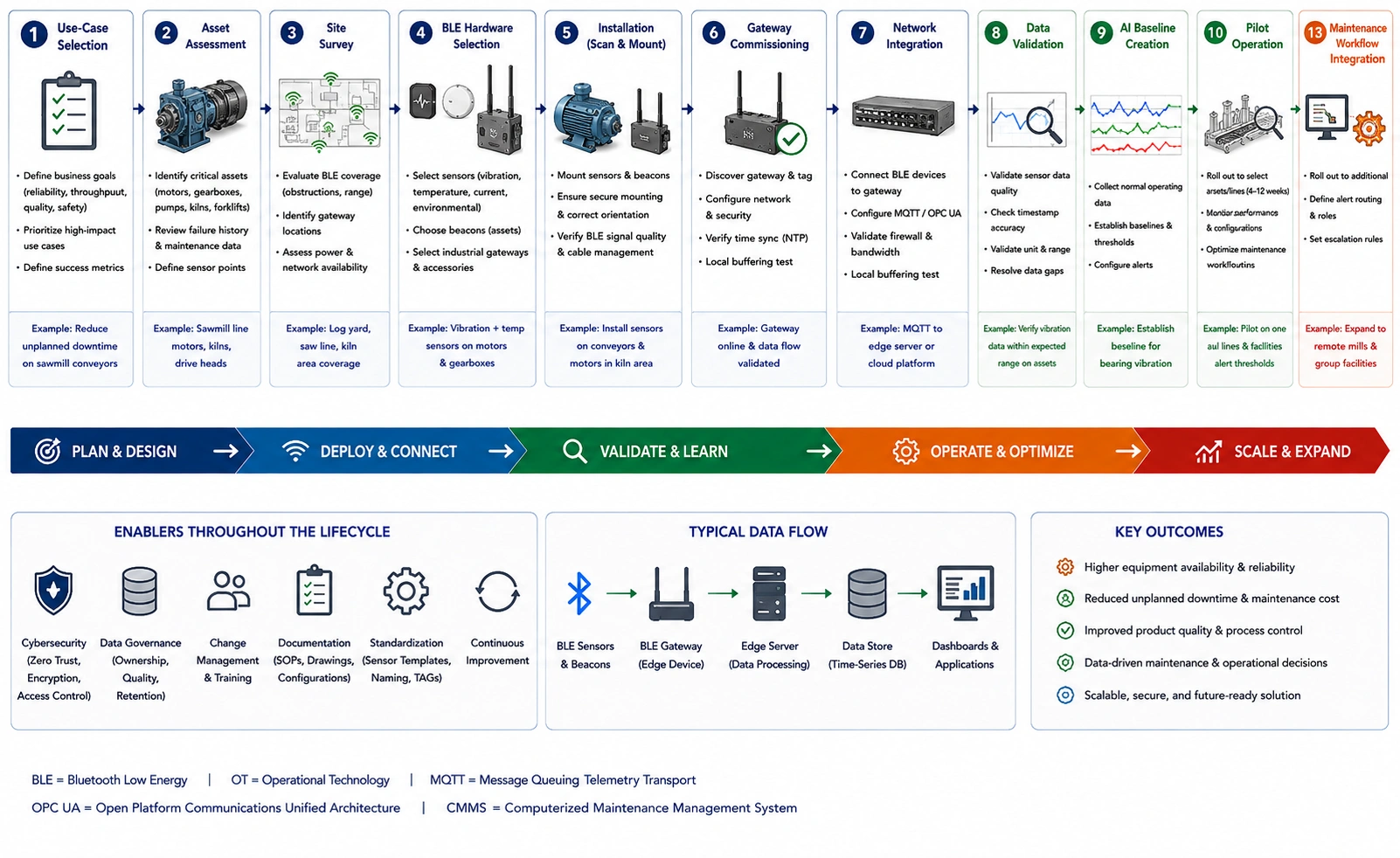
AI and BLE Implementation Lifecycle for Wood Processing Facilities
This completed lifecycle diagram shows the practical deployment path for AI and BLE in wood processing, from use-case selection and asset assessment through BLE hardware deployment, network integration, data validation, AI baseline creation, pilot operation, maintenance integration, performance monitoring, model optimization, and multi-area expansion. It also highlights cybersecurity, data governance, training, standardization, documentation, and continuous improvement as supporting requirements.
Deployment, Commissioning, and Integration
Planning and Site Survey
Deployment should begin with an inventory of production assets, wireless coverage requirements, environmental conditions, network availability, and integration points.
The engineering team should document:
- Critical production equipment
- Equipment locations and operating zones
- Candidate sensor mounting points
- BLE gateway locations
- Existing Wi-Fi and Ethernet infrastructure
- PLC and SCADA interfaces
- MES, CMMS, WMS, and ERP integration requirements
- Environmental exposure
- Maintenance access requirements
- Data retention and cybersecurity requirements
A radio survey should be conducted under representative operating conditions. Machinery, metal structures, stored lumber, racks, dust-control equipment, and moving vehicles can affect wireless performance. Gateway placement should therefore be confirmed through measured field performance.
Hardware Selection and Installation
Sensor selection should follow the measurement requirement rather than the other way around. A vibration-monitoring application may require a different sensor specification and mounting method from a temperature or humidity application.
Installation should consider:
- Measurement range and accuracy
- Sampling characteristics
- Battery life
- Mounting method
- Enclosure requirements
- Dust and moisture exposure
- Mechanical vibration
- Maintenance accessibility
- Calibration requirements
- Radio range
- Gateway density
Sensors should be installed consistently enough to make measurements comparable. Changes in mounting location or mechanical coupling can affect vibration data and may produce apparent changes that are installation-related rather than equipment-related.
Data Integration and Testing
Commissioning should verify the complete data path, not merely whether a sensor can communicate with a gateway.
Testing should confirm:
- Sensor identification
- Gateway reception
- Timestamp accuracy
- Data completeness
- Network transmission
- Database storage
- AI feature generation
- Alert delivery
- CMMS or other system integration
- User permissions
- Data recovery after connectivity interruptions
A controlled pilot can establish baseline behavior before AI alerts are enabled for production decision-making. Historical operating data should be reviewed to determine whether the selected variables contain enough information to support the intended AI application.
Maintenance and Model Optimization
AI and BLE deployments require ongoing maintenance. Sensors may need battery replacement, inspection, recalibration, repositioning, or firmware updates. Gateways require similar lifecycle management.
AI models also require monitoring. Changes in machine configuration, production schedules, maintenance practices, raw-material characteristics, or sensor installation can change the statistical behavior of the data.
Model performance should therefore be reviewed using measurable indicators such as alert precision, false-positive rate, missed-event rate, detection latency, and maintenance-confirmation rate. Operators and maintenance technicians should have a mechanism for validating or rejecting AI recommendations.
AI and BLE Implementation Lifecycle for Wood Processing Facilities
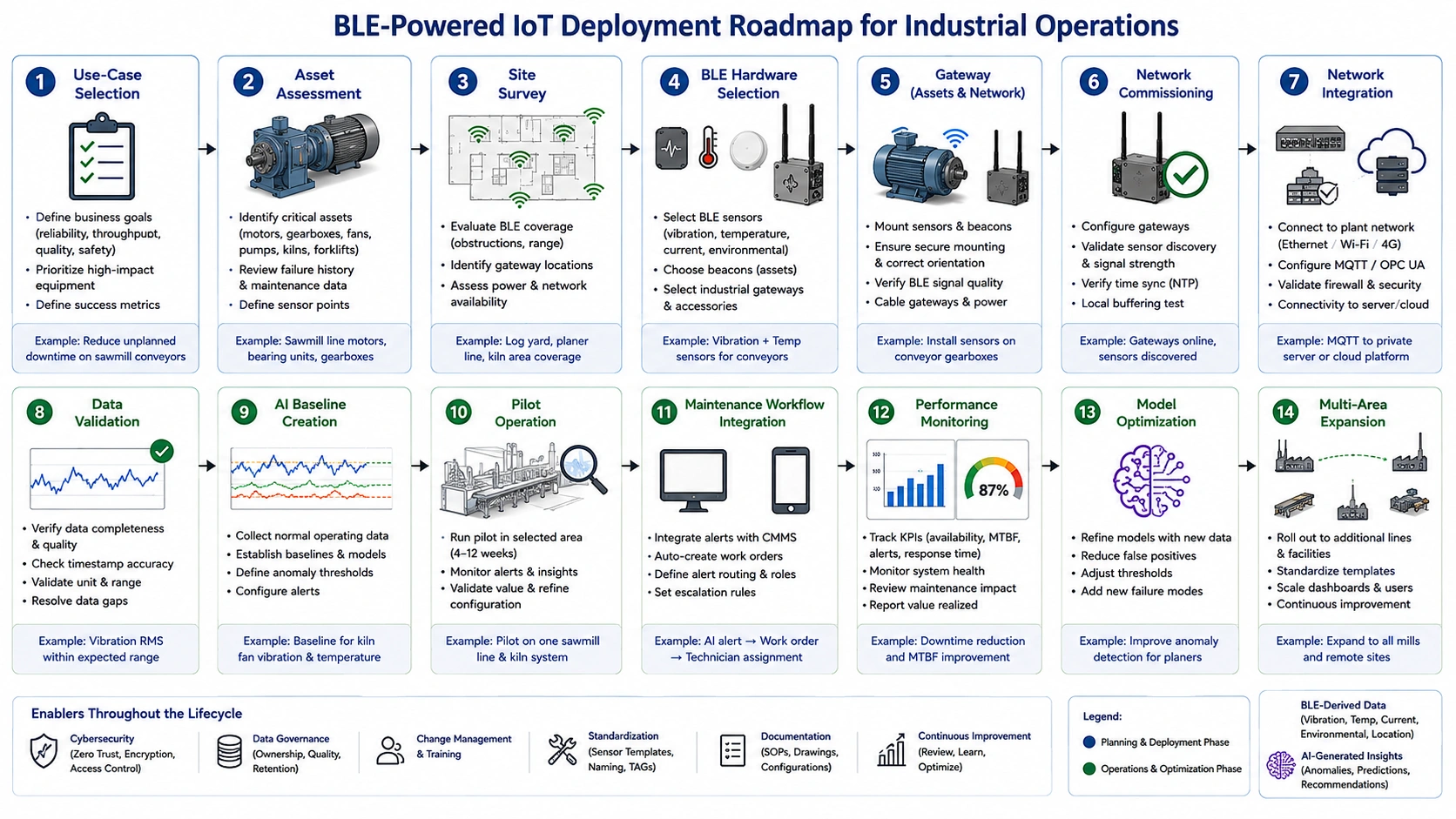
This completed lifecycle diagram illustrates the practical implementation of AI and BLE in wood processing, from use-case selection and asset assessment through site surveying, BLE hardware deployment, gateway commissioning, network integration, data validation, AI baseline creation, pilot operation, maintenance workflow integration, optimization, and multi-area expansion. It also shows supporting cybersecurity, data governance, standardization, continuous improvement, and the typical BLE-to-AI data flow.
Scaling AI and BLE Across Wood-Processing Facilities
A successful pilot should establish repeatable engineering standards before deployment across multiple production areas or facilities. Standardized sensor naming, asset identifiers, gateway configuration, data schemas, security policies, and maintenance procedures can reduce integration effort during expansion.
Multi-site deployments can also benefit from consistent KPI definitions. For example, equipment availability should be calculated consistently across mills if management intends to compare performance. The same principle applies to maintenance alerts, forklift utilization, material dwell time, and production interruptions.
A centralized cloud deployment can simplify multi-site analytics when connectivity and corporate policies permit. Alternatively, customer-managed servers can maintain local processing at each facility while sharing selected analytics with a central engineering environment.
GAO can support this type of expansion by supplying BLE gateways, beacons, sensors, RFID products, and related IoT hardware that can be incorporated into facility-specific data-collection systems.
AI and BLE Implementation Recommendations for Wood Processing
A practical implementation strategy should focus on measurable operational problems rather than technology deployment for its own sake.
- Start with one or two high-value applications, such as conveyor condition monitoring or forklift utilization.
- Select assets where sensor measurements can produce meaningful operational information.
- Establish baseline equipment and process behavior before enabling automated AI recommendations.
- Use BLE gateways with sufficient coverage and local buffering for the facility’s operational requirements.
- Keep safety-critical controls separated from AI monitoring functions unless a formally engineered control-system change is required.
- Integrate maintenance alerts with existing CMMS workflows instead of creating parallel manual processes.
- Validate AI recommendations against technician inspections and maintenance outcomes.
- Establish cybersecurity controls before connecting gateways to production networks.
- Define data ownership, retention, access permissions, and backup requirements.
- Standardize asset identifiers and sensor metadata before expanding to additional production areas.
- Measure operational outcomes such as downtime reduction, maintenance response time, material dwell time, and equipment utilization.
- Expand only after the pilot demonstrates reliable data quality and measurable operational value.
Key Technical and Business Takeaways
AI and BLE provide complementary capabilities for wood-processing operations. BLE adds wireless sensing, identification, and location observations across equipment, mobile assets, production areas, and storage operations. AI analyzes those observations together with existing industrial and business data to identify patterns that would be difficult to recognize through manual monitoring alone.
The strongest applications are those where the facility already has a clear operational question, such as why a conveyor repeatedly fails, where forklift capacity is being consumed, why material remains staged too long, or how environmental conditions relate to process performance.
Implementation should prioritize measurement quality, radio coverage, integration, cybersecurity, operational resilience, and human validation of AI recommendations. GAO provides BLE, RFID, and IoT hardware products and systems that can serve as the field-data layer for these applications, supported by engineering and technical assistance for organizations developing industrial wireless solutions.
For organizations evaluating AI and BLE for sawmills, lumber mills, kiln operations, secondary wood processing, or wood-product manufacturing, learning more about GAO’s BLE gateways, beacons, sensors, RFID products, and IoT technologies can help identify suitable hardware and integration approaches for specific production requirements.
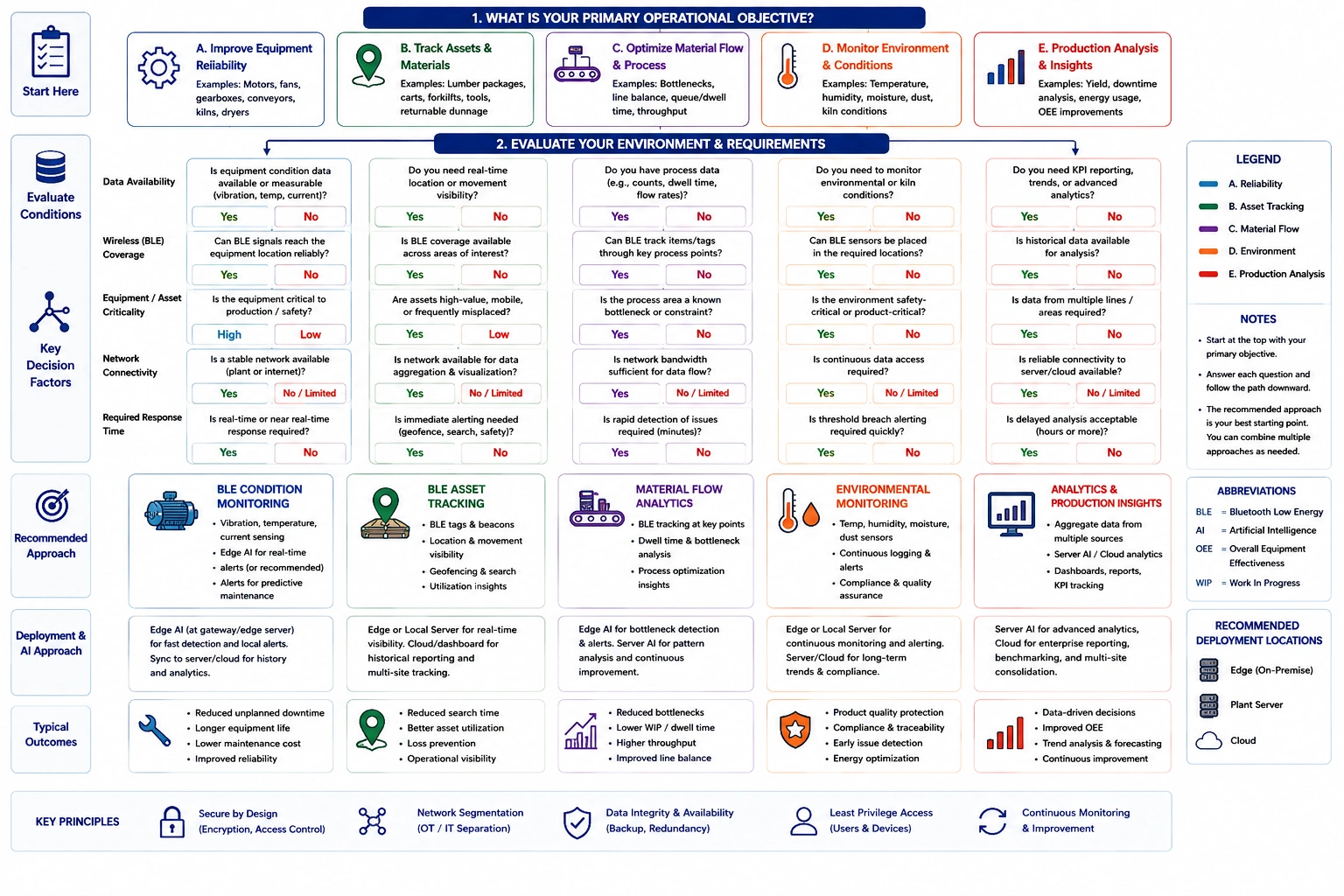
AI and BLE Application Selection Decision Tree for Wood Processing
This completed decision tree helps wood-processing engineers select appropriate AI and BLE applications based on operational objectives, data availability, BLE coverage, equipment criticality, network connectivity, and required response time. It maps common requirements to BLE condition monitoring, asset tracking, material-flow analytics, environmental monitoring, and production analytics, with guidance for edge, server, and cloud deployment.
Learn More About AI and BLE for Wood Processing
Wood-processing organizations can use AI and BLE as complementary technologies rather than isolated systems. BLE provides practical wireless data acquisition from equipment, materials, mobile assets, and environmental conditions, while AI helps convert that information into maintenance, production, logistics, and quality insights.
The most effective deployments begin with a defined operational problem, measurable KPIs, appropriate sensor selection, validated wireless coverage, secure connectivity, and integration with existing plant systems. GAO can provide BLE, RFID, and IoT hardware products and technical support for organizations assessing these requirements.
For further evaluation, readers can explore GAO’s industrial wireless technologies, discuss application requirements with technical specialists, and determine which BLE gateways, beacons, sensors, RFID products, and supporting systems are appropriate for their wood-processing environment.
GAO’s Industrial Technology Experience
GAO is headquartered in New York City and Toronto, Canada, and is ranked among the world’s leading B2B and B2G BLE and RFID suppliers. Its sister companies, GAO Research Inc. and GAO Tek Inc., form GAO Group, with operations based in New York City and Toronto.
For three decades, GAO Group has served organizations throughout the United States and Canada, including Fortune 500 companies, leading research and development firms, prestigious universities, and U.S. and Canadian government agencies.
Our product and system development has been supported by substantial R&D investment, stringent quality assurance processes, and technical support delivered remotely or onsite. This experience is relevant to wood-processing organizations evaluating wireless sensing, RFID identification, industrial IoT, and AI-enabled data systems for demanding production environments.
Building the Future of Industrial AI and IoT with Aperture Venture Studio and GAO RFID Inc.
For more than three decades, GAO Group of Companies has invested heavily in R&D for industrial BLE, RFID, and IoT. As AI became increasingly useful in industrial applications, we expanded our work in AI and IoT technologies and founded Aperture Venture Studio to advance practical AI and IoT solutions for applications such as wood processing, industrial sensing, asset monitoring, and operational analytics. Aperture brings together AI and IoT technical experts, executives, investors, and leading companies. We also developed Aperture Ventures Summit and TekSummit to discuss advanced AI and IoT topics. We welcome advisors, employees, investors, and customers interested in advancing industrial AI and IoT.