
AI-Driven Factory Equipment Manufacturing with BLE
AI Applications for Factory Equipment Manufacturing
Factory equipment manufacturing covers a wide range of production activities, including machining, fabrication, welding, casting, sheet-metal processing, electrical assembly, hydraulic and pneumatic assembly, control-panel wiring, equipment testing, painting, final inspection, packaging, and shipment preparation. Large machinery may also remain in production for extended periods while hundreds or thousands of components are assembled against a specific bill of materials.
AI becomes valuable when manufacturers need to interpret operational data rather than simply collect it. A BLE-enabled AIoT solution can associate equipment identifiers, sensor measurements, work orders, production stations, maintenance events, and operator activities with specific manufacturing processes.
Relevant applications include:
- AI production monitoring that identifies abnormal cycle times, station bottlenecks, idle equipment, and deviations from expected manufacturing sequences.
- AI asset tracking that determines where mobile tooling, test equipment, lifting equipment, calibration instruments, and partially assembled machines are located.
- AI work-in-process monitoring that follows major equipment assemblies between machining, fabrication, electrical, mechanical, testing, inspection, and staging areas.
- AI predictive maintenance that analyzes vibration, temperature, runtime, current, pressure, or other sensor information to identify developing equipment problems.
- AI quality analytics that correlates process conditions with inspection findings, rework, test failures, and warranty-related issues.
- AI production scheduling that considers machine availability, work-order priority, component readiness, technician capacity, and predicted maintenance requirements.
- AI material-flow analysis that identifies unnecessary movement of assemblies, components, tooling, and production carts.
- AI service intelligence that combines equipment history, service records, sensor readings, and technician observations to improve field-service preparation.
- AI energy monitoring that identifies abnormal consumption by machine tools, compressors, ovens, welders, test benches, and other production assets.
- AI safety monitoring that uses authorized sensor and machine data to identify potentially unsafe equipment states or operating conditions.
AI Workflow for Factory Equipment Manufacturing
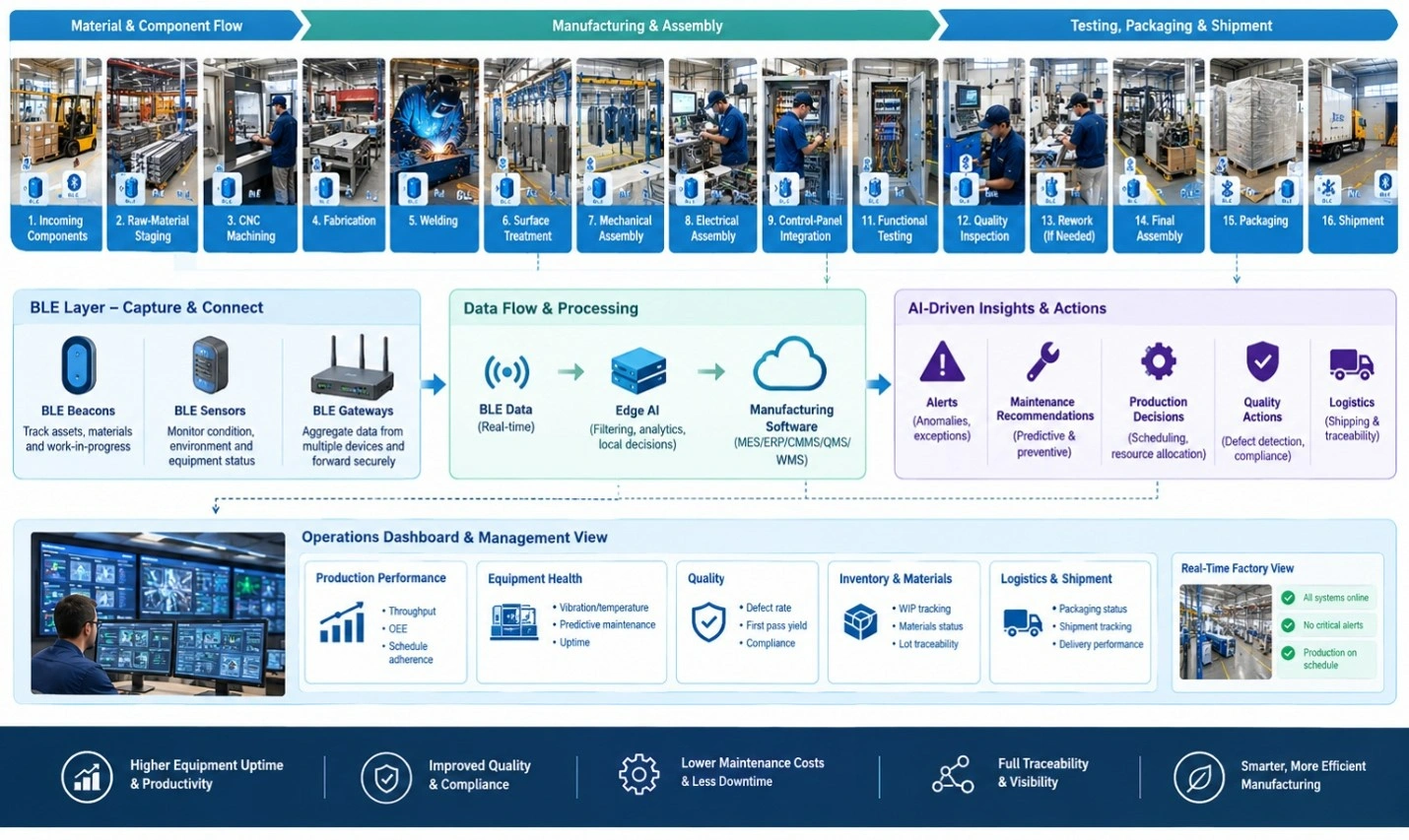
The visual maps the complete factory equipment manufacturing workflow from incoming components through final shipment. It shows how BLE Beacons, BLE Sensors, and BLE Gateways capture operational data for edge AI and manufacturing software, enabling alerts, maintenance recommendations, production decisions, quality actions, and logistics visibility.
Why AI Matters in Equipment Manufacturing Operations
Factory equipment manufacturers often work with high-value assemblies that pass through multiple production cells. A partially completed machine can occupy significant floor space, require specialized tooling, and represent substantial work-in-process value. Losing visibility into its location or production status can delay downstream operations even when individual machines and workstations are functioning normally.
AI can identify relationships across these events. For example, repeated delays involving a particular machining cell may initially appear to be scheduling problems. When production timestamps are combined with machine condition data, tooling changes, material availability, and maintenance records, an AI model may identify a recurring equipment condition or process dependency.
This creates a shift from retrospective reporting toward operational decision support.
AI can help manufacturing teams:
- Detect abnormal production patterns before they become major schedule disruptions.
- Estimate whether equipment will be ready for the next production order.
- Identify assets that remain idle despite being assigned to active work.
- Predict maintenance requirements using historical and real-time operating data.
- Prioritize inspection based on process conditions and previous defect patterns.
- Correlate equipment downtime with specific machines, tooling, shifts, work orders, or production stages.
- Improve the accuracy of production status information without requiring workers to manually report every movement.
- Provide maintenance and production managers with contextual information instead of isolated sensor readings.
The practical value depends heavily on data quality. AI should not be treated as a substitute for proper machine instrumentation, manufacturing procedures, preventive-maintenance programs, or engineering judgment. The strongest implementations establish reliable operational data first and then apply AI where the resulting predictions or recommendations can influence measurable manufacturing decisions.
BLE as the Local Data Layer for Factory Equipment
BLE is particularly useful where factory equipment manufacturers need short-range identification, proximity detection, environmental sensing, or wireless condition monitoring without installing extensive cabling throughout production areas.
BLE Beacons can be attached to mobile assets such as production carts, fixtures, test instruments, tooling, completed assemblies, and equipment under construction. BLE Sensors can capture measurements such as temperature, humidity, vibration, acceleration, or other supported parameters. BLE Gateways receive nearby BLE transmissions and forward relevant information to factory software through an IP-connected network.
The technology becomes more useful when its data is tied to manufacturing context.
For example, a BLE Beacon attached to a hydraulic power-unit assembly can provide an identifier for that assembly. Gateways positioned around machining, assembly, testing, and staging areas can provide location observations. AI software can then associate those observations with a work order, production route, expected station sequence, and elapsed processing time.
A BLE Sensor attached to a machine motor, pump, compressor, or test stand can provide operating-condition information. AI models can compare current measurements with historical patterns and engineering thresholds to identify potential anomalies.
The BLE hardware should therefore be selected according to the physical manufacturing environment rather than simply according to nominal wireless range. Metal machine frames, electrical cabinets, motors, welding equipment, moving cranes, enclosed production areas, and dense equipment layouts can influence radio performance. Gateway placement, beacon mounting, antenna orientation, transmission intervals, battery requirements, and interference conditions should be evaluated during deployment planning.
Factory Equipment Manufacturing Data Flow from Capture to Decision
A practical AIoT implementation can be viewed as a chain of operational events rather than as a collection of independent devices.
Data Acquisition at Production Equipment
Data begins with BLE Beacons and BLE Sensors attached to relevant assets or positioned at operational locations. Existing machine controls, PLCs, industrial sensors, test systems, and manufacturing equipment can provide additional data where interfaces are available.
Typical information can include:
- Equipment or assembly identifier
- Production-cell or workstation association
- Location observations
- Machine operating state
- Temperature
- Vibration
- Movement
- Runtime
- Work-order association
- Test status
- Maintenance status
- Inspection status
BLE Gateway Collection
BLE Gateways collect wireless transmissions from nearby devices and forward them through an IP network. Ethernet, Wi-Fi, or another suitable network connection can be used depending on the factory environment and gateway capabilities.
Gateway placement should account for metal obstructions, machinery density, production-cell boundaries, electromagnetic conditions, mounting height, network availability, and required location accuracy. A manufacturer attempting to determine whether an assembly is in a specific production cell has different requirements from one attempting to calculate precise indoor coordinates.
Edge Processing and Data Normalization
Edge processing can filter duplicate observations, validate sensor readings, normalize timestamps, associate devices with production zones, and reduce unnecessary data transmission.
This is particularly important for high-volume manufacturing operations. Sending every raw wireless event directly to centralized software can create unnecessary processing and storage requirements. Local filtering can retain the information required for operational decisions while reducing noise.
Edge AI can also be appropriate where rapid responses are required or where manufacturing data should remain within factory-controlled infrastructure.
AI Analysis and Manufacturing Software
Normalized data can be passed to AI services, manufacturing databases, maintenance systems, quality software, inventory applications, or production dashboards. Machine-learning models can evaluate patterns such as abnormal runtime, unexpected movement, unusual temperature changes, repeated production delays, or deviations from historical equipment behavior.
The model output should be expressed as an operationally useful result, such as:
- Maintenance inspection recommended
- Assembly remains at the previous production stage
- Test equipment utilization is below the expected level
- Production cycle time has exceeded the normal range
- Equipment condition differs significantly from historical behavior
- A mobile asset has remained outside its assigned production area
- A work order may be delayed because a required asset is unavailable
Business and Production Actions
The final stage is the action taken by personnel or connected software. A maintenance manager may create an inspection request. A production planner may revise a schedule. A supervisor may locate a missing fixture. A quality engineer may investigate an abnormal process. A service team may review equipment history before dispatching a technician.
AI therefore creates value only when its output connects to an actual manufacturing decision.
Factory Equipment Assets That Benefit from AI Visibility
The most valuable assets are not necessarily the most expensive assets. A relatively inexpensive fixture can create substantial production disruption if a custom assembly depends on it and it cannot be located when required.
Factory equipment manufacturers can consider tracking or sensing:
- CNC machines and machining centers
- Press brakes
- Hydraulic presses
- Welding systems
- Robotic cells
- Assembly fixtures
- Production jigs
- Torque tools
- Portable test instruments
- Calibration equipment
- Hydraulic power units
- Pneumatic systems
- Compressors
- Pumps
- Motors
- Gearboxes
- Control cabinets
- Electrical test benches
- Programmable automation equipment
- Production carts
- Material-handling equipment
- Work-in-process assemblies
- Subassemblies
- Finished equipment awaiting shipment
Asset selection should be driven by operational value, failure consequences, movement frequency, maintenance requirements, and the availability of useful data.
AI-Enabled Production Visibility and Work-in-Process Control
Work-in-process visibility is a major application for equipment manufacturers because large assemblies frequently move between specialized production areas. A machine may be mechanically complete but waiting for electrical wiring. Another unit may have completed wiring but be waiting for hydraulic testing. A third may be ready for final inspection but physically located in a staging area without an updated production status.
BLE observations can provide an additional source of location and movement information. AI can compare observed movements with expected production routes and work-order states.
For example, if an assembly remains near a fabrication cell significantly longer than comparable jobs, the system can flag the deviation. Production personnel can then determine whether the delay is caused by missing components, rework, tooling availability, labor capacity, engineering changes, inspection requirements, or an actual production problem.
This approach is more useful than simply displaying an asset on a floor map because it connects physical movement to manufacturing context.
BLE Work-in-Process Tracking for Equipment Manufacturing
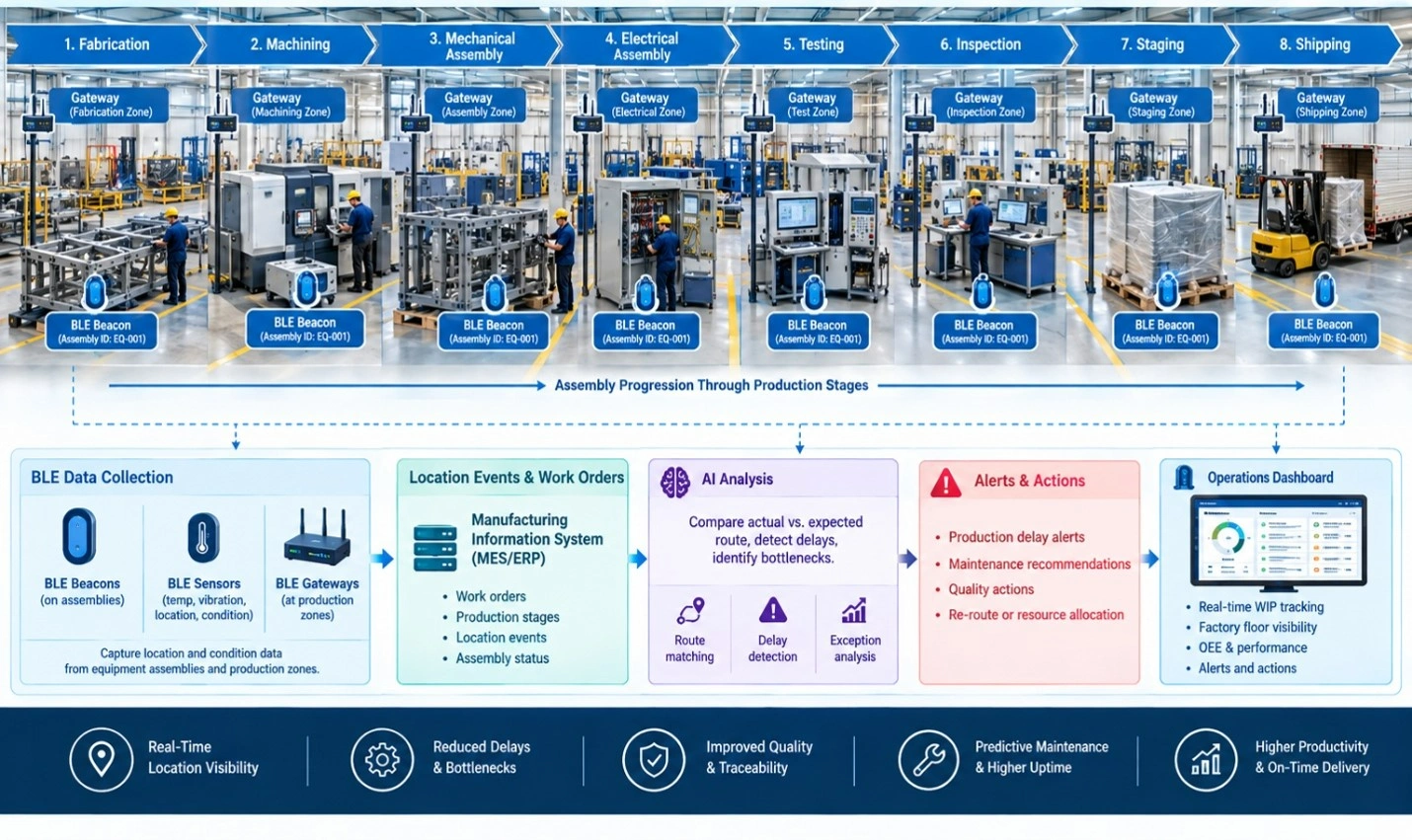
The visual illustrates how BLE Beacons and Gateways track industrial equipment assemblies across fabrication, machining, assembly, testing, inspection, staging, and shipping. Location events are connected with manufacturing work orders, while AI compares actual progress with expected routes to identify delays, bottlenecks, and production exceptions.
Predictive Maintenance for Factory Production Equipment
Maintenance is another high-value AI application because production interruptions can affect machining, fabrication, assembly, testing, and shipment schedules simultaneously.
BLE Sensors can contribute condition information from selected equipment where wireless monitoring is technically appropriate. Temperature and vibration measurements, for example, can help identify changes in motors, pumps, compressors, gearboxes, fans, or other rotating machinery.
AI models can establish baseline operating behavior and identify deviations. A useful predictive-maintenance program should distinguish between normal process variation and genuinely significant deterioration. A pump operating at different loads may naturally produce different vibration characteristics, so the model should consider operating state rather than treating every measurement change as a failure indicator.
GAO’s BLE hardware can be incorporated into systems where wireless condition monitoring, asset identification, and proximity data complement existing industrial controls and maintenance software.
Maintenance Signals Worth Combining
AI predictions become more useful when multiple data sources are correlated.
Relevant signals can include:
- BLE sensor measurements
- Machine runtime
- Maintenance history
- Failure records
- Work orders
- Spare-parts replacement history
- Motor current
- PLC status
- Production load
- Ambient conditions
- Inspection findings
- Operator observations
A practical implementation should also define what happens after an AI alert. Without a maintenance workflow, an anomaly score remains a technical output rather than an operational improvement.
AI Quality Control for Equipment Manufacturing
Quality problems in factory equipment manufacturing can originate from machining tolerances, incorrect components, assembly errors, wiring mistakes, hydraulic leaks, torque deviations, test failures, calibration problems, or incorrect configuration.
AI can correlate production conditions with inspection and test results to identify recurring causes. BLE data can add information about where an assembly has been, which production zone it occupied, or whether a mobile test instrument was available at the expected time.
Computer vision can complement BLE and other IoT technologies by inspecting welds, components, labels, connectors, surface conditions, assembly positions, and other visually observable characteristics. Test systems can provide electrical, hydraulic, pneumatic, or functional measurements.
The objective is not to make BLE perform inspection. BLE provides identification, proximity, location, or sensor information that can become useful context for AI-driven quality analysis.
Key AI and BLE Performance Measures for Equipment Manufacturers
Manufacturers should define KPIs before deployment rather than evaluating the system solely by the number of connected devices.
Useful measures include:
- Work-in-process location accuracy
- Asset search time
- Equipment utilization
- Production cycle time
- Unplanned downtime
- Mean time between failures
- Mean time to repair
- Preventive-maintenance compliance
- Predictive-maintenance alert precision
- Production schedule adherence
- First-pass yield
- Rework rate
- Test failure rate
- Inspection turnaround time
- Work-order completion time
- Tool utilization
- Material movement time
- Production staging time
- Energy consumption per manufactured unit
- Maintenance response time
The appropriate KPI set depends on whether the primary objective is production visibility, maintenance, quality, material movement, equipment utilization, or service readiness.
GAO Solutions for Connected Equipment Manufacturing
GAO provides BLE Gateways, BLE Beacons, BLE Sensors, RFID technologies, and other IoT hardware products and systems that can support manufacturing traceability, condition monitoring, asset visibility, and connected equipment applications. Our role in a factory equipment deployment can include supplying the hardware layer required to collect reliable operational data for integration with existing manufacturing and maintenance software.
GAO is headquartered in New York City and Toronto, Canada, and is ranked among the leading global B2B and B2G suppliers of BLE and RFID technologies. GAO, together with GAO Research Inc. and GAO Tek Inc., forms GAO Group, with operations based in New York City and Toronto.
Selecting Hardware for Factory Equipment Manufacturing
Hardware selection should begin with the manufacturing process rather than the wireless technology. A CNC machining area, welding cell, final assembly bay, outdoor staging yard, and finished-equipment warehouse can impose very different requirements.
BLE Beacons are appropriate for identifying mobile or stationary assets when the primary requirement is presence or location information. BLE Sensors are more suitable when equipment condition or environmental measurements are required. BLE Gateways should be selected according to coverage, network connectivity, installation conditions, data throughput, and the number of nearby BLE devices.
Important selection factors include:
- Metal density around machine tools, cabinets, frames, racks, and equipment assemblies
- Expected communication distance between BLE devices and gateways
- Required location resolution, such as zone-level versus more precise positioning
- Sensor measurement range and accuracy
- Sampling frequency required for the AI model
- Battery life for mobile assets and difficult-to-access installations
- Protection against dust, vibration, oil, moisture, and temperature extremes
- Gateway Ethernet, Wi-Fi, cellular, or other available network connectivity
- Compatibility with the manufacturer’s existing software interfaces
- Mounting method and mechanical protection
- Device replacement and maintenance procedures
High-frequency vibration analysis may require industrial sensing hardware specifically designed for that measurement rather than a general-purpose BLE sensor. BLE should complement existing PLCs, industrial control systems, condition-monitoring equipment, and test instrumentation when those systems already provide higher-quality data.
Deployment Planning for Equipment Manufacturing Plants
A successful deployment starts with a physical and operational survey. Manufacturing engineers, maintenance personnel, IT teams, controls engineers, production supervisors, and quality personnel should jointly identify where data can influence a measurable decision.
The planning process should map:
- Production cells and manufacturing routes
- CNC and fabrication areas
- Mechanical and electrical assembly stations
- Testing and inspection areas
- Material staging locations
- Tool cribs and maintenance areas
- Finished-equipment staging
- Shipping and receiving zones
- Network access points
- Existing PLC and industrial control interfaces
- Assets requiring identification
- Assets requiring condition monitoring
- Existing maintenance and manufacturing databases
Gateway coverage should then be validated against the actual floor layout. A drawing that appears to provide adequate wireless coverage may perform differently once machinery, steel structures, electrical cabinets, inventory racks, and large equipment assemblies are present.
Pilot deployments are particularly useful for equipment manufacturers with changing production layouts. A pilot can establish whether the desired location accuracy, sensor reliability, battery life, and data latency can be achieved before larger quantities of hardware are installed.
BLE Deployment Plan for Factory Equipment Manufacturing
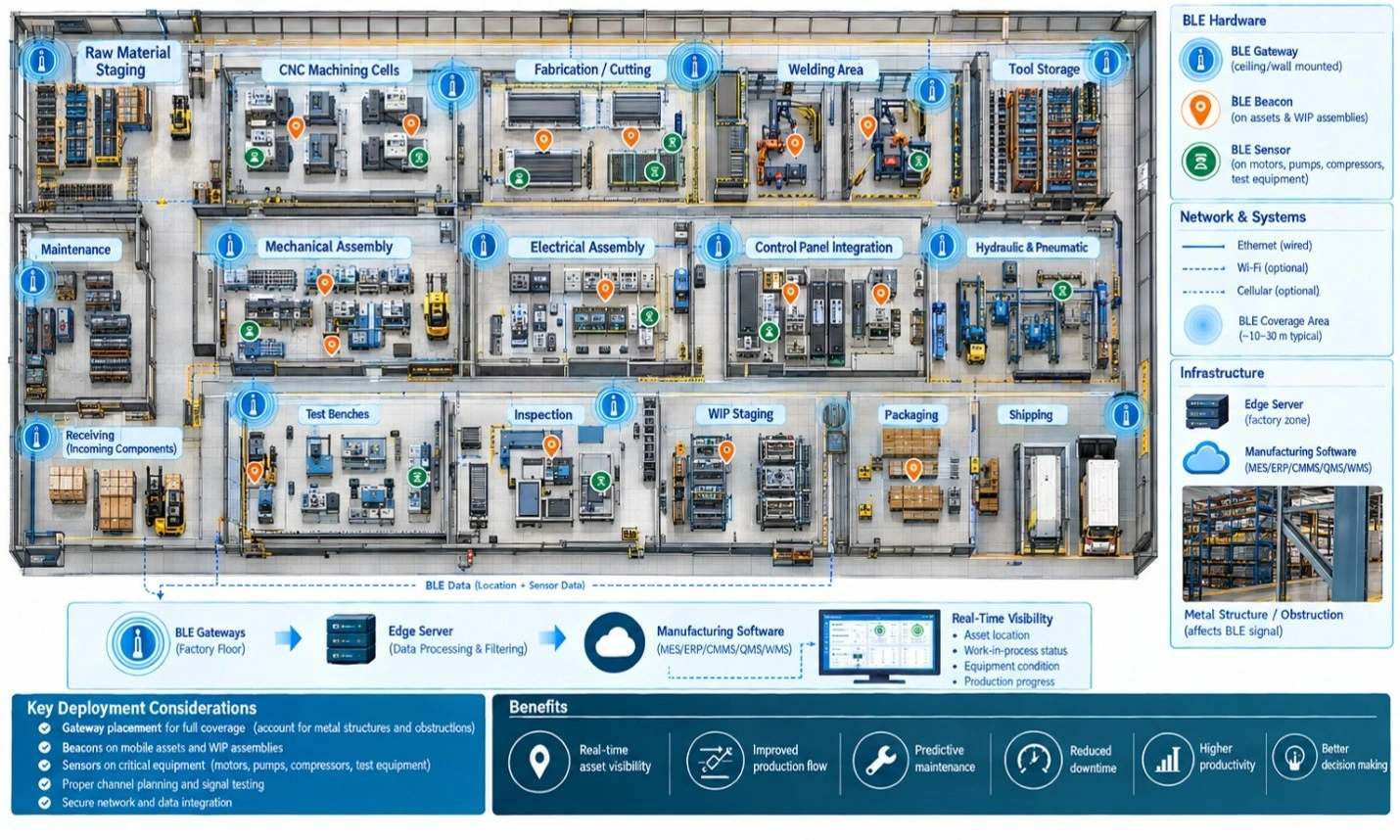
The diagram presents an engineering-oriented factory floor plan with BLE Gateways, Beacons, and Sensors positioned across machining, fabrication, assembly, testing, inspection, staging, maintenance, and shipping areas. It also illustrates BLE coverage, network connectivity, edge processing, manufacturing software integration, and key deployment considerations such as metal structures and signal obstructions.
Commissioning BLE and AI Systems
Commissioning should verify the physical installation, wireless behavior, data pipeline, software integration, and AI outputs before production use.
Each BLE device should have a controlled identity and documented installation location. Gateway configuration should be recorded, including network parameters, firmware versions, device associations, and communication settings. Sensor measurements should be checked against appropriate reference instruments where accuracy is operationally important.
Commissioning activities can include:
- Verifying beacon and sensor identifiers
- Confirming gateway connectivity
- Measuring coverage in representative production conditions
- Testing gateway behavior around large metal equipment
- Checking timestamp consistency
- Confirming sensor sampling intervals
- Validating battery status reporting
- Testing asset-to-work-order associations
- Confirming data reaches the intended manufacturing software
- Checking AI alert generation against known test scenarios
- Recording baseline equipment behavior
Commissioning should occur under realistic operating conditions. Testing an empty factory can produce misleading results because wireless propagation and asset behavior change when machines, carts, assemblies, personnel, and materials occupy production areas.
Integration with Manufacturing and Maintenance Software
BLE data rarely provides value in isolation. The strongest applications connect physical observations to software already used by factory equipment manufacturers.
Potential integration targets include:
- Manufacturing Execution Systems (MES)
- Enterprise Resource Planning (ERP) software
- Computerized Maintenance Management Systems (CMMS)
- Enterprise Asset Management (EAM) software
- Product Lifecycle Management (PLM) systems
- Warehouse Management Systems (WMS)
- Laboratory Information Management Systems where applicable to testing
- Quality Management Systems (QMS)
- Manufacturing databases
- Production scheduling software
- Service-management software
- Business intelligence dashboards
Middleware can normalize device identifiers, timestamps, location events, sensor measurements, and equipment records before they reach downstream applications.
For example, the BLE identifier of a mobile test instrument should not remain an isolated hexadecimal value in the manufacturing database. Middleware can associate that identifier with the instrument’s asset number, calibration status, assigned department, and current production location.
An AI application can then determine whether the correct test instrument is available for a particular work order and whether its condition or calibration status should affect production scheduling.
GAO hardware can serve as part of this data-collection layer while existing manufacturing applications remain the systems of record for production, maintenance, quality, and asset information.
Testing AI-Enabled Equipment Manufacturing Solutions
Testing should cover more than wireless connectivity. The complete chain from physical event to manufacturing decision must be validated.
A structured test program should examine:
- Device detection reliability
- Gateway coverage
- Location-event accuracy
- Sensor measurement accuracy
- Data transmission latency
- Duplicate-event handling
- Missing-data behavior
- Gateway failure recovery
- Network interruption behavior
- Database consistency
- Software interface behavior
- AI model response
- Alert thresholds
- False-positive rates
- False-negative risks
- User notification procedures
- Maintenance workflow creation
- Audit logging
AI models should be tested against representative historical and live production data. A model that performs well on laboratory data can produce poor results when production loads, machine configurations, material types, seasonal temperatures, or operating shifts change.
Factory engineers should establish acceptance criteria before production deployment. Examples include maximum acceptable location error, minimum sensor-data availability, maximum alert latency, acceptable false-alert frequency, and required recovery time after gateway or network failures.
Optimizing AI Models and Manufacturing Operations
Optimization should address both the technical system and the manufacturing process.
AI models can be refined by incorporating additional operational variables. A vibration anomaly model for a motor, for example, may become more accurate when motor load, runtime, temperature, and maintenance history are included. A production-delay model can improve when it considers work-order priority, component availability, engineering changes, inspection queues, and machine utilization.
Data quality deserves equal attention. Missing timestamps, duplicate identifiers, incorrectly assigned assets, sensor drift, and stale equipment records can undermine AI performance even when the machine-learning algorithm itself is technically sound.
Manufacturers should monitor:
- Data completeness
- Sensor drift
- Gateway availability
- AI prediction accuracy
- Alert resolution rates
- Production impact of recommendations
- Changes in equipment operating behavior
- Model performance across production cells
- Changes after equipment upgrades or process modifications
AI recommendations should remain traceable to the data and rules that generated them. Maintenance and production personnel need sufficient context to determine whether an alert warrants intervention.
Maintenance and Lifecycle Management
BLE hardware becomes part of the manufacturing environment and therefore requires its own maintenance process.
Maintenance teams should establish procedures for:
- Battery replacement
- Device inspection
- Gateway firmware management
- Sensor verification
- Damaged beacon replacement
- Gateway health monitoring
- Network troubleshooting
- Device inventory reconciliation
- Configuration backup
- Asset reassignment
- Decommissioning
Mobile equipment creates an additional lifecycle issue. A beacon attached to a production cart may remain useful for years, but the cart could be reassigned, rebuilt, or retired. The digital asset record should therefore be updated whenever physical equipment changes ownership or purpose.
AI models also require lifecycle management. Production processes evolve, machines are replaced, tooling changes, and new equipment configurations are introduced. A model trained on historical conditions should be periodically evaluated to determine whether its performance remains acceptable.
Scaling Across Equipment Manufacturing Facilities
Scaling from one production cell to an entire facility introduces challenges that do not necessarily appear during a pilot.
Device naming, asset identifiers, gateway configuration, network addressing, data retention, user permissions, and software interfaces should follow consistent standards.
A scalable implementation can establish reusable rules for:
- BLE device registration
- Asset naming
- Gateway commissioning
- Production-zone definitions
- Sensor calibration records
- Data retention
- AI model versioning
- Alert classification
- Maintenance escalation
- User access
- System monitoring
Multi-site manufacturers should also decide which functions should be standardized and which should remain site-specific. A machining facility may require different sensor configurations from a facility specializing in large welded equipment.
Cloud Version deployment can be appropriate when multiple manufacturing facilities need centralized access to analytics and software while avoiding the operation of dedicated application servers at every site. Cloud-hosted software can aggregate information from distributed factories, support centralized reporting, and simplify access for authorized production and maintenance teams.
Server Version deployment is appropriate when manufacturing information must remain within factory-controlled servers, private data centers, customer-managed infrastructure, or privately hosted enterprise environments. This model can be advantageous where data residency, network isolation, latency, or internal IT policies require greater control over application hosting.
Hybrid deployments can also be considered when edge processing handles immediate production decisions while selected data is transferred to centralized cloud or private servers for longer-term analysis.
Cybersecurity for Connected Factory Equipment
Security must cover the BLE devices, gateways, networks, servers, applications, and identities associated with the manufacturing system.
Relevant controls include:
- Device authentication where supported
- Strong administrative credentials
- Role-based access control
- Network segmentation
- Encrypted IP communications
- Secure gateway configuration
- Controlled firmware updates
- Centralized logging
- Asset inventory management
- Least-privilege access
- Secure API authentication
- Backup and recovery procedures
- Monitoring for unauthorized device changes
Manufacturing environments often contain sensitive information about machine configurations, production schedules, engineering changes, product designs, and equipment performance. Access to AI analytics should therefore follow the same security principles applied to other manufacturing information systems.
BLE should not be treated as a replacement for industrial network security. Gateway traffic should be integrated into the factory’s established IT and operational technology security controls.
Interoperability Across Factory Systems
Interoperability is especially important when a manufacturer already operates PLCs, MES, ERP, CMMS, QMS, and engineering systems from different vendors.
A useful data model should establish relationships among:
- Physical asset
- BLE identifier
- Production order
- Work order
- Manufacturing operation
- Production cell
- Location
- Sensor measurement
- Maintenance event
- Inspection result
- Quality event
Standard interfaces and well-defined APIs can reduce the risk of creating isolated data repositories.
The objective should be to make BLE observations useful to existing manufacturing processes rather than creating another disconnected application. A production supervisor should be able to determine why an assembly is delayed without manually reconciling several unrelated systems.
Engineering Trade-Offs and Implementation Lessons
AI-enabled factory equipment manufacturing should be designed around measurable operational problems. Connecting every asset can increase cost and data volume without producing corresponding business value.
Several engineering trade-offs deserve attention:
- Higher location precision generally requires more deliberate gateway placement and calibration than basic zone detection.
- Higher sensor sampling rates can improve analysis but increase battery consumption, network traffic, and data-processing requirements.
- Wireless monitoring reduces cabling but introduces radio-propagation considerations that must be tested around metal equipment.
- Cloud deployment can simplify centralized access, while private server deployment can provide greater control over sensitive manufacturing data.
- Automated AI recommendations can improve response time, but high-impact production decisions should retain appropriate human oversight.
- More sensors do not automatically produce better AI. Relevant, reliable measurements are generally more valuable than large volumes of poorly contextualized data.
- A highly accurate AI model has limited operational value if alerts do not connect to maintenance, production, or quality workflows.
The most effective implementations usually begin with one or two measurable problems, establish reliable data capture, validate the operational workflow, and then expand.
Practical Implementation Roadmap for Factory Equipment Manufacturers
A phased approach reduces deployment risk.
- Define the production or maintenance problem and its measurable business impact.
- Identify the equipment, assemblies, tools, and production stages involved.
- Map existing manufacturing, maintenance, quality, and network systems.
- Select BLE Beacons, BLE Sensors, and BLE Gateways according to physical and operational requirements.
- Conduct a pilot in a representative production area.
- Establish asset identities and data relationships.
- Integrate collected information with the appropriate manufacturing software.
- Develop and validate AI models using representative operating data.
- Test wireless performance, data integrity, software integration, and AI outputs.
- Establish cybersecurity, maintenance, and device-lifecycle procedures.
- Measure operational KPIs before and after deployment.
- Expand the solution to additional production cells or facilities after acceptance criteria are achieved.
This approach allows factory equipment manufacturers to demonstrate value through measurable improvements such as shorter asset-search times, reduced unplanned downtime, improved production schedule adherence, better work-in-process visibility, or reduced maintenance response times.
Business Value of AI-Enabled Equipment Manufacturing
The business value of AI and BLE is strongest when physical manufacturing events become actionable information.
Production teams gain better visibility into the movement and status of large assemblies. Maintenance teams can receive earlier indications of abnormal equipment behavior. Quality teams can correlate process conditions with inspection outcomes. Planners can make scheduling decisions using more current equipment and work-in-process information. Service teams can access better equipment history before field intervention.
GAO has served customers in the United States and Canada for three decades, including Fortune 500 companies, leading research and development organizations, universities, and government agencies. Its hardware products and systems can support applications involving BLE, RFID, and other IoT technologies.
GAO Group maintains significant R&D activity and stringent quality assurance processes, with technical support available remotely or onsite. For equipment manufacturers evaluating AIoT applications, this combination of hardware capability and engineering support can help address the practical data-collection requirements that precede effective AI deployment.
Key Takeaways for AI and BLE in Factory Equipment Manufacturing
AI-driven factory equipment manufacturing is not simply a matter of attaching wireless sensors to machines. The strongest solutions connect production assets, work-in-process assemblies, manufacturing processes, maintenance events, quality information, and enterprise software into a coherent operational data flow.
BLE Gateways, BLE Beacons, and BLE Sensors can provide useful identification, proximity, location, and condition information. AI can then analyze those observations alongside production and maintenance data to identify abnormal behavior, predict potential problems, improve scheduling, and support better manufacturing decisions.
Successful deployment depends on accurate asset identification, appropriate hardware selection, realistic wireless testing, reliable data integration, model validation, cybersecurity, and clear operational ownership.
Manufacturers can begin by identifying a high-value production problem, measuring its current performance, and determining which physical data is missing from the decision process. GAO can provide BLE, RFID, and IoT hardware products and systems, together with technical support, for organizations evaluating connected manufacturing applications.
Building the Future of Industrial AI and IoT with Aperture Venture Studio and GAO
For more than three decades, GAO Group of Companies has invested heavily in R&D covering industrial BLE, RFID, and IoT. As generative AI became increasingly useful for industrial applications, we expanded work on AIoT solutions that combine AI with connected equipment and sensors. We have also founded Aperture Venture Studio to advance AI and IoT solutions relevant to manufacturing, including intelligent factory equipment operations.
Aperture brings together AI and IoT technical experts, entrepreneurial and operational executives, investors, and leading companies. Through Aperture Ventures Summit and TekSummit, advanced AI and IoT topics are also explored with technical communities.
We welcome qualified participants as advisors, co-founders or employees, investors, and customers interested in advancing practical AI and IoT applications for factory equipment manufacturing.