
AI and BLE for Passenger Automobile Production
AI and BLE for Passenger Automobile Production & Intelligent Manufacturing Solutions for Modern Vehicle Assembly
Passenger Automobile Production has become one of the most data-intensive manufacturing environments within the Vehicle & Mobility Manufacturing industry. Modern assembly plants coordinate thousands of workers, robotic cells, automated guided vehicles (AGVs), autonomous mobile robots (AMRs), tooling assets, quality inspection stations, paint shops, body shops, powertrain assembly lines, and final vehicle assembly operations that must operate with exceptional precision and synchronization. Artificial Intelligence (AI) combined with Bluetooth Low Energy (BLE) technologies enables continuous visibility into production assets, material movement, workforce location, equipment utilization, and operational performance across the manufacturing lifecycle.
BLE beacons, BLE gateways, and BLE sensors continuously collect location, environmental, and operational data while AI transforms these data streams into actionable production intelligence. The result is improved assembly line efficiency, reduced production delays, enhanced worker safety, optimized inventory flow, predictive maintenance, and faster operational decision-making. Organizations increasingly adopt AI and BLE solutions to support digital manufacturing initiatives, Industry 4.0 programs, connected factories, and AIoT-enabled Passenger Automobile Production systems capable of responding dynamically to changing production demands.
GAO has supported manufacturers across North America by supplying BLE, RFID, and IoT hardware products and systems for demanding industrial environments. Headquartered in New York City and Toronto, Canada, GAO serves organizations requiring reliable industrial identification, tracking, sensing, and monitoring technologies.
AI and BLE for Passenger Automobile Production: Intelligent Connected Automotive Manufacturing Workflow
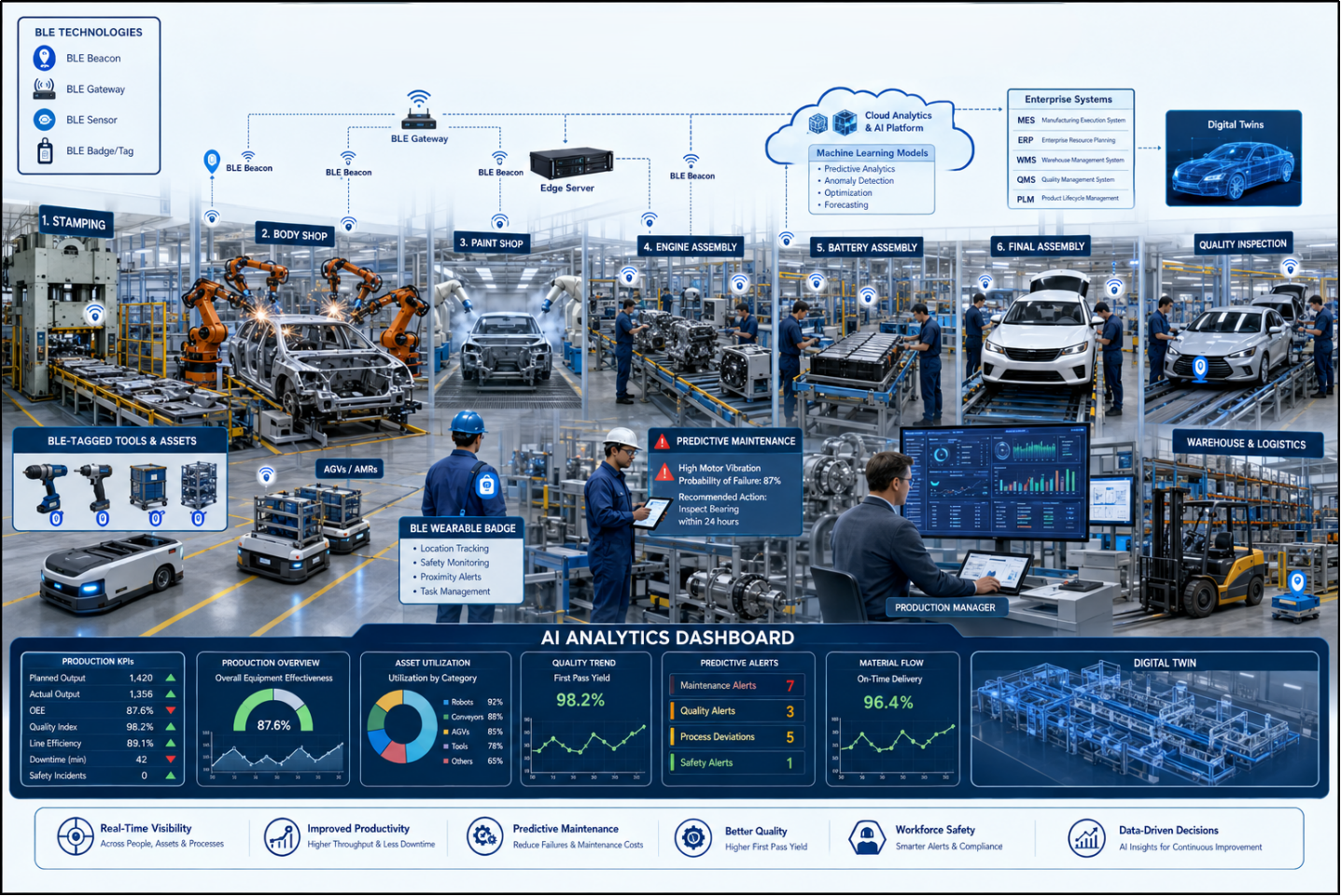
This illustration presents a comprehensive AI and BLE-enabled Passenger Automobile Production environment, showing how BLE beacons, gateways, sensors, wearable badges, and AI analytics connect stamping, body shop, paint shop, engine assembly, battery assembly, final assembly, quality inspection, and warehouse operations. It demonstrates how real-time data collected across the manufacturing facility is processed through edge servers, cloud analytics, enterprise software, and digital twins to enable predictive maintenance, production optimization, workforce visibility, and data-driven decision-making.
Understanding AI and BLE in Passenger Automobile Production
Passenger Automobile Production depends on synchronized manufacturing operations where thousands of components must arrive at the correct workstation precisely when needed. Vehicle assembly combines mechanical, electrical, electronic, software, and quality assurance processes that require continuous coordination among production equipment, operators, logistics systems, suppliers, and enterprise software.
BLE technology provides accurate indoor positioning, proximity detection, environmental sensing, equipment monitoring, and workforce visibility using low-power wireless communication. BLE beacons broadcast location identifiers, BLE gateways aggregate wireless information from production areas, and BLE sensors monitor machine conditions, environmental parameters, and production assets throughout the manufacturing plant.
Artificial Intelligence converts BLE-generated operational data into predictive insights using machine learning, anomaly detection, computer vision integration, predictive analytics, optimization algorithms, and large-scale operational intelligence. Rather than simply displaying equipment locations, AI identifies production bottlenecks, predicts workstation congestion, detects abnormal material movement, forecasts maintenance requirements, recommends workflow adjustments, and assists production supervisors with data-driven operational decisions.
Passenger Automobile Production benefits particularly from AI because manufacturing involves thousands of simultaneously moving assets whose interactions continuously influence production throughput, quality performance, inventory accuracy, and labor utilization.
Modern AI and BLE solutions have become an important component of connected automotive manufacturing by supporting:
- Vehicle body production
- Powertrain assembly
- Electric vehicle assembly
- Chassis production
- Interior assembly
- Paint shop operations
- Final vehicle inspection
- Material logistics
- Warehouse operations
- Finished vehicle yards
- Component supermarkets
- Sequenced parts delivery
- Automated storage systems
- Tool management
- Workforce safety monitoring
Unlike traditional barcode-based tracking, BLE provides continuous real-time visibility without requiring manual scanning at every production stage.
Why AI and BLE Matter in Passenger Automobile Production
Passenger automobile manufacturing demands exceptionally high production consistency while maintaining flexibility for multiple vehicle models, customer options, and rapidly changing production schedules.
Modern production facilities frequently manufacture internal combustion vehicles, hybrid vehicles, and battery electric vehicles on shared production lines. This complexity increases the need for intelligent tracking systems capable of monitoring materials, workers, equipment, and production flow continuously.
AI combined with BLE helps manufacturers address challenges including:
- Work-in-process visibility
- Tool availability
- Material shortages
- AGV congestion
- Production balancing
- Assembly sequence verification
- Equipment downtime
- Quality traceability
- Workforce coordination
- Maintenance scheduling
- Production takt adherence
- Vehicle genealogy
- Battery logistics
- High-value component tracking
Rather than reacting after production interruptions occur, AI continuously analyzes BLE data to predict developing issues before they disrupt assembly operations.
GAO supplies BLE hardware, industrial sensors, gateways, and identification technologies that support manufacturing organizations implementing intelligent monitoring solutions across demanding production environments.
How AI Enhances BLE-Generated Manufacturing Intelligence in Passenger Automobile Production
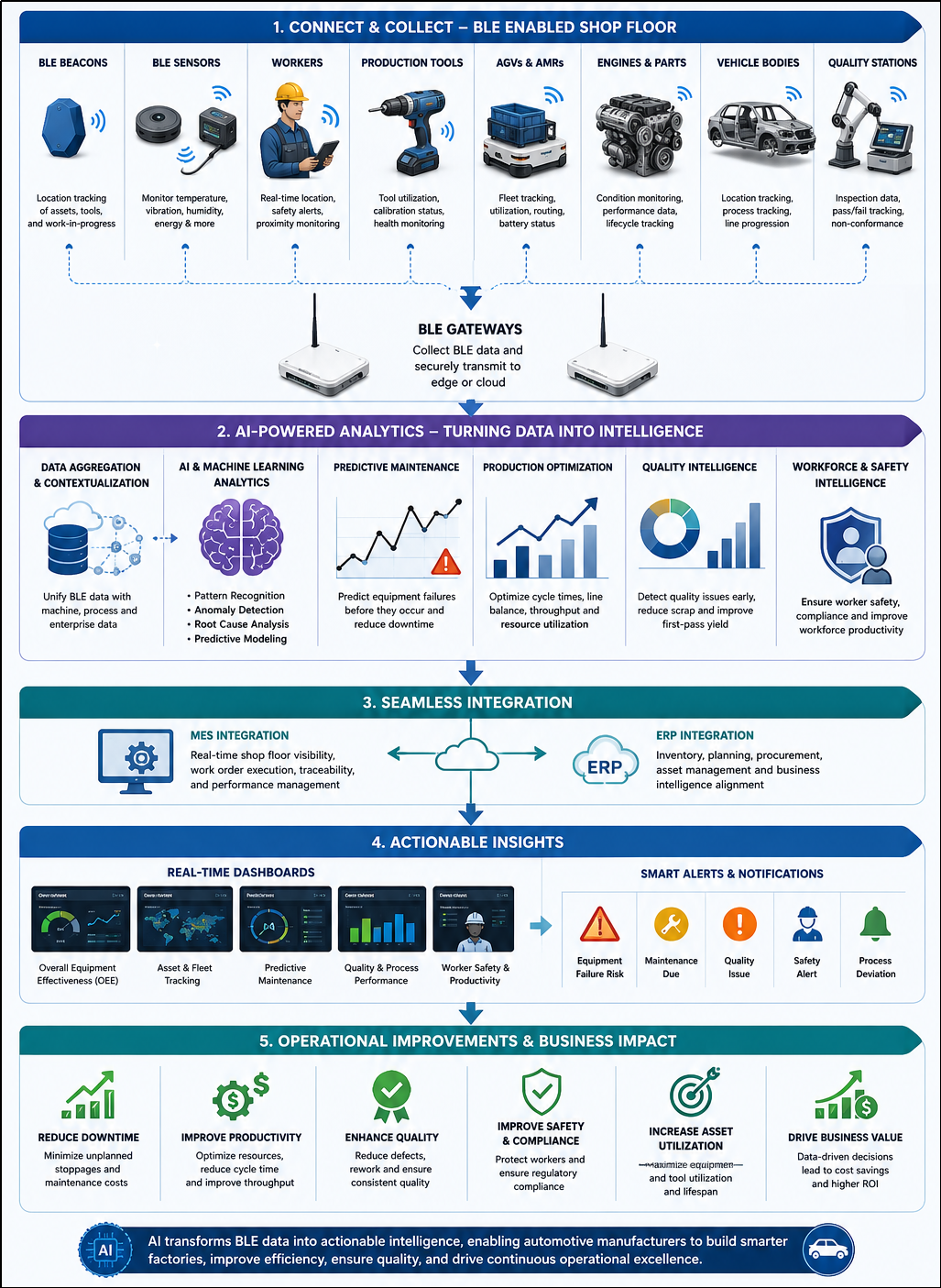
This infographic illustrates the complete AI and BLE workflow for Passenger Automobile Production, beginning with BLE-enabled data collection from production assets, workers, vehicles, and equipment. It shows how AI transforms BLE data into predictive maintenance, production optimization, quality intelligence, and workforce insights, integrates with MES and ERP systems, and delivers real-time dashboards, smart alerts, and measurable operational improvements across automotive manufacturing.
Passenger Automobile Production Applications for AI and BLE
Passenger automobile manufacturing consists of numerous interconnected production environments that benefit from AI-driven BLE monitoring.
Body Shop Operations
Body shops contain robotic welding cells, framing stations, laser measurement systems, material handling equipment, and automated conveyors. BLE enables continuous monitoring of welding fixtures, robotic tooling, maintenance carts, and mobile equipment while AI predicts equipment utilization, production delays, and maintenance requirements.
Paint Shop Management
Paint shops involve tightly controlled environmental conditions where humidity, temperature, airflow, curing ovens, paint inventory, and robotic painting systems significantly influence coating quality. BLE environmental sensors continuously monitor operating conditions while AI identifies patterns affecting paint consistency and predicts quality deviations before defects occur.
Powertrain Assembly
Engine and transmission assembly requires strict sequencing of components, torque verification, workstation balancing, and traceability. BLE tags monitor specialized assembly tools, torque equipment, pallets, and component carriers while AI analyzes production efficiency and predicts assembly bottlenecks.
Battery Assembly for Electric Vehicles
Battery manufacturing requires monitoring of battery modules, pack assembly stations, insulated tools, environmental conditions, automated transport systems, and quality inspection equipment. BLE sensors support environmental monitoring while AI assists battery traceability, quality prediction, and process optimization.
Final Vehicle Assembly
Final assembly integrates electrical systems, interiors, glazing, wheels, electronics, software programming, fluid filling, testing, and inspection. BLE tracks production carts, handheld tools, operator movements, inspection equipment, and workstations while AI improves production balancing and assembly sequence optimization.
Finished Vehicle Logistics
Completed vehicles move through inspection areas, storage yards, shipping preparation, and logistics staging. BLE provides location awareness while AI optimizes yard management, shipment sequencing, and vehicle retrieval operations.
AI and BLE Operational Workflow for Passenger Automobile Production
Passenger automobile production generates enormous quantities of operational data across manufacturing systems. AI transforms these distributed BLE data sources into coordinated manufacturing intelligence.
Typical operational workflow includes:
- BLE beacons attached to production assets continuously broadcast identification signals.
- BLE gateways receive beacon transmissions throughout manufacturing zones.
- BLE environmental sensors collect temperature, humidity, vibration, occupancy, and equipment status.
- Edge computing servers filter, validate, timestamp, and preprocess operational data.
- Manufacturing middleware aggregates BLE events with production records.
- AI software analyzes equipment utilization, production flow, workforce movement, and material logistics.
- Machine learning models identify operational anomalies and predict production interruptions.
- Digital twin software compares actual production performance with planned manufacturing schedules.
- Manufacturing Execution Systems synchronize production status.
- Enterprise Resource Planning software updates inventory, scheduling, procurement, and logistics.
- Supervisors receive dashboards, alerts, recommendations, and predictive maintenance notifications.
- Production managers implement corrective actions before assembly performance deteriorates.
This closed-loop operational workflow enables proactive production management instead of traditional reactive manufacturing.
AI and BLE Operational Workflow for Passenger Automobile Production: From Data Collection to Intelligent Manufacturing Decisions
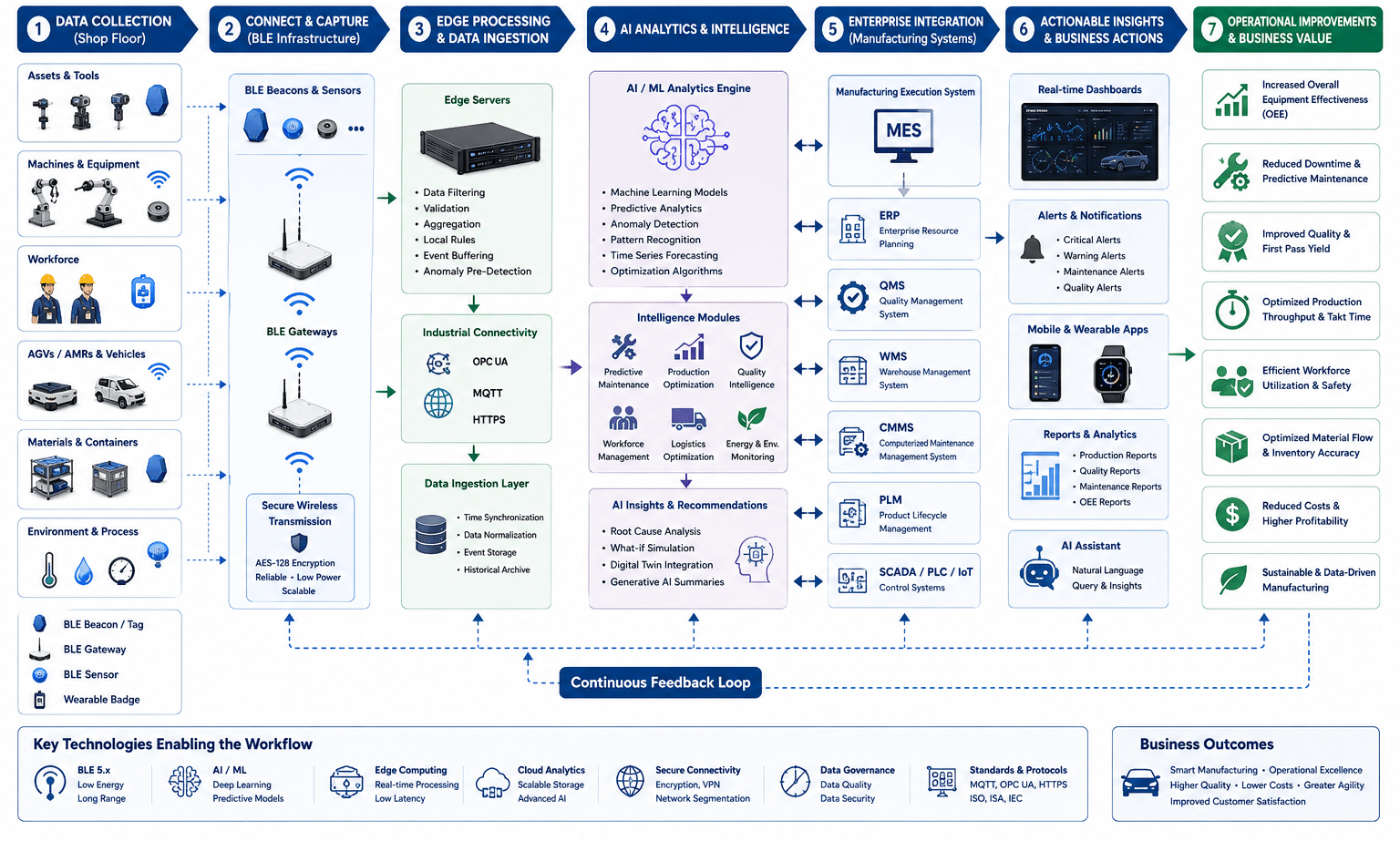
This workflow diagram illustrates the complete AI and BLE operational process for Passenger Automobile Production, beginning with BLE-enabled data collection from production assets, equipment, workers, and manufacturing environments. It shows how edge computing, AI analytics, enterprise systems such as MES, ERP, QMS, WMS, CMMS, and SCADA, and real-time dashboards work together to deliver predictive maintenance, production optimization, workforce management, quality intelligence, and continuous operational improvement.
Core Components of an AI and BLE Solution for Passenger Automobile Production
Successful AI and BLE deployments in Passenger Automobile Production require coordinated hardware, software, communications infrastructure, AI models, cybersecurity controls, and manufacturing integration. Each component contributes specific operational capabilities that enable reliable data collection, intelligent analysis, and production optimization across automotive assembly facilities.
BLE Hardware Infrastructure
BLE hardware forms the foundation of the solution by providing continuous wireless visibility across body shops, paint facilities, battery assembly lines, logistics zones, component warehouses, and final assembly operations.
Key hardware components include:
- Industrial BLE beacons mounted on tooling carts, returnable transport items, pallets, battery racks, torque tools, robotic end effectors, mobile workstations, and high-value production assets
- BLE gateways installed throughout manufacturing zones to receive beacon transmissions and relay data to factory networks
- BLE environmental sensors monitoring temperature, humidity, vibration, air quality, machine health, and occupancy in critical production areas
- Wearable BLE badges supporting workforce location awareness, emergency mustering, restricted-area compliance, and technician dispatch
- Battery-powered BLE asset tags designed for long operational life in demanding automotive environments
- Industrial edge gateways connecting BLE devices with Ethernet, industrial Wi-Fi, or private 5G networks for reliable plant-wide communication
BLE devices are typically selected based on transmission range, battery longevity, ingress protection rating, operating temperature, mounting method, and compatibility with industrial environments containing welding equipment, metal structures, and electromagnetic interference.
GAO provides BLE hardware products designed to support reliable identification, sensing, and monitoring applications across manufacturing operations.
Software, AI Models, Communication Infrastructure, and Deployment Considerations for AI and BLE in Passenger Automobile Production
A successful AI and BLE solution for Passenger Automobile Production extends far beyond wireless hardware. Manufacturing organizations require software capable of collecting millions of BLE events, correlating them with production activities, interpreting operational conditions through AI, and delivering recommendations that improve assembly efficiency, equipment availability, and production quality. The software layer acts as the operational intelligence engine that converts raw BLE data into manufacturing insights supporting supervisors, maintenance teams, production planners, logistics personnel, quality engineers, and plant management.
GAO has supplied BLE and IoT technologies for organizations implementing intelligent manufacturing systems that require dependable data acquisition, industrial reliability, and long-term operational support.
BLE Device Management Software
BLE devices deployed across automobile manufacturing facilities require centralized configuration, health monitoring, firmware management, and lifecycle administration.
Typical software capabilities include:
- Beacon registration and provisioning
- Battery health monitoring
- Signal strength optimization
- Firmware update management
- Device authentication
- Asset association
- Zone configuration
- Gateway diagnostics
- Event logging
- Fault reporting
- Configuration backup
- Remote device management
Manufacturing facilities often operate tens of thousands of BLE devices. Centralized management significantly reduces maintenance effort while improving operational reliability.
Edge Computing Software
Passenger Automobile Production generates continuous wireless communications from assembly stations, robotic cells, logistics vehicles, inspection systems, and production assets.
Rather than transmitting every BLE event directly to centralized servers, edge computing software performs localized processing near production operations.
Common edge processing functions include:
- BLE signal filtering
- Duplicate event removal
- Timestamp synchronization
- Sensor validation
- Temporary buffering
- Data aggregation
- Initial anomaly detection
- Local rule execution
- Equipment state monitoring
- Emergency alert generation
Edge processing reduces network utilization while allowing time-sensitive manufacturing decisions to occur with minimal latency.
Typical edge servers are installed within production halls, logistics warehouses, battery assembly facilities, paint shops, or body shop control rooms where deterministic performance is required.
Manufacturing Middleware
Manufacturing middleware connects BLE infrastructure with production software already operating throughout Passenger Automobile Production facilities.
Rather than replacing existing manufacturing software, middleware exchanges operational information between systems.
Typical integrations include:
- Manufacturing Execution Systems (MES)
- Enterprise Resource Planning (ERP)
- Warehouse Management Systems (WMS)
- Product Lifecycle Management (PLM)
- Computerized Maintenance Management Systems (CMMS)
- Quality Management Systems (QMS)
- Manufacturing Intelligence software
- Supervisory Control and Data Acquisition (SCADA)
- Human Machine Interfaces (HMI)
- Digital Twin software
- Industrial historians
- Business Intelligence software
Middleware correlates BLE location events with production orders, vehicle identification numbers (VINs), assembly sequences, quality records, tooling history, and maintenance activities.
This integration creates a unified operational view that improves manufacturing decision-making.
AI Software Components
Artificial Intelligence continuously evaluates BLE-generated operational information instead of relying solely on predefined rules.
AI software typically includes multiple analytical components operating simultaneously.
Common AI capabilities include:
- Predictive analytics
- Machine learning
- Deep learning
- Time-series forecasting
- Anomaly detection
- Production optimization
- Resource scheduling
- Workforce optimization
- Root cause analysis
- Intelligent alert prioritization
- Pattern recognition
- Recommendation engines
- Generative AI operational assistants
- Natural language reporting
- Knowledge retrieval systems
These capabilities enable production managers to identify developing operational problems before measurable production losses occur.
Machine Learning Models Used in Passenger Automobile Production
Different production processes require different AI approaches because assembly operations, logistics, maintenance, and quality assurance produce unique operational characteristics.
Frequently deployed models include:
Regression Models
Used for:
- Production throughput prediction
- Cycle time estimation
- Energy consumption forecasting
- Equipment utilization forecasting
- Production capacity planning
Classification Models
Applied to:
- Production state recognition
- Quality pass/fail prediction
- Tool availability
- Equipment health classification
- Operator workflow categorization
Clustering Algorithms
Useful for:
- Worker movement analysis
- Production bottleneck identification
- Asset utilization grouping
- Logistics traffic analysis
- Tool usage behavior
Time-Series Forecasting
Frequently predicts:
- Machine failures
- Conveyor congestion
- Material shortages
- Battery inventory demand
- Spare parts consumption
- Production output
Reinforcement Learning
Supports:
- AGV routing
- Autonomous material movement
- Production balancing
- Assembly sequence optimization
- Warehouse traffic optimization
Computer Vision Integration
BLE frequently complements computer vision systems rather than replacing them.
Vision systems identify:
- Vehicle body alignment
- Weld quality
- Paint defects
- Surface inspection
- Part presence verification
- Operator safety compliance
BLE simultaneously provides contextual information regarding tool location, workstation occupancy, equipment identity, and operator proximity.
Together they produce significantly richer manufacturing intelligence than either technology independently.
Generative AI for Manufacturing Operations
Generative AI increasingly assists Passenger Automobile Production by interpreting operational information gathered from BLE systems.
Typical applications include:
- Automatic shift reports
- Maintenance summaries
- Production performance explanations
- Root cause investigations
- Operational recommendations
- Equipment troubleshooting guidance
- Supervisor question answering
- Knowledge retrieval
- Standard operating procedure assistance
- Technician support
Rather than manually reviewing hundreds of dashboards, supervisors receive concise AI-generated summaries describing production conditions requiring immediate attention.
AI and BLE Software Components for Passenger Automobile Production: Intelligent Manufacturing Software and Enterprise Integration
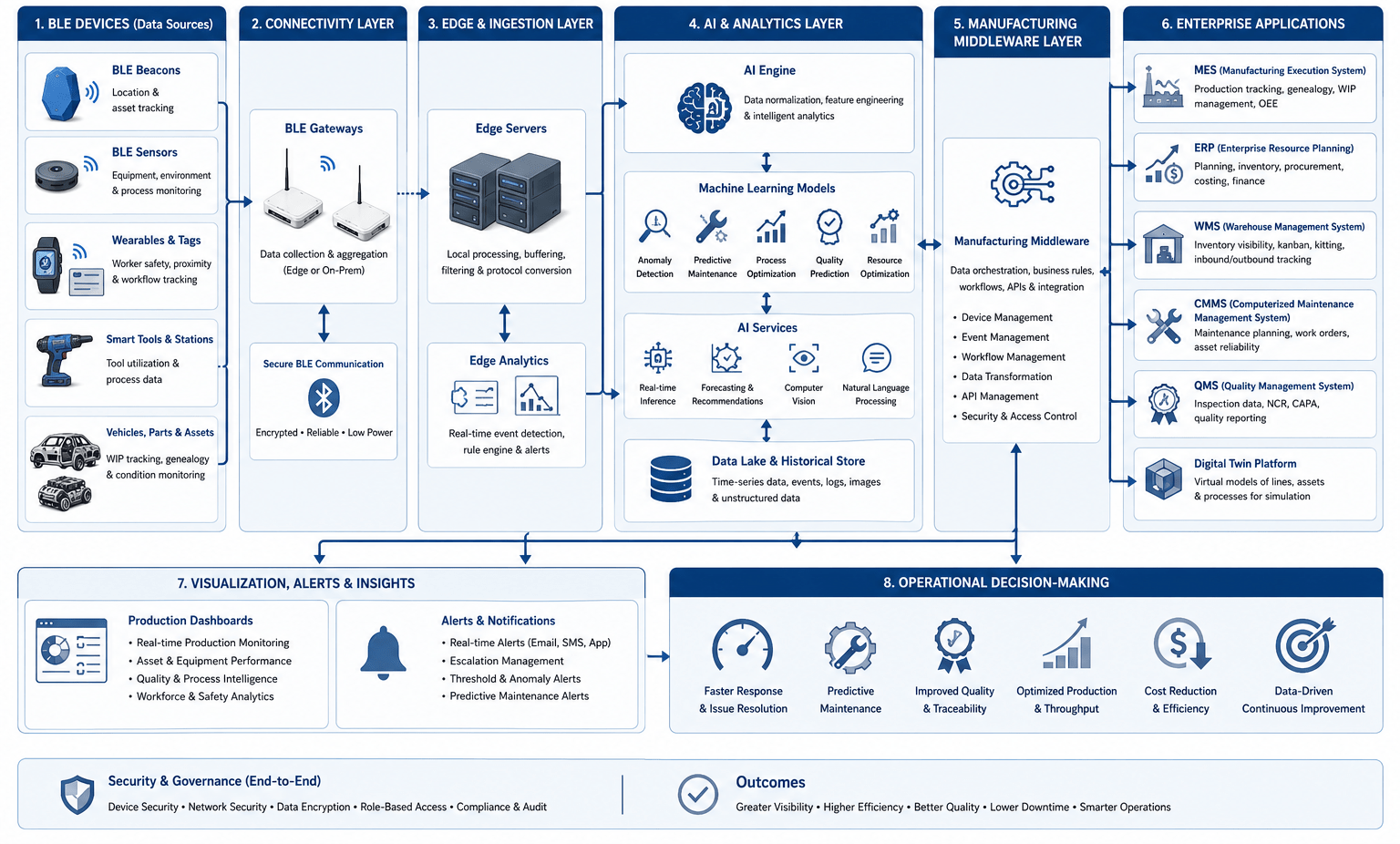
This block diagram illustrates the complete software stack supporting AI and BLE in Passenger Automobile Production, from BLE devices and gateways through edge computing, AI analytics, manufacturing middleware, and enterprise applications. It demonstrates how AI, machine learning, and enterprise systems including MES, ERP, WMS, CMMS, QMS, and Digital Twin software work together to deliver real-time dashboards, predictive maintenance, production optimization, quality management, and data-driven operational decision-making.
Communication Infrastructure Supporting AI and BLE
Reliable communications determine the effectiveness of BLE deployments inside automotive manufacturing plants.
Passenger Automobile Production facilities contain robotic welding equipment, large steel structures, automated conveyors, battery charging stations, paint booths, high-voltage equipment, and extensive production machinery that can influence wireless performance.
Typical communication technologies include:
- Bluetooth Low Energy
- Industrial Ethernet
- Gigabit Ethernet
- Time-Sensitive Networking (TSN)
- Industrial Wi-Fi
- Private 5G
- OPC UA
- MQTT
- AMQP
- HTTPS
- REST APIs
- WebSocket communication
- Modbus TCP
- PROFINET
- EtherNet/IP
MQTT is frequently used for lightweight IoT messaging between BLE gateways and edge servers.
OPC UA enables interoperability with industrial automation systems.
Industrial Ethernet provides deterministic communication between production equipment.
Private 5G increasingly supports mobile robotics, AGVs, and connected production equipment requiring predictable wireless coverage.
Cloud Version and Server Version Deployments
Passenger Automobile Production organizations frequently select deployment models based on operational requirements, cybersecurity policies, regulatory obligations, production latency, and IT governance.
Cloud Version
Cloud-hosted deployments operate within managed cloud infrastructure while manufacturing facilities transmit operational information through secure communication channels.
Cloud deployments are well suited for:
- Multi-plant manufacturing organizations
- Global production visibility
- Fleet-wide analytics
- Long-term data retention
- AI model training
- Corporate dashboards
- Executive reporting
- Supplier collaboration
- Remote engineering support
Benefits include:
- Elastic computing resources
- Simplified software updates
- Centralized management
- Faster deployment
- Reduced infrastructure administration
- Enterprise-wide reporting
- Scalable AI processing
Cloud deployments are commonly selected when production facilities are geographically distributed and require centralized operational visibility.
Server Version
Many automobile manufacturers deploy software on privately managed servers located within factory data centers, edge computing rooms, or customer-controlled hosting facilities.
Server deployments are preferred when organizations require:
- Low-latency production decisions
- Local manufacturing autonomy
- Restricted external connectivity
- Compliance with internal cybersecurity policies
- Deterministic production response
- Direct integration with existing factory software
- High availability during internet interruptions
Server deployments frequently support body shops, paint shops, battery production facilities, and final assembly operations where operational continuity is critical.
Hybrid implementations combining local servers with cloud analytics are increasingly common because they balance low-latency manufacturing operations with enterprise-wide reporting and AI model optimization.
Cybersecurity and Operational Security
Passenger Automobile Production increasingly depends on connected operational technologies, making cybersecurity an essential design consideration.
Recommended security measures include:
- Device authentication
- Role-based access control
- Multi-factor authentication
- Secure firmware updates
- TLS encrypted communications
- VPN connectivity
- Certificate management
- Network segmentation
- Zero Trust security principles
- Security Information and Event Management (SIEM)
- Continuous vulnerability monitoring
- Endpoint protection
- Security event logging
- Disaster recovery planning
- High-availability failover
- Regular penetration testing
BLE devices should be commissioned using authenticated provisioning processes, while gateways should enforce encrypted communications and certificate-based trust relationships with edge servers and enterprise software.
For manufacturers operating globally, cybersecurity strategies should also align with recognized standards such as IEC 62443, ISO/SAE 21434 (for automotive cybersecurity), ISO 27001, and the NIST Cybersecurity Framework, helping protect production continuity, connected manufacturing assets, and sensitive operational data.
Technical Capabilities of AI and BLE for Passenger Automobile Production
Combining AI with BLE technologies enables Passenger Automobile Production facilities to move beyond basic asset tracking toward intelligent manufacturing operations that continuously analyze production conditions and recommend improvements. BLE provides persistent awareness of people, tools, vehicles, equipment, and environmental conditions, while AI transforms these observations into operational intelligence that supports manufacturing excellence.
Real-Time Asset Visibility
Passenger automobile plants manage thousands of mobile assets, including torque tools, welding fixtures, robotic end effectors, returnable transport items, battery lifting devices, inspection equipment, and production carts. BLE beacons continuously broadcast asset identities, enabling gateways to determine their locations throughout body shops, paint facilities, assembly lines, warehouses, and shipping yards.
AI analyzes asset movement histories to:
- Identify underutilized equipment
- Detect misplaced production tools
- Predict asset shortages before they delay production
- Recommend equipment redistribution across production zones
- Reduce time spent searching for critical manufacturing resources
Workforce Location Awareness
Production personnel frequently move among assembly stations, maintenance areas, quality inspection zones, logistics corridors, and restricted manufacturing areas. BLE-enabled identification badges improve workforce visibility while respecting organizational privacy policies and applicable labor regulations.
AI enhances workforce management by:
- Optimizing technician dispatch
- Identifying staffing imbalances
- Monitoring emergency evacuation status
- Detecting unauthorized area access
- Improving response times for equipment failures
Intelligent Material Flow
Passenger Automobile Production depends on synchronized delivery of body panels, engines, battery packs, dashboards, wiring harnesses, seats, glass assemblies, and countless other components.
BLE enables continuous tracking of:
- Component carriers
- Sequenced delivery racks
- Returnable containers
- Material carts
- AGVs
- AMRs
- Finished vehicle movement
AI analyzes logistics patterns to reduce congestion, improve line-side replenishment, minimize inventory delays, and maintain takt time adherence.
Predictive Maintenance
Automotive manufacturing equipment often operates continuously across multiple shifts. Unexpected failures can interrupt production schedules and affect downstream operations.
BLE vibration, temperature, and equipment condition sensors provide continuous machine health data that AI models evaluate to identify developing maintenance issues.
Typical monitored assets include:
- Welding robots
- Conveyor systems
- Servo presses
- Paint pumps
- Cooling systems
- Industrial compressors
- Torque tools
- Battery handling equipment
- Automated storage systems
Predictive maintenance reduces unplanned downtime, extends equipment life, and supports more efficient maintenance scheduling.
Traditional Monitoring vs. AI and BLE in Passenger Automobile Production
| Operational Area | Traditional Manufacturing Monitoring | AI and BLE-Enabled Passenger Automobile Production | Business Impact |
| Asset Visibility | Assets such as torque tools, welding fixtures, pallets, and production carts are located using manual searches, barcode scans, or periodic inventory audits, resulting in limited real-time visibility. | BLE beacons continuously track tools, mobile equipment, returnable containers, AGVs, and production assets, while AI analyzes utilization, movement patterns, and location history in real time. | Improved asset utilization, reduced search time, lower equipment loss, and faster production support. |
| Maintenance Management | Maintenance follows fixed schedules or reacts to equipment failures, increasing unplanned downtime and unnecessary preventive maintenance. | BLE vibration and environmental sensors continuously monitor machine health, while AI predicts failures, prioritizes maintenance activities, and recommends optimal service windows. | Reduced unplanned downtime, increased equipment availability, longer asset life, and lower maintenance costs. |
| Production Scheduling | Production schedules rely on historical data and manual updates, making it difficult to respond quickly to disruptions or changing demand. | AI continuously evaluates BLE-derived production data, workstation occupancy, equipment availability, and material flow to optimize schedules dynamically. | Better takt time adherence, higher throughput, improved production balancing, and faster response to disruptions. |
| Material Tracking | Components, returnable containers, and work-in-process materials are tracked through manual documentation or barcode scanning at predefined checkpoints. | BLE provides continuous location tracking for material carriers, parts, battery modules, and logistics equipment, while AI optimizes material flow and inventory replenishment. | Reduced material shortages, improved inventory accuracy, minimized production delays, and better logistics coordination. |
| Workforce Visibility | Worker locations are monitored through manual reporting, access control systems, or supervisor observations with limited operational insight. | BLE-enabled wearable badges provide real-time personnel location awareness, while AI optimizes technician dispatch, monitors restricted-area access, and supports emergency response. | Faster maintenance response, improved workforce safety, better labor utilization, and enhanced operational coordination. |
| Quality Monitoring | Quality inspections occur at designated checkpoints, often identifying defects only after production steps have been completed. | AI correlates BLE data with production parameters, operator activities, tooling usage, and inspection results to identify quality trends and predict potential defects. | Higher first-pass yield, improved traceability, earlier defect detection, and reduced rework. |
| Operational Response | Production issues are identified after alarms, operator reports, or equipment failures, resulting in reactive decision-making. | AI continuously detects anomalies, predicts production bottlenecks, prioritizes alerts, and recommends corrective actions before disruptions affect assembly operations. | Faster issue resolution, reduced production interruptions, improved operational resilience, and lower downtime. |
| Analytics and Reporting | Reports are generated periodically using historical production data with limited predictive capability. | AI automatically analyzes millions of BLE events to produce real-time dashboards, predictive analytics, trend analysis, and AI-generated operational summaries. | Better production visibility, faster management decisions, improved forecasting, and continuous operational improvement. |
| Decision Support | Production managers rely primarily on experience, manual analysis, spreadsheets, and historical performance reports. | AI delivers real-time recommendations, predictive insights, root cause analysis, and data-driven decision support integrated with MES, ERP, WMS, and QMS software. | More informed decisions, higher manufacturing efficiency, optimized resource allocation, and stronger strategic planning. |
Operational Improvements and Business Value
Passenger Automobile Production organizations implementing AI and BLE solutions often experience measurable operational improvements because manufacturing decisions become based on continuously updated operational data rather than periodic manual observations.
Production Efficiency
AI analyzes assembly line performance, workstation occupancy, equipment utilization, and material availability to recommend workflow adjustments that improve throughput while reducing idle time.
Potential improvements include:
- Better production balancing
- Reduced assembly interruptions
- Faster changeovers
- Improved takt time compliance
- Enhanced production scheduling
- Lower work-in-process inventory
Quality Assurance
BLE provides traceability for tools, components, operators, and production stations throughout vehicle manufacturing.
AI strengthens quality management by:
- Correlating production conditions with defect trends
- Identifying recurring quality deviations
- Supporting root cause investigations
- Monitoring process consistency
- Improving first-pass yield
Maintenance Performance
Maintenance organizations benefit from AI-assisted prioritization of service activities.
Benefits include:
- Reduced emergency repairs
- Improved spare parts planning
- Better maintenance scheduling
- Longer equipment availability
- Increased production uptime
Inventory Optimization
Continuous visibility into production inventory supports:
- Accurate line-side inventory
- Reduced stock shortages
- Improved returnable container management
- Faster inventory reconciliation
- Better supplier coordination
Workforce Safety
BLE-enabled personnel awareness improves safety by supporting:
- Emergency mustering
- Restricted-area monitoring
- Lone worker protection
- Collision avoidance around AGVs and AMRs
- Faster emergency response
Performance, Scalability, and Engineering Considerations
Passenger Automobile Production facilities vary significantly in size, production volume, and manufacturing complexity. AI and BLE solutions should therefore be designed with scalability, interoperability, and long-term maintainability in mind.
Key engineering considerations include:
- BLE coverage planning to minimize radio interference caused by metal structures, robotic cells, and enclosed production areas
- Gateway placement based on manufacturing layouts and asset density
- Battery replacement strategies for long-life BLE devices
- Redundant communication paths for critical production zones
- Time synchronization across gateways and edge servers
- Integration with existing MES, ERP, and SCADA software
- Data retention policies aligned with production traceability requirements
- AI model retraining using evolving production data
- Capacity planning for future production expansion and new vehicle programs
Careful commissioning, site surveys, and performance validation help ensure reliable operation throughout the manufacturing lifecycle.
Implementation Recommendations
Organizations planning AI and BLE initiatives for Passenger Automobile Production should adopt a phased implementation approach that minimizes operational disruption while demonstrating measurable business value.
Recommended practices include:
- Define measurable objectives such as reducing equipment downtime, improving tool utilization, or increasing inventory accuracy.
- Perform a comprehensive wireless site survey before installing BLE infrastructure.
- Select industrial-grade BLE hardware suitable for welding environments, paint facilities, battery production, and logistics operations.
- Integrate BLE event data with existing manufacturing software instead of creating isolated information silos.
- Begin with pilot deployments in selected production areas before expanding plant-wide.
- Establish cybersecurity requirements during system design rather than after deployment.
- Continuously validate AI recommendations against operational outcomes and refine analytical models as manufacturing conditions evolve.
- Train production supervisors, maintenance personnel, quality engineers, and IT teams on interpreting AI-generated insights and maintaining BLE infrastructure.
Drawing on decades of experience supporting industrial identification and sensing applications, GAO assists manufacturers with selecting appropriate BLE hardware, planning deployments, integrating IoT technologies, and providing technical support throughout implementation.
Complete AI and BLE Solution for Passenger Automobile Production: End-to-End Intelligent Manufacturing System
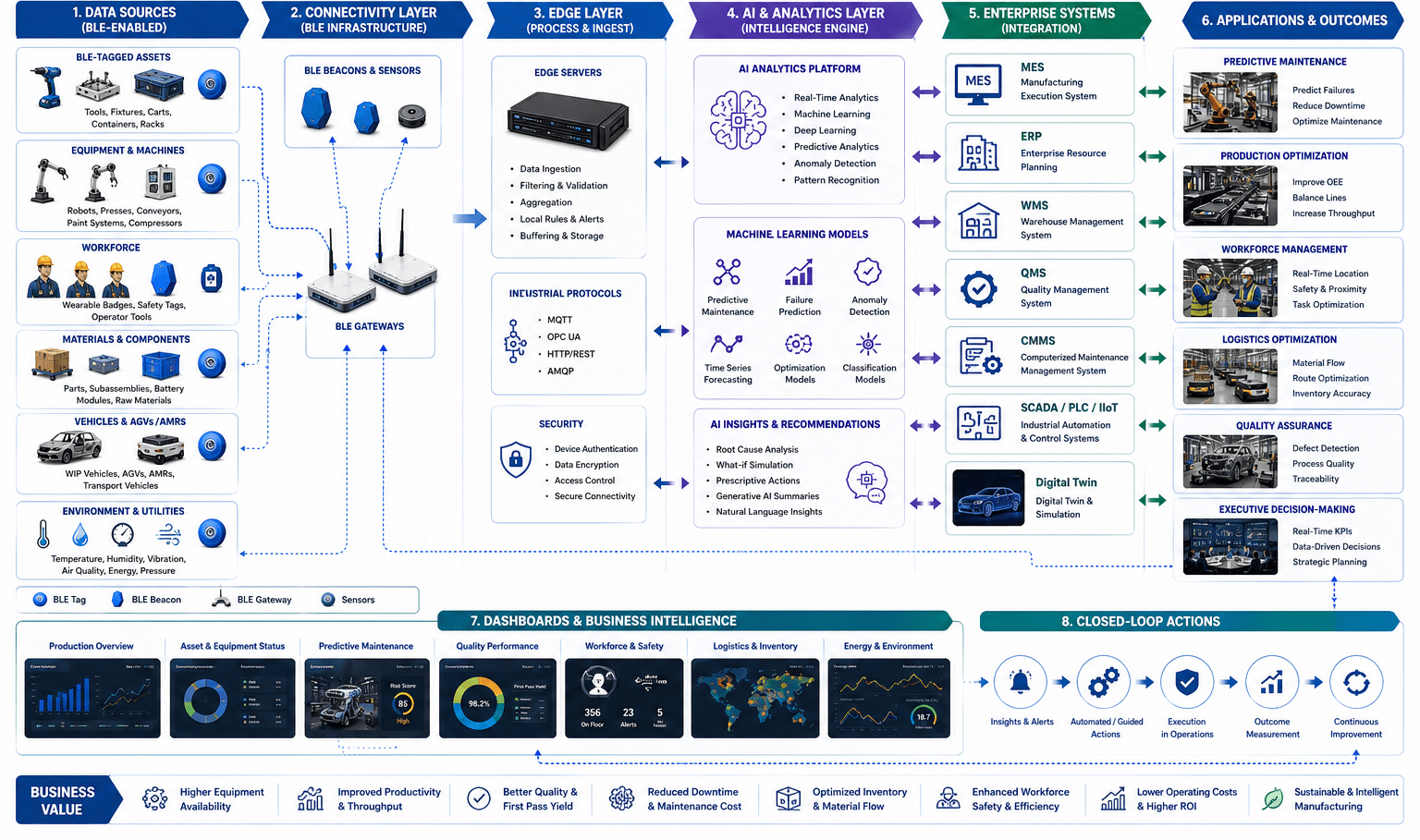
This solution overview block diagram illustrates the complete AI and BLE-enabled Passenger Automobile Production system, from BLE-tagged assets, sensors, and gateways through edge processing, AI analytics, and enterprise software integration. It demonstrates how manufacturing systems such as MES, ERP, WMS, QMS, CMMS, SCADA, and Digital Twin software transform real-time operational data into predictive maintenance, production optimization, workforce management, logistics intelligence, quality assurance, executive dashboards, and continuous operational improvement.
Advancing Passenger Automobile Production with AI and BLE
AI and BLE technologies are transforming Passenger Automobile Production by delivering continuous operational visibility, intelligent analytics, and proactive decision support across assembly lines, logistics operations, quality assurance, and maintenance activities. Together, these technologies help manufacturers improve productivity, strengthen quality control, enhance workforce safety, and optimize the movement of assets, materials, and vehicles throughout complex production facilities.
Successful implementations depend on thoughtful planning, robust wireless infrastructure, secure integration with manufacturing software, and AI models tailored to automotive production workflows. As manufacturing operations continue to evolve toward greater automation and data-driven decision-making, AI and BLE will remain important enabling technologies for connected vehicle assembly.
GAO, headquartered in New York City and Toronto, Canada, is recognized among the world’s leading B2B and B2G suppliers of BLE and RFID technologies. Together with its sister companies, GAO Research Inc. and GAO Tek Inc., GAO has supported customers throughout the United States and Canada for more than three decades, including Fortune 500 companies, leading research organizations, prestigious universities, and government agencies. Through continued investment in research and development, stringent quality assurance processes, and expert remote and onsite technical support, GAO helps manufacturers deploy reliable BLE, RFID, and AIoT solutions for demanding industrial environments.
Building the Future of Industrial AI and IoT with Aperture Venture Studio and GAO RFID Inc.
For more than three decades, GAO Group of Companies has invested extensively in industrial BLE, RFID, and IoT research and development. As generative AI has demonstrated significant value in manufacturing applications such as Passenger Automobile Production, we have continued expanding our AI and IoT capabilities while establishing Aperture Venture Studio to accelerate the development and growth of advanced AI and IoT solutions for modern industries. Aperture has brought together leading AI researchers, IoT engineers, operational executives, investors, and technology organizations while fostering technical collaboration through initiatives such as Aperture Ventures Summit and TekSummit. These collaborative communities continue advancing industrial AI and IoT innovation. We welcome participation from advisors, investors, customers, and professionals interested in shaping the future of intelligent manufacturing solutions.