
AI-Driven BLE Solutions for Precision Metal Components Manufacturing
AI-Powered BLE Systems Are Transforming Precision Metal Components Manufacturing
Precision metal component manufacturers operate under extremely tight dimensional tolerances, demanding process consistency across CNC machining, precision stamping, grinding, milling, turning, EDM, heat treatment, surface finishing, metrology, and final inspection. Artificial Intelligence of Things (AIoT) combines Artificial Intelligence with industrial IoT devices, connected manufacturing equipment, and BLE technologies to convert operational data into intelligent manufacturing decisions. Within precision metal components manufacturing, BLE gateways, BLE beacons, and BLE sensors provide continuous visibility of machines, tooling, production assets, environmental conditions, operator activities, and work-in-progress materials while AI analyzes this information to improve production quality, equipment reliability, throughput, and manufacturing efficiency.
Rather than treating BLE as the primary technology, AI uses BLE-generated operational intelligence together with machine data, MES information, ERP transactions, quality measurements, and maintenance records to optimize manufacturing performance. This approach enables manufacturers to reduce dimensional deviations, improve Overall Equipment Effectiveness (OEE), minimize scrap, optimize tool life, strengthen production traceability, and increase delivery reliability. Organizations implementing these intelligent manufacturing solutions gain better operational visibility while supporting continuous improvement across highly automated precision machining facilities. GAO has helped manufacturers deploy industrial BLE hardware products and connected IoT systems that support intelligent manufacturing initiatives requiring reliable industrial communication and asset visibility.
AI-Enabled BLE Smart Factory for Precision Metal Components Manufacturing
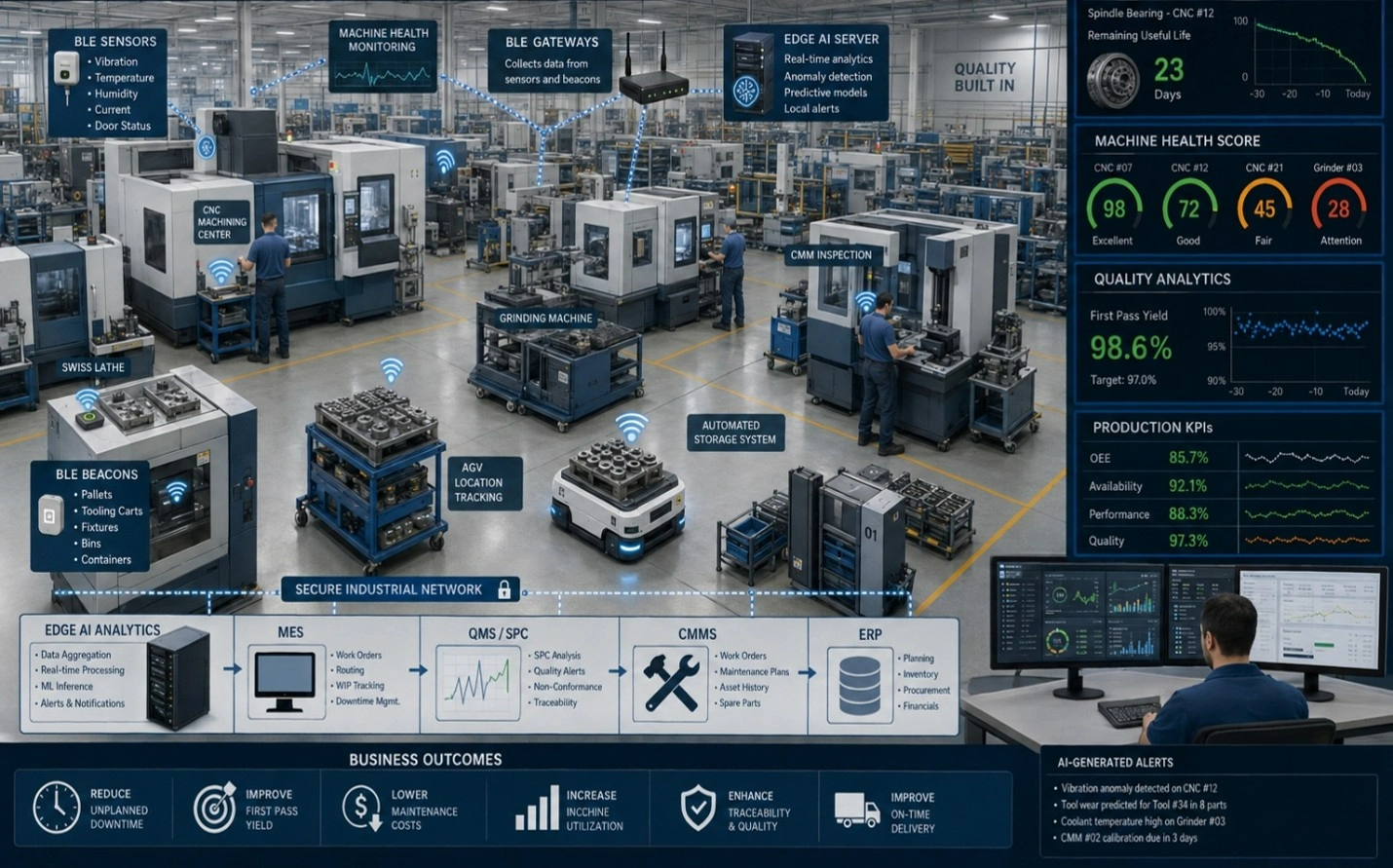
This illustration shows an AI-enabled precision metal components manufacturing facility where BLE sensors, BLE beacons, and BLE gateways continuously collect operational data from CNC machining centers, Swiss lathes, grinding machines, CMM inspection stations, AGVs, and production assets. Edge AI servers analyze machine health, quality metrics, and production performance while integrating with MES, ERP, QMS/SPC, and CMMS software to enable predictive maintenance, real-time quality monitoring, production traceability, and KPI-driven manufacturing optimization.
Understanding AI-Enabled BLE Solutions for Precision Metal Components
Precision metal component production differs significantly from general metal fabrication because dimensional tolerances often range within microns while production consistency directly affects downstream assemblies in aerospace, automotive, medical devices, semiconductor equipment, industrial automation, defense, robotics, and precision instrumentation.
AI-driven manufacturing systems continuously analyze operational information generated throughout machining and inspection processes. BLE technologies provide localized awareness of production assets, material movement, operator interactions, fixture utilization, environmental conditions, calibration schedules, and production status. AI transforms these operational signals into predictive insights supporting manufacturing decisions that were traditionally based on historical reports or manual observations.
Several manufacturing objectives make AI especially valuable for precision metal component facilities:
- Predicting machining quality before defects occur
- Detecting abnormal machine behavior during production
- Optimizing cutting parameters
- Reducing spindle downtime
- Forecasting tool replacement intervals
- Improving production scheduling
- Tracking work-in-progress movement
- Monitoring environmental stability affecting measurement accuracy
- Supporting closed-loop quality control
- Increasing machine utilization
- Improving first-pass yield
- Reducing setup variation
BLE contributes to these AI applications by providing low-power, location-aware communication across production areas without requiring extensive wired infrastructure. BLE gateways aggregate information from distributed BLE devices before forwarding data securely into industrial software for AI analysis.
Modern precision component manufacturers increasingly combine AI with technologies including:
- CNC machine monitoring
- Industrial IoT sensors
- Edge AI computing
- Machine vision inspection
- Digital twins
- Predictive maintenance software
- Manufacturing Execution Systems (MES)
- Enterprise Resource Planning (ERP)
- Statistical Process Control (SPC)
- Computerized Maintenance Management Systems (CMMS)
- Coordinate Measuring Machine (CMM) software
- Production analytics
- Industrial historians
GAO supplies industrial BLE hardware supporting these connected manufacturing environments where reliable wireless communication is required across machining cells, inspection laboratories, warehouse operations, and production facilities.
AI Applications Across Precision Metal Components Manufacturing Operations
Artificial Intelligence enhances nearly every operational stage involved in precision component production. Rather than solving isolated problems, AI continuously evaluates production conditions to improve quality, productivity, maintenance planning, and operational efficiency.
CNC Machining Optimization
AI evaluates machining parameters alongside spindle load, vibration characteristics, cutting temperatures, cycle times, coolant conditions, and tooling behavior to recommend process improvements.
BLE supports localized tracking of:
- Machine operating status
- Tool carts
- Fixture availability
- Operator assignments
- Production pallets
- Maintenance personnel
- Mobile inspection equipment
Expected outcomes include:
- Reduced machining variability
- Higher spindle utilization
- Lower setup time
- Improved cycle consistency
Intelligent Tool Life Management
Tool wear represents one of the largest contributors to dimensional variation.
AI combines information from:
- Cutting force measurements
- Machine vibration
- Historical tool performance
- Surface finish measurements
- Production history
- Tool inventory
BLE identifies tooling locations while tracking movement between tool rooms, machining cells, preset stations, and maintenance areas.
Benefits include:
- Reduced unexpected tool failures
- Better tool utilization
- Lower tooling costs
- Improved dimensional consistency
Precision Quality Inspection
AI supports automated inspection by correlating measurement data from CMM systems, laser scanners, optical inspection systems, machine vision cameras, and surface roughness analyzers.
BLE devices help identify:
- Inspection fixtures
- Measuring instruments
- Calibrated gauges
- Inspection batches
- Workpiece movement
AI enables:
- Automated defect classification
- Trend analysis
- Root cause investigation
- Measurement anomaly detection
- Process capability monitoring
Predictive Maintenance for Precision Equipment
High-value manufacturing equipment including CNC machining centers, grinding machines, EDM systems, coordinate measuring machines, compressors, chillers, and hydraulic systems require continuous health monitoring.
AI predicts maintenance needs using:
- Motor current analysis
- Bearing vibration
- Lubrication trends
- Thermal behavior
- Machine utilization
- Historical maintenance records
BLE sensors collect localized equipment condition data while BLE gateways securely transfer information for AI processing.
Maintenance improvements include:
- Fewer emergency shutdowns
- Longer equipment life
- Reduced maintenance costs
- Increased equipment availability
Work-in-Progress Tracking
Precision component manufacturers often process thousands of partially completed parts simultaneously across multiple machining operations.
AI evaluates:
- Production bottlenecks
- Queue lengths
- Routing efficiency
- Operator workload
- Machine availability
BLE beacons attached to production trays, pallets, fixtures, and transport carts improve location visibility throughout manufacturing.
Operational improvements include:
- Better production scheduling
- Reduced search time
- Lower WIP inventory
- Faster order completion
Environmental Monitoring for Metrology
Temperature and humidity directly influence dimensional measurements.
AI analyzes:
- Environmental stability
- Measurement repeatability
- Calibration history
- Inspection timing
BLE environmental sensors continuously monitor:
- Temperature
- Humidity
- Air quality
- Vibration near CMM laboratories
This helps manufacturers maintain reliable metrology conditions.
AI-Enabled Precision Metal Components Manufacturing Workflow with BLE-Based Traceability
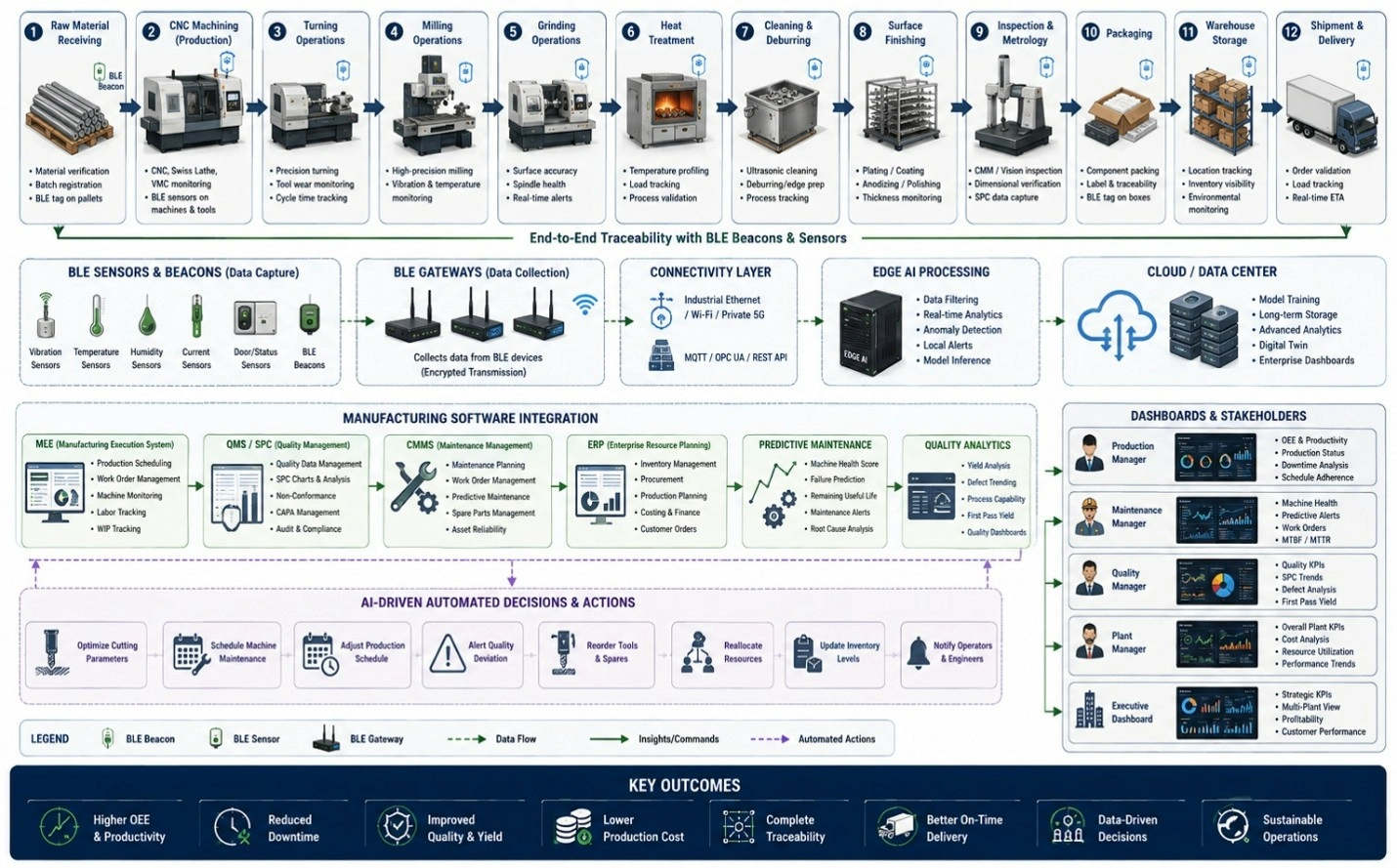
This workflow diagram illustrates the complete precision metal components manufacturing process, from raw material receiving through CNC machining, turning, milling, grinding, heat treatment, cleaning, surface finishing, inspection, packaging, warehousing, and shipment. It demonstrates how BLE sensors, BLE beacons, BLE gateways, edge AI, and integrated manufacturing software including MES, ERP, QMS/SPC, and CMMS enable predictive maintenance, real-time production monitoring, automated decision-making, end-to-end traceability, and continuous manufacturing optimization.
End-to-End Operational Workflow for AI-Driven Precision Metal Components Manufacturing
Successful AI deployment depends on creating a continuous operational information flow across production operations rather than implementing isolated monitoring systems. Precision manufacturing environments generate large volumes of production information from machining centers, inspection systems, warehouse operations, environmental monitoring devices, maintenance activities, and production management software.
The operational workflow typically begins with raw material receipt. Material batches are registered within ERP software while production orders are synchronized with Manufacturing Execution Systems. BLE beacons assigned to raw material containers, pallets, tooling assemblies, and production fixtures establish digital identities that remain associated with work orders throughout manufacturing.
Production equipment continuously generates operational data including spindle utilization, feed rates, cutting loads, coolant performance, vibration signatures, motor temperatures, lubrication conditions, energy consumption, cycle completion status, alarm conditions, and idle durations. BLE sensors deployed on auxiliary equipment, mobile assets, environmental monitoring stations, and maintenance tools complement this machine-generated information by capturing localized operational context that conventional PLC data often cannot provide.
BLE gateways positioned throughout machining departments securely aggregate information from distributed BLE devices before forwarding it through industrial Ethernet or secured wireless networks toward edge servers or centralized computing environments. Edge computing performs initial filtering, timestamp normalization, event detection, data validation, and local inference where immediate operational responses are required, such as detecting abnormal vibration or identifying misplaced tooling.
Validated operational information is then synchronized with software systems including Manufacturing Execution Systems, Statistical Process Control applications, Computerized Maintenance Management Systems, Quality Management Systems, industrial historians, ERP software, laboratory information systems supporting metrology, and production analytics software. AI models consume these combined datasets to identify hidden relationships among machining conditions, dimensional measurements, tooling behavior, maintenance activities, operator performance, environmental conditions, and production throughput.
Machine learning algorithms continuously update predictive models for tool wear, equipment degradation, dimensional drift, process capability, bottleneck formation, production scheduling, energy optimization, and maintenance planning. Computer vision systems simultaneously evaluate surface defects, burr formation, chamfer quality, edge integrity, thread accuracy, and geometric tolerances while anomaly detection models identify deviations before nonconforming parts accumulate.
Business actions generated by these AI models may include automatic maintenance work orders, revised machining parameters, production schedule adjustments, inspection frequency modifications, tooling replacement recommendations, inventory replenishment requests, operator notifications, or engineering alerts. Rather than replacing manufacturing expertise, AI provides engineers, quality specialists, production supervisors, maintenance technicians, and operations managers with faster access to actionable operational intelligence, enabling more consistent production outcomes across precision metal component facilities.
AI, BLE Technologies, Software, Security, and Deployment Models for Precision Metal Components Manufacturing
Successful AI-enabled precision metal component manufacturing depends on selecting technologies that satisfy demanding production, quality, reliability, cybersecurity, and scalability requirements. Rather than relying on a single technology, modern intelligent manufacturing solutions combine BLE devices with industrial networking, machine connectivity, AI software, manufacturing applications, and secure computing environments. Every component contributes a specific role in collecting, transporting, processing, analyzing, and acting upon production information.
BLE Hardware Supporting Intelligent Manufacturing
BLE hardware provides localized visibility throughout machining facilities without extensive cabling, making it particularly valuable for mobile assets and production environments that frequently change layouts.
BLE Beacons
BLE beacons are commonly attached to:
- Tool carts
- Precision fixtures
- Workholding assemblies
- Inspection gauges
- Production pallets
- Returnable containers
- Material bins
- AGVs
- Maintenance carts
- Mobile metrology equipment
These devices continuously broadcast identifiers that allow AI software to understand asset locations and movement histories.
BLE Sensors
BLE sensors extend visibility by measuring operational conditions including:
- Temperature
- Relative humidity
- Vibration
- Shock
- Machine enclosure conditions
- Bearing temperature
- Coolant temperature
- Air quality
- Door status
- Equipment utilization
Environmental monitoring is particularly important because thermal expansion directly affects dimensional accuracy during precision machining and coordinate measurement.
BLE Gateways
Industrial BLE gateways collect information from hundreds or thousands of BLE devices before forwarding encrypted information to manufacturing software through Industrial Ethernet, Wi-Fi, or private industrial cellular networks. Industrial-grade gateways are typically installed near machining cells, inspection laboratories, warehouses, maintenance areas, and assembly stations to ensure reliable communication coverage.
GAO supplies industrial BLE hardware that supports demanding manufacturing environments where equipment reliability, long operational life, and industrial communication performance are essential.
AI Software and Machine Learning Components
Artificial Intelligence transforms operational information into recommendations, predictions, and automated actions. Precision metal component manufacturing commonly incorporates multiple AI techniques simultaneously because no single model addresses every production challenge.
Common AI methods include:
- Predictive maintenance models
- Time-series forecasting
- Regression analysis
- Neural networks
- Gradient boosting
- Random Forest algorithms
- Computer vision
- Deep learning
- Reinforcement learning
- Bayesian optimization
- Anomaly detection
- Explainable AI
- Digital twin simulation
- Process optimization algorithms
- Statistical learning
Typical AI applications include:
- Predicting dimensional drift
- Detecting machine abnormalities
- Forecasting spindle failures
- Optimizing cutting parameters
- Predicting tool wear
- Improving production scheduling
- Forecasting maintenance requirements
- Identifying production bottlenecks
- Improving energy efficiency
- Detecting quality deviations
Enterprise Software Integration
AI generates the greatest value when operational intelligence flows into existing manufacturing software rather than remaining isolated within monitoring dashboards.
Common software integrations include:
- Manufacturing Execution Systems (MES)
- Enterprise Resource Planning (ERP)
- Quality Management Systems (QMS)
- Statistical Process Control (SPC)
- Computerized Maintenance Management Systems (CMMS)
- Product Lifecycle Management (PLM)
- Supervisory Control and Data Acquisition (SCADA)
- Human Machine Interfaces (HMI)
- Laboratory Information Management Systems (LIMS)
- Industrial historians
- Manufacturing analytics software
- Warehouse Management Systems (WMS)
These integrations allow AI recommendations to influence scheduling, maintenance planning, inventory control, engineering changes, quality documentation, and production reporting.
Communication Infrastructure
Reliable communication ensures operational data reaches AI software with sufficient quality and low latency.
Supporting technologies commonly include:
- Industrial Ethernet
- OPC UA
- MQTT
- REST APIs
- Modbus TCP
- PROFINET
- EtherNet/IP
- Time synchronization services
- VLAN segmentation
- Industrial Wi-Fi
- Private 5G where appropriate
BLE complements these industrial communication technologies by providing localized wireless connectivity for mobile assets and distributed sensors.
Cloud Version
Cloud-hosted deployments are appropriate when manufacturers require centralized visibility across multiple production facilities or contract manufacturing partners.
Typical cloud deployments provide:
- Centralized AI model management
- Multi-site production analytics
- Enterprise KPI dashboards
- Fleet-wide predictive maintenance
- Long-term historical analysis
- Supplier performance evaluation
- Corporate reporting
- Automatic software updates
- Disaster recovery
- Elastic computing resources
Cloud deployments are particularly valuable for manufacturers operating several machining plants across different geographic regions.
Server Version
Many precision component manufacturers operate private manufacturing networks where operational information remains under direct organizational control.
Server-based deployments are appropriate when organizations require:
- Low-latency AI inference
- Data sovereignty
- Customer-controlled cybersecurity
- Private engineering databases
- Integration with legacy CNC equipment
- Continuous operation despite internet outages
- Internal validation requirements
- Highly customized manufacturing software
Private server deployments may operate on factory edge servers, centralized corporate data centers, privately managed cloud infrastructure, or dedicated manufacturing computing environments.
Cybersecurity Considerations
Manufacturing cybersecurity protects production continuity, engineering intellectual property, and quality data.
Recommended security measures include:
- Device authentication
- Certificate management
- Role-based access control
- Multi-factor authentication
- TLS encryption
- Secure BLE pairing
- Network segmentation
- Continuous vulnerability assessment
- Security information and event management
- Firmware integrity verification
- Audit logging
- Zero Trust principles where appropriate
- Backup and disaster recovery procedures
Organizations producing aerospace, medical, defense, or automotive precision components often integrate these controls with broader cybersecurity programs to satisfy customer and regulatory expectations.
AI-Powered BLE Solution for Precision Metal Components Manufacturing
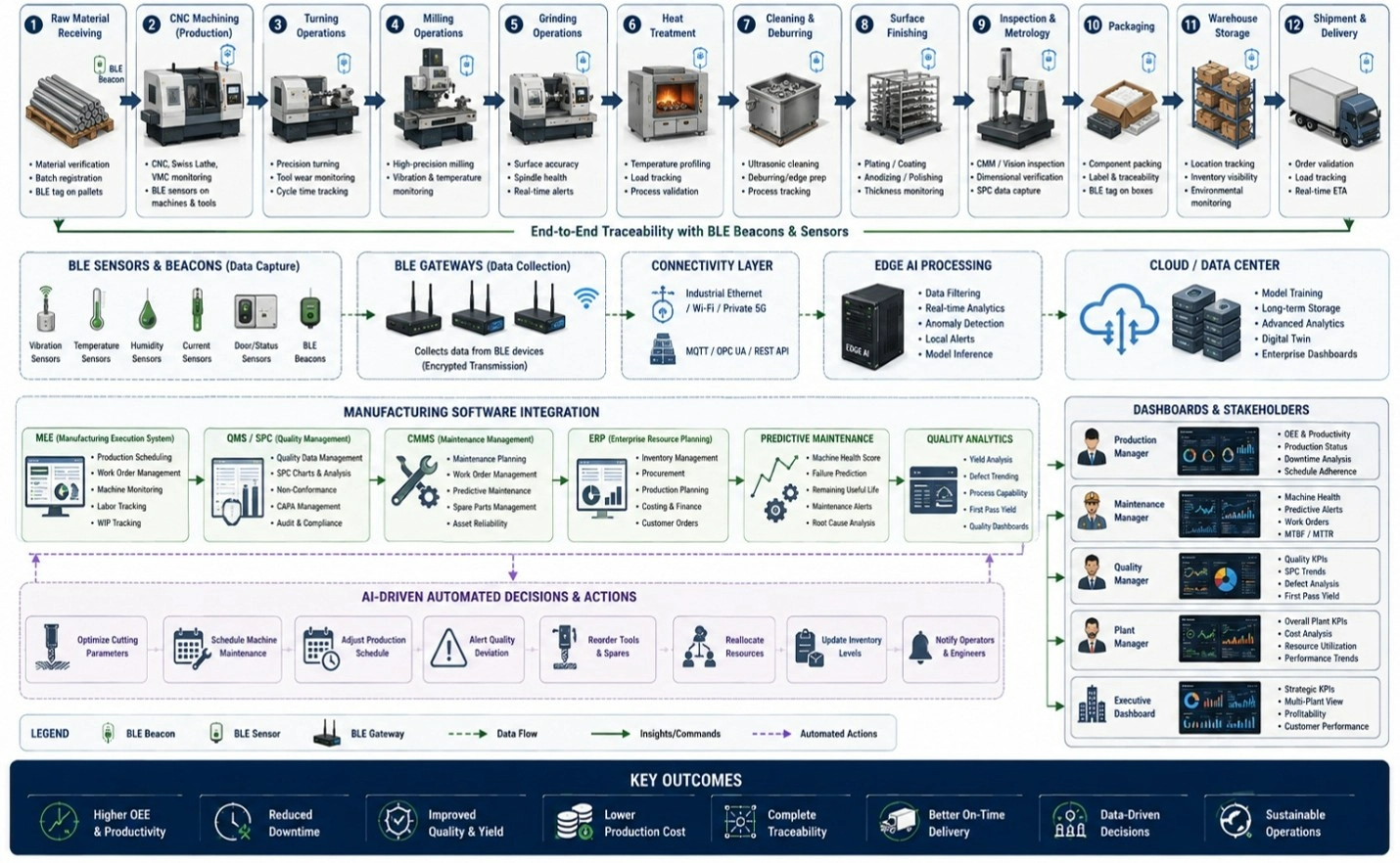
This solution diagram illustrates the complete AI-enabled manufacturing solution for precision metal components production, showing how BLE sensors, BLE beacons, and BLE gateways collect operational data from CNC machines, CMM inspection stations, and mobile production assets. The diagram highlights secure data transmission through industrial Ethernet to edge AI servers, AI analytics engines, and enterprise software including MES, ERP, QMS/SPC, CMMS, and predictive maintenance applications. It also compares cloud and private server deployment models, incorporates layered cybersecurity controls, and demonstrates how operator dashboards and executive KPI reporting transform manufacturing data into real-time operational intelligence and informed business decisions.
Technical Capabilities and Business Benefits of AI-Driven Precision Metal Components Manufacturing
Artificial Intelligence provides measurable improvements across manufacturing operations because decisions become increasingly data-driven rather than reactive.
Technical Capabilities
AI-enabled manufacturing solutions provide capabilities including:
- Continuous equipment condition monitoring
- Intelligent tool life prediction
- Automated process optimization
- Predictive quality analysis
- Dynamic production scheduling
- Automated anomaly detection
- Real-time work-in-progress visibility
- Environmental condition monitoring
- Machine utilization analysis
- Energy consumption optimization
- Automated maintenance prioritization
- Root cause analysis
- Production forecasting
- Production traceability
- Statistical process monitoring
These capabilities improve manufacturing consistency while supporting continuous process improvement.
Operational Improvements
Manufacturers commonly observe improvements including:
- Higher Overall Equipment Effectiveness (OEE)
- Increased spindle utilization
- Reduced unplanned downtime
- Lower scrap generation
- Improved first-pass yield
- Reduced production delays
- Faster setup changes
- Improved scheduling efficiency
- Better calibration management
- More accurate production forecasting
- Improved asset utilization
- Reduced search time for mobile equipment
- Better inspection planning
- Higher maintenance productivity
Business Benefits
AI-supported manufacturing contributes directly to strategic business objectives.
Benefits include:
- Reduced manufacturing costs
- Higher production throughput
- Improved customer delivery performance
- Better production traceability
- Increased manufacturing flexibility
- Lower warranty exposure
- Improved supplier collaboration
- Stronger production compliance
- Better engineering decision support
- Improved production planning
- Lower inventory carrying costs
- Increased profitability
Organizations manufacturing aerospace fasteners, orthopedic implants, hydraulic valve bodies, semiconductor tooling, precision gears, injection mold inserts, transmission components, robotic actuators, precision shafts, and high-tolerance mechanical assemblies particularly benefit from these improvements because production quality directly influences downstream product performance.
GAO has supported organizations implementing industrial BLE hardware and connected IoT systems that improve operational visibility while integrating with existing manufacturing software.
Executive AI Manufacturing KPI Dashboard for Precision Metal Components Production
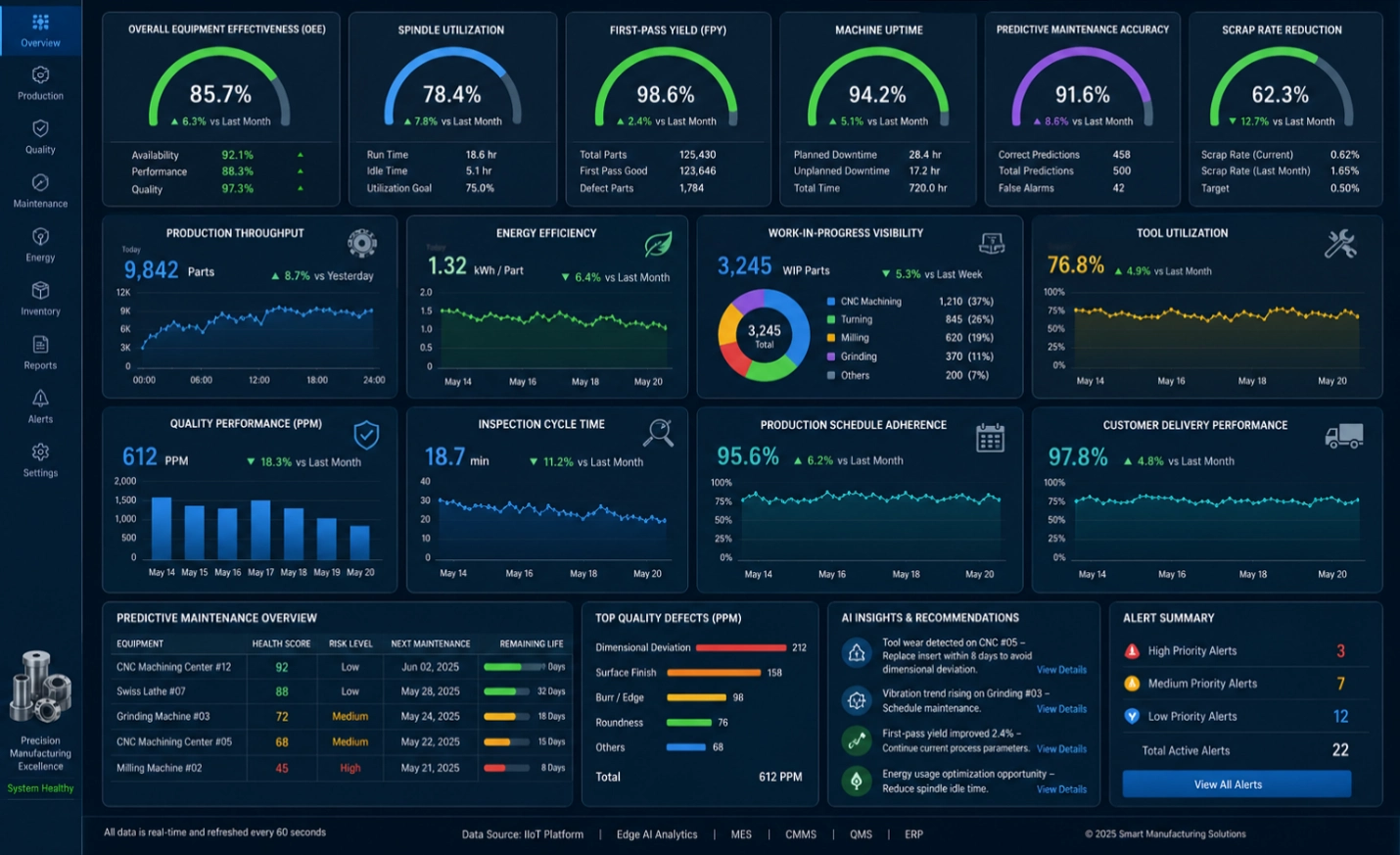
This executive dashboard presents real-time manufacturing KPIs for an AI-enabled precision metal components facility, including Overall Equipment Effectiveness (OEE), spindle utilization, first-pass yield, machine uptime, predictive maintenance accuracy, scrap rate reduction, production throughput, energy efficiency, work-in-progress visibility, tool utilization, quality performance, inspection cycle time, production schedule adherence, and customer delivery performance. Interactive gauges, trend charts, AI insights, maintenance status, quality analytics, and alert summaries provide production managers and executives with actionable intelligence for improving operational efficiency, equipment reliability, and manufacturing performance.
Engineering Best Practices and Implementation Recommendations
Organizations planning AI-enabled precision metal component manufacturing initiatives should approach implementation through carefully managed phases rather than attempting full-scale deployment immediately.
Recommended engineering practices include:
- Establish measurable business objectives before selecting technologies.
- Identify production bottlenecks using historical manufacturing data.
- Validate BLE communication coverage across machining facilities.
- Deploy pilot projects within representative production cells.
- Verify sensor calibration before AI model development.
- Integrate production data with MES, ERP, SPC, and maintenance software.
- Establish cybersecurity policies before connecting operational technology networks.
- Continuously validate AI predictions using engineering expertise.
- Develop data quality governance procedures.
- Monitor AI model accuracy as manufacturing conditions evolve.
- Train maintenance, quality, manufacturing, and production personnel on AI-supported decision making.
- Review KPIs regularly to guide continuous process improvement.
Successful implementations recognize that AI complements experienced manufacturing engineers rather than replacing engineering judgment. High-quality operational data, disciplined deployment planning, and continuous optimization remain fundamental to achieving sustainable improvements.
AI Implementation Roadmap for Precision Metal Components Manufacturing Using BLE
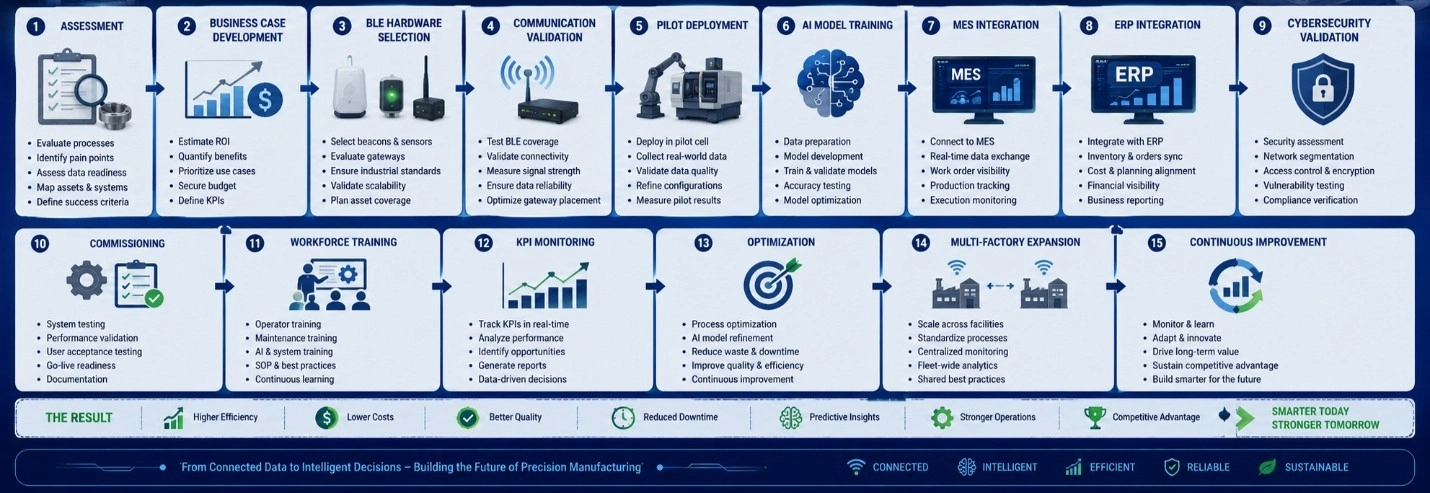
This implementation roadmap presents a structured, end-to-end deployment lifecycle for introducing AI-enabled BLE solutions into precision metal components manufacturing. It illustrates the progression from business assessment, BLE hardware selection, communication validation, pilot deployment, AI model development, MES and ERP integration, cybersecurity validation, commissioning, workforce training, KPI monitoring, process optimization, multi-factory expansion, and continuous improvement. The roadmap emphasizes a phased engineering approach that minimizes deployment risk while enabling scalable, secure, and data-driven manufacturing transformation.
Advancing Precision Metal Components Manufacturing with AI and BLE
AI-enabled manufacturing supported by BLE technologies enables precision metal component manufacturers to improve production quality, equipment reliability, operational visibility, and engineering decision making across complex machining environments. When combined with machine connectivity, manufacturing software, quality systems, predictive analytics, and disciplined engineering practices, AI transforms operational information into measurable manufacturing improvements while supporting continuous optimization.
Organizations evaluating intelligent manufacturing initiatives should prioritize business objectives, data quality, cybersecurity, software integration, and phased deployment planning. GAO, headquartered in New York City and Toronto, Canada, is recognized among the world’s leading B2B and B2G suppliers of BLE and RFID technologies. For more than three decades, GAO and its sister companies, GAO Research Inc. and GAO Tek Inc., have supported Fortune 500 companies, leading research organizations, universities, and government agencies throughout the United States and Canada by supplying industrial BLE, RFID, and IoT hardware products, investing extensively in research and development, maintaining rigorous quality assurance processes, and providing expert technical support both remotely and onsite.
Building the Future of Industrial AI and IoT with Aperture Venture Studio and GAO RFID Inc.
For more than three decades, GAO Group of Companies has invested extensively in research and development of industrial BLE, RFID, and IoT technologies that support advanced manufacturing applications, including precision metal components production. As generative AI has demonstrated measurable value in industrial environments, we have continued expanding our AI and IoT capabilities while establishing Aperture Venture Studio to accelerate the development and growth of AI and IoT solutions that address complex manufacturing and industrial challenges.
Aperture has attracted highly experienced AI specialists, IoT engineers, operational executives, strategic investors, and industry leaders. We have also developed the Aperture Ventures Summit and TekSummit to foster collaboration and technical discussions on advanced AI and IoT innovations. These initiatives have strengthened diverse technical communities dedicated to industrial digital transformation.
We welcome professionals and organizations to engage with us as:
- Advisors, co-founders, or employees
- Investors
- Customers seeking advanced AI, BLE, RFID, and industrial IoT solutions
This collaborative approach helps accelerate practical innovation while supporting the evolving needs of precision metal components manufacturers and other industrial sectors.