
AI and RFID for Intelligent Access Control
AI-Driven RFID Access Control Systems for Intelligent Security
Artificial intelligence (AI) and Radio Frequency Identification (RFID) are transforming enterprise access control by enabling intelligent identity verification, adaptive security policies, predictive analytics, and automated decision-making. Traditional access control systems primarily authenticate credentials and grant or deny entry based on predefined rules. AI extends these capabilities by continuously analyzing user behavior, credential usage, environmental conditions, occupancy patterns, and security events to improve operational efficiency while reducing unauthorized access and security risks.
Industrial and commercial facilities increasingly require access control systems capable of managing thousands of employees, contractors, visitors, vehicles, and assets across multiple buildings and geographically distributed locations. AI combined with LF RFID, HF RFID, and UHF RFID technologies creates intelligent access management solutions that support real-time authentication, anomaly detection, automated policy enforcement, occupancy monitoring, and enterprise-wide security visibility.
Beyond physical security, AI and RFID contribute to operational continuity, regulatory compliance, workforce management, and digital transformation initiatives. Organizations integrate RFID-generated identity data with enterprise software, cybersecurity functions, facility management systems, manufacturing operations, and business intelligence applications to create connected, data-driven environments. Throughout these deployments, GAO has supplied RFID hardware products and systems that help organizations implement secure identification, automate facility operations, and improve enterprise visibility. Headquartered in New York City and Toronto, Canada, GAO has served customers throughout North America for three decades, supporting enterprises, research organizations, universities, and government agencies with reliable RFID technologies and engineering expertise.
AI + RFID access control architecture
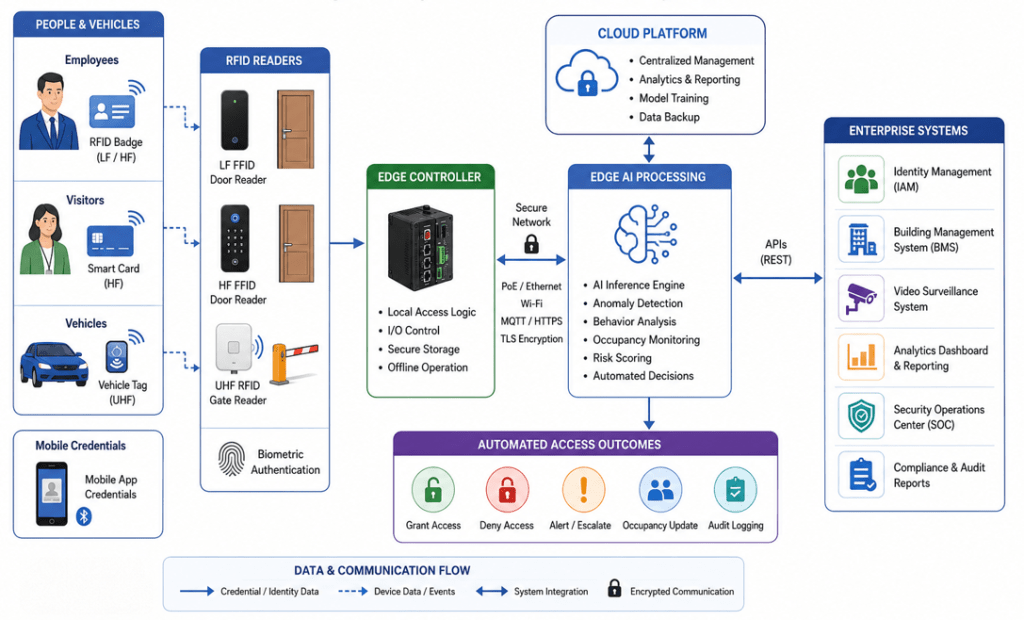
This illustrates the simplified workflow of an AI and RFID access control system for industrial and commercial facilities. It shows how employees, visitors, vehicles, and mobile credentials are authenticated through RFID readers, processed by edge AI, securely connected to cloud and enterprise systems, and used to automate access decisions, monitoring, analytics, and compliance reporting.
Understanding AI and RFID Access Control
Access control is the process of ensuring that only authorized individuals, vehicles, or equipment can enter protected areas or use designated resources. Modern enterprise access control combines physical identification technologies, cybersecurity policies, communication networks, and intelligent software to enforce security policies while maintaining operational efficiency.
RFID serves as the primary identification technology by automatically recognizing authorized credentials without requiring direct contact. AI enhances RFID by interpreting historical and real-time access events to detect suspicious behavior, predict security risks, optimize access policies, and automate operational responses.
Unlike traditional card-based systems that simply validate credentials, AI-enhanced RFID systems continuously evaluate contextual information, including:
- Historical access behavior
- Time-based access patterns
- Facility occupancy levels
- Department authorization
- Visitor schedules
- Vehicle movement history
- Security threat levels
- Emergency events
- Equipment usage
- Environmental conditions
These contextual factors allow AI to determine whether an access request is consistent with expected operational behavior rather than relying solely on credential validity.
Industrial facilities benefit from this intelligence because access decisions often involve production zones, hazardous environments, restricted laboratories, clean rooms, warehouses, loading docks, data centers, utility infrastructure, and critical operational equipment.
Commercial organizations similarly use AI and RFID to protect offices, healthcare facilities, campuses, retail stores, financial institutions, hotels, airports, logistics centers, and mixed-use buildings where thousands of users require different access privileges throughout the day.
Rather than operating independently, AI and RFID increasingly form a core component of broader AIoT (Artificial Intelligence of Things) ecosystems, where access control data contributes to occupancy analytics, workforce optimization, energy management, predictive maintenance, and enterprise risk management.
GAO has helped organizations implement RFID-based identification hardware that integrates with these intelligent enterprise environments, enabling secure authentication while supporting broader digital transformation initiatives.
Why AI Is Transforming RFID Access Control
Traditional RFID access systems operate using deterministic logic. A credential either possesses sufficient authorization or it does not. Although this approach remains effective for many facilities, growing enterprise complexity requires systems capable of understanding operational context rather than evaluating credentials alone.
AI introduces adaptive intelligence into access management by learning from operational data collected over time.
Several technical developments have accelerated this transformation:
- Increased computational capability at the edge
- Lower-cost AI inference hardware
- High-speed industrial Ethernet infrastructure
- Large-scale RFID event collection
- Enterprise cybersecurity integration
- Real-time occupancy analytics
- Improved machine learning algorithms
- Growth of Industrial Internet of Things (IIoT) architectures
- Expansion of digital identity management
- Enhanced data storage and processing capabilities
Instead of responding identically to every access request, AI evaluates multiple contextual variables simultaneously.
Examples include:
- Whether an employee is entering a facility at an unusual time
- Whether two geographically distant facilities receive credential usage within impossible travel times
- Whether visitor behavior differs from expected schedules
- Whether repeated failed authentications indicate credential misuse
- Whether a maintenance contractor accesses unauthorized production areas
- Whether emergency evacuation procedures require automatic door policy changes
These capabilities reduce both false alarms and genuine security threats while improving operational efficiency.
AI also improves decision quality by continuously adapting as organizational behavior evolves. Seasonal workforce changes, manufacturing shift adjustments, contractor schedules, and facility expansions become incorporated into AI models without requiring extensive manual policy rewriting.
RFID Technologies Used for Intelligent Access Control
Different RFID frequencies address different operational requirements. Selecting the appropriate technology depends on read range, credential type, environmental conditions, security requirements, and infrastructure constraints.
Low Frequency (LF RFID)
LF RFID operates around 125 kHz or 134.2 kHz and provides stable performance around metal, moisture, and harsh industrial environments.
Typical applications include:
- Employee identification
- Time attendance
- Industrial equipment authorization
- Parking access
- Heavy machinery operation
- Utility facilities
Advantages include:
- Reliable operation near liquids and metal
- Strong resistance to environmental interference
- Long operational life for passive credentials
- Low maintenance requirements
Limitations include shorter reading distances and lower data transfer rates compared to higher-frequency RFID systems.
High Frequency (HF RFID)
HF RFID operates at 13.56 MHz and supports secure authentication using smart cards and Near Field Communication (NFC).
Common enterprise applications include:
- Corporate building access
- Healthcare identification
- Laboratory security
- Government facilities
- Financial institutions
- Multi-factor authentication
- Secure workstation login
HF RFID supports advanced encryption mechanisms, making it suitable for environments requiring strong identity protection and regulatory compliance.
Standards commonly associated with HF deployments include:
- ISO/IEC 14443
- ISO/IEC 15693
- NFC Forum specifications
- MIFARE technologies
- FeliCa-based implementations where applicable
Ultra High Frequency (UHF RFID)
UHF RFID typically operates within regional frequency allocations around 860 to 960 MHz and enables significantly longer reading distances.
Typical enterprise applications include:
- Vehicle gate automation
- Distribution center access
- Logistics facilities
- Warehouse security
- Container yard entry
- Fleet management
- Industrial campus access
Advantages include:
- Long read distance
- High-speed credential identification
- Simultaneous tag reading
- Support for vehicle authentication
- Efficient management of high-traffic entrances
Global standards frequently include:
- EPC Gen2
- ISO/IEC 18000-63
Many organizations combine LF, HF, and UHF RFID within the same enterprise to optimize security, convenience, and operational performance across different access points.
Relationship Between AI and RFID in Enterprise Access Control
RFID provides reliable identity data, while AI transforms that data into actionable intelligence. Together, they create an adaptive access control environment capable of responding to changing operational conditions, evolving security risks, and business requirements.
RFID readers capture credential information from employees, visitors, contractors, vehicles, and authorized equipment. This data is transmitted through secure communication networks to edge computing devices or enterprise servers, where AI algorithms analyze access events in conjunction with contextual information such as schedules, user roles, location history, occupancy levels, and cybersecurity alerts.
Several AI methods commonly enhance RFID-based access control:
- Supervised learning for credential classification and access authorization.
- Unsupervised learning to identify unusual access behavior and detect anomalies without predefined attack signatures.
- Time-series forecasting to predict occupancy trends, peak entry periods, and staffing requirements.
- Computer vision fusion, combining RFID with video analytics to verify that the credential holder matches the authorized individual.
- Reinforcement learning to optimize access policies based on evolving operational conditions while maintaining compliance with organizational security rules.
- Graph analytics to uncover relationships between users, locations, assets, and access events that may indicate coordinated security risks.
Rather than replacing established access control logic, AI complements existing security policies by providing continuous analysis, adaptive decision support, and operational insights. This combination enables organizations to improve security while reducing administrative effort, minimizing false alarms, and supporting efficient facility operations.
End-to-End Operational Workflow of AI and RFID Access Control
Successful AI and RFID access control systems depend on much more than credential validation. Enterprise deployments require coordinated interaction among RFID hardware, communication networks, edge computing, AI software, enterprise applications, cybersecurity functions, and facility automation. Each component contributes to secure identity verification, intelligent decision-making, and operational efficiency.
The workflow generally follows several stages that convert RFID events into automated business actions.
Identity Registration and Credential Provisioning
Every deployment begins with identity enrollment. Employees, contractors, visitors, vendors, service personnel, and authorized vehicles are registered within the organization’s identity management software.
During enrollment, administrators define:
- User identity
- Department
- Job role
- Security clearance
- Access schedules
- Building permissions
- Emergency privileges
- Credential expiration
- Visitor sponsorship
- Vehicle authorization
- Multi-factor authentication requirements
The registered identity is associated with an RFID credential such as:
- LF RFID access cards
- HF RFID smart cards
- NFC-enabled employee badges
- UHF RFID windshield tags
- RFID key fobs
- Wearable RFID credentials
- Industrial equipment authorization tags
Modern deployments often synchronize identity information with enterprise directories such as Microsoft Active Directory, Microsoft Entra ID, LDAP services, or human resources software to reduce administrative overhead and maintain consistent user records.
RFID Credential Detection
When an individual approaches an entry point, the RFID reader energizes the credential and captures its unique identifier.
Depending on the deployment, the reader may also collect:
- Signal strength
- Read quality
- Reader location
- Timestamp
- Reader health status
- Antenna identification
- Environmental conditions
- Vehicle lane information
These additional data elements improve AI analysis by providing context beyond simple credential identification.
Industrial facilities frequently install multiple readers at a single access point to improve reliability and reduce missed reads in challenging environments containing metal structures, forklifts, conveyors, machinery, or electromagnetic interference.
Secure Data Transmission
After credential acquisition, RFID readers securely transmit event information to edge controllers or enterprise servers.
Communication methods commonly include:
- Ethernet
- Power over Ethernet (PoE)
- Wi-Fi
- RS-485
- TCP/IP
- HTTPS
- MQTT
- AMQP
- OPC UA
- VPN tunnels
- TLS-encrypted communications
Message authentication and encryption protect access events from interception, replay attacks, and unauthorized modification during transmission.
Edge Processing
Many organizations process access events locally before forwarding information to centralized software.
Edge processing performs functions such as:
- Credential validation
- Local whitelist comparison
- Temporary caching
- Network failover
- Initial anomaly filtering
- AI inference
- Door control decisions
- Local event logging
Processing decisions at the edge minimizes network latency and enables facilities to continue operating even during temporary Internet or wide-area network outages.
Manufacturing plants, utilities, oil and gas facilities, and critical infrastructure often prioritize edge intelligence because uninterrupted physical security remains essential during communication failures.
AI-Based Decision Making
After receiving access events, AI software evaluates numerous contextual variables simultaneously.
Typical evaluation criteria include:
- Historical access frequency
- Credential usage patterns
- Department schedules
- Current occupancy
- Security alerts
- Maintenance activities
- Visitor appointments
- Shift assignments
- Equipment authorization
- Facility lockdown status
- Weather events affecting operations
- Cybersecurity threat levels
The AI engine assigns confidence scores that indicate whether observed behavior aligns with expected operational patterns.
Possible automated responses include:
- Grant access
- Deny access
- Request secondary authentication
- Notify security personnel
- Trigger video recording
- Lock adjacent doors
- Activate emergency procedures
- Generate compliance reports
- Flag suspicious activity for investigation
These intelligent responses improve security while reducing unnecessary manual intervention.
Core Hardware Components of AI and RFID Access Control
Reliable enterprise deployments depend upon selecting hardware appropriate for operational conditions, environmental constraints, security requirements, and scalability objectives.
GAO has supplied RFID hardware products and systems that support deployments ranging from office environments to complex industrial facilities requiring durable, high-performance identification infrastructure.
RFID Readers
RFID readers form the primary interface between physical credentials and enterprise software.
Common reader categories include:
- Fixed door readers
- Long-range UHF gate readers
- Desktop enrollment readers
- Embedded OEM readers
- Industrial readers
- Explosion-protected readers for hazardous locations
- Vehicle access readers
- Portable maintenance readers
Reader selection depends upon:
- Required read distance
- Environmental exposure
- Number of simultaneous users
- Credential technology
- Installation location
- Security level
- IP protection rating
RFID Antennas
Antenna design significantly influences reading performance.
Organizations select antennas based upon:
- Polarization
- Beam width
- Gain
- Mounting orientation
- Indoor or outdoor installation
- Read zone control
- Environmental durability
Proper antenna placement minimizes false reads while improving credential detection accuracy.
RFID Credentials
Enterprise credentials vary according to operational requirements.
Common credential types include:
- Employee identification cards
- Smart cards
- NFC credentials
- Key fobs
- Vehicle windshield tags
- Visitor badges
- Industrial wearables
- Equipment authorization tags
Credential security may include cryptographic authentication, secure memory partitions, mutual authentication, rolling identifiers, and digital signatures.
Door Controllers
Door controllers execute physical access decisions after receiving authorization results.
Typical controller responsibilities include:
- Door unlocking
- Relay control
- Electric strike activation
- Magnetic lock control
- Exit button monitoring
- Tamper detection
- Alarm monitoring
- Battery backup management
Controllers continue enforcing local security policies even if communication with centralized software becomes temporarily unavailable.
Supporting Sensors
Many intelligent deployments integrate additional sensors alongside RFID.
Examples include:
- Door position sensors
- Motion detectors
- Occupancy sensors
- Video cameras
- Biometric readers
- Environmental sensors
- Fire alarm interfaces
- Elevator controllers
- Vehicle loop detectors
Sensor fusion provides richer operational context for AI algorithms.
Software Architecture for AI and RFID Access Control
Enterprise software coordinates communication among RFID hardware, AI analytics, enterprise systems, cybersecurity functions, and facility operations.
Instead of functioning as isolated applications, modern access control environments exchange information continuously across multiple business functions.
Major software components include:
- Identity management software
- Credential management software
- Access policy management
- AI analytics software
- Event processing software
- Facility management software
- Building automation software
- Security information and event management (SIEM)
- Computerized maintenance management software (CMMS)
- Manufacturing execution systems (MES)
- Enterprise resource planning (ERP)
- Human resources software
- Visitor management software
- Video management software
- Reporting and audit software
Each component contributes different operational capabilities while sharing information through secure APIs and standardized communication interfaces.
AI Models Used in Intelligent RFID Access Control
Different AI models solve different operational challenges. Enterprise deployments often combine several models rather than relying on a single algorithm.
Supervised Learning
Supervised learning models classify access events using previously labeled operational data.
Applications include:
- Authorized versus unauthorized access
- Visitor classification
- Credential misuse detection
- Access approval prediction
- Risk scoring
Typical algorithms include:
- Random Forest
- Gradient Boosting
- Support Vector Machines
- Logistic Regression
- Deep Neural Networks
Unsupervised Learning
Unsupervised learning discovers abnormal patterns without requiring labeled attack examples.
Common applications include:
- Insider threat detection
- Credential sharing
- Abnormal movement patterns
- Unusual facility usage
- Unknown security events
Algorithms frequently include:
- K-Means clustering
- DBSCAN
- Isolation Forest
- Autoencoders
- Gaussian Mixture Models
Time-Series Forecasting
Time-series analysis predicts future operational conditions using historical RFID event data.
Typical forecasting applications include:
- Occupancy prediction
- Shift planning
- Visitor volume forecasting
- Security staffing optimization
- Parking utilization
Frequently used models include:
- ARIMA
- Prophet
- Long Short-Term Memory (LSTM)
- Temporal Convolutional Networks
- Transformer-based forecasting models
Computer Vision Integration
Computer vision complements RFID authentication by verifying physical identity.
Applications include:
- Facial verification
- Tailgating detection
- Crowd monitoring
- PPE compliance
- Vehicle identification
- License plate recognition
Combining RFID with computer vision significantly reduces unauthorized entry using borrowed credentials.
Reinforcement Learning
Reinforcement learning continuously improves operational policies through experience.
Possible optimization objectives include:
- Door scheduling
- Energy-efficient building access
- Elevator coordination
- Queue reduction
- Emergency routing
- Security staffing allocation
Rather than replacing administrator-defined policies, reinforcement learning recommends incremental improvements while respecting organizational security constraints.
Cloud Version Versus Server Version Deployment
Enterprise organizations select deployment architecture according to security requirements, regulatory obligations, operational complexity, and IT governance.
Cloud Version
Cloud Version refers to software hosted within cloud infrastructure and managed as a cloud-hosted service.
Typical characteristics include:
- Centralized software updates
- Elastic computing resources
- Multi-site management
- High availability
- Disaster recovery support
- Remote administration
- Reduced infrastructure maintenance
Cloud deployments are often appropriate for:
- Commercial office buildings
- Retail chains
- Hospitality organizations
- Educational institutions
- Healthcare networks
- Multi-location enterprises
Cloud environments also simplify enterprise-wide AI model updates and centralized reporting across geographically distributed facilities.
Server Version
Server Version refers to software deployed on customer-managed infrastructure such as private data centers, factory servers, regional enterprise servers, edge servers, or other privately hosted enterprise computing environments.
Typical advantages include:
- Greater control over infrastructure
- Local data governance
- Reduced Internet dependency
- Custom security configurations
- Integration with existing enterprise systems
- Deterministic operational performance
- Compliance with internal IT policies
Server deployments are frequently selected by:
- Manufacturing facilities
- Defense contractors
- Utilities
- Pharmaceutical manufacturers
- Semiconductor fabrication plants
- Critical infrastructure operators
- Government organizations
Many industrial organizations adopt hybrid architectures where edge servers perform real-time access decisions while centralized servers provide enterprise analytics, reporting, and long-term data retention.
AI + RFID access control workflow
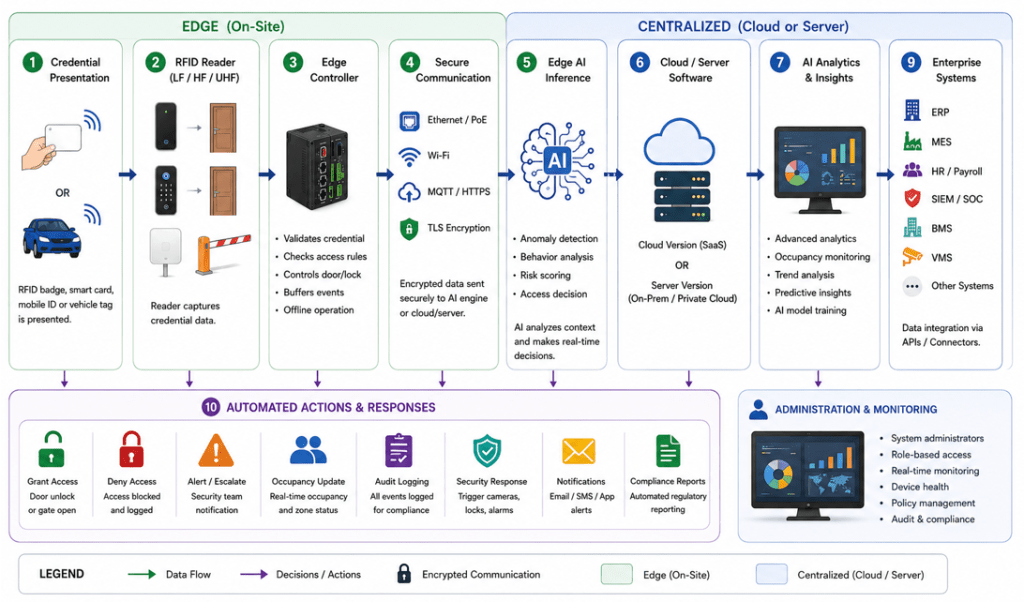
This system demonstrates the end-to-end operation of an AI and RFID access control solution. RFID credentials are securely read and processed by edge AI, connected to cloud or server software, integrated with enterprise systems, and used to automate access decisions, generate security alerts, monitor occupancy, and maintain comprehensive audit logs for industrial and commercial facilities.
AI and RFID Access Control Applications Across Industrial and Commercial Sectors
AI and RFID access control solutions support a wide range of operational environments where physical security, regulatory compliance, workforce safety, and operational efficiency are equally important. While every industry has unique security requirements, the underlying architecture can be adapted by selecting the appropriate RFID technology, AI models, communication infrastructure, and enterprise software integration.
Manufacturing Facilities
Manufacturing environments require access control that protects production assets while minimizing disruptions to operations.
Common deployment scenarios include:
- Production floor access
- Clean room authorization
- Quality control laboratories
- Tool crib management
- Hazardous material storage
- Maintenance workshops
- Robotics cells
- Warehouse entrances
AI enhances RFID by identifying unusual employee movement, detecting unauthorized entry into restricted production zones, and analyzing shift-based access behavior. Integration with Manufacturing Execution Systems (MES) and Enterprise Resource Planning (ERP) software improves workforce coordination and operational visibility.
Healthcare Facilities
Hospitals, laboratories, and pharmaceutical manufacturers require highly controlled access to protect patients, medical equipment, medications, and sensitive information.
Typical RFID-enabled areas include:
- Operating rooms
- Intensive care units
- Pharmaceutical storage
- Research laboratories
- Diagnostic imaging departments
- Medical record archives
AI supports compliance by detecting unusual credential usage, monitoring occupancy limits, identifying unauthorized after-hours access, and assisting audit reporting for healthcare regulations.
Warehousing and Logistics
Distribution centers experience continuous movement of personnel, contractors, visitors, forklifts, and commercial vehicles.
Typical applications include:
- Employee authentication
- Dock door access
- Yard gate automation
- Vehicle authorization
- Driver identification
- Contractor management
- Cross-docking security
AI evaluates historical traffic patterns, predicts congestion, identifies abnormal vehicle movements, and recommends operational adjustments that improve throughput while maintaining security.
Critical Infrastructure
Utilities, energy facilities, transportation hubs, and telecommunications sites demand resilient access control systems capable of operating during network interruptions and emergency conditions.
Typical protected areas include:
- Electrical substations
- Water treatment facilities
- Control rooms
- Telecommunications shelters
- Pipeline stations
- Renewable energy sites
Server-based deployments with local AI inference provide deterministic performance while supporting stringent cybersecurity and regulatory requirements.
Commercial Buildings
Corporate offices increasingly deploy intelligent access control to improve security while enhancing employee convenience.
Common applications include:
- Office entry
- Executive areas
- Conference rooms
- Parking facilities
- Visitor management
- Shared workspaces
- Data centers
AI learns normal workplace behavior, automatically adapts access schedules, and assists facility managers in optimizing building utilization.
Throughout these diverse industries, GAO has supported organizations by supplying RFID hardware products and systems that integrate with enterprise security environments, helping customers improve identity management, operational resilience, and facility protection.
Deployment Lifecycle and Engineering Best Practices
Deploying AI and RFID access control requires a structured engineering approach that balances security, operational efficiency, scalability, and long-term maintainability.
Planning and Requirements Analysis
A successful project begins with a comprehensive assessment of operational objectives, security risks, and infrastructure constraints.
Engineering teams should evaluate:
- Facility layout
- User population
- Credential types
- Security policies
- Regulatory requirements
- Existing access control systems
- Environmental conditions
- Network availability
- Future expansion plans
- Business continuity objectives
Early stakeholder involvement helps align operational, IT, cybersecurity, facilities management, and executive requirements.
Technology Selection
Selecting the appropriate RFID technology depends on operational needs.
General considerations include:
- LF RFID for harsh industrial environments and short-range authentication
- HF RFID for secure personnel identification and smart card applications
- UHF RFID for long-range vehicle and high-throughput access control
Hybrid deployments frequently combine all three technologies to address diverse operational scenarios across a single enterprise.
Hardware Selection
Hardware selection should account for both current and future operational requirements.
Important considerations include:
- Reader performance
- Antenna coverage
- Environmental protection ratings
- Credential durability
- Controller redundancy
- Backup power
- Network resilience
- Expansion capability
Hardware should also support relevant international standards to simplify future interoperability.
Deployment Architecture
Architects should determine where decision-making occurs.
Typical options include:
- Edge AI processing
- Private enterprise servers
- Cloud-hosted software
- Hybrid architectures combining edge and centralized intelligence
The architecture should minimize latency for critical access decisions while supporting centralized analytics and enterprise reporting.
System Integration
Enterprise access control rarely operates as a standalone system.
Integration commonly includes:
- ERP software
- MES
- Human resources software
- Identity management software
- Building automation software
- Video management software
- Visitor management software
- SIEM
- CMMS
- Digital twin environments
Standards-based APIs and middleware simplify integration while reducing long-term maintenance complexity.
Commissioning and Testing
Before production deployment, engineering teams should validate system performance under realistic operating conditions.
Testing typically includes:
- Credential verification
- Reader coverage testing
- Door controller validation
- Network failover testing
- Cybersecurity assessment
- AI model validation
- Emergency operation testing
- Power failure recovery
- User acceptance testing
- Performance benchmarking
Regular testing ensures the system meets operational and security requirements before full-scale deployment.
Interoperability, Cybersecurity, and Standards Compliance
Enterprise access control systems must exchange information reliably with multiple technologies while protecting sensitive identity data.
Interoperability
Interoperability enables organizations to integrate AI and RFID solutions with existing infrastructure rather than replacing functioning systems.
Common interoperability technologies include:
- REST APIs
- OPC UA
- MQTT
- HTTPS
- TCP/IP
- LDAP
- Active Directory integration
- Microsoft Entra ID
- BACnet for building automation
- Modbus where industrial equipment interfaces are required
Using standardized communication methods reduces vendor lock-in and simplifies future expansion.
Standards and Regulatory Considerations
Organizations should evaluate standards applicable to their operating environment.
Frequently referenced standards include:
- ISO/IEC 14443
- ISO/IEC 15693
- ISO/IEC 18000-63
- EPC Gen2
- NFC Forum specifications
- ISO 27001 information security management
- NIST Cybersecurity Framework
- IEC 62443 for industrial cybersecurity where applicable
Compliance supports interoperability, improves procurement flexibility, and assists regulatory audits.
Cybersecurity
Because access control directly protects physical assets and personnel, cybersecurity must be incorporated throughout the deployment lifecycle.
Recommended practices include:
- TLS encryption
- VPN connectivity
- Multi-factor authentication
- Role-based access control
- Certificate management
- Secure firmware updates
- Network segmentation
- Security event logging
- Continuous vulnerability assessment
- Security Information and Event Management (SIEM) integration
AI further strengthens cybersecurity by identifying credential misuse, insider threats, unusual movement patterns, and coordinated attack behavior that traditional rule-based systems may overlook.
Why Automotive Manufacturing Benefits from AI and RFID
Vehicle manufacturing represents one of the most complex industrial production environments.
Thousands of synchronized operations occur simultaneously across:
- Body shop
- Stamping operations
- Welding cells
- Paint shop
- Engine assembly
- Battery assembly
- Interior installation
- Chassis assembly
- Final assembly
- Quality inspection
- Vehicle testing
- Distribution logistics
RFID automates identification throughout these operations.
AI transforms operational information into production optimization.
Together they improve:
- Manufacturing traceability
- Production scheduling
- Material availability
- Production throughput
- Inventory accuracy
- Equipment utilization
- Workforce productivity
- Quality management
- Supplier coordination
- Operational visibility
Technical Capabilities and Business Benefits
Combining AI with RFID extends access control beyond identity verification to create an intelligent operational resource.
Time-Series Forecasting
Time-series analysis predicts future operational conditions using historical RFID event data.
Key technical capabilities include:
- Adaptive access authorization
- Continuous anomaly detection
- Predictive occupancy analytics
- Automated visitor management
- Intelligent vehicle authentication
- Behavioral risk assessment
- AI-assisted security investigations
- Automated audit reporting
- Edge-based decision making
- Enterprise-wide visibility
These capabilities translate into measurable operational improvements.
Business benefits include:
- Reduced unauthorized access
- Faster authentication
- Lower administrative workload
- Improved regulatory compliance
- Better workforce accountability
- Enhanced employee safety
- Greater facility utilization
- Reduced operational interruptions
- Improved incident response
- Scalable multi-site management
Rather than simply replacing traditional access control, AI enables organizations to make more informed security decisions while improving productivity and resource allocation.
Comparison Table: Conventional RFID Access Control vs. AI and RFID Access Control
| Capability | Conventional RFID Access Control | AI and RFID Access Control | Operational Impact | Business Value |
| Credential Verification | Verifies RFID credentials using predefined rules. | Verifies credentials while considering user behavior, location, time, and risk context. | More accurate authentication with fewer unauthorized entries. | Stronger security and reduced access fraud. |
| Anomaly Detection | Limited to simple rule-based alerts. | Uses AI to identify abnormal access patterns, credential sharing, and unusual behavior. | Faster detection of insider threats and suspicious activities. | Reduced security incidents and investigation time. |
| Occupancy Analytics | Tracks basic entry and exit events. | Continuously analyzes occupancy, movement patterns, and zone utilization in real time. | Better space utilization and emergency preparedness. | Improved facility efficiency and workforce safety. |
| Visitor Management | Manual registration and predefined visitor permissions. | AI automates visitor verification, monitors movement, and detects unusual visitor behavior. | Faster visitor processing and enhanced security oversight. | Improved visitor experience and reduced administrative effort. |
| Policy Adaptation | Static access rules require manual updates. | AI dynamically adjusts recommendations based on operational trends, schedules, and risk levels. | More adaptive and context-aware access control. | Reduced administrative workload and improved operational flexibility. |
| Threat Detection | Detects only predefined security violations. | Combines RFID data with AI analytics to identify emerging threats and suspicious activities. | Earlier threat identification and quicker response. | Lower security risks and enhanced business continuity. |
| Reporting | Generates standard event logs and access reports. | Produces intelligent dashboards, predictive insights, compliance reports, and trend analysis. | Improved visibility into security operations. | Better compliance management and executive decision-making. |
| Scalability | Expansion requires additional manual configuration and administration. | AI automates policy management and supports centralized control across multiple facilities. | Simplifies large-scale deployments. | Lower operational costs and easier enterprise growth. |
| Operational Intelligence | Provides historical access records only. | Converts access data into actionable insights using machine learning and predictive analytics. | Data-driven operational improvements. | Increased productivity and optimized resource allocation. |
| Maintenance Requirements | Frequent manual rule updates and system administration. | AI assists with automated monitoring, predictive maintenance, and policy optimization. | Reduced maintenance effort and improved system availability. | Lower total cost of ownership and higher system reliability. |
Key Technical Takeaways
AI and RFID access control combines intelligent analytics with proven identification technologies to strengthen physical security while supporting broader digital transformation initiatives across industrial and commercial sectors.
Important engineering insights include:
- Selecting the appropriate LF, HF, or UHF RFID technology depends on read distance, security requirements, environmental conditions, and operational objectives.
- Edge AI processing enables rapid access decisions and maintains operation during temporary communication failures.
- Cloud Version deployments simplify centralized management across geographically distributed facilities, while Server Version deployments provide greater control for organizations with strict security and compliance requirements.
- Integrating RFID access data with enterprise software improves workforce visibility, compliance reporting, operational efficiency, and business intelligence.
- AI models should complement established security policies rather than replace deterministic authorization logic.
- Cybersecurity, interoperability, and standards compliance should be incorporated throughout the system lifecycle to support reliable long-term operation.
Implementation Recommendations
Organizations planning AI and RFID access control projects should adopt a phased deployment strategy that minimizes operational risk while supporting future expansion.
Recommended practices include:
- Perform a comprehensive security and operational assessment before selecting technologies.
- Match LF, HF, and UHF RFID technologies to specific application requirements instead of applying a single technology across all access points.
- Design network and server infrastructure with redundancy and disaster recovery considerations.
- Validate AI models using representative operational data before production deployment.
- Integrate access control with enterprise identity management, cybersecurity, and facility management software using standards-based interfaces.
- Continuously monitor system performance, retrain AI models as operational patterns evolve, and conduct periodic security assessments to maintain accuracy and resilience.
- Plan for future scalability by selecting hardware and software that support additional facilities, users, and emerging AI capabilities without requiring major architectural changes.
GAO recommends a collaborative engineering approach involving security professionals, IT teams, operations managers, and system integrators throughout planning, deployment, and ongoing optimization. This methodology helps organizations achieve reliable performance while maximizing the long-term value of AI and RFID investments.
Advancing Intelligent Access Control with GAO
Artificial Intelligence and RFID are redefining enterprise access control by transforming credential-based authentication into an intelligent, context-aware security function. Through AI-driven analytics, adaptive authorization, and integration with enterprise systems, organizations can improve physical security, streamline operations, strengthen regulatory compliance, and gain actionable insights from access data.
For more than three decades, GAO and its sister companies, GAO Research and GAO Tek, have invested extensively in research and development, rigorous quality assurance, and expert technical support. Ranked among the world’s leading B2B suppliers of RFID and BLE technologies, we have helped Fortune 500 companies, research institutions, universities, and government organizations implement reliable identification and IoT solutions across North America.
Whether your organization is modernizing an existing access control system or designing a new AI-enabled RFID solution, GAO provides RFID hardware products, engineering expertise, and technical support to help you build secure, scalable, and interoperable access control environments tailored to your operational requirements.