
AI and RFID for Air Quality Monitoring Operations
AI and RFID for Air Quality Monitoring Operations
AI-driven air quality monitoring combines continuous environmental measurements, connected monitoring devices, field observations, historical records, weather information, and AI analytics to identify changes in air quality and support faster operational decisions. RFID provides a physical identification layer for portable analyzers, calibration equipment, sampling containers, field kits, maintenance assets, and other equipment used across air-quality programs. UHF RFID can support longer-range identification at laboratories, equipment depots, monitoring stations, and vehicle facilities, while HF RFID and LF RFID can support controlled short-range identification workflows. AI can correlate equipment identity with particulate matter, gases, meteorological conditions, calibration history, maintenance records, and sampling events to distinguish environmental changes from equipment-related data problems. For environmental services organizations operating distributed monitoring networks, this combination can improve data integrity, equipment utilization, field-work verification, anomaly investigation, and predictive maintenance. GAO provides RFID and IoT hardware products and systems that can support connected environmental monitoring workflows.
AI and RFID Air Quality Monitoring Operations Overview
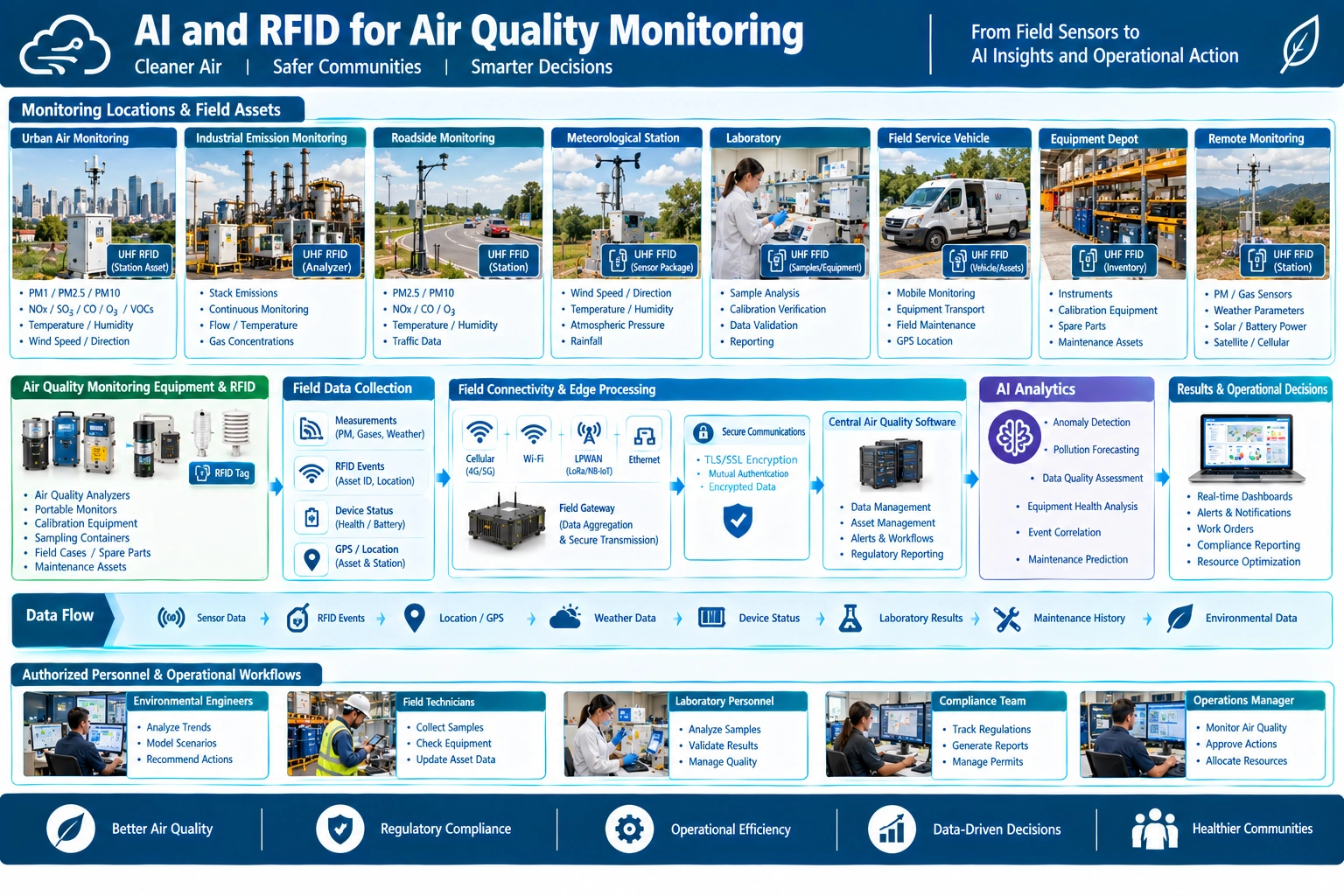
This enterprise infographic shows distributed air-quality monitoring across urban, industrial, roadside, meteorological, laboratory, vehicle, depot, and remote locations. It connects RFID-tagged equipment and environmental measurements with field gateways, secure connectivity, central software, AI analytics, alerts, dashboards, and operational teams.
Why AI Matters for Modern Air Quality Monitoring
Air quality monitoring networks increasingly generate measurements at short intervals from geographically distributed stations. The resulting data volume can exceed what environmental engineers can efficiently inspect manually, particularly when pollutant concentrations change rapidly or multiple meteorological variables affect interpretation.
AI provides analytical methods for identifying patterns that may not be obvious through fixed thresholds alone. The strongest implementations do not replace established monitoring methods. They add statistical and machine-learning capabilities that help personnel identify conditions requiring investigation.
AI for Air Quality Anomaly Detection
AI can compare current observations against historical patterns, seasonal behavior, neighboring stations, meteorological conditions, and expected pollutant relationships. This can help identify unusual PM2.5 concentrations, unexpected NO2 changes, abnormal ozone behavior, or inconsistent gaseous pollutant measurements.
A useful anomaly workflow considers both environmental and equipment context. A sudden particulate increase during a documented regional pollution event may be credible, while an isolated extreme reading from one instrument with deteriorating calibration characteristics may require equipment inspection.
RFID strengthens this distinction by associating measurements with the specific analyzer, sampling equipment, calibration kit, or field asset involved in the monitoring event.
AI for Air Pollution Forecasting
Air-quality forecasting can use historical pollutant concentrations together with meteorological variables, traffic-related information where available, emissions data, geographic characteristics, and measurements from neighboring monitoring stations.
Depending on the monitoring program, models can support:
- Short-term PM2.5 concentration forecasting.
- Ozone concentration prediction.
- NO2 trend analysis.
- Pollution episode detection.
- Regional air-quality pattern recognition.
- Forecasting of station-level measurement conditions.
- Identification of recurring pollution periods.
- Support for field inspection planning.
Forecasting accuracy depends heavily on measurement quality, geographic coverage, model selection, and the availability of representative historical data.
AI for Monitoring Device Data Quality
Air-quality monitoring devices can experience calibration drift, fouling, optical contamination, unstable baselines, communication interruptions, power problems, and environmental interference. AI can evaluate measurement behavior against historical performance and relationships among multiple variables.
For example, a device producing increasingly abnormal readings relative to nearby stations may require inspection even when its values remain below a conventional alarm threshold.
RFID can associate the data-quality event with the physical device and its maintenance history. This creates a more useful investigation trail for environmental engineers and field service teams.
AI for Predictive Maintenance of Air Monitoring Equipment
Continuous monitoring stations can contain particulate analyzers, gas analyzers, pumps, filters, sample lines, calibration equipment, power supplies, communications equipment, and environmental enclosures.
AI can estimate maintenance requirements from:
- Device operating hours.
- Calibration history.
- Previous failures.
- Measurement drift.
- Filter replacement history.
- Environmental exposure.
- Communication failures.
- Temperature and humidity conditions.
- Power-quality events.
- Maintenance intervals.
RFID can identify the affected analyzer, replacement component, calibration kit, or maintenance asset when equipment moves through controlled facilities or field-service workflows.
Air Quality Monitoring Workflows Where AI and RFID Deliver Value
Ambient Air Monitoring Stations
Ambient air monitoring networks commonly combine pollutant measurements with meteorological information and station-status data. AI can evaluate trends across multiple monitoring stations and identify abnormal measurements or developing pollution patterns.
RFID can support identification of portable equipment, calibration resources, replacement components, and field-service kits associated with station maintenance.
Industrial Emission and Fence-Line Monitoring
Industrial sites may monitor pollutants around process areas, emission points, facility boundaries, or nearby communities. Monitoring programs can involve fixed analyzers, portable instruments, sampling equipment, and scheduled inspections.
AI can correlate pollutant concentrations with production conditions, weather, historical patterns, and monitoring locations. RFID can help verify which portable analyzer or sampling kit was used during a particular inspection.
Roadside and Transportation-Related Air Monitoring
Roadside monitoring can involve particulate matter, nitrogen oxides, carbon monoxide, ozone, meteorological conditions, and traffic-related observations.
AI can analyze temporal and spatial relationships between pollutant measurements and traffic patterns where suitable data is available. Portable monitoring equipment used for roadway surveys can be RFID-identified to improve equipment assignment and field traceability.
Mobile Air Quality Monitoring
Mobile monitoring programs may use vehicles carrying portable analyzers, sampling equipment, GPS devices, meteorological instruments, and communications equipment.
RFID can verify that the correct equipment and calibration resources are loaded before deployment. AI can analyze geospatial measurements after collection to identify localized pollution patterns and recurring hotspots.
Air Quality Sampling and Laboratory Workflows
Laboratory analysis may complement continuous monitoring by providing more detailed characterization of particulate or chemical samples.
RFID can identify sample containers, field cases, laboratory equipment, calibration materials, and other controlled assets. AI can identify unusual laboratory results, compare field measurements with laboratory observations, and highlight records requiring review.
Calibration and Quality Assurance Workflows
Calibration is critical to reliable air-quality measurement. AI can examine calibration history and measurement behavior to identify devices showing signs of drift.
RFID can associate calibration events with the specific analyzer, calibration kit, gas-cylinder handling workflow where applicable, or field-service activity. This improves traceability without requiring technicians to manually transcribe every equipment identifier.
Remote and Distributed Monitoring Sites
Remote air-quality stations may experience intermittent communications, limited physical access, battery or power constraints, and environmental exposure.
Edge processing can temporarily store measurements when connectivity is unavailable. RFID can support equipment identification when field technicians arrive for inspection or maintenance. AI can prioritize remote-site visits according to equipment condition, data quality, and environmental significance.
Laboratory Equipment and Calibration Asset Management
Environmental laboratories may operate gas analyzers, particulate analysis equipment, balances, calibration equipment, sample preparation equipment, and other controlled resources.
RFID can help track equipment movement through laboratories and storage areas. AI can evaluate utilization, maintenance history, calibration status, and upcoming workload to help laboratory managers plan equipment availability.
RFID Air Quality Monitoring Deployment
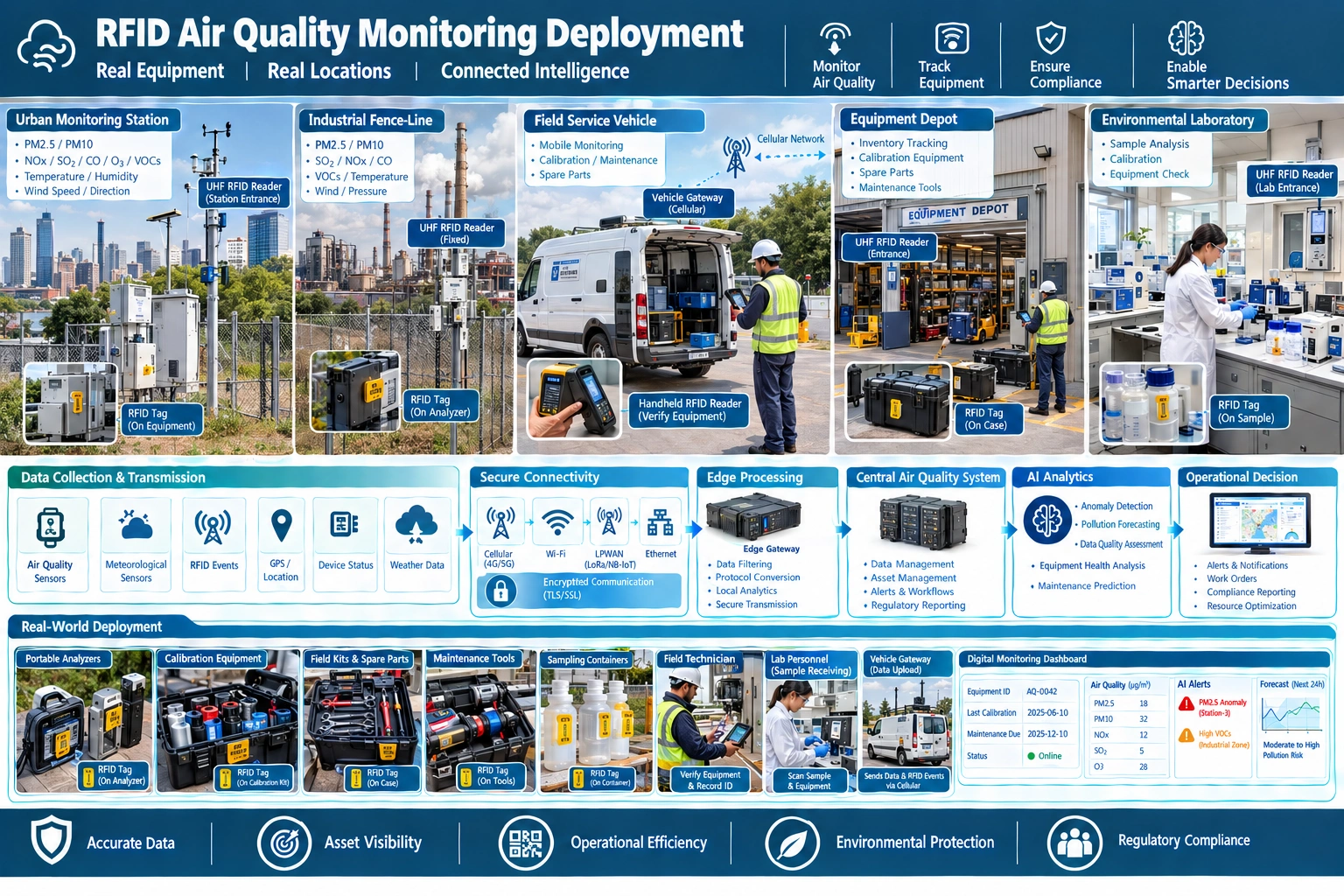
This realistic deployment scenario shows RFID-tagged air-quality equipment across urban and industrial monitoring sites, service vehicles, equipment depots, and laboratories. It connects handheld and fixed RFID readers with secure data transmission, AI analytics, monitoring dashboards, maintenance workflows, and operational decisions.
Air Quality Monitoring Challenges Addressed by AI-Enabled Asset Tracking
Misidentified or Unavailable Monitoring Equipment
Field programs can involve many portable analyzers, calibration resources, sample containers, cables, batteries, cases, and replacement components. Manual equipment checks can become difficult when multiple field teams operate simultaneously.
RFID can establish a digital identity for selected assets, while AI can use utilization and scheduling information to identify potential equipment conflicts or shortages before a field assignment.
Calibration and Maintenance Gaps
A monitoring device may be physically available but unsuitable for deployment because calibration has expired or maintenance is overdue.
Connecting RFID identity with calibration and maintenance records allows software to verify equipment status during preparation. AI can further identify equipment with increasing failure or drift risk.
False or Unexplained Air Quality Alerts
Fixed concentration thresholds can generate alerts that require substantial investigation. AI can incorporate historical measurements, meteorological conditions, neighboring stations, and device behavior to help classify unusual events.
The purpose is not to suppress alarms automatically. Instead, the system can provide additional evidence so qualified personnel can distinguish credible pollution events from possible measurement problems.
Remote Station Visibility
Distributed monitoring networks can span urban areas, industrial zones, roadsides, rural locations, and remote environmental sites.
AI can prioritize sites according to data-quality deterioration, communication status, equipment health, and environmental importance. RFID provides additional information about which physical equipment was inspected, replaced, or returned.
Data Integration Across Environmental Systems
Air-quality programs frequently involve several systems, including environmental databases, telemetry, laboratory information systems, maintenance software, GIS, SCADA where applicable, weather services, historians, and enterprise asset records.
A consistent identifier linking physical equipment to digital records is essential. RFID can provide that identity layer for selected physical assets, while middleware and APIs connect events to existing software.
GAO can help organizations evaluate RFID hardware and IoT systems for environmental monitoring workflows where equipment identification needs to coexist with existing operational and enterprise software.
Air Quality Monitoring Data Flow from Measurement to AI Decision
A reliable AI-driven air-quality monitoring system should preserve data context from the original measurement through the final operational action. The workflow typically combines environmental measurements, equipment identity, communications, edge processing, enterprise software, AI analytics, and human review.
Data Acquisition from Air Monitoring Devices
Data can originate from particulate monitors, gas analyzers, meteorological instruments, flow devices, pressure devices, sampling equipment, laboratory instruments, and station-status devices.
Typical data elements include:
- PM1, PM2.5, and PM10 measurements.
- NOx, NO2, SO2, CO, O3, VOC, and other pollutant measurements where applicable.
- Temperature and relative humidity.
- Wind speed and wind direction.
- Atmospheric pressure.
- Rainfall.
- Equipment status.
- Calibration status.
- Power status.
- Communication status.
- GPS or station location.
- RFID identity events.
- Laboratory observations.
- Maintenance events.
RFID and Field Event Capture
RFID readers can record the movement or presentation of tagged equipment and materials at defined operational points. These events may identify which analyzer was issued to a technician, which calibration kit was returned, or which sample container entered a laboratory workflow.
RFID data should be timestamped and associated with the appropriate equipment or sample identifier before it enters downstream analytics.
Communications and Edge Processing
Connectivity may use Ethernet, cellular networks, Wi-Fi, LPWAN technologies, or other communications selected for site conditions. Remote monitoring locations may require local gateways capable of buffering information during communication interruptions.
Edge processing can perform validation, timestamp synchronization, basic filtering, data buffering, event correlation, and local health checks before information is forwarded to centralized systems.
Central Software and Enterprise Integration
Centralized air-quality software can combine measurement data with RFID events, meteorological information, laboratory results, GIS information, maintenance records, and historical observations.
Integration with LIMS, CMMS, SCADA, GIS, historians, environmental reporting systems, and enterprise databases can reduce duplicate data entry and provide a common operational record.
AI Analytics and Operational Decisions
AI models can evaluate the combined information for anomaly detection, forecasting, classification, equipment-health analysis, and maintenance prediction.
The resulting output may trigger:
- Environmental engineer review.
- Field inspection requests.
- Calibration tasks.
- Maintenance work orders.
- Sampling schedule adjustments.
- Laboratory investigation.
- Data-quality review.
- Pollution-event investigation.
- Monitoring-station prioritization.
AI should remain a decision-support mechanism unless a specific control has been engineered, validated, and approved for automated operation.
RFID, AI Software, and Air Quality Monitoring Infrastructure
The software and hardware configuration should match the monitoring program, site connectivity, data volume, regulatory requirements, and security policies. A small municipal monitoring network may require a different configuration from a multinational environmental monitoring program or a large industrial emissions network.
Cloud Version for Multi-Site Air Quality Monitoring
A cloud-hosted solution can consolidate data from geographically distributed monitoring stations, laboratories, mobile monitoring teams, and environmental operations. This approach can be appropriate when organizations need centralized access, scalable data storage, remote monitoring, centralized AI model management, and cross-site analytics.
Cloud deployment can support:
- Centralized air-quality data collection.
- Multi-site equipment and RFID event visibility.
- Large historical datasets for AI model development.
- Remote environmental engineering access.
- Centralized dashboards and reporting.
- Integration APIs.
- Automated software updates where organizational policy permits.
- Scalable processing for forecasting and anomaly analysis.
Connectivity remains a critical engineering dependency. Remote stations should support local buffering so measurement continuity does not depend entirely on persistent wide-area connectivity.
Server Version for Privately Hosted Air Quality Monitoring
A server deployment can run on customer-managed servers, private data centers, environmental control-room infrastructure, edge servers, or other privately hosted enterprise computing resources.
This model may be appropriate where organizations require greater control over data location, network boundaries, integration with existing operational technology, or internal cybersecurity procedures.
Server deployment can also reduce dependence on external connectivity for certain local processing functions. However, the customer assumes greater responsibility for server maintenance, backups, operating-system updates, cybersecurity controls, redundancy, and system availability.
AI Methods Used in Air Quality Monitoring
AI methods should be selected according to the monitoring problem and the quality of available data rather than selected solely because a particular model is popular.
Relevant methods include:
- Time-series forecasting for pollutant concentration trends.
- Anomaly detection for unusual measurements and station behavior.
- Regression models for pollutant prediction.
- Classification for identifying data-quality conditions or pollution-event categories.
- Clustering for discovering spatial or temporal pollution patterns.
- Predictive models for equipment maintenance and calibration requirements.
- Multivariate analysis for relationships among pollutants and meteorological conditions.
- Computer vision where camera-based environmental observations are part of the monitoring program.
- Edge AI where rapid local analysis is required and connectivity is constrained.
Model validation should use representative historical data and operational test cases. Seasonal changes, instrument replacement, calibration events, station relocation, weather variability, and changes in emissions can all affect model performance.
Air Quality Monitoring Deployment and Integration Considerations
Successful AI-driven air quality monitoring depends on how well field equipment, RFID identification, communications, environmental software, and AI analytics operate together. Deployment decisions should reflect monitoring objectives, pollutant types, station density, environmental conditions, connectivity, regulatory requirements, and the capabilities of existing IT and operational systems.
RFID Tag Selection for Air Monitoring Assets
RFID tags should be selected according to the physical asset and environmental conditions rather than using one tag type across every air-quality monitoring application.
- Ruggedized UHF RFID tags can identify portable analyzers, field cases, calibration equipment, maintenance tools, and equipment moving through controlled depots or laboratories.
- HF RFID can support deliberate close-range identification of monitoring equipment or samples when technicians intentionally present an item to a reader.
- LF RFID can be appropriate for specialized short-range identification applications where its characteristics match the equipment and operating environment.
- Outdoor tags should tolerate temperature changes, moisture, ultraviolet exposure, dust, vibration, and repeated handling.
- Tags mounted on metal equipment may require tag constructions specifically designed for metallic surfaces.
- Tags used around chemical sampling equipment should be evaluated for compatibility with cleaning agents and environmental contaminants.
- Critical assets should retain conventional human-readable identification in addition to RFID.
RFID identification should be mapped to an existing asset identifier rather than becoming an isolated numbering system. This allows an analyzer’s RFID identity to remain connected with calibration certificates, maintenance records, measurement history, and service documentation.
Reader Placement for Air Quality Monitoring Facilities
Reader placement requires consideration of the actual movement of equipment. A laboratory entrance, equipment issue counter, field-vehicle loading point, maintenance room, or controlled storage area may provide a more reliable RFID read zone than an attempt to identify every tagged asset continuously.
UHF RFID is particularly useful when multiple tagged assets need to be detected as they move through a defined area. HF or LF can be used where controlled one-at-a-time identification is preferable.
Engineering validation should evaluate:
- Read reliability with the actual tag and asset combination.
- Antenna orientation.
- Reader coverage.
- Metallic equipment and enclosures.
- Equipment density.
- Potential unintended reads.
- RF interference.
- Technician movement.
- Vehicle movement.
- Environmental conditions.
- Network availability.
A site survey and pilot test should establish actual performance before final reader placement is approved.
Integration with Environmental Monitoring Systems
AI and RFID should generally extend existing air-quality monitoring operations rather than duplicate them. Relevant integrations may include:
- Environmental monitoring databases.
- SCADA systems where applicable.
- LIMS for laboratory workflows.
- CMMS for maintenance.
- GIS for spatial monitoring.
- Telemetry systems.
- Historian databases.
- Weather-data services.
- Enterprise asset management software.
- Work-order systems.
- Environmental reporting software.
An RFID event can identify the physical analyzer or field kit involved in an activity. The integration layer can then associate that identity with a monitoring station, work order, calibration event, sample record, or service visit.
GAO has supplied RFID and IoT hardware products and systems for organizations that require physical asset identification to work alongside connected monitoring and enterprise software.
Security and Data Governance for AI-Enabled Air Quality Monitoring
Air-quality monitoring systems can contain environmental measurements, industrial monitoring information, facility locations, equipment records, maintenance history, and information supporting regulatory reporting. Security controls therefore need to cover both the connected devices and the data-processing environment.
A practical security program should address:
- Authentication of RFID readers, gateways, monitoring devices, and servers.
- Role-based access to air-quality measurements and operational records.
- Network segmentation between field devices, operational systems, and corporate networks.
- Encryption for data transmitted between monitoring stations and central systems.
- Secure API authentication for LIMS, GIS, CMMS, SCADA, and other integrations.
- Controlled firmware and software updates.
- Audit logging for important data and configuration changes.
- Backup and disaster-recovery procedures.
- Secure remote access for field and environmental engineering personnel.
- Monitoring of unusual network or device activity.
- Protection of AI models and model configuration.
- Data retention and deletion procedures appropriate to the monitoring program.
AI governance is equally important. An environmental engineer should be able to understand why an AI system classified a measurement as anomalous and which data sources contributed to that conclusion.
Model outputs should be traceable to the underlying measurements, station identity, equipment condition, weather information, and relevant historical data. Model versions should also be recorded so that organizations can determine which analytical logic generated a particular result.
AI-generated alerts should support qualified environmental personnel rather than automatically replacing established regulatory review procedures.
AI-Enabled Operational Improvements for Air Quality Monitoring
Improved Measurement Quality
AI can continuously examine measurements for missing values, unexpected discontinuities, statistical outliers, calibration drift, and unusual relationships among pollutants.
Combining these results with RFID equipment identity provides additional context. If unusual measurements repeatedly originate from one analyzer, the organization can investigate the instrument rather than treating every observation as a genuine environmental event.
Faster Field Equipment Verification
Field technicians may spend significant time checking whether the correct analyzer, calibration equipment, batteries, sampling equipment, and replacement parts are available.
RFID can automate selected equipment verification points. A technician can identify tagged assets during preparation, while software checks whether each item is associated with the planned monitoring activity.
This can reduce preparation errors and improve field-work accountability.
Better Monitoring Station Availability
Monitoring station downtime can reduce spatial and temporal coverage. AI can evaluate device health, communications, power status, historical failures, and measurement quality to identify stations at elevated risk of failure.
Maintenance teams can then prioritize service activities according to operational impact instead of relying exclusively on fixed maintenance intervals.
Earlier Identification of Pollution Events
AI can identify developing pollutant patterns by evaluating multiple measurements and environmental variables. This is particularly useful when pollution events develop gradually or when a single threshold does not adequately describe the situation.
Meteorological conditions can provide important context because wind direction, atmospheric stability, rainfall, temperature, and humidity can influence pollutant dispersion and measured concentrations.
More Efficient Calibration Management
Calibration activities can be coordinated with equipment utilization, measurement quality, and maintenance history.
RFID can identify the physical analyzer during service activities. AI can use historical calibration behavior to identify instruments that may require attention sooner than a standard calendar interval.
Such recommendations should be validated against the manufacturer’s requirements and the organization’s quality-assurance procedures.
Better Mobile Monitoring Operations
Mobile air-quality monitoring generates large volumes of spatially referenced measurements. RFID can verify the equipment loaded into the vehicle, while AI can help analyze the resulting geospatial data.
This can support:
- Route-based pollution analysis.
- Localized hotspot identification.
- Comparison of repeated survey routes.
- Identification of unusual spatial patterns.
- Equipment-performance analysis.
- Field-service planning.
Air Quality Monitoring KPIs for AI and RFID Programs
AI and RFID deployments should be measured against operational outcomes rather than technology activity alone. Useful KPIs include:
- Measurement completeness.
- Valid measurement rate.
- Monitoring station uptime.
- Data availability.
- Telemetry uptime.
- RFID read success rate.
- Equipment identification accuracy.
- Calibration compliance.
- Device drift detection rate.
- False anomaly alert rate.
- Time to detect abnormal measurements.
- Time to investigate monitoring anomalies.
- Pollution forecast accuracy.
- Field equipment utilization.
- Equipment preparation time.
- Field-service response time.
- Monitoring station mean time between failures.
- Monitoring station mean time to repair.
- Unplanned analyzer downtime.
- Sample traceability completeness.
- Laboratory turnaround time.
- Data reconciliation rate.
- Missing-data frequency.
- Maintenance schedule adherence.
- Predictive maintenance lead time.
- Number of unresolved data-quality exceptions.
- Cost per monitoring station visit.
- Cost per valid measurement.
- Percentage of equipment with complete maintenance history.
KPI definitions should be established before deployment so that baseline performance can be compared with post-implementation results.
Standards, Regulations, and Engineering Governance
Air-quality monitoring requirements vary according to jurisdiction, pollutant, monitoring objective, facility type, and whether measurements support regulatory compliance, environmental research, industrial operations, or public reporting.
U.S. programs may involve requirements under the Clean Air Act, U.S. EPA ambient air-quality programs, National Ambient Air Quality Standards, stationary-source requirements, state implementation plans, permit conditions, and applicable monitoring and analytical methods. Industrial facilities may also operate under source-specific requirements and state or local environmental regulations.
Engineering teams should verify:
- Applicable federal, state, provincial, territorial, and local environmental requirements.
- Monitoring and reporting requirements for the pollutants being measured.
- Required calibration and quality-assurance procedures.
- Applicable EPA or other jurisdictionally approved measurement methods.
- Data retention requirements.
- Requirements for laboratory analysis where applicable.
- RFID radio-frequency requirements in the deployment country.
- FCC requirements for applicable U.S. RFID equipment.
- ISED requirements for applicable Canadian radio equipment.
- Relevant ISO and IEC RFID standards.
- Cybersecurity requirements for connected operational systems.
- Organizational environmental and quality-management procedures.
Organizations may also use ISO 9001 quality-management practices, ISO 14001 environmental-management practices, and applicable cybersecurity frameworks to govern connected environmental monitoring operations.
Regulatory applicability must always be confirmed for the specific monitoring program. AI-generated classifications should not be treated as regulatory determinations unless they have been validated and formally incorporated into the organization’s approved procedures.
Practical AI and RFID Implementation Roadmap for Air Quality Monitoring
A phased deployment allows environmental organizations to establish technical feasibility and measurable value before extending the solution across a larger monitoring network.
Assess Current Air Quality Monitoring Workflows
Document the complete flow of measurement and equipment information from monitoring stations and field teams through environmental databases, laboratories, maintenance operations, and reporting.
Identify:
- Manual equipment identification.
- Calibration bottlenecks.
- Missing measurements.
- Unexplained anomalies.
- Equipment-location uncertainty.
- Monitoring station downtime.
- Data reconciliation work.
- Field preparation delays.
- Laboratory handoff issues.
- Maintenance scheduling problems.
Define the Asset and Measurement Identity Model
Establish relationships between RFID identifiers, analyzer IDs, monitoring-station IDs, sample IDs, calibration records, work orders, laboratory records, and geographic locations.
The identity model should allow an environmental engineer to determine which equipment generated a measurement and what maintenance or calibration history applies to it.
Conduct an RFID Site Survey
Evaluate representative locations such as equipment rooms, laboratories, field-vehicle depots, monitoring stations, maintenance facilities, and controlled sample-handling areas.
Test actual tags on actual analyzers and equipment. Document read reliability, antenna placement, environmental effects, and possible unintended reads.
Integrate Existing Environmental Software
Connect RFID and AI workflows to the systems already used for air-quality monitoring, laboratory management, maintenance, GIS, telemetry, and reporting.
Avoid creating duplicate equipment and measurement records when existing identifiers can be reused.
Pilot a High-Value Workflow
A focused pilot could cover portable analyzer management, calibration verification, laboratory sample traceability, monitoring-station maintenance, or mobile monitoring equipment control.
The pilot should have measurable baseline KPIs and clearly defined acceptance criteria.
Validate AI Models
Historical air-quality data should be evaluated for seasonality, station changes, missing measurements, instrument replacements, calibration events, weather conditions, and changes in emissions.
Models should be tested for false positives and false negatives before being used for operational prioritization.
Commission and Optimize
Commissioning should verify RFID coverage, equipment identity mapping, data timestamps, communications, integration interfaces, AI alerts, cybersecurity controls, backup procedures, and failure recovery.
Actual field conditions should be included in acceptance testing.
Scale Across Monitoring Networks
Once the pilot demonstrates reliable performance, the organization can extend the solution across additional ambient monitoring stations, industrial monitoring locations, mobile programs, laboratories, equipment depots, and field-service teams.
Standardized tag-selection rules, reader configurations, integration interfaces, security procedures, and commissioning checklists can simplify multi-site deployment.
Implementation Lessons for AI-Enabled Air Quality Monitoring
- Start with a defined air-quality monitoring problem and measurable operational KPI.
- Select RFID tags based on the physical construction and environmental exposure of each asset.
- Use UHF RFID for suitable longer-range controlled identification workflows rather than assuming continuous site-wide visibility.
- Use HF or LF RFID when deliberate short-range identification is operationally preferable.
- Perform RF testing with actual analyzers, cases, samples, and field equipment.
- Maintain conventional human-readable asset identifiers alongside RFID.
- Establish a single relationship between physical equipment identity and digital environmental records.
- Preserve measurement timestamps, station identity, equipment identity, and calibration context.
- Use AI to augment environmental engineering analysis rather than bypassing established measurement-quality procedures.
- Validate anomaly models against known pollution events and known equipment failures.
- Monitor AI model performance after deployment.
- Design field gateways for intermittent connectivity and local data buffering.
- Integrate with existing LIMS, CMMS, GIS, telemetry, SCADA, and environmental databases where applicable.
- Test reader failures, damaged tags, network outages, incorrect asset mappings, missing measurements, and abnormal sensor behavior.
- Define cybersecurity ownership across field devices, RFID infrastructure, gateways, servers, and AI software.
- Establish commissioning and acceptance criteria before multi-site deployment.
Key Takeaways for AI and RFID in Air Quality Monitoring
AI provides the analytical capability needed to interpret large volumes of air-quality measurements, identify unusual conditions, forecast pollutant behavior, evaluate data quality, and prioritize equipment maintenance. RFID provides reliable physical identity for selected analyzers, field equipment, sampling resources, calibration assets, and maintenance materials.
The combination can help environmental services organizations improve:
- Air-quality measurement data integrity.
- Monitoring equipment traceability.
- Calibration and maintenance management.
- Field equipment preparation.
- Monitoring station availability.
- Pollution anomaly investigation.
- Mobile monitoring operations.
- Laboratory sample traceability.
- Data integration across environmental systems.
- Maintenance prioritization.
- Operational visibility across distributed monitoring networks.
The strongest deployments begin with a specific environmental monitoring workflow, establish measurable baseline performance, select RFID hardware according to actual field conditions, integrate with existing software, and validate AI outputs against representative operational data.
GAO has provided RFID, BLE, and IoT hardware products and systems to organizations requiring connected identification and monitoring capabilities. Our company has supported customers across the United States and Canada, including Fortune 500 organizations, R&D organizations, universities, and government agencies. GAO’s headquarters in New York City and Toronto support engineering, product, and technical-service activities for customers operating across North American markets.
Building the Future of Industrial AI and IoT with Aperture Venture Studio and GAO RFID Inc.
For more than three decades, GAO Group has invested heavily in R&D covering industrial RFID, BLE, and IoT. As generative AI became useful for industrial applications, we expanded our work into AI and IoT technologies relevant to environmental monitoring, including air-quality data analysis, asset traceability, equipment maintenance, and field operations. We also founded Aperture Venture Studio to support the development and scaling of practical AI and IoT solutions for industrial and environmental challenges such as air quality monitoring. Aperture Venture Studio brings together technical experts, operational executives, investors, and industry participants. Through the Aperture Ventures Summit and TekSummit, advanced AI and IoT topics are explored for practical applications. We welcome Advisors, technical contributors, Employees, Investors, and Customers.