
AI and RFID for Airport Cargo
AI-Driven Airport Cargo Visibility and Automation
AI for airport cargo uses machine learning, computer vision, predictive analytics, and connected identification data to improve how air freight is received, identified, screened, stored, transferred, and released. RFID provides machine-readable identity and event data for cargo containers, ULDs, pallets, baggage-compatible assets, handling equipment, and other tagged items. When RFID data is combined with cargo management systems and AI analytics, airport operators can move beyond simple item identification toward predictive cargo operations.
The practical objective is not merely to locate a tagged shipment. AI can correlate RFID reads with flight schedules, cargo milestones, warehouse events, screening status, handling resources, temperature conditions, and exception records to identify operational risks earlier. This can support decisions such as prioritizing an urgent shipment, locating a ULD before aircraft loading, identifying an abnormal dwell time, or escalating a cargo-handling exception.
GAO supplies RFID and IoT hardware products and systems that can support these data-capture requirements, including readers, antennas, tags, sensors, and associated connectivity for airport cargo environments.
Enterprise AI & RFID Airport Cargo Operations Architecture
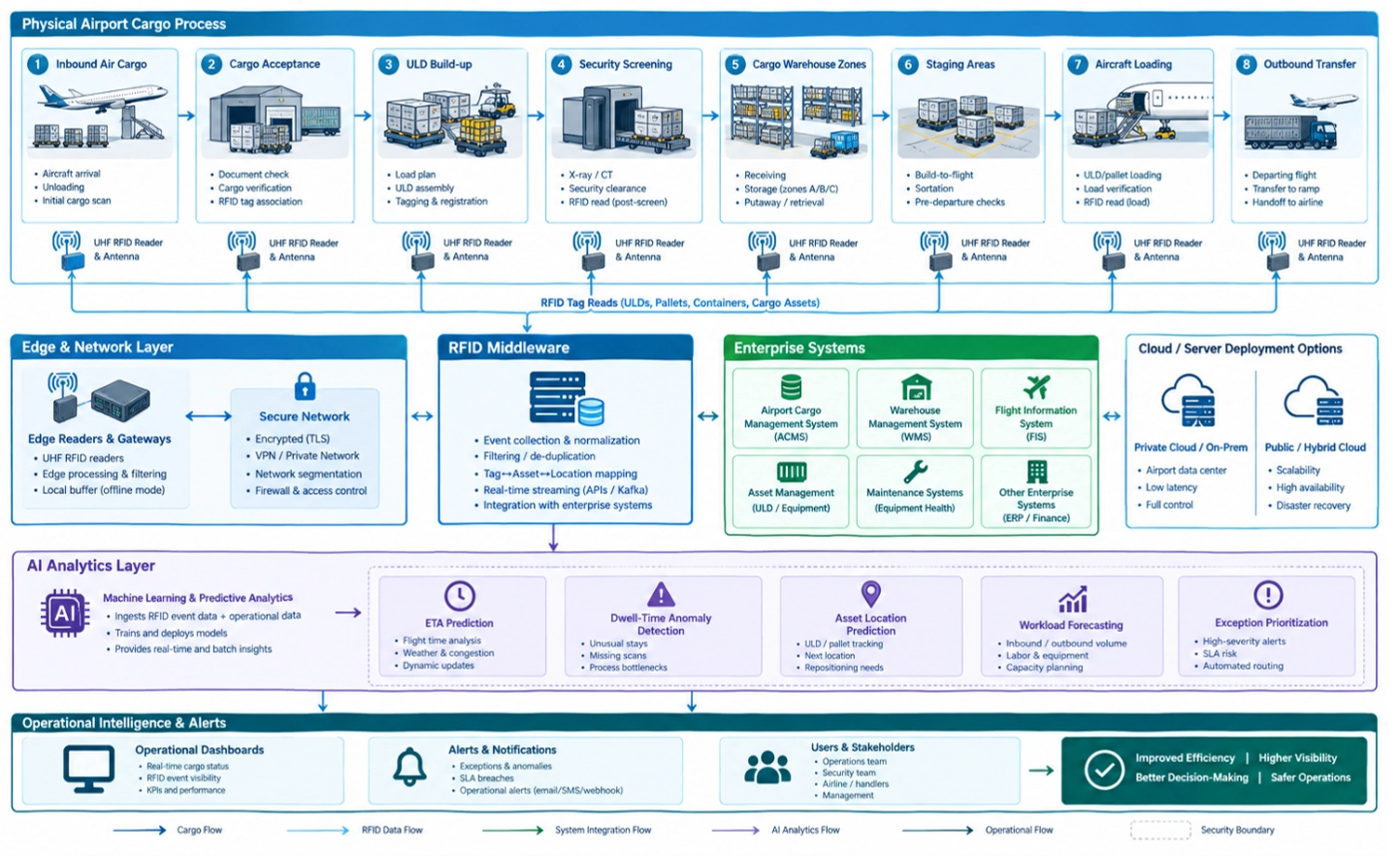
A technical system diagram illustrating the end-to-end integration of physical airport cargo processes with UHF RFID data collection, edge middleware, enterprise cargo software, and AI analytics. The architecture details physical asset tracking—spanning acceptance, build-up, security, warehouse storage, staging, and aircraft loading—and routes RFID event streams across secure network boundaries to power AI functions like ETA prediction, dwell-time anomaly detection, asset localization, workload forecasting, and operational alerting.
What AI Means for Modern Airport Cargo Operations
Airport cargo is a time-sensitive chain involving freight forwarders, airlines, ground handling organizations, cargo terminal operators, customs authorities, security personnel, warehouse teams, ramp personnel, and aircraft loading crews. A shipment may pass through multiple physical locations and operational states before it reaches the aircraft or leaves the airport.
Traditional cargo information systems can record transactions, but operational decisions often depend on whether the underlying event data is complete, timely, and correctly associated with the shipment, ULD, flight, location, and handling process. AI becomes more useful when it receives high-quality operational signals from RFID readers, barcode systems, IoT sensors, warehouse systems, flight schedules, access-control systems, and other sources.
AI can then support airport cargo operations through several layers:
- Descriptive analytics identifies where cargo and handling assets are located and what operational events have occurred.
- Diagnostic analytics helps determine why cargo has remained in a staging area, missed a handling milestone, or generated an exception.
- Predictive analytics estimates delays, congestion, asset demand, dwell time, and potential process failures.
- Prescriptive analytics recommends operational responses such as reallocating handling resources or prioritizing specific shipments.
- Computer vision can inspect cargo handling areas, labels, ULD conditions, loading activities, and process compliance where appropriate.
- Edge AI can analyze selected sensor or video information close to the cargo operation when low latency or local data processing is required.
RFID therefore functions primarily as an identification and event-capture mechanism rather than the AI itself. The value comes from connecting reliable physical-world observations with AI models and airport cargo business rules.
Airport Cargo Applications for AI-Enabled RFID Data
AI Cargo Tracking and Shipment Visibility
Cargo visibility becomes more difficult when shipments move between acceptance docks, build-up areas, screening points, storage positions, transfer zones, and aircraft-side staging. RFID can automatically record the presence of tagged items at defined checkpoints without requiring personnel to manually scan every item.
AI can use these events to establish expected cargo movement patterns and identify deviations. For example, a shipment expected to progress from acceptance to screening and then to build-up can be flagged when it remains in an intermediate area beyond its expected dwell time.
Operational users can receive alerts based on risk rather than simply receiving a large stream of RFID reads.
ULD Tracking and Aircraft Loading Coordination
ULDs are critical airport cargo assets because their availability and location directly affect build-up, aircraft loading, transfer operations, and turnaround activities.
RFID-tagged ULDs can generate location events at cargo doors, storage areas, build-up stations, staging zones, and other controlled points. AI can combine those events with flight schedules and loading plans to identify ULDs that are not positioned as expected.
Potential decisions include:
- Prioritizing ULD retrieval for an approaching departure
- Identifying ULDs that remain in the wrong handling area
- Forecasting ULD demand by flight schedule
- Detecting unusual ULD dwell patterns
- Supporting reconciliation between planned and observed ULD movements
AI Cargo Dwell-Time and Delay Prediction
Cargo dwell time is influenced by acceptance queues, documentation, screening, warehouse capacity, build-up activity, customs processes, transfer requirements, and flight schedules. Simple threshold alerts can identify delays after they have already occurred.
Machine learning can instead model normal processing times for different cargo categories, flights, handling stages, and operating periods. RFID events provide physical evidence of when cargo enters or leaves specific zones.
AI can then estimate whether cargo is likely to miss an operational milestone before the deadline is reached.
Cargo Warehouse Congestion Management
Airport cargo warehouses frequently contain multiple simultaneous workflows. Import cargo, export cargo, transfer freight, special cargo, ULDs, pallets, containers, and handling equipment may compete for limited floor space and handling resources.
AI can analyze RFID location events, warehouse transactions, historical throughput, scheduled flights, and current workload to identify developing congestion.
This can support decisions concerning staging locations, handling priorities, labor allocation, and movement sequencing.
AI-Assisted Special Cargo Monitoring
Special cargo can include temperature-sensitive pharmaceuticals, perishables, live animals, dangerous goods, valuable cargo, and other shipments requiring controlled procedures.
RFID identification can associate cargo with the correct shipment or handling unit, while IoT sensors can provide environmental measurements such as temperature and humidity where required. AI can analyze the combined event history to identify deviations from expected handling conditions.
For temperature-sensitive air cargo, the important engineering principle is that RFID identification alone does not measure temperature. RFID can establish the identity and location relationship, while dedicated temperature sensors provide the environmental measurement.
Cargo Handling Asset Management
Airport cargo operations depend on carts, dollies, containers, ULD handling equipment, pallets, ground support equipment, scanners, and other reusable assets.
AI-based asset management can use RFID events to determine utilization, movement frequency, idle time, and abnormal movement patterns. This can improve asset availability without requiring every operational team to manually search for equipment.
GAO can support such deployments with RFID readers, antennas, tags, and IoT components selected according to the physical characteristics and operating conditions of the airport cargo environment.
AI and RFID Airport Cargo Use-Case Matrix
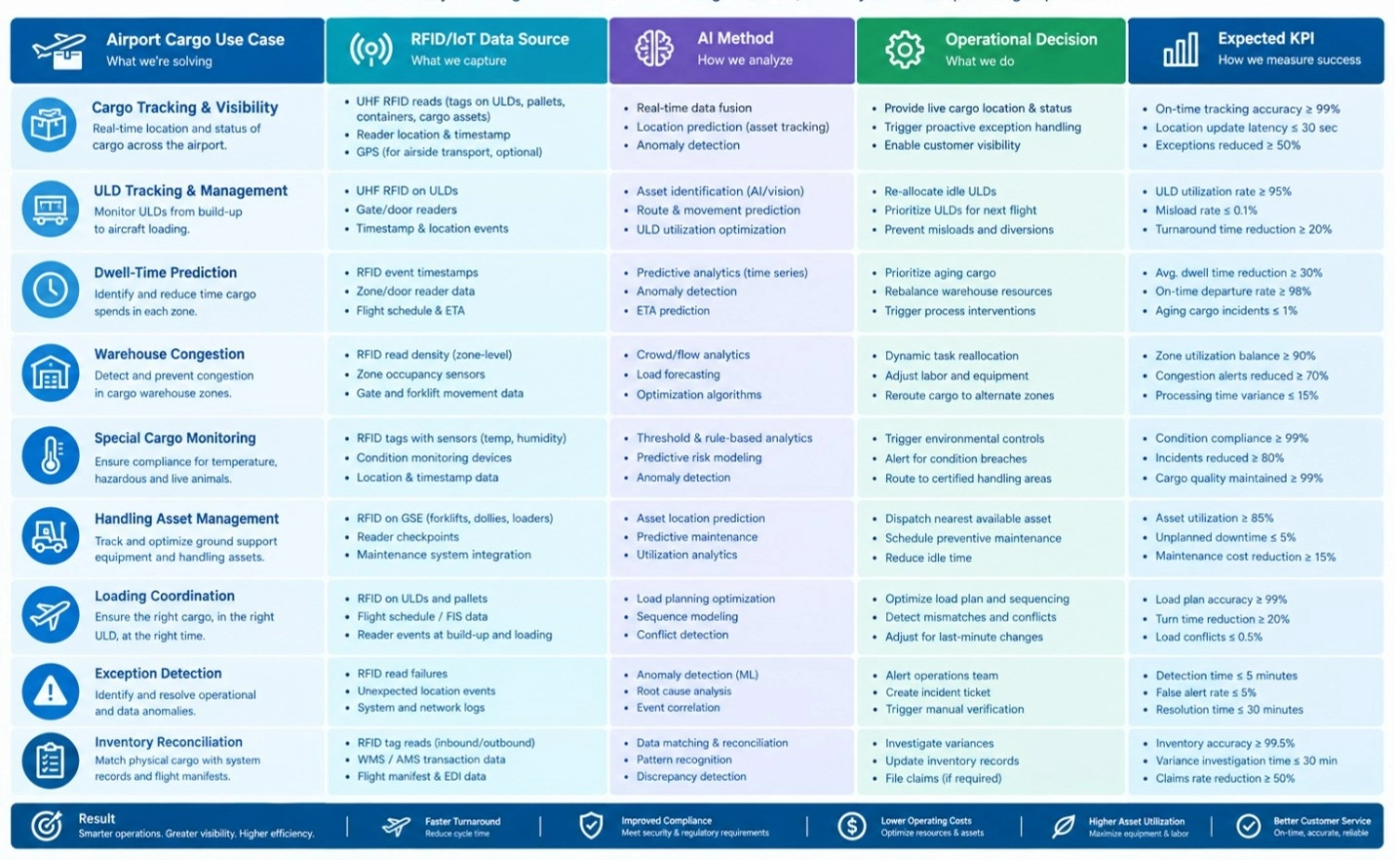
An enterprise data matrix mapping nine core airport cargo workflows to their corresponding RFID/IoT data sources, AI methods, operational decisions, and target key performance indicators (KPIs). Workflows covered include cargo tracking, ULD container management, dwell-time prediction, warehouse congestion, special cargo sensing, GSE equipment tracking, loading sequence coordination, damage/exception detection, and automated inventory reconciliation.
Airport Cargo Operational Workflow from RFID Capture to AI Decision
A practical AI-enabled airport cargo system starts with physical events and ends with an operational action. The quality of that chain depends on correct tag association, reader placement, event filtering, network reliability, data normalization, AI model performance, and integration with existing cargo software.
Data Acquisition at Cargo Handling Points
RFID readers and antennas can be installed at cargo acceptance points, warehouse doors, ULD staging areas, build-up stations, transfer locations, storage zones, and controlled movement corridors.
UHF RFID is generally relevant when airport cargo operators need longer-range identification of tagged objects and rapid multi-tag reads. HF RFID can be useful for shorter-range controlled interactions where the operating procedure is designed around close proximity. LF RFID may be considered for specialized short-range identification requirements, although its operating characteristics differ substantially from UHF.
Reader configuration should account for metal structures, liquid contents, dense cargo, reflective surfaces, antenna polarization, tag orientation, read-zone geometry, and potential interference from surrounding equipment.
RFID Event Processing and Middleware
Raw RFID observations should not automatically become business events. A reader may detect the same tag multiple times while an item remains within a read zone.
Middleware can filter duplicate reads, apply time windows, associate reads with locations, and transform raw observations into meaningful events such as:
- ULD entered export staging
- Cargo unit passed warehouse checkpoint
- Tagged asset left storage zone
- Shipment-associated container entered build-up area
- Asset remained in a location beyond the configured dwell threshold
This event layer is important because AI models perform better when the data represents meaningful operational states rather than uncontrolled reader-level observations.
Enterprise Cargo System Integration
Processed RFID events can be integrated with cargo management applications, warehouse management software, inventory systems, flight information systems, transportation systems, maintenance applications, and operational dashboards.
Integration methods can include REST APIs, message queues, database interfaces, event streaming, middleware connectors, and standards-based data exchange where supported by the existing airport environment.
The system should maintain relationships among shipment identifiers, AWB information, ULD identifiers, flight numbers, warehouse locations, handling events, and timestamps. Poor identifier mapping can create false operational conclusions even when RFID hardware is functioning correctly.
AI Processing and Operational Decisions
AI models can consume normalized event data together with historical cargo movements, scheduled flight information, warehouse workload, staffing information, and other permitted operational data.
A typical decision chain can be represented as:
RFID/IoT Event → Event Validation → Cargo State → AI Analysis → Risk Score → Operational Alert → Human Decision → Cargo Action → Recorded Outcome
The feedback loop is important. Actual outcomes should be retained so that predictive models can be evaluated and recalibrated against airport cargo operating conditions.
Comprehensive Airport Cargo RFID to AI Operational Workflow Architecture
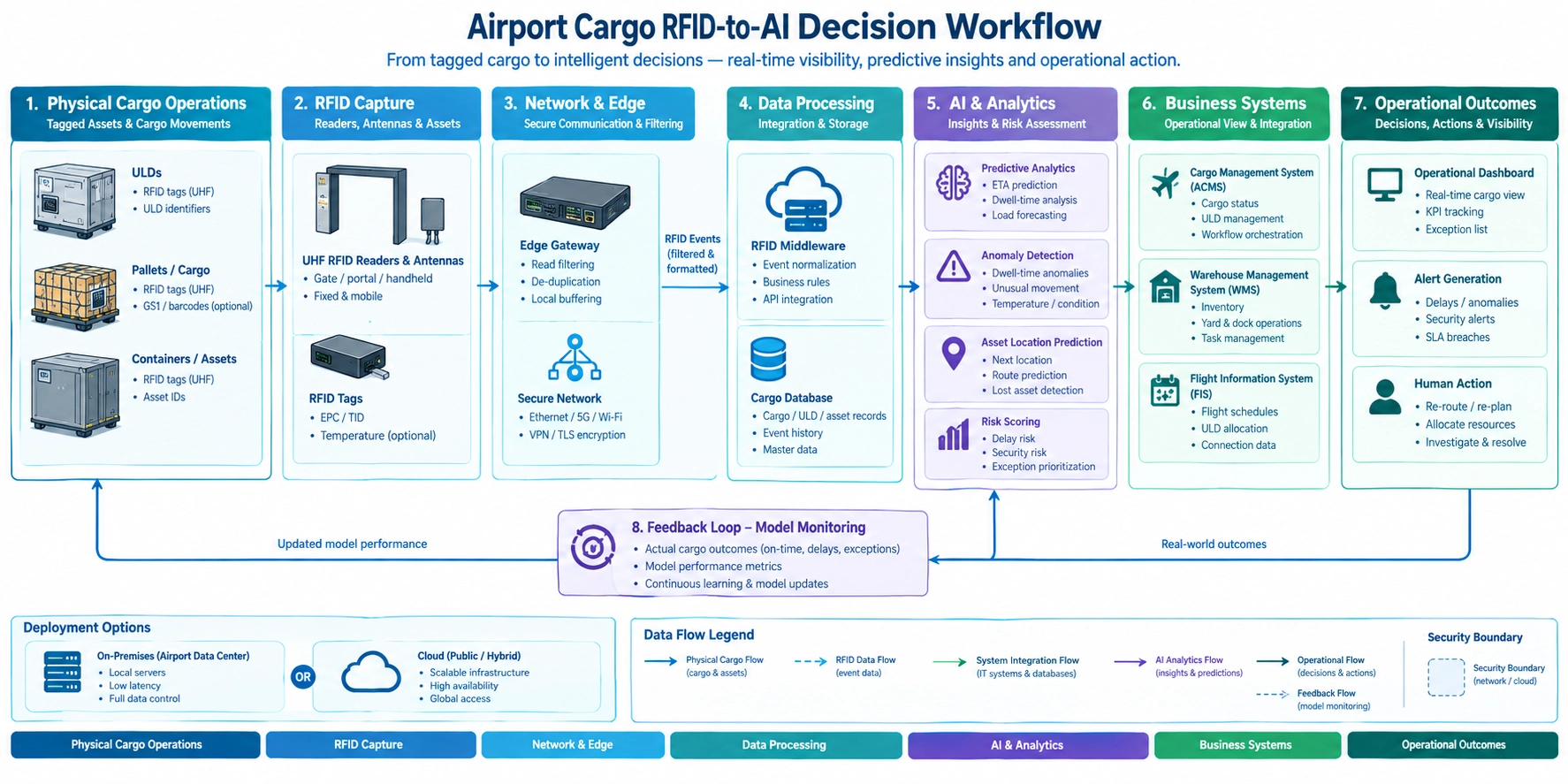
A system architecture diagram detailing the end-to-end data lifecycle in an airport cargo operation, from physical RFID tagging of ULDs and cargo units to AI-driven operational decisions. The workflow traces data through physical capture, network and edge processing, core data processing, AI analytics for predictions and risk scoring, and finally to business systems including operational dashboards, alerts, and human operator actions. A feedback loop highlights how outcomes are fed back for model re-training and optimization.
RFID, AI, and Supporting Technologies for Airport Cargo
Airport cargo deployments normally require more than RFID readers and AI software. A reliable implementation combines identification hardware, communications, software integration, data management, cybersecurity, and operational controls.
RFID Hardware
Relevant components can include:
- UHF RFID fixed readers for cargo doors, staging zones, and controlled movement points
- UHF RFID antennas selected according to required read-zone geometry
- RFID tags for ULDs, pallets, containers, reusable handling assets, and selected cargo applications
- HF RFID readers and tags for controlled short-range identification processes
- LF RFID components for specialized proximity identification requirements
- Handheld RFID readers for exception handling and manual verification
- Edge gateways for local data aggregation and protocol conversion
- IoT sensors for temperature, humidity, vibration, or other cargo conditions where required
Hardware selection should follow the cargo workflow rather than beginning with a reader model. Read distance, tag density, cargo composition, environmental conditions, mounting restrictions, network availability, and required throughput should be assessed before finalizing equipment.
AI and Data Technologies
AI-enabled airport cargo solutions can incorporate:
- Machine learning for delay and dwell-time prediction
- Anomaly detection for unusual cargo movement
- Time-series analysis for throughput and workload forecasting
- Optimization models for resource and staging decisions
- Computer vision for selected cargo handling and compliance applications
- Edge AI for low-latency local analysis
- Data warehouses or analytical databases for historical event analysis
- Operational dashboards for cargo supervisors and control teams
AI should not replace deterministic cargo business rules where regulatory, safety, security, or contractual requirements demand explicit controls. A practical design can combine rules-based validation with probabilistic AI predictions.
Communication and Integration Infrastructure
Airport cargo RFID systems can use Ethernet, Wi-Fi, cellular connectivity, or other approved communications depending on the deployment environment. Network segmentation is important because cargo identification devices should not automatically have unrestricted access to critical airport IT resources.
Secure APIs, authenticated devices, encrypted communications, access controls, logging, and controlled administrative privileges should be incorporated into the design.
Enterprise Airport Cargo RFID & AI Deployment Architecture
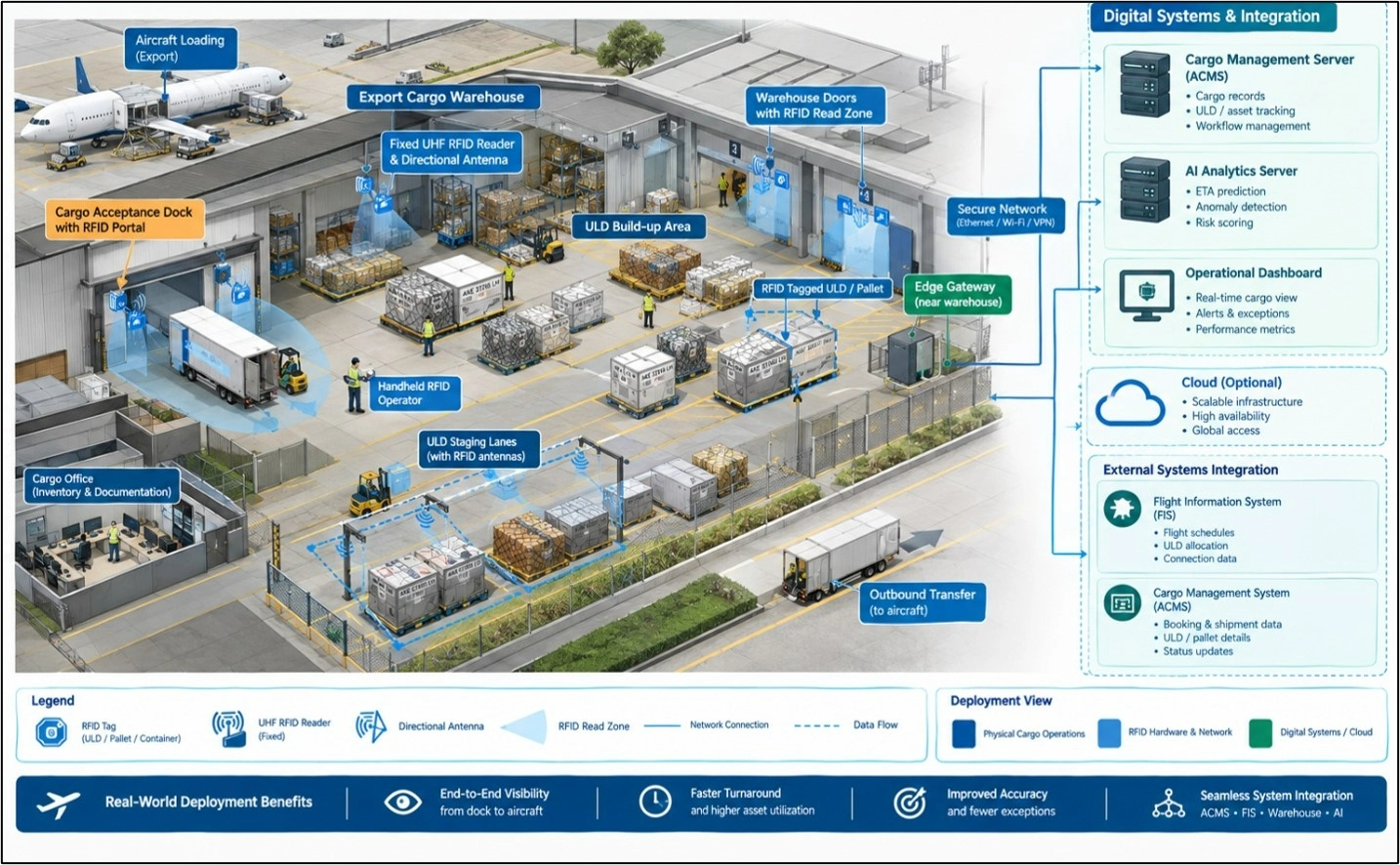
A detailed technical 3D cutaway diagram illustrating the physical and digital infrastructure for an RFID and AI-driven airport cargo operation. The visualization maps out how handheld and fixed UHF RFID readers capture data from tagged ULDs and shipments across the acceptance docks, warehouse doors, and staging lanes. This data is processed through edge gateways and a secure network, integrating with an operational dashboard, cargo management servers, AI analytics servers, and flight information systems to enable real-time tracking, dwell-time alerts, and predictive analytics in a functioning cargo terminal.
Cloud Version, Server Version, and Edge Processing for Airport Cargo
Cloud Version
A cloud-hosted deployment can centralize RFID event processing, cargo analytics, dashboards, model management, and multi-location reporting. This approach can be appropriate for cargo organizations operating across multiple terminals or airport locations where centralized analytics and software administration are important.
Cloud deployment still requires secure local connectivity and suitable edge components because RFID readers operate close to the physical cargo process. Local buffering can also protect against temporary network interruptions.
Server Version
A server-based deployment places application software on customer-managed servers, private data centers, airport IT infrastructure, or other privately hosted enterprise environments. This model can be appropriate when airport cargo operators require greater control over data location, network connectivity, integration boundaries, or operational software management.
Server Version does not necessarily mean that every RFID processing function must be centralized. Edge processing can remain close to the readers while higher-level analytics operate on private servers.
Edge Processing
Edge processing is useful when RFID events must be filtered, normalized, buffered, or analyzed close to the cargo operation. It can reduce unnecessary network traffic and provide local continuity when connectivity to centralized systems is temporarily unavailable.
A practical airport cargo deployment can therefore use:
RFID Reader → Edge Processing → Secure Network → Cloud Version or Server Version → AI Analytics → Cargo Operations
The appropriate combination depends on airport IT policies, data governance, network availability, latency requirements, integration complexity, and the number of cargo locations being monitored.
Technical Capabilities and Operational Improvements for Airport Cargo
AI-enabled airport cargo systems become valuable when physical cargo events are converted into timely operational decisions. The combination of RFID identification, IoT sensing, cargo software, and AI analytics can improve visibility without requiring personnel to manually verify every movement.
Predictive Cargo Operations
Historical cargo movements can be used to establish expected processing times for acceptance, screening, storage, build-up, transfer, and aircraft-side staging. Machine learning models can then identify conditions associated with delayed cargo.
Relevant variables may include:
- Flight departure time and planned cargo milestones
- Cargo acceptance and screening timestamps
- ULD location history
- Warehouse dwell time
- Current cargo volume
- Historical processing duration
- Handling resource availability
- Special handling requirements
- Previous exception events
The output should normally be treated as a decision-support signal rather than an autonomous operational command. Cargo supervisors can review risk scores alongside current operational conditions before changing handling priorities.
Exception Detection and Root-Cause Analysis
A useful AI cargo system does more than report that a shipment is late. It should help identify the operational condition contributing to the exception.
For example, a cargo unit may have:
- Entered the expected warehouse zone but not progressed to screening
- Cleared screening but remained outside the expected build-up area
- Been associated with a ULD that has not reached the planned staging location
- Experienced an unusually long dwell period
- Generated RFID observations inconsistent with the expected movement sequence
Combining RFID event history with cargo-management transactions can allow analytics software to distinguish a missing RFID read from a genuine process deviation.
AI-Based Workload Forecasting
Airport cargo volumes fluctuate according to flight schedules, seasonal demand, transfer patterns, and irregular operations. AI models can forecast expected workload by time period and operational area.
Forecasts can support decisions concerning:
- Cargo warehouse staffing
- ULD handling resources
- Staging-space allocation
- Equipment availability
- Screening workload
- Dock utilization
- Exception-response capacity
The practical benefit comes from connecting forecasts to actual cargo processes. A generic volume forecast has limited operational value if it is not associated with specific warehouse areas, flight banks, cargo types, or handling milestones.
Cargo Inventory and Reconciliation
RFID can provide automated identification at controlled cargo movement points, helping reconcile physical observations against expected records.
AI can identify recurring discrepancies between planned and observed inventory states. For example, repeated mismatches involving particular locations, shifts, equipment, or handling processes can indicate a process-control issue rather than isolated human error.
GAO can provide RFID hardware and IoT systems that support physical data capture while existing airport cargo applications remain the system of record for shipment and operational transactions.
Airport Cargo KPIs for AI and RFID Programs
A successful deployment should be measured through operational KPIs rather than RFID read counts alone. The most useful metrics connect technology performance to cargo outcomes.
| KPI | What It Measures | AI/RFID Contribution |
|---|---|---|
| Cargo dwell time | Time cargo remains within a process stage | RFID events establish physical timestamps; AI predicts abnormal dwell |
| ULD retrieval time | Time required to locate and position a ULD | RFID provides location events and AI can prioritize retrieval |
| Cargo milestone compliance | Percentage of cargo meeting planned milestones | AI compares actual progress against expected timelines |
| RFID read accuracy | Reliability of physical identification events | Reader and antenna optimization improves event quality |
| False exception rate | Incorrect operational alerts | Model validation and event filtering reduce unnecessary escalation |
| Cargo reconciliation rate | Agreement between physical and digital records | RFID observations support automated reconciliation |
| Warehouse throughput | Cargo processed within a period | AI forecasting supports resource planning |
| Staging-area utilization | Use of available cargo staging capacity | Location events support occupancy analysis |
| Asset utilization | Use of carts, dollies, ULDs, and handling assets | RFID movement history supports utilization analytics |
| Prediction accuracy | Reliability of AI forecasts | Continuous model monitoring measures operational performance |
| Mean time to resolve exceptions | Speed of operational response | Prioritized AI alerts help teams address high-risk events |
| Data completeness | Availability of required cargo events | Event monitoring identifies missing or delayed data |
Read accuracy should not be treated as an isolated laboratory metric. A reader that performs well in an open test area may behave differently around metal ULD structures, dense cargo, liquids, forklifts, doors, and other airport equipment.
Airport Cargo Implementation Lifecycle
A technically sound deployment should progress from process analysis to controlled production use. Installing readers before understanding cargo movement patterns often creates unnecessary read events, blind zones, and integration problems.
Planning and Site Assessment
The initial assessment should document:
- Cargo process maps
- ULD and shipment identification methods
- Existing barcode and RFID technologies
- Cargo warehouse zones
- Door and staging locations
- Reader mounting opportunities
- Network availability
- Metal and RF-reflective structures
- Cargo density
- Required read distances
- Existing cargo management applications
- Security and IT requirements
The assessment should also determine where RFID creates measurable operational value. Not every cargo movement needs continuous RFID coverage.
Hardware Selection and Engineering Design
Hardware should be selected according to the cargo use case.
UHF RFID is generally suited to longer-range automated identification, especially at cargo doors and controlled movement points. HF can support short-range controlled identification processes, while LF can serve specialized proximity applications.
Tag selection deserves equal attention. ULD surfaces, metal structures, plastic containers, liquid contents, temperature exposure, attachment method, and expected tag orientation can significantly affect RFID performance.
A site survey should validate:
- Read-zone coverage
- Antenna orientation
- Reader power configuration
- Tag placement
- Cross-read containment
- Network connectivity
- Electromagnetic interference
- Physical protection
- Maintenance accessibility
Commissioning and Testing
Commissioning should test the complete operational chain rather than RFID hardware alone.
Testing should cover:
- Tag readability
- Read-zone boundaries
- Duplicate-event filtering
- Correct location association
- Reader-to-middleware communication
- Middleware-to-cargo-system integration
- Timestamp accuracy
- Shipment and ULD identifier mapping
- Exception generation
- Dashboard updates
- Network interruption recovery
- Data buffering
- AI alert behavior
Negative testing is particularly important. Teams should deliberately introduce missing reads, duplicated reads, delayed network messages, incorrect tag associations, and unexpected cargo movements to determine whether the system fails safely.
Cybersecurity and Data Governance for Airport Cargo
Airport cargo data can include shipment identifiers, flight information, operational timestamps, location information, security-related events, and information exchanged among airlines, ground handlers, freight forwarders, customs authorities, and other parties.
Security controls should therefore be applied across the complete data path.
Recommended controls include:
- Unique credentials for RFID readers and gateways
- Role-based access to cargo information
- Network segmentation for RFID and IoT devices
- Encryption for data in transit
- Secure administrative interfaces
- Device inventory and lifecycle management
- Centralized event logging
- Configuration backups
- Software and firmware update procedures
- API authentication and authorization
- Monitoring for unusual device behavior
- Controlled retention of historical cargo events
AI introduces additional governance requirements. Model inputs should be traceable, training data should be validated, and prediction outputs should be monitored for drift.
Human operators should also be able to determine why a high-priority cargo alert was generated. Explainable rules, supporting event evidence, and confidence indicators can make AI recommendations more operationally useful.
Air Cargo Standards, Regulations, and Interoperability
Airport cargo deployments must be aligned with the regulatory environment of the specific airport, country, airline, cargo operator, and cargo category. RFID and AI systems should support existing compliance processes rather than bypass them.
ICAO Annex 9 addresses facilitation and includes procedures relevant to international airport operations and clearance processes. The current ICAO Store listing identifies the 17th edition of Annex 9 as published in March 2025.
Security requirements must also be considered. ICAO Annex 17 establishes the international framework for aviation security, including controls concerning cargo and mail.
Dangerous goods workflows require particular care. ICAO Annex 18 establishes provisions governing the safe transport of dangerous goods by air, while IATA maintains detailed dangerous-goods operational guidance.
Digital interoperability is increasingly important. IATA Cargo-XML supports air cargo messaging and regulatory information exchange, including customs and security-related processes.
IATA ONE Record provides a standardized data-sharing approach based on a common data model, APIs, and security specifications. This creates an important integration consideration for AI systems that need consistent shipment information across multiple air cargo stakeholders.
The key engineering lesson is that RFID event data should be mapped into the organization’s existing cargo information model rather than creating an isolated identification database.
Engineering Trade-Offs in Airport Cargo RFID Deployments
Continuous Coverage vs. Controlled Checkpoints
Continuous RFID coverage may appear attractive but can generate large quantities of event data and increase deployment complexity. Controlled read zones at strategically selected cargo doors, staging points, and transfer locations can provide more meaningful events with lower infrastructure requirements.
Automation vs. Human Verification
Automation can reduce repetitive scanning, but exception handling still requires personnel. Handheld RFID readers can provide a verification mechanism when fixed infrastructure cannot determine the correct operational state.
Centralized AI vs. Edge Processing
Centralized processing simplifies model management and cross-location analytics. Edge processing can reduce latency and maintain local functionality during network interruptions.
Many airport cargo deployments benefit from a combination of both approaches.
Read Sensitivity vs. Cross-Read Control
Increasing RFID reader sensitivity does not automatically improve operational accuracy. Excessive read range can cause tags from adjacent lanes or storage areas to appear in the wrong operational zone.
Read-zone engineering should therefore prioritize correct identification at the correct location rather than maximum theoretical read distance.
Business Value of AI-Enabled Airport Cargo Operations
The business value comes from improving the relationship between physical cargo movement and operational information.
AI-supported RFID systems can help airport cargo organizations:
- Reduce manual cargo and ULD location searches
- Identify abnormal dwell time earlier
- Improve shipment and ULD reconciliation
- Increase visibility across warehouse and staging processes
- Improve handling-resource planning
- Detect recurring operational bottlenecks
- Reduce unnecessary exception investigation
- Support more accurate cargo milestone monitoring
- Improve reusable handling-asset utilization
- Provide stronger historical data for process optimization
These outcomes depend on deployment quality. AI cannot compensate for poorly positioned readers, incorrect tag attachment, incomplete event data, weak identifier mapping, or inadequate integration with cargo systems.
GAO’s role can include supplying RFID and IoT hardware products and systems that form part of the physical data-capture layer, with engineering support for selecting appropriate components for specific operational requirements.
Practical Recommendations for Airport Cargo Technology Teams
Organizations evaluating AI-enabled airport cargo identification should begin with an operational problem rather than a hardware specification.
Recommended practices include:
- Select one measurable cargo workflow for the initial deployment.
- Define the business event that each RFID read must represent.
- Survey RF conditions before finalizing reader and antenna placement.
- Test RFID tags using representative ULD and cargo materials.
- Separate raw RFID observations from validated business events.
- Establish authoritative mappings among AWB, ULD, shipment, flight, and location identifiers.
- Integrate with existing cargo software instead of creating duplicate records.
- Use AI initially for prediction, anomaly detection, and prioritization where the operational value is measurable.
- Keep safety, security, and regulatory decisions subject to appropriate deterministic controls.
- Establish cybersecurity controls before connecting RFID devices to production networks.
- Measure prediction accuracy and false alerts continuously.
- Conduct a controlled pilot before extending RFID coverage across additional cargo areas.
- Design maintenance procedures for readers, antennas, tags, gateways, and network equipment.
- Document failure modes and provide manual fallback procedures for operational continuity.
GAO Expertise for Airport Cargo RFID and AI Systems
Headquartered in New York City and Toronto, Canada, GAO is among the leading B2B and B2G suppliers of RFID, BLE, and IoT technologies. GAO and its sister companies, GAO Research and GAO Tek, form GAO Group, serving organizations across the United States and Canada.
For three decades, GAO Group has supplied products and systems to Fortune 500 companies, R&D organizations, universities, and government agencies. Its work spans RFID, BLE, IoT, and related technologies used for physical identification, sensing, monitoring, and operational data capture.
GAO emphasizes product R&D, quality assurance, and technical support, including remote and onsite assistance where appropriate. For airport cargo organizations, this experience is relevant when selecting RFID hardware, designing identification workflows, integrating connected devices, and developing practical deployment and support procedures.
Building the Future of Industrial AI and IoT with Aperture Venture Studio and GAO RFID Inc.
For more than three decades, GAO Group of Companies has invested heavily in R&D of industrial RFID, BLE, and IoT. As generative AI has become increasingly useful for industrial applications, we have developed AI and IoT technologies that can support areas such as airport cargo visibility, asset tracking, and operational analytics. We have also founded Aperture Venture Studio to build, launch, and scale AI and IoT companies and solutions relevant to industries adopting connected operational technologies.
Aperture brings together AI and IoT technical experts, entrepreneurial and operational executives, investors, and leading companies.
We have also developed the Aperture Ventures Summit and TekSummit to discuss advanced topics in AI and IoT.
We welcome you to join us as:
- Advisors, Co-founders, or Employees
- Investors
- Customers