
AI and RFID for Airports
AI-Powered Airport Operations with RFID
Airports manage thousands of baggage items, aircraft components, ground support assets, maintenance tools, security equipment, consumables, and other mobile resources across terminals, airside facilities, cargo areas, maintenance hangars, and restricted zones. AI-powered airport operations use machine learning, computer vision, predictive analytics, and automated decision support together with RFID data to improve visibility and operational control. RFID provides the identification and location-related event data required to understand where tagged assets and items move through airport workflows, while AI converts those events into operational insights and predictions. UHF RFID is particularly useful for longer-range identification of baggage, equipment, inventory, and maintenance assets, while HF and LF RFID address selected short-range identification requirements. The resulting system can connect RFID readers, gateways, edge computing, middleware, airport databases, baggage handling systems, maintenance software, inventory systems, and analytics applications. GAO supplies RFID and IoT hardware and systems that can support these airport deployments.
Why AI-Powered RFID Matters for Airport Operations
Airport operations depend on continuous movement, strict timing, accurate identification, and coordination between multiple operational teams. A delayed baggage transfer, unavailable maintenance component, misplaced ground support asset, or missing tool can create downstream operational consequences.
Traditional identification methods often depend on barcode scans, manual checks, spreadsheets, radio communication, or visual confirmation. These methods can work effectively for controlled processes, but they may provide limited visibility when assets move rapidly across large airport facilities.
RFID changes the data acquisition layer by allowing tagged objects to be identified automatically when they pass through configured reader zones. AI adds an analytical layer that can interpret large volumes of RFID events and identify patterns that may not be apparent through manual monitoring.
For airports, this combination can support:
- Baggage movement monitoring and exception detection
- Aircraft maintenance tool and component tracking
- Ground support equipment visibility
- Airport inventory and consumables management
- Cargo and ULD identification
- Maintenance, repair, and overhaul workflow monitoring
- Secure movement monitoring for selected tagged assets
- Asset utilization analysis
- Predictive maintenance support
- Automated reconciliation between physical assets and enterprise records
AI does not replace RFID identification. RFID supplies structured physical-world events, while AI analyzes those events alongside operational information from airport systems.
Airport Workflows Supported by AI and RFID
Baggage Handling and Transfer Monitoring
Baggage is one of the most visible airport applications for automated identification. RFID-tagged baggage can generate identification events at configured points in baggage handling, transfer, sorting, loading, and arrival processes.
AI can analyze event sequences to identify unusual routing, missed transfer events, extended dwell times, or baggage movement patterns associated with operational delays. Integration with baggage handling systems can allow RFID events to be compared with flight schedules, baggage routing information, and transfer requirements.
The engineering challenge is not simply installing RFID readers. Reader placement, antenna orientation, tag selection, RF interference, conveyor speed, baggage density, metal structures, and read-zone design directly affect identification performance.
Aircraft Maintenance and MRO Asset Tracking
Aircraft maintenance environments contain high-value tools, serialized components, test equipment, calibration assets, and consumable materials. RFID can automate identification as tools and components enter or leave designated maintenance areas.
AI can use historical movement records to identify abnormal tool utilization, unusual dwell times, frequently misplaced equipment, or inventory patterns that may affect maintenance planning.
A practical implementation can connect RFID readers with maintenance management software so that physical movement events become part of the maintenance record rather than remaining in a separate tracking database.
Ground Support Equipment Visibility
Ground support equipment such as baggage carts, tow tractors, ground power units, aircraft stairs, catering equipment, and selected service equipment can move between terminals, ramps, maintenance areas, and storage locations.
RFID can establish automated checkpoints for selected equipment categories. AI can analyze movement history and utilization to identify underused assets, abnormal movement patterns, or potential availability constraints.
Airport operators can then use these insights for equipment allocation, maintenance planning, and fleet utilization decisions.
Airport Inventory and Consumables
Airports and aviation maintenance organizations maintain inventories of spare parts, maintenance materials, safety equipment, uniforms, tools, and other operational supplies.
RFID can automate inventory identification at storage rooms, receiving areas, maintenance stores, and controlled issue points. AI can analyze historical consumption, replenishment patterns, stock levels, and operational demand to support inventory planning.
This approach can reduce dependence on manual stock counts while providing a more continuous view of physical inventory.
Airport RFID and AI Operational Data Flow Diagram
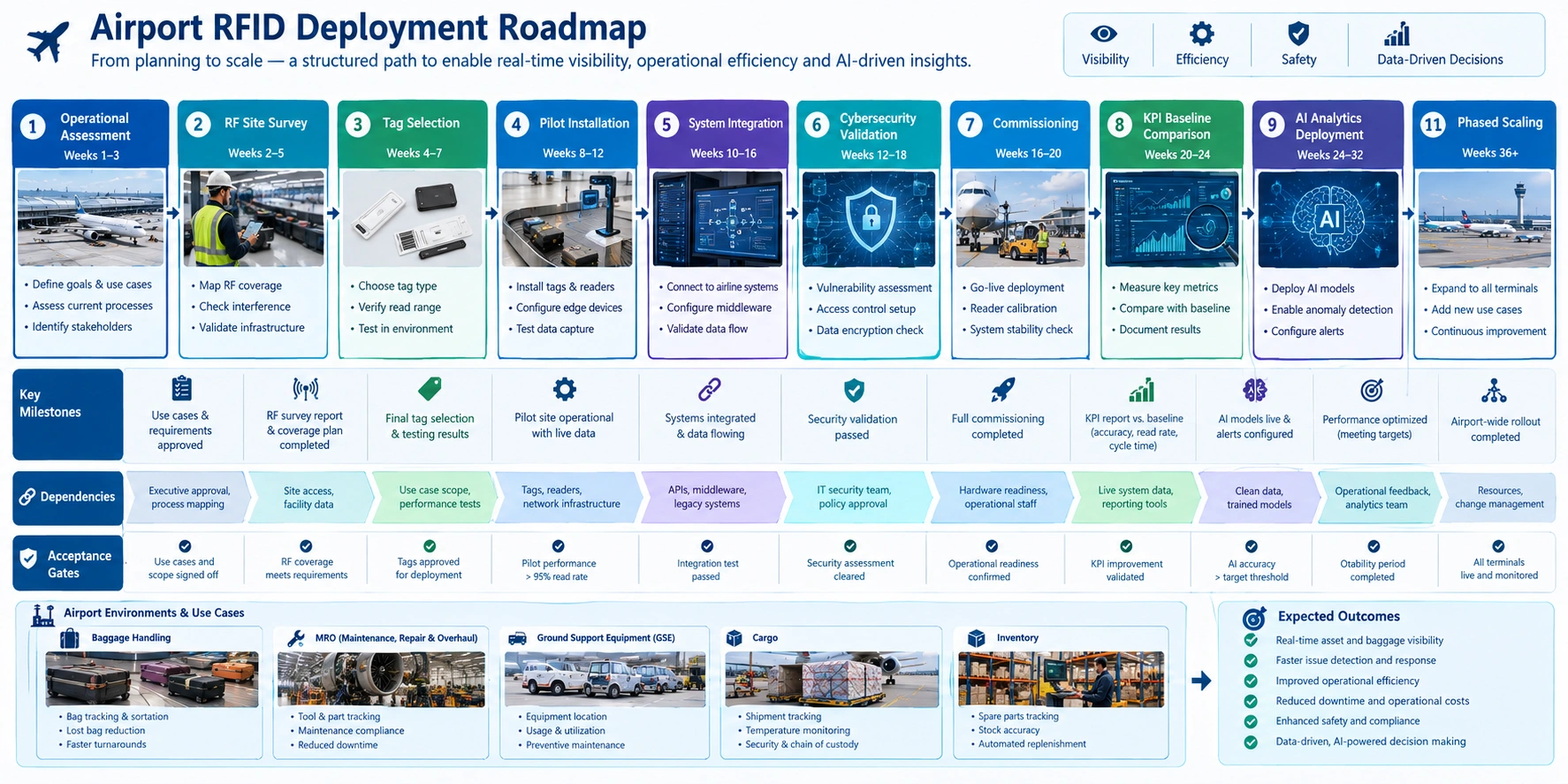
This diagram shows how RFID-tagged airport assets, baggage, cargo, maintenance tools, and ground support equipment generate identification events. UHF RFID readers send data through gateways and secure IP networks to edge processing, cloud or private-hosted software, middleware, airport databases, and AI analytics. The resulting insights support real-time dashboards, alerts, maintenance, resource allocation, and operational decisions.
RFID Technology for Airport Identification
RFID selection should follow the physical characteristics of the airport workflow rather than applying one RFID frequency universally.
UHF RFID
UHF RFID is generally appropriate where airports require longer read distances and automated identification of multiple tagged objects. Potential applications include baggage, ground support assets, maintenance inventory, tools, containers, and selected cargo workflows.
UHF performance depends heavily on antenna configuration, reader power, tag design, object orientation, nearby metal, liquids, conveyor geometry, and RF interference. Airport deployment teams should validate read performance under real operating conditions rather than relying only on laboratory measurements.
HF RFID
HF RFID operates at a shorter range and can be appropriate for controlled identification points where close-range reading is desirable. It can support selected access, asset identification, authentication, and item-level workflows.
HF can be useful when the physical process requires intentional presentation of an item or controlled proximity between the tag and reader.
LF RFID
LF RFID is suitable for specialized short-range identification scenarios and environments where its operating characteristics provide an appropriate engineering trade-off. Airport applications should be selected according to required read distance, tag geometry, environmental conditions, and system integration requirements.
RFID frequency selection should therefore be treated as an engineering decision based on the airport workflow, physical environment, required identification distance, throughput, tag cost, and interference conditions.
AI Methods for Airport RFID Data
RFID produces event data such as tag identity, reader identity, timestamp, antenna information, and potentially location or zone information. AI models can combine these events with operational datasets to produce higher-level conclusions.
Relevant AI techniques include:
- Anomaly detection for unusual baggage, equipment, or inventory movement
- Classification models for identifying operational event categories
- Time-series analysis for asset utilization and movement patterns
- Predictive models for demand, inventory requirements, and maintenance planning
- Clustering for discovering recurring movement or utilization patterns
- Optimization algorithms for resource allocation and operational scheduling
- Natural language interfaces for querying operational information
- Generative AI for summarizing operational exceptions and historical RFID events
AI quality depends on data quality. Duplicate reads, missed reads, incorrect reader configuration, stale asset records, inconsistent tag associations, and inaccurate timestamps can produce misleading analytical results.
A strong airport deployment therefore establishes RFID data-quality controls before using AI for operational decisions.
Airport RFID Data Flow from Capture to Decision
A practical AI-enabled RFID system can be understood as a sequence of connected processing layers.
- RFID tags provide unique identifiers attached to baggage, equipment, tools, components, containers, or inventory items.
- Fixed or mobile RFID readers capture tag responses within defined operating zones.
- Antennas establish the physical read areas and influence identification reliability.
- RFID gateways or edge devices collect and normalize reader events.
- Edge processing can filter duplicate reads, apply business rules, and reduce unnecessary data transmission.
- Middleware associates RFID identifiers with asset records and operational events.
- Airport enterprise systems provide additional context such as flight schedules, maintenance records, inventory data, work orders, and asset ownership.
- AI software analyzes historical and real-time information for anomalies, predictions, optimization, and decision support.
- Dashboards and alerts present relevant operational information to baggage, maintenance, logistics, inventory, and airport operations personnel.
- Business processes respond through asset reassignment, investigation, replenishment, maintenance action, exception handling, or operational escalation.
Edge Processing, Cloud Version, and Server Version
Airport environments can require different deployment models because of connectivity requirements, security policies, operational continuity, data governance, and integration constraints.
Edge Processing
Edge processing places selected data-processing functions close to RFID readers and airport operational areas. An edge computer or gateway can filter repeated RFID observations, validate events, apply local business rules, buffer data during network interruptions, and forward only relevant information to central software.
This approach can reduce network traffic and improve response time for local alerts. It is particularly useful for baggage conveyors, maintenance facilities, controlled inventory areas, and other locations where RFID events occur at high frequency.
Cloud Version
A cloud-hosted deployment can centralize RFID data, analytics, dashboards, device management, and AI services. Multiple airport facilities or geographically distributed operations can connect to a common software environment through secure networks.
Cloud deployment can simplify centralized software maintenance and provide scalable computing resources for analytics. It is most appropriate when airport policies, connectivity, cybersecurity controls, and data governance requirements permit cloud processing.
Server Version
A privately hosted Server Version can run on edge servers, customer-managed servers, private data centers, airport data centers, or other controlled enterprise infrastructure. This approach can be appropriate where airport operators require greater control over data location, network connectivity, software integration, or operational processing.
A hybrid arrangement can also use edge processing for immediate RFID event handling while forwarding selected data to privately hosted server software or approved cloud services.
GAO can provide RFID hardware and related IoT products that form part of these deployment environments, while system integrators and airport IT teams can determine the appropriate software, networking, security, and integration configuration.
Engineering Considerations for Airport RFID Deployment
RFID deployment quality depends on the physical environment as much as the software.
Airport engineering teams should evaluate:
- RF propagation around metal structures, aircraft equipment, conveyors, racks, and vehicles
- Tag placement and orientation on different asset materials
- Required read distance and identification throughput
- Reader and antenna positioning
- Electromagnetic interference and nearby radio systems
- Environmental exposure including temperature, moisture, dust, vibration, and cleaning processes
- Reader enclosure and mounting requirements
- Network availability and redundancy
- Edge-processing requirements
- Integration with existing airport information systems
- Asset master-data quality
- RFID tag commissioning and association procedures
- Read-zone testing and validation
- Cybersecurity controls for connected readers and gateways
- Maintenance procedures for RFID hardware
- Scalability from pilot areas to additional airport facilities
A commissioning process should validate actual operational performance. Airport teams should test representative baggage, equipment, containers, tools, and components under realistic movement speeds and environmental conditions.
Airport Enterprise System Integration
AI-powered airport RFID becomes most valuable when identification events are connected to the systems already used to manage baggage, aircraft maintenance, ground operations, inventory, cargo, and facilities. RFID should therefore be treated as an operational data source rather than an isolated tracking system.
Typical integration points include:
- Baggage handling systems (BHS) for associating RFID reads with bag routing, transfer status, conveyor events, and exception handling.
- Airport operational databases (AODB) for relating operational events to flights, gates, stands, and scheduled activities.
- Maintenance management and MRO software for tracking aircraft components, maintenance tools, inspection equipment, and serviceable inventory.
- Enterprise resource planning (ERP) and warehouse management systems (WMS) for inventory transactions, stock movements, replenishment, and asset records.
- Cargo management systems for identifying tagged cargo, containers, ULDs, and handling events.
- Ground support equipment systems for connecting equipment identification with dispatch, utilization, maintenance, and availability information.
- Identity and access systems where RFID identification is appropriate for authorized equipment, controlled assets, or operational workflows.
Middleware provides an important separation between RFID readers and business applications. It can normalize reader messages, remove duplicate reads, apply business rules, associate tag identifiers with asset records, and forward validated events through APIs or message-based interfaces.
REST APIs can support application integration, while MQTT can be useful for lightweight event transmission between edge components and centralized software. SQL databases can retain structured event history, while message queues or event brokers can decouple high-volume RFID capture from downstream applications.
GAO can support airport deployments with RFID hardware and related IoT components that provide the physical identification layer required for these integrations.
Airport RFID Cybersecurity and Data Governance
Airport environments require cybersecurity controls that protect operational data without interfering with safety, availability, or time-sensitive workflows. RFID readers, gateways, edge computers, network interfaces, middleware, and application servers should be considered part of the airport’s connected technology environment.
Core controls include:
- Network segmentation that separates RFID equipment from sensitive airport operational networks where appropriate.
- Device authentication and unique credentials rather than shared default passwords.
- Role-based access control and least-privilege permissions for administrators, operators, integrators, and service personnel.
- Encryption for sensitive communications, particularly when RFID event data crosses untrusted or shared networks.
- Secure API authentication and authorization between RFID middleware and airport applications.
- Firmware and software lifecycle management with controlled update procedures.
- Centralized audit logging for configuration changes, administrative access, integration activity, and significant system events.
- Backup and recovery procedures for databases, configurations, device settings, and integration components.
- Physical protection of readers, gateways, antennas, and edge computers located in public, baggage, ramp, cargo, or maintenance areas.
- Data retention policies that define how long identification and operational event records should be stored.
RFID deployments should also be evaluated against the airport’s existing cybersecurity policies and applicable aviation, information-security, and operational-technology requirements. Frameworks such as NIST cybersecurity guidance, ISO/IEC 27001, and IEC 62443 can provide useful reference points depending on the systems involved, but compliance requirements should be determined according to the airport, jurisdiction, application, and system classification.
Security design should account for availability as well as confidentiality. A temporary network failure should not necessarily stop baggage or maintenance operations. Edge buffering, local event validation, redundant connectivity, and controlled recovery procedures can allow operations to continue while preserving data for later synchronization.
AI-Driven Operational Benefits for Airports
AI adds analytical capability to RFID event data by identifying patterns that are difficult to manage manually across thousands of daily movements. The value comes from combining reliable physical identification with contextual operational information.
AI Baggage Exception Detection
A baggage system can compare RFID events against expected routing and transfer sequences. AI models can identify unusual dwell times, missing checkpoints, unexpected routing, or transfer risks and prioritize exceptions for operational teams.
The result is not simply another tracking screen. The system can help personnel focus attention on bags or processes that require intervention.
AI Asset Utilization Analysis
Airport maintenance organizations often have large inventories of tools, test equipment, mobile assets, and service equipment. RFID establishes when an asset enters, leaves, or remains within defined areas.
AI can analyze this history to identify:
- Frequently used and underutilized equipment.
- Repeated movement between maintenance areas.
- Long periods of inactivity.
- Unusual asset movement patterns.
- Locations associated with recurring search delays.
- Potential opportunities for asset redistribution.
Predictive Maintenance Support
RFID does not directly predict mechanical failure. Its value comes from providing reliable information about asset identity, location, movement, and workflow history.
When RFID events are combined with maintenance records, inspection results, operating hours, sensor measurements, and service history, AI models can help estimate maintenance needs or identify unusual usage patterns.
Inventory Optimization
AI can combine RFID inventory events with consumption history, purchase orders, stock levels, lead times, and operational schedules. This supports more accurate replenishment decisions for aircraft maintenance parts, tools, consumables, uniforms, safety equipment, and facility supplies.
Workflow Bottleneck Detection
RFID timestamps provide a measurable record of movement through physical processes. AI can compare expected process durations with observed event sequences to identify recurring bottlenecks.
For example, repeated delays between a maintenance tool checkout and return event could indicate process inefficiency, equipment availability problems, or workflow congestion.
Operational Resilience
Airport operations are exposed to irregular schedules, weather disruptions, equipment failures, staffing changes, and high passenger volumes. AI-driven RFID analytics can provide a common source of operational evidence that helps teams detect deviations and respond earlier.
Airport RFID KPIs for Performance and ROI
A successful deployment should establish measurable baseline values before implementation. RFID performance should be evaluated alongside operational outcomes rather than judged only by reader counts or tag quantities.
Useful airport KPIs include:
- RFID read accuracy
- RFID read completeness
- Missed-read rate
- Duplicate-event rate
- Baggage tracking completeness
- Baggage exception detection rate
- Transfer-risk detection accuracy
- Asset search time
- Mean time to locate an asset
- Ground support equipment utilization
- Tool availability
- Inventory record accuracy
- Inventory stockout rate
- Inventory reconciliation time
- Maintenance turnaround time
- Asset dwell time
- Process cycle time
- RFID event processing latency
- API integration latency
- System availability
- Edge gateway availability
- Reader fault rate
- Tag replacement rate
- False-positive alert rate
- False-negative alert rate
- Operator response time
- Number of manually resolved tracking events
- Number of unidentified assets
- RFID-enabled workflow coverage
- Cost per tracked asset or operational event
The most useful ROI calculations connect RFID performance to a business metric. For example, reducing the average time required to locate maintenance tools can be converted into labor savings and maintenance productivity. Improving inventory accuracy can reduce emergency purchases and excess stock. Better baggage visibility can reduce manual investigation and improve exception management.
Airport RFID Implementation Recommendations
Successful airport deployments usually begin with a clearly defined operational problem rather than a decision to install RFID everywhere.
Start With a Measurable Workflow
Select a workflow where asset visibility or event traceability has a clear operational value. Baggage transfer monitoring, maintenance tool tracking, GSE visibility, and inventory control can provide practical starting points.
Define the current process, existing systems, baseline KPIs, operating constraints, and expected improvement before selecting hardware.
Perform an Airport RF Site Survey
Physical conditions strongly influence RFID performance. Survey teams should examine baggage conveyors, metal structures, aircraft maintenance areas, cargo handling zones, doors, ramps, storage racks, restricted areas, and other locations where tags and readers will operate.
The survey should consider:
- Reader and antenna placement.
- Expected tag orientation.
- Metal and liquid interference.
- RF reflections and multipath.
- Electromagnetic interference.
- Read-zone boundaries.
- Required read distance.
- Network availability.
- Power availability.
- Environmental exposure.
- Physical protection requirements.
Select Tags for the Actual Asset
Tag selection should be based on the material and operating environment rather than appearance or nominal read range.
Metal assets may require specialized on-metal tags. Outdoor GSE may require ruggedized tags. Baggage applications may require compact tags that tolerate handling conditions. Maintenance tools may require durable labels capable of surviving repeated use and cleaning.
Pilot Before Scaling
A representative pilot should include real tags, representative assets, actual operating conditions, target readers, antennas, middleware, network connectivity, and integration interfaces.
Testing only in a controlled office environment can produce misleading results because airport environments contain metal, moving equipment, personnel, RF reflections, and changing operational conditions.
Commission Against Defined Acceptance Criteria
Commissioning should verify:
- Read performance at required locations.
- Correct tag-to-asset associations.
- Reader and antenna configuration.
- Network communication.
- Edge buffering and recovery.
- Middleware filtering.
- API integration.
- Alarm and exception handling.
- User permissions.
- Logging and audit trails.
- Database synchronization.
- Recovery after device or network failures.
Establish Maintenance Procedures
RFID systems require ongoing maintenance just like other airport operational technology. Maintenance plans should address reader health, antenna condition, cable integrity, power supplies, network connections, tag replacement, software updates, backups, and configuration management.
Periodic performance testing is particularly useful after baggage equipment changes, warehouse rearrangement, construction, installation of large metal structures, or modifications to nearby RF systems.
Scale Through Reusable Integration Patterns
Once a pilot has demonstrated measurable value, additional airport workflows can reuse established device management, middleware, cybersecurity, database, and API patterns.
A controlled expansion can reduce integration complexity and improve consistency across terminals, maintenance facilities, cargo areas, warehouses, and airside operations.
Airport RFID Deployment Roadmap
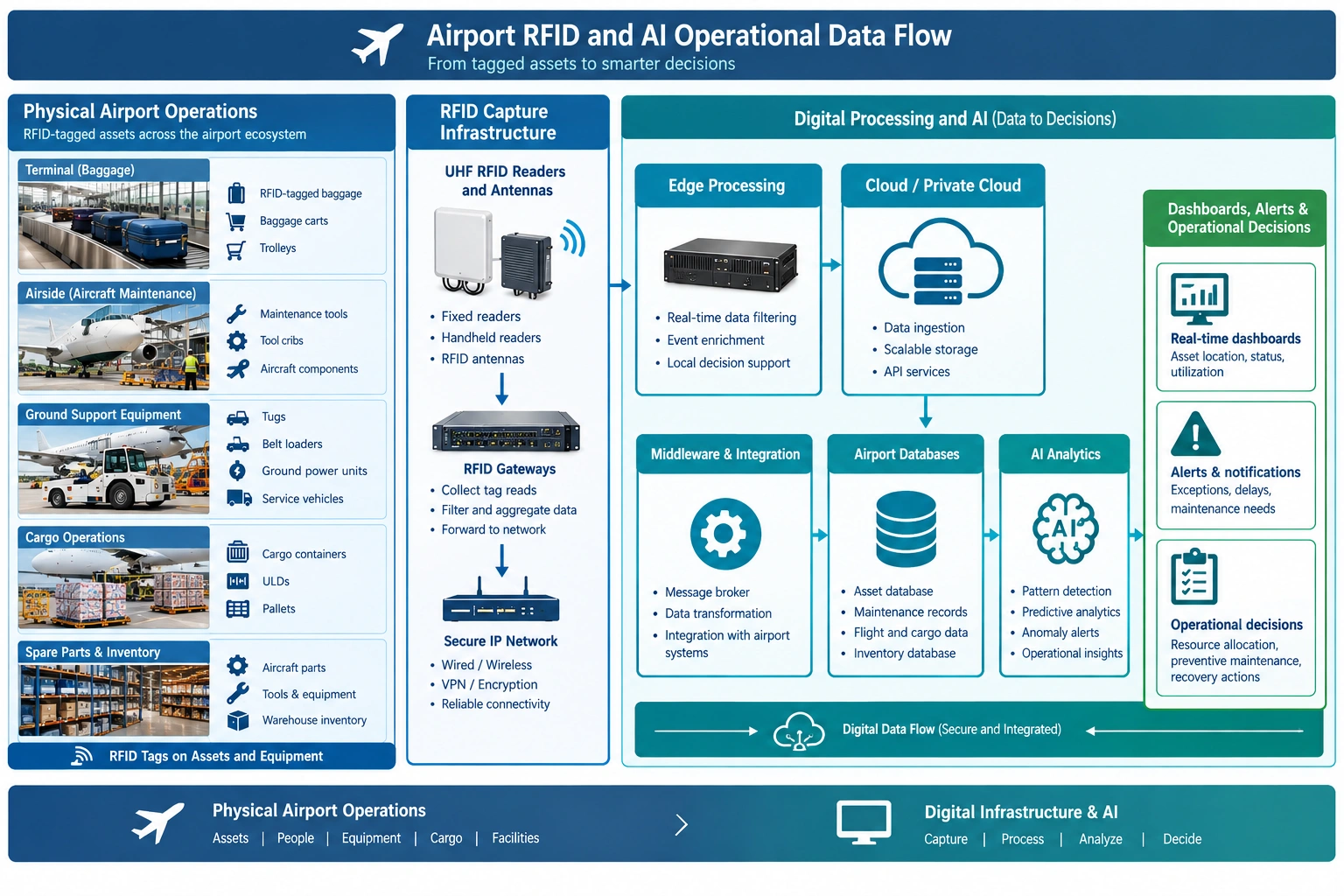
A structured implementation timeline showing the progression from operational assessment and RF site surveying through pilot deployment, system integration, cybersecurity validation, AI analytics, optimization, and phased airport-wide scaling across key aviation environments.
GAO RFID and IoT Technology for Airport Deployments
GAO supplies RFID, BLE, and other IoT hardware products and systems that can serve as the identification and sensing layer for airport applications. Its technology portfolio can be applied to use cases involving asset identification, location awareness, inventory visibility, equipment monitoring, and operational data capture.
GAO is headquartered in New York City and Toronto, Canada, and is ranked among the top 10 leading B2B and B2G BLE and RFID suppliers globally, with additional activity in B2B2C and B2D markets. This positioning reflects a long-standing focus on business and government technology requirements.
The broader GAO organization, together with GAO Research Inc. and GAO Tek Inc., has served customers across the United States and Canada for three decades, including Fortune 500 companies, leading R&D organizations, universities, and government agencies.
GAO has invested substantially in product and system R&D and maintains stringent quality assurance processes. Remote and onsite technical support can also be important for airport projects where deployment conditions, integration requirements, and operational schedules require engineering assistance.
For airport operators, integrators, MRO organizations, baggage-service providers, cargo operators, and technology teams, the practical objective is to select RFID hardware and supporting software that can operate reliably within the physical and cybersecurity constraints of the target environment.
Key Takeaways for AI-Powered Airport RFID
AI-powered airport operations depend on reliable physical-world data. RFID provides a practical mechanism for identifying baggage, tools, equipment, inventory, GSE, and other tagged assets as they move through airport workflows.
The strongest implementations connect RFID events with operational context and then apply analytics or AI to identify exceptions, bottlenecks, utilization patterns, and maintenance requirements.
Key implementation principles include:
- Select the operational problem before selecting the RFID hardware.
- Perform an RF site survey before final reader and antenna placement.
- Match tag construction to the asset and environment.
- Validate read performance under real operating conditions.
- Use middleware to normalize and filter identification events.
- Integrate RFID data with existing airport software rather than creating isolated records.
- Apply cybersecurity controls to readers, gateways, servers, APIs, and databases.
- Establish measurable KPIs before deployment.
- Use edge processing when local continuity and low latency are important.
- Select cloud or privately hosted server deployment according to airport security, connectivity, governance, and operational requirements.
- Scale only after pilot performance and acceptance criteria have been demonstrated.
AI can improve decision support, but it cannot compensate for unreliable source data. Strong RFID engineering, disciplined commissioning, accurate asset records, and well-designed integrations remain the foundation for useful AI outcomes.
Conclusion: Building Smarter Airport Operations With AI and RFID
AI-powered airport operations can combine machine intelligence with physical asset identification to improve baggage visibility, MRO productivity, GSE utilization, inventory accuracy, and operational response.
RFID provides the event data needed to understand where tagged items are, when they moved, and how they interact with defined workflows. AI then adds analytical capabilities that can identify anomalies, prioritize exceptions, forecast operational requirements, and reveal recurring process inefficiencies.
Airports should approach deployment as an engineering program that includes RF planning, hardware selection, commissioning, integration, cybersecurity, data governance, KPI measurement, and lifecycle maintenance.
Organizations evaluating airport RFID solutions can learn more about GAO’s RFID and IoT products, technical resources, engineering capabilities, and support options when planning a pilot or larger deployment.
Building the Future of Industrial AI and IoT with Aperture Venture Studio and GAO
For more than three decades, GAO has invested heavily in R&D involving industrial RFID, BLE, and IoT technologies. As generative AI has become increasingly useful for industrial applications, we have expanded work connecting AI with IoT technologies, including RFID and BLE, and established Aperture Venture Studio to support the development and scaling of practical AI and IoT solutions for industries such as aviation and airport operations.
Aperture has attracted AI and IoT technical experts, entrepreneurial and operational executives, influential investors, and leading companies. We have also developed the Aperture Ventures Summit and TekSummit to encourage discussion of advanced AI and IoT topics and foster technical communities.
We welcome you to join us as:
- Advisors, Co-founders or Employees
- Investors
- Customers