
AI and RFID for Apparel Retail
AI-Driven Apparel Retail Operations with RFID
AI for apparel retail uses inventory, transaction, product, store, fulfillment, and customer-demand data to improve decisions across merchandising, replenishment, store operations, omnichannel fulfillment, returns, and loss prevention. RFID serves as an important item-identification and data-capture technology by providing item-level visibility for garments, footwear, accessories, cartons, and other retail merchandise. GS1 describes EPCIS as a standard for sharing visibility events concerning the what, when, where, why, and how of products and other assets.
For apparel retailers, the combination is particularly useful because size, color, style, season, location, and individual item availability can change rapidly. AI can analyze RFID observations alongside POS, ecommerce, order management, warehouse, merchandising, and customer data to identify inventory discrepancies, forecast demand, prioritize replenishment, detect unusual movement, and improve fulfillment decisions. GAO supplies RFID, BLE, and IoT hardware products and systems that can support these retail data-capture and operational workflows.
AI-Driven Apparel Retail Operations Overview
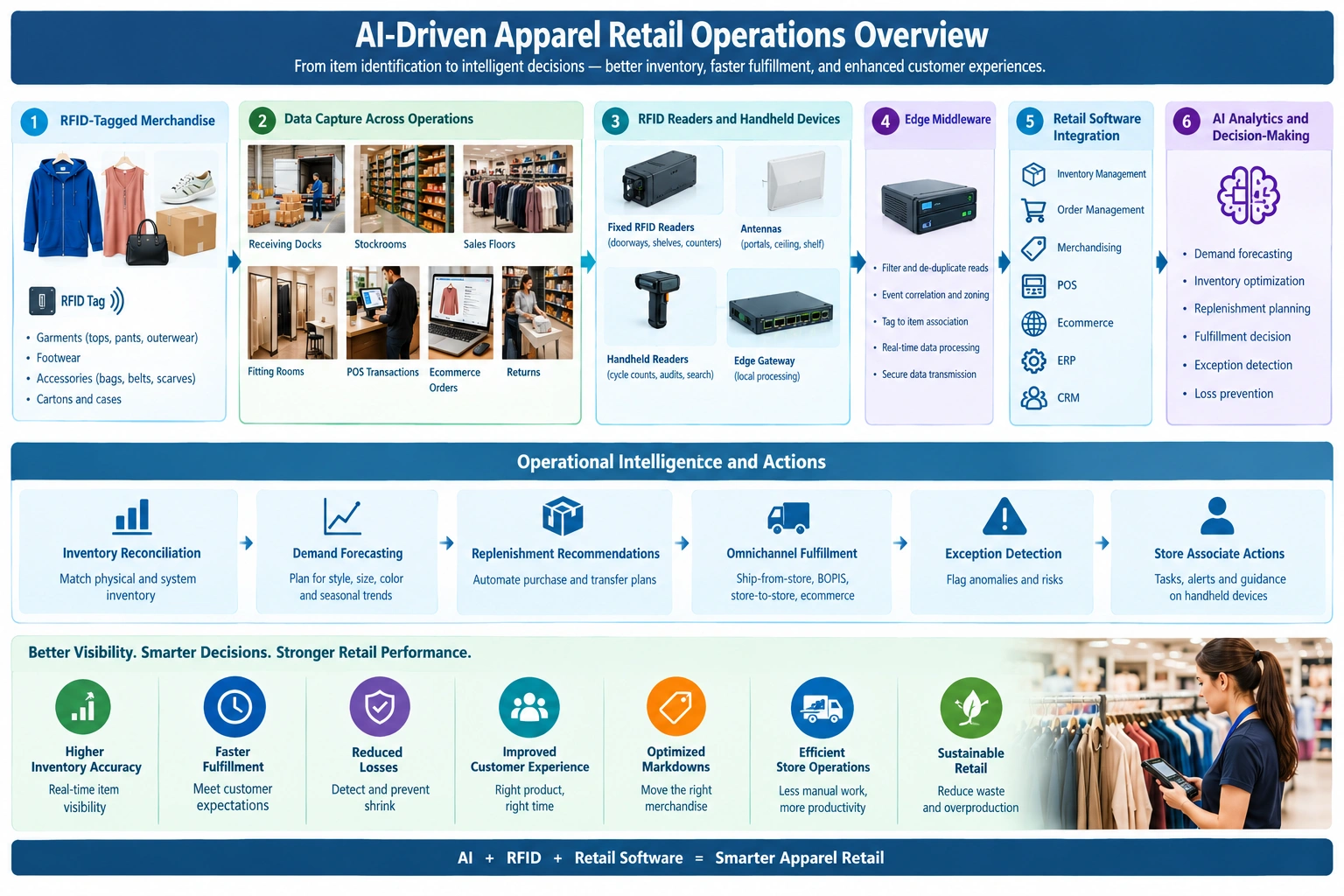
This workflow diagram shows how RFID-tagged apparel moves through receiving, stockrooms, sales floors, POS, ecommerce, and returns into edge processing, retail software, and AI analytics. It highlights inventory reconciliation, demand forecasting, replenishment, omnichannel fulfillment, exception detection, and store associate actions.
What AI and RFID Mean for Apparel Retail
Apparel retail has an unusually granular inventory structure. A single style can contain multiple colors and sizes, with each variant distributed across stores, stockrooms, distribution centers, ecommerce fulfillment locations, and sometimes temporary promotional locations. Traditional barcode processes generally require an item to be individually presented to a scanner, while UHF RFID can identify multiple tagged items without requiring direct line-of-sight.
The important role of RFID is therefore not simply “tracking clothing.” It creates machine-readable observations associated with individual merchandise items or defined product classes. A useful apparel retail data model can associate an item identifier with a GTIN or SKU, style, color, size, brand, season, location, receiving transaction, sales status, return status, and relevant fulfillment order. GS1 standards provide mechanisms for connecting product identifiers and visibility events across business processes.
AI adds a decision layer above these operational observations. Machine learning and statistical models can identify patterns that are difficult to manage through static rules alone. Examples include repeated inventory discrepancies at a particular store, unexpected demand for a size-color combination, abnormal movement between stockroom and sales floor, or a growing probability that an ecommerce order will fail because the recorded store inventory does not match physical merchandise.
This distinction is important: RFID primarily improves the quality and timeliness of item-level observations, while AI interprets those observations in relation to apparel retail objectives.
Apparel Retail Applications for AI-Enabled Inventory Intelligence
AI Inventory Management for Stores and Stockrooms
AI inventory management can combine RFID reads, POS sales, goods receipts, transfers, returns, cycle counts, stock adjustments, and ecommerce reservations to maintain a more useful picture of available merchandise.
RFID can support frequent inventory checks across racks, shelves, bins, and backroom locations. GS1 apparel material describes EPC/RFID as a method for improving inventory accuracy and real-time availability information, including omnichannel retail use cases.
AI can then classify discrepancies rather than treating every variance equally. A missing RFID observation might indicate an item sold but not yet reconciled, a transfer in progress, an incorrectly recorded return, an item moved to another store area, or a genuine inventory exception. The appropriate response should be determined from transaction and location context rather than automatically assuming theft or employee error.
GAO can support these deployments with RFID readers, antennas, handheld devices, tags, gateways, and related IoT hardware products used to capture item-level retail data.
AI Demand Forecasting for Style, Size, and Color
Demand forecasting becomes more difficult when apparel inventory is segmented by style, size, color, season, geography, channel, and promotional activity.
AI forecasting models can combine historical sales with RFID-derived availability, replenishment history, markdown activity, ecommerce demand, local store patterns, holidays, promotions, weather-related variables where appropriate, and product lifecycle information.
A forecasting system can identify situations such as:
- A popular style having adequate total inventory but insufficient quantities in specific sizes.
- A color variant selling faster in one geographic market than the retailer’s aggregate forecast indicates.
- Ecommerce demand creating store-level stock pressure before the next planned replenishment.
- Slow-moving seasonal merchandise accumulating in selected stores.
- Replenishment quantities that should be adjusted because recorded inventory differs from physically observed inventory.
The operational objective is not simply higher forecast accuracy. The objective is better merchandise availability with appropriate inventory investment, fewer avoidable stockouts, and more informed allocation decisions.
AI for Omnichannel Apparel Fulfillment
Buy-online-pickup-in-store, ship-from-store, store-to-store transfers, and ecommerce returns depend heavily on trustworthy inventory availability. GS1 notes that EPC/RFID can support near-real-time inventory visibility and improve the reliability of store inventory information used for omnichannel commerce.
AI can evaluate multiple fulfillment options rather than selecting a location solely because its enterprise system reports one unit available. A decision model can consider physical RFID observations, order priority, store workload, distance, inventory confidence, promised delivery time, and the probability that an item will actually be found.
This creates a practical feedback loop:
- RFID observes merchandise.
- Retail software associates observations with item and location records.
- AI evaluates inventory confidence and fulfillment alternatives.
- The order management system selects or recommends an action.
- Store associates receive a picking or exception task.
- The completed transaction creates new operational data for subsequent model improvement.
AI Loss Prevention and Merchandise Movement Analysis
Apparel retailers must distinguish legitimate merchandise movement from unexplained movement. RFID observations can provide additional evidence when merchandise passes receiving areas, stockroom zones, sales-floor transition points, fitting-room areas, returns counters, or exit-related read zones.
AI can correlate these events with POS transactions, transfers, returns, employee workflows, store schedules, and known operational processes. Anomaly detection can flag patterns for investigation, such as repeated unexplained movement of high-value merchandise or inventory that repeatedly disappears from one operational zone without a corresponding transaction.
A sound deployment should treat AI-generated loss-prevention alerts as investigation signals. RFID read behavior can be affected by tag orientation, reader placement, RF interference, dense merchandise, metal fixtures, and other environmental factors. Operational validation is therefore essential before a retailer interprets an RFID event as proof of a business event.
AI-Assisted Returns and Reverse Logistics
Returns create another major apparel retail data problem because a returned garment may need to be inspected, matched to its original item record, assessed for resale condition, routed back to inventory, transferred to another location, or designated for a different disposition.
RFID can help associate the physical garment with its item identity during return processing. AI can use return history, product attributes, condition information, customer transaction context, and disposition rules to support decisions about inspection priority, routing, restocking, or exception handling.
Computer vision can complement RFID where visual inspection is required for stains, tears, missing components, damaged packaging, or other observable conditions. RFID answers “which item is this?” while computer vision can contribute evidence about “what condition is this item in?”
Apparel Retail Workflow from Item Data to AI Decisions
A production deployment should treat apparel RFID observations as operational events rather than isolated reader scans. A representative workflow begins when merchandise is received at a distribution center or store and continues through inventory placement, sales-floor activity, fulfillment, sale, return, transfer, and replenishment.
Data Acquisition
RFID readers capture item identifiers at receiving stations, portals, stockrooms, sales-floor zones, inventory-counting routes, fulfillment areas, and other carefully selected read points. UHF RFID is generally the primary choice for apparel item-level inventory applications because it supports longer-range reading and multi-item identification. HF and LF RFID can be considered where the application requires different read distances, coupling characteristics, or specialized identification conditions.
Reader configuration should account for garment density, tag orientation, antenna polarization, metal fixtures, liquids, reader power, conveyor speed, portal geometry, and unintended reads. A successful deployment therefore begins with a physical site survey and representative merchandise testing rather than assuming identical RF performance across every store.
Edge Processing and Event Normalization
Raw RFID observations can contain duplicate reads, transient reads, missed reads, and observations from adjacent zones. Middleware or edge software can filter duplicates, apply read-zone logic, associate observations with time windows, and convert low-level reads into operational events.
A useful event model can include:
- Tag or item identifier
- Reader identifier
- Antenna or read-zone identifier
- Timestamp
- Store, stockroom, distribution center, or facility location
- Read confidence or supporting RF information where available
- Transaction or order context
- Event classification
- Exception status
- Associated SKU, GTIN, style, size, and color information
Separating a raw read observation from a confirmed business transaction is an important engineering practice. A reader seeing a tagged jacket near a checkout area does not by itself prove that the jacket was sold.
Retail Software Integration
The normalized events can be integrated with retail inventory management, POS, order management, warehouse management, merchandising, enterprise resource planning, customer relationship management, ecommerce, loss-prevention, and business intelligence software.
Integration methods can include REST APIs, webhooks, message queues, SQL interfaces, middleware APIs, and structured file exchange where legacy applications require it. GS1 EPCIS 2.0 is relevant where standardized visibility event sharing is required across systems because it provides an interoperable model for capturing and sharing events about objects, locations, movements, and business context.
AI Analytics and Operational Actions
AI services can consume the normalized retail event stream together with historical business data. Appropriate techniques may include anomaly detection, time-series forecasting, classification, optimization, recommendation models, and computer vision.
The resulting output should be actionable rather than simply descriptive. Examples include an inventory verification task for a store associate, a replenishment recommendation for a merchandise planner, a fulfillment-location recommendation for an order-management team, or an exception alert for loss-prevention personnel.
The AI layer should preserve traceability. A recommendation should be explainable through the underlying merchandise records, RFID observations, sales transactions, fulfillment events, and model inputs that contributed to the decision. NIST’s AI Risk Management Framework emphasizes managing AI risks throughout the system lifecycle, including governance, measurement, and ongoing management.
Apparel Retail Technology Foundation for AI-Driven Operations
The technology foundation for AI-enabled apparel retail extends beyond RFID readers. Reliable results depend on item identification, RF engineering, store connectivity, event processing, retail software integration, data quality, AI model governance, and operational procedures working together.
UHF RFID is commonly suited to high-volume apparel inventory counting and item movement because many tagged garments can be read in a relatively short operational interval. HF RFID can be appropriate for shorter-range identification or specialized interaction points, while LF RFID is generally associated with shorter-range identification applications where its propagation characteristics are advantageous. Selection should follow the physical read requirement rather than a blanket assumption that one RFID frequency is suitable for every apparel retail process.
AI workloads can operate through cloud-hosted software, privately hosted servers, or a combination of local and cloud resources. The appropriate model depends on store connectivity, data residency requirements, integration constraints, latency requirements, security controls, and the retailer’s existing IT environment.
GAO’s experience supplying RFID, BLE, and IoT hardware products and systems can support retailers evaluating readers, antennas, tags, handheld devices, gateways, and related data-capture requirements. GAO’s sister companies, GAO Research and GAO Tek, form GAO Group, with operations based in New York City and Toronto, Canada. The group has served U.S. and Canadian organizations for three decades, including Fortune 500 companies, research organizations, universities, and government agencies, with remote and onsite technical support.
RFID Hardware, AI Software, and Retail Integration
A reliable AI-driven apparel retail solution depends on selecting hardware and software according to the physical merchandise workflow rather than deploying RFID equipment uniformly across every store area. The most important engineering question is where an accurate item observation can improve a specific retail decision.
RFID Readers, Antennas, and Apparel Tags
- Fixed UHF RFID readers can be installed at receiving areas, stockroom entrances, fulfillment stations, inventory-counting points, and other controlled read zones.
- Handheld UHF RFID readers allow store associates to perform rapid cycle counts, locate specific merchandise, verify replenishment, and investigate inventory discrepancies.
- RFID antennas should be positioned according to the physical geometry of racks, doors, counters, conveyors, and other retail fixtures. Antenna polarization and orientation should be validated with representative garments.
- Apparel RFID tags should be selected for attachment method, read performance, durability, appearance, supplier encoding requirements, and the retailer’s product and packaging characteristics.
- HF RFID can support short-range item identification or specialized customer-interaction points where its coupling characteristics are appropriate.
- LF RFID is generally more suitable for specialized short-range identification applications than high-volume apparel inventory counting.
- RFID gateways and edge devices can connect readers to local processing and retail software while buffering events during temporary network interruptions.
Reader selection should also consider read-rate requirements, supported RFID standards, network interfaces, power requirements, antenna ports, environmental conditions, device management, and integration interfaces. A store with dense metal fixtures and closely spaced read zones may require substantially different RF tuning from a distribution center handling cartons of garments.
Middleware and Event Processing
RFID middleware converts low-level reader observations into useful retail events. Typical functions include duplicate suppression, filtering, reader health monitoring, zone definition, temporal correlation, tag association, event classification, and local buffering.
For apparel retail, event logic can distinguish receiving, inventory verification, stockroom movement, fulfillment picking, transfer preparation, shipment, return processing, and other operational states. This reduces the risk that AI models receive raw RF observations as though every observation were a confirmed inventory transaction.
AI Models for Apparel Retail
AI methods should be selected according to the business decision being improved.
- Time-series forecasting can estimate demand by style, size, color, store, channel, and selling period.
- Anomaly detection can identify unusual inventory movements, unexplained variances, or deviations from established store processes.
- Classification models can categorize inventory exceptions, fulfillment conditions, or return-processing cases.
- Optimization models can support allocation, replenishment, fulfillment-location selection, and transfer decisions subject to business constraints.
- Computer vision can assist with visual inspection of garment condition, shelf or rack presentation, product placement, and certain loss-prevention workflows.
- Natural-language interfaces can allow authorized personnel to query retail inventory and operational information using business terminology while maintaining appropriate access controls.
- Predictive models can identify patterns associated with stockout risk, fulfillment failure, inventory inaccuracy, or other operational conditions.
Model inputs should be governed carefully. A forecasting model trained on sales alone may fail to distinguish low demand from unavailable merchandise. Combining sales history with physically observed inventory can provide additional context.
Cloud and Server Deployment for Apparel Retail AI
Cloud Version
The Cloud Version hosts RFID event processing, databases, analytics, AI services, dashboards, and selected integrations within cloud infrastructure. This model can be useful for apparel retailers operating many stores because centralized software can support common configurations, model management, reporting, and cross-location analytics.
Cloud deployment should still provide appropriate local processing where immediate store operations depend on connectivity. RFID events can be buffered at the store or edge layer before synchronization with cloud services.
Key considerations include:
- Store-to-cloud network reliability
- Data encryption in transit and at rest
- Identity and access management
- API security
- Centralized software maintenance
- Multi-store configuration management
- Data retention requirements
- AI model deployment and monitoring
- Disaster recovery and backup procedures
Server Version
The Server Version places software on edge servers, customer-managed servers, private data centers, store or distribution-center servers, or other privately hosted enterprise infrastructure. It can be appropriate when a retailer requires greater control over data processing, integration boundaries, network dependencies, or internal IT operations.
A privately hosted deployment may process RFID events locally and synchronize selected information with corporate retail systems. This can be useful in environments where store operations must continue despite intermittent external connectivity.
The decision between Cloud Version and Server Version should be based on operational requirements rather than assuming that one model is universally preferable. A multi-store retailer may also use a hybrid approach, keeping time-sensitive event processing close to stores while using centralized infrastructure for enterprise analytics and AI model management.
Security, Privacy, and Interoperability
Security for AI-enabled apparel retail begins with the entire data path from RFID reader to business application. RFID tags themselves generally do not provide the security boundary for the complete retail solution. Network, device, application, identity, database, and AI controls must work together.
Important controls include:
- Mutual or appropriately authenticated device-to-server communication
- Encrypted network connections
- Role-based access control for store associates, merchandise planners, IT administrators, fulfillment teams, and loss-prevention personnel
- Secure API authentication and authorization
- Network segmentation for RFID and IoT devices
- Device credential management and lifecycle rotation
- Software and firmware update procedures
- Centralized logging and security monitoring
- Database backup and recovery controls
- AI model access controls and version management
- Data minimization and retention policies
- Audit trails for important inventory and fulfillment decisions
Retailers should also separate operational access from analytical access. A store associate may need to locate a garment, while a merchandise planner may need aggregated sales and inventory information across hundreds of locations. Access permissions should reflect those different responsibilities.
Interoperability is equally important. GS1 standards can provide common identifiers and event structures for connecting physical products with digital business processes. EPCIS is particularly relevant when retailers need standardized visibility-event information across systems or trading partners.
Secure Apparel Retail Data and RFID Integration Flow
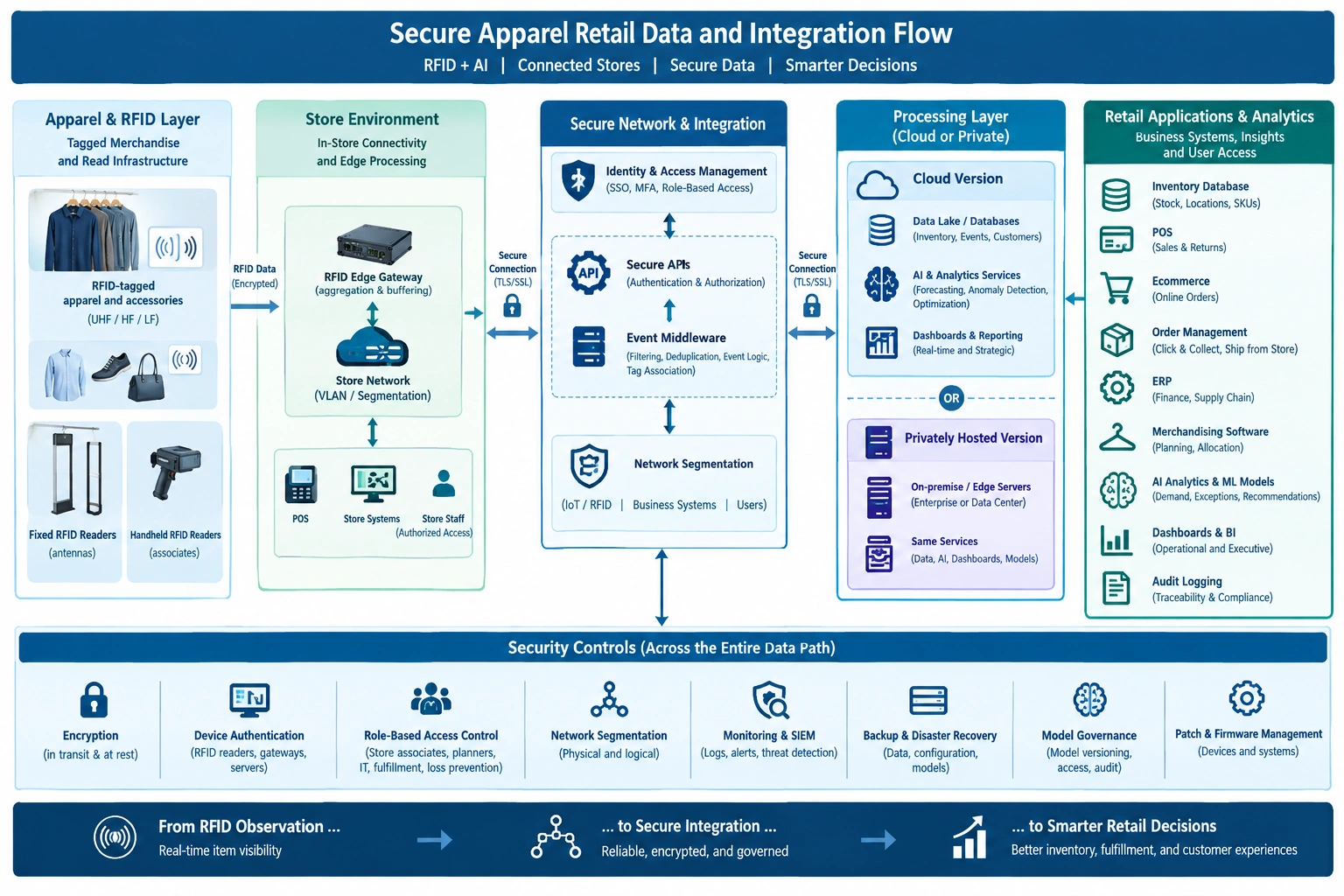
The diagram shows how RFID-tagged apparel moves from store-level readers and edge processing through secure network controls into cloud or privately hosted AI services. It connects inventory, POS, ecommerce, order management, ERP, merchandising, and analytics while highlighting encryption, authentication, segmentation, monitoring, backup, and AI model governance.
Apparel Retail KPIs for AI and RFID Programs
Performance measurement should connect RFID deployment to measurable retail outcomes. Reader read rates alone are insufficient because a technically successful RFID installation can still fail to improve a business process if the resulting events are not integrated into retail operations.
Useful KPIs include:
- Inventory accuracy by store, department, SKU, style, size, and color
- Inventory count completion time
- Stockout frequency
- Item availability rate
- Replenishment response time
- Pick success rate for ship-from-store orders
- Buy-online-pickup-in-store fulfillment accuracy
- Order cancellation caused by unavailable merchandise
- Inventory discrepancy rate
- Transfer accuracy
- Receiving processing time
- Return processing time
- Merchandise locating time
- Cycle-count labor time
- Shrink or unexplained inventory variance
- Full-price sell-through
- Markdown exposure
- Forecast accuracy
- Forecast bias
- Replenishment accuracy
- Store-to-store transfer frequency
- RFID read-zone exception rate
- RFID event processing latency
- Reader uptime
- Network availability
- AI alert precision
- AI alert investigation rate
- AI recommendation acceptance rate
- Fulfillment cycle time
- Return-to-inventory cycle time
- Data reconciliation rate
A practical KPI program should establish a baseline before deployment and compare results after commissioning. Measurements should distinguish technology performance from business-process performance. For example, a high RFID read rate does not necessarily mean inventory accuracy has improved if item identifiers are not correctly associated with the retailer’s SKU master and location records.
Implementing AI-Enabled RFID Across Apparel Retail Operations
Successful deployment should begin with the retail decision that needs better information rather than with a specific RFID reader or AI model. A controlled implementation provides an opportunity to validate merchandise tagging, RF behavior, integration quality, data accuracy, and store procedures before broader deployment.
Planning and Site Assessment
A planning team can map merchandise flows from supplier receipt through distribution, store receiving, stockroom storage, sales-floor presentation, fulfillment, sale, return, transfer, and disposition.
The assessment should document:
- Merchandise packaging and tag placement
- Store and distribution-center layouts
- Metal shelving and other RF-impacting materials
- Receiving and stockroom traffic
- Sales-floor rack configuration
- Fitting-room and checkout processes
- Network availability
- Existing POS and inventory systems
- Ecommerce and order-management workflows
- Current inventory-count procedures
- Security and access requirements
- Expected event volumes
- Existing APIs and integration interfaces
Representative garments should be tested rather than relying exclusively on laboratory specifications. A folded cotton shirt, a jacket containing metallic components, footwear, accessories, and densely packed merchandise can produce different RF behavior.
Pilot Deployment and Commissioning
A pilot should cover representative stores, merchandise categories, and operating conditions. The objective is to verify the complete chain from RFID observation to business action.
Testing can include:
- Tag encoding and item-master association
- Reader installation and antenna positioning
- Read-zone containment
- Inventory-count accuracy
- Receiving-event accuracy
- Stockroom-to-sales-floor observations
- Fulfillment picking
- Returns processing
- Data synchronization
- API behavior
- Offline buffering
- Exception handling
- AI output validation
- User acceptance testing
- Security controls
- Operational training
Commissioning should include acceptance criteria for both technical and business performance. A reader should not be considered fully commissioned merely because it detects tags. The associated event must also be correctly interpreted by middleware and reflected in the appropriate retail software process.
Optimization and Scale-Up
After pilot validation, retailers can expand to additional stores or distribution centers using standardized installation, configuration, testing, and support procedures.
AI models should be monitored after deployment because apparel demand changes with seasons, promotions, assortment changes, store openings, closures, regional behavior, and product lifecycle stages. Model drift can reduce performance when the data distribution changes materially.
RFID infrastructure also requires ongoing maintenance. Reader health, antenna connections, network status, firmware, event throughput, tag quality, and read-zone behavior should be monitored. Store remodeling can alter RF conditions, so major fixture changes should trigger a new RF assessment.
GAO’s product and systems experience can support organizations during RFID hardware selection, deployment, integration, and technical troubleshooting, including remote or onsite support where required.
Engineering Considerations and Implementation Trade-Offs
AI-enabled apparel retail systems involve several practical trade-offs.
Read coverage versus read-zone precision: Increasing RF coverage can improve the probability of detecting merchandise but may also increase unintended reads from adjacent areas. Controlled zones are often more valuable than simply maximizing RF range.
Automation versus human validation: AI can prioritize exceptions and recommend actions, but high-impact decisions should retain appropriate human oversight, particularly where incorrect inventory or loss-prevention decisions could affect customers or employees.
Cloud centralization versus local resilience: Centralized AI services simplify cross-store analysis, while local processing can reduce dependence on continuous wide-area connectivity. Hybrid processing can address both requirements.
Model complexity versus explainability: A more complex model is not automatically more useful. Retail personnel need actionable recommendations supported by understandable evidence, especially when decisions affect inventory allocation or exception handling.
Inventory visibility versus data quality: More RFID reads do not compensate for incorrect SKU masters, duplicate item identifiers, inaccurate location data, or poorly defined business events. Data governance must therefore accompany RFID deployment.
Business Value of AI-Enabled Apparel Retail
Combining AI with RFID-derived item visibility can improve apparel retail operations because the technology addresses different parts of the decision process. RFID can provide more frequent physical merchandise observations, while AI can use those observations with sales, order, location, and merchandising data to support decisions.
Potential operational improvements include:
- More accurate store and stockroom inventory records
- Faster physical inventory verification
- Better identification of size and color availability
- Improved ship-from-store and pickup fulfillment decisions
- Earlier identification of stockout risk
- More informed replenishment and allocation
- Faster return processing
- Better visibility into merchandise transfers
- More targeted investigation of inventory anomalies
- Improved coordination between stores, distribution centers, ecommerce, and merchandising teams
- Better utilization of historical and real-time retail data
The business value should be measured against the specific workflow being improved. For example, reducing the time required to locate a particular size can have different value from improving seasonal demand forecasting. Each use case should therefore have its own baseline, target KPI, operational owner, and acceptance criteria.
GAO Expertise in RFID and AI-Enabled Retail Solutions
GAO is headquartered in New York City and Toronto, Canada, and is ranked among the top 10 leading B2B and B2G, with a lesser degree of B2B2C and B2D, BLE and RFID suppliers in the world. GAO provides RFID, BLE, and IoT hardware products and systems for organizations that require reliable identification, tracking, sensing, and connected operational data.
GAO Group consists of GAO and its sister companies, GAO Research and GAO Tek. The group has served customers in the United States and Canada for three decades, including Fortune 500 companies, leading R&D organizations, prestigious universities, and U.S. and Canadian government agencies.
Our work in RFID and IoT includes hardware products and systems that can be incorporated into apparel retail workflows such as inventory identification, item tracking, data acquisition, and connected operational monitoring. GAO has invested substantially in research and development and maintains stringent quality-assurance processes, with technical support available remotely or onsite.
For apparel retailers evaluating AI-assisted inventory management, RFID deployment, omnichannel fulfillment, or connected merchandise operations, the practical starting point is to define the business workflow, required item visibility, integration requirements, and measurable KPI before selecting hardware and software.
Key Takeaways for AI and RFID in Apparel Retail
AI-enabled apparel retail operations are most effective when item-level merchandise visibility is connected directly to decisions involving inventory, replenishment, fulfillment, returns, merchandising, and exception management. RFID can provide the physical observation layer, while middleware, retail software, and AI transform those observations into operational information and recommendations.
A practical implementation should begin with measurable apparel retail use cases, representative merchandise testing, accurate item and location data, controlled RFID read zones, secure integration, and clearly defined KPIs. Cloud-hosted and privately hosted deployment models can both support the solution when selected according to connectivity, governance, integration, and operational requirements.
GAO can help organizations evaluate and implement RFID, BLE, and IoT hardware products and systems for these workflows, supported by technical expertise and product development experience. Readers interested in applying AI-enabled inventory intelligence, RFID merchandise identification, or connected retail technologies can explore GAO’s technology solutions and technical support resources.
Building the Future of Industrial AI and IoT with Aperture Venture Studio and GAO RFID Inc.
For more than three decades, GAO Group of Companies has invested heavily in R&D for industrial RFID, BLE, and IoT. As generative AI became increasingly useful for industrial and operational applications, we expanded our work in AI and IoT, including RFID and BLE, and founded Aperture Venture Studio to help advance AI and IoT solutions relevant to fields such as apparel retail, inventory intelligence, connected operations, and other industries.
Aperture has attracted AI and IoT technical experts, entrepreneurial and operational executives, influential investors, and leading companies. We have also developed the Aperture Ventures Summit and TekSummit to discuss advanced AI and IoT topics and foster technical communities.
We welcome you to join us as:
- Advisors, co-founders, or employees
- Investors
- Customers