
AI and RFID for Archives
AI and RFID Architecture for Intelligent Archival Collection Management
Archives are increasingly using artificial intelligence to improve collection discovery, records processing, physical file tracking, and preservation workflows. AI can analyze descriptive metadata, OCR output, images, documents, and movement histories, while RFID provides a machine-readable identity for physical archival holdings. Together, these technologies can connect physical boxes, folders, manuscripts, photographs, media, and other archival assets with collection-management and records-management systems. The result is a more traceable workflow from accessioning and cataloging through storage, retrieval, research-room delivery, return, and disposition. For archival institutions managing large backlogs or distributed repositories, the combination can reduce repetitive searching and improve visibility into collection location and status. AI can also support semantic discovery, metadata enrichment, classification, and anomaly detection, but archivists should retain authority over provenance, authenticity, appraisal, access restrictions, and sensitive-content decisions. Recent archival AI initiatives demonstrate growing interest in semantic search, automated metadata generation, entity extraction, and natural-language access to collections.
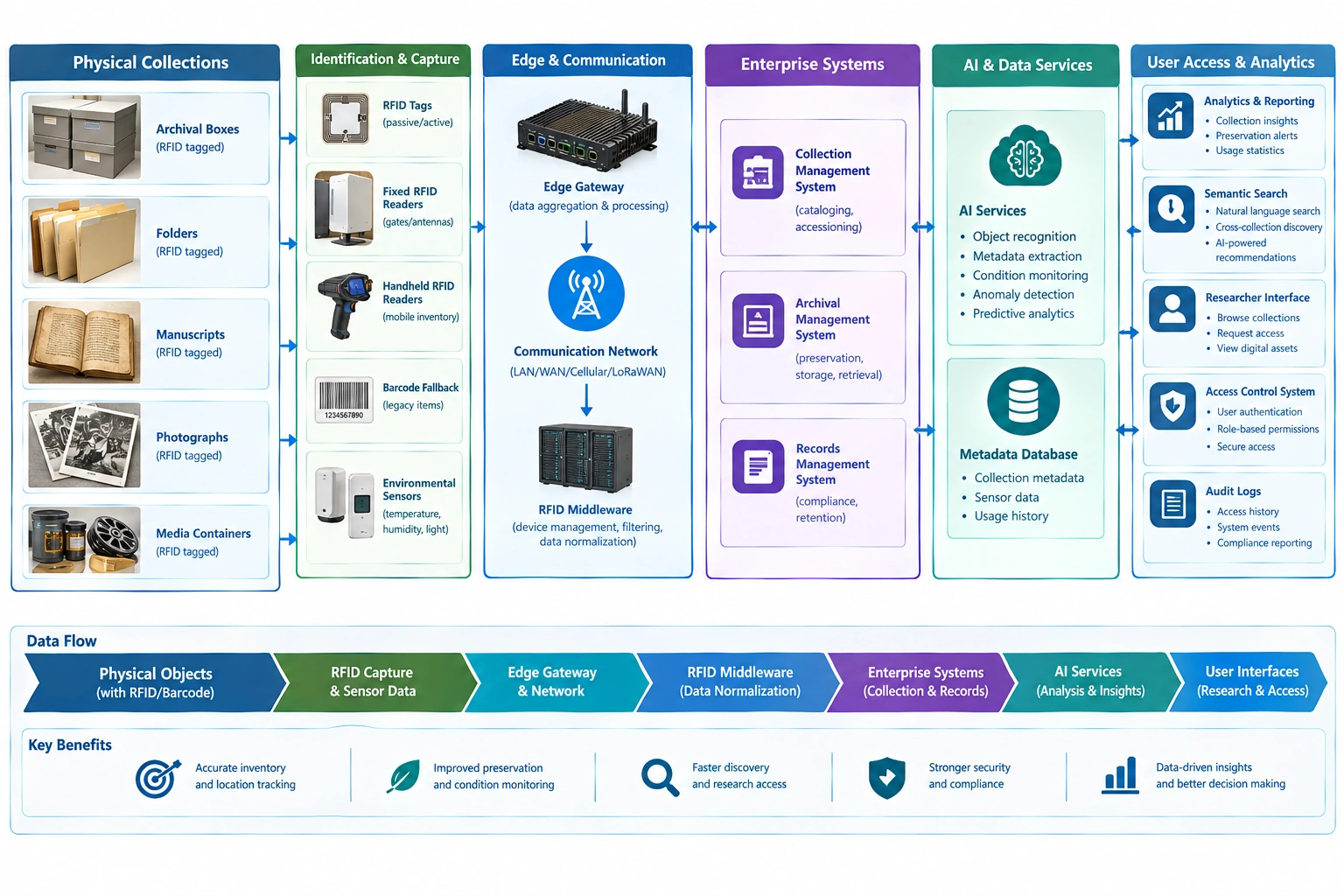
What AI-Enabled Archival Management Means
AI-enabled archival management applies machine learning, computer vision, natural language processing, optical character recognition, semantic search, anomaly detection, and related methods to archival workflows. RFID supplies an additional machine-readable identity and location signal for physical holdings. The important distinction is that RFID does not replace archival description or preservation controls. It provides structured identification and movement data that can be combined with descriptive, administrative, and preservation information.
For archives, the strongest use cases occur where physical and digital records must remain connected. An archival collection may have a finding aid, accession record, series and file descriptions, digitized surrogates, preservation metadata, access restrictions, and a physical storage location. AI can help interpret and enrich the information surrounding those records, while RFID can help verify that the physical item or container is where the management system expects it to be.
AI can therefore support several archival decisions:
- Identify likely metadata fields from OCR text, transcripts, images, or existing descriptions.
- Detect inconsistent names, dates, subjects, identifiers, and terminology across archival descriptions.
- Extract entities such as people, organizations, places, events, dates, and document types.
- Improve discovery across collections by connecting semantic concepts rather than relying exclusively on exact keyword matches.
- Detect unusual movement patterns or discrepancies between expected and observed physical locations.
- Prioritize records for human review based on confidence scores, sensitivity indicators, or metadata quality.
- Assist staff with natural-language discovery while preserving source references and archival context.
Research into AI-ready archives emphasizes that provenance, authenticity, reliability, and trustworthiness must remain central when applying AI to archival data. AI should therefore be treated as an assistive processing and discovery capability, not as an autonomous authority over archival evidence.
Why AI Matters to Modern Archives
Archival institutions face a different operational problem from ordinary inventory environments. A box is not simply an item to count. Its significance may depend on provenance, original order, series relationships, retention or disposition rules, restrictions, preservation requirements, donor agreements, and contextual description.
That makes archival AI particularly valuable when it operates against structured collection information rather than treating every record as an isolated object.
A practical AI-enabled archival workflow can connect:
- Accession records with physical containers and RFID identities.
- Finding aids with box, folder, or item identifiers.
- OCR and transcription outputs with archival descriptions.
- Digital surrogates with corresponding physical holdings.
- Research-room requests with retrieval and return transactions.
- Environmental observations with preservation priorities.
- Access restrictions with controlled retrieval and researcher permissions.
- Movement history with audit records and chain-of-custody information.
NARA’s current AI use-case inventory provides a useful example of the direction of archival AI. Its documented use cases include semantic search, automated descriptive metadata, entity extraction, natural-language interaction with archival documents, and automated data discovery and classification.
The engineering objective is not simply to “add AI” to an archival system. The objective is to create reliable data flows in which AI outputs can be evaluated against authoritative archival information.
Priority AI Applications for Archives
AI-Assisted Archival Description
Large archival backlogs can make detailed description difficult to complete manually. Natural language processing can analyze OCR text, transcripts, existing finding aids, accession information, and structured metadata to suggest descriptive fields.
A useful implementation separates generated suggestions from authoritative metadata. The AI output can enter a review queue where an archivist accepts, modifies, or rejects proposed descriptions. Confidence scores and source references should be retained so staff can understand why a suggestion was generated.
This human-review model is especially important for historical collections containing outdated terminology, culturally sensitive descriptions, incomplete provenance, or ambiguous identities.
Semantic Search Across Archival Collections
Traditional search often depends on exact words appearing in metadata or OCR text. Semantic retrieval can instead identify conceptually related records. A researcher searching for a historical organization, event, geographic area, or subject may receive related materials even when the exact search phrase does not appear in the description.
For archives, semantic search should preserve collection hierarchy and provenance. A highly relevant document should not be separated from the series, fonds, collection, accession, or contextual information that explains its significance.
OCR and Document Intelligence
OCR can convert scanned correspondence, reports, forms, newspapers, registers, and other textual materials into machine-readable content. AI-based document processing can then classify documents, extract entities, identify dates, and associate content with existing archival descriptions.
Degraded manuscripts and historical documents require particular care. OCR confidence should be measured, and low-confidence outputs should be routed for review rather than silently becoming authoritative metadata.
Recent archival machine-learning research has explored combinations of document image classification, OCR correction, natural-language processing, and multimodal processing for heterogeneous archival materials.
AI-Assisted Sensitivity and Access Review
AI can help identify potential sensitive information within large collections by detecting names, personal identifiers, topics, or patterns associated with restrictions. It can prioritize records for human examination.
This is a screening function, not a final legal or archival determination. Access decisions may depend on applicable law, donor restrictions, institutional policy, historical context, privacy considerations, and other factors that cannot safely be reduced to a model prediction.
Physical Collection Tracking and Anomaly Detection
RFID-generated movement events become more valuable when AI can analyze them alongside expected workflows.
For example, if a container is recorded as stored in a particular vault location but appears at an unexpected reader zone, the system can generate an exception. Multiple unusual movements involving the same accession can also be flagged for review.
A research publication on RFID-based intelligent file management specifically examined archival workflows involving storage and retrieval, tracking, borrowing and returning, personnel management, access control, and information collection.
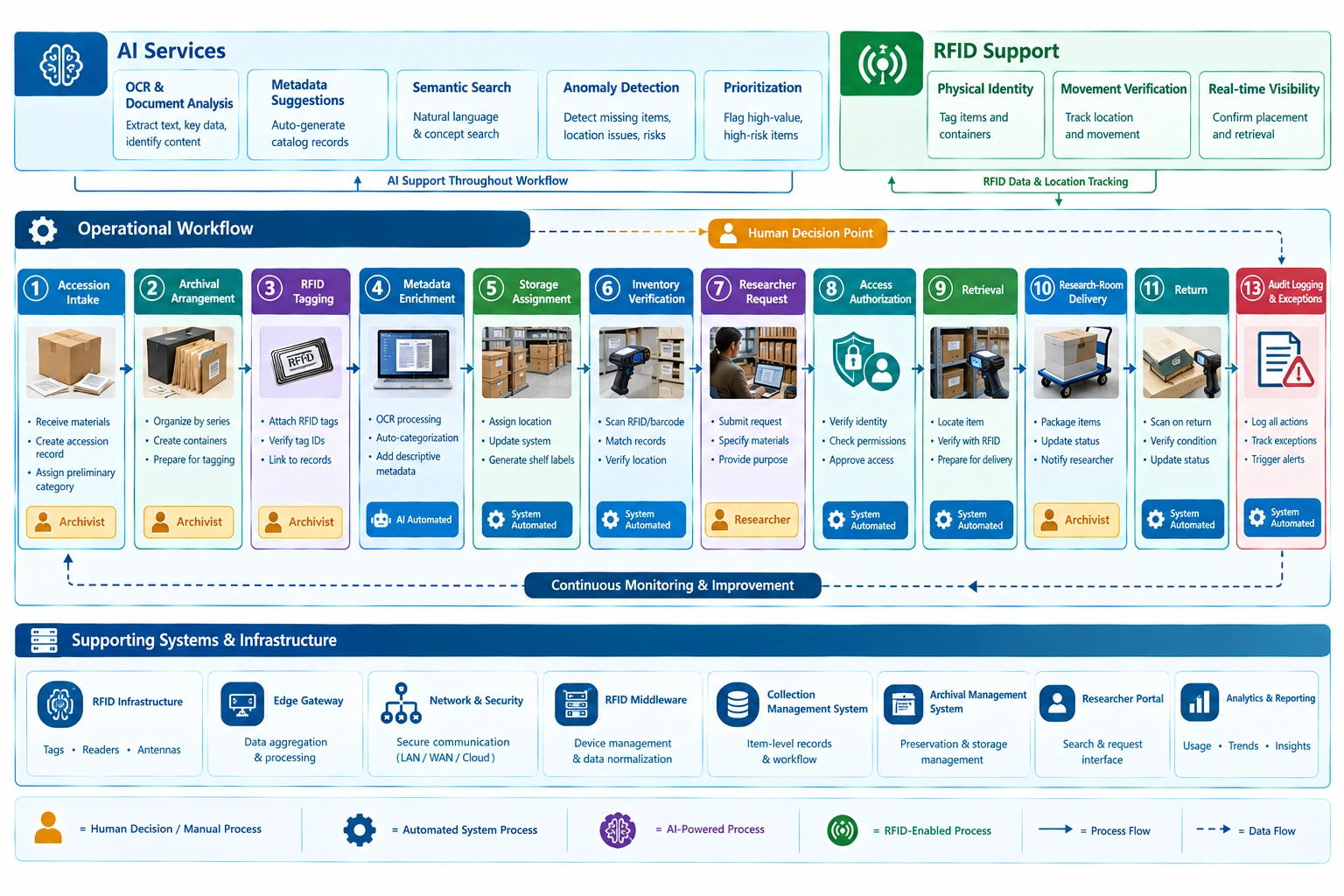
Archival Workflows from Accession to Retrieval
AI and RFID solutions should follow the existing archival lifecycle rather than forcing archivists into a technology-defined process.
Accessioning and Intake
When new materials enter an archive, staff establish accession information, identifiers, provenance, custody information, and initial descriptions. An RFID identifier can then be associated with the physical box, folder, container, or other appropriate asset.
The RFID identifier should not be treated as a replacement for the archival identifier. Instead, it should provide a machine-readable link to the authoritative collection-management record.
AI can assist with intake by extracting information from donor documentation, accession forms, inventories, and digitized material. Proposed metadata can be reviewed before it becomes part of the authoritative archival record.
Processing and Arrangement
During processing, materials may be arranged into collections, series, subseries, files, and containers. RFID can support verification during movement between processing areas and storage locations.
AI can identify duplicate or inconsistent descriptive terms and suggest relationships between existing metadata and newly processed material.
This creates an important control point: RFID records physical identity and movement, while the archival management system remains responsible for intellectual arrangement and description.
Storage and Location Verification
Archival storage requires more than knowing whether an object exists. Staff need to know where a container should be located and whether the physical environment remains suitable for preservation.
A location-control workflow can combine RFID readers, handheld devices, storage-location identifiers, environmental monitoring, and collection records. Periodic inventory sweeps can compare observed RFID identities with expected storage assignments.
Environmental information can also be correlated with collection priorities. For example, a preservation team may use temperature, relative humidity, light exposure, or other monitored conditions to prioritize inspections, while RFID establishes which collection containers are physically associated with a storage area.
NARA’s archival storage guidance addresses structural, environmental-control, fire-safety, preservation, and security requirements, illustrating why physical tracking should operate alongside broader preservation controls rather than independently.
Retrieval and Research-Room Delivery
A researcher request normally creates a chain of actions: identify the requested material, locate the container, retrieve it, verify the identifier, record the transaction, deliver it to the appropriate research area, and later confirm return.
RFID can reduce manual identification steps during these transitions. AI can further prioritize requests, identify likely related materials, or help staff search across descriptions.
The resulting workflow can produce an auditable sequence such as:
- Research request received.
- Access authorization verified.
- Archival identifier matched to physical RFID identity.
- Storage location confirmed.
- Retrieval task assigned.
- RFID identity verified during removal.
- Research-room delivery recorded.
- Return transaction captured.
- Expected storage location restored.
- Exception generated if the observed movement differs from the authorized workflow.
AI-Enabled Archival Management Workflow with RFID Tracking
RFID as the Physical Identity Layer for Archives
RFID selection should follow the physical characteristics of the collection and the required read environment. UHF RFID is generally suited to longer-range and faster multi-tag identification, making it useful for inventory activities involving multiple containers. HF RFID can be appropriate where shorter-range controlled reads are preferred, while LF RFID is generally associated with short-range identification and specialized environments.
The correct frequency is therefore a deployment decision rather than a default specification.
For archival collections, tag placement is particularly important. Metal shelving, dense paper stacks, foil-containing materials, media containers, and tightly packed archival boxes can influence RF performance. A pilot should measure read reliability using representative containers, shelving, tag locations, reader power settings, antenna placement, and actual storage density.
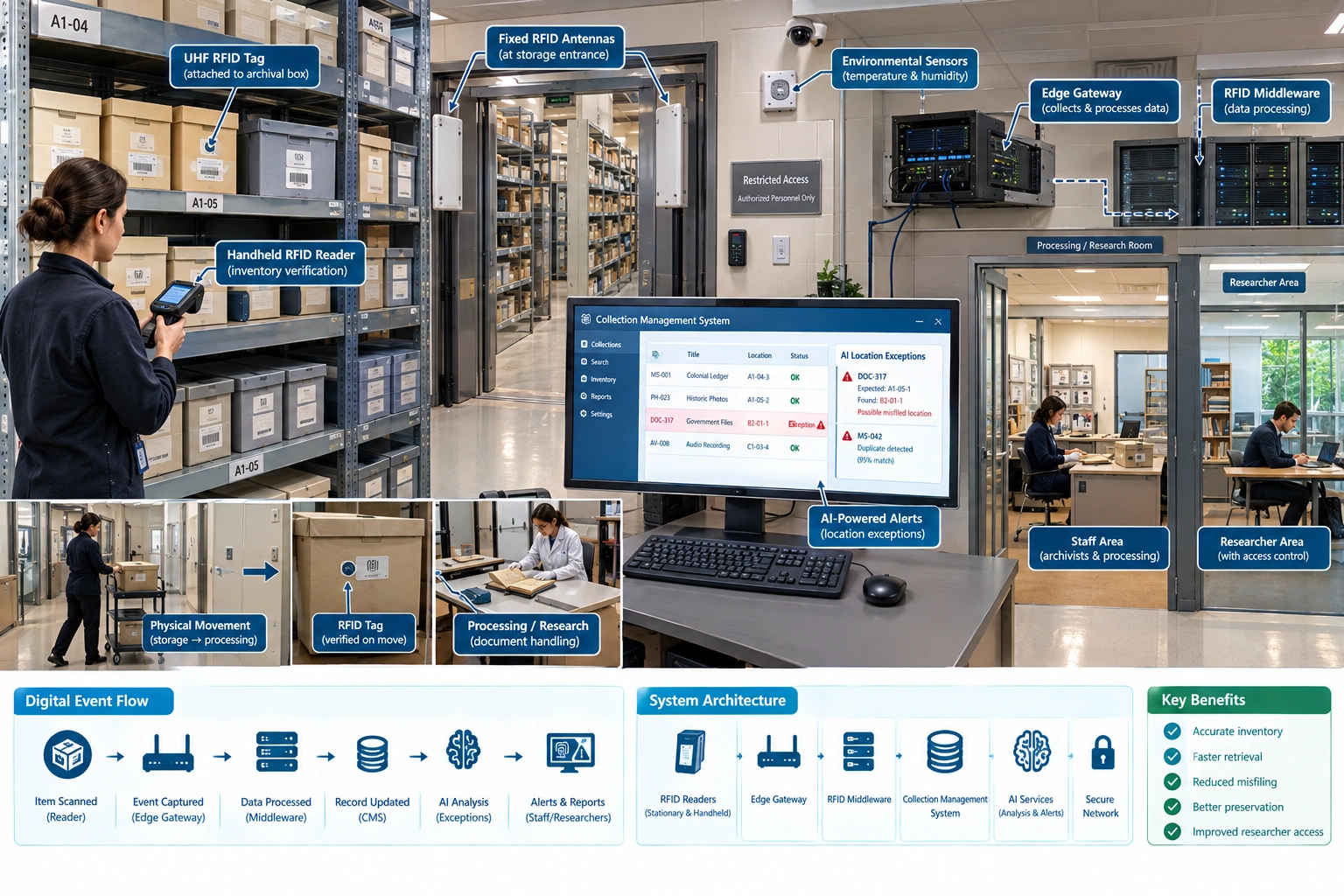
RFID data should also be normalized before reaching the archival management software. Middleware can filter duplicate reads, apply reader-zone logic, associate tag identities with authorized locations, timestamp events, and forward only meaningful state changes.
ISO 28560-1:2023 provides a standards-based RFID data framework for library items, including data elements, implementation guidance, security, privacy, migration, label design, and label location. Although archival deployments have their own requirements, the standard is useful reference material when designing interoperable identification and data structures for related cultural-heritage environments.
ISO 28560-2:2023 further defines encoding rules for RFID data elements based on ISO/IEC 15962, providing another useful interoperability reference when RFID data structures overlap with library-oriented collection workflows.
Realistic RFID Deployment for AI-Enabled Archival Repository Management
AI Data Flow and Archival System Integration
A dependable implementation separates physical identification, event processing, archival records, AI services, and human decisions.
A representative data flow is:
RFID tag → RFID reader → edge gateway → middleware → event normalization → archival or collection-management system → AI processing → review workflow → approved metadata or operational action.
The same pattern can support handheld inventory operations. A handheld reader captures tag identifiers, the application associates them with the current storage zone, middleware removes duplicate observations, and the system compares observed locations against expected records.
AI can then examine accumulated event data for anomalies, such as repeated unexpected movements, missing expected observations, unusual retrieval patterns, or inconsistencies between physical and digital records.
For digital archival content, another path may be:
Digitized record → OCR or transcription → document processing → entity extraction → metadata suggestion → archivist review → approved archival description → semantic index.
The two data flows become more powerful when linked. A researcher can discover a digital surrogate through semantic search and then determine the corresponding physical archival location. Conversely, a staff member handling a physical box can retrieve its authoritative descriptive record through its RFID identity.
This relationship between physical custody and digital discovery is one of the most valuable aspects of AI-enabled archival management.
Deployment Planning for Archival Institutions
A successful implementation should begin with a clearly defined operational problem rather than a technology purchase.
A practical discovery phase should document:
- Collection hierarchy and identifiers.
- Current accessioning, processing, storage, retrieval, and return workflows.
- Existing collection-management and archival-management software.
- Physical storage configuration and shelf construction.
- Container materials and representative archival formats.
- Required read zones and handheld inventory routes.
- Access restrictions and staff permissions.
- Existing barcode or identifier systems.
- Environmental monitoring infrastructure.
- Network availability in storage and processing areas.
- Required audit trails and retention periods.
- AI governance and human-review requirements.
- Integration interfaces available from existing software.
GAO can support organizations with RFID, BLE, IoT hardware products and systems used to connect physical assets with software workflows. The engineering emphasis should remain on matching readers, tags, antennas, gateways, and software interfaces to the archive’s actual operating conditions rather than selecting equipment in isolation.
Pilot Before Repository-Wide Deployment
A representative pilot should include different box materials, shelf configurations, tag orientations, storage densities, and operational workflows.
Testing should measure:
- Read success rate.
- False reads and unintended reads.
- Duplicate event frequency.
- Read performance at realistic shelf density.
- Handheld scanning productivity.
- Fixed-reader zone accuracy.
- Location-assignment accuracy.
- Network interruption behavior.
- Middleware event filtering.
- Integration latency.
- AI recommendation precision.
- Human-review workload.
- Recovery behavior after device or network failures.
The pilot should also test exceptions. An archival system that performs well during a clean inventory demonstration but fails when containers are moved unexpectedly, network connectivity is interrupted, or staff bypass a normal workflow is not ready for production.
Cloud and Server Deployment for Archives
Cloud-hosted software can be appropriate when archival institutions want centrally managed services, elastic compute resources, remote access, and integration with cloud-based AI services. It can simplify centralized management across multiple repositories or geographically distributed facilities.
A privately hosted server deployment can be preferable when an archive requires tighter control over sensitive collection metadata, network isolation, local processing, integration with existing data centers, or operation during restricted connectivity.
A hybrid implementation can keep RFID event capture and operational controls close to the repository while using cloud resources for selected AI workloads, analytics, or centralized discovery services.
The choice should be based on collection sensitivity, institutional IT policy, network reliability, data residency requirements, integration constraints, AI workload size, and operational support capability.
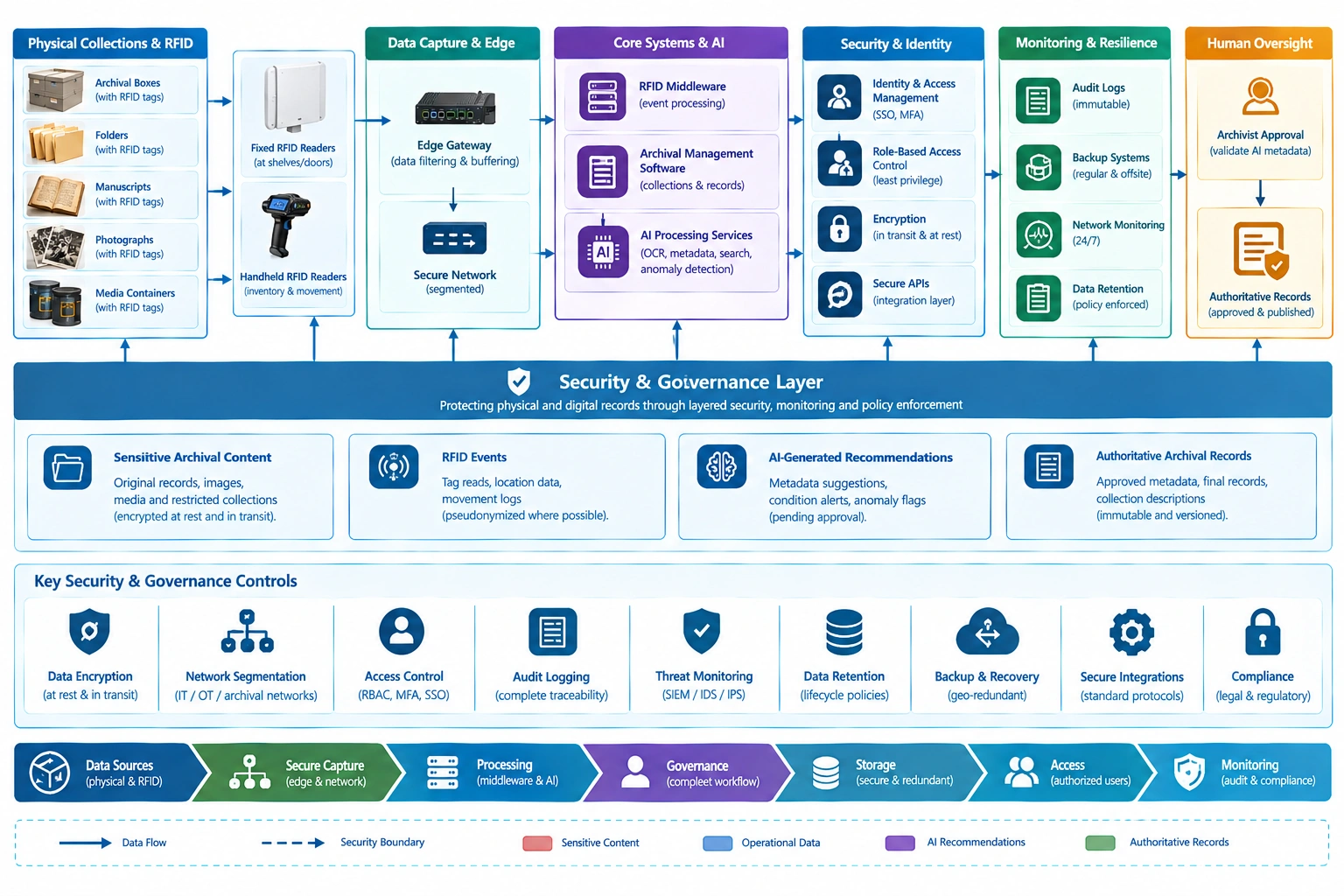
Security, Privacy, and Trust in AI-Enabled Archives
Security controls must protect both archival information and physical collections.
RFID identifiers should not unnecessarily contain sensitive descriptive information. A safer design can use a pseudonymous tag identifier that maps to authoritative records in the archival management system.
Access controls should distinguish between inventory staff, archivists, preservation staff, researchers, administrators, and technical personnel. Movement events should be timestamped and associated with authorized users or processes where appropriate.
AI services require additional controls. Sensitive archival material should not automatically be transmitted to external AI services without an approved data-governance process. Institutions should define what information may be processed, where models run, how prompts and outputs are retained, how access is controlled, and how AI-generated metadata is reviewed.
For government archives and other regulated environments, records-management requirements must be considered alongside AI and RFID implementation. NARA publishes extensive records-management regulations and guidance covering records creation, management, disposition, electronic records, storage, and related requirements.
The core engineering principle is simple: AI recommendations and RFID observations should be traceable back to authoritative source data and auditable human decisions.
Security and Governance Framework for AI-Enabled Archival Management
AI-Enabled Capabilities for Archival Operations
Combining AI-driven software with RFID-based physical identification gives archives a way to connect collection intelligence with physical custody. The greatest value comes from linking these capabilities to specific archival workflows rather than deploying AI or RFID as isolated technologies.
Faster Collection Discovery
Semantic search can connect finding aids, OCR text, transcripts, descriptive metadata, and digitized materials. Researchers and archivists can search by concepts, entities, subjects, dates, organizations, and related terminology instead of depending entirely on exact keyword matches.
RFID adds physical context to that discovery process. Once the relevant archival identifier is known, staff can associate it with a tagged container and determine its expected storage location.
More Reliable Physical Inventory
Manual inventory can require staff to read labels individually and reconcile observations with collection records. RFID-assisted inventory can capture multiple tagged containers during a controlled scan and provide a machine-readable observation record.
AI can analyze historical observations to identify recurring discrepancies, unexpected movements, missing observations, or unusual activity.
The engineering objective should be to reduce manual reconciliation rather than eliminate staff verification. Physical collections require controlled handling, and inventory exceptions should remain reviewable by authorized archival personnel.
Improved Metadata Quality
AI can identify inconsistent names, duplicate entities, missing fields, date variations, and relationships between descriptions. It can also propose standardized metadata for archivist review.
This is particularly useful when archives contain large legacy finding aids or collections described using different terminology over many years.
AI-generated metadata should retain provenance information indicating its source, processing date, model or service where appropriate, confidence information, and human approval status.
Better Retrieval Accuracy
A retrieval request can be matched against the archival identifier, RFID identity, storage location, access permissions, and current movement status.
A verification step can confirm that the physical container being removed corresponds to the requested record. This reduces the risk of retrieving a similarly labeled box or returning material to the wrong location.
Auditable Chain of Custody
Each meaningful physical movement can become a timestamped event. When linked with user authentication, request records, storage locations, and return transactions, these events create a stronger audit trail.
This can be valuable for rare manuscripts, restricted collections, government records, institutional archives, and materials requiring controlled research-room access.
Scalable Multi-Repository Operations
Organizations managing multiple archival facilities can centralize selected software functions while maintaining local RFID capture and operational controls at each repository.
A distributed design can support common identifiers, standardized workflows, centralized analytics, and location-specific permissions without requiring every repository to operate identically.
Technical Components for AI-Driven Archival Systems
The physical and digital components should be selected around archival workflows and integration requirements.
RFID Tags and Readers
UHF RFID is useful for archival inventory scenarios where longer read ranges and rapid identification of multiple containers are beneficial. HF RFID can support controlled short-range interactions, while LF RFID is generally used for specialized short-range identification requirements.
Tag selection should consider container material, label construction, reader distance, shelving, orientation, density, and the possibility of interference from metal or other materials.
Fixed readers can monitor controlled transition points, while handheld readers are generally more flexible for shelf-by-shelf inventory and exception investigation.
RFID Middleware
Middleware sits between readers and archival software. It can normalize reader events, remove duplicate observations, associate readers with physical zones, apply business rules, and transmit validated events to downstream systems.
This layer is important because raw RFID reads are not equivalent to confirmed archival movements. A reader may observe a tag multiple times, and a nearby tag may be captured unintentionally. Business rules are therefore required to convert RF observations into meaningful archival events.
Edge Computing and Gateways
An edge gateway can process reader data near the repository. Local processing can reduce unnecessary network traffic and allow basic operations to continue during temporary connectivity interruptions.
Depending on the design, the gateway can buffer events, synchronize timestamps, monitor reader health, and forward normalized information to centralized software.
AI and Machine Learning
Different archival problems require different AI methods.
- Natural language processing can extract entities and concepts from archival descriptions.
- Large language models can assist with metadata drafting, question answering, summarization, and controlled natural-language discovery.
- Computer vision can classify document images and other visual archival material.
- OCR and intelligent document processing can transform scanned records into searchable text.
- Embedding-based retrieval can support semantic search across heterogeneous descriptions and documents.
- Anomaly detection can identify unusual physical movement or inventory patterns.
- Classification models can help prioritize records for human review.
- Multimodal AI can combine text, images, and structured metadata where appropriate.
AI model selection should be driven by measurable archival requirements. A general-purpose model is not automatically appropriate for sensitive collections or specialized historical terminology.
Archival and Enterprise Software Integration
AI and RFID data can connect with several software categories:
- Archival management systems.
- Collection-management systems.
- Records-management systems.
- Digital asset management systems.
- Library services platforms where archival collections share infrastructure.
- Document-management systems.
- Identity and access-management systems.
- Researcher request systems.
- Environmental monitoring software.
- Business intelligence and analytics software.
- Databases and data warehouses.
- API gateways and integration middleware.
Open APIs and structured data interfaces are preferable to manual data exchange. Integration should preserve authoritative identifiers and avoid creating competing versions of collection metadata.
Communication and Network Infrastructure
Repository connectivity can use wired Ethernet, Wi-Fi, secure local networks, and other approved communication methods depending on reader and gateway requirements.
Network segmentation can isolate RFID devices and edge systems from higher-value institutional systems. Firewall policies, authentication, encryption, device certificates, secure APIs, and centralized monitoring can further reduce the attack surface.
Practical Archival KPIs
Performance should be measured using operational outcomes rather than technology deployment counts.
Useful KPIs include:
- Inventory completion time per storage area.
- RFID read success rate for representative archival containers.
- Location discrepancy rate.
- Number of unresolved location exceptions.
- Retrieval turnaround time.
- Retrieval accuracy.
- Return-to-storage accuracy.
- Research-room delivery time.
- Manual inventory labor hours.
- Metadata review time per record.
- AI metadata acceptance rate.
- AI false-positive rate.
- AI false-negative rate for defined screening tasks.
- OCR accuracy on representative archival documents.
- Semantic-search relevance measured through staff evaluation.
- Percentage of physical holdings linked to authoritative digital records.
- Percentage of movement events successfully synchronized.
- Reader and gateway availability.
- Integration processing latency.
- Unauthorized movement alerts investigated within the required response period.
KPIs should be established during the pilot so that improvements can be compared against the archive’s existing baseline.
Engineering Considerations for Production Deployment
Production deployment should account for the physical behavior of RFID, the characteristics of archival materials, AI reliability, software integration, and operational governance.
Tag Placement and Read Performance
A tag that works reliably on one box may perform differently when placed on another material or orientation. Pilot testing should therefore use actual archival containers rather than relying exclusively on vendor specifications.
Metal shelving and other RF-reflective materials can affect antenna performance. Dense shelving can also change read behavior compared with an isolated test box.
Controlled read zones should be validated using real movement paths and representative personnel behavior.
Location Modeling
Storage locations should have structured identifiers rather than relying only on descriptive names.
A useful model can represent:
- Repository.
- Building.
- Floor.
- Room.
- Vault.
- Aisle.
- Bay.
- Shelf.
- Position.
- Container.
- Folder or item where appropriate.
The RFID system should map physical observations to this location model while the archival management system remains authoritative for collection hierarchy.
Exception Handling
Exceptions should be designed before deployment.
Examples include:
- RFID tag not detected during expected inventory.
- Tag observed in an unauthorized zone.
- Container associated with the wrong location.
- Duplicate RFID identity.
- Reader offline.
- Gateway disconnected.
- Network interruption.
- Unauthorized retrieval.
- Missing return transaction.
- AI confidence below the configured review threshold.
- Conflicting metadata between source systems.
An exception should produce a clear operational action rather than simply appearing as an alert in a dashboard.
Interoperability and Data Quality
Archives frequently operate with established identifiers and legacy databases. Replacing these systems solely to introduce RFID or AI may create unnecessary migration risks.
A better approach can be to establish integration interfaces that connect existing archival software with RFID middleware and AI services.
Data mapping should preserve collection identifiers, accession numbers, series relationships, location codes, digital-object identifiers, and provenance information.
AI Governance
AI outputs should be classified according to their operational consequence.
Low-risk assistance, such as suggesting keywords for staff review, can generally tolerate a different risk threshold from automated access decisions or archival disposition recommendations.
High-impact decisions should require stronger controls, human review, traceability, testing, and documented acceptance criteria.
Common Implementation Mistakes to Avoid
Several deployment approaches can reduce the value of an otherwise capable AI and RFID system.
- Tagging every physical object without first determining the appropriate archival tracking level.
- Treating RFID reads as automatically accurate location confirmations.
- Deploying fixed readers without testing shelf density and reader-zone behavior.
- Allowing AI-generated metadata to overwrite authoritative descriptions without review.
- Sending sensitive archival information to external AI services without governance approval.
- Ignoring existing archival identifiers during RFID integration.
- Measuring success by the number of tags installed rather than retrieval, inventory, and metadata outcomes.
- Designing alerts without assigning a responsible operational workflow.
- Testing AI only on clean modern documents rather than representative historical materials.
- Assuming cloud connectivity will always be available inside controlled repository environments.
- Failing to plan device maintenance, reader calibration, tag replacement, and software updates.
- Treating cybersecurity as a post-deployment activity.
These issues are usually easier and less expensive to correct during a controlled pilot than after repository-wide deployment.
Where GAO Supports AI-Enabled Archival Operations
GAO provides RFID, BLE, and IoT hardware products and systems that can support physical asset identification, location monitoring, data capture, and connected operational workflows. For archival organizations, these capabilities can be applied to container-level tracking, inventory verification, controlled movement monitoring, and integration with software-based collection workflows.
GAO’s broader technical experience also includes supplying hardware products and systems to organizations that require connected identification and monitoring capabilities. Its customer base across the U.S. and Canada includes Fortune 500 companies, leading R&D organizations, universities, and government agencies.
Headquartered in New York City and Toronto, Canada, GAO is ranked among the top 10 leading B2B and B2G BLE and RFID suppliers globally. GAO’s technical approach emphasizes product and system development, quality assurance, and expert support that can be delivered remotely or onsite.
For an archival deployment, this support can be valuable during hardware selection, RF testing, reader placement, system integration, commissioning, troubleshooting, and operational optimization.
Putting AI-Enabled Archival Intelligence into Practice
The most effective AI and RFID projects for archives begin with operational requirements, not hardware specifications. Organizations should first identify where collection discovery, metadata processing, physical inventory, retrieval, access control, or movement verification creates measurable operational friction.
A practical implementation path is:
- Document existing accessioning, processing, storage, retrieval, and research-room workflows.
- Identify the physical collection level that requires machine-readable identification.
- Establish authoritative archival identifiers and location structures.
- Test UHF, HF, or LF RFID options against representative archival materials.
- Validate reader placement, tag orientation, read zones, and inventory procedures.
- Integrate RFID middleware with existing archival or collection-management software.
- Establish AI governance, human-review processes, and data-security controls.
- Pilot AI-assisted metadata, OCR, semantic search, or anomaly detection on representative collections.
- Define KPIs before production deployment.
- Test failure conditions, network interruptions, duplicate reads, missing tags, and unauthorized movement scenarios.
- Train archivists and technical staff on normal workflows and exception handling.
- Expand deployment incrementally after measurable pilot results.
GAO can help archival organizations evaluate RFID and connected IoT hardware requirements and develop implementation approaches aligned with their physical collection environment and existing software systems.
The strongest long-term result is not simply faster scanning or automated metadata. It is a traceable connection between archival evidence, descriptive context, physical custody, digital discovery, and authorized human decisions.
Building the Future of Industrial AI and IoT with Aperture Venture Studio and GAO RFID Inc.
For more than three decades, GAO Group of Companies has invested heavily in R&D for industrial RFID, BLE, and IoT. As generative AI became increasingly useful for industrial applications, we expanded our work across AI and IoT, including RFID and BLE, and founded Aperture Venture Studio to build, launch, and scale AI and IoT companies and solutions relevant to areas such as intelligent archival management, connected collections, physical asset tracking, and digital discovery.
Aperture has attracted AI and IoT technical experts, entrepreneurial and operational executives, influential investors, and leading companies. We have also developed the Aperture Ventures Summit and TekSummit to discuss advanced AI and IoT topics.
These activities have helped us build technical communities around AI and IoT. We welcome you to join us as:
- Advisors, co-founders, or employees.
- Investors.
- Customers.