
AI and RFID for Art Galleries
How AI-Driven RFID Improves Art Gallery Collection Management
AI-driven RFID helps art galleries establish a more reliable digital record of where artworks, frames, crates, exhibition materials, and other collection assets are located, how they move, and whether their movement matches approved operational activity. Rather than treating RFID as only an identification technology, galleries can use RFID-generated location and movement events as operational data for AI systems that detect anomalies, reconcile inventories, support exhibition preparation, and improve collection handling decisions.
Art galleries manage assets whose financial, cultural, historical, and reputational value can far exceed the number of objects involved. A missed painting during exhibition deinstallation, an incorrectly documented transfer to a conservation room, or an unauthorized movement from secure storage can create significant operational and security consequences. AI helps interpret RFID events within their gallery-specific context by considering exhibition schedules, loan records, approved handlers, collection locations, and expected movement patterns.
For art galleries, the result is more than faster inventory counting. AI-supported RFID can improve collection visibility, strengthen chain-of-custody records, reduce manual reconciliation, support security teams, and provide better evidence for operational decisions involving valuable works of art. GAO supplies RFID hardware products and systems that can support these identification and location requirements across gallery storage, exhibition, receiving, conservation, and outbound loan workflows.
AI-Driven RFID Art Gallery Collection Management and Artwork Tracking
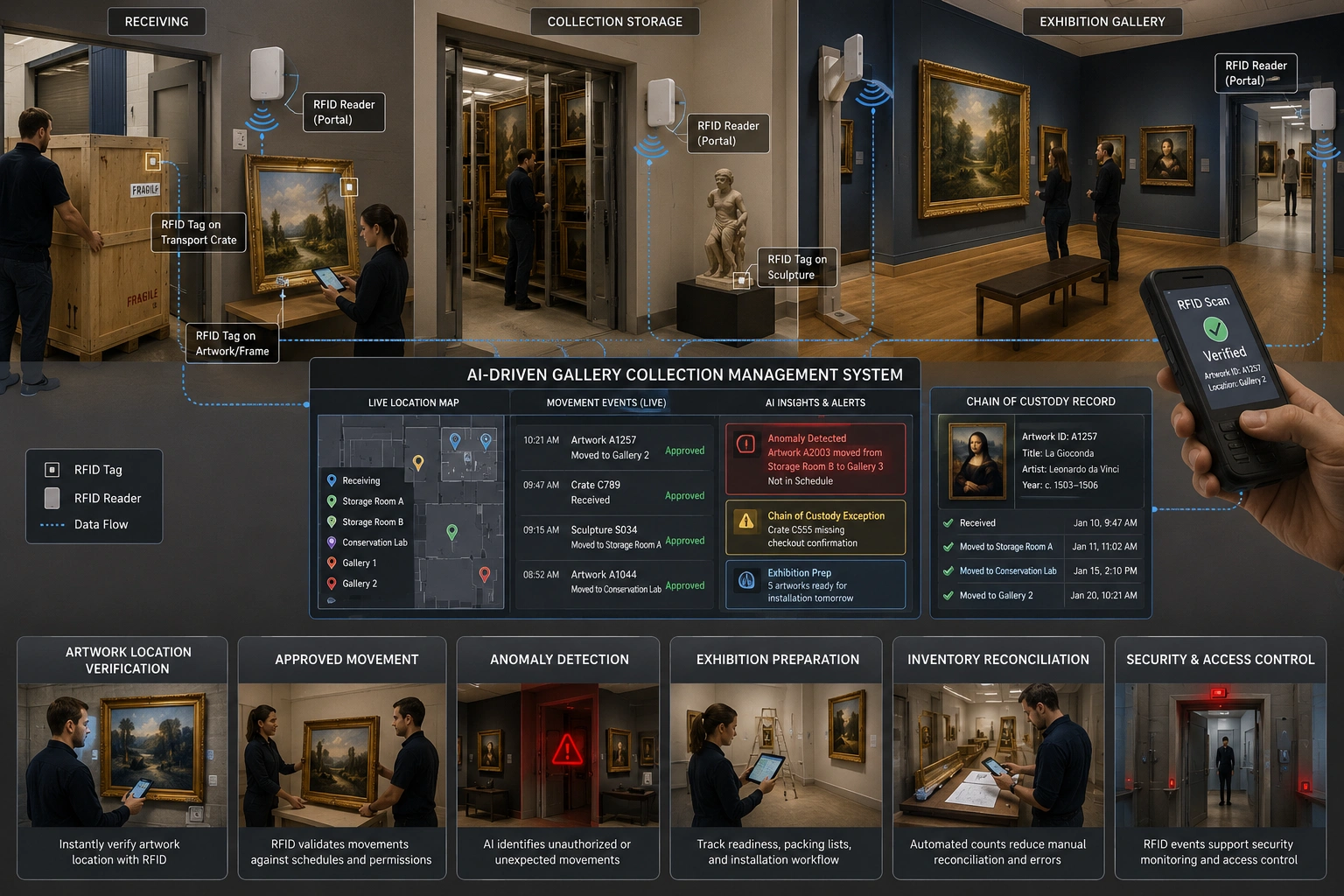
What AI and RFID Mean for Modern Art Gallery Operations
Artificial Intelligence of Things, commonly called AIoT or AI and IoT, combines artificial intelligence with IoT devices, sensors, connected equipment and industrial systems. Within art galleries, RFID becomes one of the identification technologies that supplies structured events to AI-driven collection management, asset movement analysis, security workflows, and operational decision support.
The underlying principle is straightforward. RFID identifies a tagged object or associated handling asset when it enters a reader’s operating zone. AI evaluates that event in relation to the artwork’s expected state and the surrounding gallery workflow.
A single RFID event may therefore be interpreted differently depending on context:
- A painting moving from secure storage to an exhibition preparation room may be an expected event when linked to an approved installation work order.
- The same painting appearing near a loading bay outside a scheduled loan dispatch window may require investigation.
- A transport crate entering a gallery receiving zone without a matching loan or acquisition record may indicate a reconciliation exception.
- Repeated movement of a sculpture between rooms may reveal an inefficient exhibition preparation workflow or incomplete documentation.
- An artwork that remains absent from its expected RFID verification zone after deinstallation may trigger a targeted search rather than a full collection inventory.
This contextual interpretation is where AI adds value. Traditional RFID systems can record that an identifier was observed. AI models and rules can help determine whether the observation represents normal handling, a documentation mismatch, a possible security event, or a workflow condition requiring staff action.
Modern art galleries commonly operate across several interconnected collection activities, including acquisition intake, accessioning, cataloging, condition assessment, provenance documentation, storage, conservation, exhibition installation, deinstallation, loans, packing, transport coordination, and inventory audits. These activities often involve collection managers, registrars, curators, conservators, preparators, security personnel, art handlers, logistics coordinators, and external shippers.
RFID event data can connect parts of these workflows when deployed with appropriate collection identifiers, zone definitions, handling procedures, and integration with collection management software. GAO has helped organizations across the U.S. and Canada by supplying RFID, BLE, and related IoT hardware products and systems, bringing practical experience that is particularly relevant where identification accuracy, deployment planning, and technical support affect operational outcomes.
Why Art Galleries Need AI-Supported Artwork Tracking
Art gallery operations present a different RFID problem from ordinary retail inventory management. A collection may contain paintings with irregular frames, fragile sculptures, works on paper requiring controlled handling, installations composed of multiple components, and objects that cannot physically accommodate a conventional tag. RFID deployment must therefore account for conservation requirements, tag placement, materials, read-zone design, and the relationship between the RFID identifier and the authoritative collection record.
Common operational challenges include:
- Locating artworks distributed across galleries, secure storage rooms, conservation spaces, staging areas, and temporary exhibition zones.
- Maintaining accurate chain-of-custody records when multiple art handlers and external logistics providers participate in a movement.
- Reconciling physical objects with accession numbers, object IDs, loan agreements, exhibition checklists, and transport documentation.
- Detecting unexpected artwork movement without generating excessive false alarms during approved installation and handling activities.
- Conducting inventory audits without repeatedly disturbing fragile or valuable objects.
- Tracking multi-component installations, shipping crates, reusable packing materials, display pedestals, and other supporting assets separately from the artwork itself.
- Managing temporary loans and outgoing exhibitions where custody and location responsibility changes over time.
- Maintaining reliable operational records when galleries contain areas with architectural constraints, metal structures, dense storage racks, or limited reader placement options.
AI-driven RFID addresses these challenges by combining physical identification events with operational context. The objective is not simply to collect more data. The objective is to reduce uncertainty around artwork identity, location, status, custody, and expected movement.
Art Gallery Applications for AI-Driven RFID
AI Artwork Location Verification
Artwork location verification is one of the strongest applications for RFID in art galleries. Fixed readers, handheld readers, or designated verification points can record the presence of tagged works or associated tags within defined operational zones.
AI can compare observed events against the expected location maintained in collection management records. Instead of requiring staff to manually investigate every mismatch, the system can prioritize exceptions based on factors such as artwork value, loan status, security classification, last confirmed location, and whether the object is scheduled for handling.
A gallery can use this approach to distinguish between a temporary staging discrepancy and a potentially serious location exception.
AI-Assisted Collection Inventory Reconciliation
Collection inventories often require staff to verify individual objects against collection records. Manual barcode scanning can require line-of-sight access and significant handling. RFID can accelerate portions of this process when tags and readers are suitable for the collection environment.
AI can improve reconciliation by grouping missing reads, duplicate associations, historical movement records, and known exceptions. A work not detected during an inventory sweep may not necessarily be missing. It may be on approved loan, undergoing conservation, temporarily staged for photography, or associated with an unreadable tag.
AI-driven exception classification can direct staff toward the most likely explanation before escalating the event.
Chain-of-Custody Monitoring for Loans and Artwork Transfers
Loan movements frequently involve several custody transitions:
- Collection storage to preparation
- Preparation to packing
- Packing to loading
- Gallery to specialized art transport
- Receiving at a borrowing institution
- Exhibition staging and installation
- Return transport and receiving inspection
RFID checkpoints can record custody-related events when integrated with approved transfer procedures. AI can evaluate whether the sequence matches the planned loan workflow and identify missing or unusual transitions.
The value is especially significant when gallery staff need an auditable movement history without relying entirely on manually entered timestamps.
Exhibition Installation and Deinstallation Control
Exhibition installation often requires dozens or hundreds of objects to move through staging areas under time pressure. Registrars and preparators must verify that the correct works reach the correct gallery rooms and that deinstallation reverses the process accurately.
AI can combine RFID observations with exhibition checklists, room assignments, wall locations, installation schedules, and object records. The system can identify works that have reached the wrong zone, remain in staging after their scheduled installation window, or have not been verified during deinstallation.
This approach can reduce last-minute searches and improve accountability during exhibition turnover.
Security Exception Detection
Security applications require careful system design because RFID alone does not replace physical security controls. An RFID event should be evaluated alongside approved movement schedules, access control events, camera analytics where permitted, and established gallery security procedures.
AI can identify patterns that deserve attention, such as:
- A high-value artwork observed near an exit outside an approved handling window.
- Movement through an unusual sequence of gallery zones.
- Repeated unsuccessful or inconsistent identification events.
- An object remaining outside its assigned secure location longer than expected.
- A transport crate moving without an associated approved dispatch workflow.
Human review remains essential. AI should prioritize and contextualize exceptions rather than autonomously declaring that an artwork has been stolen or mishandled.
RFID-Driven Artwork Movement Workflow: From Collection Storage to Loan Dispatch
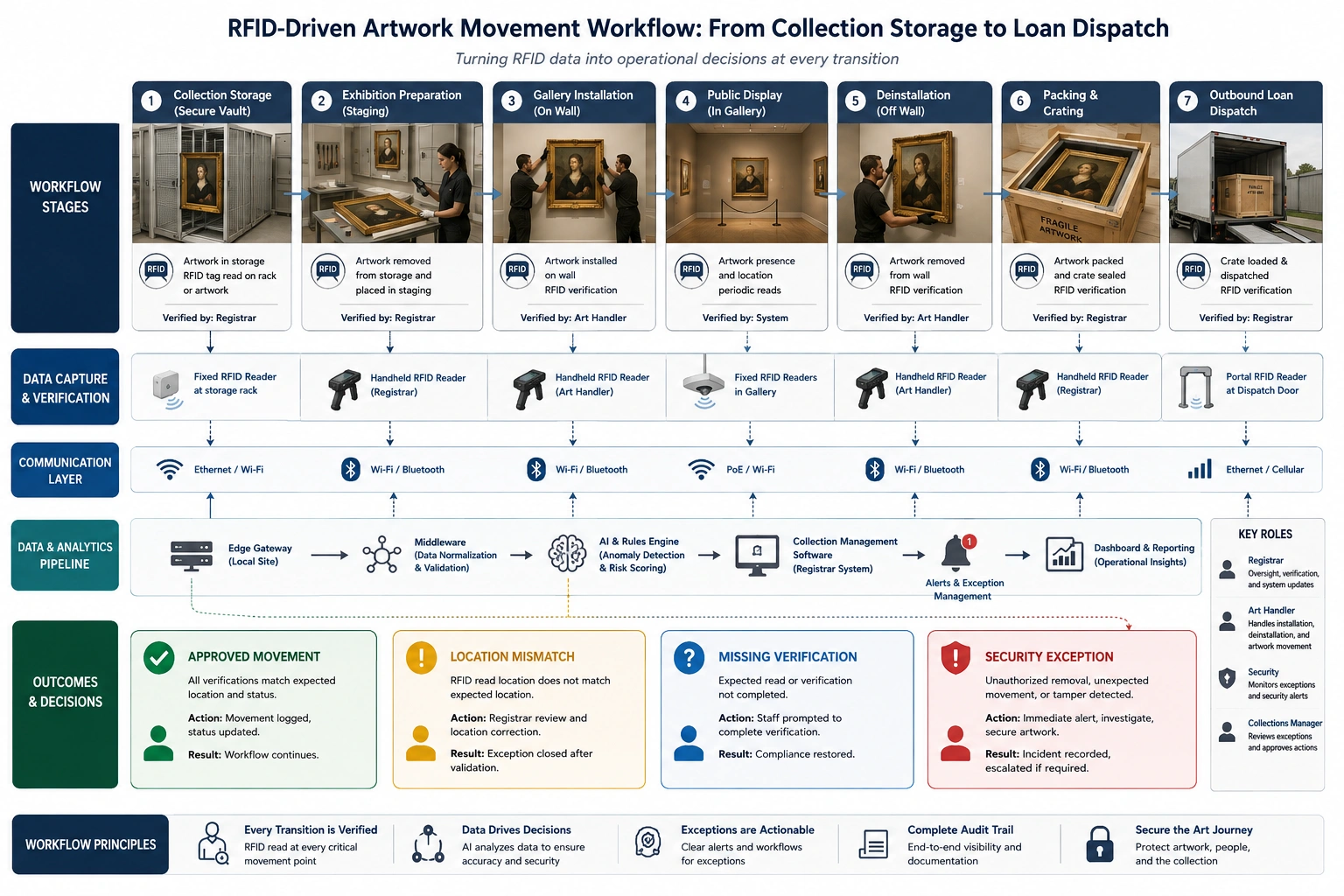
How RFID Data Becomes AI-Driven Gallery Decisions
A reliable AI-driven RFID solution for art galleries begins with a clear distinction between object identity, physical observation, operational status, and authoritative collection records. These should not be treated as the same thing.
The RFID tag or identifier represents a digital identity associated with an artwork, frame, crate, or operational asset. A reader event indicates that the identifier was observed under specific conditions. The collection management system may contain the authoritative object record, accession number, artist information, ownership status, loan information, condition history, insurance requirements, and current registered location.
The operational workflow typically follows these stages:
Artwork and Asset Identification
Each RFID association should be governed by a controlled commissioning process. Gallery personnel verify that the RFID identifier is correctly associated with the relevant object record before the tag becomes active within operational workflows.
Tag association errors are particularly serious for art collections because a technically successful RFID read is useless if it is linked to the wrong artwork record. GAO can support hardware selection and identification system planning where tag characteristics, object materials, read range, and handling procedures must be evaluated before broader deployment.
Event Capture and Communication
UHF RFID is generally useful where longer read distances and rapid identification of multiple tagged items are required, such as controlled inventory sweeps, crate verification, staging zones, and selected doorway monitoring. HF RFID can be appropriate where close-proximity identification and controlled read interactions are preferred. LF RFID may be relevant for specialized low-frequency identification requirements where environmental or legacy system constraints justify its use.
The reader system transmits structured events through appropriate wired or wireless infrastructure. Depending on the deployment, communication may use Ethernet, Wi-Fi, HTTPS, MQTT, or other supported enterprise communication methods.
Edge Processing and Event Filtering
Raw RFID reads should not automatically become business events. A reader can observe the same tag repeatedly while an artwork remains within a read zone.
Edge software or reader-side processing can:
- Remove duplicate observations.
- Apply time windows and zone logic.
- Associate reads with specific doors, rooms, staging areas, or verification stations.
- Detect reader health and communication failures.
- Continue selected local processing during temporary network interruptions.
- Forward normalized events to gallery software.
This step is important because poor event filtering can produce noisy records and undermine confidence in the system.
Middleware and Operational Context
Middleware connects RFID events with the rest of the gallery’s operational software. Depending on the organization, integrations may involve collection management systems, digital asset management software, loan management tools, conservation records, security systems, identity and access management, and business reporting tools.
The middleware layer can convert a technical event such as a tag observation into a business event such as:
“Artwork verified in Exhibition Gallery 3.”
“Loan crate passed approved outbound verification.”
“High-value object observed outside expected handling zone.”
This normalization gives AI systems a more useful and consistent input.
AI Analysis and Decision Support
AI methods may combine rules, anomaly detection, pattern recognition, forecasting, and machine learning models depending on the maturity and data quality of the deployment.
Rules are often appropriate for clearly defined gallery procedures, while anomaly detection can identify movement sequences that differ from historical or expected patterns. Machine learning can become more valuable when sufficient reliable event history exists.
The AI output may support:
- Exception prioritization.
- Probable location recommendations.
- Missing verification investigation.
- Movement pattern analysis.
- Exhibition workflow forecasting.
- Inventory reconciliation.
- Risk scoring for selected operational events.
Staff Action and Feedback
The final stage remains operational. A registrar, collection manager, security officer, or art handler reviews the recommendation and takes the appropriate action.
Confirmed outcomes can improve future rules and models. This feedback loop is essential because gallery procedures, exhibition schedules, loan activity, and physical layouts can change over time.
RFID, AI, Software and Deployment Components for Art Galleries
A practical AI-driven art gallery solution combines identification hardware with operational software rather than relying on readers alone. The exact design depends on gallery layout, collection characteristics, conservation requirements, security policy, expected movement frequency, and integration requirements.
RFID Hardware and Identification Layer
Relevant hardware may include UHF RFID readers, HF RFID readers, LF RFID equipment where appropriate, antennas, handheld readers, RFID tags, ruggedized asset tags, gateways, and controlled verification stations.
Hardware selection should begin with a site survey and representative testing. Metal frames, foil-backed materials, dense storage arrangements, display cases, architectural surfaces, and tag placement constraints can materially affect performance. A gallery should test representative artworks, crates, and operational zones rather than selecting hardware solely from published read-range specifications.
AI and Analytics Software
AI software can process normalized RFID events alongside collection records and workflow data. Depending on the use case, the software may use anomaly detection, classification, rules engines, graph-based relationship analysis, time-series analysis, or machine learning.
For example, an anomaly model may learn typical movement sequences for exhibition installation while a deterministic rule prevents a high-value artwork from being marked as normally transferred unless a scheduled handling event exists.
Cloud Version
A cloud-hosted SaaS deployment can be appropriate for galleries that require centralized access across multiple locations, remote administration, managed software updates, and integration with distributed exhibition or loan operations. Cloud infrastructure can support centralized analytics and consolidated reporting while retaining local edge processing for time-sensitive or connectivity-dependent workflows.
Cloud deployment requires careful review of data residency, identity management, API security, audit logging, network segmentation, and the type of collection information permitted to leave privately controlled systems.
Server Version
A Server Version can run on an edge server, customer-managed server, private data center, or other privately hosted enterprise infrastructure. This model can be appropriate when galleries require greater control over collection data, need integration with locally managed systems, operate under strict security requirements, or need selected functions to continue independently of external cloud connectivity.
Server deployment is not limited to an on-premises installation. A privately hosted server environment can also support geographically distributed galleries while maintaining customer-managed control.
Security and Supporting Infrastructure
Security should include role-based access control, strong authentication, encrypted communications, network segmentation, audit trails, device management, secure API controls, and backup procedures. RFID identifiers should not be treated as proof of authorization by themselves. A robust system separates object identification from staff authentication and approval authority.
GAO supplies RFID and related IoT hardware products and systems that can be incorporated into these deployments, while engineering teams can evaluate reader placement, tag selection, communication requirements, integration points, and operational testing before full-scale commissioning.
Deployment Engineering Considerations for Valuable Art Collections
Successful deployment begins before equipment is installed. Art galleries should first map the movement and verification points that matter operationally. Installing readers everywhere can increase cost and event noise without improving collection control.
A practical deployment assessment should examine:
- Collection storage rooms and high-value holding areas.
- Exhibition galleries and temporary staging zones.
- Receiving and loading locations.
- Conservation and photography areas.
- Installation and deinstallation routes.
- Loan packing and outbound verification points.
- Existing security infrastructure and controlled access zones.
- Construction materials and potential RF interference.
- Artwork conservation requirements affecting tag attachment or placement.
Tagging strategy requires equal attention. A tag associated with an artwork may be integrated with an approved label, protective enclosure, frame component, or other non-invasive identification method, depending on conservation policy. The goal is to maintain reliable association without introducing unacceptable physical, visual, or preservation risks.
Commissioning should include controlled read testing, identifier validation, zone calibration, integration testing, staff workflow testing, and exception testing. Teams should deliberately test scenarios such as an artwork entering the wrong gallery, a crate missing an expected object, duplicate reads, reader disconnection, and an approved after-hours movement.
These tests reveal whether the AI and RFID solution can distinguish genuine exceptions from normal operational variation.
Realistic Deployment Scenario: Exhibition Turnover in an Art Gallery
Consider a gallery preparing for a major exhibition while simultaneously deinstalling a previous collection. Paintings move from secure storage to staging, while outgoing works are packed for return to lenders. Registrars must reconcile exhibition checklists, preparators must confirm room assignments, and security teams must remain aware of unusual movement.
A well-designed deployment could use controlled RFID verification points at collection storage exits, staging areas, designated gallery entrances, and loan packing stations. Handheld RFID readers can support targeted searches and periodic inventory verification.
The operational flow could be:
- A registrar releases approved artworks against the exhibition checklist.
- RFID events verify movement from secure storage into the assigned staging workflow.
- AI compares observed objects against room assignments and installation schedules.
- A work detected in an incorrect staging zone is flagged for review.
- During deinstallation, AI checks whether each outgoing work has completed the expected sequence of removal, staging, packing, and dispatch verification.
- A missing verification event is prioritized according to the object’s value, loan requirements, and last confirmed location.
- Staff investigate the highest-priority exceptions using handheld readers and collection records.
This approach supports faster reconciliation without allowing automation to replace registrar judgment or established collection procedures.
AI + RFID Deployment in an Art Gallery During Exhibition Turnover
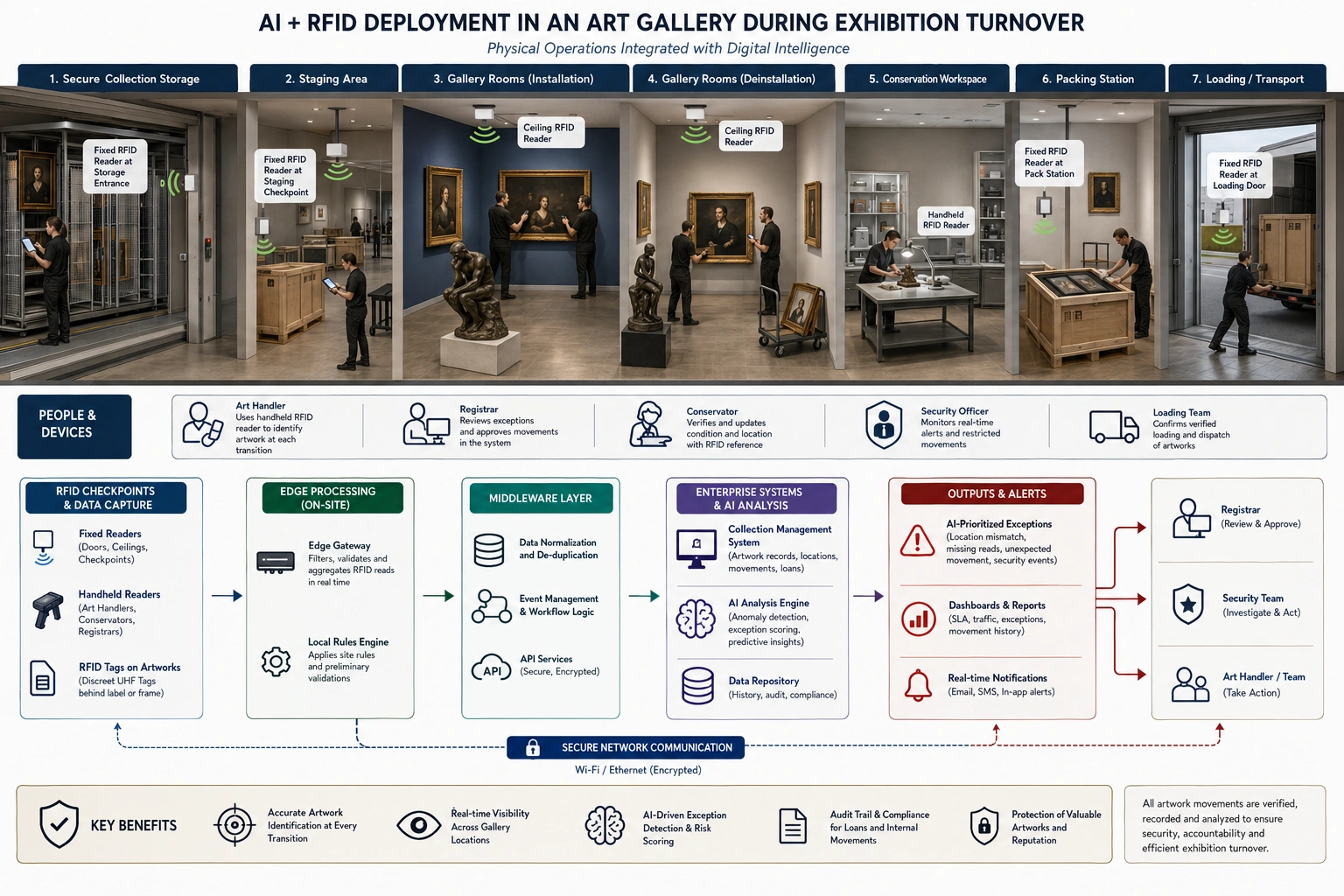
Key Capabilities and Operational Improvements
The combination of AI-driven decision support and RFID-based identification can improve art gallery operations in several measurable ways.
Higher Confidence in Artwork Location
RFID verification provides repeatable observations, while AI evaluates those observations against expected locations and workflow context. The result is a more targeted approach to investigating discrepancies.
Faster Inventory and Reconciliation Work
Handheld and fixed identification can reduce the amount of manual searching required during collection checks. AI can further reduce workload by separating probable administrative discrepancies from higher-risk exceptions.
Stronger Loan and Transfer Documentation
Movement events can supplement manually maintained chain-of-custody records. When integrated correctly, they provide timestamps and verification points that support loan administration and post-event investigation.
Better Exhibition Turnover Coordination
AI can identify incomplete movement sequences and location mismatches while installation and deinstallation activities are still underway, helping teams correct issues before deadlines become critical.
Improved Security Prioritization
Security personnel can focus on events that conflict with approved movement patterns rather than treating every RFID observation as equally important.
Scalable Collection Operations
A well-designed identification model can extend from a single gallery room to multiple exhibition spaces, collection stores, temporary loan staging areas, or additional locations. Scalability depends on maintaining consistent identifier governance, data definitions, reader configuration, and integration practices.
The next section examines implementation KPIs, performance measurement, operational trade-offs, cybersecurity practices, and practical recommendations for deploying AI-driven RFID systems across art gallery collection workflows.
Measuring Performance and ROI for AI-Driven Art Gallery RFID
An AI-driven RFID deployment should be measured against collection operations rather than generic technology metrics alone. A gallery may achieve high RFID read performance while still failing to improve inventory reconciliation, exhibition turnover, or chain-of-custody control. KPIs should therefore connect technical performance with registrar, collection management, security, and art-handling outcomes.
Relevant KPIs include:
- Artwork inventory reconciliation accuracy.
- Percentage of collection objects verified within the planned audit period.
- Time required to complete a collection inventory.
- Average time required to locate a requested artwork.
- Number of unresolved location discrepancies.
- Percentage of approved artwork movements automatically verified.
- Loan transfer verification completeness.
- Exhibition installation checklist completion rate.
- Deinstallation reconciliation time.
- Number of false security exceptions requiring investigation.
- Mean time to investigate an unexpected movement.
- RFID read reliability at critical verification points.
- Reader and communication availability.
- Duplicate or noisy event rate before normalization.
- Percentage of RFID identifiers correctly associated with authoritative collection records.
- Time required to commission newly tagged collection assets.
- Number of manual data-entry corrections.
- Percentage of high-priority exceptions resolved within the defined response target.
GAO recommends establishing baseline measurements before deployment. For example, if a gallery currently spends several days reconciling an exhibition during deinstallation, the deployment team should measure the existing labor effort, number of discrepancies, search time, and causes of reconciliation delays.
After commissioning, the same measurements can show whether RFID and AI are producing a measurable operational improvement.
Read Accuracy Is Not the Same as Operational Accuracy
One of the most important engineering lessons is that RFID performance should not be evaluated solely through a single read-rate percentage.
Operational accuracy depends on several layers:
- Whether the correct RFID identifier is associated with the correct artwork.
- Whether the reader correctly identifies the object in the intended verification zone.
- Whether duplicate observations are filtered correctly.
- Whether the event is assigned to the correct operational location.
- Whether middleware correctly maps the event to the authoritative collection record.
- Whether AI interprets the event according to current gallery procedures.
- Whether staff can act on the resulting exception without unnecessary investigation.
A technically successful RFID read can still produce an operationally incorrect conclusion if identifier commissioning or integration logic is wrong. Gallery deployments should therefore include end-to-end testing from physical object identification through staff action.
AI Methods That Improve RFID-Based Art Gallery Operations
Different AI methods are appropriate for different art gallery workflows. A reliable solution does not require the most complex model. The most suitable approach depends on the quality of RFID events, availability of historical movement data, operational consistency, and the consequences of incorrect recommendations.
Rules-Based Decision Logic
Rules are effective when gallery procedures are clearly defined.
Examples include:
- Flag an artwork if it crosses a controlled outbound verification point without an approved dispatch record.
- Mark a loan transfer for review if an expected verification checkpoint is missing.
- Notify the collection team if a high-priority object remains outside its assigned location beyond an approved time period.
- Identify an installation discrepancy when an artwork is verified in a gallery different from its scheduled room assignment.
Rules are transparent and easier for registrars and security personnel to validate.
Anomaly Detection
Anomaly detection can identify unusual movement patterns without requiring every possible exception to be predefined.
The system may examine:
- Typical movement sequences.
- Time spent in staging areas.
- Expected room transitions.
- Frequency of movement.
- Historical handling patterns.
- Differences between planned and observed exhibition workflows.
An anomaly score should be treated as decision support rather than conclusive evidence. Gallery staff need visibility into why an event was prioritized.
Classification Models
Classification models can help categorize events such as:
- Expected movement.
- Administrative mismatch.
- Probable inventory discrepancy.
- Incomplete workflow.
- Potential security exception.
- Reader or tag performance issue.
Training data must be carefully governed. A gallery should avoid training a model on historical records that contain unresolved identification errors or undocumented handling practices.
Predictive Analysis
Historical exhibition and collection movement data may support forecasting of:
- Peak staging requirements.
- Expected art-handling workload.
- Inventory verification duration.
- Reader utilization.
- Recurring workflow bottlenecks.
- Likely locations for temporarily staged collection objects.
Predictive models are most useful when gallery operations follow repeatable patterns and historical records are sufficiently complete.
Computer Vision and Multimodal Verification
Computer vision can complement RFID in selected use cases, particularly where visual confirmation is operationally appropriate. RFID provides object identity events, while computer vision may provide additional confirmation of object presence, movement, or visual context.
These technologies should not be assumed to provide identical information. A painting may be visually detected without its RFID identifier being successfully read, while an RFID event may identify an associated object that is outside a camera’s view.
Combining multiple data sources requires carefully defined confidence rules and privacy policies, particularly in public gallery spaces.
Cybersecurity and Data Integrity for Art Collection Tracking
Art collection data can include sensitive information about object locations, ownership, loan schedules, insurance values, security classifications, transport arrangements, and access procedures. Cybersecurity must therefore protect not only the RFID infrastructure but also the operational information connected to it.
A practical security program should address:
Identity and Access Control
Role-based access control should distinguish between collection managers, registrars, conservators, art handlers, security personnel, IT administrators, and external service providers.
A user who can verify an artwork’s location does not necessarily require permission to modify its collection record or access sensitive security information.
Secure Device Management
RFID readers and gateways should be inventoried, authenticated, updated according to controlled procedures, and monitored for configuration changes.
Device credentials should not be shared across all readers. Unique identities and controlled credential management reduce the impact of a compromised device.
Network Segmentation
RFID infrastructure should be separated appropriately from unrelated business systems. Communication between readers, edge systems, middleware, and collection software should follow defined network and firewall rules.
Segmentation can limit the impact of a compromised device or misconfigured endpoint.
Data Integrity and Auditability
The system should distinguish between:
- Raw RFID observations.
- Normalized movement events.
- AI recommendations.
- Human decisions.
- Authoritative collection record changes.
These categories should not overwrite one another without an audit trail. A registrar correcting a location should create a traceable operational action rather than silently changing the historical event record.
API and Integration Security
Collection management software, security systems, digital asset management tools, and AI software may exchange information through APIs or middleware. These interfaces require authentication, authorization, encryption, logging, and controlled error handling.
GAO’s experience supplying RFID and IoT hardware products and systems supports the practical reality that cybersecurity begins with deployment discipline. Secure configuration, controlled commissioning, documented network requirements, and lifecycle maintenance are as important as higher-level security software.
Cybersecurity and Data Integrity for AI-Driven RFID Art Galleries
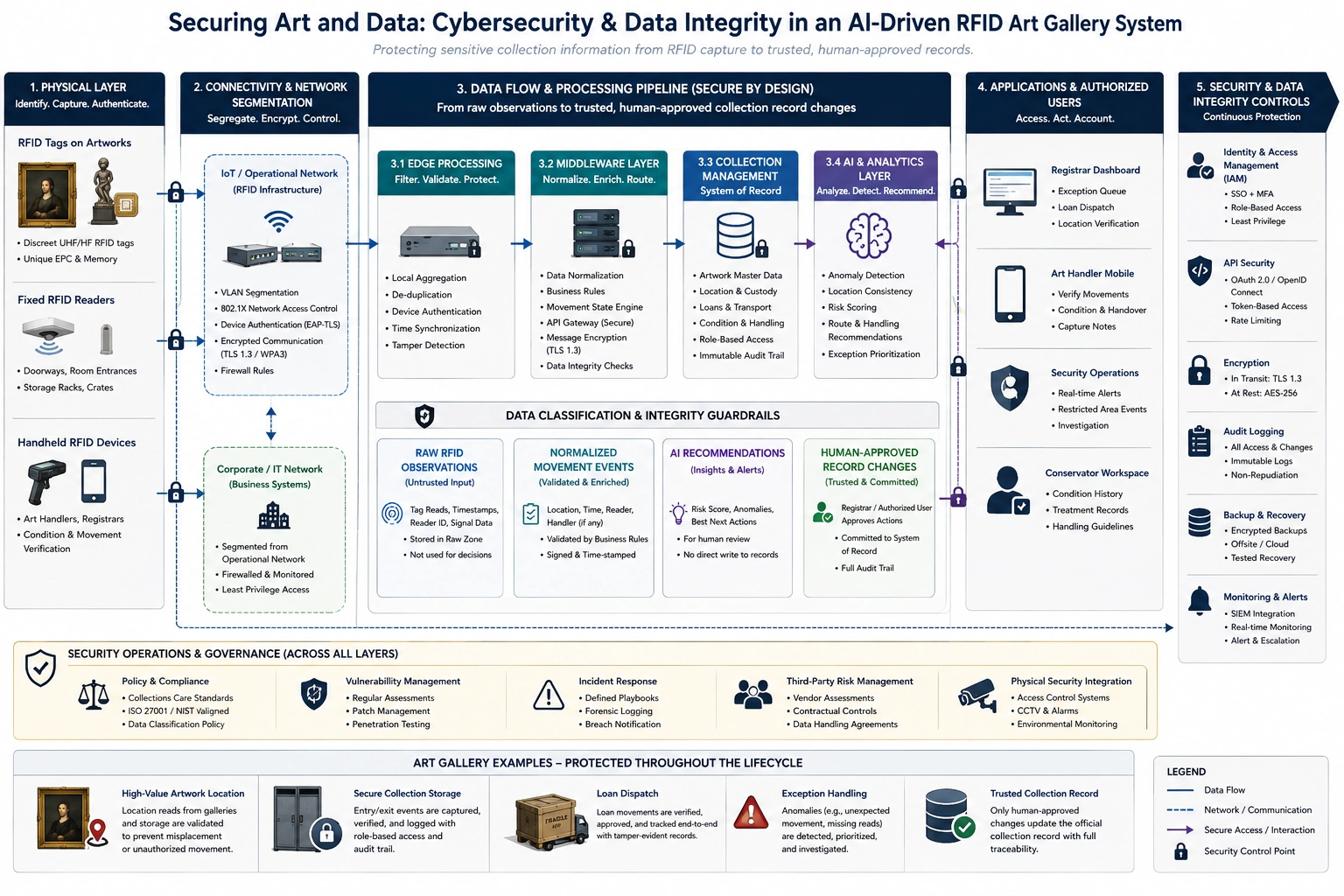
Integration with Art Gallery Software and Operational Systems
AI-driven RFID is most valuable when it contributes to established collection workflows rather than becoming another isolated application.
Integration priorities may include:
- Collection management systems for authoritative object records, accession data, current locations, artist information, ownership, and collection status.
- Digital asset management systems for associated images, documentation, exhibition media, and related digital records.
- Loan management systems for outgoing and incoming loan schedules, lenders, borrowers, transport milestones, and custody requirements.
- Conservation management records for treatment status, examination history, handling restrictions, and movement constraints.
- Security systems for selected event correlation and approved movement procedures.
- Identity and access management systems for staff authorization.
- Business intelligence software for collection operations reporting and KPI analysis.
- Service management systems for reader maintenance, device incidents, and infrastructure support.
Integration should use a clearly defined data model. Every artwork, RFID identifier, zone, reader, movement event, workflow state, and exception category should have an agreed definition.
A common deployment failure occurs when one system treats “location” as a precise room assignment while another treats it as a building or collection area. AI models can produce misleading results if operational data uses inconsistent definitions.
Event Normalization for Reliable AI Analysis
A normalized event might contain:
- Object identifier.
- RFID identifier.
- Event timestamp.
- Reader identifier.
- Verification zone.
- Event confidence.
- Associated workflow.
- Current expected location.
- Observed location.
- Custody state where applicable.
- AI risk or exception score.
- Human review status.
Consistent event definitions improve interoperability and make historical analysis more reliable.
Implementation Roadmap for AI-Driven RFID in Art Galleries
A phased deployment generally reduces operational and collection risk. The first implementation should focus on workflows where improved verification produces measurable value.
Discovery and Collection Workflow Assessment
The project team documents:
- Artwork movement processes.
- Collection storage layouts.
- Exhibition preparation workflows.
- Loan and transport procedures.
- Existing inventory methods.
- Collection management software.
- Security requirements.
- Conservation restrictions.
- IT and network constraints.
This stage should identify the highest-value verification points before selecting reader locations.
RFID Site Survey and Representative Testing
Representative objects should be tested rather than relying exclusively on laboratory specifications.
Testing may include:
- Framed paintings.
- Sculptures.
- Works in protective housings.
- Transport crates.
- Reusable packing assets.
- Dense collection storage.
- Doorway and corridor verification points.
- Exhibition spaces with architectural constraints.
The team should evaluate tag association procedures, read consistency, interference, antenna positioning, and the effect of normal staff movement.
Pilot Deployment
A pilot may focus on one of the following:
- A high-value collection storage area.
- An exhibition turnover workflow.
- Incoming and outgoing loan verification.
- Targeted inventory reconciliation.
- Transport crate and packing asset tracking.
The pilot should include technical testing and real operational activity. A demonstration involving only stationary tagged objects is not sufficient to validate a production workflow.
Software Integration and AI Validation
Before broader deployment, the project team should test:
- Collection record integration.
- Event normalization.
- Reader failure handling.
- Duplicate event filtering.
- Network interruption recovery.
- AI recommendation logic.
- False-positive rates.
- Exception escalation.
- User permissions.
- Audit trail generation.
AI models should be evaluated against known operational scenarios before their recommendations influence high-priority workflows.
Staff Training and Standard Operating Procedures
Technology changes should be reflected in operational procedures.
Registrars, art handlers, conservators, security teams, and IT personnel may each require different training covering:
- RFID verification procedures.
- Exception interpretation.
- Handheld reader use.
- Tag and identifier association.
- Approved manual overrides.
- Reader failure reporting.
- Security escalation.
- Data correction procedures.
Scale-Up and Continuous Optimization
After successful commissioning, additional galleries, collection stores, or workflows can be added gradually.
Configuration standards should remain consistent as the deployment expands. Reader naming, zone definitions, object status codes, exception categories, and integration mappings should be governed centrally to prevent operational fragmentation.
Practical Engineering Trade-Offs and Implementation Lessons
AI-driven RFID deployment in art galleries requires practical compromises. The objective is not to maximize the number of readers or collect the largest possible volume of events. The objective is to create reliable verification at points where better information changes an operational decision.
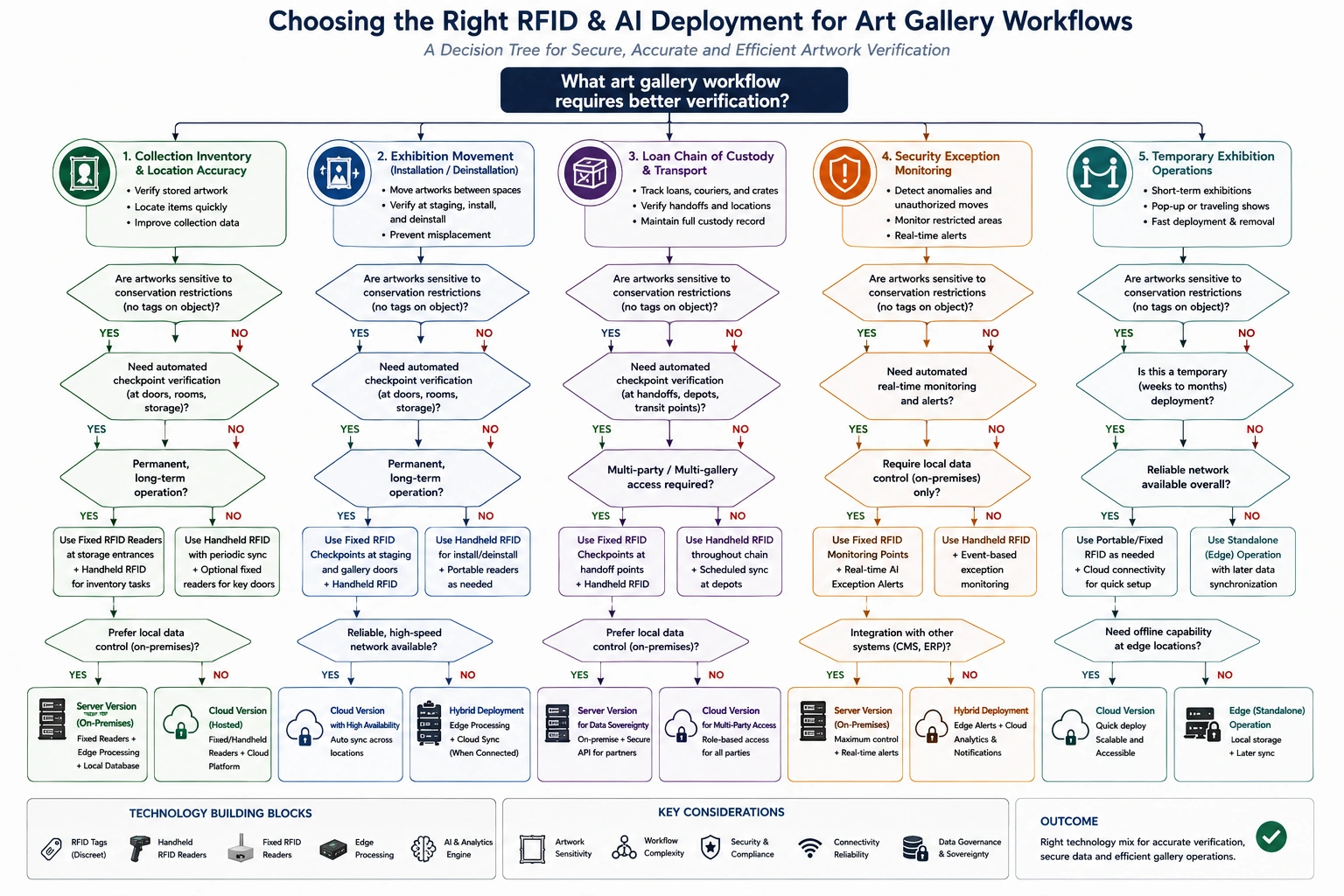
Fixed Readers Versus Handheld RFID
Fixed readers provide automated observations at defined locations. They are useful for controlled transitions and repeatable workflows.
Handheld readers provide flexibility for collection inventories, targeted searches, temporary exhibitions, and environments where permanent installation is not justified.
Many galleries may benefit from a hybrid approach.
Broad Coverage Versus Controlled Verification
Continuous coverage can appear attractive but may increase installation complexity and ambiguous read zones. Controlled checkpoints often provide more meaningful operational events.
A reader positioned at a verified storage exit may be more useful than several readers attempting to determine the precise position of every artwork continuously.
AI Automation Versus Human Authority
AI can prioritize, classify, and recommend. Collection professionals should retain authority over sensitive decisions involving artwork location, custody, conservation handling, and security escalation.
Systems should provide explainable information, including the RFID observations and operational conditions that contributed to an AI recommendation.
Centralization Versus Local Resilience
Cloud-hosted software can simplify multi-location access and centralized management. Privately hosted Server Version deployments can provide greater direct control and local integration options.
A hybrid approach may use local edge processing to maintain critical verification functions while synchronizing selected data with centralized software.
Tag Visibility Versus Conservation Requirements
The technically easiest tag location may not be acceptable for an artwork. Conservation policy and object characteristics take priority over identification convenience.
A successful design may use a non-invasive association method, controlled proximity verification, or tagging of approved secondary handling components where direct tagging is unsuitable.
RFID & AI Deployment Decision Tree for Art Gallery Workflows
Business Value of AI-Driven RFID for Art Galleries
The strongest business value comes from reducing uncertainty in collection operations.
For registrars, the system can reduce time spent reconciling movement records and searching for objects whose recorded and observed locations do not match.
For collection managers, it can improve inventory visibility and support more reliable evidence when evaluating collection movement.
For art handlers and preparators, it can provide clearer verification during installation, deinstallation, staging, and packing.
For security teams, AI-driven prioritization can help distinguish approved operational activity from events requiring investigation.
For gallery leadership, improved operational data can support planning, staffing, technology investment, insurance discussions, and process improvement.
Scalability also matters. A carefully governed identification and data model can support additional collection locations, traveling exhibitions, loan workflows, temporary galleries, and new categories of operational assets without rebuilding the entire system.
GAO has spent three decades serving customers across the U.S. and Canada, including Fortune 500 companies, leading R&D organizations, prestigious universities, and U.S. and Canadian government agencies. This experience, combined with sustained R&D investment, stringent quality assurance, and remote or onsite technical support, helps organizations evaluate RFID and related IoT systems against practical deployment requirements rather than product specifications alone.
Implementation Recommendations for Art Gallery RFID Projects
Organizations evaluating AI and RFID for art galleries should begin with the operational problem rather than the hardware.
Recommended priorities include:
- Select a workflow where better identification and verification can produce measurable value.
- Establish the authoritative source for artwork identity and location data.
- Define clear rules for RFID identifier association and commissioning.
- Test representative artworks, frames, crates, and gallery environments before large-scale procurement.
- Design read zones around meaningful custody or workflow transitions.
- Normalize raw RFID observations before applying AI analysis.
- Start with transparent rules and measurable anomaly detection before introducing more complex machine learning.
- Maintain human approval for sensitive collection and security decisions.
- Integrate with existing collection, loan, conservation, and security workflows where technically appropriate.
- Measure inventory effort, discrepancy resolution, search time, and workflow completion before and after deployment.
- Include reader maintenance, software updates, cybersecurity, and staff training in the lifecycle plan.
- Expand only after the pilot demonstrates reliable operational value.
GAO, headquartered across New York City and Toronto, Canada, is recognized among the world’s leading B2B and B2G suppliers of RFID and BLE technologies. Through GAO, organizations can access RFID hardware products, supporting systems, and technical expertise for evaluating identification requirements, reader deployment, integration, and long-term operational support.
Building More Reliable Art Gallery Operations with AI and RFID
AI-driven RFID can help art galleries transform identification events into useful collection decisions. The greatest value comes from connecting artwork verification with real gallery workflows such as inventory reconciliation, exhibition turnover, loan handling, chain of custody, and security exception management.
Successful implementation depends on more than reader selection. Galleries need accurate identifier association, representative RF testing, meaningful verification zones, reliable software integration, secure data handling, and operational procedures that reflect how registrars, art handlers, conservators, and security personnel actually work.
GAO can help organizations evaluate RFID hardware and supporting IoT systems for these requirements, from early testing and deployment planning through scalable implementation and technical support. Readers can explore GAO’s RFID technologies and engineering capabilities to identify a solution aligned with their collection management and artwork tracking objectives.
Building the Future of Industrial AI and IoT with Aperture Venture Studio and GAO
For more than three decades, GAO Group of Companies has invested heavily in R&D involving industrial RFID, BLE, and IoT. As generative AI demonstrated practical value across operational applications, we expanded our work in AI and IoT, including technologies relevant to RFID-based identification, tracking, and decision support for environments such as art galleries and other collection-intensive operations. We founded Aperture Venture Studio to advance AI and IoT solutions across diverse application areas.
Aperture Venture Studio has attracted accomplished AI and IoT technical experts, entrepreneurial and operational executives, influential investors, and leading organizations. We have also developed the Aperture Ventures Summit and TekSummit to encourage discussion of advanced AI and IoT topics and strengthen technical communities.
We welcome you to join us as:
- Advisors, co-founders, or employees.
- Investors.
- Customers.