
AI and RFID for Banks
How AI and RFID Improve Banking Operations
AI and RFID for banks combine AI-driven analytics with UHF RFID, HF RFID, and LF RFID identification to improve how banks track, secure, locate, and manage physical assets and operational records. The approach is particularly valuable for banks managing branch equipment, IT assets, cash-handling support equipment, records, secure storage areas, maintenance inventories, and high-value devices across multiple locations. RFID provides machine-readable identification and location-event data, while AI can correlate those events with asset registers, maintenance histories, access events, work orders, and banking operational data. This enables banks to move from periodic manual inventories toward continuous or event-driven asset visibility. AI can also identify unusual movement, missing equipment, abnormal inventory patterns, and workflow exceptions. For banking operations, the result is better asset accountability, faster reconciliation, stronger physical controls, reduced search time, and more informed decisions across branches, vault-support areas, data centers, offices, and centralized operations.
Why Banks Are Applying AI to RFID-Based Asset Operations
Banking operations depend on accurate control of physical resources even though many critical workflows are primarily digital. Branches, operations centers, records facilities, data centers, ATM support areas, cash-management facilities, and corporate offices still contain large inventories of computers, network equipment, secure devices, storage containers, documents, tools, spare parts, and other controlled assets.
Traditional spreadsheets, barcode scans, manual asset audits, and periodic reconciliation can create gaps between an asset register and the physical environment. A bank may know that a laptop, network appliance, security device, records container, or maintenance component is assigned to a particular location without knowing whether it is physically present, whether it moved without authorization, or whether its current condition matches the recorded status.
RFID addresses the identification and event-capture problem. AI addresses the interpretation and decision-support problem.
A bank can therefore use RFID events as operational evidence rather than treating RFID simply as an inventory-labeling technology. AI models can correlate RFID reads with:
- Branch and facility asset registers
- IT asset management records
- Configuration management databases
- Work orders and maintenance schedules
- Employee or contractor authorization records
- Physical access-control events
- Shipping and receiving records
- Procurement and purchase-order information
- Records-retention systems
- ATM and self-service banking maintenance data
- Data center equipment inventories
- Loss-prevention and security events
The engineering objective is not to attach an RFID tag to every object indiscriminately. Banks should identify workflows where physical visibility has measurable operational value, determine the required read accuracy and location granularity, and then select the RFID frequency, readers, antennas, tags, middleware, and AI processing approach accordingly.
GAO provides RFID, BLE, and other IoT hardware products and systems that can support organizations implementing these types of connected asset workflows. Its experience supplying hardware and systems to organizations helps inform practical considerations such as tag selection, reader placement, environmental
AI and RFID for Banking Operations
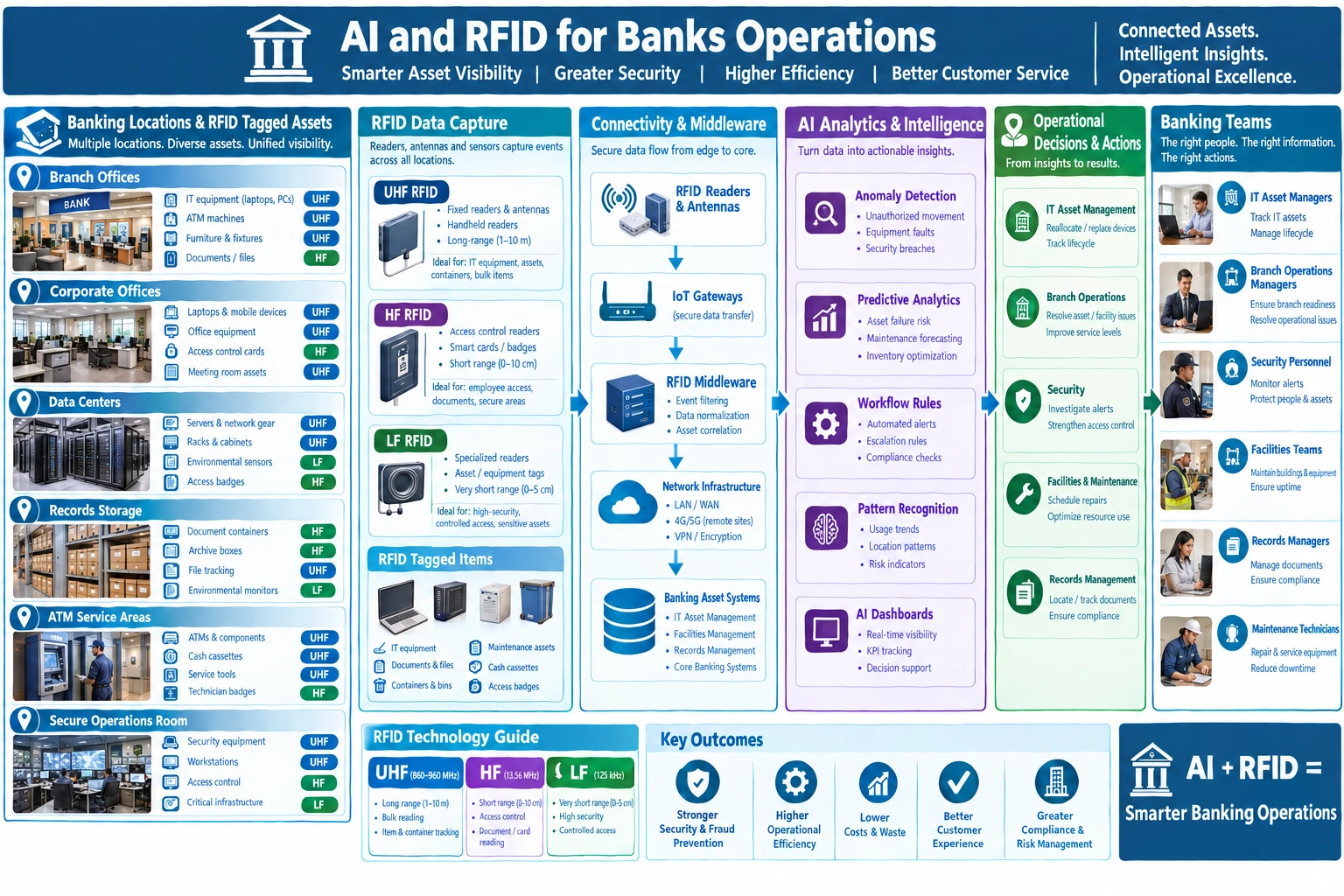 ”
This infographic shows how RFID data from banking assets flows through connectivity, middleware, and AI analytics to improve asset visibility, security, maintenance, compliance, and operational decisions across branches and facilities.
Banking Use Cases for AI-Enabled RFID
AI-enabled RFID is most valuable where banks have large numbers of physical assets, repeated movement events, controlled locations, audit requirements, or costly manual reconciliation.
AI Asset Tracking for Bank IT Equipment
Banks can use RFID to identify laptops, desktop systems, network appliances, servers, switches, access points, backup devices, test equipment, and other technology assets. AI can compare RFID movement events with the bank’s asset records and approved work activities.
This can help identify situations such as an asset appearing in an unexpected branch, equipment moving outside an approved maintenance workflow, or an asset remaining in a staging area longer than expected.
For large banks, the operational value comes from connecting physical asset movement with IT service management and configuration records rather than maintaining RFID information as a separate inventory.
AI Inventory Management for Branches and Banking Facilities
Branches maintain operational supplies, replacement equipment, networking components, security-related equipment, forms, maintenance items, and other physical resources. RFID can reduce manual counting requirements, while AI can analyze consumption and replenishment patterns.
AI models can identify unusually high consumption, slow-moving inventory, recurring stockouts, or branch-level differences that justify investigation.
Relevant outputs can include:
- Replenishment recommendations
- Exception alerts
- Inventory variance detection
- Branch stock comparisons
- Excess inventory identification
- Maintenance-spare forecasting
- Asset redistribution recommendations
AI Records and Document Tracking
Banks retain documents and records subject to retention schedules, legal holds, regulatory requirements, internal controls, and information-governance procedures. RFID can identify tagged boxes, folders, containers, archive media, or other physical records units.
AI can analyze movement histories and reconciliation results to identify misplaced containers, unexpected movement, incomplete returns, or unusual handling patterns.
A practical implementation should maintain clear separation between RFID identifiers and sensitive document contents. The RFID event should normally indicate that a controlled physical object was observed, not expose confidential banking information through the RFID layer.
AI Data Center Asset Management
Bank data centers contain servers, network switches, storage equipment, power-distribution components, racks, removable devices, spare parts, and maintenance equipment. RFID can provide physical identification at receiving, staging, rack, maintenance, and decommissioning points.
AI can correlate these events with configuration management databases, change-management records, maintenance work orders, and equipment lifecycle information.
This enables a bank to detect discrepancies between the recorded configuration and the observed physical environment.
AI ATM and Self-Service Equipment Operations
ATM networks create distributed physical asset-management requirements. Banks and ATM service organizations may need to track replacement modules, tools, maintenance kits, components, diagnostic equipment, and other service assets.
RFID can capture movement through receiving, staging, technician dispatch, maintenance, return, and storage workflows. AI can then analyze service cycles, inventory availability, recurring component requirements, and unusual asset movements.
This can support better technician preparation and reduce time spent locating service equipment.
AI Security and Controlled Asset Monitoring
Banks require strong physical controls around selected equipment and assets. RFID can provide identification events at controlled doors, cabinets, storage areas, staging locations, and designated checkpoints.
AI can evaluate movement against authorization and operational context. A single RFID read should not automatically be treated as a security incident. More reliable detection comes from combining RFID observations with access-control events, schedules, work orders, employee authorization, and known asset assignments.
This multi-source approach can reduce false positives while improving investigation quality.
AI Banking RFID Use-Case Matrix
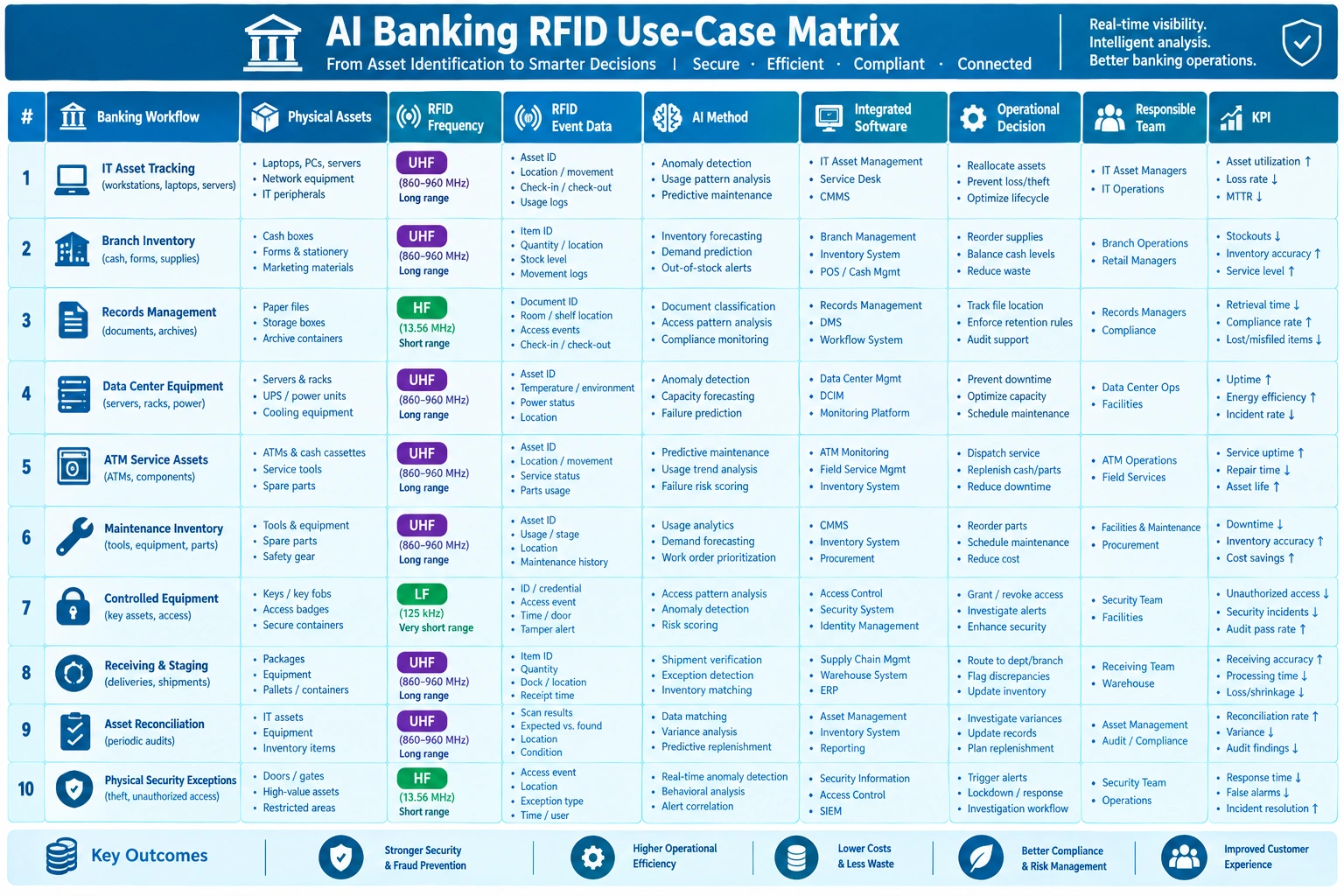
This matrix compares key banking workflows, RFID event data, AI methods, integrated systems, operational decisions, responsible teams, and measurable KPIs.
Where Banks Gain the Most Operational Value
The strongest deployments generally occur where physical asset uncertainty creates measurable cost, compliance exposure, service delays, or security risk.
| Banking operational area | RFID contribution | AI contribution | Example outcome |
|---|---|---|---|
| IT asset management | Physical identification and movement events | Exception detection and reconciliation | Faster asset audits |
| Branch operations | Inventory and equipment visibility | Demand and variance analysis | Better replenishment |
| Records management | Container and archive tracking | Movement anomaly detection | Improved records accountability |
| Data centers | Equipment identification | Configuration discrepancy analysis | Better physical-to-record accuracy |
| ATM support | Component and service-asset tracking | Service demand analysis | Improved technician readiness |
| Maintenance | Tool and spare-part visibility | Consumption and failure-pattern analysis | Reduced search and stockout time |
| Security operations | Controlled asset movement events | Contextual anomaly scoring | Better investigation prioritization |
| Receiving and staging | Arrival and movement capture | Dwell-time and workflow analysis | Reduced staging delays |
The business case should be based on measurable banking workflows rather than RFID tag counts. Useful measurements include inventory reconciliation time, asset search time, unexplained inventory variance, maintenance response time, stockout frequency, asset utilization, unauthorized movement exceptions, records retrieval time, and percentage of assets with verified physical location.
AI-Driven Banking Asset Reconciliation
Physical reconciliation is one of the most practical areas for AI and RFID in banks.
A conventional audit may require staff to scan or inspect assets individually and compare results against an asset register. RFID can automate portions of the physical observation process. AI can then classify discrepancies according to operational context.
For example, a bank may receive an RFID event showing that a tagged network device moved from a secure staging room into a branch equipment area. If the bank’s change-management system contains an approved deployment work order, the movement may be normal. If no corresponding authorization exists, the same movement may warrant investigation.
This contextual approach is important because physical movement is not inherently abnormal.
AI models can therefore classify events using factors such as:
- Asset identity
- Expected location
- Previous movement history
- Employee or technician authorization
- Work-order status
- Scheduled maintenance
- Branch assignment
- Shipment status
- Access-control events
- Time and date
- Historical movement patterns
The output can be an operational exception rather than a raw RFID alarm.
GAO’s RFID and IoT hardware systems can form part of the physical data-acquisition layer used by banks, while enterprise software and AI services can provide the higher-level reconciliation, analytics, and workflow functions.
Banking Deployment Scenarios for UHF, HF, and LF RFID
RFID frequency selection should follow the physical banking workflow rather than being determined by a generic preference for one frequency.
UHF RFID for High-Volume Bank Asset Visibility
UHF RFID is generally suited to workflows requiring longer read distances and relatively fast identification of multiple tagged objects. Banks can consider UHF RFID for IT asset inventories, equipment rooms, storage areas, receiving docks, records containers, maintenance inventories, and other locations where multiple assets need to be identified efficiently.
Read performance depends strongly on tag design, reader power, antenna orientation, mounting surfaces, metal content, nearby electronics, and the physical layout of the banking facility.
HF RFID for Short-Range Banking Identification
HF RFID can be appropriate for controlled near-field interactions such as document identification, item authentication, workstation interactions, access-related workflows, and other applications where short-range reading is desirable.
The shorter operating range can be advantageous when the banking process requires deliberate item presentation rather than broad-area detection.
LF RFID for Specialized Banking Identification
LF RFID can be considered for specialized short-range identification applications where its operating characteristics match the physical environment and reader requirements. Banks should evaluate read distance, tag availability, interference conditions, integration requirements, and security objectives before selecting LF RFID.
The frequency decision should therefore be based on the required read zone, asset material, tag mounting location, identification density, workflow speed, and desired event granularity.
AI and RFID Banking System Design
A practical bank deployment should treat RFID as one data source within a broader operational solution. The physical layer normally includes RFID tags, fixed readers, antennas, handheld readers, printers, gateways, and supporting network equipment. The software layer receives RFID observations, filters duplicate reads, associates events with asset identities, and forwards validated information to banking systems.
AI can operate above this event-processing layer to identify patterns and exceptions.
A typical banking deployment may contain:
- RFID tags selected according to asset material and attachment method
- Fixed RFID readers at controlled checkpoints
- Handheld readers for inventory audits and maintenance teams
- Antennas designed for specific read zones
- Edge gateways for local processing and protocol conversion
- Secure Ethernet, Wi-Fi, cellular, or other approved connectivity
- RFID middleware for filtering and event normalization
- Asset management and configuration management software
- Facilities and maintenance management software
- Records-management systems
- Identity and access-management systems
- Security information and event monitoring
- AI services for classification, anomaly detection, forecasting, and prioritization
- Dashboards and workflow interfaces for banking operations teams
The system should also account for read-zone engineering. Metal cabinets, server racks, liquid-filled materials, dense shelving, electromagnetic interference, and poorly positioned antennas can influence RFID performance. Banks should therefore conduct a site survey and proof-of-concept before committing to a large deployment.
Cloud and Server Deployment Models for Banks
Cloud Version
A cloud-hosted deployment can centralize RFID events and AI processing across geographically distributed branches and facilities. This model can be appropriate for banks seeking centralized analytics, multi-location dashboards, scalable processing, and integration with cloud-based enterprise software.
Security controls should include strong identity management, encryption in transit and at rest, network segmentation, logging, privileged-access controls, data-retention policies, and appropriate governance for operational data.
Server Version
A server deployment places the software on customer-managed infrastructure such as edge servers, private data centers, bank-operated facilities, or other privately hosted enterprise servers. This can be appropriate where banks require tighter control over data processing, network boundaries, integration with legacy systems, or local operation during WAN interruptions.
A hybrid model can also be practical. RFID events can be processed locally for immediate operational decisions while selected normalized data is transferred to centralized AI services and enterprise reporting systems.
The correct choice depends on the bank’s cybersecurity policies, data-governance requirements, latency requirements, existing IT environment, connectivity model, integration constraints, and operational support capabilities.
Integration with Core Banking Support Systems
RFID should not operate as an isolated inventory database. The greatest operational value comes when physical observations are correlated with systems already used by banking teams.
Common integration targets include:
- IT asset management systems
- Configuration management databases
- Enterprise resource planning software
- Computerized maintenance management systems
- Facilities management software
- Records-management systems
- Warehouse and inventory software
- Procurement systems
- Identity and access-management systems
- Physical access-control systems
- Security monitoring systems
- Service desk and work-order software
- Data center infrastructure management software
Integration should use controlled interfaces and clearly defined asset identifiers. A common failure mode is allowing multiple systems to maintain different versions of an asset’s identity, ownership, location, or lifecycle state.
A robust implementation establishes a master asset identifier and defines which system owns each critical attribute. RFID then supplies physical observation events that can be reconciled against those authoritative records.
AI Models for Banking RFID Events
AI methods should be selected according to the banking problem being solved.
- Anomaly detection can identify unusual asset movement or inventory behavior.
- Classification models can categorize normal and exceptional RFID events.
- Time-series models can forecast branch inventory consumption or maintenance demand.
- Clustering can identify similar movement and utilization patterns across banking locations.
- Predictive models can support maintenance and replenishment planning.
- Computer vision can complement RFID where visual confirmation is required.
- Edge AI can support low-latency decisions close to RFID readers.
- Generative AI can help summarize asset exceptions, maintenance histories, or reconciliation results for authorized personnel.
AI outputs should remain explainable enough for banking operations teams to understand why an asset event was flagged and what underlying evidence supports the recommendation.
Engineering Considerations Before Bank-Wide Deployment
Banks should begin with a controlled workflow rather than attempting to RFID-enable every physical asset simultaneously.
Important engineering questions include:
- Which banking assets create the highest reconciliation cost?
- Which physical movements need reliable event capture?
- Is the requirement item-level identification, zone presence, or checkpoint confirmation?
- Which assets contain metal, liquids, or other materials that affect tag performance?
- What read distance is actually required?
- Where can readers and antennas be installed without disrupting branch operations?
- Which banking systems contain the authoritative asset record?
- What network connectivity is available at each location?
- Which RFID events require local processing?
- Which events should generate alerts?
- What constitutes a genuine operational exception?
- How will tags be replaced when assets are repaired or reassigned?
- How will readers be tested and recalibrated after branch modifications?
- How will cybersecurity teams monitor the connected RFID infrastructure?
Implementing AI-Enabled RFID Across Bank Operations
Successful deployment requires more than installing RFID readers. Banks should treat implementation as an operational transformation involving asset governance, facility engineering, IT integration, cybersecurity, user workflows, and ongoing performance management.
Planning and Asset Selection
The first step is to identify banking workflows where physical visibility produces measurable value. Candidate assets can include laptops, network equipment, servers, maintenance tools, ATM components, records containers, spare parts, and other controlled equipment.
Asset selection should consider:
- Asset value and replacement cost
- Movement frequency
- Current inventory accuracy
- Audit frequency
- Security sensitivity
- Maintenance requirements
- Location changes
- Tag attachment constraints
- Required read range
- Expected RFID read density
Not every banking asset requires RFID. High-value or frequently moved assets generally provide a stronger business case than inexpensive consumables.
RFID Site Survey and Read-Zone Engineering
A site survey should precede fixed-reader installation. Banking environments can contain metal cabinets, server racks, secure doors, glass partitions, electrical equipment, dense shelving, and other materials that affect radio-frequency performance.
Engineers should test:
- Tag orientation
- Reader-to-tag distance
- Antenna placement
- Reader power settings
- Read-zone boundaries
- Adjacent-reader interference
- Metal and liquid effects
- Human movement through read zones
- Tag mounting surfaces
- Network availability
- Environmental conditions
The objective is controlled identification rather than maximum possible read distance. An overly large read zone can create false movement events when assets are physically close to a doorway or adjacent room.
Commissioning and Acceptance Testing
Commissioning should verify both physical RFID performance and software behavior.
A bank can establish acceptance criteria for:
- Read accuracy
- Missed-read rate
- False-read rate
- Duplicate-event filtering
- Asset-to-tag association
- Reader availability
- Event transmission latency
- Network resilience
- Alert generation
- Enterprise-system synchronization
- Audit reporting
Testing should use representative banking assets rather than laboratory test objects alone. A UHF RFID tag that performs well on cardboard may behave differently when attached to a metal network switch, laptop docking station, server chassis, or equipment case.
Cybersecurity and Data Governance for Banking RFID
RFID deployments should be incorporated into the bank’s existing cybersecurity and IT governance processes. Readers, gateways, management servers, APIs, wireless connections, and administrative interfaces become components of the bank’s connected technology environment.
Security controls can include:
- Network segmentation for RFID infrastructure
- Role-based administrative access
- Strong authentication
- Encryption for data transmission
- Secure device configuration
- Firmware and software patch management
- Centralized logging
- Security event monitoring
- Credential rotation
- Least-privilege access
- Configuration baselines
- Asset inventory for RFID equipment
- Backup and recovery procedures
- Vulnerability management
- Incident-response procedures
RFID identifiers should also be governed appropriately. A tag identifier should not unnecessarily contain confidential customer information, account information, personally identifiable information, or transaction details.
For banking environments, the preferred design is generally to use RFID identifiers as references to controlled asset records while keeping sensitive information within authorized banking systems.
AI introduces additional governance considerations. Banks should control which operational data can be submitted to AI services, define retention requirements, validate model outputs, and restrict AI-generated recommendations to authorized workflows.
Operational Improvements from AI and RFID for Banks
The combination of physical event capture and AI analysis can improve several measurable banking processes.
Faster Asset Audits
RFID can allow staff to identify multiple tagged assets without manually scanning individual barcodes. AI can then compare observed assets with expected inventories and highlight exceptions.
The improvement is particularly useful for large branch networks, technology inventories, data centers, and centralized records facilities.
Reduced Asset Search Time
AI can use historical RFID observations to provide the most recently observed location or movement path for a tagged asset.
This does not necessarily mean the system provides centimeter-level real-time location. Unless the deployment includes an appropriate real-time location solution, the result may instead represent the last reliable checkpoint or zone observation.
That distinction is important when establishing operational expectations.
Better Maintenance Preparation
Maintenance teams can use RFID to verify that required tools, replacement components, and equipment are available before dispatch.
AI can analyze historical maintenance activities to identify frequently required components and improve preparation for recurring service work.
For ATM and banking infrastructure maintenance, this can reduce technician delays caused by missing equipment or unavailable replacement parts.
Improved Inventory Accuracy
AI can compare physical RFID observations with expected inventory and identify recurring variances.
A branch repeatedly reporting missing equipment, for example, may have a process problem rather than an isolated inventory discrepancy. AI can identify the pattern and prioritize investigation.
More Effective Security Investigation
RFID events can provide additional physical evidence when combined with access-control logs, work orders, shipment records, and employee authorization.
AI can correlate those signals and prioritize unusual events for investigation instead of generating an alert for every physical movement.
Banking KPIs for AI-Enabled RFID
Banks should establish measurable KPIs before deployment.
| KPI | What it measures | Why it matters |
|---|---|---|
| Inventory accuracy | Agreement between physical and recorded assets | Measures reconciliation quality |
| Audit cycle time | Time required to complete an inventory audit | Measures labor efficiency |
| Asset search time | Time required to locate an asset | Measures operational visibility |
| Unresolved variance rate | Inventory discrepancies remaining unresolved | Indicates control effectiveness |
| Read accuracy | Correct RFID observations versus expected observations | Measures RFID performance |
| False-read rate | Observations outside the intended read zone | Indicates read-zone quality |
| Asset utilization | Frequency and duration of asset use | Supports lifecycle planning |
| Maintenance response time | Time from service request to technician action | Measures service efficiency |
| Spare-part availability | Required components available when needed | Supports maintenance readiness |
| Unauthorized movement exceptions | Physical movements inconsistent with authorization | Supports security monitoring |
| Records retrieval time | Time required to locate physical records | Measures records workflow efficiency |
| Branch inventory turnover | Rate of equipment or supply movement | Supports replenishment planning |
KPIs should be measured against a baseline. Without pre-deployment measurements, a bank may find it difficult to determine whether the RFID and AI investment actually improved the targeted workflow.
Scaling AI and RFID Across Bank Branches and Facilities
Scaling requires standardization without assuming that every banking facility has identical physical conditions.
A branch may have a small equipment room and limited inventory, while a data center may contain thousands of tagged assets and tightly controlled access zones. A records facility may prioritize container-level tracking, while an ATM service center may emphasize parts and technician workflows.
A scalable approach should standardize:
- Asset identification conventions
- Tag naming and association procedures
- RFID event formats
- Reader configuration standards
- Cybersecurity controls
- API and integration methods
- KPI definitions
- Exception categories
- Maintenance procedures
- User roles
- Testing procedures
Local configuration can then account for facility-specific conditions.
GAO’s experience supplying RFID, BLE, and IoT hardware products and systems can support organizations that require different reader, tag, gateway, and deployment configurations across multiple operating environments.
Practical Implementation Recommendations for Banks
A technically sound implementation should begin with the business workflow and work backward toward the technology selection.
Recommended practices include:
- Select a high-value banking workflow with measurable operational pain.
- Establish baseline KPIs before installing RFID infrastructure.
- Test UHF, HF, or LF tags against the actual banking assets being tracked.
- Conduct a physical site survey before fixed-reader installation.
- Define read zones to prevent unintended asset observations.
- Establish a single authoritative asset identifier.
- Integrate RFID events with existing asset and maintenance systems.
- Use AI to interpret events rather than simply generating additional alerts.
- Keep sensitive customer and transaction information outside the RFID identifier layer.
- Apply banking cybersecurity controls to readers, gateways, servers, APIs, and management interfaces.
- Test failure conditions such as network interruption, reader downtime, duplicate events, and missing tags.
- Train branch, IT, facilities, records, security, and maintenance personnel according to their workflows.
- Monitor read performance after facility changes or equipment relocation.
- Scale only after the initial deployment demonstrates measurable operational improvement.
The strongest implementations generally treat RFID as an operational data-acquisition mechanism and AI as a decision-support layer. This separation makes the system easier to test, troubleshoot, govern, and expand.
GAO Expertise for Banking RFID and AI Solutions
GAO is headquartered in New York City and Toronto, Canada, and is ranked among the top 10 leading B2B and B2G RFID and BLE suppliers globally. GAO, GAO Research Inc., and GAO Tek Inc. form the GAO Group, with operations based in New York City and Toronto. Over three decades, the companies have served organizations across the United States and Canada, including Fortune 500 companies, leading R&D organizations, universities, and government agencies.
That experience is relevant to banking deployments where hardware selection, integration, quality assurance, and technical support must be considered together. GAO has invested heavily in R&D and maintains stringent quality-assurance processes while providing remote and onsite expert support.
Key Takeaways for AI and RFID in Banks
AI and RFID can give banks a more reliable connection between physical assets and the digital records used to manage them. RFID supplies identification and movement observations, while AI helps determine whether those observations represent normal operations, inventory discrepancies, maintenance requirements, or potential exceptions.
The most practical applications include AI asset tracking, branch inventory management, records tracking, data center equipment reconciliation, ATM service inventory, maintenance management, and controlled asset monitoring.
Successful deployment depends on accurate tag selection, read-zone engineering, system integration, cybersecurity, measurable KPIs, and disciplined commissioning. Banks should begin with a defined operational problem, validate the solution in a representative environment, and expand after demonstrating measurable results.
Readers evaluating banking asset-management, RFID, BLE, and IoT requirements can learn more about GAO’s hardware products, systems, engineering capabilities, and technical support for connected operational solutions.
Building the Future of Industrial AI and IoT with Aperture Venture Studio and GAO RFID Inc.
For more than three decades, GAO Group of Companies has invested heavily in R&D covering industrial RFID, BLE, and IoT. As AI became increasingly useful in operational applications, we expanded our work across AI and IoT, including RFID and BLE, and founded Aperture Venture Studio to support AI and IoT solutions relevant to areas such as banking asset management, secure physical operations, and connected enterprise workflows.
Aperture has attracted AI and IoT technical experts, entrepreneurial and operational executives, investors, and leading companies. We have also developed Aperture Ventures Summit and TekSummit to discuss advanced AI and IoT topics and foster technical communities.
We welcome you to join us as:
- Advisors, co-founders, or employees
- Investors
- Customers