
AI and RFID for Battery Manufacturing
AI-Driven Battery Manufacturing Traceability and Production Control
AI and RFID for battery manufacturing combine machine learning, computer vision, industrial IoT, connected production equipment, and automated identification to improve how battery materials, cells, modules, packs, tools, and production records are tracked and controlled. The practical objective is not simply to identify an asset. It is to connect physical production events with manufacturing data so AI systems can detect deviations, predict process risks, optimize work-in-process flow, and support faster operational decisions. In lithium-ion battery manufacturing, this approach can connect electrode materials, coated rolls, slitting and calendaring operations, cell assembly, electrolyte filling, formation, aging, inspection, module assembly, and pack production with traceable digital records. UHF RFID, HF RFID, and LF RFID can provide identification at appropriate process points, while edge computing, manufacturing execution systems, quality systems, and analytics software turn captured events into actionable information. For battery manufacturers, the resulting value includes stronger genealogy, reduced search time, improved WIP visibility, earlier quality intervention, and more controlled production execution.
AI Applications Across Battery Manufacturing Processes
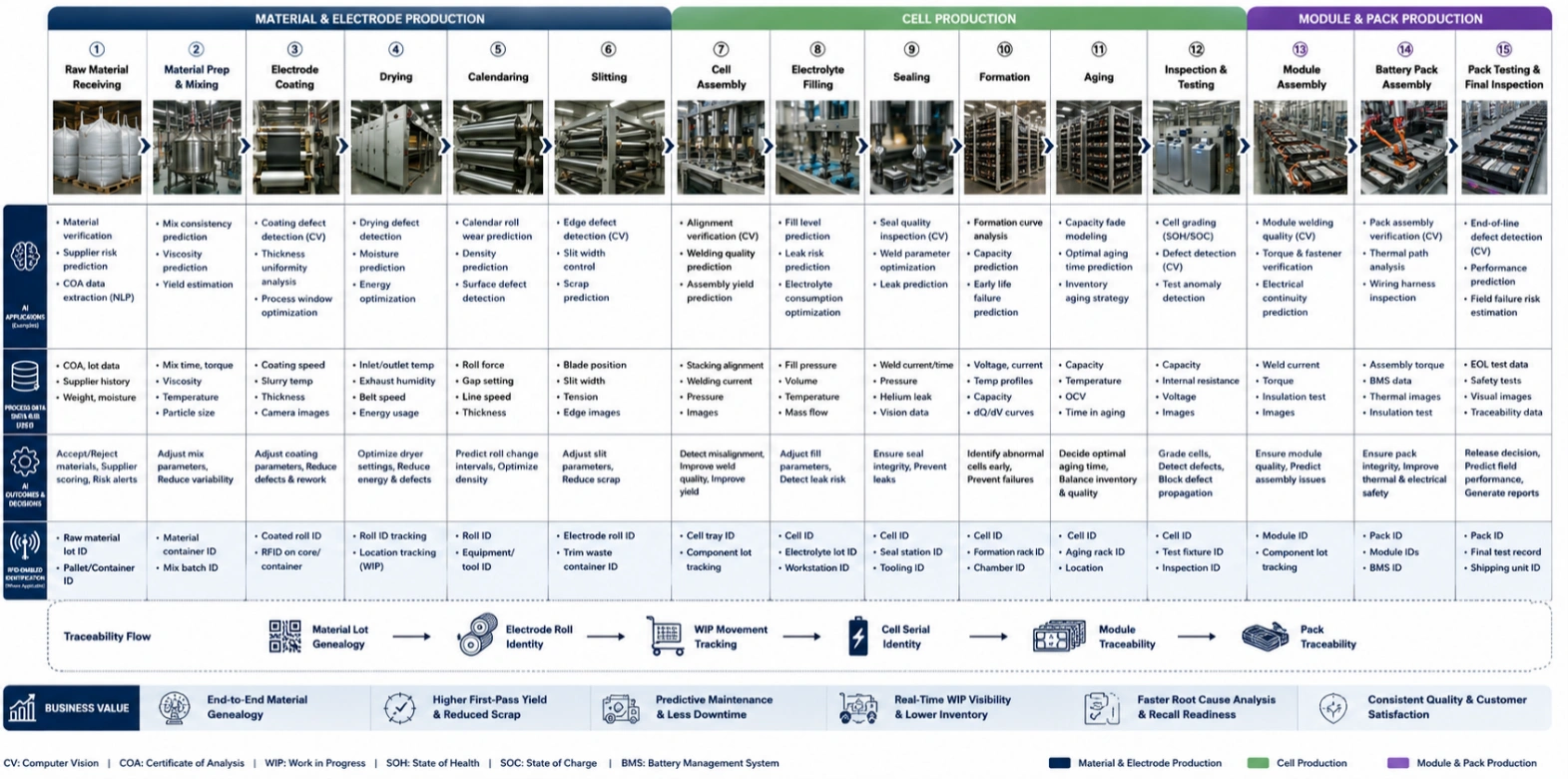
Why AI Matters in Battery Manufacturing
Battery manufacturing produces large volumes of process data from equipment, sensors, inspection systems, laboratory instruments, environmental controls, material handling systems, and manufacturing software. The engineering challenge is rarely a lack of data. It is the ability to associate the right data with the correct material lot, electrode batch, cell, module, pack, tool, process step, and production condition.
AI addresses this problem by identifying relationships that conventional rule-based manufacturing software may not detect efficiently.
For example, a battery manufacturing AI system can correlate:
- Electrode coating parameters with subsequent cell inspection results
- Slurry batch characteristics with electrode quality measurements
- Dry-room humidity excursions with moisture-related process risks
- Calendering conditions with electrode density and downstream performance
- Cell assembly parameters with formation behavior
- Formation and aging curves with early indicators of cell abnormalities
- Inspection images with cell defect classifications
- Production genealogy with recurring quality deviations
- WIP location and process status with bottlenecks
- Tool utilization and maintenance records with process variation
The resulting system can move battery manufacturing from retrospective analysis toward earlier intervention. Rather than waiting for a quality engineer to identify a recurring defect after a large production quantity has been processed, an AI model can flag unusual patterns while production is still underway.
AI is particularly useful when battery manufacturing generates high-dimensional, time-dependent data. Machine learning can analyze process variables and quality outcomes, while computer vision can evaluate electrode surfaces, welds, seals, labels, and assembled components. Edge AI can make rapid decisions close to production equipment, while centralized analytics can evaluate longer-term production trends.
GAO supports organizations with RFID, BLE, and IoT hardware products and systems that can provide the physical data-capture layer required by these applications. GAO
Battery Manufacturing Processes Where AI Creates the Most Value
AI applications should be selected according to the process risk, data availability, decision latency, and financial impact of the manufacturing operation. Battery production contains several areas where automated identification and AI-driven analytics can work together particularly effectively.
Raw Material and Batch Traceability
Cathode active materials, anode materials, conductive additives, binders, solvents, separators, current collectors, electrolyte components, packaging materials, and other production inputs require controlled identification and genealogy.
An RFID-based identification layer can associate containers, drums, totes, pallets, and material handling units with batch records. The manufacturing software can then use those identifiers to associate material movement with receiving, storage, dispensing, mixing, coating, and subsequent production records.
AI can analyze material genealogy against quality outcomes to identify recurring relationships between incoming material characteristics and downstream manufacturing performance.
Electrode Manufacturing and Coating Control
Electrode manufacturing is sensitive to process conditions such as slurry composition, viscosity, coating weight, web tension, drying conditions, line speed, temperature, and humidity. Small process deviations can propagate into downstream cell performance.
A battery manufacturing AI solution can combine equipment data, laboratory measurements, inspection results, and material genealogy to detect process drift.
RFID can provide the identity of the material lot or work-in-process unit associated with a particular manufacturing event. This distinction is important because AI predictions are only useful when the system can reliably associate the observed process data with the correct production unit.
Cell Assembly and Formation
Cell assembly introduces additional traceability requirements involving separators, electrodes, tabs, cans or pouches, electrolyte filling, sealing, welding, and inspection.
Formation and aging generate valuable electrochemical data, including voltage, current, temperature, charge and discharge behavior, capacity-related measurements, and cycle characteristics. AI models can evaluate these records to identify anomalous cells and support predictive quality decisions.
A reliable identifier allows the resulting formation data to remain connected to upstream genealogy and downstream module or pack assembly.
Module and Battery Pack Production
Module and pack production introduces additional material and component relationships, including cells, busbars, cooling components, housings, fasteners, thermal interface materials, battery management system components, connectors, and structural parts.
AI can evaluate production data to identify assembly anomalies, abnormal torque patterns, welding defects, thermal behavior, or recurring component-level problems. Traceability also supports containment when a particular cell lot, component batch, or production condition is later associated with a quality issue.
Maintenance and Production Tool Management
Battery manufacturing depends on specialized equipment such as coating lines, mixing systems, calenders, slitters, winding or stacking machines, electrolyte filling equipment, formation systems, aging racks, inspection stations, laser welding systems, conveyors, automated material handling equipment, and environmental control systems.
AI can use equipment telemetry, maintenance history, alarm data, production counts, and tool identity to estimate failure risk or identify maintenance conditions.
RFID can identify movable tooling, fixtures, carriers, containers, and maintenance assets where conventional barcode scanning is inconvenient or where automatic identification is operationally advantageous.
Battery Manufacturing Operational Challenges AI Can Address
Battery manufacturing creates several interconnected operational problems that become more difficult as production volume, product variants, and regulatory traceability requirements increase.
Fragmented Production Data
A single cell or module may generate records across material handling, laboratory testing, machine controllers, inspection systems, MES software, quality management systems, maintenance software, and formation equipment.
Without reliable identifiers and consistent event timestamps, correlating those records becomes difficult.
AI requires appropriately structured training and inference data. Poor genealogy can therefore become an AI quality problem as much as a manufacturing information problem.
WIP Visibility and Material Location
Battery plants often move large quantities of materials and WIP through controlled production areas. Manual scanning can introduce delays or missed transactions, while fixed identification points can automatically record selected movement events.
The engineering decision depends on the physical environment. Metal structures, RF reflections, liquid-containing materials, process equipment, read-zone geometry, tag mounting location, and required read distance all affect RFID performance.
Quality Containment
When a quality deviation is discovered, production and quality teams need to determine which material lots, cells, modules, packs, equipment conditions, and production windows may be affected.
AI-assisted genealogy analysis can reduce the time required to identify correlations. A well-designed traceability system can support queries such as which cells were produced from a particular electrode lot, which modules contain cells from a selected production window, or which finished products passed through equipment during an identified process excursion.
Process Variation
Battery manufacturing processes are highly sensitive to controlled conditions. Temperature, humidity, pressure, coating characteristics, web handling, electrolyte conditions, welding parameters, and electrochemical behavior can all affect quality.
AI models can establish expected operating patterns and identify statistically unusual behavior. However, model performance depends on representative historical data, accurate labels, stable sensor calibration, and appropriate handling of process changes.
Cybersecurity and Data Integrity
Connecting production equipment, RFID readers, edge computers, MES software, analytics systems, and cloud services increases the number of interfaces that require security controls.
Battery manufacturing systems should therefore apply network segmentation, role-based access control, secure authentication, software patch management, logging, device inventory, encrypted communications where appropriate, and controlled interfaces between operational technology and IT environments.
AI should not be treated as a substitute for these controls. The AI layer depends on trustworthy production data, and compromised or incorrectly attributed data can produce unreliable decisions.
Battery Manufacturing Traceability and AI Decision Workflow
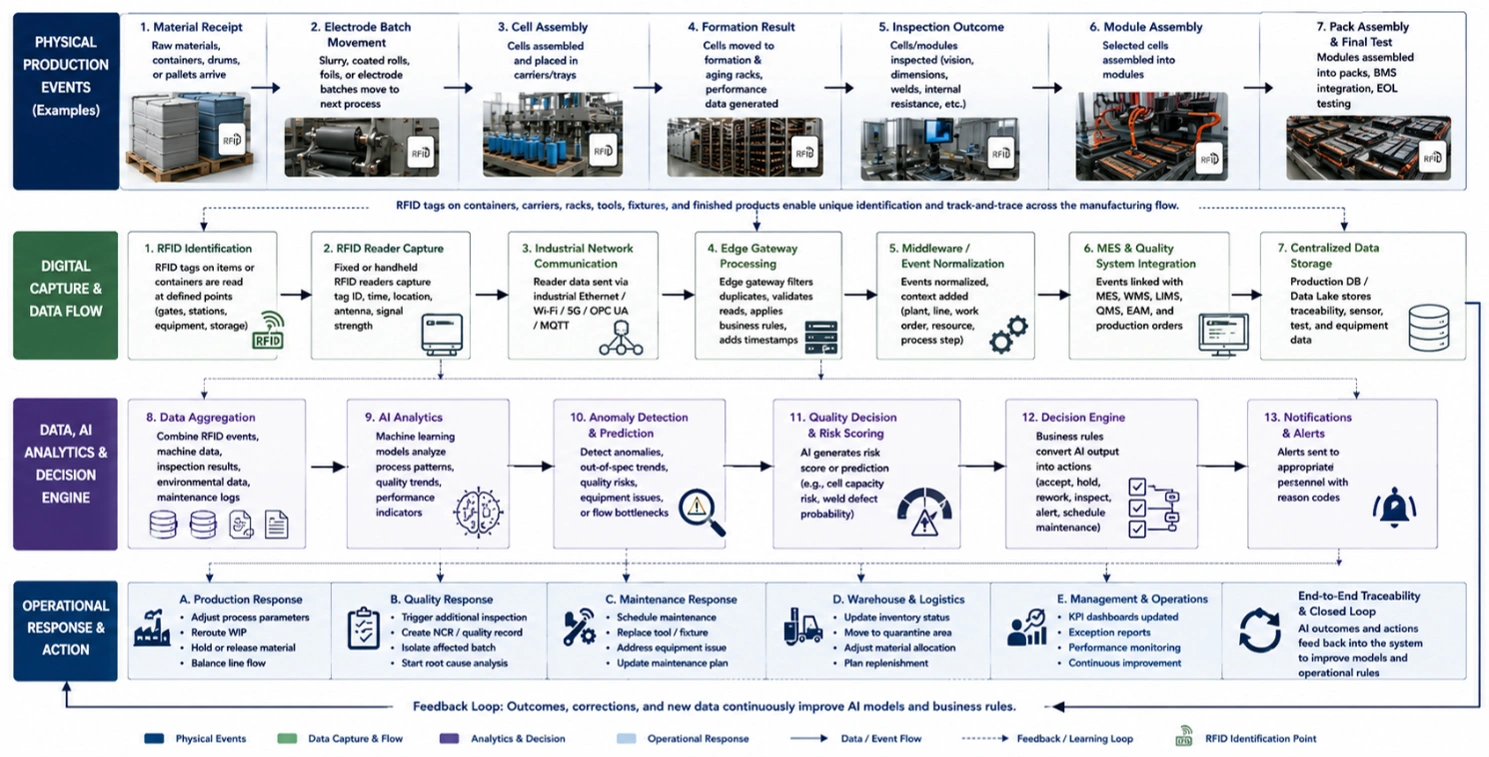
AI and RFID Data Flow in a Battery Manufacturing System
A practical battery manufacturing solution normally begins at the physical process and progressively transforms production events into usable information.
Data Acquisition at the Production Process
Data can originate from RFID readers, machine sensors, programmable logic controllers, SCADA systems, cameras, barcode scanners, laboratory instruments, formation equipment, environmental monitoring systems, and operator terminals.
UHF RFID is often appropriate where longer read ranges and automatic identification of containers, pallets, carriers, WIP units, or assets are needed. HF RFID can be useful for shorter-range controlled identification points, while LF RFID can be appropriate for specific applications where its operating characteristics match the environment.
RFID selection should be based on the actual battery manufacturing process rather than on frequency alone. Read distance, tag size, mounting material, metal exposure, liquid proximity, throughput, antenna positioning, reader density, and required identification reliability should be validated during a site survey and pilot deployment.
Edge Processing and Industrial Communication
An edge computer or industrial gateway can receive identification events and production signals before forwarding normalized information to manufacturing software.
Typical interfaces may include industrial Ethernet, OPC UA, MQTT, REST APIs, database interfaces, and vendor-specific equipment protocols. The correct interface depends on the installed production equipment and the required data exchange model.
Edge processing can also perform filtering, duplicate-event suppression, local validation, buffering during temporary network interruptions, and time synchronization.
Manufacturing Software Integration
RFID events become substantially more valuable when they are connected with MES, warehouse management software, quality management systems, enterprise resource planning software, computerized maintenance management systems, laboratory information systems, and production databases.
For example, an RFID event identifying a carrier at an electrode manufacturing station can become a manufacturing transaction linked to a specific work order, material lot, production line, timestamp, and operator or equipment context.
AI applications can then consume the normalized records together with process and quality data.
AI Analytics and Operational Decisions
AI processing can operate at the edge, on a private server, or through cloud infrastructure depending on latency, data volume, cybersecurity requirements, connectivity, and organizational policy.
Potential AI functions include:
- Anomaly detection for process and equipment behavior
- Predictive maintenance for production machinery
- Computer vision inspection for electrodes, cells, welds, seals, and assemblies
- Quality prediction based on upstream manufacturing parameters
- Production scheduling and WIP optimization
- Material genealogy analysis
- Root-cause analysis assistance
- Energy and utility optimization
- Forecasting of production losses and equipment downtime