
AI and RFID for Beverage Manufacturing
AI-Driven Beverage Manufacturing with RFID-Based Traceability
AI is changing beverage manufacturing by turning production, packaging, warehouse, and logistics data into operational decisions. RFID provides an important data-capture layer by identifying and tracking pallets, cases, kegs, reusable containers, ingredients, packaging materials, work-in-process inventory, and finished products as they move through a beverage facility. When RFID data is combined with machine data, production records, quality information, warehouse transactions, and AI models, beverage manufacturers can obtain a more continuous view of material flow and production performance. AI can use these data streams for inventory prediction, anomaly detection, production scheduling, quality monitoring, asset utilization, and exception management. UHF RFID is particularly useful for pallet and case-level tracking, while HF and LF RFID can address more specialized identification requirements. GAO supplies RFID, BLE, and IoT hardware products and systems that can support these connected beverage-manufacturing workflows.
AI and RFID Beverage Manufacturing Deployment Workflow
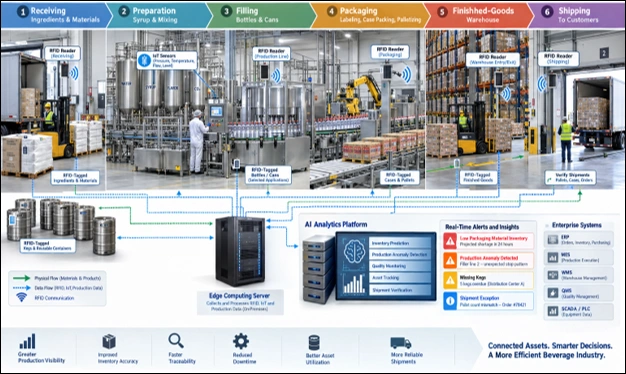
This industrial infographic illustrates how RFID, IoT sensors, edge computing, and AI analytics work together across beverage manufacturing. It follows materials and products from receiving and preparation through filling, packaging, warehousing, and shipping, showing how operational data supports inventory management, anomaly detection, traceability, asset tracking, and shipment verification.
Why AI Matters in Beverage Manufacturing
Beverage manufacturing involves tightly coordinated material, production, packaging, quality, warehouse, and distribution processes. A production interruption on a filler, labeler, depalletizer, packer, or palletizer can affect downstream packaging and shipment schedules. Ingredient shortages, incorrect packaging materials, lot-control problems, container losses, and inaccurate inventory records can create additional operational risk.
AI is valuable because beverage plants generate data at many different operational points. Manufacturing execution systems, enterprise resource planning software, programmable logic controllers, industrial sensors, laboratory systems, warehouse management software, RFID readers, barcode scanners, and production equipment can all contribute information. The challenge is not simply collecting more data. The objective is to convert operational data into reliable decisions.
RFID strengthens this process by providing machine-readable identity and location information. For example, an AI system can evaluate whether the expected pallet, packaging material, keg, or finished-product case is present at the correct production or warehouse location. This creates an additional context layer for AI models that would otherwise rely primarily on manually entered transactions.
GAO’s RFID and IoT hardware can therefore serve as part of a larger beverage-manufacturing solution in which identification data is combined with production and operational information rather than treated as an isolated tracking application.
Beverage Manufacturing Applications for AI and RFID
AI Inventory Management for Ingredients and Packaging Materials
Beverage plants must manage ingredients and packaging components such as bottles, cans, caps, closures, labels, cartons, trays, pallets, and other production supplies. Inventory errors can cause production delays even when an ERP system indicates sufficient stock.
RFID can capture material movements at receiving areas, storage locations, staging zones, and production lines. AI can then analyze consumption rates, historical production schedules, current inventory, supplier lead times, and production requirements to identify potential shortages.
Practical applications include:
- Predicting packaging-material shortages before a scheduled production run
- Detecting unexpected movement or consumption of tagged materials
- Matching material identity with production requirements
- Improving visibility into staging inventory near filling and packaging lines
- Identifying discrepancies between recorded and physically observed inventory
- Supporting replenishment decisions based on predicted production demand
Production Line Monitoring and Anomaly Detection
Beverage production lines contain interconnected equipment including conveyors, fillers, cappers, labelers, case packers, palletizers, pumps, mixers, and process-control systems. AI can analyze equipment data to detect abnormal operating patterns and identify conditions associated with downtime or quality problems.
RFID contributes identity and movement context. A tagged production batch, pallet, case, keg, or container can be associated with equipment events and process records. This can help connect a physical product movement with the digital production history.
For example, if a pallet is identified leaving a packaging line at an unexpected time, the software can correlate the RFID event with production output, machine status, and scheduled work orders. AI can then prioritize the event for investigation instead of treating every deviation equally.
AI Quality and Batch Traceability
Beverage manufacturers need accurate traceability across ingredients, batches, production runs, packaging materials, and finished goods. Traceability becomes particularly important when investigating quality deviations, customer complaints, or product recalls.
RFID can provide automated identification at selected material and product transition points. AI can correlate RFID events with batch records, laboratory measurements, production parameters, and quality-control information.
Potential capabilities include:
- Associating raw-material lots with production batches
- Improving visibility into finished-product movement
- Detecting unusual material or product routing
- Supporting faster investigation of quality deviations
- Identifying affected inventory during a recall investigation
- Maintaining more complete digital movement records
RFID does not by itself establish product quality. Rather, it supplies reliable identification and movement events that AI and manufacturing software can combine with process and quality data.
AI Warehouse Management for Finished Beverages
Finished beverages often move rapidly from packaging lines into staging areas, warehouses, distribution centers, or outbound docks. Manual scans can create gaps between physical movement and system records.
UHF RFID is well suited to pallet and case-level identification where tag placement, packaging composition, reader positioning, and RF conditions have been validated. Fixed readers can capture movement through defined points while handheld readers can support inventory verification and exception investigation.
AI can use these events to:
- Predict warehouse congestion
- Identify misplaced finished-goods inventory
- Prioritize picking or staging activities
- Detect unexpected pallet movement
- Compare expected and actual inventory positions
- Improve shipment-readiness decisions
- Forecast storage requirements
Keg and Reusable Container Tracking
Breweries and other beverage operations may manage reusable kegs, containers, totes, racks, and other returnable assets. These assets can leave the facility and return later, creating visibility challenges across distribution and reverse logistics.
RFID can provide persistent asset identification, while AI can analyze movement histories to identify unusually long dwell times, missing assets, repeated routing problems, and demand patterns.
The value comes from combining asset identity with operational history. A manufacturer can move beyond simply asking where a keg was last detected and instead analyze return cycles, utilization, dwell time, and abnormal movement patterns.
AI Logistics and Shipment Verification
Outbound beverage shipments can involve large numbers of pallets and cases with strict order, destination, and timing requirements. RFID checkpoints can verify that the physical shipment corresponds to the expected warehouse transaction or loading instruction.
AI can analyze shipment histories and operational conditions to identify likely loading exceptions, delayed orders, unusual staging durations, or discrepancies between planned and actual movements.
This can reduce dependence on manual exception discovery and help warehouse teams focus on shipments that require intervention.
AI and RFID Use Cases for Beverage Manufacturing
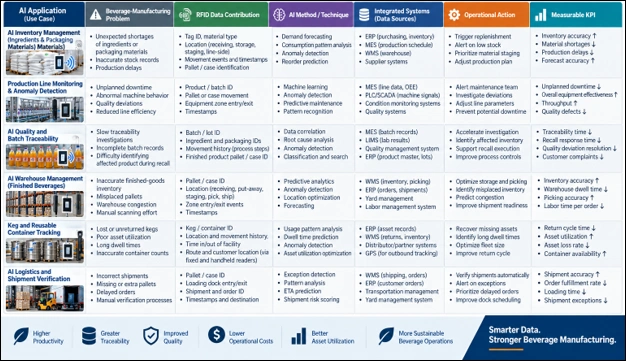
This comparison infographic maps six beverage-manufacturing applications to their RFID data inputs, AI methods, integrated systems, operational actions, and measurable KPIs. It covers inventory management, production anomaly detection, batch traceability, finished-goods warehousing, reusable-container tracking, and shipment verification.
From RFID Data Capture to AI-Driven Beverage Operations
A practical AI and RFID solution for beverage manufacturing should be designed as an end-to-end data workflow rather than as a collection of disconnected devices.
Data Acquisition at Beverage Manufacturing Processes
The workflow begins with physical events. RFID readers capture tag identifiers as pallets, cases, containers, materials, or reusable assets pass through defined locations. Depending on the use case, readers can be fixed at production transitions, warehouse doors, conveyor points, staging areas, or shipping docks. Handheld RFID readers can supplement fixed infrastructure for inventory audits and exception handling.
Other data sources may include PLCs, SCADA systems, production sensors, machine controllers, weighing equipment, vision systems, laboratory instruments, environmental sensors, barcode scanners, and operator transactions.
Communication and Edge Processing
Reader and equipment data normally passes through industrial Ethernet, Wi-Fi, or other plant communication infrastructure to local software or an edge server. Edge processing can filter duplicate reads, validate identifiers, associate events with locations, and reduce unnecessary transmission of raw RFID reads.
This is particularly important in beverage facilities where RFID readers may generate repeated observations as tagged items remain within an RF field. The solution should transform raw reads into meaningful events such as “pallet entered finished-goods staging” rather than treating every RF observation as a separate business transaction.
Middleware and Event Processing
RFID middleware can normalize device data and apply business rules before information is sent to higher-level applications. The middleware layer can connect reader events with product identifiers, locations, production orders, pallet IDs, batch numbers, or other relevant records.
A well-designed implementation should also handle device health, duplicate filtering, event timestamps, reader zones, exception conditions, and connectivity interruptions.
AI Analytics and Decision Support
Once RFID events are combined with production, inventory, and operational data, AI models can identify patterns that are difficult to detect through individual transactions.
Possible AI methods include machine learning for demand and inventory prediction, anomaly detection for unusual material movement, classification models for exception prioritization, computer vision for packaging and quality inspection, and optimization models for production or warehouse decisions.
The AI output should be actionable. Examples include an inventory-shortage warning, an abnormal pallet-routing alert, a predicted warehouse bottleneck, or a recommendation to investigate a production deviation.
Operational Action
The final stage is the business response. A warehouse supervisor may verify a pallet location, a production planner may adjust material staging, a quality team may investigate a batch, or maintenance personnel may inspect equipment associated with an abnormal production pattern.
The effectiveness of the system should therefore be evaluated not only by RFID read rates or AI model accuracy, but also by whether the resulting decisions improve beverage manufacturing operations.
AI and RFID Workflow for Beverage Manufacturing
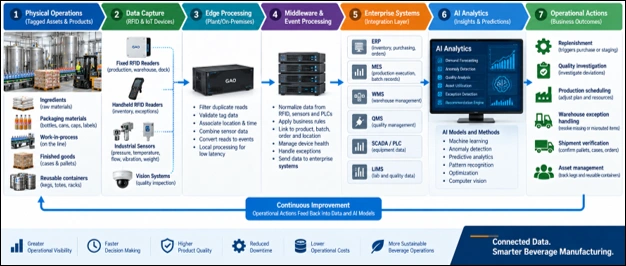
This workflow diagram shows how beverage manufacturing data moves from tagged ingredients, packaging materials, pallets, cases, and reusable containers through RFID and IoT capture, edge processing, middleware, enterprise systems, and AI analytics. It connects AI-generated insights to operational actions such as replenishment, quality investigation, production scheduling, warehouse exception handling, shipment verification, and asset management.
RFID, AI Hardware, Software, and Deployment Options for Beverage Plants
Beverage manufacturers should select hardware and software according to the physical process, read environment, required latency, integration requirements, and data-governance policies.
UHF RFID is generally appropriate for longer-range identification of pallets, cases, and selected reusable assets. HF RFID can be useful for shorter-range identification applications where proximity and controlled read zones are desirable. LF RFID can support specialized applications where its operating characteristics are appropriate. Tag selection must account for the material being tagged because liquids, metal containers, dense packaging, and closely packed products can affect RF performance.
RFID readers and antennas should be positioned according to the actual movement path rather than simply installed at convenient network locations. Beverage facilities can contain conveyors, stainless-steel equipment, tanks, liquid-filled products, motors, pipes, and other structures that affect RF behavior. Site surveys and pilot testing are therefore important before large-scale deployment.
AI processing can run through several software configurations. A cloud-hosted SaaS deployment can be appropriate when the manufacturer wants centralized analytics across multiple facilities and has suitable connectivity and data-governance controls. A server deployment can run on factory servers, edge servers, customer-managed infrastructure, private data centers, or other privately hosted enterprise infrastructure. This model can be preferable where low-latency processing, local data control, plant-network isolation, or continued operation during intermittent external connectivity is important.
A hybrid approach can keep real-time event processing and selected operational functions near the beverage production environment while sending aggregated information to cloud services for broader analytics.
Integration commonly involves ERP, MES, WMS, quality-management software, SCADA, PLC-connected systems, databases, APIs, and industrial communication interfaces. Security should include network segmentation, authenticated device access, encrypted communications where supported, role-based access control, secure credential management, software patching, logging, and controlled remote access.
GAO provides RFID, BLE, and IoT hardware products and systems that can be incorporated into these deployment models. The appropriate configuration depends on the beverage manufacturer’s facility layout, tagged materials, production processes, integration requirements, and operational objectives.
Engineering Considerations Before Scaling RFID Across a Beverage Facility
RFID performance should be validated in the actual production environment before expanding beyond a pilot area. Tag selection, reader sensitivity, antenna orientation, conveyor speed, pallet configuration, liquid content, metal surfaces, reader-zone boundaries, and electromagnetic interference can all influence read performance.
A beverage manufacturer should define the business event before selecting the RFID hardware. For example, “pallet crossed shipping verification point” is a more useful requirement than simply specifying “track pallets with RFID.” The event definition determines reader placement, antenna configuration, middleware rules, data fields, and integration requirements.
AI implementation also requires disciplined data preparation. Historical production records, RFID events, inventory transactions, downtime information, quality records, and machine signals must have consistent identifiers and timestamps before predictive models can produce dependable results.
Pilot testing should measure operational KPIs such as inventory accuracy, material-search time, shipment verification accuracy, production interruptions caused by material shortages, asset return cycle time, traceability investigation time, RFID read performance, and AI alert precision. These measurements provide a stronger basis for scaling than technology deployment counts alone.
Business and Operational Benefits of AI-Enabled Beverage Manufacturing
Combining AI with RFID-based identification can improve beverage manufacturing by connecting physical product movement with production, inventory, quality, and logistics decisions. The greatest value usually comes from reducing information gaps between operational systems rather than from RFID or AI operating independently.
Higher Inventory Accuracy
RFID can automate selected inventory observations and reduce dependence on manual counting and barcode scanning. AI can use these observations alongside consumption history and production schedules to identify inventory anomalies and predict future requirements.
For beverage manufacturers, this can improve visibility into:
- Bottles, cans, caps, closures, labels, cartons, and other packaging materials
- Ingredients and production materials
- Finished-product pallets and cases
- Kegs and reusable containers
- Staged materials awaiting production
- Inventory awaiting outbound shipment
Improved inventory accuracy can reduce material-search time, prevent avoidable line interruptions, and support more reliable production planning.
Faster Batch and Product Traceability
When product and material identities are connected to production events, manufacturers can investigate traceability questions more quickly. RFID events can provide time-stamped observations that complement batch records, ERP transactions, MES records, and quality-control data.
AI can help identify relationships between large volumes of operational records, allowing quality and operations teams to narrow an investigation to relevant batches, locations, materials, or movement events.
Reduced Production Disruptions
Production interruptions can originate from material shortages, incorrect staging, equipment problems, quality deviations, or downstream packaging constraints.
AI can identify patterns associated with these conditions while RFID provides additional information about whether required materials and products are physically where the system expects them to be.
This can support earlier intervention, particularly when production planning, inventory, and physical material movement are normally managed through separate processes.
Better Warehouse and Shipping Performance
RFID can reduce manual effort associated with locating and verifying finished-product inventory. AI can analyze movement patterns and warehouse activity to identify congestion, unusual dwell times, misplaced inventory, or potential shipment exceptions.
The resulting workflow can help warehouse personnel focus on exceptions rather than repeatedly checking every pallet or storage location.
Improved Reusable-Asset Utilization
For kegs, totes, racks, and other reusable beverage assets, RFID can create a history of movements while AI identifies utilization patterns.
Useful metrics include asset dwell time, return cycle time, utilization frequency, loss rates, and location history. These insights can help determine whether assets are being held too long at particular distribution points or whether additional inventory is required.
Scalable Multi-Facility Visibility
A standardized RFID event model can support multiple beverage manufacturing facilities while allowing each plant to retain its own operational processes. Cloud analytics can aggregate selected information for corporate-level analysis, while local servers or edge computing can retain time-sensitive plant operations.
This approach is particularly useful for manufacturers operating multiple bottling, canning, brewing, or beverage-processing facilities.
AI and RFID Benefits and KPIs for Beverage Manufacturing
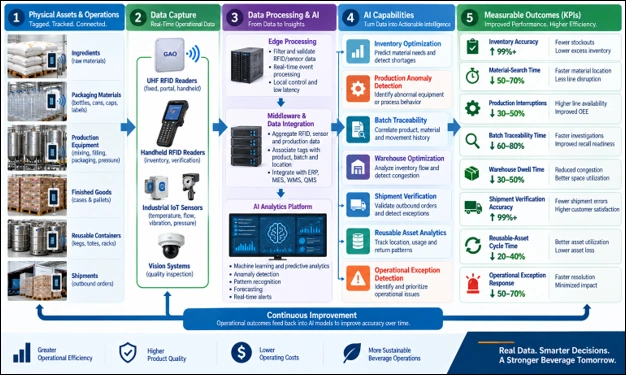
This infographic shows how RFID, industrial IoT, edge processing, and AI analytics convert beverage-manufacturing data into actionable capabilities and measurable operational outcomes. It connects inventory optimization, anomaly detection, batch traceability, warehouse optimization, shipment verification, reusable-asset analytics, and exception detection with relevant performance indicators.
Key KPIs for AI and RFID in Beverage Manufacturing
Technology deployment should be measured against operational performance rather than the number of RFID readers, tags, or AI models deployed.
Relevant beverage-manufacturing KPIs include:
- Inventory accuracy
- Packaging-material availability
- Material-search time
- Production-line downtime
- Unplanned production interruptions
- Overall equipment effectiveness
- Throughput
- Production schedule adherence
- Batch traceability time
- Recall investigation time
- Quality deviation response time
- Finished-goods inventory accuracy
- Warehouse dwell time
- Picking accuracy
- Shipment verification accuracy
- Order fulfillment accuracy
- Pallet staging time
- Keg or reusable-container return cycle time
- Reusable-asset utilization
- Asset loss rate
- RFID read accuracy
- RFID event-processing latency
- AI alert precision
- AI false-positive rate
- Exception resolution time
- Energy consumption per production unit
- Waste or product-loss rate
- Changeover duration
- Maintenance response time
- Forecast accuracy
The appropriate KPI set depends on the business case. A keg-tracking deployment should emphasize asset cycle time and return rates, while an ingredient and packaging application may place greater emphasis on material availability and production interruptions.
Cybersecurity and Data Governance for Connected Beverage Plants
Connecting RFID readers, edge servers, production systems, AI software, and enterprise applications increases the number of systems that must be secured. Beverage manufacturers should therefore treat cybersecurity as part of system engineering rather than as a later software configuration.
Recommended controls include:
- Segmenting RFID and industrial networks from general corporate networks
- Applying least-privilege access to RFID middleware and AI applications
- Using authenticated device and user access
- Encrypting data transmissions where technically supported
- Maintaining controlled credentials and rotating sensitive credentials
- Applying security updates to servers, readers, gateways, and supporting software
- Recording system and administrative events for investigation
- Restricting remote administrative access
- Establishing backup and recovery procedures
- Defining data-retention requirements for RFID and production events
- Controlling access to batch, production, quality, and shipment information
- Testing failure and recovery procedures before production deployment
Data governance is equally important. RFID events should have consistent timestamps, location identifiers, tag identifiers, product identifiers, and event types. AI models should also have documented data sources, model objectives, validation criteria, and escalation procedures.
For safety-critical or quality-sensitive decisions, AI should normally assist qualified personnel rather than automatically override established manufacturing controls without appropriate validation.
Interoperability with Beverage Manufacturing Systems
AI and RFID solutions become more useful when they exchange information with existing beverage-manufacturing software rather than creating another isolated data store.
Common integration points include:
- ERP systems for inventory, purchasing, orders, and production planning
- MES software for production execution and batch records
- WMS software for warehouse inventory and movement
- Quality-management systems for inspections, deviations, and corrective actions
- SCADA systems for plant monitoring
- PLC and industrial-control systems for equipment events
- Laboratory information systems for analytical and quality data
- Maintenance-management systems for equipment history and work orders
- Databases and data warehouses for historical analytics
- APIs and middleware for application-to-application integration
The integration design should define a common identifier strategy. For example, a pallet ID should be consistently associated with its product, batch, production order, location, and shipment transaction wherever those relationships are required.
This is an important implementation lesson: RFID cannot compensate for inconsistent master data. If product IDs, locations, batch identifiers, or production orders are poorly governed, adding additional RFID events can increase the volume of inconsistent information rather than solve the underlying problem.
Implementation Strategy for Beverage Manufacturers
A phased deployment is generally more practical than attempting to RFID-enable an entire beverage operation simultaneously.
Define the Operational Problem
Start with a measurable problem such as finished-goods inventory inaccuracies, missing reusable containers, shipment verification, packaging-material shortages, or slow traceability investigations.
The project should establish baseline KPIs before equipment is installed.
Map the Physical Process
Document where materials and products physically move through receiving, storage, preparation, processing, filling, packaging, palletizing, staging, warehousing, and shipping.
The map should identify:
- Material transition points
- Production-line interfaces
- Reader installation locations
- RF-sensitive areas
- Required tag attachment locations
- Operator interaction points
- Existing barcode or scanning processes
- Network connections
- Required system integrations
Select Tags and Readers Through Site Testing
Tag performance should be tested using the actual bottles, cans, cases, pallets, kegs, packaging configurations, and materials used by the plant.
Liquid-filled products and metal containers can create RF challenges. Consequently, laboratory specifications alone should not determine final tag selection.
Reader and antenna configuration should also be tested under realistic conveyor speeds, pallet orientations, product densities, and environmental conditions.
Build a Controlled Pilot
A pilot should cover a clearly defined production or logistics process and include representative operating conditions.
The manufacturer should validate:
- RFID read performance
- Event accuracy
- Reader-zone separation
- Network reliability
- Middleware processing
- ERP/MES/WMS integration
- AI data quality
- Alert accuracy
- Operator workflows
- Exception handling
- Cybersecurity controls
- KPI improvement
Commission and Optimize
After successful testing, the system can be expanded incrementally. Reader placement, antenna orientation, tag placement, event rules, AI thresholds, and integration logic may require optimization after real production data becomes available.
Operational personnel should participate in commissioning because they understand exceptions that may not appear in process documentation.
Scale Across Production and Distribution
Once the use case produces measurable results, the manufacturer can extend the solution to additional lines, warehouses, facilities, products, or reusable assets.
A standardized data model and documented deployment procedures can simplify expansion while allowing site-specific RF and operational adjustments.
Beverage RFID Deployment Lifecycle from Pilot to Multi-Site Scaling
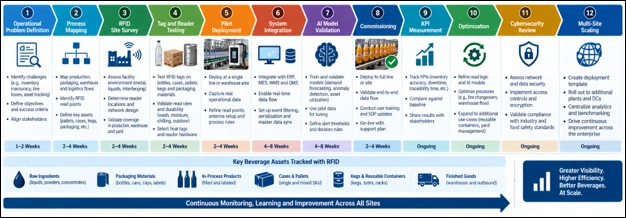
This lifecycle infographic presents a 12-stage approach to deploying RFID and AI in beverage manufacturing, from operational problem definition and process mapping through RFID testing, pilot deployment, system integration, AI validation, KPI measurement, cybersecurity review, and multi-site scaling. It also highlights representative beverage assets including ingredients, packaging materials, cases, pallets, kegs, reusable containers, and finished goods.
Practical Design Recommendations for Beverage Manufacturing
Several engineering principles can reduce implementation risk.
- Design RFID events around actual beverage-manufacturing business processes rather than around reader installations.
- Validate tags with the real products and packaging configurations before purchasing large quantities.
- Use fixed readers where automated transition detection provides clear operational value.
- Use handheld RFID readers where cycle counting, investigation, or flexible inventory verification is required.
- Keep real-time event filtering close to the physical operation when latency and network resilience matter.
- Integrate RFID events with existing ERP, MES, WMS, and quality records rather than creating isolated operational records.
- Establish consistent identifiers for products, batches, pallets, containers, locations, and production orders.
- Separate AI recommendations from safety-critical control functions unless the complete control application has been appropriately validated.
- Measure business outcomes before and after deployment.
- Design for equipment maintenance, reader replacement, tag replenishment, software updates, and network failures from the beginning.
- Include cybersecurity and access control in the initial design.
- Pilot difficult RF environments, especially where liquid products, metal packaging, dense pallet loads, or complex conveyor paths are involved.
- Give production, quality, warehouse, maintenance, IT, and engineering personnel defined roles in deployment and validation.
GAO’s experience supplying RFID, BLE, and IoT hardware products and systems can support organizations evaluating these engineering considerations, particularly when hardware selection and deployment need to fit existing operational processes.
Where AI and RFID Deliver the Most Value in Beverage Manufacturing
The strongest use cases generally occur where three conditions overlap: physical assets need reliable identification, operational decisions depend on timely information, and sufficient historical data exists for AI analysis.
Examples include:
| Beverage-Manufacturing Challenge | RFID Contribution | AI Contribution | Potential Outcome |
| Packaging-material shortages | Material identification and movement | Consumption and shortage prediction | Fewer material-related interruptions |
| Finished-goods inventory errors | Automated pallet/case observations | Anomaly detection | Higher inventory accuracy |
| Slow traceability investigations | Batch and product movement events | Record correlation and prioritization | Faster investigation |
| Missing kegs or reusable assets | Persistent asset identity | Dwell and return analysis | Better asset utilization |
| Shipment discrepancies | Loading and staging verification | Exception prioritization | Improved shipment accuracy |
| Warehouse congestion | Location and movement events | Congestion prediction | Better staging and storage decisions |
| Production anomalies | Product and material context | Pattern and anomaly detection | Earlier intervention |
| Quality investigations | Material/product identity | Cross-record analysis | Faster root-cause investigation |
The important distinction is that AI creates value from operational context. RFID supplies one important source of that context, while production equipment, quality systems, warehouse records, and other IoT sources provide additional evidence.
GAO’s Role in Beverage Manufacturing Technology Solutions
GAO supplies RFID, BLE, and other IoT technologies-based hardware products and systems for organizations that need connected identification, sensing, tracking, and monitoring capabilities. For beverage manufacturing applications, this can include RFID readers, tags, antennas, handheld equipment, gateways, and related hardware selected according to the physical environment and operational requirement.
GAO’s work is supported by substantial research and development investment across RFID, BLE, IoT, and related technologies. The company and its sister companies, GAO Research Inc. and GAO Tek Inc., form GAO Group, with operations based in New York City and Toronto, Canada.
For three decades, GAO Group has served customers in the United States and Canada, including Fortune 500 companies, leading R&D organizations, prestigious universities, and U.S. and Canadian government agencies. Its quality-assurance processes and remote or onsite technical support are intended to help customers deploy and operate technology products and systems in demanding professional environments.
Building AI-Enabled Beverage Manufacturing Operations
AI and RFID can provide beverage manufacturers with a practical way to connect physical material and product movement with production, inventory, quality, warehouse, and logistics intelligence. RFID provides automated identification and movement events, while AI can analyze those events alongside machine, production, inventory, and quality data to identify anomalies, forecast requirements, and support operational decisions.
Successful deployment depends on more than selecting RFID readers or an AI model. Manufacturers should begin with measurable business problems, validate RFID performance in the actual beverage environment, establish reliable master data, integrate with existing manufacturing software, secure the connected systems, and continuously measure operational KPIs.
Organizations evaluating AI-driven beverage manufacturing, RFID traceability, asset tracking, or connected production systems can learn more about GAO’s RFID, BLE, and IoT hardware products and technical solutions and work with our team to identify an appropriate implementation approach.
Building the Future of Industrial AI and IoT with Aperture Venture Studio and GAO RFID Inc.
For more than three decades, GAO Group of Companies has invested heavily in R&D of industrial RFID, BLE, and IoT. As generative AI became increasingly useful for industrial applications, we have continued developing AI and IoT technologies, including RFID and BLE, and have founded Aperture Venture Studio to build, launch, and scale next-generation AI and IoT companies for various industries. Aperture has attracted AI and IoT technical experts, entrepreneurial and operational executives, influential investors, and leading companies. We have also developed Aperture Ventures Summit and TekSummit to discuss advanced AI and IoT topics. We welcome you to join us as advisors, co-founders or employees, investors, or customers.