
AI and RFID for Biotechnology
AI and RFID for Biotechnology
Biotechnology organizations increasingly use AI-driven software, connected laboratory systems, and automated identification to improve the control of biological materials, reagents, samples, equipment, and production workflows. AI can analyze operational data to detect anomalies, forecast material requirements, optimize laboratory processes, and support decisions across research, development, quality control, and biomanufacturing. UHF, HF, and LF RFID provide machine-readable identification and location or status data that can feed these AI applications. The combination is particularly useful where biotechnology workflows involve high-value materials, strict chain-of-custody requirements, temperature-sensitive inventory, controlled laboratory environments, and complex equipment utilization. GAO supplies RFID hardware products and systems that can support biotechnology organizations in capturing reliable identification data for integration with laboratory information management systems, manufacturing software, inventory systems, and AI applications.
AI and RFID Integration Across the Biotechnology Workflow from R&D to Manufacturing
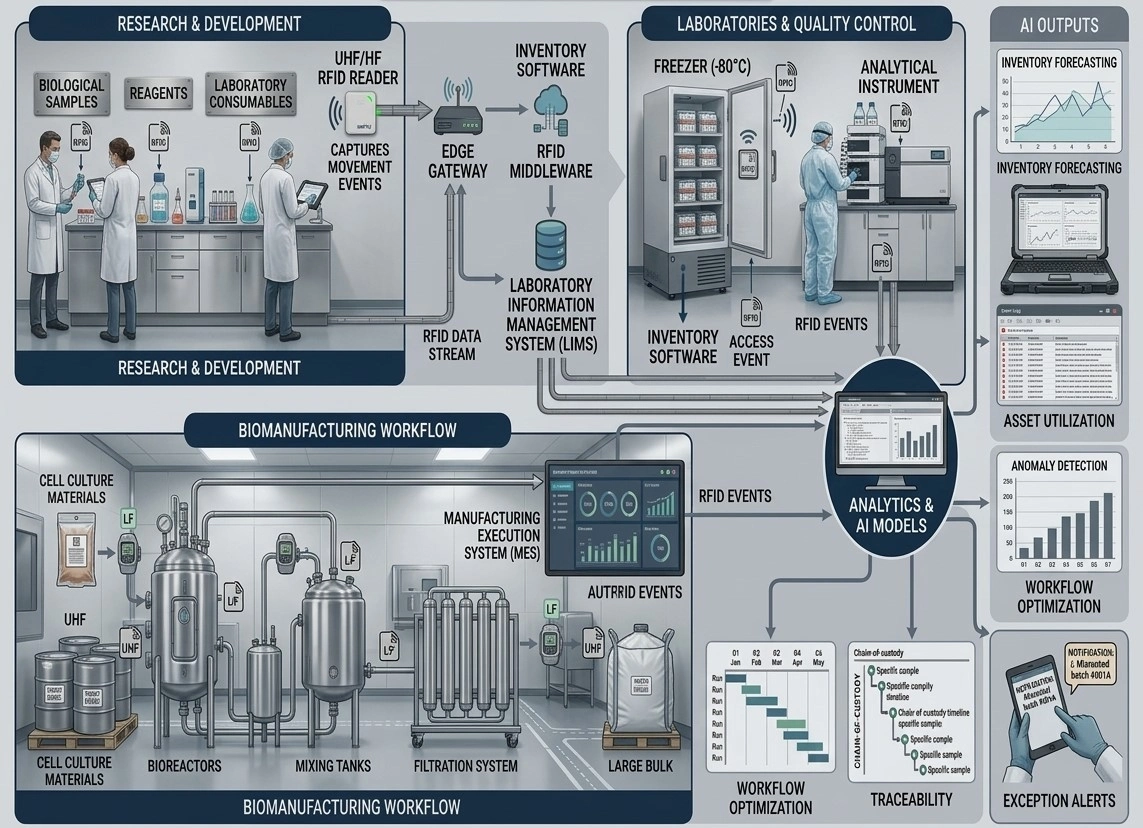
This detailed enterprise infographic illustrates the integration of RFID tracking and AI analytics across the full biotechnology workflow, from R&D and laboratories to biomanufacturing. It visualizes physical materials like samples and bioreactors moving through realistic environments, with data captured by various RFID types (UHF, HF, LF) feeding into systems like LIMS and MES. The graphic highlights how this data drives advanced AI models, outputting specific operational insights including inventory forecasting, anomaly detection, workflow optimization, and exception alerts to improve efficiency and traceability.
What AI-Driven Identification Means for Biotechnology
AI-driven identification in biotechnology combines machine-readable identification data with artificial intelligence, connected equipment, enterprise software, and laboratory information. RFID is an enabling technology rather than the objective itself. Its primary role is to identify and capture events associated with physical objects as they move through biotechnology workflows.
Biotechnology facilities can apply this approach to research samples, cell banks, culture media, reagents, laboratory consumables, analytical instruments, mobile equipment, storage containers, production materials, and other controlled assets. AI software can then use those events with information from laboratory instruments, environmental sensors, electronic batch records, laboratory information management systems, enterprise resource planning software, and manufacturing execution systems.
The resulting system can answer operational questions that are difficult to resolve through manual records alone:
- Which reagent lot entered a laboratory workflow and when?
- Which storage location currently contains a specific material?
- Which equipment has been used most frequently?
- Which consumables are approaching their required replenishment level?
- Which material movement deviates from the expected process?
- Which samples or containers require an exception review?
- Which equipment utilization patterns indicate maintenance requirements?
- Which workflow stages are causing avoidable delays?
AI becomes valuable when identification events are transformed into operational signals and decisions rather than simply stored as historical records.
Why Biotechnology Operations Are Adopting AI
Biotechnology workflows generate large volumes of structured and unstructured operational data. Research laboratories may handle thousands of samples, reagents, consumables, and experimental records, while bioprocessing environments must maintain controlled movement of raw materials, intermediates, single-use components, and production-related assets.
AI can process these datasets to identify relationships that may not be obvious through manual review. Machine learning models can detect unusual inventory movements, predict replenishment requirements, classify operational anomalies, and identify patterns in equipment utilization. Computer vision can complement RFID for visual inspection, container recognition, and process verification. Edge AI can process selected events close to laboratory or manufacturing equipment where rapid response or reduced network dependency is important.
RFID contributes another important layer: physical identity. A barcode generally requires controlled presentation to a scanner, while RFID can support non-contact identification and automated event capture. The appropriate RFID frequency depends on the material, read distance, container composition, required automation level, and laboratory environment.
GAO’s RFID hardware and systems can provide the identification layer needed to connect physical biotechnology workflows with digital records and AI-based analysis.
Biotechnology Applications for AI-Enabled RFID Workflows
Sample and Specimen Traceability
Biotechnology research frequently involves biological samples, aliquots, assay materials, cell lines, tissue-derived materials, and experimental specimens. RFID can associate a physical container with a digital record and create identification events when the container enters or leaves defined locations.
AI can analyze movement histories to identify unusual handling patterns, missed process steps, unexpected dwell times, or deviations from predefined workflows. This approach can strengthen chain-of-custody visibility while reducing manual identification tasks.
Reagent and Consumables Management
Reagent inventory is a major operational consideration in biotechnology laboratories. Expired, misplaced, incorrectly stored, or unexpectedly depleted reagents can disrupt experiments and production schedules.
RFID can automate identification of tagged reagents and consumables at storage points, workstations, receiving areas, and controlled-access locations. AI-based inventory models can combine consumption history, project schedules, lead times, lot information, and storage conditions to improve replenishment forecasting.
Cold Storage and Biobanking
Freezers, refrigerators, cryogenic storage systems, and biobanks can contain large inventories of high-value biological materials. Manual inventory checks can be labor intensive and may create opportunities for identification errors.
RFID can provide automated identification at appropriate access points, while temperature sensors and environmental monitoring systems provide complementary condition data. AI can correlate inventory movements with temperature excursions, access events, storage duration, and historical operating conditions to prioritize exceptions.
RFID selection for cold environments requires careful evaluation of tag materials, condensation, metal surfaces, dielectric materials, reader placement, and read reliability. Tag qualification should therefore be performed under actual storage conditions rather than relying solely on laboratory bench testing.
RFID-Enabled Biobank Cryogenic Storage with AI-Powered Inventory and Environmental Monitoring
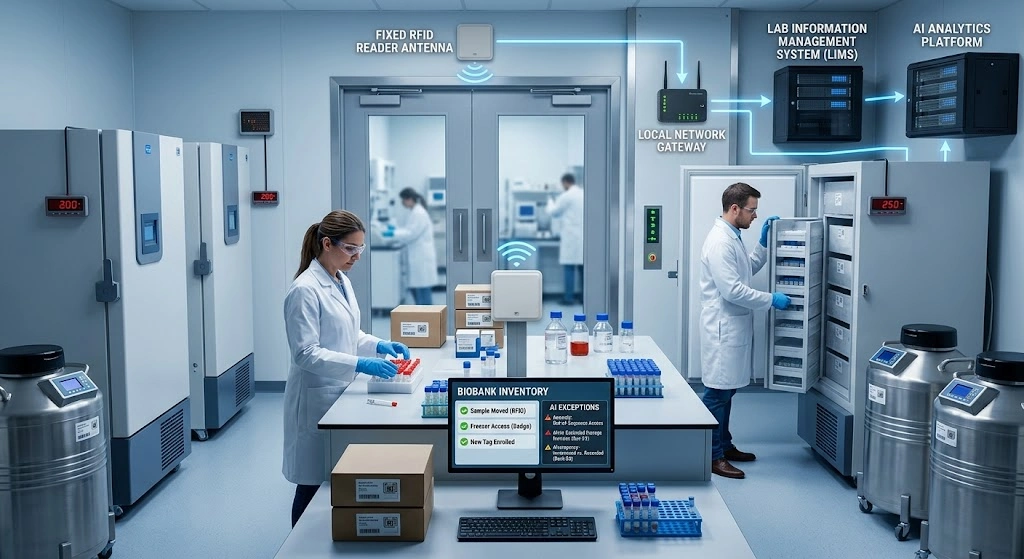
This photorealistic illustration shows technicians in a specialized biotechnology biobank managing cryogenic storage using an integrated RFID deployment. It features labeled components like RFID tags on sample racks, fixed readers, temperature sensors, and software displays that validate inventory, monitor environmental events, and integrate with AI analytics to detect exceptions like abnormal access or temperature deviations within the cold storage workflow.
Laboratory Equipment Tracking
Biotechnology laboratories often share centrifuges, incubators, spectrophotometers, liquid handlers, PCR systems, balances, microscopes, freezers, biosafety cabinets, and other specialized equipment. Manual asset registers can become inaccurate when equipment is moved between laboratories or service areas.
RFID can establish automated equipment identification at laboratory entrances, storage areas, service locations, and designated work zones. AI can analyze utilization events to identify underused equipment, recurring movement patterns, scheduling conflicts, and potential maintenance priorities.
The objective is not simply to locate equipment. A more useful implementation connects equipment identity with maintenance history, calibration status, utilization, laboratory scheduling, and authorized operating procedures.
Bioprocess Material Tracking
Biomanufacturing introduces additional requirements for material traceability. Raw materials, media components, single-use assemblies, process containers, production tools, and other materials may pass through receiving, quarantine, staging, dispensing, processing, quality control, and storage activities.
RFID event data can support material movement records while AI analyzes process timing, inventory consumption, and deviations. Manufacturing execution systems and electronic batch records can remain the systems of record while RFID provides automated physical-event information.
Laboratory Workflow Optimization
Experimental workflows can contain repeated movements between preparation benches, instruments, storage areas, and analytical stations. AI can analyze timestamps and identification events to detect bottlenecks and unnecessary movement.
A biotechnology organization could use these insights to evaluate workstation layouts, instrument scheduling, sample-handling procedures, and resource allocation. This creates a feedback loop between physical laboratory operations and process improvement.
From RFID Events to AI-Based Biotechnology Decisions
A practical biotechnology implementation usually follows a connected data flow rather than deploying RFID independently.
Physical Data Acquisition
RFID readers capture tag identifiers when biological materials, laboratory assets, containers, or supplies pass through defined read zones. Fixed readers are useful for controlled points such as doorways, cabinets, receiving stations, or process transitions. Handheld readers can support exception handling, inventory verification, and mobile laboratory operations.
UHF RFID is generally suitable for longer-range identification and automated movement detection where the surrounding materials and environment permit reliable performance. HF RFID can be appropriate for shorter-range identification and controlled point-of-use interactions. LF RFID can be considered for specialized short-range identification requirements and environments where its characteristics are advantageous.
RFID should not be treated as universally suitable for every biotechnology object. Water-rich biological materials, liquids, metal equipment, foil packaging, dense storage configurations, and cryogenic conditions can affect RF performance. Engineering validation should therefore examine actual containers, tag attachment methods, reader power, antenna positioning, interference, and read-zone geometry.
Communication and Edge Processing
Reader events are transferred through wired Ethernet, Wi-Fi, or other suitable communication infrastructure to local gateways or software services. Edge processing can filter duplicate reads, apply business rules, normalize event formats, and reduce unnecessary data transmission.
A biotechnology facility may define an event such as “reagent entered controlled storage” rather than forwarding every raw RF observation to downstream applications. This distinction is important because AI models generally benefit from meaningful operational events rather than large volumes of unfiltered reader data.
RFID Middleware and Event Processing
Middleware connects RFID readers with biotechnology software. It can manage reader configurations, tag filtering, event deduplication, device health, location logic, and interfaces to downstream applications.
Rules can convert low-level observations into business events such as:
- Material received
- Sample transferred
- Equipment moved
- Reagent issued
- Storage location changed
- Process material staged
- Asset returned
- Inventory discrepancy detected
GAO can supply RFID hardware and supporting systems that form part of this data-capture layer, while integration requirements should be defined around the biotechnology organization’s existing software and operating procedures.
Laboratory and Manufacturing Software Integration
RFID data can be integrated with laboratory information management systems, laboratory execution systems, electronic laboratory notebooks, enterprise resource planning software, manufacturing execution systems, computerized maintenance management systems, warehouse or inventory applications, and data analytics systems.
Integration may use APIs, database interfaces, message queues, web services, or other enterprise integration mechanisms. Data ownership should be defined before deployment so that RFID-generated events do not create conflicting records across systems.
AI, RFID Hardware, Software, and Deployment Architecture for Biotechnology
A biotechnology solution normally combines several technical layers. Each layer should be selected according to the physical workflow, data quality requirements, laboratory environment, integration requirements, and security controls.
RFID Hardware
The physical RFID layer can include tags, fixed readers, handheld readers, antennas, printers or encoders, gateways, and associated network equipment.
Tag selection requires particular attention to substrate and container characteristics. Glass, plastic, liquids, metallic equipment, cryogenic containers, and foil-lined packaging can produce substantially different RF behavior. Read-zone testing should therefore use representative biotechnology materials.
Fixed readers are appropriate where identification must occur automatically at defined process points. Handheld readers can supplement fixed infrastructure for inventory reconciliation, investigations, and exception management.
AI and Analytics Software
AI software can use RFID-derived events together with laboratory, manufacturing, environmental, maintenance, and inventory data. Suitable methods may include supervised machine learning, unsupervised anomaly detection, time-series forecasting, classification, clustering, optimization algorithms, and computer vision.
The AI method should match the biotechnology problem. Forecasting reagent consumption is fundamentally different from detecting an abnormal sample movement or predicting equipment maintenance requirements. Model selection should therefore follow the operational decision rather than forcing every workflow into the same AI technique.
Cloud Version
A cloud-hosted deployment can centralize RFID event processing, analytics, dashboards, AI services, and software integration across multiple biotechnology laboratories or manufacturing facilities. This approach can be appropriate when geographically distributed facilities require common reporting and centralized model management.
Cloud deployment also requires careful consideration of data residency, connectivity, identity management, encryption, API security, vendor access, audit requirements, and the biotechnology organization’s regulatory obligations.
Server Version
A server deployment can place RFID middleware, databases, analytics software, or AI services on customer-managed servers, private data centers, laboratory servers, factory servers, or other privately hosted infrastructure.
This model can be appropriate where biotechnology operations require tighter control over sensitive operational data, local processing, limited external connectivity, or integration with established private infrastructure. A hybrid arrangement can also process time-sensitive RFID events locally while sending selected datasets to centralized analytics services.
Security and Access Control
Biotechnology RFID systems should follow the organization’s broader cybersecurity controls. Reader devices, gateways, APIs, databases, and AI services introduce additional endpoints that must be managed.
Security controls can include authenticated device access, role-based access control, encrypted communications, network segmentation, credential rotation, audit logging, software patching, backup procedures, vulnerability management, and controlled administrative privileges.
RFID identification data should also be governed according to its business sensitivity. A system tracking laboratory equipment may require different controls from one handling information associated with regulated research materials or controlled production records.
GAO’s experience supplying RFID hardware and systems to organizations in the United States and Canada supports the practical importance of product quality, deployment testing, integration, and technical support when implementing connected identification systems.
Engineering Considerations Before Biotechnology Deployment
Successful deployment begins with the physical process rather than the reader specification. Engineers should map where materials and assets actually move, identify mandatory identification points, determine which events need to reach enterprise software, and establish acceptable read performance.
Important design questions include:
- What objects require identification?
- Which objects contain liquids or other RF-sensitive materials?
- Which assets contain metal or are stored near metal surfaces?
- What read distance is actually required?
- Which movement events need automatic detection?
- Where should handheld RFID be retained for exception handling?
- Which applications own inventory, sample, asset, or production records?
- What data should be retained for audit and operational analysis?
- Which decisions will AI make or support?
- What happens when RFID identification fails?
- How will tags be replaced, validated, and associated with digital records?
- How will reader and gateway failures be detected?
- Which cybersecurity controls apply to readers, gateways, APIs, and databases?
A controlled pilot should reproduce the actual biotechnology environment, including representative containers, storage racks, laboratory benches, equipment, doors, freezers, process areas, and network conditions. Read-rate measurements should be performed across realistic orientations and object densities rather than using an isolated tag in an open laboratory.
GAO can provide RFID products and systems for such implementations, while the final configuration should be engineered around the biotechnology workflow and the customer’s existing information systems.
AI-Enabled Biotechnology Use Cases and Operational Improvements
The value of AI-supported RFID becomes clearer when identification events are connected to measurable biotechnology workflows. The strongest implementations focus on decisions that are difficult, expensive, or time-consuming to perform manually.
AI Inventory Forecasting for Reagents and Laboratory Supplies
Biotechnology laboratories consume reagents, media components, assay kits, pipette tips, tubes, filters, single-use assemblies, and other consumables at different rates. Simple minimum-stock rules may not account for changing experimental schedules, production demand, supplier lead times, lot constraints, or seasonal research activity.
AI forecasting can combine RFID inventory events with historical consumption, planned experiments, production schedules, purchase orders, supplier lead times, and material shelf life. The resulting forecast can identify likely shortages before they interrupt laboratory work.
RFID contributes automated physical inventory events, while the AI model determines consumption patterns and replenishment priorities. This division of responsibility helps prevent the identification technology from being treated as a substitute for inventory-management logic.
Anomaly Detection for Sample and Material Movement
A biotechnology workflow normally has expected movement patterns. A sample may move from preparation to analysis, while a reagent may move from controlled storage to a laboratory workstation. Unexpected movement, prolonged dwell time, or an unrecognized transition can trigger investigation.
AI anomaly detection can establish normal movement patterns from historical events and identify deviations. Rules can be added for known exceptions so that legitimate operational variations are not incorrectly treated as anomalies.
This approach can be particularly useful for high-value biological materials, research samples, specialized reagents, and production materials requiring documented custody.
Predictive Equipment Maintenance
Equipment downtime can disrupt laboratory schedules and bioprocessing operations. RFID does not directly determine mechanical or electrical equipment health, but it can establish equipment identity and utilization history.
When RFID events are combined with vibration, temperature, runtime, calibration, maintenance, and service data, AI models can identify usage patterns associated with maintenance requirements. A computerized maintenance management system can then use these insights to prioritize inspections, calibration, preventive maintenance, or service activities.
AI-Based Workflow Optimization
Laboratory productivity depends on more than individual instrument performance. Waiting time, material movement, equipment availability, sample queues, and operator activities can collectively determine throughput.
RFID timestamps provide evidence of when physical events occur. AI can analyze those events to identify recurring bottlenecks, excessive dwell time, inefficient movement patterns, or resource conflicts.
For example, a biotechnology laboratory could discover that samples consistently accumulate before a particular analytical instrument. Management could then evaluate scheduling, staffing, instrument capacity, or process sequencing instead of simply purchasing additional equipment.
Quality and Traceability Support
Quality operations depend on accurate relationships among materials, equipment, processes, personnel, and records. RFID can automate selected physical identification events that support those relationships.
AI can analyze historical event data to identify missing transitions, unusual sequences, duplicate records, or other conditions requiring quality review. Such systems should support qualified procedures and established quality controls rather than independently overriding regulated decisions.
Measuring Biotechnology AI and RFID Performance
A biotechnology deployment should be evaluated using operational KPIs rather than RFID read counts alone. Read performance is important, but the ultimate objective is better laboratory, research, quality, inventory, and biomanufacturing performance.
Useful KPIs include:
- Inventory record accuracy for reagents, samples, consumables, and production materials
- Sample or material traceability completeness
- RFID identification success rate at defined read points
- False-read and duplicate-event rate
- Time required for inventory reconciliation
- Material search and retrieval time
- Reagent stockout frequency
- Expired-material incidents
- Equipment utilization rate
- Equipment idle time
- Maintenance response time
- Unplanned equipment downtime
- Sample-processing cycle time
- Workflow dwell time
- Exception detection time
- Exception resolution time
- Chain-of-custody completeness
- Manual data-entry reduction
- Forecast accuracy for material consumption
- AI anomaly detection precision and recall
- Percentage of automated process transitions
- System availability
- Reader and gateway availability
- Integration transaction success rate
- User adoption and exception-handling performance
KPIs should be established before implementation so the pilot can demonstrate measurable operational change.
Biotechnology Standards, Regulatory Controls, and Data Governance
Biotechnology deployments may intersect with regulated laboratory and manufacturing activities. The applicable requirements depend on the organization’s activities, products, jurisdiction, and intended use of the system.
Relevant frameworks can include:
- FDA 21 CFR Part 11 requirements where electronic records and electronic signatures fall within its scope
- FDA quality-system requirements applicable to regulated biotechnology and pharmaceutical manufacturing
- Good Laboratory Practice requirements where applicable
- Good Manufacturing Practice requirements for applicable production activities
- Good Documentation Practices
- GxP computerized-system validation principles where applicable
- Data integrity principles such as attributable, legible, contemporaneous, original, and accurate records
- ISO 9001 quality-management practices where applicable
- ISO 27001 information-security management practices where adopted
- ISO/IEC 17025 requirements for applicable testing and calibration laboratories
- NIST cybersecurity guidance where adopted by the organization
- Applicable OSHA laboratory and workplace requirements
- Applicable environmental, biosafety, and hazardous-material requirements
- Applicable privacy and data-protection requirements when personal information is processed
RFID event data should be classified according to its role. A basic equipment-location event may have different compliance implications from an electronic record used as part of a regulated manufacturing or laboratory process.
Validation should also distinguish between the RFID identification layer and the business application that consumes its events. If an RFID-generated event becomes part of a regulated record, the organization should establish appropriate requirements, testing, auditability, change control, access control, backup, and validation procedures.
GAO can provide RFID hardware and technical systems, but regulatory qualification and validation remain dependent on the customer’s intended use, procedures, quality system, and applicable requirements.
Integrating RFID with Biotechnology Software
Laboratory Information Management Systems
A laboratory information management system can maintain information about samples, tests, materials, storage locations, and laboratory workflows. RFID events can provide automated physical status information that complements laboratory records.
A robust integration should define which system owns each data element. RFID middleware should not create duplicate master records when the laboratory information management system is already the authoritative source.
Manufacturing Execution Systems
Biomanufacturing operations can integrate RFID events with manufacturing execution software to improve visibility of material movement and process transitions.
Examples include identifying raw materials entering a production area, confirming staging activities, associating containers with production orders, and documenting movement between defined processing locations.
Enterprise Resource Planning
ERP systems commonly contain purchasing, inventory, supplier, financial, and material-management information. RFID can provide physical confirmation of receiving, movement, issuance, and inventory status.
AI can combine this information with purchase orders, supplier lead times, historical usage, and planned production to improve material forecasting.
Computerized Maintenance Management Systems
RFID can associate equipment with maintenance records, service locations, and calibration information. AI can then combine identification and utilization events with service history and sensor measurements to identify maintenance priorities.
Deployment, Commissioning, and Scaling Recommendations
A biotechnology organization should begin with a clearly defined operational problem rather than attempting to RFID-tag every physical object.
A practical implementation sequence includes:
- Identify the highest-value biotechnology workflow with measurable operational problems.
- Map physical material, sample, equipment, and personnel interactions.
- Define the required identification events and business decisions.
- Classify objects according to RF characteristics and environmental conditions.
- Select UHF, HF, or LF RFID according to the required read distance and physical environment.
- Test representative tags on actual containers and equipment.
- Design reader and antenna locations around physical process boundaries.
- Establish event filtering and duplicate-read logic.
- Define integration ownership between RFID middleware and existing biotechnology software.
- Establish cybersecurity and user-access requirements.
- Define operational exception procedures for missed or incorrect reads.
- Establish baseline KPIs before the pilot.
- Conduct controlled testing under representative laboratory or bioprocess conditions.
- Validate data flows from the reader through the business application.
- Train laboratory, warehouse, quality, maintenance, and IT personnel as applicable.
- Measure pilot performance against predefined acceptance criteria.
- Expand only after the physical and digital processes demonstrate stable performance.
Scaling should not simply mean installing more readers. A multi-laboratory deployment may require common tag-management rules, device monitoring, software version control, centralized reporting, consistent naming conventions, and standardized integration interfaces.
Practical RFID Selection for Biotechnology Environments
UHF RFID is generally attractive for automated identification across longer distances and controlled transition points. It can support receiving, inventory, asset movement, laboratory entrances, storage areas, and selected process transitions when the physical environment permits reliable reads.
HF RFID is more appropriate for short-range interactions where controlled proximity is desirable. It can support point-of-use identification, selected laboratory workflows, authentication-style interactions, and applications where a deliberately constrained read zone is advantageous.
LF RFID can be considered for specialized short-range applications where its operating characteristics provide an advantage. It should be evaluated against the required read distance, object type, reader availability, environmental conditions, and integration requirements.
The correct frequency is therefore a workflow-engineering decision rather than a simple product-category choice.
Cybersecurity and Reliability for AI-Enabled Biotechnology Systems
Connected RFID infrastructure should be included within the biotechnology organization’s broader cybersecurity program. Reader devices and gateways can become operational endpoints, while APIs and databases create additional communication paths.
Recommended controls include:
- Network segmentation for RFID and IoT devices where appropriate
- Strong device authentication
- Role-based access control
- Encrypted communications
- Secure API authentication
- Centralized audit logging
- Regular firmware and software updates
- Vulnerability management
- Backup and recovery procedures
- Monitoring of reader and gateway health
- Controlled administrative privileges
- Secure credential management
- Configuration baselines
- Change management
- Incident-response procedures
Reliability engineering is equally important. A biotechnology workflow should define what happens when a reader is unavailable, a tag is damaged, network connectivity is interrupted, or an integration service fails.
Local buffering can help preserve events during temporary network interruptions. Manual fallback procedures should remain available for critical operations. Recovery processes should prevent duplicate or incorrectly sequenced events from being inserted into downstream records.
AI Model Governance and Human Oversight in Biotechnology
AI-generated recommendations should be treated according to their operational consequence. Forecasting reagent consumption may require different controls from an AI system used to identify deviations associated with regulated production.
Model governance should address training-data quality, data lineage, model versioning, performance monitoring, threshold management, false-positive handling, and human review.
A useful operating model assigns clear responsibility for AI-generated alerts. Laboratory personnel, quality teams, manufacturing operators, maintenance teams, or supply-chain personnel should know which alerts require action and which are informational.
AI should support expert biotechnology decisions rather than obscure them. A useful system should provide enough context for a user to understand why an anomaly, forecast, or recommendation was generated.
Business Value of AI-Supported RFID in Biotechnology
The combination of AI and RFID can produce measurable value when it addresses specific operational constraints.
Improved traceability results from associating physical objects with digital records and capturing defined movement events automatically. Better inventory accuracy can result when physical identification reduces reliance on manual counts and data entry.
AI forecasting can reduce material shortages by recognizing consumption patterns and planned demand. Anomaly detection can shorten the time between an unusual physical event and its investigation. Equipment analytics can improve utilization and maintenance planning when identification events are combined with service and sensor data.
The business impact therefore comes from the complete information flow rather than RFID alone. The strongest solutions connect physical identification, reliable event processing, biotechnology software, AI analytics, human decisions, and measurable process outcomes.
Implementing AI and RFID with GAO for Biotechnology
Biotechnology organizations evaluating AI-driven inventory, sample traceability, equipment management, laboratory workflow optimization, or bioprocess material tracking should begin by defining the operational decisions that require better data.
GAO provides RFID hardware products and systems that can support automated identification, asset tracking, inventory visibility, and connected operational workflows. Our solutions can be evaluated for UHF, HF, and LF RFID requirements and integrated with broader IoT and software environments according to the deployment need.
Headquartered in New York City and Toronto, Canada, GAO is ranked among the top 10 leading B2B and B2G, and to a lesser degree B2B2C and B2D, BLE and RFID suppliers globally. Our sister companies, GAO Research and GAO Tek, form GAO Group, with operations based in New York City and Toronto.
For three decades, GAO Group has served organizations across the United States and Canada, including Fortune 500 companies, leading research and development organizations, prestigious universities, and government agencies. Its substantial investment in product and system R&D is complemented by stringent quality assurance processes and remote or onsite technical support.
Biotechnology organizations can therefore approach AI-enabled RFID as an engineering program: define the workflow, validate the physical identification method, integrate the resulting events with existing software, establish cybersecurity and quality controls, measure operational performance, and scale only after the system demonstrates reliable results.
Key Takeaways for Biotechnology AI and RFID Deployment
AI-enabled RFID can help biotechnology organizations connect physical materials and equipment with digital operational intelligence. UHF, HF, and LF RFID each have different characteristics and should be selected according to the workflow, object material, read-zone requirements, and operating environment.
The highest-value applications include sample traceability, reagent inventory, biobank visibility, equipment utilization, bioprocess material tracking, workflow optimization, predictive maintenance support, and anomaly detection.
Successful implementation requires more than installing readers. Biotechnology teams should engineer tag selection, read zones, event processing, software integration, cybersecurity, data governance, validation, exception handling, and KPI measurement as one coordinated implementation.
GAO can support organizations evaluating RFID hardware and systems for biotechnology applications. Readers interested in developing a specific laboratory, biobank, or biomanufacturing use case can explore appropriate RFID solutions, discuss deployment requirements with technical specialists, and evaluate hardware against representative operating conditions.
Building the Future of Industrial AI and IoT with Aperture Venture Studio and GAO RFID Inc.
For more than three decades, GAO Group of Companies has invested heavily in R&D of industrial RFID, BLE, and IoT. As generative AI has demonstrated value in industrial applications, we have continued developing AI and IoT technologies, including RFID and BLE, and have founded Aperture Venture Studio to help advance practical AI and IoT solutions for specialized industries such as biotechnology.
Aperture brings together AI and IoT technical experts, entrepreneurial and operational executives, influential investors, and leading companies. Through Aperture Ventures Summit and TekSummit, advanced AI and IoT topics are discussed while technical communities and professional relationships continue to develop.
We welcome biotechnology organizations and professionals to engage with us as:
- Advisors, co-founders, or employees
- Investors
- Customers