
AI and RFID for Blood Banks
AI-Driven Blood Bank Management Enabled by RFID Tracking and Intelligence
Blood banks operate within one of the most time-sensitive and quality-sensitive healthcare environments. Every blood unit must be collected, tested, processed, stored, transported, and transfused under strict regulatory and temperature-control requirements. Artificial intelligence combined with RFID-enabled identification and tracking helps blood banks improve inventory visibility, reduce wastage, strengthen traceability, and support safer transfusion practices.
AI-powered blood bank management solutions use RFID-tagged blood products, connected readers, middleware, analytics software, and machine learning models to create real-time visibility across blood collection centers, testing laboratories, storage facilities, distribution networks, and hospital transfusion services. These systems enable blood banks to predict shortages, optimize stock rotation, monitor cold chain compliance, identify operational bottlenecks, and improve donor-to-recipient traceability.
Healthcare organizations increasingly deploy AI-supported RFID solutions to address rising blood demand, regulatory compliance requirements, product expiration risks, and the operational complexity of managing multiple blood components such as whole blood, red blood cells, platelets, plasma, and cryoprecipitate.
Understanding AI-Enabled RFID Solutions for Blood Banks
Blood bank operations involve highly controlled workflows where every blood product must maintain identity integrity throughout its lifecycle. AI-supported RFID systems provide automated identification and continuous visibility without relying solely on manual barcode scanning.
RFID technology within blood banks commonly includes:
- UHF RFID tags for inventory tracking and logistics visibility
- HF RFID tags for controlled blood product identification
- LF RFID technologies for specialized healthcare asset applications
- Fixed RFID readers at storage locations
- Handheld RFID readers for inventory audits
- RFID-enabled refrigerators and freezers
- Environmental monitoring sensors
- Blood management software
- AI analytics engines
- Hospital information systems integration
AI transforms RFID-generated operational data into actionable intelligence. Rather than simply identifying where a blood product is located, AI models analyze inventory movement patterns, blood demand trends, donation rates, expiry risks, seasonal fluctuations, and transfusion requirements.
Healthcare providers use these capabilities to improve blood availability while reducing waste associated with expired products.
GAO has supported organizations with RFID hardware products and identification systems that help create reliable asset visibility and traceability throughout mission-critical operations where accuracy and compliance are essential.
Operational Challenges Driving AI Adoption in Blood Banks
Blood banks face unique operational constraints that differ significantly from other healthcare inventory environments.
Blood Product Expiration Management
Red blood cells, platelets, plasma, and other blood products have different shelf-life limitations. Platelets often present the greatest challenge because of their short storage duration. Manual inventory processes can result in avoidable expirations and product loss.
AI models continuously analyze inventory age profiles and recommend redistribution strategies before products become unusable.
Donor-to-Recipient Traceability
Regulatory compliance requires complete traceability throughout collection, testing, processing, storage, transportation, and transfusion.
RFID-based tracking creates digital chain-of-custody records that support audits, recalls, investigations, and quality management programs.
Cold Chain Compliance
Blood products require strict temperature management.
Storage deviations can compromise blood quality and patient safety.
AI-supported monitoring systems evaluate temperature patterns, identify risk conditions, and alert personnel before compliance violations occur.
Demand Forecasting Complexity
Blood demand varies according to:
- Trauma events
- Surgical schedules
- Seasonal disease outbreaks
- Emergency situations
- Regional healthcare utilization trends
Machine learning forecasting models help blood banks maintain optimal inventory levels while minimizing waste.
Inventory Visibility Across Multiple Facilities
Large healthcare networks frequently operate:
- Regional blood centers
- Collection sites
- Testing laboratories
- Distribution facilities
- Hospital blood banks
- Emergency transfusion centers
RFID-generated visibility enables coordinated inventory management across these distributed environments.
AI-Enabled RFID Blood Lifecycle Workflow for End-to-End Blood Bank Traceability
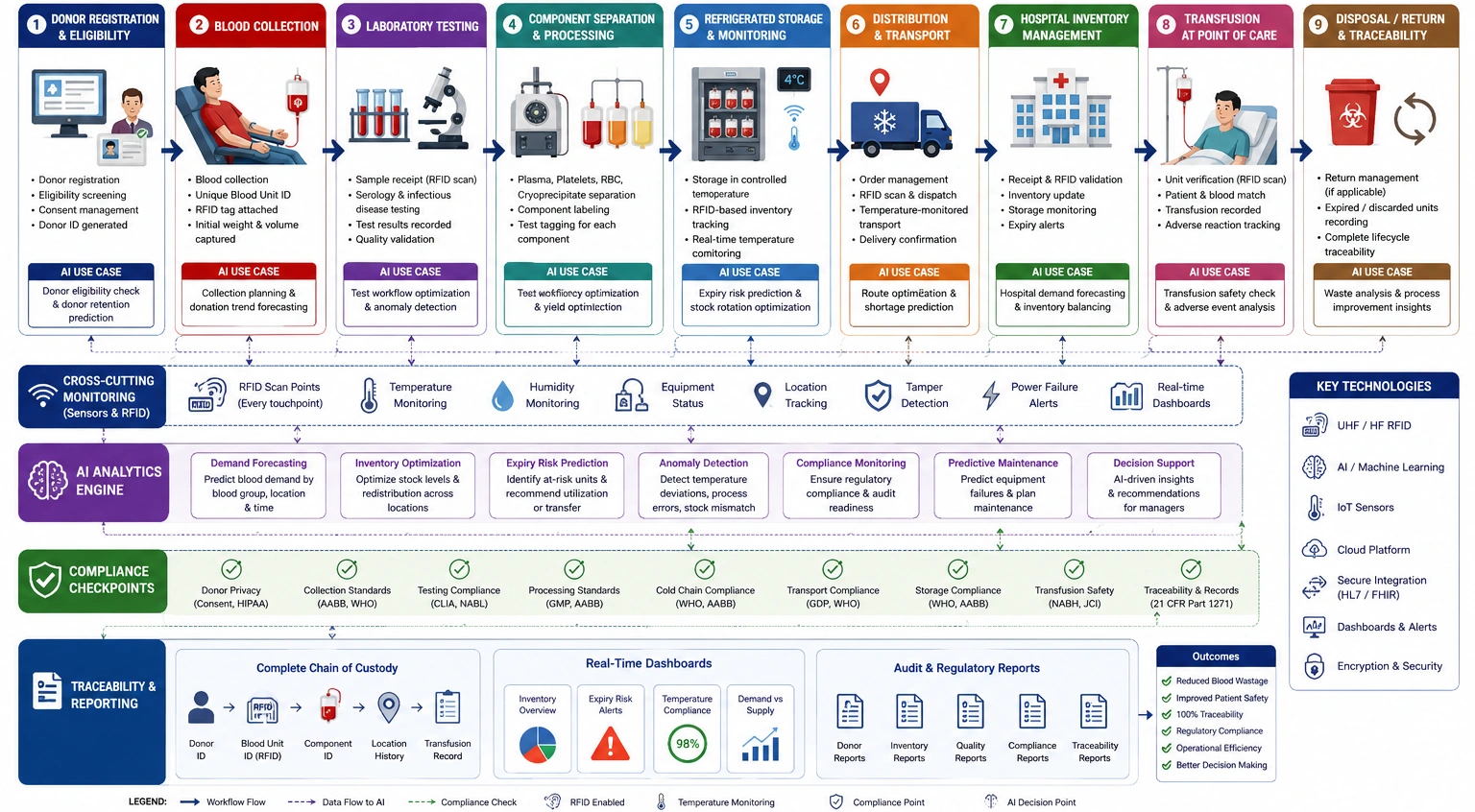
This workflow diagram illustrates the complete lifecycle of blood products, from donor registration and blood collection through laboratory testing, component processing, refrigerated storage, distribution, hospital inventory management, transfusion, and disposal tracking. The visual highlights how RFID technology, AI analytics, temperature monitoring, compliance checkpoints, and chain-of-custody reporting work together to improve blood safety, inventory visibility, regulatory compliance, and operational efficiency across blood bank operations.
Blood Bank Applications Benefiting from AI and RFID
Blood Collection and Donor Management
RFID-enabled identification improves tracking of collected units immediately after donation.
AI applications support:
- Donor eligibility analysis
- Donation pattern forecasting
- Collection campaign planning
- Geographic demand matching
- Donor retention analysis
These capabilities help collection centers align donation programs with projected blood demand.
Blood Component Processing
After collection, blood undergoes testing and component separation.
RFID tracking supports:
- Sample identification
- Laboratory workflow management
- Component traceability
- Quality control verification
- Processing status visibility
AI assists laboratory teams by identifying process delays, predicting throughput constraints, and optimizing resource utilization.
Blood Inventory Management
Inventory management represents one of the most significant AI use cases within blood banks.
AI models analyze:
- Blood type demand
- Product aging
- Usage velocity
- Inventory turnover
- Seasonal consumption patterns
- Emergency reserve requirements
RFID data provides the real-time operational visibility required to support these predictive models.
Benefits include:
- Reduced blood wastage
- Improved stock rotation
- Better inventory balancing
- Faster inventory audits
- Higher product availability
Blood Storage Monitoring
RFID-enabled storage systems provide automated visibility into product locations and storage conditions.
AI applications support:
- Temperature anomaly detection
- Storage utilization optimization
- Compliance monitoring
- Equipment performance analysis
- Predictive maintenance of refrigeration systems
Blood banks can identify risks before they affect product quality.
Blood Distribution and Logistics
Blood products often move between blood centers and healthcare facilities.
RFID-supported logistics tracking helps monitor:
- Shipment status
- Transportation conditions
- Delivery confirmation
- Inventory transfers
- Emergency redistribution
AI optimization engines can recommend the most effective allocation strategies during shortages or emergency response situations.
AI-Enabled RFID Blood Bank Deployment for Real-Time Inventory Visibility and Traceability
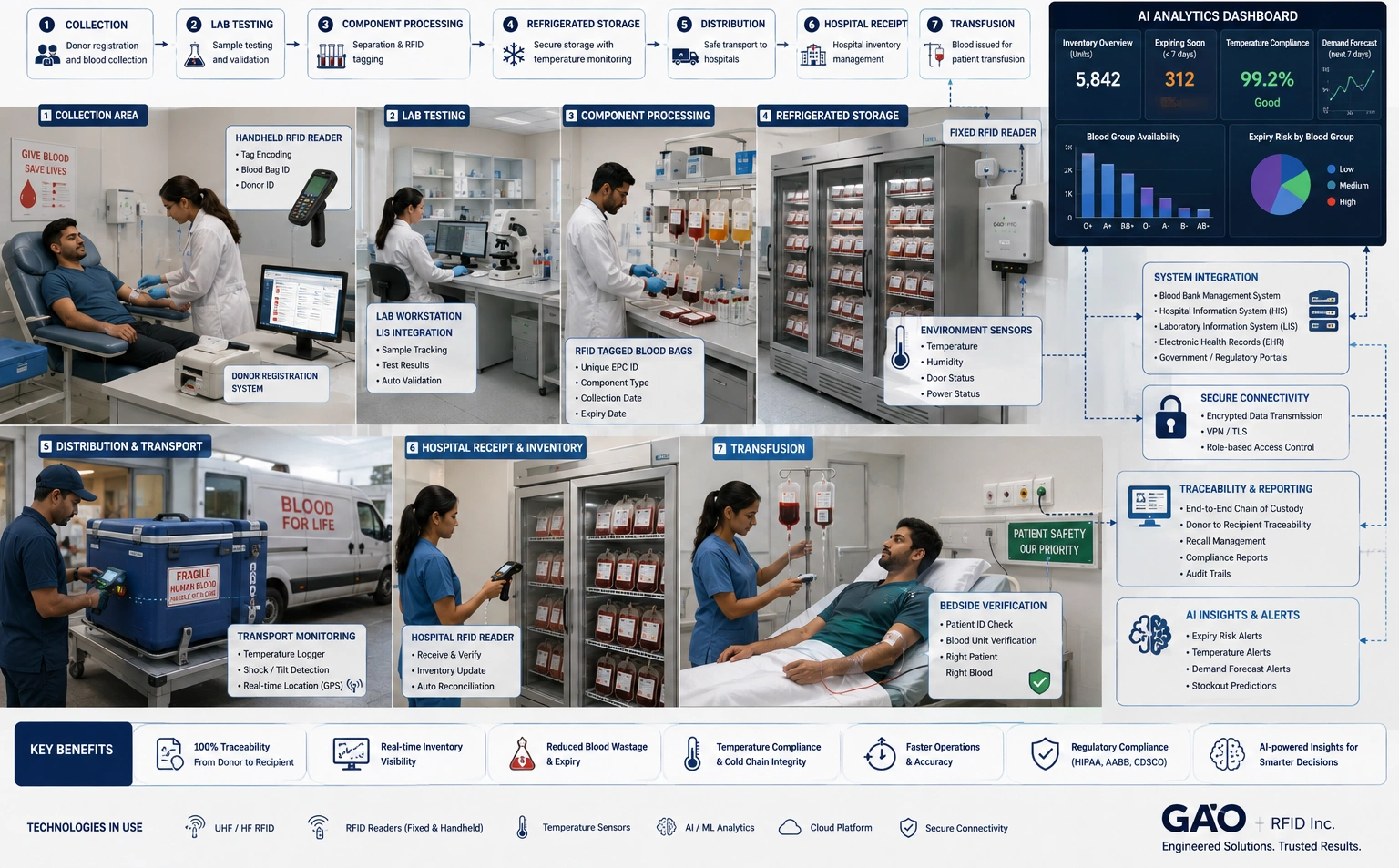
This illustration depicts a realistic blood bank environment where RFID-tagged blood products are tracked across collection, laboratory testing, component processing, refrigerated storage, distribution, hospital inventory management, and transfusion workflows. AI analytics, temperature monitoring, fixed and handheld RFID readers, and healthcare system integrations provide continuous visibility, compliance monitoring, and end-to-end traceability. The key takeaway is that combining RFID-generated operational data with AI-driven intelligence enables safer blood management, reduced wastage, stronger regulatory compliance, and more informed decision-making.
End-to-End Operational Workflow for AI-Enabled Blood Bank Management
Successful blood bank intelligence systems depend on a structured flow of information from physical blood products to operational decision-making processes.
Data Acquisition Layer
Data collection begins at blood donation centers and continues throughout the blood product lifecycle.
Primary data sources include:
- RFID-tagged blood units
- Donor management records
- Laboratory information systems
- Blood testing equipment
- Refrigeration monitoring systems
- Environmental sensors
- Transportation monitoring devices
- Hospital transfusion records
Each interaction generates operational data that contributes to real-time visibility.
Data Communication and Integration
Captured information is transmitted through healthcare information infrastructure using secure communication mechanisms.
Common integration points include:
- Blood bank management software
- Laboratory information systems (LIS)
- Electronic health records (EHR)
- Hospital information systems (HIS)
- Inventory management software
- Quality management systems
This integration ensures that blood inventory status remains synchronized across operational teams.
Edge Processing and Local Decision Support
Many blood banks require immediate operational responses.
Edge-based processing supports:
- Real-time inventory validation
- Local temperature monitoring
- Storage access control
- Exception detection
- Immediate alert generation
These functions reduce latency and improve responsiveness during critical events.
AI Analytics and Decision Intelligence
AI engines process operational data streams to generate insights related to inventory optimization, compliance, demand forecasting, and blood utilization efficiency.
The next section continues with deployment models, technical components, cybersecurity controls, cloud and server implementations, and engineering design considerations for AI-enabled RFID blood bank systems.
Technical Components, Deployment Models, Security, and Supporting Infrastructure
AI-enabled blood bank management solutions combine identification technologies, healthcare software, analytics engines, monitoring systems, and secure communication infrastructure to support safe blood product management throughout the supply chain.
RFID Hardware Components for Blood Banks
Blood bank deployments typically include:
- RFID-tagged blood bags
- RFID-tagged blood component containers
- Fixed RFID readers at storage locations
- Handheld RFID inventory readers
- RFID-enabled refrigerators and freezers
- RFID-enabled transportation containers
- Environmental monitoring sensors
- Temperature logging devices
- Network gateways
- Industrial computing devices
Each component contributes to real-time blood inventory visibility and traceability.
Software Components
Software systems commonly include:
- Blood bank management software
- Inventory management systems
- Laboratory information systems
- Quality management software
- Regulatory compliance software
- AI analytics software
- Reporting and audit systems
- Data integration middleware
- Alert management software
- Business intelligence dashboards
Healthcare organizations benefit when operational data is consolidated into a unified decision-support environment.
Artificial Intelligence Methods Used in Blood Banks
AI capabilities vary depending on operational objectives.
Common methods include:
- Machine learning demand forecasting
- Predictive inventory optimization
- Anomaly detection
- Time-series analysis
- Resource utilization optimization
- Predictive maintenance
- Risk scoring models
- Classification algorithms
- Natural language processing for incident reporting
- Reinforcement learning for inventory allocation
These techniques help blood banks transform operational data into measurable performance improvements.
Communication Infrastructure
Blood bank systems require reliable and secure communication.
Typical technologies include:
- Ethernet networks
- Wi-Fi infrastructure
- VPN connectivity
- Secure cloud connections
- Healthcare interoperability interfaces
- HL7 messaging
- FHIR integration standards
- API-based integrations
- Database synchronization services
Reliable communications ensure operational continuity across collection centers, laboratories, storage facilities, and hospitals.
Cloud Deployment Model
Cloud-hosted deployments are often appropriate for:
- Multi-site blood networks
- Regional blood centers
- National blood organizations
- Distributed healthcare systems
Advantages include:
- Centralized data visibility
- Simplified software updates
- Enhanced disaster recovery
- Scalable computing resources
- Centralized AI model management
- Cross-facility analytics
Cloud deployments are particularly effective when multiple blood centers must coordinate inventory balancing and shortage management.
Server-Based Deployment Model
Server-based implementations are commonly selected when organizations require:
- Greater infrastructure control
- Private healthcare data management
- Local processing requirements
- Strict data residency policies
- Isolated operational environments
Server deployments may be hosted within:
- Hospital data centers
- Healthcare private clouds
- Regional healthcare facilities
- Dedicated enterprise infrastructure
Many blood organizations adopt hybrid approaches that combine local processing with centralized analytics.
Security and Compliance Controls
Blood bank systems process highly sensitive healthcare information and require comprehensive protection measures.
Important controls include:
- Role-based access control
- Multi-factor authentication
- Data encryption
- Audit logging
- Secure device authentication
- Network segmentation
- Security monitoring
- Backup and recovery procedures
- Incident response workflows
- Regulatory compliance reporting
Healthcare organizations must align deployments with applicable healthcare regulations, blood safety standards, quality management requirements, and cybersecurity frameworks.
GAO has supplied RFID and IoT technologies to organizations that require reliable identification, traceability, monitoring, and operational visibility in highly regulated environments where security and data integrity are critical.
AI-Enabled RFID Blood Bank System Architecture for End-to-End Traceability and Compliance
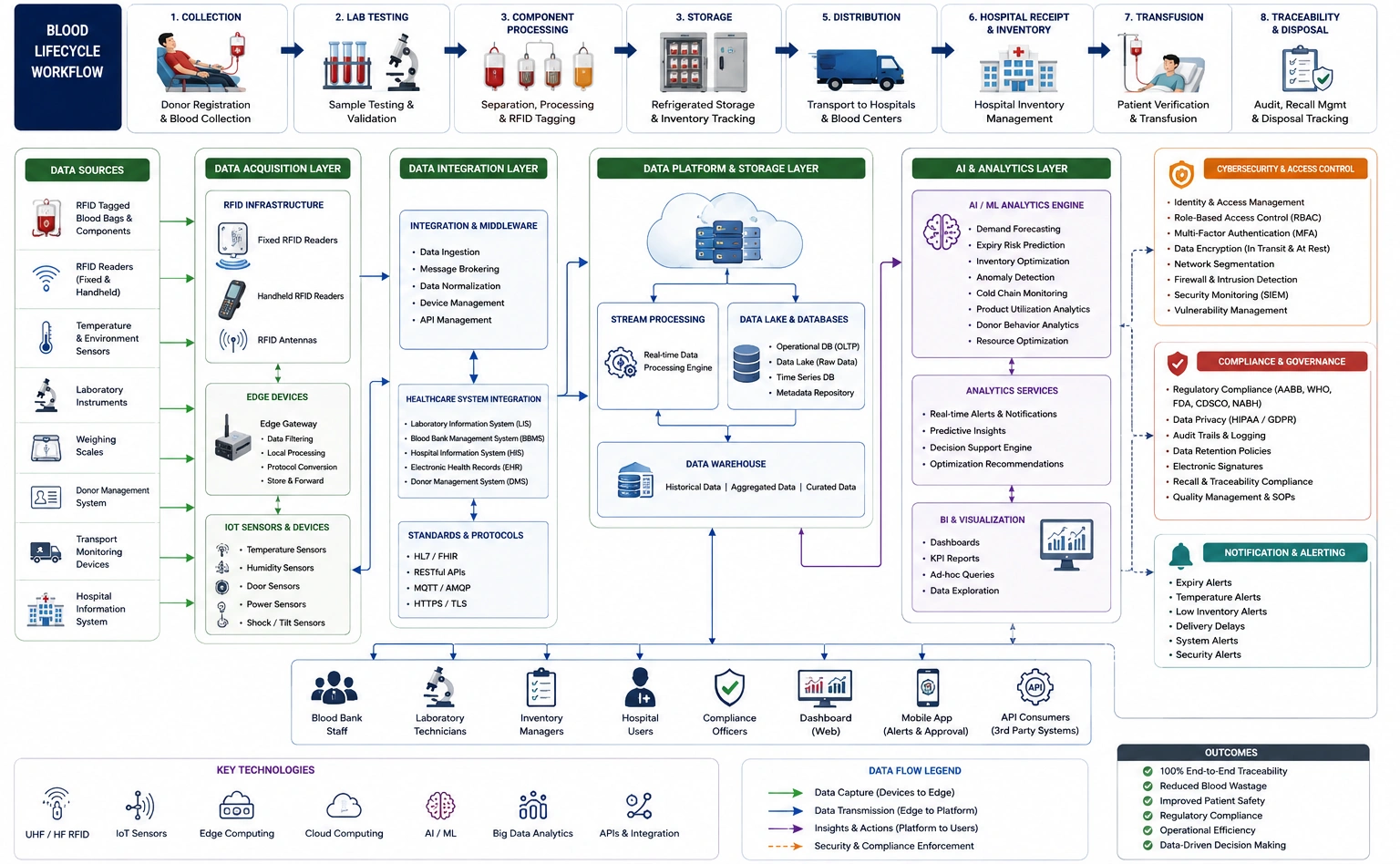
This system architecture diagram illustrates how RFID infrastructure, laboratory systems, edge devices, healthcare software, cloud services, AI analytics, and cybersecurity controls work together to manage blood products throughout their lifecycle. The visual shows data flow from donor registration and blood collection through testing, storage, distribution, transfusion, and disposal tracking. Its key takeaway is that AI-driven analytics combined with RFID-generated operational data enables real-time visibility, predictive decision-making, regulatory compliance, and improved patient safety across blood bank operations.
Technical and Operational Benefits of AI-Driven Blood Bank Intelligence
Reduced Blood Product Waste
Blood product expiration remains a significant challenge for healthcare providers.
AI models analyze inventory age, consumption rates, and regional demand trends to recommend optimal stock allocation strategies.
RFID visibility ensures accurate inventory status information is available when decisions are made.
Benefits include:
- Lower expiration rates
- Reduced disposal costs
- Improved utilization of donated blood
- Better inventory turnover
Improved Blood Availability
Shortages can affect patient care and emergency preparedness.
Predictive forecasting helps blood banks maintain appropriate inventory levels for:
- O-negative blood
- Rare blood groups
- Platelet inventories
- Emergency reserves
- Seasonal demand fluctuations
Improved planning supports continuity of patient care.
Enhanced Traceability
Every blood product movement can be automatically documented.
Traceability improvements support:
- Regulatory audits
- Recall management
- Quality investigations
- Patient safety programs
- Chain-of-custody verification
Comprehensive visibility reduces reliance on manual record keeping.
Faster Inventory Audits
Traditional inventory audits can consume substantial staff resources.
RFID-enabled inventory management allows personnel to rapidly identify:
- Product location
- Storage status
- Expiration dates
- Inventory discrepancies
- Missing units
Operational efficiency improves while administrative workload decreases.
Better Cold Chain Protection
AI continuously evaluates environmental conditions.
Benefits include:
- Early detection of refrigeration issues
- Reduced product spoilage risk
- Improved compliance reporting
- Better equipment utilization
- Enhanced storage reliability
Blood quality protection remains a primary objective throughout the supply chain.
Improved Resource Allocation
AI helps managers optimize:
- Staff scheduling
- Collection planning
- Distribution routes
- Storage utilization
- Equipment maintenance
These capabilities support more efficient blood bank operations.
Engineering Considerations for Successful Blood Bank Deployment
Healthcare organizations planning AI-enabled blood bank initiatives should evaluate operational requirements before selecting technologies and deployment approaches.
Important considerations include:
- Blood component tracking requirements
- Facility size and storage volume
- Regulatory obligations
- Existing healthcare software integration needs
- Cold chain monitoring requirements
- Data retention policies
- Cybersecurity requirements
- Disaster recovery objectives
- Multi-site coordination requirements
- Future scalability plans
Successful implementations generally begin with clearly defined operational objectives and measurable performance indicators.
Recommended Blood Bank KPIs
Organizations commonly measure:
- Blood expiration rate
- Inventory accuracy
- Stockout frequency
- Temperature compliance rate
- Blood utilization rate
- Inventory turnover
- Recall response time
- Audit preparation time
- Collection-to-transfusion cycle time
- Emergency fulfillment performance
These metrics help quantify operational improvements and return on investment.
Practical Implementation Lessons
Operational experience across healthcare environments demonstrates several recurring best practices:
- Standardize blood identification processes before deployment.
- Validate integration with laboratory and hospital systems early.
- Implement rigorous data quality controls.
- Establish inventory governance procedures.
- Train staff on exception management workflows.
- Test emergency response scenarios.
- Monitor KPI performance continuously.
- Review forecasting accuracy regularly.
- Conduct cybersecurity assessments periodically.
- Scale deployments incrementally where appropriate.
Organizations that combine process optimization with technology deployment typically achieve stronger long-term outcomes than those focusing solely on hardware implementation.
GAO’s experience supplying RFID, BLE, and IoT hardware products and systems has demonstrated the importance of combining reliable identification technologies with operational processes, quality controls, and effective system integration.
Advancing Blood Bank Operations Through AI-Driven Intelligence
AI-enabled blood bank management supported by RFID identification technologies provides healthcare organizations with greater visibility, stronger traceability, improved inventory control, and more effective blood utilization. By combining real-time operational data with predictive analytics, blood banks can reduce waste, strengthen regulatory compliance, improve patient safety, and respond more effectively to fluctuating demand.
Successful deployments require careful planning across identification technologies, healthcare software integration, security controls, operational workflows, and performance measurement. Blood organizations that adopt data-driven decision-making can better manage inventory lifecycles, support transfusion services, and maintain resilient blood supply operations.
As a trusted supplier of RFID, BLE, and IoT technologies, GAO supports healthcare organizations with hardware products, technical expertise, quality assurance processes, and deployment guidance that help improve visibility, traceability, and operational performance throughout critical healthcare environments. Headquartered in New York City and Toronto, GAO has served organizations across the United States and Canada for more than three decades, including Fortune 500 companies, leading research institutions, universities, and government agencies.
Building the Future of Industrial AI and IoT with Aperture Venture Studio and GAO RFID Inc.
To further accelerate innovation across AI and IoT applications, we established Aperture Venture Studio to help advance and scale practical AI and connected-technology initiatives that support organizations across multiple sectors, including healthcare.
Aperture has attracted leading AI and IoT technical experts, operational leaders, investors, and technology-focused organizations. Through initiatives such as Aperture Ventures Summit and TekSummit, we continue to foster collaboration around advanced AI, RFID, BLE, and IoT technologies.
These efforts have helped create strong technical communities focused on the future of AI and IoT. We welcome participation from:
- Advisors, co-founders, and employees
- Investors
- Customers seeking advanced AI and IoT solutions