
AI and RFID for Border Security
AI-Driven Border Security Using RFID for Smarter Government Border Protection
Modern border security requires much more than physical barriers and manual inspections. Increasing cross-border travel, international trade, transnational crime, illegal immigration, customs fraud, and national security threats require government agencies to process large volumes of people, vehicles, cargo, and assets while maintaining high levels of security and operational efficiency. AI-driven border security supported by RFID enables customs authorities, immigration agencies, border patrol organizations, and government security agencies to transform traditional border inspection into an intelligent, data-driven operation. Rather than simply identifying tagged assets, RFID continuously captures movement data from vehicles, shipping containers, travel documents, cargo pallets, security equipment, personnel, and controlled assets. Artificial intelligence analyzes these data streams to detect anomalies, assess operational risks, prioritize inspections, optimize resource allocation, and support faster decision-making. Combined with computer vision, IoT sensors, biometric systems, geospatial intelligence, and predictive analytics, RFID becomes a critical data acquisition technology supporting intelligent border management. GAO has supplied RFID hardware and industrial IoT solutions to government organizations, research institutions, and large enterprises throughout North America, helping customers deploy reliable identification and tracking systems for mission-critical operations.
Intelligent Border Security Powered by AI and RFID
Border security has evolved into a highly connected operational environment where thousands of assets, travelers, transport vehicles, inspection stations, surveillance systems, and customs operations generate continuous streams of operational information. Artificial Intelligence of Things (AIoT) combines artificial intelligence with RFID, connected sensors, surveillance equipment, edge computing devices, communication networks, and operational software to improve visibility throughout border crossings, ports of entry, customs inspection facilities, and remote surveillance areas. Within border security operations, RFID primarily functions as a trusted identification and event-capture technology. AI converts those identification events into operational intelligence by learning normal traffic behavior, identifying suspicious movement patterns, predicting congestion, supporting risk-based inspections, and improving allocation of border personnel. Government agencies increasingly use AI-assisted RFID solutions to support:
- Automated border checkpoint operations
- Customs cargo inspection
- Trusted traveler programs
- High-security asset tracking
- Vehicle identification
- Secure equipment accountability
- Evidence chain of custody
- Temporary detention management
- Patrol equipment inventory
- Border infrastructure monitoring
- Cross-border logistics visibility
- Emergency response coordination
Unlike traditional checkpoint operations that rely heavily on manual verification, AI continuously evaluates operational conditions while RFID supplies accurate identification data throughout the border security process.
AI-Enabled RFID Border Security Solution for Intelligent Government Border Management
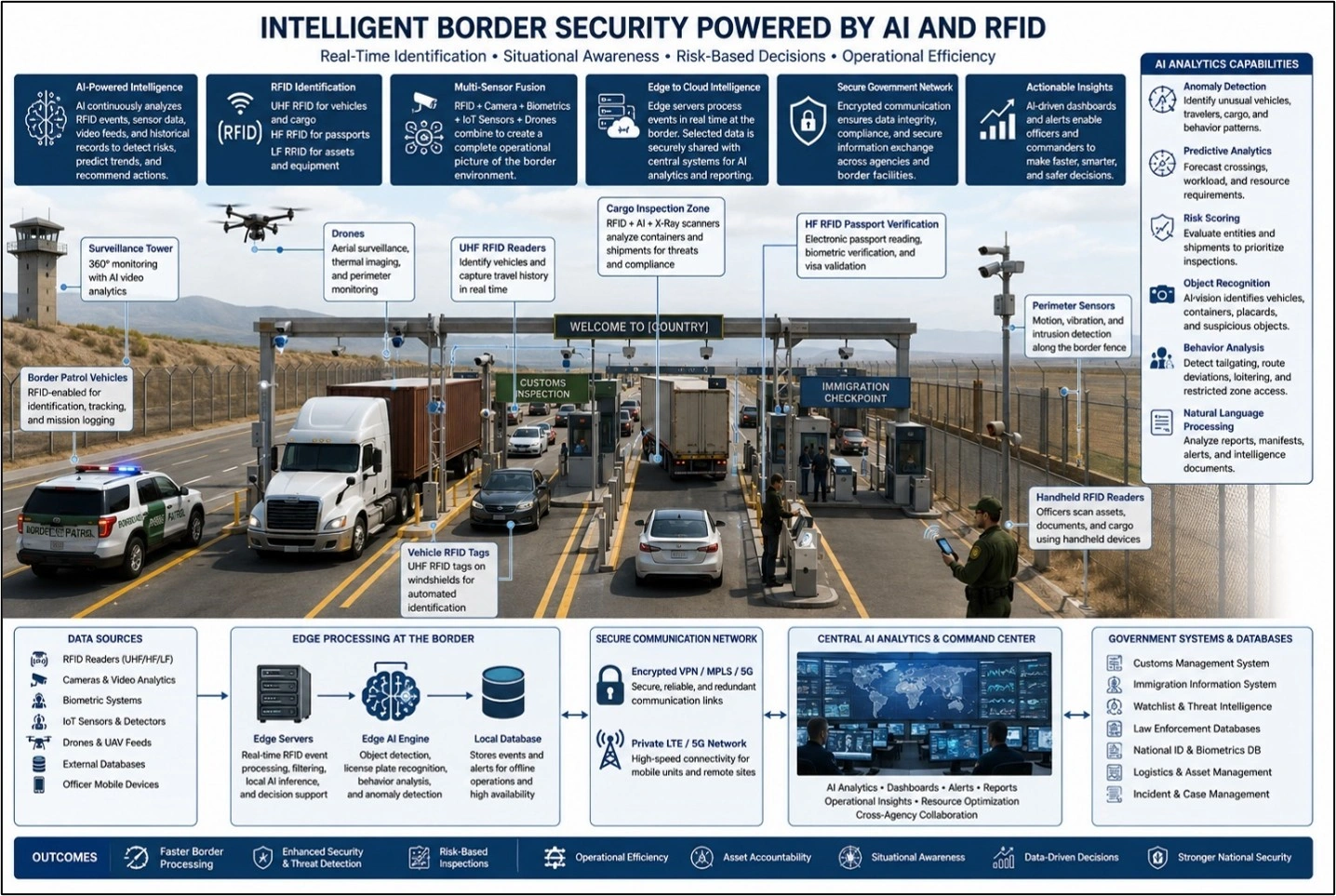
This diagram illustrates a comprehensive AI-enabled RFID border security solution integrating international border crossings, customs inspection lanes, immigration checkpoints, cargo inspection zones, surveillance systems, biometric verification, drones, edge AI, and government command centers. It demonstrates how RFID-generated identification data flows through secure communication networks into AI analytics to support real-time threat detection, risk-based inspections, operational visibility, and faster border security decision-making.
Why AI Is Reshaping Modern Border Security Operations
Border agencies must simultaneously balance security, traveler experience, customs compliance, operational efficiency, and national security. Manual inspection alone cannot effectively process millions of travelers and cargo movements while identifying relatively rare but high-risk threats. Common operational challenges include:
- High traveler volumes during peak crossings
- Increasing international freight movement
- Customs declaration fraud
- Cargo tampering
- Unauthorized border crossings
- Vehicle identity fraud
- Smuggling activities
- Limited inspection personnel
- Long vehicle queues
- Manual asset inventory
- Delayed intelligence sharing
- Equipment accountability
- Border infrastructure maintenance
- Inspection lane congestion
- False identity documents
- Operational blind spots across multiple border facilities
Artificial intelligence addresses these challenges by learning operational behavior across numerous border checkpoints rather than relying solely on predefined rules. AI models continuously analyze RFID reads, surveillance feeds, inspection histories, travel patterns, customs declarations, geolocation information, and sensor telemetry to recommend operational actions. Examples include:
- Predicting inspection lane congestion before queues develop
- Identifying abnormal cargo routing
- Detecting unauthorized vehicle movements
- Prioritizing high-risk shipments
- Forecasting equipment maintenance
- Recommending additional inspection resources
- Monitoring patrol asset utilization
- Detecting unusual border crossing behavior
- Supporting coordinated multi-agency responses
Because RFID produces reliable identification data, AI models operate with significantly higher confidence than systems relying only on camera recognition or manual data entry.
Border Security Applications Where AI Uses RFID Data
Border security encompasses numerous operational environments, each requiring different combinations of RFID technologies, AI models, communication systems, and government software.
Intelligent Vehicle Border Processing
Vehicles entering border crossings can carry RFID windshield tags or secure government-issued identifiers. AI evaluates:
- Historical crossing frequency
- Vehicle inspection history
- License plate recognition
- Customs declarations
- Cargo manifests
- Travel risk indicators
- Inspection lane utilization
The result is intelligent lane assignment, reduced congestion, and more effective allocation of customs inspection resources.
Customs Cargo Inspection
Large freight volumes require customs agencies to rapidly determine which shipments warrant additional inspection. RFID identifies:
- Shipping containers
- Cargo pallets
- Sealed trailers
- High-value goods
- Inspection status
- Customs checkpoints
AI correlates these records with:
- Trade documentation
- Container movement history
- Import/export records
- Risk scoring
- Geospatial movement
- Historical anomalies
This enables risk-based customs inspections instead of random inspection strategies.
Secure Government Asset Tracking
Border agencies manage thousands of operational assets distributed across multiple facilities. Examples include:
- Firearms
- Tactical equipment
- Radios
- Surveillance drones
- Portable scanners
- Inspection tools
- Medical kits
- Patrol vehicles
- Evidence containers
- IT equipment
RFID automates asset visibility while AI predicts shortages, identifies abnormal movement, and improves equipment lifecycle management.
Immigration Document Verification
HF RFID embedded in electronic passports enables secure traveler identification. AI supplements passport verification by analyzing:
- Travel history
- Watchlists
- Biometric verification
- Border crossing frequency
- Identity consistency
- Inspection outcomes
Rather than replacing immigration officers, AI assists them by highlighting unusual travel patterns requiring additional review.
Temporary Evidence and Seized Goods Management
Border enforcement agencies frequently seize goods involved in customs violations. RFID simplifies chain-of-custody tracking while AI monitors:
- Storage duration
- Evidence movement
- Custody transfers
- Storage capacity
- Regulatory compliance
This reduces manual documentation while improving accountability.
Border Infrastructure Monitoring
Border facilities contain numerous critical infrastructure assets. Examples include:
- Access gates
- Surveillance towers
- Inspection booths
- Communications equipment
- Mobile inspection stations
- Power systems
- Network cabinets
- Security barriers
AI analyzes RFID maintenance records alongside sensor information to predict failures before operational disruptions occur.
AI-Powered RFID Applications for Intelligent Border Security Operations
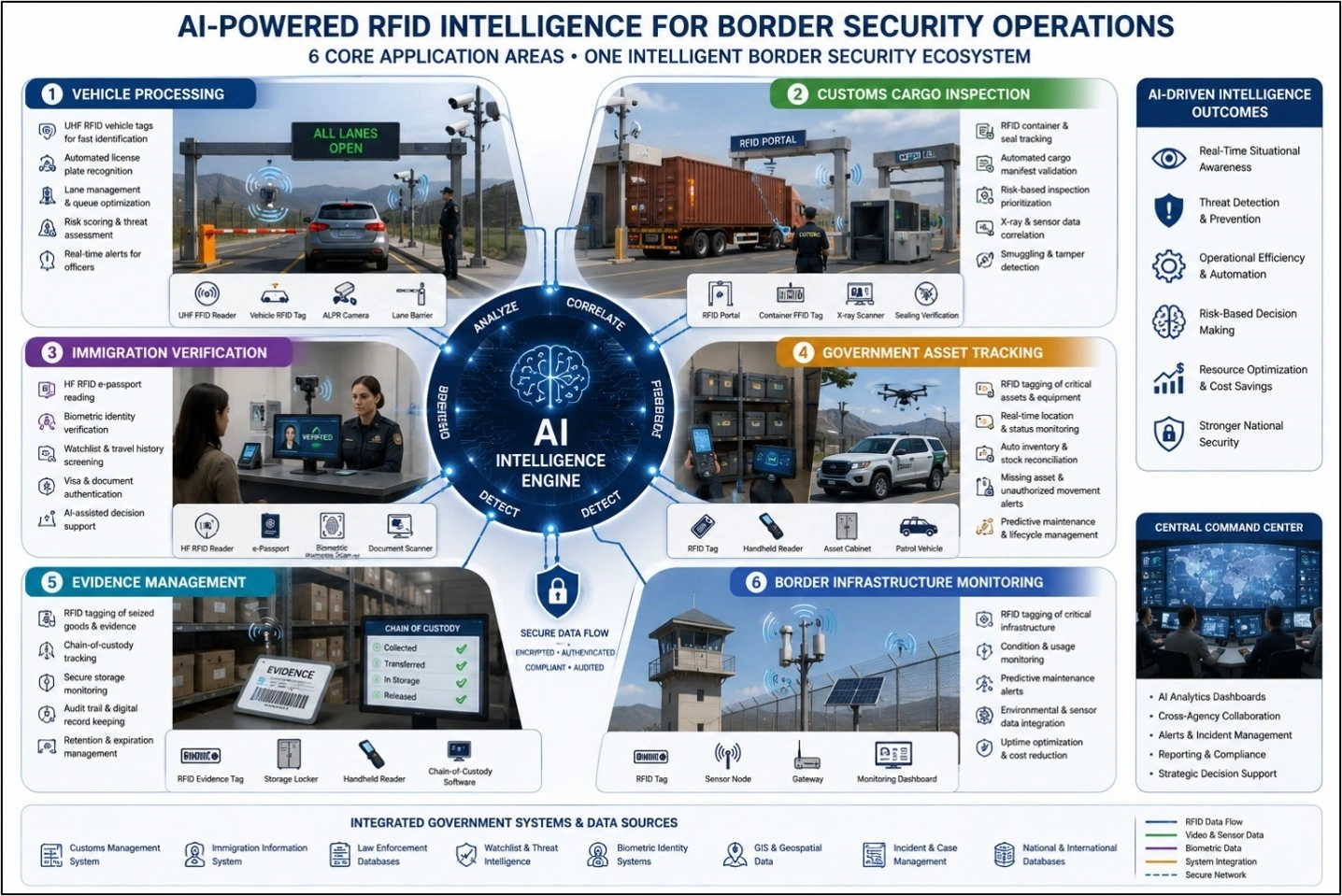
This infographic illustrates six core border security applications where AI leverages RFID-generated intelligence: vehicle processing, customs cargo inspection, immigration verification, government asset tracking, evidence management, and border infrastructure monitoring. It demonstrates how a centralized AI intelligence engine integrates RFID data with biometric systems, surveillance technologies, and secure government databases to improve threat detection, operational efficiency, situational awareness, and data-driven border security decisions.
Operational Workflow of AI-Enabled RFID Border Security
Successful border security depends on transforming millions of RFID identification events into operational decisions with minimal delay. The complete workflow integrates field hardware, secure communications, intelligent software, analytics, and government information systems.
RFID Data Acquisition
RFID data originates from numerous operational environments, including:
- Vehicle inspection lanes
- Cargo entry gates
- Customs warehouses
- Immigration checkpoints
- Equipment storage rooms
- Border patrol facilities
- Temporary inspection sites
- High-security access points
Depending on operational requirements, UHF RFID supports long-range vehicle and cargo identification, HF RFID secures electronic passport verification, and LF RFID may be used for specialized identification scenarios involving harsh environments or legacy systems. Readers capture tag identifiers, timestamps, antenna location, signal characteristics, and movement direction. Fixed readers monitor inspection lanes and warehouse portals, while handheld readers support mobile inspections and inventory verification by officers in the field.
Secure Communication Infrastructure
Captured RFID events are transmitted through resilient communication networks that may include:
- Gigabit Ethernet
- Fiber-optic backbones
- Secure Wi-Fi
- Private LTE
- 5G government networks
- VPN tunnels
- Message queuing services
Communication paths are designed with redundancy to maintain continuous operation even during network disruptions. Encryption and mutual authentication protect RFID traffic from interception or unauthorized access.
Edge Processing and Event Filtering
Edge servers positioned at border facilities perform the first stage of data processing. Duplicate tag reads, incomplete records, and transient events are filtered before forwarding validated events to central software. Local processing enables rapid responses such as opening authorized vehicle barriers, updating inspection lane occupancy, or alerting officers to unauthorized equipment movement without waiting for cloud processing.
Middleware and Government Software Integration
RFID middleware aggregates validated events and synchronizes them with government information systems. Typical integrations include customs management systems, immigration databases, border management software, law enforcement records, asset management applications, maintenance management software, geographic information systems (GIS), and security information and event management (SIEM) solutions. Application programming interfaces (APIs), message brokers, and standardized data formats enable interoperability between legacy government systems and modern AI-driven analytics.
AI Analytics and Decision Support
Machine learning models analyze historical and real-time RFID events together with biometric verification results, computer vision outputs, cargo manifests, customs declarations, inspection histories, and geospatial information. Techniques such as anomaly detection, predictive maintenance, route optimization, risk scoring, and time-series forecasting help identify abnormal border activity, prioritize inspections, and optimize staffing levels. Operational dashboards present actionable recommendations to customs officers, border patrol supervisors, and command centers, enabling faster and more informed decisions while maintaining compliance with government security policies.
End-to-End AI-Enabled RFID Border Security Workflow for Intelligent Government Operations
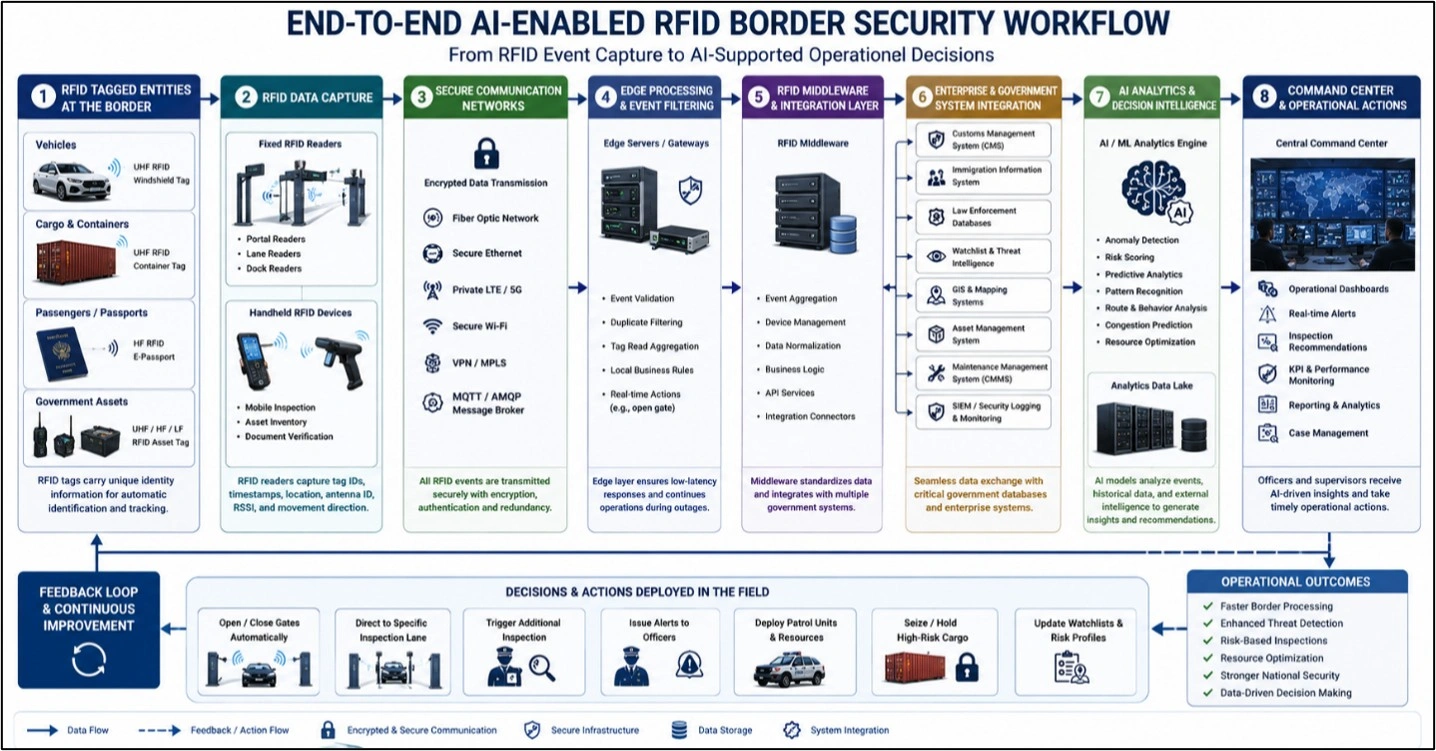
This workflow diagram illustrates the complete operational lifecycle of an AI-enabled RFID border security system, from RFID event capture on vehicles, cargo, passports, and government assets through secure communications, edge processing, middleware, AI analytics, and integration with government systems. It demonstrates how real-time RFID data is transformed into actionable intelligence that supports risk-based inspections, operational dashboards, automated alerts, and informed decision-making by border security personnel.
Core Technologies Supporting AI-Enabled Border Security Solutions
Delivering reliable AI-assisted border security requires coordinated integration of identification hardware, communication infrastructure, intelligent software, cybersecurity controls, and deployment models. At GAO, we help government organizations select components that align with operational requirements, regulatory obligations, and long-term scalability rather than adopting a one-size-fits-all solution.
RFID Hardware and Field Devices
A typical deployment combines multiple RFID technologies to match operational environments:
- UHF RFID readers for vehicle identification, cargo portals, freight yards, and logistics checkpoints where long read ranges and high throughput are required.
- HF RFID readers for electronic passports, identity documents, secure credentials, and controlled access points requiring short-range, high-security interactions.
- LF RFID devices for specialized government assets or legacy applications operating in environments where low-frequency performance offers advantages.
Supporting field equipment commonly includes rugged handheld readers, fixed portal readers, directional antennas, gate controllers, industrial RFID printers, environmental sensors, edge gateways, and backup power systems to ensure uninterrupted operation during critical border activities.
AI Software, Analytics, and Supporting Systems
AI software extends beyond simple identification by processing RFID events alongside data from computer vision systems, biometric verification, license plate recognition, drone surveillance, radar feeds, and operational databases. Common analytical functions include anomaly detection, predictive maintenance, inspection prioritization, traffic forecasting, asset utilization analysis, and operational trend monitoring.
Communication Protocols and System Interoperability
Border security solutions depend on reliable communication between field devices, local processing systems, centralized software, and government information systems. Since border checkpoints often operate continuously in demanding environments, communication infrastructure must provide high availability, low latency, redundancy, and strong cybersecurity. Common communication technologies include:
- Ethernet for fixed RFID readers and edge servers
- Fiber-optic networks connecting inspection facilities and command centers
- Secure Wi-Fi for handheld inspection devices
- Private LTE and 5G for mobile patrol units and remote border locations
- VPN tunnels for encrypted communications between geographically distributed facilities
- HTTPS and TLS for secure web services
- MQTT for lightweight IoT messaging
- AMQP or message queue services for reliable event distribution
- RESTful APIs for software integration
- JSON and XML for standardized data exchange
- SNMP for infrastructure monitoring
- NTP for synchronized timestamps across distributed border facilities
Interoperability is equally important. Border security operations rarely rely on a single software system. Instead, RFID events are shared with multiple government systems responsible for customs processing, immigration, law enforcement, intelligence, logistics, maintenance, and operational reporting. Open standards and well-documented APIs simplify integration while reducing future modernization costs.
AI Models Supporting Border Security Decisions
Different AI models address different operational objectives within border security.
Machine Learning
Supervised learning models classify cargo, vehicles, and operational events based on historical inspection outcomes, helping customs agencies prioritize inspections while reducing unnecessary delays.
Anomaly Detection
Unsupervised learning identifies unusual crossing behavior that deviates from historical traffic patterns, such as unexpected vehicle movements, repeated border crossings, abnormal cargo routing, or unauthorized equipment relocation.
Computer Vision
Vision models process surveillance cameras, automated license plate recognition (ALPR), X-ray scanners, thermal cameras, and drone imagery. RFID provides reliable identity data that complements visual observations, reducing false positives.
Predictive Analytics
Time-series forecasting predicts:
- Border crossing volumes
- Customs workload
- Equipment maintenance schedules
- Inspection lane demand
- Staffing requirements
- Seasonal traffic fluctuations
Optimization Algorithms
AI continuously recommends improved allocation of inspection officers, customs resources, mobile patrols, and inspection lanes to minimize congestion while maintaining security.
Natural Language Processing
Government agencies often manage large volumes of inspection reports, customs declarations, intelligence bulletins, and operational logs. NLP assists analysts by extracting relevant information, identifying trends, and supporting investigative workflows.
Cloud Version Versus Server Version
Selecting an appropriate deployment model depends on operational requirements, regulatory obligations, cybersecurity policies, network availability, and data sovereignty considerations.
Cloud Version
The Cloud Version hosts RFID software, AI analytics, reporting dashboards, and centralized management services within a secure cloud environment managed by the solution provider or an approved government cloud service. Cloud deployment is generally appropriate when organizations require:
- Rapid implementation
- Multi-site border management
- Centralized software updates
- Elastic computing resources
- Disaster recovery capabilities
- Remote operational visibility
- Lower infrastructure management overhead
Cloud-hosted systems are particularly suitable for national customs agencies operating numerous border crossings that benefit from centralized AI model management and cross-site operational intelligence.
Server Version
The Server Version deploys software on customer-managed infrastructure, which may include secure government data centers, privately hosted cloud environments, regional command facilities, edge servers, or classified operational networks. Server deployments are often preferred when agencies require:
- Complete control over operational data
- Compliance with classified network policies
- Integration with isolated government systems
- Very low latency decision making
- Local processing during communication outages
- Customer-managed cybersecurity controls
- Support for disconnected operational environments
Many national border agencies adopt hybrid deployments in which edge servers perform immediate operational decisions locally while selected operational information is synchronized with centralized government systems for long-term analytics.
Cloud vs. Server Deployment Models for AI-Enabled RFID Border Security Systems
| Feature | Cloud Version | Server Version |
|---|---|---|
| Infrastructure Ownership | Hosted and managed by the cloud service provider or an approved government cloud environment. | Deployed on customer-managed servers, private data centers, edge servers, or government-owned infrastructure. |
| Cybersecurity Control | Shared responsibility with provider-managed infrastructure, security monitoring, and software updates. | Full control over cybersecurity policies, network segmentation, access controls, encryption, and security operations. |
| Deployment Speed | Rapid deployment with minimal infrastructure preparation, typically within days or weeks. | Longer deployment due to server procurement, installation, configuration, security validation, and integration. |
| Scalability | Elastic resource allocation supports fluctuating border traffic, seasonal demand, and multi-site expansion. | Scaling requires additional hardware, storage, and computing resources, making expansion more deliberate. |
| Latency | Slightly higher latency because data traverses external networks before AI processing. | Very low latency through local processing, making it suitable for real-time operational decisions. |
| Regulatory Compliance | Supports government-certified cloud environments and standardized compliance frameworks where permitted. | Ideal for agencies requiring strict regulatory compliance, classified environments, and agency-controlled security policies. |
| Data Sovereignty | Data is stored within approved cloud regions according to government data residency requirements. | Complete control over where operational data is stored, processed, and retained within government infrastructure. |
| Disaster Recovery | Built-in redundancy, automated backups, geographic replication, and rapid disaster recovery capabilities. | Disaster recovery depends on agency-designed backup systems, redundancy, and business continuity planning. |
| Maintenance Responsibility | Infrastructure maintenance, software updates, patches, and monitoring are primarily managed by the provider. | Government IT teams manage hardware, operating systems, software updates, security patches, and maintenance schedules. |
| Integration Flexibility | Easily integrates with cloud services, centralized analytics, APIs, and multi-site government software. | Provides extensive customization and direct integration with isolated, legacy, or classified government systems. |
| Operational Resilience | High availability through redundant cloud infrastructure, automatic failover, and managed services. | Maintains operations during external network disruptions through localized processing and agency-managed resilience. |
| AI Processing | Centralized AI models analyze data collected from multiple border crossings and regional facilities. | AI processing occurs locally on edge servers or government infrastructure, supporting immediate operational responses. |
| Remote Accessibility | Secure access to dashboards, reports, and operational analytics from authorized locations. | Remote access is controlled by agency security policies and may be restricted in highly secure environments. |
| Best Suited For | National customs agencies, multi-site border management, distributed operations, rapid deployment, and centralized analytics. | Classified border facilities, defense-related border operations, isolated government networks, mission-critical checkpoints, and environments requiring maximum security and local control. |
This comparison table evaluates Cloud Version and Server Version deployment models for AI-enabled RFID border security solutions across key technical and operational criteria, including cybersecurity, scalability, latency, regulatory compliance, data sovereignty, disaster recovery, and integration flexibility. It helps government agencies determine the most appropriate deployment approach based on mission requirements, security policies, operational environments, and infrastructure management preferences.
Technical Capabilities of AI-Enabled RFID Border Security
Combining AI with RFID significantly expands operational capabilities beyond simple identification and asset tracking. Government agencies gain continuous situational awareness, improved decision support, and higher operational efficiency across border checkpoints and supporting facilities. Key technical capabilities include:
- Automated vehicle identification
- Intelligent cargo verification
- Real-time asset visibility
- Continuous traveler flow analysis
- Dynamic inspection prioritization
- Automated equipment accountability
- Predictive maintenance of border infrastructure
- Risk-based customs processing
- Secure chain-of-custody management
- Multi-site operational visibility
- AI-assisted incident detection
- Automated operational reporting
- Historical trend analysis
- Resource utilization optimization
- Cross-agency information sharing
Each capability is supported by continuous RFID event collection and AI-driven analysis that converts operational data into timely recommendations for officers and supervisors.
Operational Improvements Across Border Security
AI-assisted RFID solutions improve nearly every stage of border operations by reducing manual processes, increasing visibility, and enabling proactive decision-making.
Faster Border Processing
Continuous RFID identification minimizes repetitive manual checks for vehicles, cargo, and government equipment. AI dynamically balances inspection lanes based on predicted traffic, reducing congestion while maintaining inspection quality.
Improved Risk-Based Inspections
Rather than inspecting every shipment equally, AI evaluates historical inspection records, customs declarations, transportation routes, and RFID movement history to identify higher-risk cargo requiring additional examination.
Enhanced Government Asset Accountability
Border agencies manage extensive inventories of firearms, communications equipment, surveillance devices, medical supplies, and tactical assets. RFID automates inventory while AI identifies missing equipment, unusual movement patterns, and underutilized resources.
Better Infrastructure Availability
Maintenance records linked to RFID-tagged infrastructure components allow AI to forecast equipment failures before operational disruptions occur. Preventive maintenance reduces unexpected downtime at inspection facilities.
Increased Situational Awareness
Command centers receive continuously updated operational dashboards showing border activity, inspection workloads, equipment status, traveler throughput, and operational alerts, enabling faster response to changing conditions.
Stronger Multi-Agency Coordination
Shared operational intelligence improves coordination between customs authorities, immigration services, border patrol units, transportation agencies, emergency responders, and law enforcement organizations.
Real-World AI-Enabled RFID Border Security Deployment at a Modern Government Checkpoint
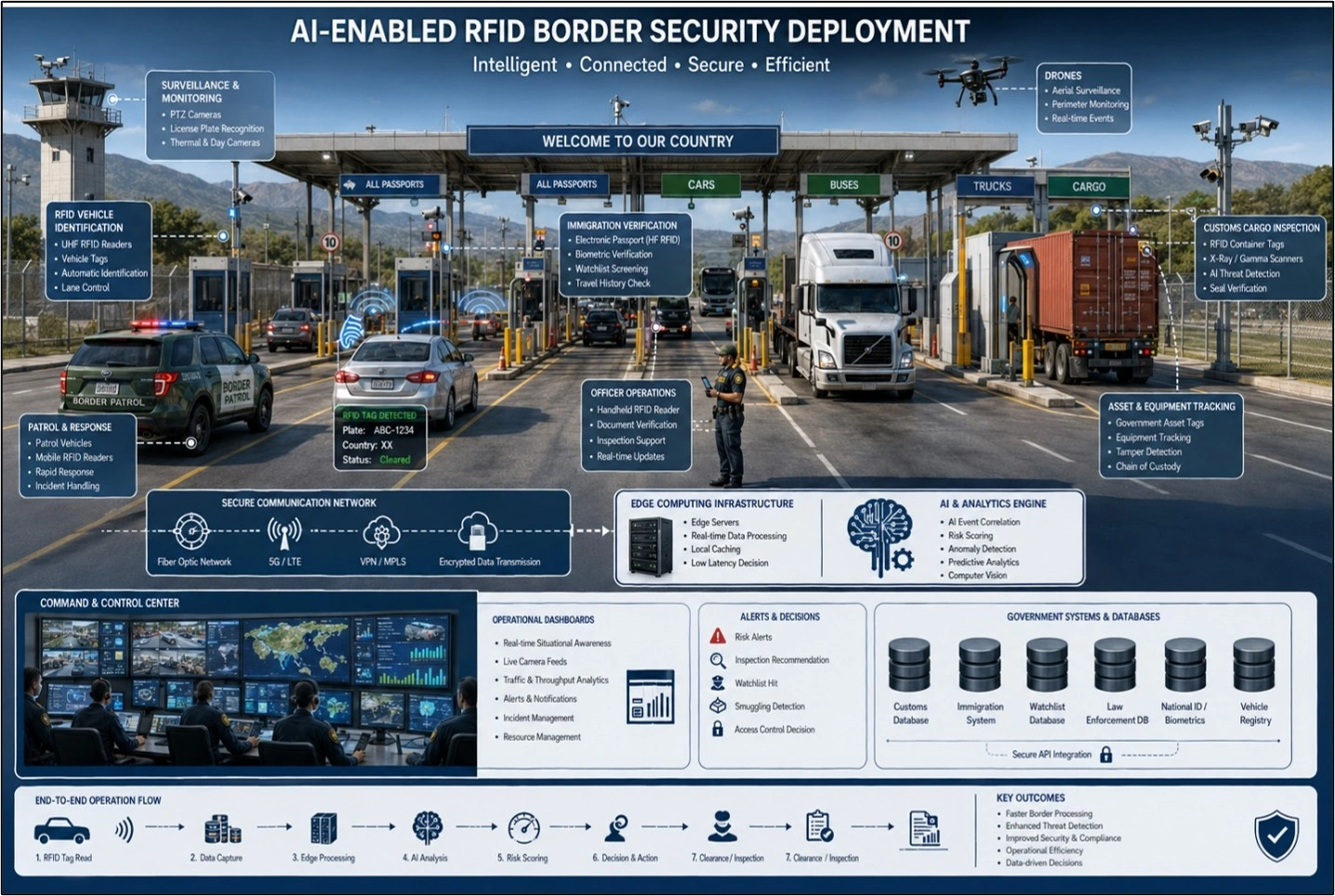
This deployment diagram illustrates a complete AI-enabled RFID border security solution operating at a modern government border crossing. It shows how RFID vehicle identification, electronic passport verification, cargo inspection, handheld RFID readers, surveillance systems, drones, edge computing, AI analytics, secure communication networks, and government databases work together to support real-time monitoring, risk-based inspections, faster border processing, and informed operational decision-making.
Business Benefits for Government Border Security
Government organizations implementing AI-enabled RFID solutions can realize measurable operational, financial, and security benefits. Key benefits include:
- Reduced border crossing delays
- Improved customs processing efficiency
- Higher inspection accuracy
- Lower manual administrative workload
- Increased operational transparency
- Better utilization of inspection personnel
- Reduced equipment loss
- Improved regulatory compliance
- Enhanced traveler experience
- Faster incident response
- More accurate operational reporting
- Improved infrastructure utilization
- Lower maintenance costs
- Better allocation of security resources
- Stronger national security readiness
These benefits become increasingly significant as border agencies process growing volumes of travelers, commercial freight, and government assets without proportionally increasing staffing levels.
Engineering Considerations and Deployment Best Practices
Successful AI-enabled RFID implementations require careful engineering planning beyond hardware installation. Recommended practices include:
- Conduct detailed RF site surveys before reader installation.
- Select RFID frequencies appropriate for passports, vehicles, cargo, and government assets.
- Design overlapping reader coverage to minimize blind spots.
- Establish redundant communication paths for mission-critical facilities.
- Encrypt RFID communications using government-approved cybersecurity policies.
- Integrate RFID software using standardized APIs whenever possible.
- Validate AI models using representative operational datasets before deployment.
- Monitor model performance continuously to detect concept drift.
- Implement role-based access control for operational software.
- Maintain comprehensive audit logs supporting government investigations.
- Schedule regular calibration of RFID readers and antennas.
- Periodically review AI recommendations with operational personnel to ensure continued accuracy.
Drawing on more than three decades of serving customers across the United States and Canada, including Fortune 500 organizations, leading research institutions, universities, and government agencies, GAO has helped organizations deploy RFID hardware and IoT systems supported by rigorous quality assurance processes and expert technical assistance delivered remotely or onsite.
AI-Enabled RFID Border Security: Key Takeaways
AI-enabled border security transforms RFID from a reliable identification technology into a continuous source of operational intelligence. By integrating RFID with AI, computer vision, IoT sensors, secure communications, and government software, border agencies gain improved visibility across vehicles, cargo, travelers, assets, and infrastructure while strengthening national security and operational efficiency. Successful deployments require careful planning of RFID coverage, secure communications, AI model governance, software interoperability, and cybersecurity controls. Agencies should also evaluate Cloud Version, Server Version, or hybrid deployments based on regulatory requirements, operational resilience, latency expectations, and data sovereignty policies. Headquartered in New York City and Toronto, GAO is recognized among the world’s leading B2B and government-focused suppliers of RFID and BLE technologies. We continue supporting government organizations by providing RFID hardware, IoT systems, engineering expertise, and technical guidance that help build secure, scalable, and reliable border security solutions. We encourage readers to explore GAO’s RFID technologies, technical resources, and expert support to learn how intelligent identification can strengthen modern border operations.
Building the Future of Industrial AI and IoT with Aperture Venture Studio and GAO RFID Inc.
For more than three decades, GAO Group of Companies has invested extensively in research and development of industrial RFID, BLE, and IoT technologies. As generative AI has matured into a practical tool for government and industrial applications, we have expanded our work in AI, RFID, BLE, and AIoT solutions while establishing Aperture Venture Studio to accelerate the development and advancement of AI and IoT technologies for sectors such as border security and other critical government operations. Aperture has attracted leading AI researchers, IoT specialists, experienced operational executives, investors, and technology organizations. Through initiatives such as the Aperture Ventures Summit and TekSummit, we continue fostering technical collaboration and knowledge sharing across the AI and IoT community. We welcome advisors, employees, investors, and customers who wish to contribute to the advancement of intelligent government technology solutions.