
AI and RFID for Calibration Laboratories
AI-Driven Instrument Tracking and Calibration Management for Calibration Laboratories
AI and RFID for Calibration Laboratories combines machine learning, automated identification, instrument data, and laboratory software to improve how calibration laboratories control equipment, reference standards, work orders, and measurement records. RFID provides machine-readable identity and location information for instruments, calibration standards, test equipment, accessories, and mobile assets, while AI analyzes historical calibration records, utilization patterns, environmental data, and workflow information to support operational decisions. For calibration laboratories, the combination can reduce manual asset searches, improve calibration due-date management, identify unusual equipment behavior, and strengthen traceability. UHF RFID is generally suited to broader-area instrument identification, while HF RFID can support controlled identification at benches, cabinets, or close-range checkpoints. AI can then turn the resulting data into recommendations for scheduling, workload balancing, exception handling, and asset control. GAO supplies RFID, BLE, and IoT hardware products and systems that can support these laboratory data-capture requirements.
AI-Enabled RFID Calibration Laboratory System for Intelligent Instrument Management
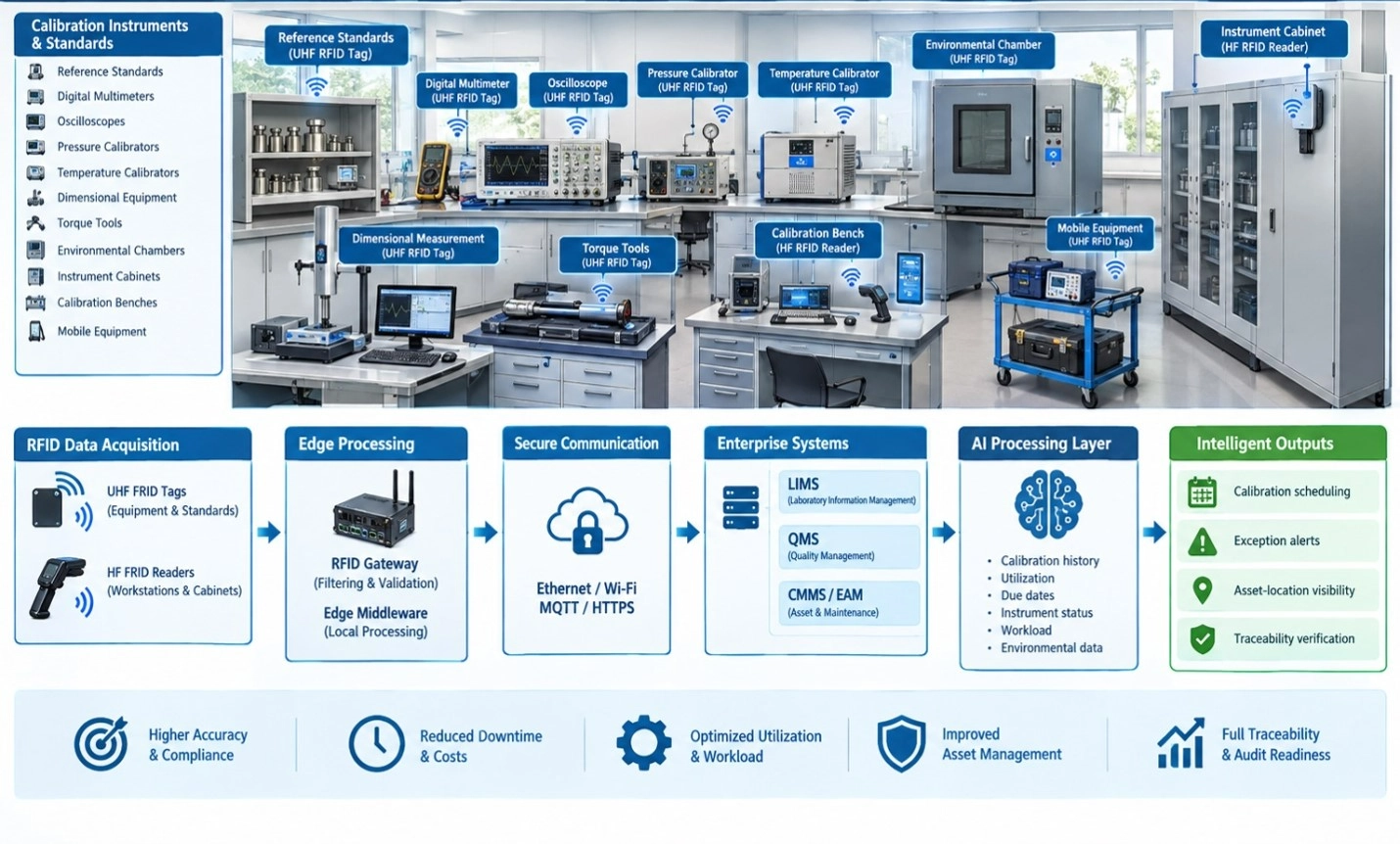
This enterprise illustration shows how RFID-tagged calibration instruments and standards connect through readers, edge processing, enterprise laboratory systems, and an AI analytics layer. It highlights intelligent outputs including calibration scheduling, exception alerts, asset-location visibility, and traceability verification.
What AI-Enabled RFID Means for Calibration Laboratories
Calibration laboratories operate around measurement traceability, controlled procedures, reference standards, competent personnel, documented results, and equipment whose calibration status must be known before it is used. A laboratory may manage thousands of instruments and standards across receiving areas, storage cabinets, calibration benches, environmental rooms, quarantine locations, and customer-return areas. Manual identification methods can become difficult when instruments move frequently between these locations.
RFID creates a digital identity for physical laboratory assets. A tag can be associated with an instrument identifier, asset number, manufacturer information, model, serial number, calibration interval, status, or a secure reference to records maintained in laboratory software. The RFID tag itself should not be treated as the authoritative calibration record. The LIMS, QMS, EAM, or other controlled system should remain the system of record.
AI adds a decision-support layer to these identification events. Instead of simply answering “Where is this instrument?”, an AI-enabled solution can help answer questions such as:
- Which instruments are approaching calibration due dates?
- Which reference standards are being used more frequently than expected?
- Which equipment has repeated calibration failures or adjustment events?
- Which instruments are likely to create workload congestion during the next calibration cycle?
- Which assets have entered a laboratory area without the expected workflow status?
- Which environmental conditions correlate with abnormal measurement behavior?
- Which instruments have not followed the expected movement or usage pattern?
- Which calibration jobs should receive priority based on due date, customer commitment, equipment availability, and laboratory workload?
This distinction is important. RFID primarily improves identification and event capture, while AI interprets accumulated operational data and supports decisions.
Why Calibration Laboratories Need Automated Identification and AI
Calibration laboratories must maintain confidence in measurement results while managing physical equipment and documentation efficiently. The operational challenge is not simply knowing how many instruments exist. Personnel need to establish which specific instrument was received, where it is located, whether it is in calibration, whether it is available for use, which procedure applies, which reference standard was used, and whether the required records are complete.
RFID can reduce manual asset identification at receiving, storage, calibration benches, inspection points, and dispatch areas. AI can analyze the resulting data alongside calibration certificates, work orders, instrument history, environmental measurements, and laboratory capacity.
The combination is particularly valuable for laboratories that manage:
- Electrical and electronic calibration
- Dimensional calibration
- Pressure and vacuum calibration
- Temperature and humidity calibration
- Mass and force calibration
- Torque calibration
- Flow calibration
- Time and frequency calibration
- Optical and photometric calibration
- Mechanical measurement equipment
- Multifunction test instruments
- Reference standards and transfer standards
- Customer-owned measurement equipment
For laboratories operating under ISO/IEC 17025, automated identification can also support controlled processes and traceability when appropriately validated and integrated with documented procedures. RFID should support the laboratory’s quality system rather than bypassing established controls.
Calibration Laboratory Applications for AI and RFID
AI-Assisted Instrument and Reference Standard Tracking
RFID-tagged instruments can be identified as they move through receiving, inspection, quarantine, storage, calibration, review, and dispatch areas. UHF RFID is useful where laboratories need identification over several feet and where multiple tagged assets may be detected in a controlled reading zone. HF RFID can be preferable where intentional close-range identification is required at a specific calibration workstation, cabinet, or controlled handoff point.
AI can analyze movement histories to identify unexpected asset movements, prolonged dwell times, repeated searches, or bottlenecks between process stages.
For example, an instrument expected to move from receiving to inspection and then to a calibration queue could generate an exception if its recorded movement pattern differs significantly from the laboratory’s established workflow.
Calibration Due-Date and Workload Prediction
Calibration scheduling is often driven by fixed intervals, customer requirements, laboratory procedures, equipment usage, and historical performance. AI can supplement these rules by analyzing previous calibration dates, adjustment history, failure rates, usage frequency, customer commitments, and laboratory capacity.
RFID supplies reliable asset identity when instruments enter or leave controlled areas. The resulting events can be associated with calibration work orders so that scheduling software has better visibility into actual equipment availability.
A practical implementation should not allow a machine-learning model to independently change a controlled calibration interval without an authorized review process. AI recommendations should remain subject to laboratory procedures, technical authority, quality requirements, and documented approval.
Calibration Workflow and Job Routing
A calibration laboratory can use RFID checkpoints to establish whether an instrument has reached the expected process stage. Events can be associated with work-order IDs in a LIMS or laboratory workflow application.
AI can evaluate queue length, technician skills, equipment requirements, procedure availability, turnaround commitments, and instrument priority to recommend job routing.
For example, a laboratory may have several pressure calibrators awaiting service while only one qualified technician and one appropriate reference standard are available. AI can identify the constraint and recommend a scheduling sequence that reduces avoidable idle time.
Reference Standard Control
Reference standards require particularly strong control because their status and traceability affect the validity of calibration activities. RFID can identify reference standards at storage locations and controlled work areas.
AI can analyze utilization frequency, movement history, calibration status, environmental exposure, and usage records to identify unusual patterns requiring review.
RFID should not be treated as proof that a standard is valid for use. The controlled laboratory database must determine whether the reference standard is within its approved calibration status and applicable measurement range.
Calibration Certificate and Record Quality Checks
AI can assist with document and data-quality checks across calibration records. Optical character recognition, natural-language processing, rules engines, and anomaly-detection models can identify missing fields, inconsistent identifiers, unusual values, duplicate records, or discrepancies between physical equipment and digital records.
RFID strengthens this process by supplying an independent physical identifier. If the RFID identity associated with an instrument does not match the instrument identifier in a calibration record, the system can flag the discrepancy for human review.
Environmental Condition Monitoring
Temperature, humidity, vibration, electromagnetic interference, and other environmental variables can influence calibration activities depending on the measurement discipline and laboratory procedure.
IoT sensors can collect environmental data while RFID identifies the instruments and standards present in a controlled area. AI can correlate environmental conditions with historical calibration results or exception events.
This can help laboratory personnel investigate whether repeated deviations are associated with environmental conditions rather than treating every anomaly as an isolated instrument issue.
AI-Enabled RFID Calibration Laboratory Workflow from Receipt to Dispatch
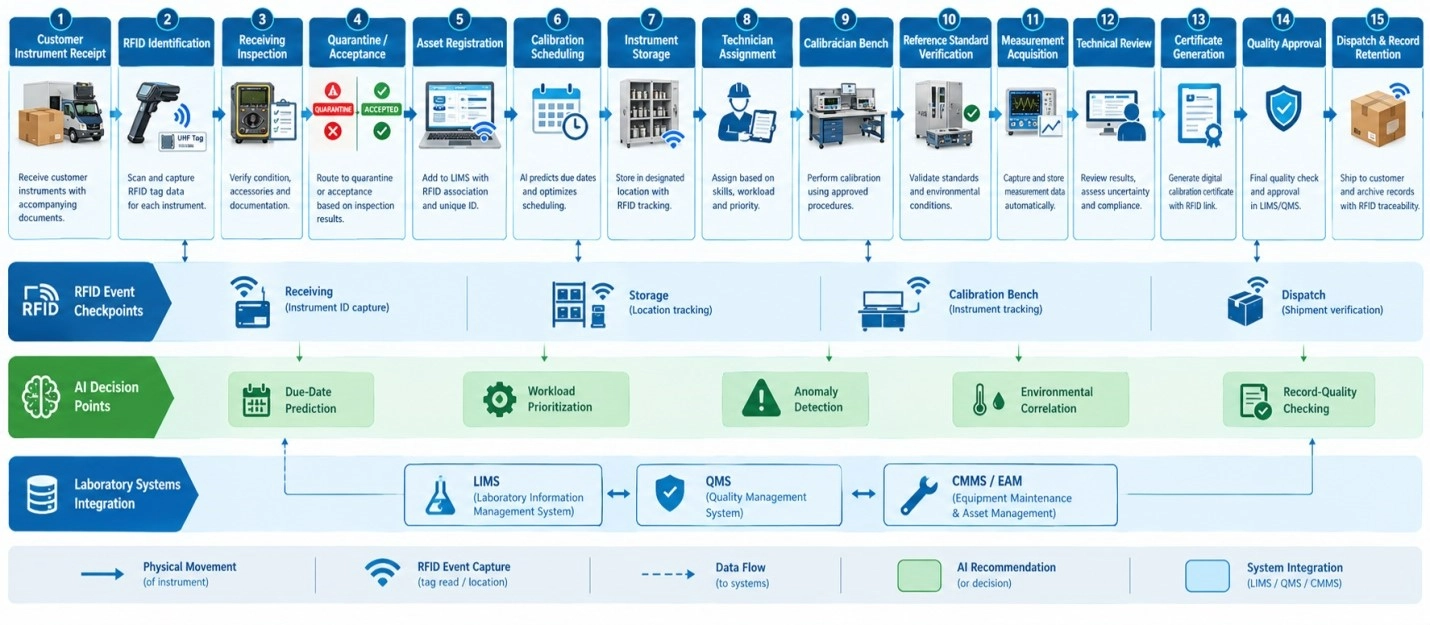
This workflow diagram illustrates the movement of calibration instruments from customer receipt through RFID identification, inspection, scheduling, calibration, technical review, certification, quality approval, and dispatch. It highlights RFID checkpoints, AI decision points, and integration with LIMS, QMS, and CMMS/EAM for traceability and intelligent laboratory management.
End-to-End Data Flow from RFID Capture to AI Decisions
A technically sound calibration-laboratory solution should treat RFID as one data source within a controlled information flow rather than as an isolated tracking technology.
Physical Data Acquisition
RFID readers capture tag identities at defined points such as receiving stations, equipment cabinets, laboratory entrances, calibration benches, and dispatch areas. Reader selection depends on read range, asset density, tag orientation, metal interference, required read accuracy, and whether the laboratory requires automatic zone detection or intentional close-range confirmation.
UHF RFID can provide wider-area identification, but calibration laboratories must account for metal instrument housings, cables, shielding, racks, and dense equipment arrangements. On-metal UHF tags and carefully positioned antennas may be necessary.
HF RFID can provide more controlled short-range identification and can be useful where the technician intentionally presents an instrument or standard to a reader.
LF RFID is generally less attractive for broad calibration-laboratory asset tracking because of its limited data capacity and short-range characteristics. It can nevertheless be considered for specialized identification requirements where its operating characteristics are appropriate.
RFID Readers, Gateways, and Middleware
Reader events should pass through middleware that filters duplicate reads, applies location logic, validates tag associations, and converts low-level reader events into meaningful laboratory events.
For example, dozens of repeated UHF reads of the same instrument while it remains beside a calibration bench should not create dozens of independent “asset movement” transactions. Middleware can aggregate these observations into a meaningful presence or transition event.
A robust system can include:
- RFID readers and antennas
- On-metal or laboratory-suitable RFID tags
- Reader controllers or edge gateways
- Ethernet or Wi-Fi connectivity
- RFID middleware
- Event filtering and normalization
- REST APIs or other integration interfaces
- Database services
- LIMS, QMS, EAM, CMMS, or ERP integration
- AI and analytics services
- Role-based user interfaces
- Audit logging and monitoring
Edge Processing and Controlled Data Transfer
Edge processing is useful when RFID events must be filtered locally before they reach a central server. A gateway can remove duplicate reads, apply zone rules, buffer events during temporary network outages, and forward normalized information to laboratory software.
This is particularly useful for calibration laboratories with controlled networks or areas where network connectivity is limited.
Communication can use standard enterprise networking such as Ethernet and Wi-Fi. MQTT can be useful for lightweight event messaging in suitable IoT implementations, while HTTPS and REST APIs are common for application-level integration. TLS should protect communications carrying laboratory asset information or credentials.
Laboratory Software Integration
RFID events become operationally valuable when they connect to the laboratory’s existing systems.
A LIMS can maintain calibration jobs, methods, results, customer information, certificates, and controlled records. A QMS can manage quality procedures, nonconformances, corrective actions, audits, and controlled documentation. A CMMS or EAM system can manage equipment maintenance and asset lifecycle information. ERP software may contain customer, purchasing, inventory, and financial information.
The RFID system should exchange identifiers and events with these systems through controlled interfaces rather than creating conflicting records.
AI Processing and Decision Support
AI services can consume normalized RFID events together with calibration history, work-order data, instrument utilization, environmental measurements, technician workload, and other approved data sources.
Appropriate methods may include:
- Time-series forecasting for workload and calibration demand
- Classification models for exception prioritization
- Anomaly detection for unusual asset behavior
- Predictive models for maintenance or calibration-related risk
- Natural-language processing for calibration documents and service records
- Computer vision where visual inspection is part of a validated process
- Optimization algorithms for scheduling and resource allocation
- Rules-based decision engines for controlled compliance checks
AI outputs should be traceable to source data and presented as recommendations or controlled alerts where human technical judgment is required.
AI and RFID Data Pipeline Architecture for Calibration Laboratories
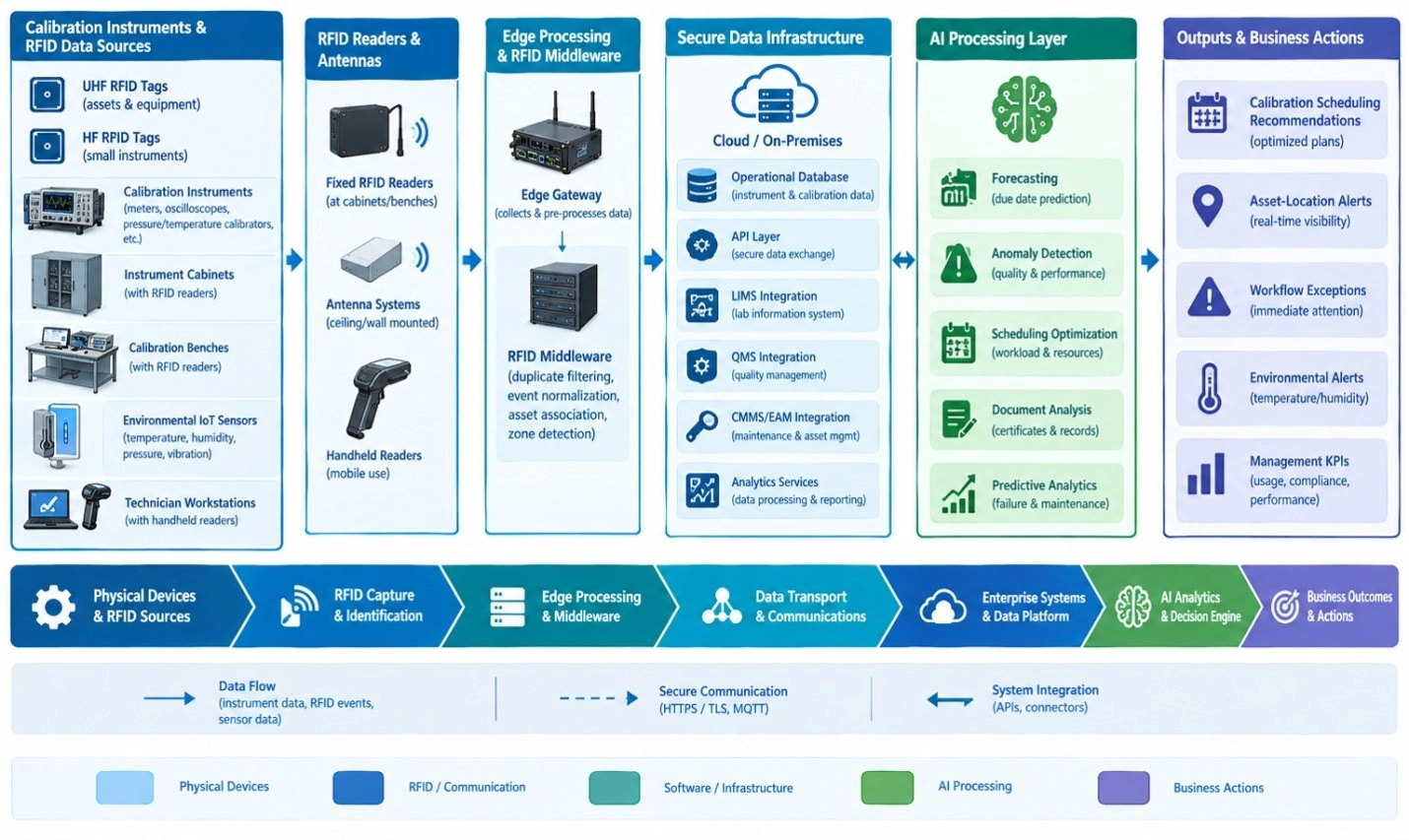
This architecture diagram illustrates the end-to-end flow of calibration data from UHF and HF RFID tags, readers, instruments, and environmental sensors through edge middleware and secure data infrastructure. It shows how LIMS, QMS, and CMMS/EAM integrations connect with AI capabilities such as forecasting, anomaly detection, scheduling optimization, document analysis, and predictive analytics to support operational decisions.
RFID Hardware and AI Software Selection for Calibration Laboratories
Selecting RFID hardware for a calibration laboratory requires more than choosing the longest read range. The physical characteristics of laboratory equipment strongly influence tag performance.
Metal instrument housings can detune conventional RFID tags, while cables, batteries, shielding materials, liquid-filled equipment, racks, and closely packed instruments can change the RF environment. On-metal tags should be evaluated on representative equipment before deployment.
A site survey should examine:
- Instrument enclosure materials
- Tag mounting surfaces
- Required read distance
- Reader antenna placement
- Asset orientation
- Density of tagged instruments
- Potential cross-zone reads
- Electromagnetic conditions
- Cabinet and shelving construction
- Human workflow around calibration benches
- Required identification accuracy
- Network availability
- Data retention requirements
UHF RFID is generally the strongest candidate for automatic identification across receiving, storage, and controlled movement zones. HF RFID can complement UHF where close-range confirmation is more appropriate. LF RFID should be selected only where its specific characteristics solve a defined laboratory requirement.
AI software should similarly be selected according to the decision problem rather than simply the availability of a particular model. A workload forecasting model, for example, requires different data and validation from an anomaly-detection model analyzing instrument movement.
Cloud Version and Server Version for Calibration Laboratory Systems
A cloud-hosted deployment can be appropriate for calibration organizations that need centralized access across multiple laboratory locations, remote management, scalable analytics, and reduced responsibility for maintaining application infrastructure. RFID gateways can send controlled events to cloud services through secure connections, while authorized users access dashboards and workflow information through approved applications.
A privately hosted server deployment can be preferable when the laboratory has strict data-control requirements, restricted networks, existing data centers, or integration requirements with locally managed LIMS and QMS systems. The server may operate on a laboratory server, customer-managed infrastructure, private data center, or other controlled computing environment.
The choice should consider:
- ISO/IEC 17025 quality-system requirements
- Customer contractual requirements
- Data residency and retention policies
- Network availability
- Integration with existing LIMS and QMS software
- Cybersecurity controls
- IT support capabilities
- Number of laboratory locations
- Required AI processing capacity
- Disaster recovery requirements
- Backup and audit requirements
A hybrid arrangement can also be practical. RFID event processing may occur through a local gateway or server, while approved analytics and management reporting are performed through centralized infrastructure.
For either deployment model, cybersecurity should include network segmentation, authenticated devices, encrypted communications, least-privilege access, role-based permissions, secure credential management, audit logging, software patching, backup controls, and controlled firmware updates.
GAO’s experience supplying RFID, BLE, and IoT hardware products and systems can support the physical identification layer, while the final software and integration design should be aligned with the calibration laboratory’s existing quality, IT, and operational controls.
Engineering Considerations Before RFID Deployment
RFID deployment should begin with the physical workflow rather than the reader specification. Calibration laboratories should first identify where asset identification creates measurable operational value.
A receiving area may need reliable bulk identification, while a calibration bench may require deliberate one-instrument-at-a-time confirmation. A storage cabinet may require a different reader and antenna configuration from an open equipment staging area.
Pilot testing should therefore use representative instruments, including metal-bodied devices and the actual tags proposed for production. The laboratory should measure false reads, missed reads, unintended zone reads, read consistency, and workflow impact.
AI should also be introduced using validated historical data where possible. Poor asset identifiers, inconsistent calibration records, duplicate instrument numbers, missing timestamps, and incomplete workflow states can produce unreliable model outputs. Data quality should therefore be treated as an engineering requirement rather than a later analytics task.
The most reliable deployment sequence is to establish trustworthy asset identity and workflow events first, validate RFID performance second, integrate the resulting events with controlled laboratory software third, and introduce AI decision support after sufficient operational data is available.
Technical Capabilities and Operational Improvements
Combining AI with RFID-based identification gives calibration laboratories a more complete view of physical assets and the processes surrounding them. RFID provides timely identity and movement events, while AI can identify patterns across those events and other laboratory records.
Improved Instrument Traceability
RFID can associate physical instruments with their controlled digital records at receiving, storage, calibration, review, and dispatch points. This reduces dependence on manually reading serial numbers or entering asset identifiers.
The resulting traceability can help laboratory personnel determine:
- Which customer instrument entered the laboratory
- Which calibration job is associated with the instrument
- Where the instrument was last detected
- Which workflow stage it has reached
- Whether its calibration status permits the intended operation
- Which reference standards were associated with the calibration process
- Whether the physical and digital identities agree
For ISO/IEC 17025 laboratories, this information can complement documented traceability and quality procedures. RFID does not replace technical records, calibration certificates, measurement uncertainty calculations, or controlled quality processes.
Faster Asset Retrieval and Reduced Search Time
Instrument searches can consume technician and administrative time when equipment is distributed across storage areas, calibration benches, staging locations, and quarantine areas.
RFID zone detection can provide a more current location estimate. AI can further identify assets that frequently remain in unexpected locations or spend unusually long periods in a particular workflow stage.
A useful KPI is average asset retrieval time. Other relevant measures include search frequency, unidentified-asset rate, location accuracy, and percentage of instruments associated with valid digital records.
Better Calibration Scheduling
AI can combine RFID-derived availability information with calibration due dates, historical workload, technician qualifications, reference-standard availability, customer turnaround requirements, and laboratory capacity.
This can help schedulers identify future congestion before it becomes an operational problem.
A practical implementation should retain deterministic rules for mandatory deadlines and quality controls while using AI for forecasting and prioritization. This approach avoids treating probabilistic model output as an uncontrolled replacement for laboratory procedures.
Early Detection of Workflow Exceptions
Unexpected RFID events can indicate that an instrument has moved into an inappropriate area, remained in a staging zone too long, or bypassed an expected process stage.
AI-based anomaly detection can prioritize unusual patterns for investigation. For example, repeated movement between storage and calibration areas without a corresponding work-order transition could indicate a process problem, data synchronization issue, or operational exception.
The objective is not to automatically accuse a technician or invalidate a calibration job. The system should identify evidence that warrants review.
Improved Laboratory Capacity Utilization
Calibration laboratories frequently have constraints involving qualified technicians, reference standards, specialized equipment, environmental chambers, and calibration benches.
AI can model these constraints and help identify underused capacity or developing bottlenecks.
Relevant measures can include:
- Calibration turnaround time
- Queue time
- Technician utilization
- Bench utilization
- Equipment utilization
- Work-in-process volume
- On-time completion rate
- Average time in each workflow stage
- Rework rate
- Customer turnaround performance
RFID contributes physical-event data that can make these measurements more representative of actual laboratory operations.
Stronger Reference Standard Control
Reference standards can be tagged and associated with controlled records. RFID events can help establish when a standard entered a calibration area or storage location.
AI can examine usage frequency and historical records to identify unusual utilization patterns. A sudden increase in use of a particular standard, for example, may justify checking whether the workload allocation or process configuration has changed.
The laboratory should continue to rely on its controlled records to determine whether a standard is within calibration, suitable for the measurement range, and authorized for a particular procedure.
Improved Data Quality and Record Reconciliation
Physical asset identity and digital records can be compared automatically.
A reconciliation process can identify:
- RFID tag linked to the wrong asset
- Duplicate asset identifiers
- Instruments detected without an active work order
- Work orders associated with missing physical assets
- Instruments appearing in unauthorized workflow zones
- Calibration records missing expected asset information
- Retired assets still appearing in operational locations
These checks can improve the reliability of the data subsequently used by AI models.
Cybersecurity and Data Integrity for AI and RFID in Calibration Laboratories
RFID introduces additional connected devices into the laboratory environment. Readers, gateways, middleware servers, databases, APIs, and AI services should therefore be incorporated into the laboratory’s cybersecurity controls.
A secure implementation should consider:
- Unique device identities
- Strong authentication
- Role-based access control
- Least-privilege permissions
- TLS-protected communications
- Network segmentation
- Secure API authentication
- Centralized audit logging
- Firmware and software patch management
- Backup and recovery procedures
- Controlled administrator access
- Credential rotation
- Monitoring for unauthorized devices
- Time synchronization across readers, gateways, and servers
Data integrity is particularly important because AI decisions depend on the quality and provenance of source information.
Each significant RFID event should retain appropriate information such as asset identity, reader or zone identity, timestamp, and event type. Where required, the system should maintain audit information showing how events were processed or transformed before entering laboratory software.
AI models should also have version control, documented inputs, defined validation procedures, and appropriate monitoring for model drift.
For quality-sensitive applications, AI recommendations should be explainable enough for responsible personnel to understand the principal data or conditions contributing to an alert or recommendation.
Standards, Quality Controls, and Laboratory Governance
Calibration laboratories should align technology deployment with their existing quality-management requirements rather than treating RFID or AI as a separate operational system.
ISO/IEC 17025 is particularly relevant because it establishes requirements for the competence, impartiality, and consistent operation of testing and calibration laboratories. RFID and AI can support these objectives indirectly through better identification, traceability, record handling, and workflow visibility, but neither technology by itself establishes laboratory competence or measurement traceability.
Additional technical considerations may include:
- RFID air-interface standards such as EPCglobal UHF specifications and ISO/IEC 18000-series standards
- HF RFID standards such as ISO/IEC 15693 and ISO/IEC 14443 where applicable
- Relevant electrical and electromagnetic compatibility requirements
- Laboratory equipment manufacturer’s operating requirements
- Internal quality procedures
- Measurement traceability procedures
- Calibration interval policies
- Data retention requirements
- Access-control policies
- Customer-specific contractual requirements
- Cybersecurity and IT governance policies
The exact standards applicable to a laboratory depend on its measurement disciplines, geographic jurisdiction, equipment, customer requirements, and quality system.
Implementation Lifecycle for AI-Enabled RFID Calibration Systems
Planning and Process Mapping
The first step is documenting the actual laboratory workflow. Stakeholders should identify receiving, identification, inspection, quarantine, storage, scheduling, calibration, technical review, quality review, dispatch, and record-retention activities.
The laboratory should then determine where manual identification creates measurable cost, delay, or error.
Asset and Tag Assessment
Representative instruments should be classified by material, dimensions, operating environment, mobility, and identification requirements.
Metal-bodied instruments require particular attention because nearby conductive materials can affect UHF RFID performance. Tags should be evaluated on the actual instruments rather than only on laboratory samples.
RFID Site Survey and Pilot
A pilot should establish:
- Read performance
- Read-zone boundaries
- Missed-read rate
- False-read rate
- Tag durability
- Antenna positioning
- Reader power settings
- Network reliability
- Reader-to-middleware event latency
- Technician workflow impact
Testing should occur during realistic laboratory operations because people, equipment carts, metal racks, and instrument density can change RF behavior.
Software Integration
Once RFID performance is validated, the identification events can be integrated with LIMS, QMS, CMMS/EAM, ERP, or other relevant software.
The integration should define authoritative identifiers and data ownership. For example, the LIMS may own calibration-job information while the RFID middleware owns raw reader events. Clear ownership prevents contradictory records.
AI Model Development and Validation
AI development should begin with a clearly defined operational problem.
Examples include predicting calibration workload, detecting unusual workflow behavior, identifying likely delays, or analyzing historical calibration records.
Historical data should be cleaned and validated before model training. The laboratory should evaluate false positives and false negatives because an overly sensitive anomaly model can create alert fatigue.
Models should be tested using data that represents real laboratory conditions and should be periodically reviewed after deployment.
Commissioning and Acceptance Testing
Production commissioning should verify the complete chain:
RFID tag → reader → network → middleware → database → laboratory software → AI processing → alert or recommendation → human action.
Acceptance testing should include normal scenarios and failure scenarios such as disconnected readers, duplicate reads, unavailable network connections, invalid tags, incorrect asset associations, and delayed software responses.
Optimization and Maintenance
RFID performance can change when laboratory layouts, storage cabinets, equipment density, or workflows change. Reader configurations should therefore be reviewed after significant physical modifications.
AI models also require monitoring. Changes in workload, calibration procedures, asset populations, or data collection methods can affect model performance.
Preventive maintenance should cover RFID readers, antennas, gateways, servers, network equipment, tags, software, databases, and backups.
AI and RFID Calibration Laboratory Deployment Lifecycle from Planning to Optimization
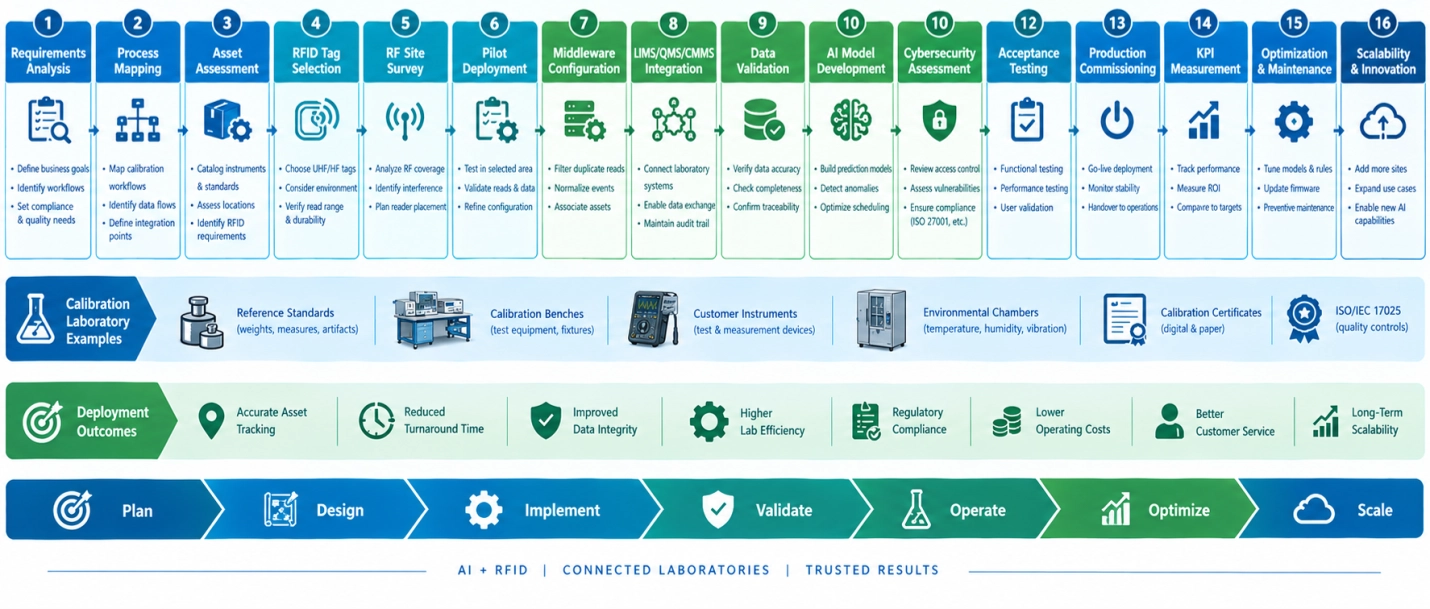
This lifecycle infographic presents the 16-stage deployment path for AI-enabled RFID in calibration laboratories, from requirements analysis and asset assessment through pilot deployment, systems integration, validation, commissioning, KPI measurement, and scalability. It highlights laboratory-specific assets, ISO/IEC 17025 quality controls, and the progression from planning to continuous optimization.
Key Performance Indicators for Calibration Laboratory AI and RFID Systems
A successful implementation should be measured using operational KPIs rather than RFID read counts alone.
| KPI | What It Measures | Potential RFID or AI Contribution |
|---|---|---|
| Instrument retrieval time | Time required to locate an instrument | RFID location visibility and AI prioritization |
| Asset identification accuracy | Correct association between physical and digital assets | RFID identity capture and reconciliation |
| Calibration turnaround time | Time from receipt to completed calibration | Workflow visibility and scheduling optimization |
| On-time calibration rate | Percentage completed within required deadlines | AI workload forecasting |
| Work-in-process aging | Time assets remain in workflow stages | RFID movement events and anomaly detection |
| Technician utilization | Productive use of qualified personnel | AI workload and resource analysis |
| Bench utilization | Use of calibration workstations | RFID presence events and scheduling analytics |
| Reference-standard utilization | Frequency and pattern of standard usage | RFID tracking and AI analysis |
| Exception rate | Frequency of workflow anomalies | RFID event rules and anomaly detection |
| Record reconciliation rate | Agreement between physical and digital records | RFID-based identity validation |
| False-read rate | Incorrect RFID detections | RF engineering and reader tuning |
| Missed-read rate | RFID events not successfully captured | Tag and antenna optimization |
| Customer turnaround performance | Ability to meet promised service times | AI scheduling and bottleneck prediction |
These KPIs should be established during the planning phase so the laboratory can compare baseline performance with post-deployment results.
Scaling AI and RFID Across Multiple Calibration Laboratories
Multi-location calibration organizations can use standardized asset identifiers, tag policies, middleware configurations, integration interfaces, and security controls to support consistent deployment.
A centralized data model can enable management teams to compare workload, asset utilization, turnaround performance, and exception rates across locations while allowing individual laboratories to retain local workflow requirements.
Scaling should not mean installing identical RFID equipment everywhere. RF conditions, instrument types, laboratory layouts, customer workflows, and measurement disciplines differ significantly.
A scalable approach should standardize data and governance while allowing reader configuration, tag selection, and workflow rules to reflect each laboratory’s physical environment.
GAO can support organizations evaluating RFID hardware and IoT data-capture requirements for these deployments, including the selection of tags, readers, antennas, and associated hardware based on the laboratory’s operating conditions.
Practical Recommendations for Calibration Laboratory Deployment
Calibration laboratories considering AI-enabled RFID should prioritize controlled operational problems rather than deploying identification technology simply because it is available.
Recommended engineering practices include:
- Start with a measurable workflow problem such as instrument retrieval, calibration scheduling, or reference-standard control.
- Establish a single authoritative asset identifier across RFID, LIMS, QMS, and maintenance records.
- Test RFID tags on actual calibration instruments, especially metal-bodied equipment.
- Use UHF RFID where wider-area automatic identification is required and HF RFID where controlled close-range identification is more appropriate.
- Treat RFID middleware as an event-processing layer that filters and normalizes reader observations.
- Keep calibration certificates, technical records, and controlled quality information in the appropriate laboratory system of record.
- Validate RFID read zones before using location events for operational decisions.
- Introduce AI only after establishing sufficiently reliable historical and operational data.
- Use human technical review for decisions affecting calibration validity, measurement traceability, or quality-system status.
- Establish cybersecurity controls before connecting RFID readers and gateways to laboratory networks.
- Measure operational KPIs before and after deployment.
- Design integration interfaces around stable asset and work-order identifiers.
- Test network outages, duplicate reads, incorrect tags, and synchronization failures during commissioning.
- Review AI performance periodically as laboratory workflows and asset populations change.
- Expand the deployment only after the initial workflow demonstrates measurable operational value.
GAO RFID and IoT Solutions for Calibration Laboratory Operations
GAO provides RFID, BLE, and IoT hardware products and systems that can support physical asset identification and data capture in calibration laboratory environments. The appropriate solution depends on factors such as instrument construction, required read distance, asset density, laboratory layout, network design, and the laboratory’s existing software.
Headquartered in New York City and Toronto, Canada, GAO is ranked among the top 10 leading B2B and B2G suppliers of BLE and RFID technologies globally. GAO, together with GAO Research Inc. and GAO Tek Inc., forms GAO Group, with operations based in New York City and Toronto.
For three decades, GAO Group has served organizations in the United States and Canada, including Fortune 500 companies, major R&D organizations, universities, and government agencies. The group has invested substantially in R&D and maintains stringent quality-assurance processes, supported by technical assistance available remotely or onsite.
For calibration laboratories, this experience is relevant when RFID hardware must operate reliably around metal instruments, controlled work areas, storage systems, and connected laboratory equipment. Organizations can evaluate GAO’s RFID and IoT products according to their specific identification, connectivity, integration, and deployment requirements.
Building More Traceable and Predictive Calibration Laboratories
AI-enabled RFID can help calibration laboratories connect physical instrument activity with controlled digital workflows. RFID establishes reliable identification and movement events, while AI can analyze those events alongside calibration history, workload, environmental conditions, and laboratory records.
The strongest deployments begin with a clearly defined operational problem, validate RFID performance in the real laboratory environment, integrate with existing LIMS and quality systems, and introduce AI only after data quality is established. Security, auditability, human technical review, and ISO/IEC 17025-aligned procedures should remain central to implementation.
GAO can provide RFID, BLE, and IoT hardware products and technical support for organizations evaluating these requirements. Learn more about GAO’s RFID and IoT solutions and discuss the hardware, integration, and deployment considerations applicable to your calibration laboratory.
Building the Future of Industrial AI and IoT with Aperture Venture Studio and GAO RFID Inc.
For more than three decades, GAO Group of Companies has invested heavily in R&D for industrial RFID, BLE, and IoT. As AI has become increasingly useful in industrial applications, we have continued developing AI-enabled IoT technologies that can support applications such as calibration-laboratory asset tracking, workflow intelligence, and operational analytics. We have also founded Aperture Venture Studio to build, launch, and scale AI and IoT companies and technologies serving practical industry requirements. Aperture brings together AI and IoT technical experts, executives, investors, and leading companies. We also developed Aperture Ventures Summit and TekSummit to discuss advanced AI and IoT topics. We welcome you to join us as:
- Advisors, Co-founders, or Employees
- Investors
- Customers