
AI and RFID for Cell Therapy – GAO
How AI and RFID Improve Cell Therapy Manufacturing and Traceability
AI-enabled cell therapy systems combine artificial intelligence with connected equipment, sensors, and RFID identification to improve how cellular therapy materials, products, consumables, equipment, and manufacturing events are monitored throughout their lifecycle. For cell therapy manufacturers, the objective is not simply to identify a container. The more important objective is to maintain reliable chain of identity, chain of custody, process genealogy, environmental history, and material status while reducing manual data entry and decision delays.
AI can correlate RFID events with manufacturing records, temperature observations, equipment states, laboratory information, and manufacturing execution data to identify deviations and operational risks earlier. UHF RFID can support non-line-of-sight identification of tagged materials and containers, while HF or LF RFID can be selected for more specialized identification scenarios. When combined with AI, these technologies can support cell therapy inventory management, material tracking, cold-chain monitoring, workflow compliance, exception detection, and manufacturing traceability. GAO supplies RFID, BLE, and other IoT hardware and systems that can support these connected cell therapy workflows.
Why AI Matters in Cell Therapy Operations
Cell therapy manufacturing differs from conventional pharmaceutical manufacturing because the material being processed can be highly individualized, biologically variable, time-sensitive, and difficult to replace. Autologous workflows can require an especially strict relationship between a specific patient, collection event, starting material, manufacturing batch or lot, intermediate material, final product, and administration event.
The operational data surrounding that material can also be fragmented. Information may originate from barcode scans, RFID readers, temperature sensors, freezers, incubators, centrifuges, biosafety cabinets, environmental monitoring systems, laboratory instruments, electronic batch records, laboratory information management systems, manufacturing execution systems, and enterprise resource planning software.
AI becomes valuable when these data streams are correlated rather than treated as isolated records. Machine learning and rule-based analytics can identify abnormal process sequences, missing events, unexpected dwell times, temperature excursions, equipment utilization anomalies, or inventory discrepancies. Edge AI can support local event processing where rapid response is important, while centralized analytics can identify trends across manufacturing campaigns.
The result is a more complete operational view of the cell therapy process without requiring operators to manually reconcile every event.
RFID and AI-Enabled Cell Therapy Lifecycle from Patient Collection to Infusion
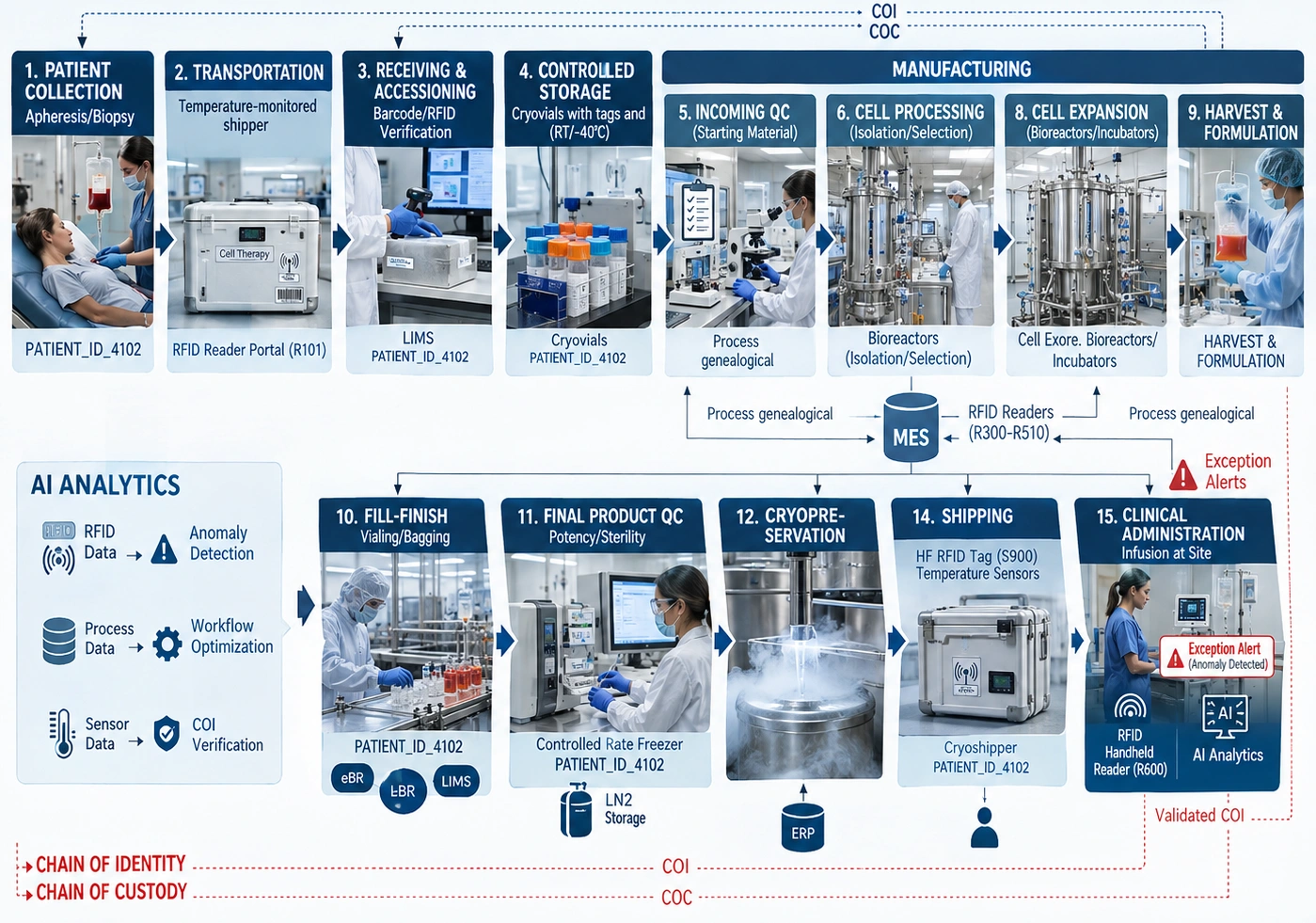
A clean, professional enterprise workflow diagram mapping the entire cell therapy lifecycle from patient collection to clinical administration. It details 15 distinct stages, including apheresis, transport, receiving, multi-stage manufacturing (processing, genetic modification, expansion, formulation), fill-finish, quality control, cryopreservation, release, shipping, and infusion. Key identification points for UHF and HF RFID are integrated throughout material transfers. The visualization illustrates how temperature sensors, readers, and edge gateways provide raw data to AI analytics, which correlates physical events with LIMS, MES, ERP, and eBR systems for continuous Chain of Identity (COI), Chain of Custody (COC), Process Genealogy, and Real-Time Exception Alerts, ensuring optimized and validated workflows.
Cell Therapy Applications for AI-Enabled RFID Systems
Chain of Identity and Chain of Custody
Chain of identity is one of the most important applications for connected identification in cell therapy. A system can associate a collection container, processing container, intermediate material, final product, and associated records with a controlled identifier.
RFID can provide an automated event layer around that identifier. Reader events can record when a tagged container enters or leaves controlled areas, while AI software can compare the observed sequence with the expected manufacturing workflow.
This is particularly relevant for autologous cell therapy, where patient-specific material must remain correctly associated throughout collection, manufacturing, storage, transportation, and administration. ISBT 128 provides internationally recognized coding and labeling standards for medical products of human origin, including cellular therapy products, and ICCBBA has also defined a standardized Chain of Identity identifier for applicable cellular therapy workflows.
Cell Therapy Inventory Management
Cell therapy facilities manage more than final therapeutic products. They also control starting materials, culture media, reagents, single-use assemblies, bags, tubing sets, cryogenic containers, sample containers, quality-control materials, and other production consumables.
RFID-assisted inventory management can provide automatic location and movement events for selected materials. AI can then analyze consumption patterns, material availability, expiry dates, lot relationships, and manufacturing schedules.
For example, a system can identify that a required reagent is physically available but located outside the designated manufacturing area, or that a scheduled manufacturing run depends on material approaching its expiration window.
Cryogenic Storage and Cold-Chain Monitoring
Cryopreserved cellular materials require tightly controlled storage and transportation conditions. A useful AI-enabled system should therefore associate the identity of the material with its storage location and environmental history.
RFID can identify containers at freezer or transfer points, while temperature sensors provide environmental observations. AI analytics can correlate material identity, storage duration, freezer status, transfer events, and temperature conditions.
This allows operators to investigate whether an environmental excursion affected a specific material rather than treating the entire storage location as a single undifferentiated event.
Manufacturing Workflow and Work-in-Progress Tracking
Cell therapy production can include multiple controlled processing stages. Operators may transfer materials between cleanrooms, processing suites, incubators, centrifuges, biosafety cabinets, automated cell-processing instruments, and temporary storage locations.
RFID events can provide automated work-in-progress observations. AI can compare those observations against expected process sequences and identify missing or unusual transitions.
A manufacturing execution system can use these events to improve electronic batch records, production status, material genealogy, and operational scheduling.
Equipment and Asset Tracking
Cell therapy facilities depend on specialized equipment, including centrifuges, cell counters, incubators, cryogenic storage equipment, biosafety cabinets, automated cell-processing systems, freezers, temperature-monitoring devices, and material-handling equipment.
RFID can support identification and location tracking for selected equipment and mobile assets. AI can analyze utilization patterns, movement history, maintenance records, and process dependencies.
This can help manufacturing teams identify equipment bottlenecks, reduce unnecessary searching, and improve maintenance planning without relying entirely on manual asset logs.
RFID-Enabled Cell Therapy Facility with Real-Time Chain-of-Identity and AI Monitoring
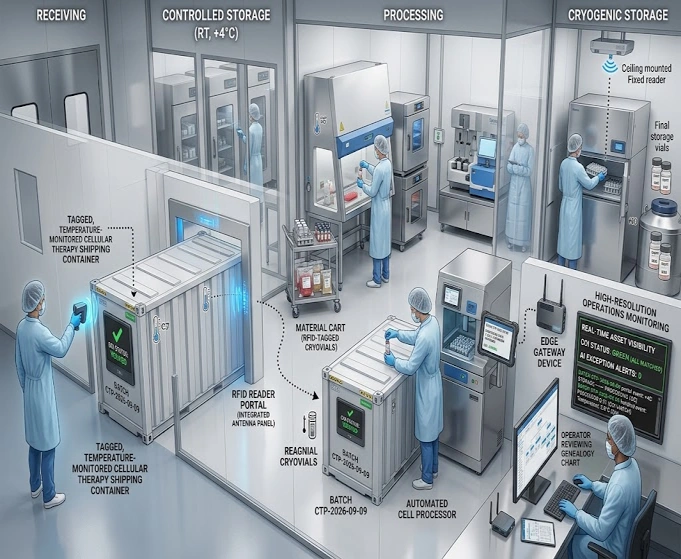
A photorealistic, elevated illustration of an enterprise cell therapy manufacturing facility, depicting the end-to-end deployment of RFID technology within a controlled GMP environment. The visual tracks a temperature-monitored cell therapy container through logical zones: receiving, controlled storage, processing, and cryogenic storage. It clearly shows the physical installation of RFID tags on containers and cryovials, alongside reader portals, handheld readers, temperature sensors, and edge gateways. These devices are visually connected to an operations workstation, where real-time dashboards display verified Chain-of-Identity (COI) status and AI-generated exception alerts, illustrating how physical events become digital logic.
The Cell Therapy Operational Data Workflow
A practical AI and RFID solution should be designed around the actual movement and processing of cellular materials rather than around RFID hardware alone.
Data Acquisition at the Point of Activity
The workflow begins when a material, container, asset, or product is identified. Depending on the application, identification can involve UHF RFID, HF RFID, LF RFID, barcode technology, or a combination of identification methods.
UHF RFID is useful where multiple tagged objects must be detected at controlled portals, storage areas, staging locations, or material-transfer points. HF RFID can be appropriate for short-range identification or controlled workstation interactions. LF RFID may be considered for specialized proximity-based identification requirements.
The identification event should contain more than an RFID tag number. A useful event model can associate the identifier with time, reader location, operator or workstation context where appropriate, material status, process stage, and relevant environmental measurements.
Edge Processing and Event Validation
Raw RFID reads should not automatically become manufacturing records. Multiple reads may occur because a container remains inside a reader field or because a tag is detected from an adjacent location.
Edge software or middleware can filter duplicate reads, apply location logic, validate expected transitions, and generate meaningful business events.
For cell therapy, this distinction is important because an event such as “container detected by reader” is different from “container transferred into controlled storage.” Business logic should determine whether the physical observation represents an operational event.
AI Analysis and Exception Detection
Validated events can be combined with data from LIMS, MES, ERP, electronic batch records, environmental monitoring systems, equipment systems, and quality systems.
AI models can evaluate this combined data for patterns such as:
- Unexpected material movement
- Missing process transitions
- Abnormal dwell time
- Repeated handling events
- Temperature excursion risk
- Unusual freezer or equipment utilization
- Material expiration risk
- Inventory discrepancies
- Process sequence deviations
- Potential chain-of-identity exceptions
Rules-based validation remains important for deterministic GMP-controlled processes. Machine learning should complement, rather than silently replace, validated business rules and established quality controls.
RFID, AI, Hardware, Software, and Deployment Choices for Cell Therapy
A cell therapy solution normally requires several coordinated technology components rather than a single RFID product. The correct design depends on the facility layout, material flow, cleanroom classification, tag requirements, read distance, environmental conditions, software validation strategy, and integration requirements.
RFID Hardware
Relevant hardware can include fixed UHF RFID readers, antennas, near-field or short-range HF readers, specialized LF readers, handheld RFID readers, RFID printers or encoders, RFID tags, industrial computers, edge gateways, and network infrastructure.
Tag selection requires particular care. Cryogenic environments, condensation, metal surfaces, liquid-rich containers, sterile packaging, and small-form-factor containers can affect RFID performance. A tag that performs well on a cardboard carton may not perform equivalently when attached to a cryogenic vessel or liquid-filled container.
RFID engineering should therefore include representative tag qualification and reader testing under actual operating conditions before production deployment.
Middleware and Enterprise Software Integration
RFID middleware translates low-level reader observations into usable operational events. Integration services can then exchange information with LIMS, MES, ERP, warehouse or inventory software, electronic batch records, quality management systems, and data historians.
API-based integration, message queues, event-driven interfaces, and standardized data models can reduce unnecessary point-to-point dependencies. Data governance should define which system remains authoritative for patient, material, batch, product, equipment, and quality records.
Cloud Version and Server Version
A Cloud Version can be appropriate when geographically distributed cell therapy operations require centralized analytics, consolidated reporting, remote monitoring, or scalable computational resources. Cloud deployment can also simplify centralized software administration when regulatory and organizational requirements permit the selected data architecture.
A Server Version can run on customer-managed servers, private data centers, facility edge servers, or other privately hosted infrastructure. This approach can be useful when the cell therapy organization requires tighter control over network boundaries, data residency, local processing, integration with regulated systems, or continued operation during loss of external connectivity.
Neither model is automatically superior. The decision should consider validation requirements, cybersecurity controls, data governance, network resilience, disaster recovery, integration latency, IT support capabilities, and organizational policies.
Electronic records and electronic signatures used within regulated workflows require appropriate controls. FDA guidance on 21 CFR Part 11 addresses electronic records and signatures, including considerations around validation, audit trails, record retention, and system controls.
AI Models and Decision Support
AI capabilities can range from anomaly detection and predictive analytics to forecasting, classification, process optimization, and computer vision.
For cell therapy, practical AI applications include identifying abnormal material movement, predicting inventory requirements, detecting unusual environmental patterns, identifying process bottlenecks, forecasting equipment utilization, and prioritizing operational exceptions.
AI outputs should remain traceable to the underlying data. Where an AI recommendation can influence a regulated manufacturing decision, organizations should define validation, change control, human oversight, auditability, and model-performance monitoring requirements appropriate to the intended use.
Regulatory and Data-Integrity Considerations
Cell therapy technology deployments should be aligned with the applicable regulatory framework for the jurisdiction, product type, development stage, and manufacturing activity. U.S. organizations may need to consider FDA requirements and guidance covering cellular and gene therapy products, biological products, electronic records, and applicable current good manufacturing practice requirements.
FDA has continued to issue cell and gene therapy guidance in 2026, including guidance on CMC flexibility and additional guidance addressing development of potential cellular and gene therapy products.
A particularly important engineering principle is to distinguish identification technology from the regulated record itself. An RFID reader can provide evidence that an identifier was observed at a particular location and time, but the validated software and business process determine how that observation becomes a controlled manufacturing or quality record.
ISBT 128 should also be evaluated where applicable because its standards address coding and labeling for cellular therapy products and other medical products of human origin.
Engineering Design Priorities for Cell Therapy RFID
Successful deployment requires more than selecting a reader and attaching tags to containers. The engineering team should first map the material flow and identify where automated identification creates measurable operational value.
Key design considerations include:
- Defining chain-of-identity and chain-of-custody requirements before selecting RFID hardware
- Mapping every controlled material-transfer point where an identification event has operational meaning
- Testing RFID performance with representative containers, liquids, cryogenic packaging, and metal equipment
- Separating raw RFID observations from validated business events
- Defining authoritative data sources across LIMS, MES, ERP, quality systems, and electronic batch records
- Establishing event timestamps and location semantics consistently
- Designing network and edge-processing resilience for critical manufacturing areas
- Applying role-based access control and least-privilege principles
- Maintaining auditability for material movement and system-generated decisions
- Validating software functions according to their intended use and regulated environment
- Establishing procedures for tag failure, unreadable tags, damaged labels, network outages, and reader faults
- Testing exception-handling workflows before production commissioning
- Monitoring system performance after deployment rather than treating commissioning as the end of engineering work
GAO’s experience supplying RFID, BLE, and IoT hardware and systems can support organizations that need to connect physical cell therapy operations with digital tracking and monitoring workflows. GAO’s products and systems are used by organizations across the United States and Canada, including Fortune 500 companies, research organizations, universities, and government agencies. GAO maintains operations in New York City and Toronto, Canada, and emphasizes product R&D, quality assurance, and technical support.
AI-Driven Capabilities for Cell Therapy Operations
Combining AI with RFID-based identification and other connected data sources can improve cell therapy operations by turning individual material movements and environmental observations into actionable process information. The strongest value comes from correlating physical events with manufacturing context, rather than using RFID as an isolated tracking mechanism.
Automated Chain-of-Identity Verification
AI can compare observed RFID events with the expected identity and process history of a cellular therapy material. When a container appears at an unexpected location or a required transition is missing, the system can generate an exception for investigation.
This approach can reduce dependence on manual reconciliation while retaining human oversight for quality-critical decisions. It is particularly useful when many patient-specific materials move through shared receiving, processing, storage, and shipping areas.
Intelligent Material and Inventory Management
AI can analyze historical consumption, scheduled manufacturing activities, inventory levels, expiration dates, supplier lead times, and material locations.
For cell therapy manufacturing, this can support more accurate planning of reagents, single-use components, collection supplies, cryogenic containers, culture media, and other production materials. RFID observations provide physical inventory evidence that complements transactional records.
The system can identify discrepancies between expected and observed inventory, highlight materials approaching expiration, and help manufacturing teams prioritize replenishment or investigation.
Predictive Cold-Chain and Cryogenic Monitoring
Temperature and environmental data become significantly more useful when linked to individual materials and locations.
AI can analyze historical temperature patterns and detect abnormal conditions before they become major operational events. For example, a gradual change in freezer behavior can be evaluated together with door activity, storage utilization, sensor readings, and material locations.
The purpose is not to allow an AI model to independently determine product disposition. Rather, analytics can help quality and operations personnel identify conditions that require investigation.
Process Deviation and Anomaly Detection
Cell therapy workflows can contain highly structured sequences. AI can compare actual event histories with expected process patterns and flag unusual sequences.
Examples include:
- Material remaining in a staging area longer than expected
- Unexpected movement between controlled areas
- Missing RFID observations at a required transfer point
- Repeated handling of a material
- Unusual equipment utilization
- Abnormal environmental conditions
- Inventory consumption inconsistent with manufacturing activity
- Unexpected delays between process stages
Rule-based controls can handle deterministic requirements, while machine learning can identify patterns that are difficult to capture with fixed thresholds.
Equipment Utilization and Maintenance Analytics
AI can correlate equipment utilization with manufacturing schedules, maintenance records, alarms, and RFID-based equipment location data.
This can help identify bottlenecks involving incubators, centrifuges, cell-processing instruments, freezers, biosafety cabinets, and other production equipment.
Predictive maintenance should be introduced carefully. A model can identify an elevated probability of equipment problems, but maintenance decisions should remain subject to established procedures, equipment qualification requirements, and quality controls.
Business and Operational Benefits for Cell Therapy
Stronger Traceability
Automated identification creates a more consistent record of where materials were observed and when operational events occurred. When connected with LIMS, MES, electronic batch records, and quality systems, these events can strengthen material genealogy and traceability.
Reduced Manual Data Entry
Operators can spend substantial time scanning, recording, reconciling, and searching for materials. Appropriate automation can reduce repetitive identification tasks while allowing personnel to concentrate on manufacturing, quality, and exception management.
Faster Exception Response
An AI-enabled system can surface unusual events without requiring staff to manually review every transaction. Prioritized alerts can help operations and quality personnel focus attention on the events most likely to require investigation.
Improved Manufacturing Visibility
Cell therapy managers can obtain a more current view of material status, work-in-progress, equipment utilization, storage locations, and process progress.
This can support production scheduling and coordination between manufacturing, warehouse, quality, logistics, and laboratory personnel.
Better Use of Cryogenic Storage Capacity
Storage analytics can identify utilization patterns across freezers and other controlled-storage equipment. This can help organizations understand available capacity, reduce unnecessary movements, and plan future storage requirements.
Improved Scalability
A standardized event model allows additional readers, sensors, workstations, storage areas, and manufacturing suites to be added without redesigning every downstream process.
Scalability still requires controlled commissioning. Each new location should be tested for RFID performance, network connectivity, data quality, software behavior, and interaction with validated workflows.
Cell Therapy Systems Integration
AI and RFID should be integrated with the systems that already govern cell therapy manufacturing rather than creating a disconnected tracking application.
LIMS Integration
A LIMS can provide laboratory information associated with samples, testing, results, specifications, and laboratory workflows.
RFID events can add physical location and movement information to the laboratory record. For example, a tagged sample container can generate an observation when transferred between designated laboratory locations.
The integration should clearly distinguish identification events from laboratory results. RFID should not become the authoritative source for analytical test data.
MES and Electronic Batch Records
MES software can coordinate manufacturing activities, work instructions, material usage, equipment status, and production records.
RFID events can automatically provide evidence of material movement and process-stage transitions. AI can analyze these events to identify deviations from expected manufacturing sequences.
Electronic batch records can then incorporate appropriate validated event information without requiring operators to manually re-enter every physical movement.
ERP and Supply Management
ERP systems typically contain purchasing, supplier, inventory, financial, and material-management information.
An RFID-enabled cell therapy inventory process can provide additional physical evidence that complements ERP transactions. AI can compare expected inventory balances with observed material movements and identify discrepancies for investigation.
Quality Management Systems
Quality systems manage deviations, CAPA activities, change control, investigations, training, and other quality processes.
An AI-enabled tracking system can provide supporting evidence for investigations, including material movement histories, environmental observations, and relevant equipment events. The quality system should remain the controlled location for formal quality records when required by organizational procedures.
Cybersecurity and Data Integrity
Cell therapy systems handle operational and potentially sensitive information, making cybersecurity part of the engineering design rather than an afterthought.
Identity and Access Management
Access should be assigned according to job responsibilities. Manufacturing operators, quality personnel, laboratory users, system administrators, and maintenance personnel should receive only the permissions necessary for their roles.
Multi-factor authentication, strong credential management, session controls, and centralized identity management can reduce unauthorized access.
Network Segmentation
RFID readers, edge gateways, manufacturing equipment, laboratory systems, and business applications should not necessarily share a single unrestricted network.
Segmentation can reduce the impact of a compromised device and limit unnecessary communication between operational technology and business systems.
Auditability
Important events should be traceable to the relevant system, timestamp, identifier, and user or automated process where appropriate.
Audit trails should make it possible to determine what happened, when it happened, what data were involved, and what subsequent action occurred.
Data Integrity
Cell therapy organizations should define controls for completeness, consistency, accuracy, availability, and traceability of relevant electronic records.
AI models should also preserve sufficient provenance to understand which data contributed to an alert or recommendation. Model outputs should not be treated as inherently correct simply because they were generated algorithmically.
KPIs for AI-Enabled Cell Therapy Tracking
Performance should be measured using operational and quality-oriented indicators rather than RFID read counts alone.
Relevant KPIs can include:
- Chain-of-identity exception rate
- Chain-of-custody exception rate
- Material-location accuracy
- RFID read success rate
- Unreadable-tag rate
- Duplicate-event rate
- Inventory discrepancy rate
- Material search time
- Average material-transfer time
- Manufacturing workflow deviation rate
- Environmental excursion detection time
- Average alert response time
- Cryogenic storage utilization
- Freezer capacity utilization
- Equipment utilization
- Equipment downtime
- Maintenance response time
- Manufacturing cycle time
- Work-in-progress dwell time
- Material expiration loss
- Manual data-entry frequency
- Electronic record reconciliation time
- RFID reader availability
- Edge gateway availability
- Network availability
- AI anomaly detection precision
- AI false-alert rate
- Integration transaction failure rate
- System recovery time
- User adoption and workflow compliance
KPIs should be established during requirements engineering so the deployment can be evaluated against measurable operational objectives.
Implementation Roadmap for Cell Therapy
A controlled deployment normally begins with process mapping rather than hardware procurement.
Requirements and Process Mapping
Document the complete lifecycle of relevant cellular materials, including collection, receipt, processing, storage, testing, release, transportation, and administration where applicable.
Identify every point where an automated identification event can prevent a meaningful operational error or provide useful traceability.
Site Survey and RFID Qualification
Evaluate room dimensions, reader locations, antenna orientation, metal surfaces, liquids, cryogenic equipment, doors, cleanroom controls, network connectivity, and expected tag orientation.
Representative tags and containers should be tested under realistic operating conditions.
Pilot Deployment
A limited pilot can validate reader placement, tag performance, event filtering, software integration, user workflows, and exception handling.
The pilot should use realistic cell therapy materials or representative test articles without compromising controlled manufacturing operations.
Integration and Validation
Connect the tracking solution to required LIMS, MES, ERP, electronic batch records, quality systems, or other approved applications.
Validation activities should be proportional to intended use and applicable quality requirements. Change control should be established before modifying validated workflows.
Commissioning and Training
Commissioning should confirm hardware installation, network performance, reader coverage, tag behavior, event processing, software functionality, alarms, security controls, and recovery procedures.
Personnel should be trained not only on normal operation but also on exceptions such as unreadable tags, damaged labels, misplaced materials, network outages, and equipment failures.
Optimization and Expansion
Post-deployment data can identify dead zones, excessive reads, missed transitions, workflow bottlenecks, and user-interface problems.
Additional readers, sensors, AI models, or manufacturing areas should be introduced based on measured operational requirements rather than technology availability alone.
Practical Engineering Recommendations for Cell Therapy
Several design principles are particularly important when deploying AI-enabled RFID systems in cell therapy.
- Start with chain-of-identity, chain-of-custody, material genealogy, and process-control requirements instead of starting with a reader model.
- Treat RFID as one source of operational evidence within a larger information system.
- Test tags against the actual containers, liquids, cryogenic conditions, packaging, and equipment used by the facility.
- Use RFID middleware to convert raw reader observations into meaningful business events.
- Maintain deterministic controls for regulated workflows and use AI to augment anomaly detection, forecasting, and decision support.
- Define system-of-record ownership before integration begins.
- Design for network outages and local operation where manufacturing continuity requires it.
- Segment RFID and operational networks appropriately.
- Maintain auditability for important material and process events.
- Establish clear procedures for RFID failures and manual fallback.
- Measure false alerts as well as successful detections when evaluating AI performance.
- Validate changes to software and workflows according to their intended regulated use.
- Use representative-site testing before expanding deployment to additional manufacturing rooms or facilities.
- Include manufacturing, quality, laboratory, IT, engineering, cybersecurity, and validation personnel in requirements development.
AI and RFID for Cell Therapy: Key Takeaways
AI-enabled RFID systems can provide cell therapy organizations with a more connected method for monitoring patient-linked materials, manufacturing work-in-progress, inventory, cryogenic storage, equipment, and operational events.
The principal value comes from combining physical identification with contextual manufacturing data. RFID can establish reliable observations of material and asset movement, while AI can correlate those observations with process sequences, environmental conditions, equipment status, inventory records, and manufacturing schedules.
Successful implementation depends on appropriate tag engineering, controlled reader placement, reliable middleware, system integration, cybersecurity, data integrity, validation, and clearly defined human oversight.
GAO provides RFID, BLE, and IoT hardware products and systems that can be incorporated into these types of connected workflows. With operations in New York City and Toronto, Canada, GAO has supplied technology to organizations across the United States and Canada, including Fortune 500 companies, R&D organizations, universities, and government agencies. GAO also maintains extensive R&D and quality-assurance activities and provides technical support remotely or onsite.
Organizations evaluating AI-enabled cell therapy tracking can learn more about GAO’s RFID and IoT technologies, discuss application requirements with technical specialists, and assess appropriate hardware and system configurations for their specific manufacturing environment.
Building the Future of Industrial AI and IoT with Aperture Venture Studio and GAO RFID Inc.
For more than three decades, GAO Group of Companies has invested heavily in R&D for industrial RFID, BLE, and IoT technologies. As AI became increasingly useful for industrial applications, we expanded our work into AI and IoT systems and founded Aperture Venture Studio to advance AI and IoT solutions relevant to applications such as cell therapy manufacturing, traceability, connected equipment, and intelligent operations.
Aperture brings together AI and IoT technical experts, entrepreneurial and operational executives, investors, and leading companies. Its Aperture Ventures Summit and TekSummit also provide forums for discussing advanced AI and IoT technologies.
We welcome professionals and organizations interested in contributing as advisors, co-founders or employees, investors, or customers.