
AI-Powered RFID Solutions for Coal Mining
AI-Driven RFID Systems Are Transforming Modern Coal Mining
Coal mining operations depend on continuous coordination of heavy mobile equipment, underground infrastructure, production assets, personnel, maintenance activities, safety systems, and logistics. Traditional manual tracking methods frequently result in equipment delays, misplaced assets, production bottlenecks, safety risks, and limited operational visibility. Artificial Intelligence integrated with RFID technology enables coal mining companies to capture operational data automatically while converting that data into actionable intelligence for production optimization, predictive maintenance, workforce safety, inventory control, and autonomous operational decision support.
Within coal mining environments, RFID serves as the primary identification and data acquisition technology, while AI analyzes operational patterns, predicts equipment failures, identifies production anomalies, optimizes dispatching, and supports safety-critical decision making. Combined with Industrial IoT sensors, machine vision, wireless communications, and enterprise mining software, AI-powered RFID solutions improve operational transparency throughout underground mines, surface mines, preparation plants, stockyards, rail loading terminals, and maintenance facilities.
For more than three decades, GAO has supplied RFID, BLE, and Industrial IoT hardware and systems to organizations throughout North America. Headquartered in New York City and Toronto, GAO serves Fortune 500 companies, research institutions, universities, and government agencies by delivering reliable identification technologies supported by extensive engineering expertise.
AI-Enabled RFID Across the Coal Mining Value Chain: Intelligent Asset Tracking, Safety, and Operational Optimization
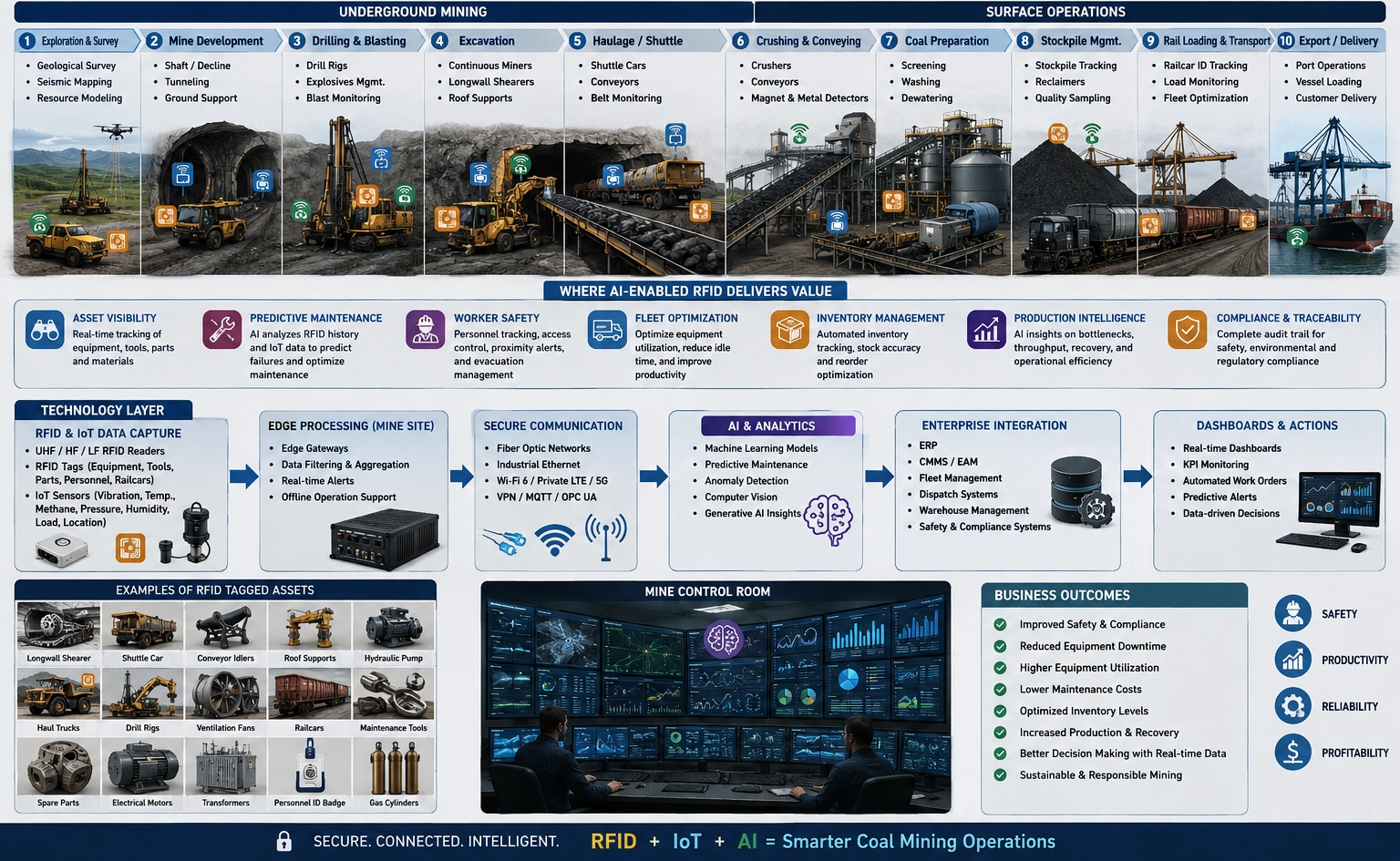
This infographic illustrates how AI-powered RFID supports the complete coal mining lifecycle, from geological exploration and underground extraction to coal preparation, stockpile management, rail loading, and export. It shows how RFID, Industrial IoT sensors, edge computing, and AI analytics work together to improve asset visibility, predictive maintenance, workforce safety, fleet optimization, production intelligence, and enterprise software integration. The key takeaway is that combining RFID with AI enables data-driven, safer, and more efficient coal mining operations.
Understanding AI-Powered RFID in Coal Mining Operations
Artificial Intelligence of Things (AIoT) combines artificial intelligence with connected sensors, RFID technologies, industrial communications, and operational software to automate data collection and improve decision making throughout mining operations.
Within coal mining, RFID provides persistent digital identities for critical operational assets such as:
- Continuous miners
- Longwall shearers
- Roof bolters
- Shuttle cars
- Battery-powered personnel carriers
- Diesel-powered utility vehicles
- Conveyor belt components
- Hydraulic roof supports
- Ventilation equipment
- Electrical substations
- Mine transformers
- High-voltage switchgear
- Pump stations
- Gas monitoring instruments
- Conveyor idlers
- Conveyor motors
- Coal stockpiles
- Rail wagons
- Shipping containers
- Maintenance tools
- Spare parts
- Personal protective equipment
- Underground personnel
- Explosive inventories
- Rescue equipment
Rather than simply identifying tagged assets, AI continuously evaluates RFID-generated operational data alongside production metrics, equipment telemetry, methane measurements, vibration sensors, thermal cameras, and maintenance histories. Machine learning algorithms detect deviations from normal operating conditions, identify production constraints, recommend maintenance schedules, optimize haulage routes, and improve workforce safety.
Coal mining environments create unique engineering challenges that require highly durable RFID deployments, including:
- Coal dust accumulation
- High humidity
- Water ingress
- Mechanical vibration
- Metallic infrastructure
- Narrow underground tunnels
- Electromagnetic interference
- Explosive atmospheres
- Variable temperatures
- Limited wireless coverage
Successful deployments require careful engineering of RFID reader placement, antenna orientation, tag encapsulation, communication redundancy, and integration with existing mining automation systems.
Why AI-Enabled RFID Has Become Essential for Coal Mining
Coal producers increasingly operate under pressure to improve production efficiency while strengthening worker safety, reducing operating costs, minimizing unplanned downtime, and meeting environmental compliance requirements.
AI-supported RFID systems address several operational challenges unique to coal mining.
Equipment Visibility Across Complex Mine Operations
Coal mines operate thousands of mobile and stationary assets simultaneously.
Examples include:
- Longwall equipment
- Conveyor drives
- Pump stations
- Diesel generators
- Battery charging stations
- Ventilation fans
- Mobile substations
- Drill rigs
- Roof support systems
- Coal crushers
- Screening equipment
AI analyzes RFID movement histories to identify equipment utilization trends, idle periods, relocation inefficiencies, and maintenance scheduling opportunities.
Underground Workforce Safety
Personnel accountability remains one of the highest priorities within underground mining.
RFID-enabled worker identification allows AI software to monitor:
- Entry and exit points
- Refuge chamber occupancy
- Emergency evacuation progress
- Restricted-area access
- Shift attendance
- Worker proximity to hazardous equipment
- Underground location histories
When integrated with methane monitoring systems, ventilation sensors, and emergency communications, AI can recommend evacuation priorities based on real-time environmental conditions.
Intelligent Maintenance Planning
Coal mining equipment operates under severe mechanical loads.
AI combines RFID maintenance histories with sensor information collected from:
- Hydraulic pressure sensors
- Bearing vibration sensors
- Gearbox temperature sensors
- Motor current monitors
- Lubrication systems
- Conveyor speed monitoring
Maintenance teams receive recommendations before failures occur, reducing catastrophic breakdowns and improving equipment availability.
Production Optimization
RFID-generated movement histories enable AI to analyze:
- Coal extraction rates
- Conveyor utilization
- Loading delays
- Haul truck cycle times
- Stockpile turnover
- Rail loading efficiency
- Crusher throughput
Mining supervisors gain operational insights that improve production planning without increasing manual reporting.
GAO has supported organizations requiring reliable RFID hardware for demanding industrial environments by providing rugged identification devices designed for dependable performance in harsh operating conditions.
Underground Coal Mine AI-Enabled RFID Deployment Diagram for Asset Tracking, Worker Safety, and Predictive Maintenance
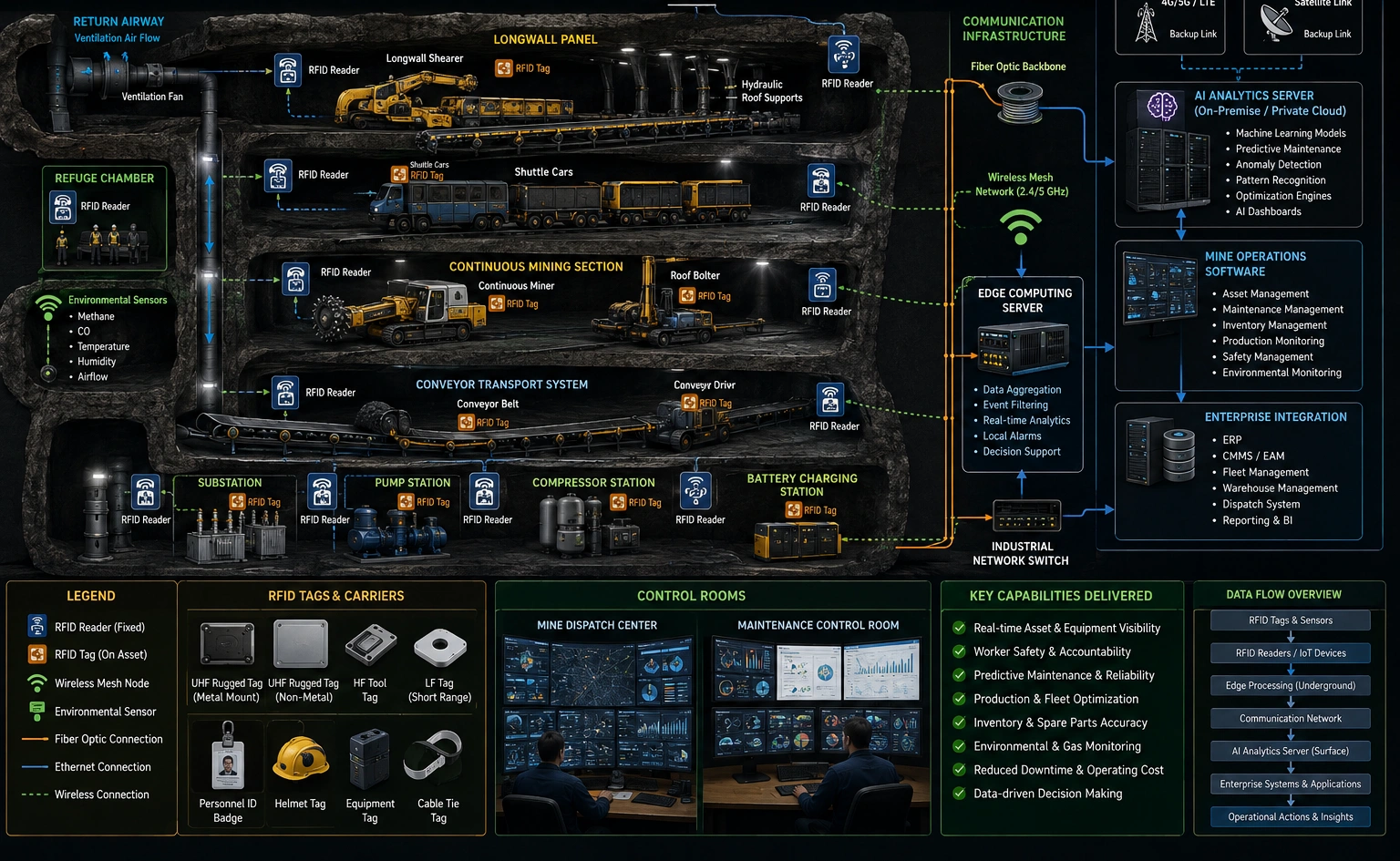
This engineering deployment diagram illustrates how AI-enabled RFID is implemented throughout an underground coal mine, connecting mining equipment, personnel, environmental sensors, and communication infrastructure to edge computing and AI analytics. It shows the complete operational data flow from RFID readers and IoT devices to dispatch, maintenance, and enterprise software, demonstrating how intelligent monitoring improves asset visibility, workforce safety, predictive maintenance, and operational efficiency.
Coal Mining Applications and Operational Deployment Scenarios
AI-powered RFID solutions support nearly every operational phase of coal extraction and processing.
Longwall Mining Operations
Longwall systems involve hundreds of synchronized hydraulic roof supports, armored face conveyors, stage loaders, and shearers.
RFID enables automatic identification of equipment components during maintenance and replacement.
AI analyzes historical movement and maintenance records to identify recurring component failures, optimize replacement intervals, and reduce production interruptions.
Continuous Mining Sections
Continuous mining requires coordination among continuous miners, shuttle cars, roof bolters, battery charging systems, and personnel.
AI evaluates RFID movement histories to improve:
- Machine dispatching
- Shuttle car utilization
- Queue management
- Equipment balancing
- Shift productivity
Conveyor Belt Management
Conveyor systems frequently extend several kilometers through underground workings.
RFID assists with identification of:
- Belt sections
- Motors
- Gearboxes
- Idlers
- Rollers
- Belt cleaners
- Take-up systems
- Transfer stations
AI predicts wear patterns and identifies maintenance priorities before production losses occur.
Coal Preparation Plants
Preparation plants process raw coal through crushing, screening, washing, flotation, thickening, and dewatering.
RFID identifies:
- Processing equipment
- Chemical inventories
- Maintenance tools
- Spare parts
- Laboratory samples
AI correlates equipment utilization with production quality metrics, enabling process optimization and reduced downtime.
Stockpile Management
Coal stockyards often contain multiple grades destined for different customers.
RFID identifies:
- Stockpile zones
- Reclaim equipment
- Stacker-reclaimers
- Loader inventory
- Rail wagon assignments
AI predicts inventory depletion, blending requirements, and shipping schedules while minimizing product contamination.
Rail Loading and Logistics
Coal transportation depends on accurate coordination between mine production and outbound logistics.
RFID identifies:
- Rail wagons
- Locomotives
- Loading chutes
- Shipment documentation
- Customer orders
AI improves wagon sequencing, loading efficiency, turnaround times, and shipment traceability.
End-to-End Operational Workflow for AI-Enabled RFID in Coal Mining
A successful AI-powered RFID solution follows a structured operational workflow that converts physical mining activities into digital operational intelligence.
Data Acquisition
RFID tags are attached to mining equipment, mobile assets, maintenance tools, consumables, rail wagons, and personnel identification badges. Fixed and handheld RFID readers automatically capture identification events at haul roads, underground intersections, conveyor transfer points, maintenance workshops, warehouses, and loading facilities. Additional Industrial IoT devices, including vibration sensors, methane detectors, temperature probes, motor current monitors, and machine telemetry units, continuously collect complementary operational data.
Industrial Communications
Captured data is transmitted through resilient communication infrastructure such as fiber optic networks, industrial Ethernet, Wi-Fi 6, private LTE, 5G private networks, wireless mesh networks, and intrinsically safe underground communication systems. Edge gateways aggregate RFID events and sensor streams while maintaining reliable data flow in areas with intermittent connectivity.
Edge Processing and Operational Intelligence
Local edge servers validate RFID reads, remove duplicate events, synchronize timestamps, and execute low-latency AI inference for time-sensitive applications such as personnel accountability, equipment access control, and collision avoidance. Relevant operational events are prioritized before being forwarded to central software systems for deeper analytics.
AI-Enabled RFID End-to-End Operational Workflow for Coal Mining: From Data Capture to Intelligent Decision Making
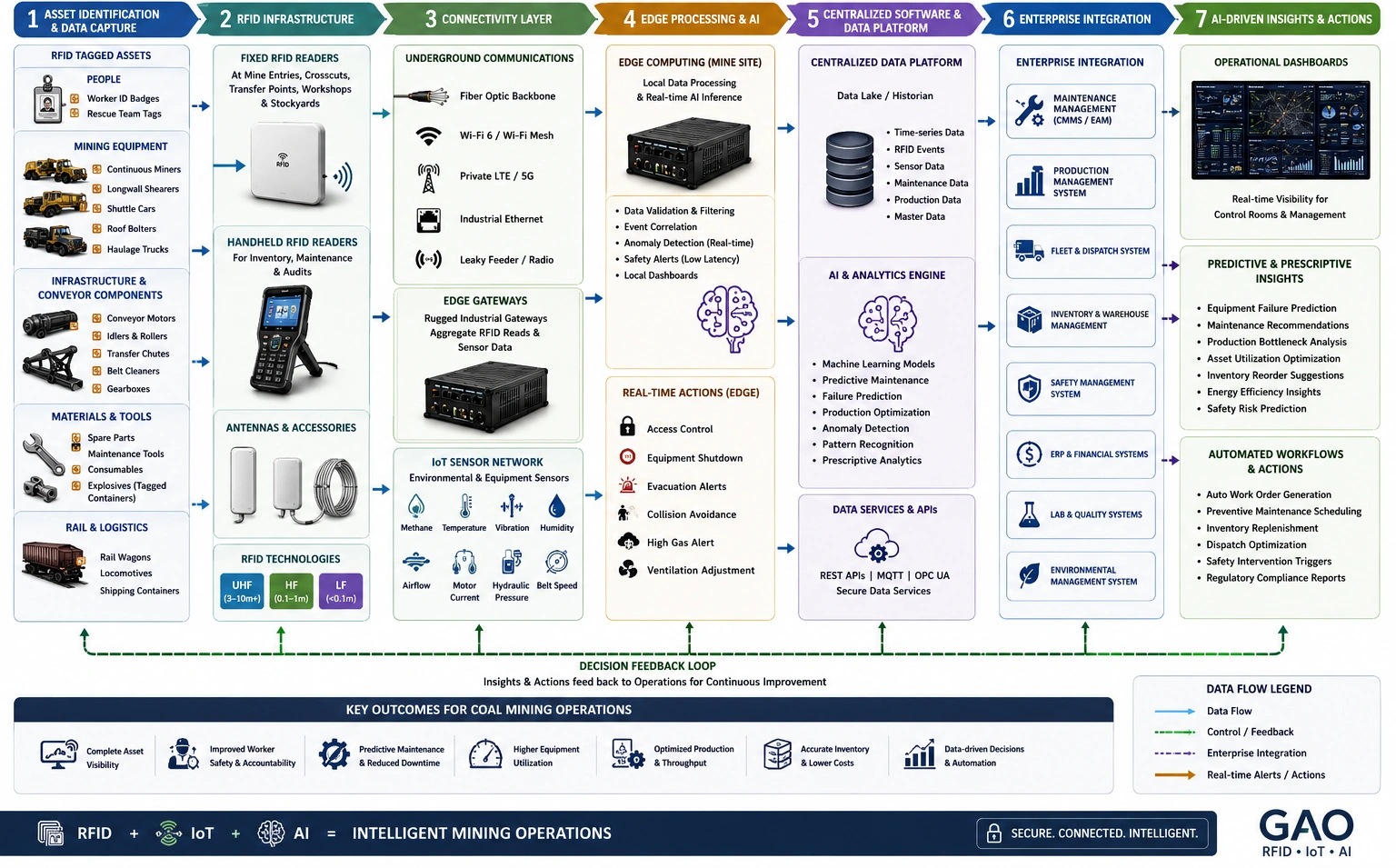
This workflow diagram illustrates the complete operational data flow of an AI-enabled RFID solution in coal mining, beginning with RFID-tagged personnel, equipment, conveyor components, and logistics assets. It shows how RFID data is collected, transmitted through industrial communication networks, processed by edge AI, integrated with enterprise mining software, and transformed into predictive maintenance insights, production optimization, automated workflows, and real-time operational decisions.
RFID, AI, and Industrial Infrastructure for Intelligent Coal Mining
A successful AI-powered RFID solution for coal mining depends on a carefully engineered combination of rugged identification hardware, industrial communications, AI software, operational databases, and enterprise mining systems. Every component must withstand demanding environmental conditions while supporting continuous operations, real-time decision making, and long equipment life cycles.
Unlike conventional RFID deployments focused solely on asset identification, AI-driven coal mining solutions continuously combine RFID events with telemetry, environmental sensing, maintenance records, production schedules, and workforce information. This enables operational intelligence that extends far beyond location tracking.
RFID Hardware Components
Coal mining environments require industrial-grade RFID hardware capable of operating under exposure to coal dust, abrasive particles, water spray, vibration, mechanical shock, and metallic infrastructure.
Typical hardware includes:
- Rugged UHF RFID readers installed at mine entrances, conveyor transfer stations, maintenance workshops, warehouses, stockyards, and rail loading facilities
- HF RFID readers for maintenance stations, tool cribs, laboratory sample tracking, and operator authentication
- LF RFID readers for applications requiring short-range, reliable identification in high-metal environments
- Passive UHF RFID tags attached to equipment, conveyor assemblies, hydraulic roof supports, electrical components, and spare parts
- High-temperature RFID tags for motors, gearboxes, pumps, and rotating machinery
- Encapsulated RFID tags resistant to water ingress, chemicals, and impact
- Handheld RFID readers for maintenance personnel, warehouse operators, and inventory audits
- RFID-enabled personnel identification badges integrated with access control systems
- Industrial RFID antennas engineered to maximize read reliability while minimizing interference from metallic structures
Selecting the appropriate RFID technology depends on required read distance, environmental conditions, asset mobility, mounting surface, and operational workflow.
Industrial IoT Sensors Supporting AI
RFID identifies assets, while Industrial IoT devices provide operational context for AI analysis.
Frequently integrated sensors include:
- Methane gas detectors
- Carbon monoxide sensors
- Airflow monitoring devices
- Temperature sensors
- Humidity sensors
- Vibration sensors
- Bearing condition monitors
- Motor current sensors
- Hydraulic pressure transmitters
- Oil quality sensors
- Belt speed sensors
- Conveyor misalignment detectors
- Thermal imaging cameras
- Dust concentration monitors
- GPS receivers for surface mining fleets
- Inertial measurement units
- Fuel monitoring sensors
- Battery management systems
- Electrical power analyzers
AI correlates RFID identification events with sensor measurements to detect abnormal operating conditions, identify degradation trends, and recommend corrective actions.
AI Models Used in Coal Mining
Different operational objectives require different AI methods.
Common techniques include:
- Supervised learning for equipment failure prediction
- Unsupervised learning for anomaly detection
- Time-series forecasting for production planning
- Reinforcement learning for haulage optimization
- Computer vision for conveyor inspection
- Deep learning for rock fragmentation analysis
- Predictive analytics for maintenance scheduling
- Graph analytics for equipment dependency analysis
- Natural language processing for maintenance log analysis
- Generative AI for technical documentation, maintenance recommendations, and operational knowledge retrieval
Rather than replacing mining engineers, these AI methods enhance decision quality by processing operational data volumes that exceed manual analysis capabilities.
Communication Infrastructure and Enterprise Software Integration
Reliable communications are essential because mining operations often extend across large surface areas and complex underground tunnel networks.
Typical communication technologies include:
- Industrial Ethernet
- Fiber optic backbone networks
- Wi-Fi 6 access points
- Private LTE
- Private 5G
- Wireless mesh networking
- Serial industrial communications
- OPC UA
- Modbus TCP
- MQTT
- HTTPS-based application interfaces
- REST APIs
RFID data typically flows through middleware before reaching enterprise software.
Common integrations include:
- Enterprise Resource Planning (ERP)
- Enterprise Asset Management (EAM)
- Computerized Maintenance Management Systems (CMMS)
- Manufacturing Execution Systems adapted for mining operations
- Warehouse Management Systems
- Fleet Management Systems
- Mine Dispatch Systems
- Production Reporting Software
- Geographic Information Systems (GIS)
- Laboratory Information Management Systems
- Environmental Monitoring Software
- Safety Management Systems
- Business Intelligence dashboards
These integrations ensure RFID-generated operational events automatically update maintenance schedules, inventory records, work orders, production reports, compliance documentation, and management dashboards.
GAO has helped organizations implement RFID hardware that integrates with a broad range of industrial software environments, reducing manual data entry while improving operational data quality.
Cloud Version and Server Version Deployment
Selecting the appropriate deployment model depends on operational requirements, cybersecurity policies, connectivity constraints, regulatory obligations, and IT management preferences.
Cloud Version
Cloud-hosted deployments centralize software within managed cloud infrastructure while allowing mining sites to transmit RFID events and AI-generated operational data securely over encrypted communications.
Cloud deployments are particularly appropriate for organizations operating multiple mines across different geographic regions because centralized analytics simplify enterprise-wide reporting, predictive maintenance, inventory visibility, and fleet performance comparisons.
Typical advantages include:
- Simplified software updates
- Centralized AI model management
- Enterprise-wide reporting
- Elastic computing resources
- High-availability infrastructure
- Remote engineering support
- Centralized backup and disaster recovery
- Faster deployment of analytics improvements
Cloud deployments are especially valuable for mining organizations requiring consolidated operational intelligence across multiple preparation plants, distribution terminals, and transportation networks.
Server Version
Many coal mining companies prefer software deployed on privately managed servers because operational continuity, cybersecurity requirements, or regulatory policies require direct control over operational data.
Server deployments may operate on:
- Mine edge servers
- Underground control rooms
- Regional data centers
- Corporate data centers
- Customer-managed virtual infrastructure
Server deployments provide:
- Lower latency
- Greater control over sensitive operational information
- Independent operation during internet outages
- Integration with legacy mining software
- Compliance with internal cybersecurity policies
- Flexible customization for site-specific operational workflows
Hybrid deployments are increasingly common, with real-time operational decisions executed locally while aggregated operational data is synchronized periodically with centralized reporting environments.
Cybersecurity and Operational Resilience
Because coal mining infrastructure forms part of critical industrial operations, cybersecurity must be incorporated throughout the entire solution.
Recommended practices include:
- End-to-end encryption
- Role-based access control
- Multi-factor authentication
- Secure RFID credential management
- Certificate-based device authentication
- Network segmentation
- Industrial firewalls
- Continuous vulnerability assessment
- Security Information and Event Management (SIEM)
- Intrusion detection systems
- Secure firmware updates
- Hardware root of trust
- Audit logging
- Backup and disaster recovery procedures
Operational resilience should also address hardware redundancy, communication failover, edge processing continuity, and disaster recovery planning to maintain safe operations during infrastructure failures.
AI-Enabled RFID System Diagram for Coal Mining: Industrial IoT, Enterprise Integration, and Real-Time Analytics
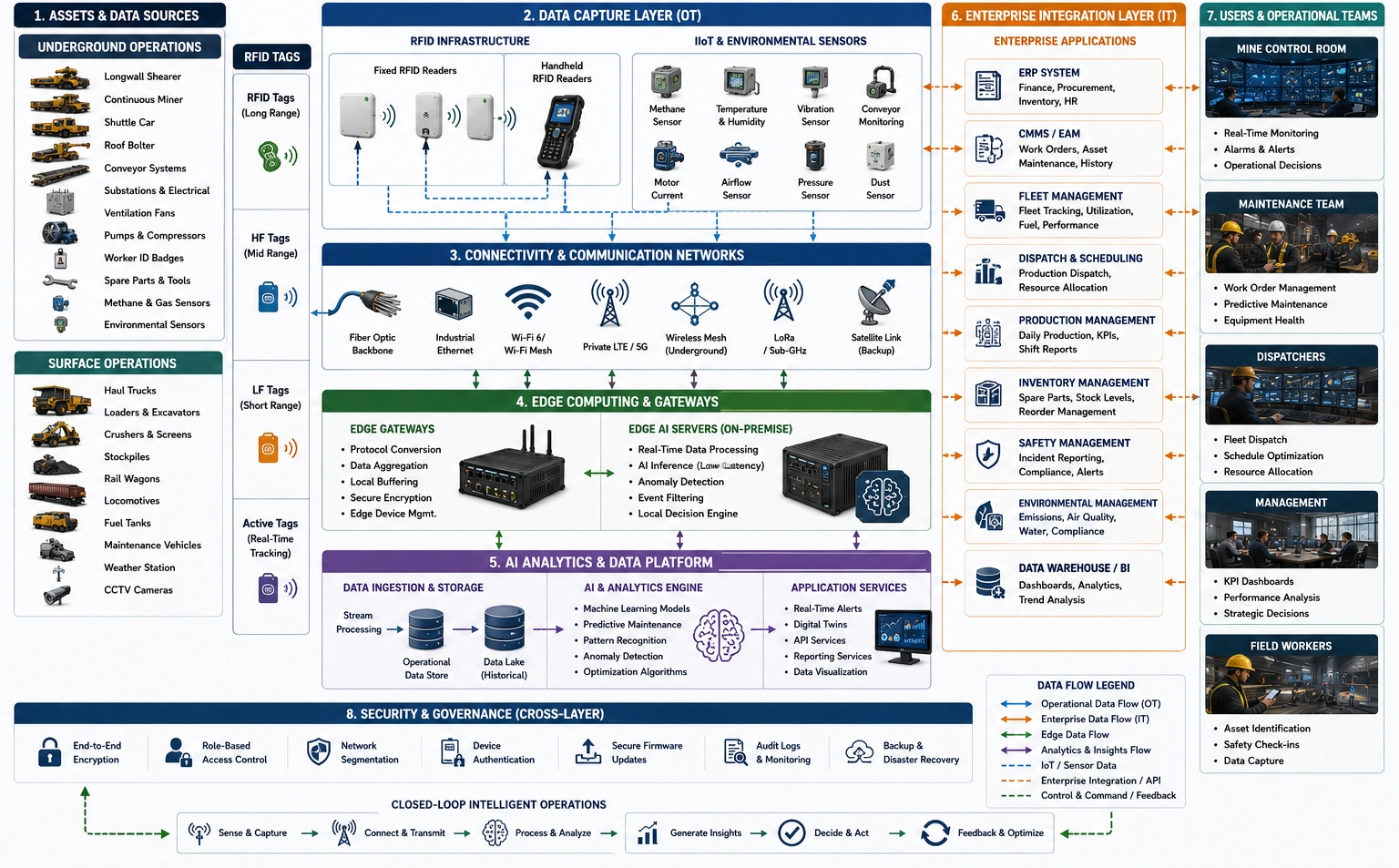
This engineering system diagram illustrates how RFID infrastructure, Industrial IoT sensors, communication networks, edge computing, AI analytics, and enterprise mining software work together across underground and surface coal mining operations. It highlights secure bidirectional data flows between operational technology and enterprise applications, enabling predictive maintenance, fleet management, production monitoring, safety management, and data-driven operational decision making.
Technical Capabilities and Operational Value of AI-Powered RFID in Coal Mining
When AI continuously analyzes RFID-generated operational data alongside Industrial IoT sensor information, coal mining organizations gain a comprehensive operational view that supports safer, more efficient, and more predictable production. The value extends well beyond asset identification by enabling intelligent operational decision support throughout the mining lifecycle.
Intelligent Asset Visibility
AI continuously correlates RFID events with production schedules, maintenance records, and operational locations to provide near real-time visibility of mobile equipment, fixed infrastructure, maintenance tools, consumables, and critical spare parts.
Operational improvements include:
- Reduced time locating specialized mining equipment
- Faster deployment of maintenance teams
- Improved spare parts availability
- Lower inventory discrepancies
- Better utilization of high-value assets
- Reduced equipment idle time
Predictive Maintenance
Rather than relying solely on calendar-based maintenance, AI evaluates RFID service histories together with vibration, temperature, motor current, hydraulic pressure, and operating hour data.
This enables:
- Early detection of component degradation
- Optimized maintenance scheduling
- Reduced catastrophic failures
- Extended equipment life
- Higher equipment availability
- Improved maintenance labor planning
Typical equipment benefiting from predictive maintenance includes:
- Longwall shearers
- Continuous miners
- Roof bolters
- Conveyor drives
- Gearboxes
- Crushers
- Pumps
- Ventilation fans
- Electrical substations
Workforce Safety Enhancement
Personnel safety remains a primary objective in underground and surface coal mining.
AI-supported RFID solutions improve safety by enabling:
- Automated personnel accountability
- Restricted-area access control
- Emergency evacuation tracking
- Refuge chamber occupancy monitoring
- Equipment proximity awareness
- Shift attendance verification
- Contractor access management
- Incident investigation using historical movement records
When integrated with methane monitoring, ventilation control, and environmental sensors, AI can assist mine supervisors by identifying potentially hazardous conditions and prioritizing evacuation or response activities.
Production Optimization
Coal production involves tightly coordinated interactions among mining equipment, conveyor systems, preparation plants, stockyards, and transportation assets.
AI analyzes RFID movement histories to identify:
- Conveyor bottlenecks
- Equipment queuing delays
- Underutilized assets
- Production interruptions
- Stockpile imbalances
- Rail loading inefficiencies
- Maintenance-related production losses
These insights support more accurate production planning and improved operational efficiency.
Inventory and Warehouse Management
Mining operations maintain extensive inventories of consumables, replacement parts, safety equipment, and maintenance tools.
AI-supported RFID enables:
- Automated inventory counting
- Faster receiving and issuing processes
- Reduced stock discrepancies
- Optimized reorder points
- Improved warehouse space utilization
- Better traceability of critical components
- Reduced manual inventory audits
Engineering Best Practices for Successful Deployment
Successful AI-powered RFID implementation in coal mining requires careful planning, multidisciplinary collaboration, and phased deployment.
Recommended engineering practices include:
- Perform comprehensive site surveys before reader installation to identify potential RF interference, metallic obstructions, and environmental challenges.
- Select RFID tags designed for harsh mining conditions, including resistance to dust, moisture, vibration, abrasion, and temperature extremes.
- Position fixed readers at operational control points such as mine entrances, conveyor transfer stations, maintenance workshops, warehouses, and rail loading facilities.
- Validate read accuracy under normal production conditions before expanding deployment.
- Integrate RFID events with existing ERP, CMMS, fleet management, dispatch, and safety systems to eliminate duplicate data entry.
- Implement edge processing for safety-critical functions requiring low-latency responses.
- Establish data governance policies covering asset identifiers, personnel records, maintenance histories, and operational event retention.
- Develop cybersecurity policies that include encryption, device authentication, role-based access control, and routine security assessments.
- Train maintenance teams, warehouse personnel, dispatch operators, and production supervisors on new workflows and AI-generated operational insights.
- Define measurable performance indicators before deployment to evaluate operational improvements.
GAO supports customers by supplying rugged RFID hardware and providing technical guidance that helps organizations deploy reliable identification systems suited to demanding industrial environments.
Key Performance Indicators for Measuring Success
Organizations implementing AI-powered RFID in coal mining commonly monitor the following KPIs to evaluate operational performance:
- Equipment availability
- Overall Equipment Effectiveness (OEE)
- Mean Time Between Failures (MTBF)
- Mean Time to Repair (MTTR)
- Maintenance schedule compliance
- Conveyor uptime
- Longwall productivity
- Continuous miner utilization
- Asset utilization rate
- Inventory accuracy
- Spare parts availability
- Tool utilization
- Personnel accountability response time
- Emergency evacuation verification time
- Rail wagon turnaround time
- Stockpile inventory accuracy
- Production throughput
- Coal recovery rate
- Unplanned downtime
- Safety incident frequency
- Maintenance cost per operating hour
- Energy consumption per ton of coal produced
Tracking these indicators enables mining organizations to quantify operational improvements and refine AI models over time.
Implementation Recommendations
Organizations planning AI-enabled RFID projects should adopt a phased implementation strategy rather than attempting mine-wide deployment from the outset.
A practical roadmap includes:
- Identify high-value operational challenges such as asset tracking, maintenance optimization, or personnel safety.
- Conduct an RFID feasibility assessment to determine appropriate UHF, HF, and LF technologies based on environmental conditions and read requirements.
- Deploy a pilot in a controlled operational area, such as a maintenance workshop, conveyor section, or warehouse.
- Validate read performance, communication reliability, and software integration before expanding coverage.
- Incorporate Industrial IoT sensors where additional operational context is required.
- Train AI models using operational data collected during the pilot phase.
- Expand incrementally to additional production areas while continuously monitoring KPIs and user adoption.
- Periodically review AI model performance and update decision logic as equipment, workflows, and production objectives evolve.
A phased approach reduces implementation risk, minimizes operational disruption, and provides opportunities for continuous optimization.
Advancing the Future of AI-Enabled Coal Mining with RFID
AI-powered RFID solutions are reshaping coal mining by combining automated identification with intelligent analytics, Industrial IoT sensing, and operational software integration. Rather than functioning solely as an asset tracking technology, RFID becomes a foundational data source that enables predictive maintenance, production optimization, workforce safety, inventory visibility, and informed operational decision making.
As coal mining operations continue to pursue higher productivity, improved safety, and greater operational resilience, integrating AI with RFID provides a practical pathway toward more data-driven mining practices. By combining durable RFID hardware with engineering expertise and robust software integration, GAO helps organizations build reliable identification systems that support long-term operational improvements across underground mines, surface mines, coal preparation plants, stockyards, and transportation facilities.
Building the Future of Industrial AI and IoT with Aperture Venture Studio and GAO RFID Inc.
For more than three decades, GAO Group of Companies has invested extensively in research and development of industrial RFID, BLE, and Industrial IoT technologies. As Artificial Intelligence has become increasingly valuable for coal mining automation, predictive maintenance, workforce safety, and operational intelligence, we have expanded our AI and IoT initiatives and established Aperture Venture Studio to accelerate the advancement and practical adoption of AI and Industrial IoT solutions across mining and other industrial sectors.
Aperture has attracted experienced AI researchers, Industrial IoT engineers, operational executives, respected investors, and leading technology organizations. Through initiatives such as the Aperture Ventures Summit and TekSummit, we facilitate technical discussions on emerging AI, RFID, BLE, and Industrial IoT applications. These efforts have strengthened collaborative technical communities focused on advancing intelligent industrial systems. We welcome opportunities to engage with advisors, investors, customers, and professionals interested in shaping the future of Industrial AI and IoT.
AI-Enabled RFID Coal Mining Lifecycle: End-to-End Operational Workflow and Intelligent Decision Support
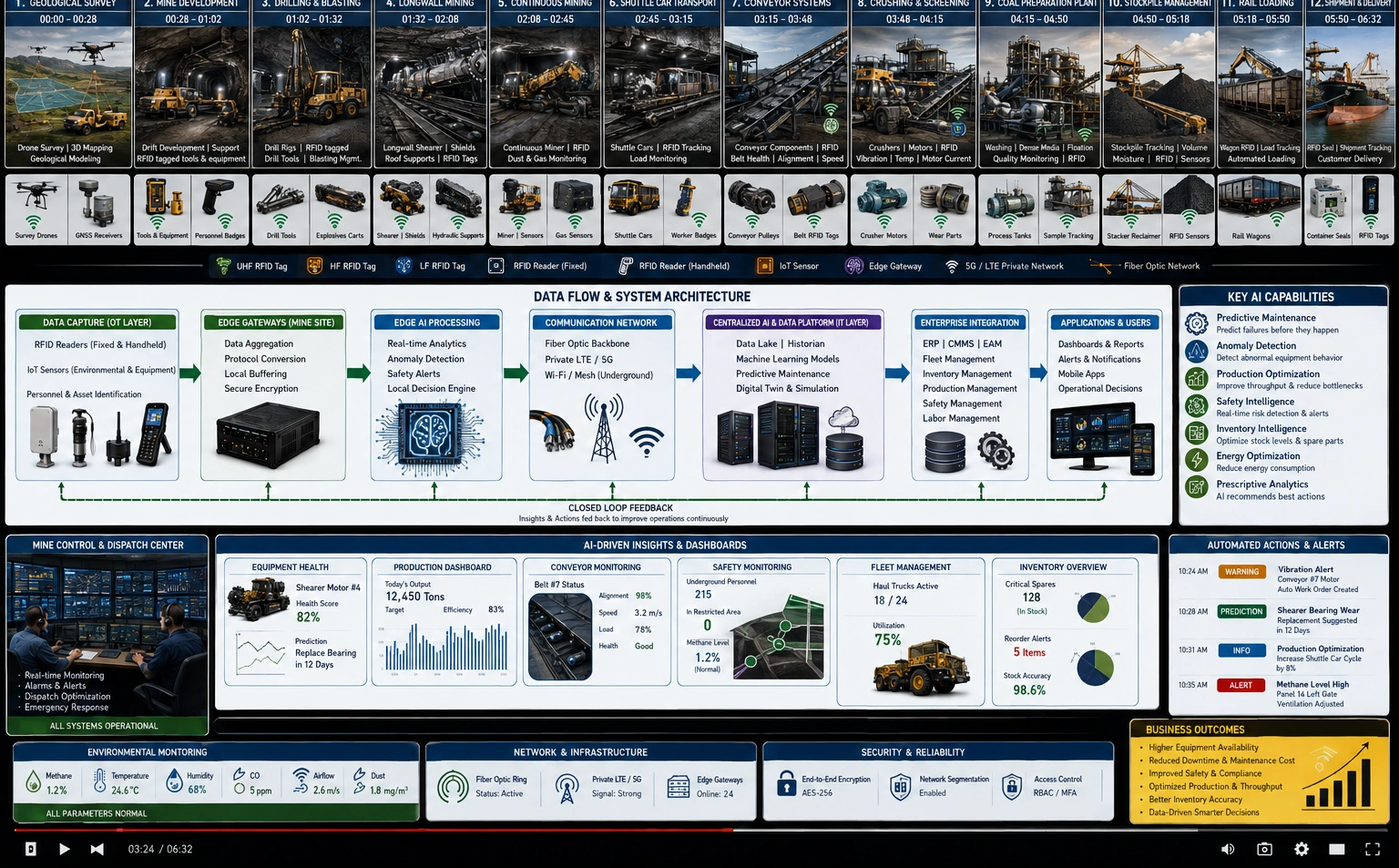
This visual presents a complete end-to-end view of an AI-enabled RFID solution across the coal mining lifecycle, from geological surveying and underground mining to coal processing, stockpile management, rail loading, and shipment. It demonstrates how RFID, Industrial IoT sensors, edge AI, communication networks, and enterprise software work together to deliver predictive maintenance, production optimization, workforce safety, inventory visibility, and real-time operational intelligence.