
AI and RFID for Commercial Construction
AI and RFID for Commercial Construction Asset Tracking
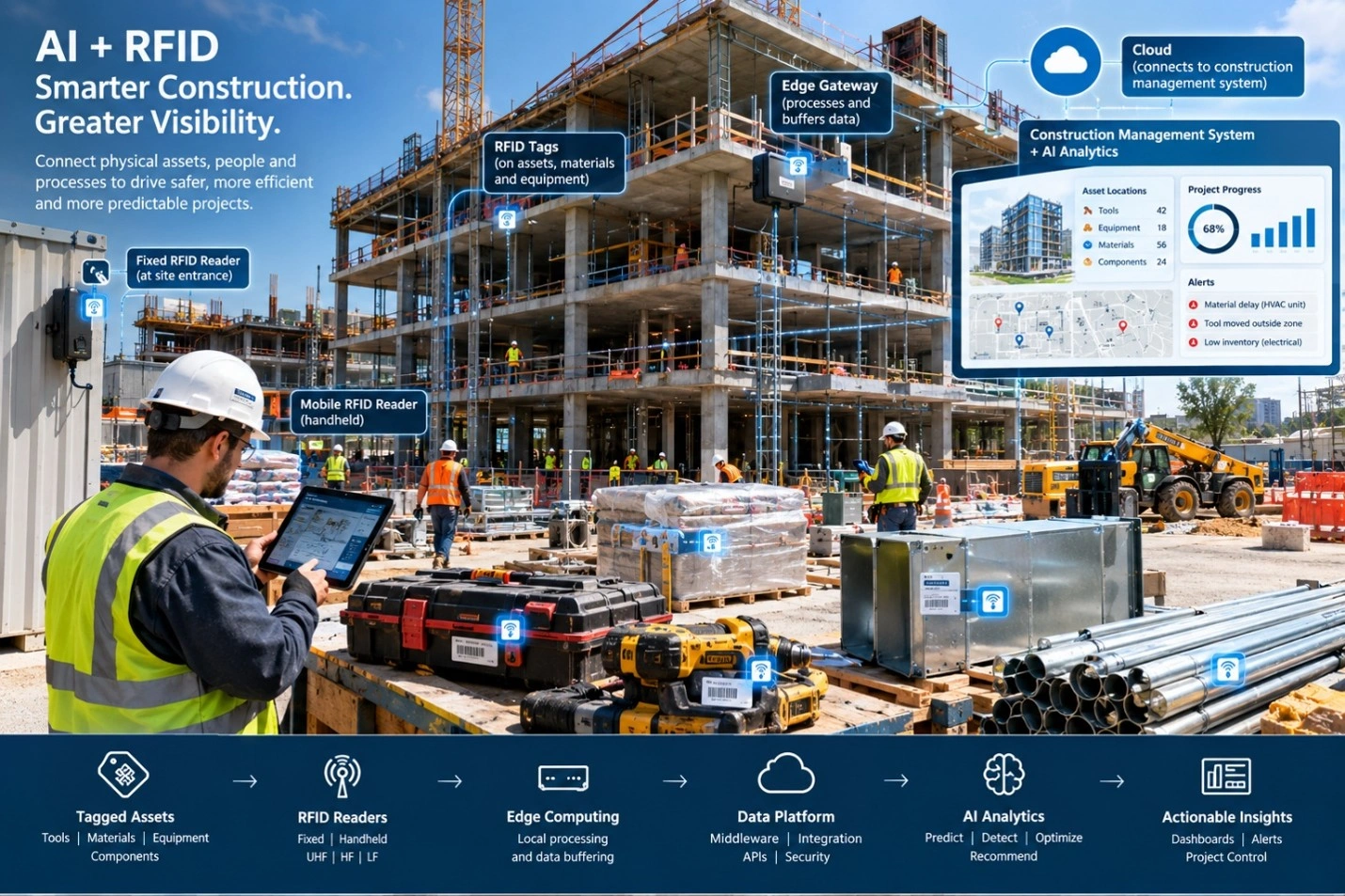
A realistic commercial construction site illustrates how RFID-tagged tools, materials, equipment, and components connect through fixed and handheld RFID readers, edge computing, cloud systems, and AI analytics. The visual highlights how physical construction assets become actionable data for project visibility, material tracking, equipment management, and operational decision-making.
How AI Is Changing Commercial Construction Operations
AI for commercial construction combines artificial intelligence with data generated by construction equipment, workers, project systems, IoT devices, and RFID-tagged assets to improve how contractors plan, execute, monitor, and control projects. RFID provides machine-readable identification and location or event data for tools, materials, equipment, prefabricated components, and other physical assets, while AI converts operational data into predictions, alerts, classifications, and recommendations.
For general contractors, specialty contractors, construction managers, and owners, the value is not simply knowing where an asset is. The greater opportunity is connecting asset movements with procurement, material handling, work packages, installation sequences, labor activity, safety processes, and project schedules. AI can identify patterns such as recurring material delays, abnormal equipment movements, inefficient staging, missing tools, or inventory discrepancies that may otherwise require manual investigation.
Commercial construction projects are particularly suitable for this approach because work is distributed across changing zones, floors, laydown areas, warehouses, fabrication facilities, and temporary storage locations. RFID-enabled data collection can reduce manual scanning and record events as materials and equipment move through these environments. AI can then use the resulting data to support project controls, logistics planning, asset utilization, and operational decision-making.
GAO provides RFID, BLE, and IoT hardware products and systems that can support organizations implementing connected asset-tracking and data-collection solutions for demanding operational environments.
AI-Enabled Construction Intelligence & Traceability: From RFID-Tagged Assets to Smarter Decisions
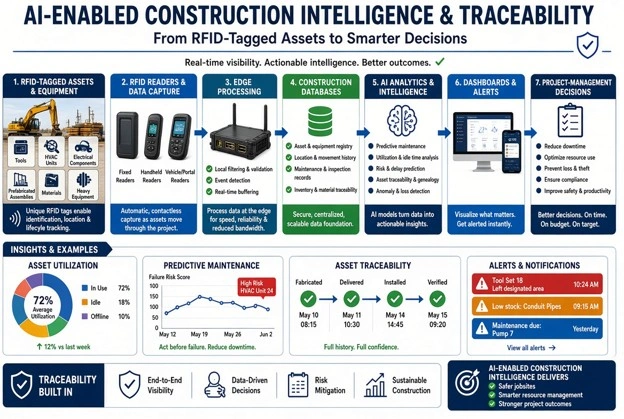
This professional enterprise infographic maps the complete data cycle in commercial construction from RFID-tagged tools, HVAC units, electrical components, prefabricated assemblies, materials, and heavy equipment through readers, edge processing, and construction databases into AI analytics, live dashboards, alerts, and project-management decisions. It shows how real-time visibility and actionable intelligence drive better outcomes on schedule, budget, and safety.
What AI and RFID Mean for Commercial Construction
AI-enabled construction systems depend on reliable operational data. RFID can provide an automated identification layer for physical assets, while AI provides analytical capabilities that help construction teams interpret the resulting information.
The appropriate RFID technology depends on the asset, operating environment, read range, material composition, and required workflow. UHF RFID is generally useful for longer-range identification of tagged construction materials, tools, equipment, and components. HF RFID can be appropriate for shorter-range identification and controlled interactions. LF RFID can be considered for specialized applications where its operating characteristics match the construction use case.
AI methods can include machine learning, anomaly detection, predictive analytics, computer vision, natural language processing, and generative AI. For example, machine learning can analyze historical equipment utilization and movement records, while computer vision can supplement RFID information by analyzing construction-site imagery. Generative AI can help project personnel query operational information using natural language, provided the underlying data is accurate and appropriately governed.
The combination becomes especially useful when RFID events are correlated with project information. A material receiving event can be associated with a purchase order. Movement into a staging area can be associated with a work package. Removal of a tool from a secured storage location can be associated with an assigned crew. Installation of a tagged component can be linked to a building zone and project milestone.
The resulting system can support more timely decisions than periodic manual inventories.
High-Value AI Applications for Commercial Construction
AI Construction Asset Tracking
Commercial construction companies manage large inventories of tools, equipment, materials, components, and temporary assets. Manual tracking becomes increasingly difficult as projects expand across multiple floors, buildings, warehouses, and staging locations.
RFID can automate identification events as tagged assets pass through designated reader zones. AI can analyze these events to identify utilization patterns, unusual movements, prolonged inactivity, and potential losses.
Relevant assets include:
- Power tools and specialized trade tools
- Surveying and measurement equipment
- Generators and temporary electrical equipment
- Scaffolding and temporary site equipment
- HVAC components and mechanical equipment
- Electrical panels and prefabricated assemblies
- Construction materials and high-value components
- Safety equipment and selected reusable site assets
The objective is not simply asset visibility. AI-assisted asset tracking can help determine whether equipment is being adequately utilized, whether additional equipment should be procured, and whether assets are accumulating unnecessarily at a project location.
AI Construction Material Management
Material availability directly affects commercial construction productivity. Missing, misplaced, damaged, or incorrectly staged materials can create downstream disruption even when procurement has technically been completed.
RFID can record material receipt and movement events, while AI can compare those events with schedules, purchase orders, expected quantities, storage locations, and installation requirements.
A construction team could use this information to identify materials that have arrived but have not moved toward their required work zone, components that remain in storage beyond expected durations, or discrepancies between expected and recorded quantities.
For prefabricated mechanical, electrical, and plumbing components, automated identification can also support traceability from receiving through staging and installation.
AI-Powered Construction Site Logistics
Commercial construction sites frequently change configuration as structural, architectural, mechanical, electrical, and finishing activities progress. Laydown areas that are appropriate during one phase may become unavailable during another.
AI can analyze RFID movement records together with project schedules and site information to identify recurring logistics bottlenecks. Construction managers can use this information when deciding where to stage materials, how frequently equipment should be relocated, and which delivery sequences require adjustment.
This can be particularly valuable on constrained urban sites where storage space, vehicle access, crane utilization, and material-handling routes are limited.
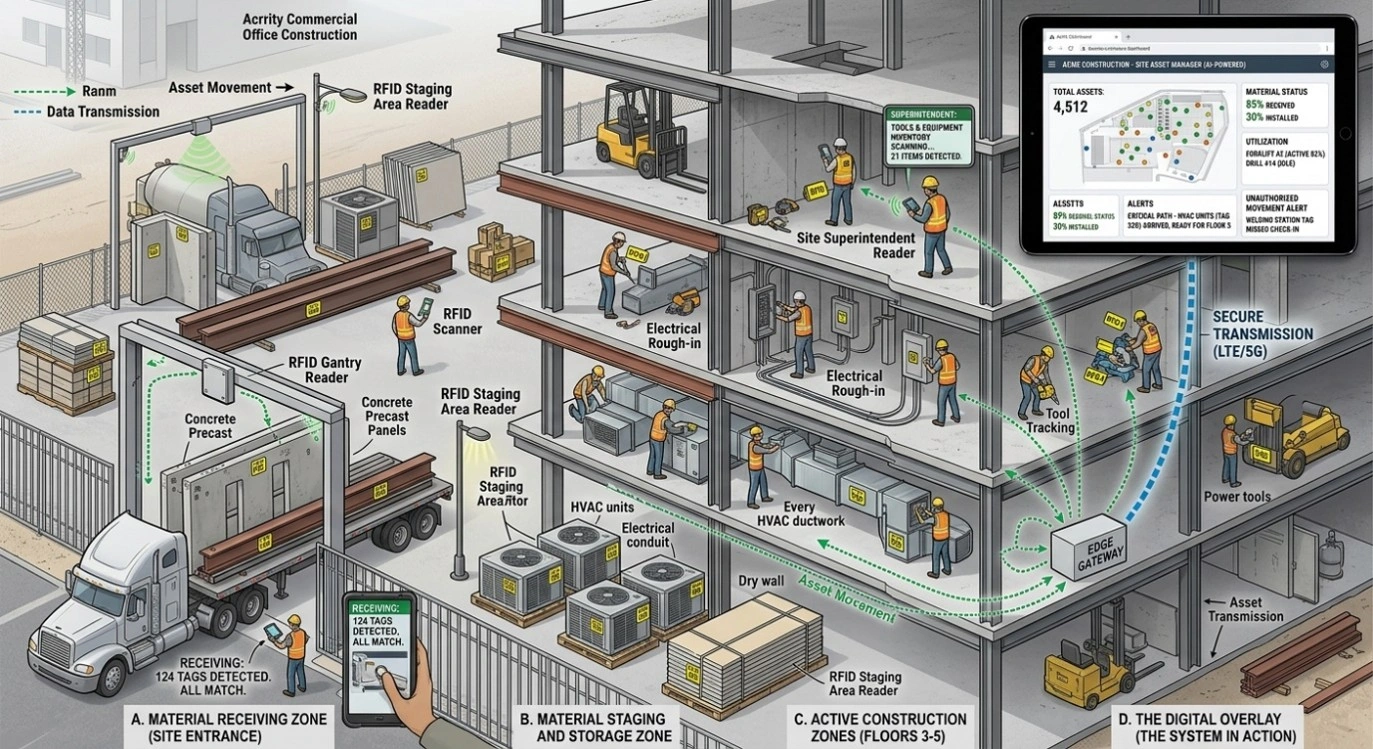
This detailed cross-section diagram illustrates the end-to-end deployment of an AI-powered UHF RFID asset tracking system across an active multi-story commercial construction site. It visualizes the physical lifecycle of materials, tools, and equipment as they move through receiving, staging, and installation zones. Key hardware components—including gantry readers, handheld scanners, and edge gateways—are depicted transmitting real-time tracking data directly to an integrated AI dashboard. The visual emphasizes how automated RFID data capture eliminates manual inventory errors and optimizes jobsite logistics.
AI for Construction Equipment Utilization
Construction equipment can represent a substantial operating cost. Equipment that remains idle, is unnecessarily duplicated, or is unavailable when required can reduce project efficiency.
RFID identification can establish equipment movement and utilization events, while additional sensors can provide operational information such as runtime, operating status, or location. AI models can use historical data to identify utilization patterns and support equipment planning.
Potential applications include:
- Identifying underutilized equipment
- Detecting unexpected equipment movement
- Supporting equipment allocation between projects
- Forecasting equipment demand
- Identifying unusual idle periods
- Supporting maintenance planning when combined with equipment-condition data
RFID should not be treated as a replacement for equipment telemetry where detailed machine operating data is required. Instead, RFID can complement machine sensors and other IoT technologies by providing reliable asset identity and event context.
AI for Construction Inventory Control
Construction inventory differs from conventional warehouse inventory because materials frequently move between procurement locations, fabrication facilities, warehouses, project sites, floors, temporary staging areas, and installation zones.
AI-assisted inventory systems can reconcile RFID events with expected quantities and project requirements. This can reduce dependence on manual counts and help identify discrepancies earlier.
For GAO-supported RFID deployments, the selection of tags and readers should account for metal surfaces, liquids, dense material storage, environmental exposure, reader placement, interference, and the required read accuracy. Construction materials such as steel, piping, electrical equipment, and mechanical assemblies can create challenging radio-frequency conditions, making site testing important before full deployment.
From RFID Data Capture to AI-Driven Construction Decisions
A commercial construction AI and RFID solution typically begins with physical data acquisition.
RFID tags are attached or associated with selected construction assets, tools, materials, equipment, or components. Fixed readers can capture events at receiving points, controlled access locations, staging areas, storage zones, or other defined checkpoints. Handheld readers can provide mobile identification during inventory, installation, inspection, or field verification activities.
The RFID readers transmit event data through an appropriate communications network. Depending on the project environment, connectivity may use Ethernet, Wi-Fi, cellular connectivity, or other suitable communications methods. Edge gateways can aggregate and preprocess events before forwarding them to centralized software.
Middleware is responsible for transforming raw reader events into useful business information. It can apply filtering, duplicate-event suppression, tag association, device management, and data normalization. The resulting information can then be connected with construction-management software, enterprise resource planning systems, procurement systems, inventory databases, computerized maintenance management systems, or project-control applications.
AI analytics operate on this structured information. Models can identify patterns, generate forecasts, detect anomalies, classify events, and produce operational recommendations. Dashboards and alerts then present the results to project managers, superintendents, logistics personnel, warehouse teams, procurement staff, and other authorized users.
The final step is the business action. A system might alert a project team that a critical component has not reached its required installation zone, identify a tool that has moved outside its expected area, flag an inventory discrepancy, or highlight equipment that has remained idle longer than expected.
The effectiveness of the system therefore depends on the complete chain from accurate physical identification to actionable construction decisions.
Complete RFID Construction Asset Operational Lifecycle and Decision-Making Workflow
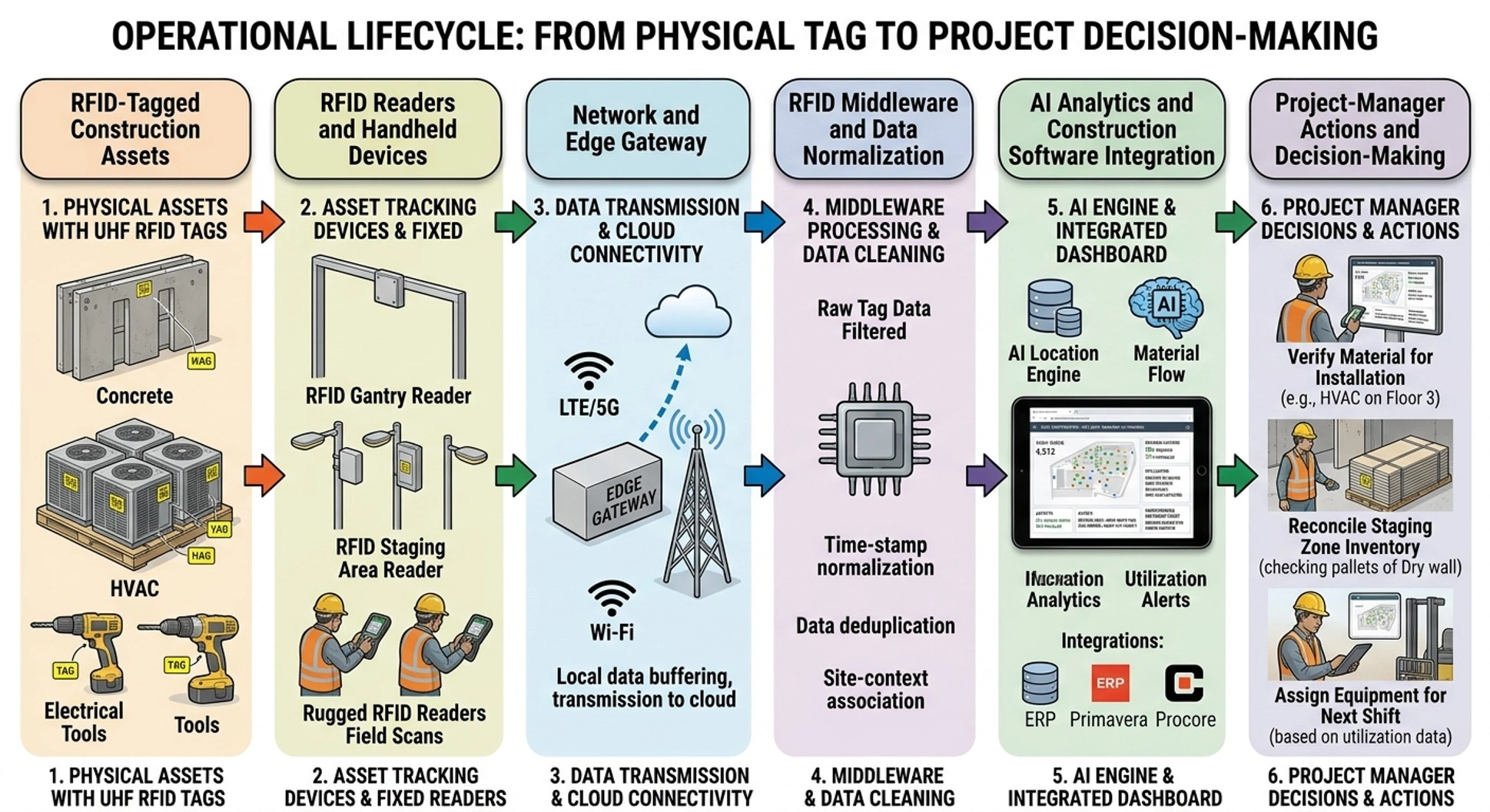
This workflow diagram illustrates the end-to-end process of tracking construction assets using RFID technology, from physical tagging on the jobsite to data-driven decision-making by project managers. It details a six-stage lifecycle involving asset identification, data capture, transmission via edge gateways, software integration, and finally, actionable insights derived from real-time analytics. The visual demonstrates how automated material and equipment tracking streamlines logistics and improves project efficiency.
RFID, AI, and Supporting Technologies for Commercial Construction
A practical deployment normally combines several technologies rather than relying on RFID alone.
RFID tags provide asset identity. Fixed and handheld RFID readers capture identification events. Edge gateways can process or buffer data close to the construction site, particularly where connectivity is intermittent. Network infrastructure transfers data to centralized systems. Middleware converts reader events into usable records.
AI software can then apply machine learning, anomaly detection, forecasting, computer vision, or generative AI according to the business requirement. Construction-management and ERP systems provide the operational context needed to turn individual RFID events into project information.
Cloud-hosted software can be appropriate for contractors managing multiple projects and requiring centralized access across geographically distributed sites. It can simplify centralized analytics, software maintenance, and cross-project reporting.
A server-based deployment can be preferable where a contractor or owner requires greater control over data processing, has strict information-security requirements, or needs selected functions to remain within privately managed infrastructure. Server deployments can operate on edge servers, customer-managed servers, private data centers, or other controlled enterprise infrastructure.
Commercial construction deployments should also address identity and access management, encrypted communications, device authentication, network segmentation, secure APIs, audit logging, software patching, and appropriate retention policies. RFID data may appear operationally simple, but once it is connected to project schedules, procurement information, worker workflows, and other systems, it becomes part of the organization’s broader information environment.
GAO’s experience supplying RFID, BLE, and IoT hardware and systems provides a foundation for construction organizations evaluating the physical data-capture layer of these solutions.
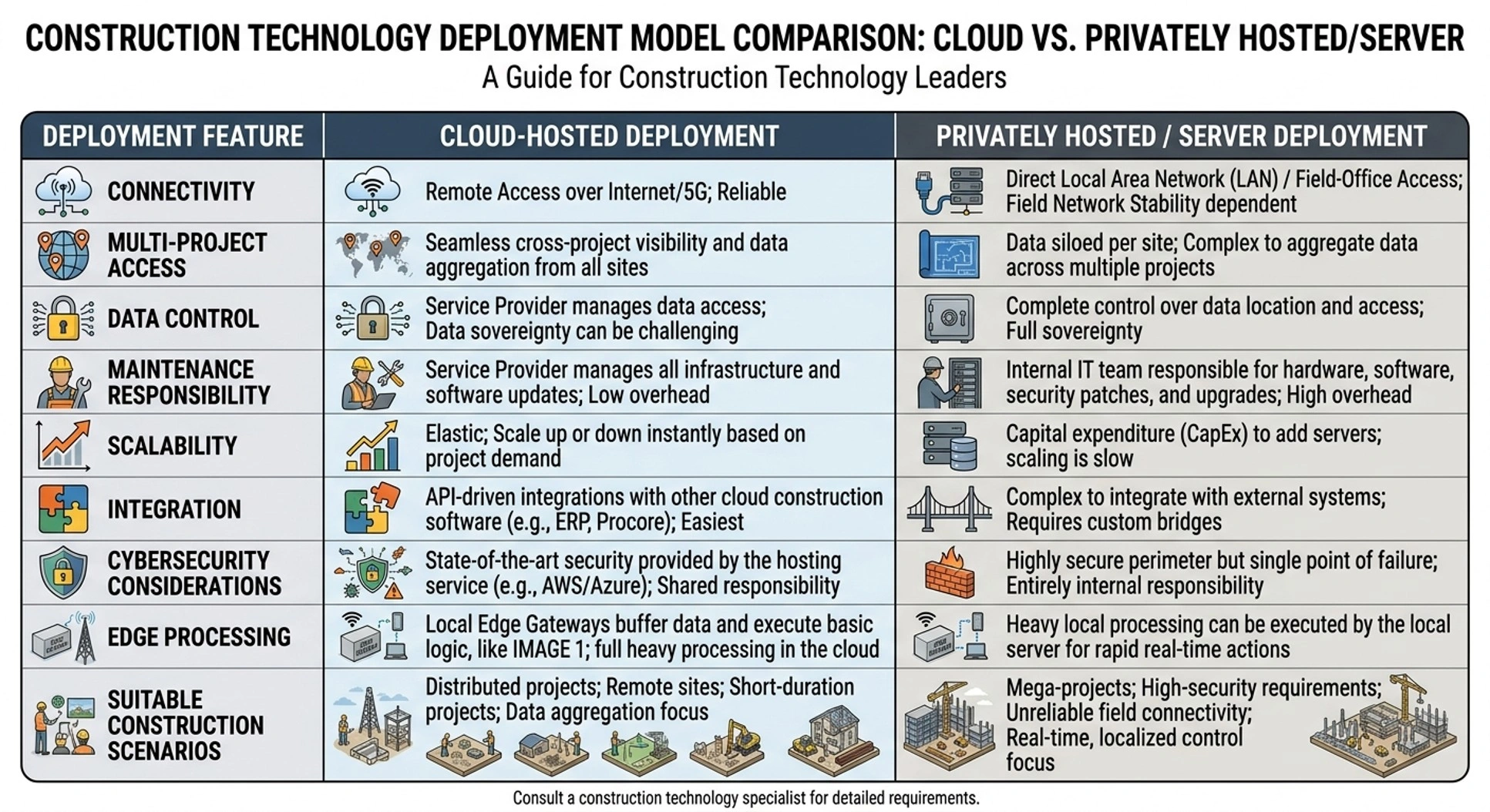
This detailed comparison infographic contrasts cloud-hosted and privately hosted server deployments for commercial construction technology. It provides a comprehensive analysis across nine critical operational factors, including multi-project access, cybersecurity, and suitable deployment scenarios. The key takeaway is to help technology leaders choose the ideal deployment model for data management and jobsite logistics based on their specific project scale and resource requirements.
Designing an AI-Enabled Commercial Construction Deployment
A successful deployment should begin with a clearly defined operational problem rather than the technology itself. Construction organizations should identify which assets, materials, or workflows create the greatest operational cost or project risk.
RFID tag selection should then be based on the physical characteristics of the asset. Metal, dense materials, liquids, outdoor exposure, vibration, dust, and temperature can affect tag performance. Reader placement should be validated under actual site conditions rather than relying only on laboratory specifications.
The data model is equally important. Asset identifiers should have consistent relationships with project numbers, purchase orders, work packages, locations, equipment records, and other relevant business identifiers. Without this data relationship, AI models may generate technically sophisticated analysis that has limited operational value.
Testing should cover tag readability, reader coverage, false reads, missed reads, network interruptions, duplicate events, integration failures, and user workflows. A controlled pilot in one project zone can expose these issues before the system is expanded across an entire construction project.
Cybersecurity should be incorporated during system design rather than added after deployment. Device credentials, API security, network access, software updates, logging, and role-based permissions should be considered from the beginning.
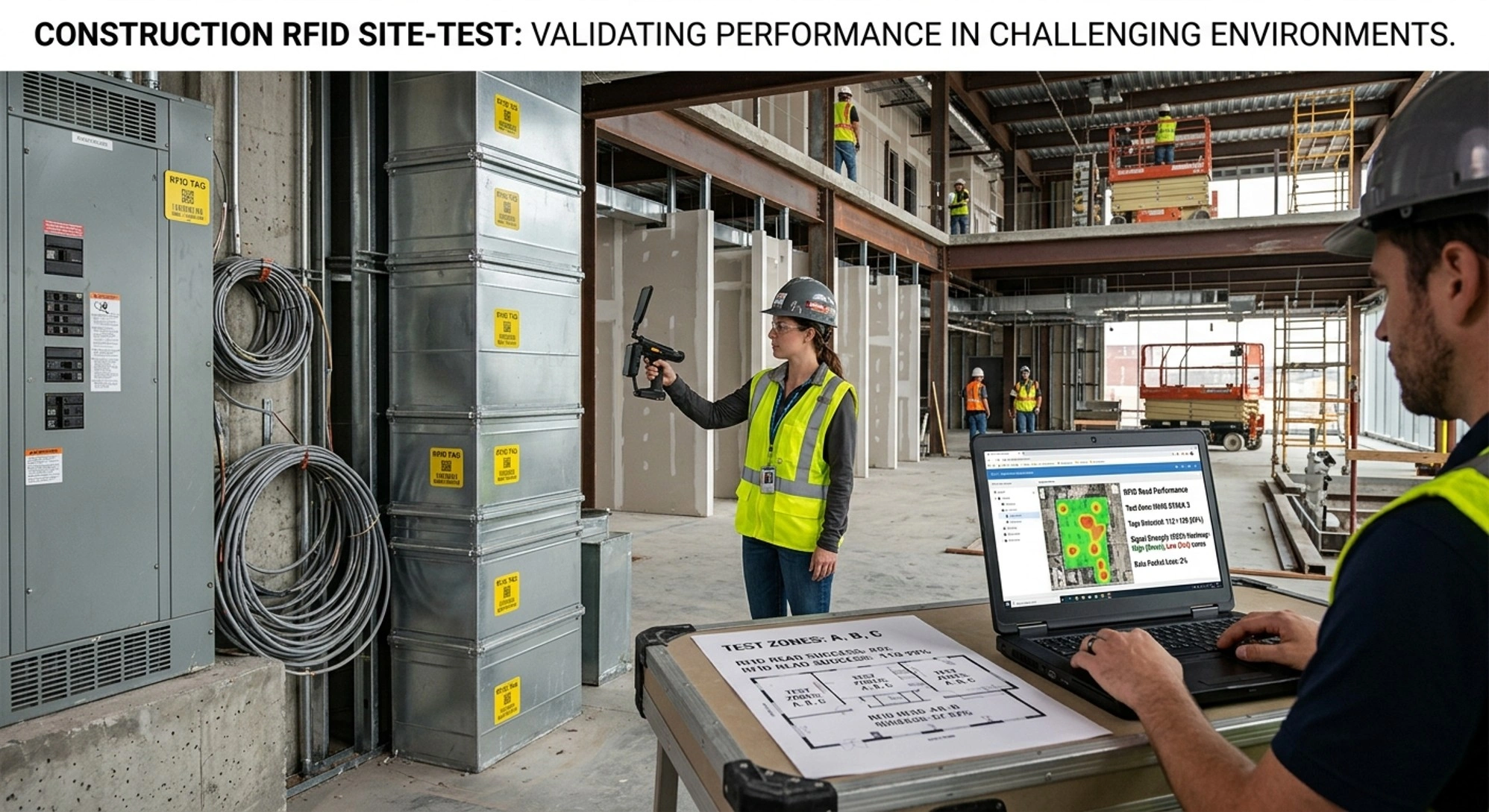
This realistic photograph shows a field team conducting an RFID site survey inside an active commercial office construction project. Engineers are shown scanning tagged metallic HVAC ductwork and electrical panels with a handheld reader while monitoring read performance on a ruggedized laptop showing signal maps. The image highlights the necessity of validating asset tracking systems in complex environments with significant radio frequency interference.
Business and Operational Benefits of AI for Commercial Construction
The combination of AI, RFID, IoT sensors, and construction-management data can improve commercial construction operations by connecting physical project activity with digital project controls.
Better Material Availability and Traceability
Construction teams can gain greater visibility into where critical materials and prefabricated components are located throughout receiving, storage, staging, and installation. AI can compare actual movement with planned requirements and identify exceptions that require attention.
This is particularly useful for long-lead items such as mechanical equipment, electrical assemblies, specialized fixtures, and building-system components. Earlier identification of material delays can give procurement and project teams more time to respond before the shortage affects a scheduled activity.
Improved Tool and Equipment Utilization
AI-assisted RFID tracking can show how frequently tools and equipment are moved, where they spend most of their time, and whether they remain inactive for extended periods. Construction managers can use these insights to improve allocation between crews and projects.
For contractors operating several commercial projects, aggregated utilization information can also support procurement decisions. Instead of purchasing additional equipment based solely on reported shortages, managers can evaluate whether existing equipment is actually being used efficiently.
Reduced Manual Inventory Work
Traditional construction inventory processes can require supervisors, warehouse personnel, or field staff to perform repeated manual counts and record asset information. RFID can automate portions of this process, reducing the amount of repetitive identification work.
AI can further prioritize exceptions so that personnel concentrate on discrepancies rather than manually reviewing every asset record.
Stronger Project Control
Project controls teams depend on reliable information about materials, equipment, work progress, and schedule dependencies. Connecting RFID events with project-management systems can provide additional operational evidence for these activities.
For example, an expected component that has been received but not staged for installation may represent a different project risk from a component that has not yet been delivered. AI-assisted analysis can help distinguish between these situations.
Improved Loss Prevention
Construction sites can contain portable tools, equipment, and high-value materials that move between locations throughout the project lifecycle. RFID event records can provide an auditable history of selected asset movements.
AI-based anomaly detection can flag movements that differ from established patterns, such as an asset leaving a designated area outside expected operating periods. Such alerts should support human investigation rather than automatically assuming theft or misuse.
Scalable Multi-Project Visibility
A construction company managing multiple commercial developments can use standardized asset identifiers and data structures to compare operational information across projects.
This can help management identify recurring patterns such as equipment shortages, excessive idle time, material staging delays, or repeated inventory discrepancies. Standardization is important because AI models require consistent and sufficiently complete data to produce useful results.
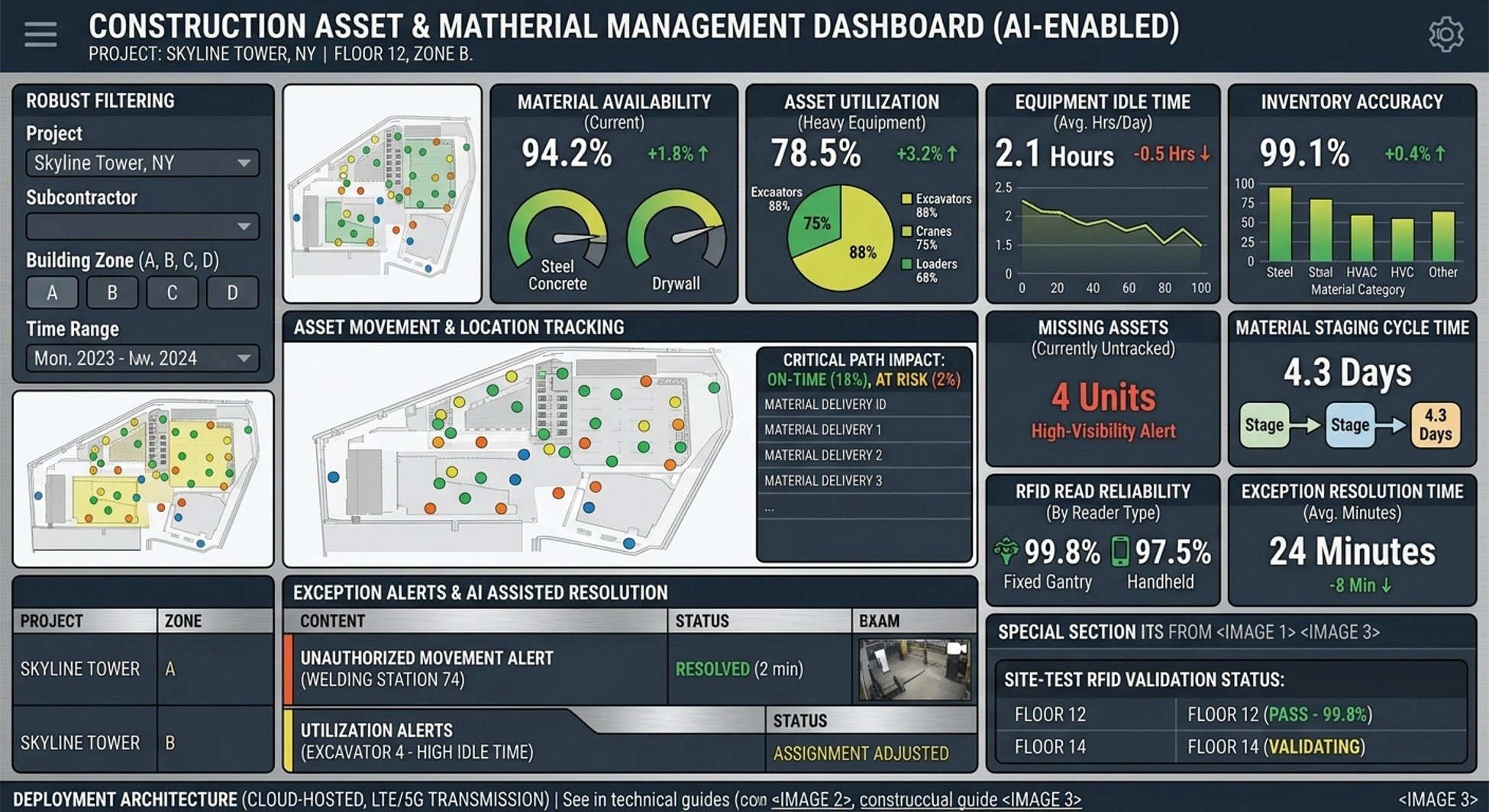
This comprehensive analytics dashboard visualizes critical KPIs for an AI-powered construction asset management system, including real-time asset movement on a building map, inventory accuracy, material availability, and equipment utilization metrics. It tracks exception alerts like unauthorized movement or high idle time and provides AI-assisted resolution status for faster decision-making and optimal jobsite logistics. The key takeaway is how integrated IoT data and AI analytics enable construction managers to proactively reduce waste, prevent delays, and improve efficiency across active building zones.
Key KPIs for AI-Enabled Commercial Construction
Technology deployment should be measured using construction-specific operational metrics rather than RFID read counts alone.
Relevant KPIs include:
- Inventory accuracy percentage
- Material receiving cycle time
- Material staging cycle time
- Percentage of critical materials available when required
- Tool utilization rate
- Equipment utilization rate
- Equipment idle hours
- Asset recovery time
- Missing-asset incidents
- Inventory discrepancy rate
- Material search time
- Number of manual inventory hours
- RFID read success rate
- RFID exception rate
- Asset movement anomalies
- Time from delivery to staging
- Time from staging to installation
- Equipment maintenance response time
- Procurement-related material delays
- Work-package material readiness
- Percentage of assets with complete digital records
- Alert-to-resolution time
- Project logistics delays associated with material availability
- Number of repeated asset-location exceptions
- Cost associated with lost or underutilized equipment
The most useful KPI set depends on the construction workflow. A general contractor may prioritize material readiness and equipment utilization, while an electrical contractor may focus more heavily on component traceability, tool availability, and installation-zone readiness.
AI performance should also be evaluated separately. Useful analytical metrics can include false-positive alert rates, prediction accuracy, anomaly-detection precision, data completeness, and model response time.
Integration with Construction and Enterprise Software
AI-enabled RFID systems become more valuable when their information is connected with software already used by commercial construction organizations.
Potential integration targets include:
- Construction project-management software
- Enterprise resource planning systems
- Procurement and purchasing systems
- Warehouse and inventory-management software
- Equipment-management systems
- Computerized maintenance management systems
- Building information modeling workflows
- Document-management systems
- Scheduling and project-controls software
- Business intelligence and analytics systems
- Identity and access-management systems
Integration can occur through APIs, databases, middleware, message queues, or other supported interfaces.
A common implementation approach is to maintain a master asset record containing the RFID identifier, asset type, project association, responsible department, expected location, and relevant procurement or equipment information. RFID events can then update the operational status of the record.
For example, when a tagged HVAC component arrives at a commercial construction site, the RFID event can be associated with its purchase order and project record. A subsequent movement event can update its staging location. When the component is installed, an authorized field workflow can change its status to installed.
AI can analyze this sequence to identify deviations from the planned construction process.
BIM data can also provide useful spatial context where integration is technically feasible. An RFID-tagged component can be associated with a building zone, floor, room, system, or equipment identifier. This creates opportunities for location-aware construction analytics.
The quality of these integrations depends heavily on consistent identifiers and data governance. Organizations should avoid creating isolated RFID databases that cannot be reconciled with existing project records.
Cybersecurity and Data Governance for Construction RFID and AI
Commercial construction systems increasingly connect field devices with corporate networks and cloud services. Security therefore needs to cover both physical devices and software systems.
Important controls include:
- Unique device credentials
- Role-based access control
- Secure API authentication
- Encrypted communications
- Network segmentation
- Secure configuration of RFID readers and gateways
- Regular firmware and software updates
- Centralized audit logging
- Controlled administrative access
- Backup and recovery procedures
- Data retention policies
- Monitoring for unauthorized device activity
- Protection of project and procurement information
Construction organizations should also determine which data is necessary for AI analysis. Collecting more information does not automatically produce better results. Data should have a defined operational purpose, appropriate access controls, and a documented retention approach.
Where worker-related information is involved, organizations should carefully distinguish between asset tracking and personnel monitoring. A system designed to track tools or equipment should not automatically become a workforce surveillance system.
AI governance is also important. Construction managers should understand which data is being used by analytical models, what assumptions affect predictions, and when human review is required. High-impact project decisions should remain subject to appropriate professional oversight.
Deployment Challenges and Engineering Trade-Offs
AI-enabled construction tracking has practical limitations that should be addressed during planning.
RF Performance Around Construction Materials
Steel, reinforced concrete, liquids, dense storage, metal containers, and building services can affect RFID performance. Construction sites also change continuously, meaning a reader installation that performs well during structural work may behave differently after walls, ductwork, ceilings, and other services are installed.
Field testing should therefore be performed at representative stages of the project.
Changing Site Layouts
Construction sites are temporary environments. Reader locations, storage areas, access routes, and work zones may change as construction progresses.
Systems should be designed with sufficient flexibility to relocate readers or update logical zones without rebuilding the entire solution.
Data Quality
AI cannot compensate indefinitely for poor source data. Incorrect asset identifiers, missing project associations, duplicate records, inconsistent location names, or incomplete event histories can reduce analytical accuracy.
Data validation should therefore be part of commissioning and ongoing operations.
Connectivity Limitations
Basements, reinforced structures, remote portions of large sites, and temporary construction areas may have inconsistent network connectivity.
Edge processing and local data buffering can help maintain operational continuity when communication with centralized systems is temporarily unavailable.
User Adoption
Superintendents, foremen, warehouse personnel, equipment managers, and field technicians need workflows that fit their daily responsibilities. If an RFID or AI system introduces excessive manual steps, personnel may bypass it.
Successful deployments therefore consider the user workflow as carefully as the hardware.
Cost Versus Coverage
Full-site RFID coverage may not always provide the best return on investment. A more effective approach may be to identify high-value assets, critical material flows, or specific operational bottlenecks and instrument those areas first.
The deployment can then expand after measurable operational benefits have been demonstrated.
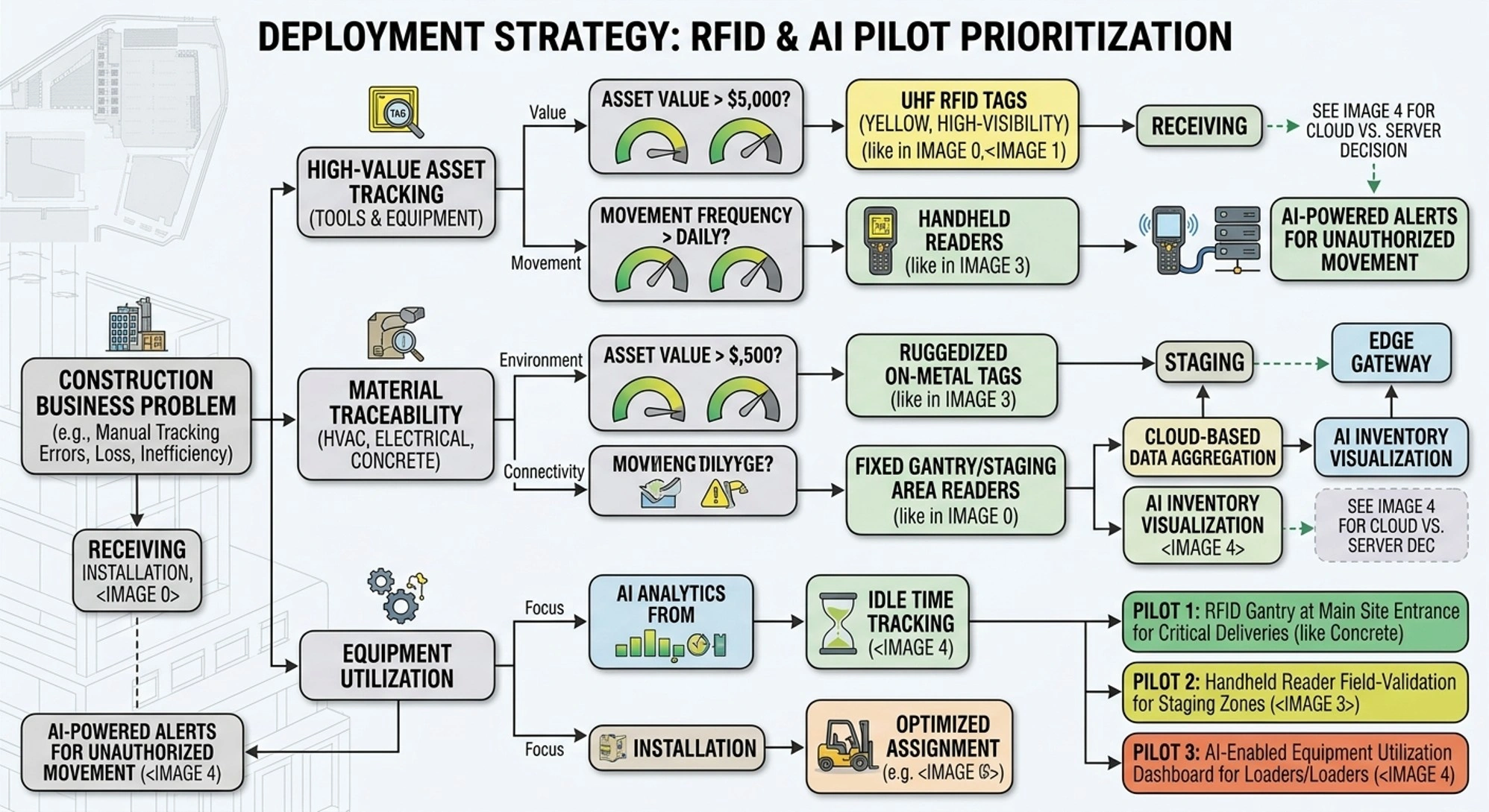
This professional decision tree diagram helps construction technology planners systematically prioritize RFID and AI deployments by analyzing business problems. It provides branching paths for High-Value Asset Tracking, Material Traceability, and Equipment Utilization, using specific decision factors such as asset value, movement frequency, and environmental conditions. The key takeaway is to identify the most impactful and feasible pilot projects, leading to targeted recommendations like starting with gantry readers for critical deliveries or AI-enabled utilization dashboards.
Recommended Implementation Approach for Commercial Construction
A phased implementation can reduce technical and operational risk.
Define the Construction Use Case
Begin with a measurable problem. Examples include excessive tool-search time, material staging delays, inaccurate equipment inventories, or poor visibility into high-value components.
Define the baseline KPI before deploying the technology.
Select Assets and Workflows
Identify which assets provide enough operational value to justify automated tracking. Avoid attempting to tag every physical object at the beginning of a project.
Map the relevant workflow from procurement or receiving through storage, staging, installation, return, maintenance, or disposal.
Perform an RFID Site Survey
Test representative tags, readers, mounting methods, read zones, antenna positions, and environmental conditions.
Testing should include the actual construction materials and physical configurations expected during operation.
Build the Data and Integration Model
Define relationships between RFID identifiers and project numbers, purchase orders, asset records, locations, work packages, equipment records, and other relevant systems.
Determine which system owns each data element to prevent conflicting records.
Deploy a Controlled Pilot
A pilot can focus on one building zone, material category, equipment group, or project workflow.
Measure the agreed KPIs and document operational exceptions.
Integrate AI Analytics
Once the underlying data is sufficiently reliable, AI can be introduced for anomaly detection, forecasting, utilization analysis, material readiness, or other defined applications.
AI should be deployed against a specific operational objective rather than added simply because the system contains data.
Commission and Optimize
Commissioning should verify hardware performance, data transmission, middleware processing, software integration, security controls, user access, reporting, and alert behavior.
Performance should be reviewed after deployment because construction conditions change over time.
Scale Across Projects
Once the workflow is proven, standardized tag specifications, device configurations, data structures, APIs, security policies, and deployment procedures can support expansion to additional commercial construction projects.
GAO can support organizations evaluating RFID, BLE, and IoT hardware and system requirements as they move from proof-of-concept deployments toward operational construction applications.
Where AI and RFID Fit Within the Commercial Construction Lifecycle
AI-enabled RFID can support multiple phases of a commercial construction project.
Procurement and Receiving
RFID identification can associate physical deliveries with expected purchase information and help document receiving events.
Storage and Staging
Asset and material movement records can provide visibility into where selected items are stored and whether they have reached the appropriate staging area.
Installation
Tagged components can provide additional traceability as equipment and materials move toward installation zones. Where combined with authorized field verification workflows, the resulting information can help establish installation status.
Commissioning
Construction equipment and installed components can retain digital identities that support commissioning records and handover documentation.
Maintenance and Facilities Handover
For assets that remain relevant after project completion, RFID identifiers can potentially become part of the facility’s asset-management records. This creates continuity between construction and subsequent operations.
The transition should be planned carefully because the asset information required during construction may differ from the information required by facilities-management teams.
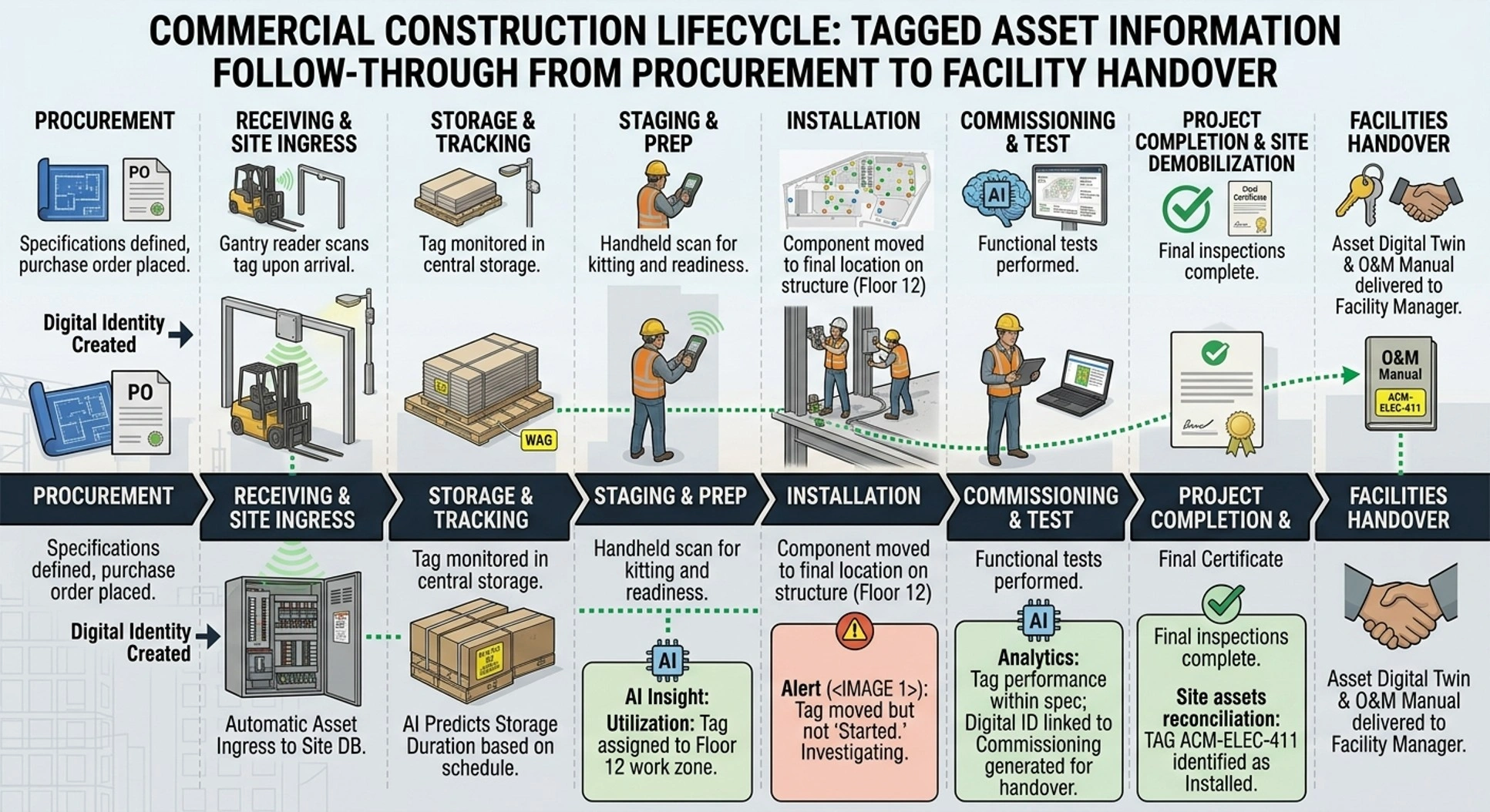
This comprehensive timeline visualizes how a tagged asset, such as an electrical component, retains its unique digital identity across eight distinct construction stages—from initial procurement and site ingress to installation, commissioning, and final facility handover. Real-time data from various scanning devices is aggregated and processed by an AI engine to provide continuous visibility into asset location, utilization, and status. The key takeaway is the seamless transfer of a complete ‘digital twin’ containing all historical and operational data to the facility manager at project completion for long-term operational efficiency.
Practical Recommendations for Construction Technology Leaders
Commercial construction organizations considering AI and RFID should prioritize measurable operational outcomes.
Start with high-value construction workflows rather than attempting project-wide instrumentation immediately.
Select RFID tags based on the actual materials and environmental conditions of the construction site.
Conduct field testing before specifying large quantities of hardware.
Establish standardized asset and location identifiers.
Integrate RFID data with existing project and procurement records.
Use edge processing where connectivity is unreliable or rapid local response is required.
Introduce AI only after establishing reliable and sufficiently complete operational data.
Define construction-specific KPIs before deployment.
Protect readers, gateways, APIs, and project data using appropriate cybersecurity controls.
Design for changing construction zones and temporary site layouts.
Provide simple workflows for superintendents, foremen, warehouse personnel, and equipment managers.
Use human review for significant operational decisions influenced by AI.
Expand the solution based on measured project value rather than technology coverage alone.
The Role of GAO in AI-Enabled Commercial Construction
GAO supplies RFID, BLE, and IoT hardware products and systems that can serve as components of connected construction solutions. Its work in RFID and IoT provides relevant technical foundations for applications involving asset identification, equipment tracking, material traceability, and automated data collection.
Headquartered in New York City and Toronto, Canada, GAO is recognized as one of the leading B2B and B2G suppliers of BLE and RFID technologies. GAO and its sister companies, GAO Research and GAO Tek, form GAO Group, with operations based in New York City and Toronto.
For more than three decades, GAO Group has served organizations across the United States and Canada, including Fortune 500 companies, research and development organizations, universities, and government agencies. Its investment in research and development, quality assurance processes, and remote or onsite technical support provides construction organizations with access to technical resources when evaluating connected hardware and systems.
The appropriate solution will depend on the construction environment, asset types, read requirements, software integrations, cybersecurity policies, and operational objectives. Technical evaluation and site testing should therefore precede final hardware and system selection.
Conclusion: Applying AI to Commercial Construction Operations
AI can provide commercial construction organizations with more useful operational intelligence when it is connected to reliable physical-world data. RFID can contribute automated identification and movement information for selected tools, materials, equipment, and building components, while AI can transform that information into anomaly detection, utilization analysis, forecasting, and operational recommendations.
The strongest deployments connect these capabilities with construction-management, procurement, inventory, equipment, scheduling, and project-control processes rather than operating as isolated tracking systems.
Construction companies should begin with a clearly defined workflow, establish measurable KPIs, validate RFID performance in real site conditions, build reliable data relationships, and introduce AI where it addresses a specific operational requirement. GAO’s RFID, BLE, and IoT hardware products and systems can provide part of the technical foundation for organizations developing these connected commercial construction solutions.
Building the Future of Industrial AI and IoT with Aperture Venture Studio and GAO RFID Inc.
For more than three decades, GAO Group of Companies has invested heavily in R&D across industrial RFID, BLE, and IoT. As generative AI and other AI methods have become increasingly useful for industrial applications, we have continued developing AI and IoT technologies that can address practical challenges such as commercial construction asset tracking, material visibility, and operational intelligence.
We have also founded Aperture Venture Studio to support the development and scaling of AI and IoT solutions relevant to industries where physical assets, connected systems, and intelligent software intersect.
Aperture has attracted AI and IoT technical experts, entrepreneurial and operational executives, investors, and leading companies. We have also developed the Aperture Ventures Summit and TekSummit to encourage discussion of advanced AI and IoT topics.
We welcome organizations and professionals interested in working with us as:
- Advisors, co-founders, or employees
- Investors
- Customers
For commercial construction organizations exploring AI-enabled asset tracking, material intelligence, RFID, BLE, and IoT systems, GAO provides an opportunity to engage with an experienced technology supplier and technical support organization.
Connected Construction Intelligence: RFID, Edge & AI-Powered Project Control
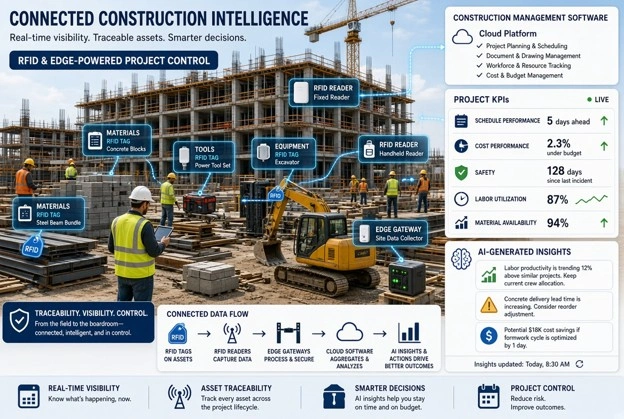
This enterprise illustration depicts a live commercial construction site where RFID-tagged materials, tools, and equipment feed data through fixed and handheld readers and edge gateways into cloud construction-management software. Real-time project KPIs and AI-generated insights appear alongside the jobsite, highlighting practical traceability, visibility, and operational control that keep projects on schedule and under budget.