
AI and RFID for Container Terminals and Port Operations
AI-Driven Container Terminal Operations with RFID Visibility
Container terminals coordinate vessel discharge and loading, container yard storage, truck gates, rail interfaces, equipment dispatch, reefer operations, maintenance, customs-related processes, and cargo documentation within tightly constrained operating windows. AI can analyze terminal operating system data, equipment telemetry, camera feeds, gate transactions, historical moves, and IoT events to improve yard planning, equipment allocation, congestion forecasting, maintenance scheduling, and exception management. RFID provides an additional physical identification layer for selected containers, chassis, maintenance assets, tools, spare parts, and material movements.
The practical value of AI and RFID for container terminals comes from connecting physical events with terminal decisions. RFID can establish that a tagged asset passed a defined gate, warehouse door, maintenance area, or staging point. AI can combine those events with vessel schedules, container moves, equipment availability, work orders, yard density, and historical performance. Terminal operators can then identify abnormal dwell, anticipate equipment constraints, verify material readiness, reduce asset search time, and improve coordination between marine, yard, gate, rail, warehouse, and maintenance teams.
Why AI Is Transforming Container Terminal Operations
Container terminal productivity depends on synchronizing vessel operations, yard storage, horizontal transportation, gate transactions, rail operations, equipment maintenance, and labor resources. A delay at one operating point can propagate through multiple processes.
AI is particularly useful for container terminals because many operational decisions are time-sensitive and involve multiple variables. A yard planner may need to consider vessel stowage, export receiving windows, container dwell, reefer requirements, hazardous cargo restrictions, yard density, equipment availability, truck appointments, and rail schedules simultaneously.
AI does not replace terminal operating procedures or the judgment of experienced planners. Its strongest role is to process large volumes of operational data, identify patterns, forecast likely conditions, and present actionable exceptions to personnel responsible for the decision.
AI for Container Yard Planning
Yard planning determines where containers are positioned and how equipment can retrieve them efficiently. Poor positioning can increase rehandles, travel distance, equipment demand, and truck service time.
AI models can evaluate historical dwell behavior, vessel schedules, import and export status, container attributes, yard density, reefer requirements, hazardous-material restrictions, and planned truck or rail movements.
Predictive models can identify containers likely to remain in the terminal longer than expected, while optimization methods can help planners evaluate alternative yard assignments.
RFID can supplement established container identification methods where selected cargo units, containers, pallets, or related assets are tagged. It should complement container numbers, OCR, terminal operating systems, and other established identification mechanisms rather than being treated as a universal replacement.
AI for Quay Crane and Yard Equipment Utilization
Quay cranes, ship-to-shore cranes, RTGs, RMGs, straddle carriers, reach stackers, terminal tractors, forklifts, mobile harbor cranes, and other handling equipment determine much of a container terminal’s physical throughput.
AI can analyze equipment utilization, availability, location, maintenance status, workload, travel patterns, and historical productivity. These models can support equipment dispatch and identify conditions that may reduce planned handling capacity.
RFID can provide identification events for selected mobile equipment, attachments, maintenance tools, spare parts, and support assets. For example, an RFID transition point near a maintenance facility can establish when a tagged maintenance asset enters or leaves the workshop.
AI for Gate Operations and Truck Turnaround
Truck turnaround depends on appointment schedules, container availability, gate processing, inspection requirements, documentation, chassis availability, traffic conditions, and yard congestion.
AI can forecast gate workload using historical transaction patterns, appointment data, vessel discharge schedules, yard conditions, and other available operational information.
RFID can support controlled identification of tagged chassis, terminal assets, cargo-support equipment, or other authorized objects passing through defined gate zones. Combining these events with gate transaction records can improve physical movement traceability.
AI for Intermodal Rail Operations
Rail interfaces add another scheduling constraint to container terminals. Containers must be positioned, transferred, and released according to train schedules and available rail-handling capacity.
AI can evaluate rail cut schedules, container availability, yard locations, equipment requirements, and historical transfer times to identify potential conflicts.
RFID can support selected material and asset movement events around rail staging areas, maintenance facilities, or intermodal transfer points. The resulting physical events can supplement terminal operating and transportation management records.
AI for Reefer Container Operations
Reefer containers require controlled handling because temperature-sensitive cargo may be affected by power interruptions, equipment failure, incorrect connections, or delayed intervention.
AI can analyze reefer telemetry, alarm history, maintenance records, power status, and operational schedules to prioritize attention.
RFID can identify selected reefer-related equipment, maintenance tools, replacement parts, or inspection assets as they move through maintenance and staging workflows. RFID should complement, rather than replace, dedicated reefer monitoring systems.
AI for Container Terminal Maintenance
Container terminals maintain cranes, terminal tractors, conveyors, power systems, hydraulic equipment, electrical systems, reefer infrastructure, workshop machinery, and other assets.
AI can analyze work orders, operating hours, equipment alarms, inspection records, spare-parts consumption, and failure history to support predictive maintenance and maintenance prioritization.
RFID can help maintenance teams track torque tools, hydraulic tools, electrical test equipment, lifting equipment, calibration devices, spare parts, maintenance kits, and portable equipment.
GAO supplies RFID, BLE, and IoT hardware products and systems that can support these physical tracking requirements. The appropriate configuration depends on the terminal workflow, asset characteristics, RF environment, and existing maintenance software.
Container Terminal AI and RFID Operations Overview
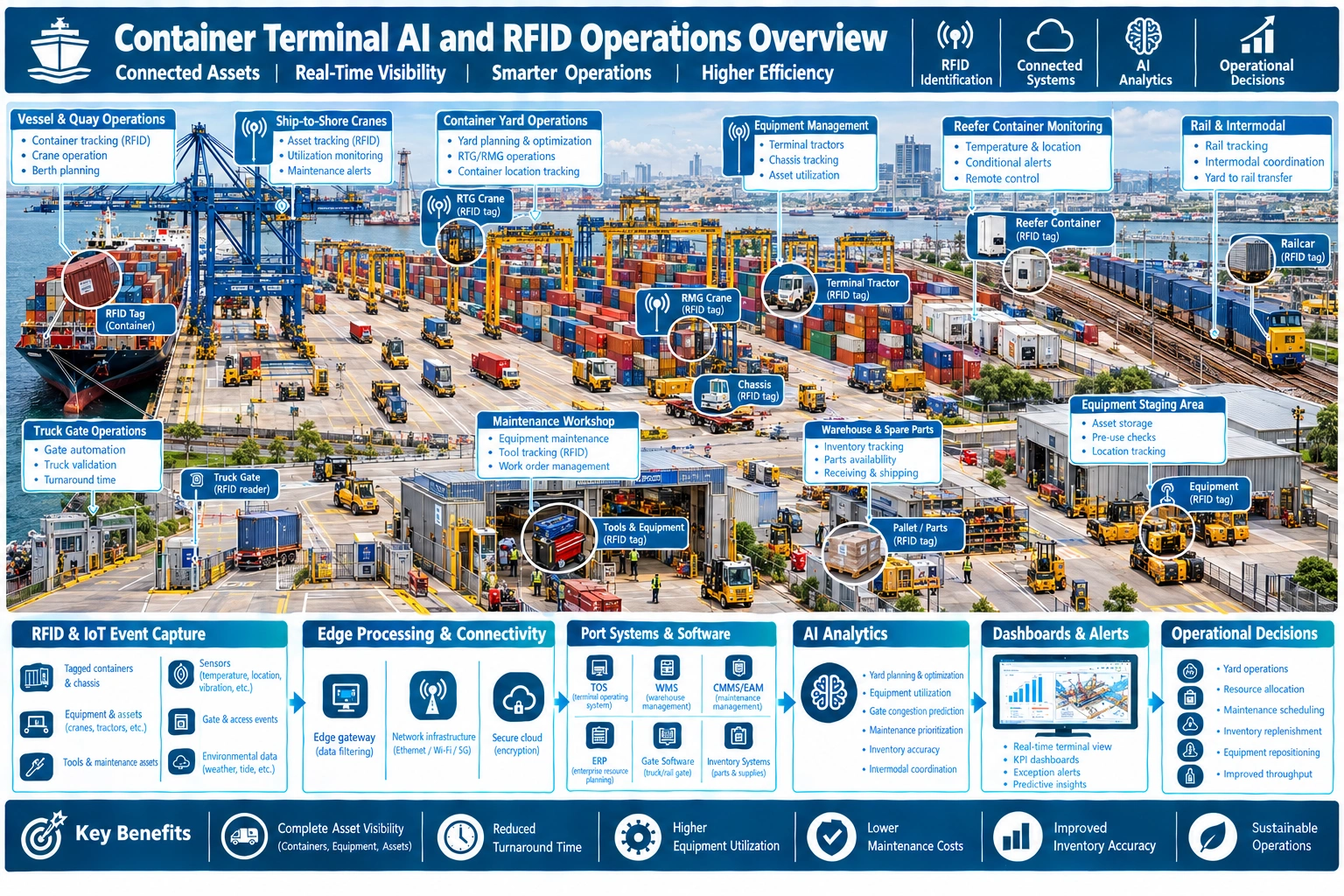
This infographic shows RFID-tagged containers, chassis, equipment, tools, and terminal assets moving across vessel berths, container yards, gates, rail connections, warehouses, and maintenance areas. RFID and IoT events flow through edge processing and terminal systems into AI analytics, dashboards, and operational decisions.
Container terminal RFID and IoT data connect assets, equipment, AI analytics, dashboards, and operational decisions.
Container Terminal Applications for AI and RFID
RFID delivers the greatest value when it is attached to a defined terminal transaction. The objective is not to tag every physical object, but to identify assets and material flows where automated event capture can improve throughput, maintenance readiness, inventory accuracy, security, or exception handling.
Container and Cargo Identification
RFID can be considered for selected containers, cargo units, pallets, project cargo, or reusable transport assets where automated identification provides a measurable operational benefit.
Controlled read points can be installed at warehouse entrances, cargo staging areas, transfer points, or other defined locations. The resulting event can indicate that an identified item crossed a particular operational boundary.
For container terminals, read-zone engineering is important because container stacks, cranes, trucks, chassis, and other steel structures can produce RF reflections and unwanted reads.
Chassis Tracking and Availability
Chassis shortages or poor visibility can delay truck transactions and create unnecessary yard movements.
RFID-tagged chassis can generate movement events at selected gate, staging, inspection, or storage locations. AI can analyze movement history, utilization, dwell, and demand to identify potential chassis availability problems.
The combination can help terminal personnel distinguish an actual chassis shortage from a chassis that is available but physically difficult to locate.
Terminal Equipment Tracking
Terminal tractors, forklifts, portable equipment, lifting accessories, maintenance equipment, and specialized attachments may move across large operating areas.
RFID can provide event records when selected assets pass defined maintenance, storage, or staging points. Handheld RFID readers can provide additional search and verification capability.
AI can use asset movement and utilization history to identify underused equipment, unusual movement, or potential availability constraints.
Maintenance Tool Crib Management
A container terminal maintenance organization may maintain specialized tools across multiple workshops and field service locations.
Typical assets include:
- Hydraulic torque tools.
- Electrical test equipment.
- Calibration instruments.
- Welding equipment.
- Portable generators.
- Hydraulic pumps.
- Lifting equipment.
- Alignment tools.
- Diagnostic equipment.
- Specialized crane-maintenance tools.
RFID-enabled tool issue and return points can create automatic transaction records. Handheld readers can help technicians locate tools when a maintenance task is time-sensitive.
AI can analyze tool utilization, overdue returns, demand patterns, and maintenance schedules to identify tools that could become unavailable during planned equipment service.
Spare Parts and Maintenance Kits
Container terminal maintenance requires bearings, motors, gear assemblies, hydraulic components, valves, filters, cables, electrical components, fasteners, sensors, lubricants, and other parts.
RFID can support receiving, storage, kitting, staging, issue, return, and transfer events for suitable tagged inventory.
AI can combine these physical events with CMMS or EAM work orders to identify whether required parts are actually staged for a planned crane, terminal tractor, reefer, conveyor, or power-system maintenance task.
Warehouse and Workshop Inventory
Terminal maintenance warehouses may support several equipment groups and maintenance disciplines. Inventory can move from receiving to inspection, storage, picking, kitting, staging, field issue, return, or quarantine.
RFID can automate selected physical movement events. AI can compare those events with expected transactions and identify discrepancies.
A kit recorded as available in the warehouse system but physically detected in a staging area can be treated differently from a kit that cannot be located anywhere within the expected operating zones.
High-Value Maintenance and Inspection Assets
Calibration equipment, diagnostic devices, lifting equipment, specialized tools, portable power equipment, and other high-value maintenance assets can be difficult to manage when shared among several terminal teams.
RFID can provide controlled movement visibility while AI can evaluate utilization and demand. This can help maintenance supervisors allocate scarce equipment to jobs where it has the greatest operational value.
Realistic RFID Deployment in Container Terminal Operations
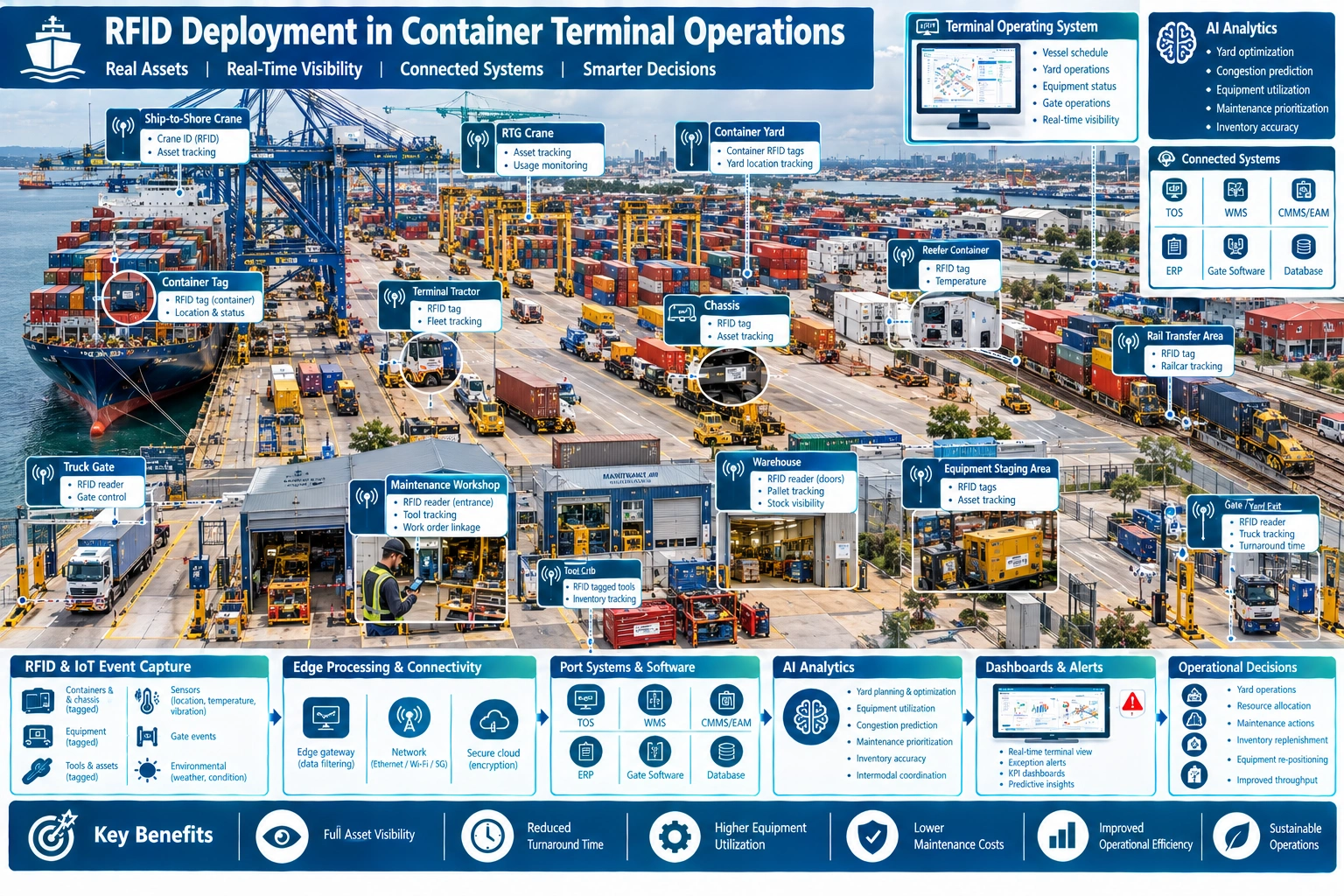
This visual shows practical RFID deployment across a modern container terminal, including vessel berths, cranes, container yards, truck gates, rail transfer areas, warehouses, maintenance workshops, and equipment staging zones. RFID events flow through edge processing and connected terminal systems into AI analytics to support asset visibility, maintenance, inventory, and operational decisions.
RFID deployment connects terminal assets, equipment, edge systems, AI analytics, and container operations.
Container Terminal Challenges Addressed by AI-Enabled RFID
Container and Asset Location Uncertainty
Large container yards can contain thousands of physical objects distributed across multiple blocks, maintenance areas, warehouses, gates, and staging locations.
Manual location records can become stale as equipment and support assets move. RFID can provide physical transition events, while AI can identify assets whose movement differs from expected patterns.
Yard Congestion and Rehandling
Yard density, vessel arrival changes, import dwell, export receiving patterns, equipment availability, and truck demand can create congestion.
AI can evaluate these variables to forecast potential congestion and support alternative planning decisions. RFID events can add physical movement information for tagged assets and selected cargo-support workflows.
Equipment Availability Constraints
A terminal can lose effective capacity even when equipment exists physically but is unavailable because of maintenance, charging, fueling, inspection, relocation, or parts shortages.
AI can forecast equipment availability using maintenance and operating history. RFID can establish whether tools, maintenance kits, or replacement components are physically available where required.
Spare-Parts Shortages
A maintenance work order may be approved and scheduled while a required component remains somewhere in the supply chain or warehouse.
RFID can provide physical material status at selected receiving and staging points. AI can compare planned maintenance demand with observed material movement and identify work orders at risk.
Tool Search and Shared-Asset Problems
Shared maintenance tools can move between workshops, crane service areas, terminal vehicles, and field locations.
RFID can reduce uncertainty around the last recorded transition. AI can analyze usage patterns and planned work to predict periods when tool demand may exceed availability.
Fragmented Terminal Data
Container terminals commonly operate several software systems for vessel planning, yard management, gate operations, equipment maintenance, inventory, transportation, access control, and business management.
AI becomes more effective when relevant records can be correlated. RFID contributes physical-world event data that can be linked through asset IDs, equipment IDs, location IDs, container identifiers, work-order numbers, and timestamps.
Container Terminal Workflow from Data Capture to AI Decision-Making
An AI and RFID solution should follow the terminal’s operating workflow from the physical transaction to the final business action.
Physical Data Acquisition
Data can originate from RFID readers, handheld RFID devices, IoT devices, equipment controllers, reefer monitoring systems, cameras, OCR systems, gate software, terminal operating systems, maintenance applications, warehouse systems, and transportation systems.
RFID tags can be attached to selected assets according to the required operating life and physical environment. On-metal tags are commonly considered for metal equipment, steel tool cases, chassis, and other conductive surfaces.
RFID Event Capture
Fixed readers can monitor controlled transitions such as warehouse doors, workshop entrances, maintenance staging areas, and selected gate or equipment transfer points.
Handheld RFID readers can support inventory counts, asset searches, maintenance inspections, and exception investigation.
A useful event normally includes an identifier, location or reader ID, timestamp, and transaction context. Duplicate suppression prevents repeated observations of the same tag from being interpreted as multiple business transactions.
Communication Infrastructure
Container terminals may contain large outdoor yards, steel structures, warehouses, equipment shelters, maintenance buildings, and locations with varying wireless coverage.
Ethernet, Wi-Fi, private wireless, and cellular communications can transport RFID and IoT events according to the terminal’s network design.
Edge gateways can buffer events during temporary connectivity interruptions. This is important when the loss of a network connection should not cause the loss of an equipment or inventory movement record.
Edge Processing
Edge processing can filter duplicate RFID reads, validate event structure, associate readers with locations, synchronize timestamps, and monitor reader health before events are forwarded to higher-level software.
A reader-health function is particularly valuable. The absence of an RFID event could mean that an asset did not pass a location, but it could also mean that a reader, antenna, network connection, or power supply has failed.
Middleware and Enterprise Software
Middleware can normalize RFID events and connect them to established terminal software.
Relevant integration points can include:
- Terminal operating systems.
- Yard management systems.
- Warehouse management systems.
- Enterprise resource planning systems.
- CMMS and EAM software.
- Transportation management systems.
- Gate management software.
- Equipment monitoring systems.
- Access-control systems.
- Document management systems.
The integration should preserve established master records rather than creating unnecessary duplicate asset or container databases.
AI Analytics
AI models can combine RFID events with terminal operating data to identify patterns, forecast conditions, and prioritize exceptions.
Potential applications include:
- Yard congestion prediction.
- Container dwell prediction.
- Equipment availability forecasting.
- Crane maintenance prioritization.
- Spare-parts demand forecasting.
- Chassis utilization analysis.
- Inventory anomaly detection.
- Tool availability prediction.
- Truck gate workload forecasting.
- Maintenance work-order prioritization.
- Abnormal asset movement detection.
- Vessel operation support.
The AI output should connect to a specific operational action. For example, a predicted maintenance constraint may trigger a work-order review, spare-parts transfer, equipment reassignment, or maintenance scheduling change.
RFID, AI Software, and Container Terminal Infrastructure
UHF RFID for Container Terminal Tracking
UHF RFID is generally suited to controlled longer-range identification where tagged objects move through defined zones. Container-terminal applications can include selected chassis, maintenance assets, warehouse inventory, tool cribs, staging areas, and controlled transfer points.
Metal structures require careful engineering because containers, cranes, vehicles, racks, and other conductive surfaces can cause RF reflections and multipath effects. On-metal UHF tags can be appropriate for many steel assets, but actual performance depends on tag design, mounting position, object geometry, antenna configuration, and reader settings.
HF RFID for Controlled Terminal Transactions
HF RFID supports shorter-range identification and can be appropriate for workstation-based transactions where close-range identification is desirable.
Examples can include selected maintenance stations, controlled tool transactions, identification of specific equipment components, and other applications where limiting the read distance helps prevent unintended reads.
LF RFID for Specialized Short-Range Identification
LF RFID can be useful for specialized short-range identification workflows where its operating characteristics match the asset and transaction.
Selection among UHF, HF, and LF should consider required read distance, throughput, tag density, asset material, environmental conditions, reader placement, and integration requirements rather than simply selecting the frequency with the greatest nominal range.
AI Models for Container Terminal Operations
AI methods should correspond to the operational question.
Time-series models can forecast equipment workload, gate demand, container dwell, or maintenance requirements. Classification models can prioritize work orders or operational exceptions. Anomaly-detection models can identify unusual asset movement or inventory transactions.
Optimization models can support yard planning, equipment allocation, and resource scheduling. Computer vision can complement RFID for container recognition, equipment monitoring, safety applications, and gate processes.
Cloud Version for Multi-Terminal Operations
A cloud-hosted SaaS deployment can centralize data and analytics across multiple container terminals, maintenance facilities, warehouses, or geographic locations.
This approach can support centralized dashboards, common data models, cross-terminal KPI comparison, and centralized AI analysis. Network availability, cybersecurity, data residency, latency, and operational continuity should be assessed before deployment.
Server Version for Controlled Terminal Infrastructure
A Server Version can operate on edge servers, customer-managed servers, private data centers, privately hosted enterprise infrastructure, or other controlled computing environments.
This model may be appropriate when a terminal operator requires greater control over operational data, restricted network connectivity, private integration with terminal systems, or local processing for time-sensitive workflows.
A hybrid design can keep immediate event processing near the terminal while forwarding selected historical data to centralized analytics.
RFID Hardware for Container Terminals
A container-terminal deployment may include fixed RFID readers, directional antennas, handheld readers, vehicle-mounted readers, UHF, HF, or LF tags, on-metal tags, edge gateways, industrial network equipment, and supporting power infrastructure.
Hardware should be selected according to the physical transaction. A warehouse door, outdoor chassis yard, maintenance workshop, crane service area, and gate lane can have very different RF and environmental requirements.
GAO provides RFID readers, tags, antennas, handheld devices, BLE equipment, and IoT hardware products and systems that organizations can evaluate for these applications. Physical testing remains essential because actual container-terminal conditions can differ significantly from laboratory specifications.
RF Site Survey and Read-Zone Engineering
RFID deployment should begin with the intended transaction rather than maximum theoretical read distance.
A terminal RF survey should evaluate:
- Container stacks and steel structures.
- Crane and vehicle movement.
- Chassis positioning.
- Reader antenna orientation.
- Tag mounting surfaces.
- Required read-zone boundaries.
- Potential adjacent-lane reads.
- Network and power availability.
- Environmental exposure.
- Expected tag density.
- Required event latency.
- Maintenance access to readers and antennas.
Controlled read zones are especially important at gates and warehouse doors. A reader that detects tags from neighboring lanes can generate incorrect movement events, while an overly narrow read zone can miss the intended transaction.
The objective is reliable identification at the precise operational boundary where the terminal needs a trusted physical event.
Below is a stronger rewrite of Part 2, continuing directly from the RF site-survey section in Part 1. I have made the content more container-terminal-specific, strengthened the operational workflows, added more decision-oriented AEO language, and kept RFID as an operational enabler rather than the main subject.
Security and Data Governance for AI-Enabled Container Terminals
AI and RFID deployments in container terminals must protect operational data while preserving the event accuracy required for vessel, yard, gate, rail, and maintenance workflows. A useful design does not treat RFID events as isolated identification records. Each event should be associated with a known asset, location, transaction, timestamp, operational state, and responsible workflow.
Container terminal data may include container movements, chassis assignments, truck transactions, equipment locations, maintenance activities, gate events, cargo status, reefer information, and access-controlled operational records. These records can affect customer service, cargo release, terminal productivity, maintenance planning, and security investigations.
RFID and Network Security
RFID readers, handheld devices, edge computers, gateways, network switches, and connected software should be incorporated into the terminal’s existing cybersecurity controls.
Recommended controls include:
- Unique credentials for readers, gateways, handheld terminals, and administrative users.
- Role-based access for gate operators, yard planners, maintenance personnel, inventory staff, IT administrators, and management.
- Network segmentation between RFID equipment and business-critical terminal systems.
- Encrypted communications where supported by the selected hardware and network design.
- Secure device configuration and controlled firmware updates.
- Reader health monitoring to identify unexpected outages or configuration changes.
- Event logs that preserve the origin, timestamp, reader identity, and processing status of RFID transactions.
- Retention policies appropriate to cargo, operational, security, and customer requirements.
- Controlled interfaces between RFID middleware, the terminal operating system, CMMS or EAM software, ERP, warehouse software, and other enterprise systems.
Security controls should also address false reads and unauthorized reads. A reader that captures a nearby tag outside the intended transaction zone can create an operational error even when the RFID hardware itself is functioning correctly.
AI Data Quality and Model Governance
AI decisions are only as reliable as the terminal data supplied to the model. Container terminals should therefore validate RFID events before using them for forecasting, optimization, or automated exception handling.
Important validation rules include:
- Rejecting duplicate reads generated by a single physical passage.
- Correlating RFID reads with known gate, yard, workshop, warehouse, or equipment locations.
- Detecting impossible movement sequences.
- Comparing RFID events with TOS transactions and equipment telemetry.
- Identifying missing events caused by reader downtime or connectivity loss.
- Distinguishing planned movements from unplanned movements.
- Recording manual overrides and exception resolutions.
- Monitoring changes in read performance after yard reconfiguration, equipment relocation, or construction.
For example, an AI model should not interpret a container as having remained in a yard block for six hours if the RFID event stream contains a reader outage during that period. Similarly, a maintenance model should not forecast spare-parts demand from duplicate RFID reads generated by repeated passage through a workshop doorway.
Human review remains important for high-consequence decisions. AI recommendations affecting crane maintenance, equipment release, cargo handling, dangerous-goods workflows, security exceptions, or other safety-sensitive operations should remain subject to defined operational approval rules.
Integration with Existing Terminal Systems
RFID should supplement the terminal operating system rather than create a separate operational record that conflicts with it. Terminal operating systems commonly coordinate vessel, yard, gate, cargo, and equipment activities, making integration essential for useful RFID deployment. (IST InfoSysTech)
A practical integration model can connect:
- RFID readers and handheld devices for physical identification.
- Edge software for local event filtering and buffering.
- RFID middleware for tag-to-asset association and event normalization.
- Terminal operating system for container and movement status.
- Yard management functions for location and stacking information.
- CMMS or EAM for maintenance work orders and equipment history.
- ERP for purchasing, inventory, and financial records.
- Gate management for truck and container transactions.
- Warehouse software for spare-parts and maintenance inventory.
- Equipment control systems for crane and cargo-handling equipment status.
- AI software for forecasting, anomaly detection, prioritization, and operational recommendations.
The integration objective is not simply to move RFID data between applications. It is to establish a trusted operational event chain that can answer questions such as:
- Where was the asset last confirmed?
- Which terminal workflow generated the event?
- What transaction was expected?
- Was the movement planned?
- Did the associated work order require the asset?
- Has the asset exceeded its expected dwell time?
- Is the next operation dependent on the asset being available?
Technical Capabilities for Container Terminal Operations
The strongest AI and RFID implementations solve specific operational problems rather than attempting to tag every object in the terminal. Deployment should concentrate on workflows where physical identification, movement confirmation, inventory accuracy, or asset availability directly affects throughput, maintenance readiness, or exception handling.
Automated Asset and Inventory Reconciliation
Maintenance departments frequently manage large inventories of spare parts, tools, consumables, repairable components, electrical equipment, and maintenance kits. RFID can record controlled movements into and out of stores, tool cribs, workshops, and staging areas.
AI can compare expected inventory against observed transactions and identify:
- Parts issued without a corresponding work order.
- Tools that remain outside their expected location.
- Maintenance kits missing required components.
- Repeated stock discrepancies.
- Unusual consumption patterns.
- Parts approaching critical stock thresholds.
- Assets returned to the wrong storage location.
- Items repeatedly transferred between workshops without completion records.
The result is a more reliable connection between physical inventory and maintenance planning.
Container and Equipment Dwell Analysis
Dwell time is not limited to containers. Chassis, terminal tractors, maintenance assets, tools, spare parts, and equipment attachments can also remain in operational states longer than planned.
AI can analyze RFID-confirmed transitions to distinguish normal dwell from operational exceptions.
For containers, this can support analysis of:
- Import dwell.
- Export staging dwell.
- Transshipment dwell.
- Reefer dwell.
- Customs or inspection holds.
- Excessive yard dwell.
- Containers awaiting truck or rail pickup.
For terminal assets, the same approach can identify equipment sitting idle, unavailable equipment awaiting parts, or chassis that are not being cycled efficiently.
Predictive Equipment Availability
Container terminals depend on ship-to-shore cranes, RTGs, RMGs, straddle carriers, terminal tractors, reach stackers, forklifts, generators, pumps, compressors, and other cargo-handling and support equipment.
AI can combine maintenance history, equipment utilization, operating hours, fault information, work orders, parts consumption, and RFID-confirmed maintenance activity to estimate equipment availability.
For example, a model can identify a maintenance event that has been completed physically but has not been properly reconciled with the work order. It can also identify equipment awaiting a component that is physically available in a maintenance store but has not yet been staged for the job.
This distinction matters because a part being present in inventory does not necessarily mean the equipment is ready to return to service.
Material Staging Verification
Maintenance delays often occur between parts withdrawal and technician execution. A maintenance kit may have been picked but not delivered to the correct workshop bay. A replacement motor may be physically available but still sitting in a receiving area. A calibration device may have been checked out but not returned after a job.
RFID can confirm controlled transitions such as:
- Store to staging area.
- Staging area to workshop.
- Workshop to equipment.
- Tool crib to maintenance team.
- Calibration laboratory to maintenance location.
- Returned equipment to inspection.
- Completed maintenance kit to inventory.
AI can identify staging patterns that repeatedly cause work-order delays and recommend changes to inventory locations, kit preparation, or maintenance scheduling.
Exception Management
Container terminals operate with constant exceptions. Vessel schedules change. Containers are rehandled. Trucks arrive outside expected windows. Chassis become unavailable. Equipment goes down. Maintenance work orders are reprioritized.
AI can rank exceptions according to operational impact rather than simply generating alerts.
A high-value exception model can consider:
- Vessel departure deadline.
- Container priority.
- Current yard location.
- Planned next movement.
- Equipment availability.
- Truck or rail appointment.
- Container dwell.
- Maintenance status.
- Parts availability.
- Historical resolution time.
- Current workload.
The resulting workflow gives planners and supervisors a prioritized queue rather than an undifferentiated list of events.
Container Terminal Performance Metrics and KPIs
AI and RFID programs should be evaluated against terminal performance rather than the number of tags or readers installed.
Relevant operational KPIs include:
| Operational Area | Recommended KPI |
|---|---|
| Yard | Container dwell time |
| Yard | Yard utilization |
| Yard | Rehandling frequency |
| Yard | Container location accuracy |
| Vessel | Vessel turnaround time |
| Quay | Crane productivity |
| Equipment | Equipment utilization |
| Equipment | Equipment availability |
| Equipment | MTBF |
| Equipment | MTTR |
| Gate | Truck turnaround time |
| Gate | Gate transaction time |
| Intermodal | Rail transfer cycle time |
| Maintenance | Maintenance backlog |
| Maintenance | Preventive maintenance compliance |
| Maintenance | Parts availability at job start |
| Inventory | Inventory accuracy |
| Inventory | Tool search time |
| RFID | Read success rate |
| RFID | False-read rate |
| RFID | Duplicate-event rate |
| AI | Forecast accuracy |
| AI | Alert precision |
| AI | Exception resolution time |
RFID-specific metrics should never be evaluated independently of the workflow. A 99 percent read rate has limited value if the remaining one percent contains the containers or maintenance assets that determine whether a vessel, crane, or work order is delayed.
Operational KPIs should therefore connect physical event quality to business outcomes such as throughput, dwell, equipment availability, maintenance completion, and truck turnaround.
Regulations, Standards, and Compliance Considerations
Container terminal deployments must account for the regulations and operating rules applicable to the specific site, country, cargo type, equipment, and workflow.
Potential considerations include:
- Applicable FCC requirements in the United States for RFID radio operation.
- Applicable ISED requirements in Canada.
- OSHA requirements relevant to terminal workplaces and maintenance activities.
- U.S. Coast Guard requirements where applicable to marine terminal operations.
- EPA requirements where environmental controls apply.
- DOT requirements for applicable transportation and hazardous-material workflows.
- Port authority operating rules.
- Customs and cargo-security requirements.
- Dangerous-goods handling procedures.
- Crane and lifting-equipment requirements.
- Electrical safety requirements.
- Hot-work procedures.
- Confined-space procedures.
- Environmental and spill-control requirements.
- Data-security and access-control requirements defined by the terminal operator.
Not every requirement applies to every terminal. Engineering teams should create a site-specific compliance matrix before deployment rather than assuming that a marine terminal has the same requirements as a refinery, chemical facility, or other specialized industrial site.
RFID selection should also account for the applicable radio-frequency regulations in the deployment jurisdiction. Tag and reader selection, transmit settings, antenna configuration, and operating bands should be validated for the intended country and installation.
Implementing AI and RFID for Container Terminals
A phased implementation reduces operational risk and provides measurable evidence before expanding RFID coverage.
Phase 1: Map the Container Terminal Workflow
Begin with the physical process rather than the RFID hardware.
Document:
- Vessel arrival and departure processes.
- Quay crane operations.
- Container discharge and loading.
- Yard transfer.
- Yard stacking and retrieval.
- Gate-in and gate-out.
- Truck appointment workflows.
- Rail interchange.
- Reefer handling.
- Maintenance execution.
- Spare-parts receiving and issuing.
- Tool control.
- Workshop staging.
- Exception handling.
Identify where an incorrect location, missing asset, delayed transaction, or unavailable component creates measurable operational cost.
Phase 2: Select High-Value RFID Points
Select controlled read zones where RFID provides reliable confirmation.
Suitable locations can include:
- Gate lanes.
- Warehouse entrances.
- Maintenance stores.
- Tool cribs.
- Workshop doors.
- Maintenance staging areas.
- Controlled equipment yards.
- Chassis interchange points.
- Selected container transfer locations.
- High-value asset storage areas.
Avoid installing readers solely because an asset is physically visible. The business value comes from confirming a meaningful operational transition.
Phase 3: Conduct a Physical Pilot
A pilot should represent actual terminal conditions.
Test:
- Steel containers and chassis.
- Vehicle movement.
- Crane and equipment interference.
- Outdoor weather.
- Reader placement.
- Antenna orientation.
- Tag mounting.
- Read-zone boundaries.
- Network availability.
- Handheld exception workflows.
- False-read suppression.
Measure read performance at realistic vehicle speeds and approach angles instead of relying only on laboratory specifications.
Phase 4: Prepare AI Data
Create a clean event history before deploying sophisticated AI models.
The data pipeline should establish:
- Asset identity.
- Container identity where applicable.
- Reader identity.
- Physical location.
- Timestamp.
- Direction of movement.
- Expected workflow.
- Actual workflow.
- Associated work order or transaction.
- Exception status.
- Manual correction.
- Resolution outcome.
Historical data should be segmented according to vessel schedules, yard blocks, equipment types, seasons, operating shifts, and other variables that materially affect terminal behavior.
Phase 5: Integrate and Commission
Integration testing should include normal transactions and failure scenarios.
Test cases should include:
- Reader unavailable.
- Network interruption.
- Duplicate tag read.
- Unknown tag.
- Wrong asset at a controlled location.
- Manual override.
- Container rehandling.
- Equipment breakdown.
- Emergency maintenance.
- Work-order cancellation.
- Inventory adjustment.
- TOS transaction reversal.
The terminal should retain a safe manual workflow when RFID or network services are unavailable.
Phase 6: Optimize and Scale
Use pilot results to adjust antenna positions, read zones, tag mounting, event rules, workflow logic, AI thresholds, and user interfaces.
Scale only after the terminal demonstrates measurable improvement in selected KPIs.
Practical Engineering Considerations for Container Terminals
Design for Metal-Rich Operating Conditions
Containers, chassis, cranes, trucks, steel structures, racks, and equipment create a difficult RF environment.
On-metal UHF RFID tags are often appropriate for steel assets, but tag selection should be validated on the actual mounting surface. Antenna orientation, reader position, tag placement, vehicle geometry, and nearby structures can materially affect read performance.
Control the Read Zone
More RFID range is not automatically better.
A gate reader should identify the intended truck or container movement without capturing assets in an adjacent lane. A workshop reader should confirm the asset crossing the workshop threshold without recording every tagged item several meters away.
Read-zone engineering should therefore be treated as a process-control problem.
Account for Weather and Outdoor Exposure
Outdoor terminal equipment can experience rain, humidity, salt exposure, dust, vibration, temperature changes, mechanical impact, and prolonged ultraviolet exposure.
Tags, readers, antennas, enclosures, cables, connectors, and mounting hardware should be selected for their actual environmental conditions.
Use Edge Buffering for Connectivity Interruptions
RFID event capture should continue during temporary network interruptions where operationally appropriate.
Edge processing can buffer events locally, assign timestamps, suppress duplicates, and forward validated records after connectivity returns. This prevents short communication failures from becoming permanent gaps in container or asset histories.
Maintain Handheld RFID for Exceptions
Fixed readers are effective at controlled transition points, but they should not be expected to solve every terminal workflow.
Handheld RFID devices remain useful for:
- Yard exception verification.
- Maintenance asset searches.
- Tool inventories.
- Spare-parts counts.
- Container verification.
- Workshop inspections.
- Lost-asset recovery.
- Reader outage recovery.
- Manual reconciliation.
This combination provides controlled automation for repeatable transactions and mobile verification for irregular conditions.
Business Value of AI and RFID for Container Terminals
The business case should connect every technology investment to a measurable terminal outcome.
Faster Asset Location
Personnel spend less time searching for tools, maintenance kits, spare parts, chassis, equipment attachments, and selected high-value assets.
Better Maintenance Readiness
Maintenance teams can identify whether required parts, tools, and kits are actually available and staged before technicians begin work.
Improved Yard and Equipment Utilization
AI can use validated movement and location events to identify underutilized equipment, abnormal dwell, excessive rehandling, and recurring congestion patterns.
Improved Inventory Accuracy
RFID-confirmed transactions can reduce the gap between recorded inventory and physical inventory for selected spare parts, tools, and maintenance assets.
Better Operational Traceability
A structured event history helps reconstruct where an asset moved, when it moved, which workflow generated the transaction, and whether the movement matched the expected operating plan.
Faster Exception Resolution
AI can rank exceptions by operational impact, allowing supervisors to address events affecting vessel schedules, gate throughput, equipment availability, or maintenance execution before lower-priority issues.
Scaling AI and RFID Across Container Terminals
A successful pilot should establish reusable engineering and software patterns rather than simply adding more readers.
Multi-terminal organizations can standardize:
- RFID tag identification rules.
- Reader configuration templates.
- Asset master-data structures.
- Event schemas.
- Edge buffering policies.
- Duplicate suppression rules.
- API interfaces.
- Cybersecurity controls.
- AI data-quality checks.
- KPI definitions.
- Maintenance workflows.
- Exception categories.
Cloud-hosted software can be useful when operators need centralized analytics across multiple terminals and locations. Server-based deployments can be appropriate where enterprise IT policies, restricted connectivity, data-control requirements, or privately managed infrastructure favor customer-controlled environments.
The deployment model should follow the terminal’s operational and IT requirements rather than becoming the starting point of the design.
How GAO Supports Container Terminal RFID and AI Solutions
GAO supports container terminal organizations by supplying RFID hardware products and developing practical system solutions around the physical workflows where identification, location confirmation, inventory control, and asset traceability matter.
Our approach begins with the operating process. We can help organizations evaluate RFID requirements for gates, warehouses, maintenance workshops, tool cribs, spare-parts stores, chassis operations, equipment yards, and other controlled terminal locations. We also consider tag selection, reader placement, antenna configuration, handheld operation, connectivity, edge processing, software integration, and operational reporting.
Headquartered in New York City and Toronto, Canada, GAO is ranked among the top 10 leading B2B and B2G, and to a lesser degree B2B2C and B2D, BLE and RFID suppliers in the world.
GAO and sister companies GAO Research Inc. and GAO Tek Inc. form GAO Group, with operations based in New York City and Toronto. For three decades, GAO Group has served customers in the United States and Canada, including many Fortune 500 companies, leading R&D firms, prestigious universities, and U.S. and Canadian government agencies.
GAO Group has invested heavily in R&D, maintains stringent quality assurance practices, and provides expert technical support remotely or onsite. For container terminals, this experience supports practical deployments where RFID hardware, connected devices, software, and operational workflows must function together under demanding field conditions.
Key Takeaways for AI and RFID in Container Terminals
AI and RFID can improve container terminal operations when they are deployed around measurable operational workflows rather than treated as standalone technology projects.
Key principles include:
- Use RFID to confirm meaningful physical transitions.
- Apply UHF, HF, or LF according to the required read distance and workflow.
- Use on-metal tags where steel surfaces require them.
- Engineer read zones to prevent unintended reads.
- Integrate RFID events with the TOS, CMMS/EAM, ERP, gate, warehouse, and equipment systems.
- Use AI to convert validated operational events into forecasts, anomaly detection, prioritization, and decision support.
- Apply edge buffering where terminal connectivity can be intermittent.
- Retain handheld RFID workflows for exceptions and reconciliation.
- Measure business KPIs such as dwell, rehandling, equipment availability, truck turnaround, maintenance readiness, and inventory accuracy.
- Keep human oversight for safety-critical and high-consequence decisions.
- Scale RFID deployment only after the pilot demonstrates measurable operational value.
The most effective container-terminal solution is not the one with the largest number of tags or readers. It is the one that produces trustworthy operational data at the points where better information can improve vessel turnaround, yard flow, equipment availability, maintenance execution, inventory control, and exception resolution.
Building the Future of Industrial AI and IoT with Aperture Venture Studio and GAO RFID Inc.
Aperture Venture Studio and GAO RFID Inc. support practical technology development and deployment across industrial environments where connected devices, AI, RFID, and enterprise software must address measurable operational requirements. For container terminals, this means focusing on physical cargo movement, yard utilization, equipment readiness, maintenance execution, inventory accuracy, gate performance, and operational traceability. Combining disciplined engineering, applied AI, RFID capabilities, and industry-specific workflows can help organizations develop scalable solutions that improve visibility and decision-making while fitting existing terminal processes and enterprise systems.