
AI and RFID for Container Tracking
AI-Driven Container Tracking for Transportation and Logistics
AI-driven container tracking combines machine learning, connected identification devices, operational data, and logistics software to improve visibility across the movement and handling of intermodal containers. RFID provides a practical identification layer for associating a container, chassis, seal, or related asset with a specific checkpoint, while AI converts those captured events and other operational data into predictions, anomaly detection, and actionable decisions.
For container tracking operations, the objective is not simply to determine whether a container was scanned. The larger requirement is to understand where the container should be, whether it is moving according to plan, whether a transfer has occurred correctly, and whether an exception requires intervention. AI can correlate RFID reads with gate transactions, terminal events, GPS data, vessel schedules, transportation management systems, warehouse systems, and historical movement patterns.
GAO supplies RFID, BLE, and IoT hardware products and systems that can support these identification and connected-asset workflows. Such solutions can be applied at container yards, intermodal terminals, distribution facilities, depots, ports, and transportation transfer points where automated identification improves the quality and timeliness of container movement data.
What AI Means for Modern Container Tracking
Traditional container tracking depends heavily on scheduled status updates, manual scans, gate records, carrier messages, GPS systems, and operator-entered information. These sources can provide valuable events, but they can also produce incomplete or delayed visibility when containers pass through multiple facilities, transportation modes, and handling processes.
AI adds a decision layer to this operational information.
A container tracking system can use AI to evaluate historical and real-time events and identify patterns such as:
- Containers remaining in a terminal longer than their expected dwell time
- Unexpected gaps between gate-out and subsequent transportation events
- Container movements that do not correspond with the planned route
- Repeated identification failures at a particular gate or checkpoint
- Abnormal dwell patterns associated with specific terminals, routes, carriers, or container types
- Potential congestion based on accumulated container movement data
- Predicted arrival times based on historical transit and current operational conditions
- Exceptions requiring dispatch, yard, terminal, or logistics personnel intervention
RFID contributes highly structured identification events to this process. A reader detects an RFID tag within its effective read zone and associates the tag identifier with a particular location or operational event. Middleware can then normalize the event before sending it to container tracking software, a transportation management system, a terminal operating system, or an analytics environment.
AI should therefore be viewed as a decision-support and automation layer around container movement data rather than as a replacement for the identification infrastructure.
Container Tracking Applications Where AI Creates Operational Value
Gate-In and Gate-Out Verification
Container gates are high-value locations for automated identification because each transaction can establish a precise operational event. RFID readers can identify tagged containers as trucks enter or leave a facility, while associated systems can correlate the RFID event with truck, chassis, appointment, container, and driver information.
AI can compare the observed transaction with the expected movement. An unexpected container at a gate, a missing container event, or an unusual sequence of movements can be flagged for review.
For a busy container depot or terminal, this can reduce reliance on manual reconciliation between gate records and physical inventory.
Yard Inventory and Container Location
Container yards can contain thousands of units distributed across blocks, rows, lanes, and storage positions. Maintaining accurate container location information becomes difficult when containers are frequently moved by reach stackers, rubber-tired gantry cranes, terminal tractors, forklifts, or other handling equipment.
RFID checkpoints can provide identification events as containers move through designated locations. AI can then combine these events with yard management information to identify discrepancies and predict operational bottlenecks.
A practical implementation should not assume that RFID alone provides continuous centimeter-level positioning. RFID is particularly useful for event-based identification at controlled read points. GPS, cellular IoT, BLE, computer vision, or terminal equipment telemetry can complement RFID where continuous location information is required.
Intermodal Transfer Tracking
Containers frequently transition between ocean vessels, trucks, rail, inland terminals, warehouses, and distribution facilities. Every transfer creates an opportunity for a tracking discrepancy.
AI-based container tracking can evaluate whether expected transfer events occur in the correct sequence. An RFID event at a rail facility, for example, can be correlated with transportation records and expected arrival information to improve confidence that the physical container has entered the appropriate logistics flow.
This is particularly useful when organizations need to reconcile information from multiple carriers, terminals, depots, and transportation systems.
Dwell-Time and Exception Management
Container dwell time is an important operational metric because prolonged dwell can consume yard capacity, delay downstream transportation, and increase handling requirements.
AI models can establish expected dwell patterns using historical container movements and operational variables. The system can identify containers approaching or exceeding expected dwell thresholds and prioritize them for investigation.
Rather than generating an alert for every container that exceeds a static threshold, an AI system can classify exceptions according to factors such as location, container status, planned departure, historical dwell behavior, and transportation schedule.
Container Handoff and Chain-of-Custody Events
Container handoffs between transportation providers and facilities require reliable event records. RFID can provide an automated identification mechanism at controlled handoff points.
AI can use the resulting event history to identify incomplete or inconsistent chains of custody. For example, if a container is recorded as leaving one facility but no corresponding arrival event is detected within an expected period, the system can generate an exception for logistics personnel.
Container Tracking Workflow from RFID Capture to AI Decision
A production container tracking solution normally involves several processing stages rather than a reader sending raw RFID data directly to an AI model.
Data Acquisition at Container Handling Points
RFID readers and antennas capture identification events at selected operational locations. UHF RFID is generally suited to longer-range identification applications such as gate lanes and container handling checkpoints. HF and LF RFID have different operating characteristics and may be appropriate for more controlled, short-range identification requirements.
The physical installation requires attention to antenna orientation, read-zone geometry, metal interference, vehicle movement, tag placement, and the possibility of multiple containers being within the same RF field.
A container identification event should contain more than a tag ID where possible. Useful contextual fields can include:
- Container or asset identifier
- RFID tag identifier
- Reader identifier
- Antenna or read-point identifier
- Timestamp
- Facility or terminal location
- Direction of travel
- Gate or lane identifier
- Associated truck or chassis identifier
- Confidence or read-quality information
- Relevant shipment or transportation reference
Edge Processing and Event Filtering
Raw RFID reads can contain duplicate detections, transient reads, and multiple observations of the same tag. Edge software can filter and aggregate these events before they enter enterprise applications.
For example, a container passing through a gate may produce several RFID reads during a short interval. Middleware can convert these reads into a single meaningful “gate-in” or “gate-out” event using configurable timing and location rules.
Edge processing also reduces unnecessary network traffic and can allow operational decisions to continue when connectivity to a remote server is temporarily degraded.
Middleware and Enterprise Integration
RFID middleware provides the translation layer between identification hardware and business applications. It can normalize reader-specific data, apply event rules, associate RFID identifiers with container records, and expose standardized events to other software.
Integration targets can include:
- Terminal operating systems
- Transportation management systems
- Warehouse management systems
- Yard management systems
- Enterprise resource planning systems
- Fleet management software
- Customs and trade documentation systems
- Data warehouses
- Operational dashboards
- AI and machine-learning services
API-based integration, message queues, database interfaces, and event-driven messaging can all be appropriate depending on the existing IT environment.
AI Analytics and Decision Support
After identification events have been cleaned and contextualized, AI models can analyze movement histories and operational conditions.
Different analytical methods serve different container tracking requirements. Classification models can categorize exceptions, time-series models can support dwell and arrival predictions, anomaly-detection methods can identify unusual movement patterns, and optimization techniques can help prioritize operational actions.
The model should receive relevant context rather than RFID events in isolation. Container status, planned route, terminal schedule, historical dwell, transportation mode, facility congestion, and previous identification events can materially improve the usefulness of the resulting decision.
AI-Enabled RFID Container Tracking System Architecture
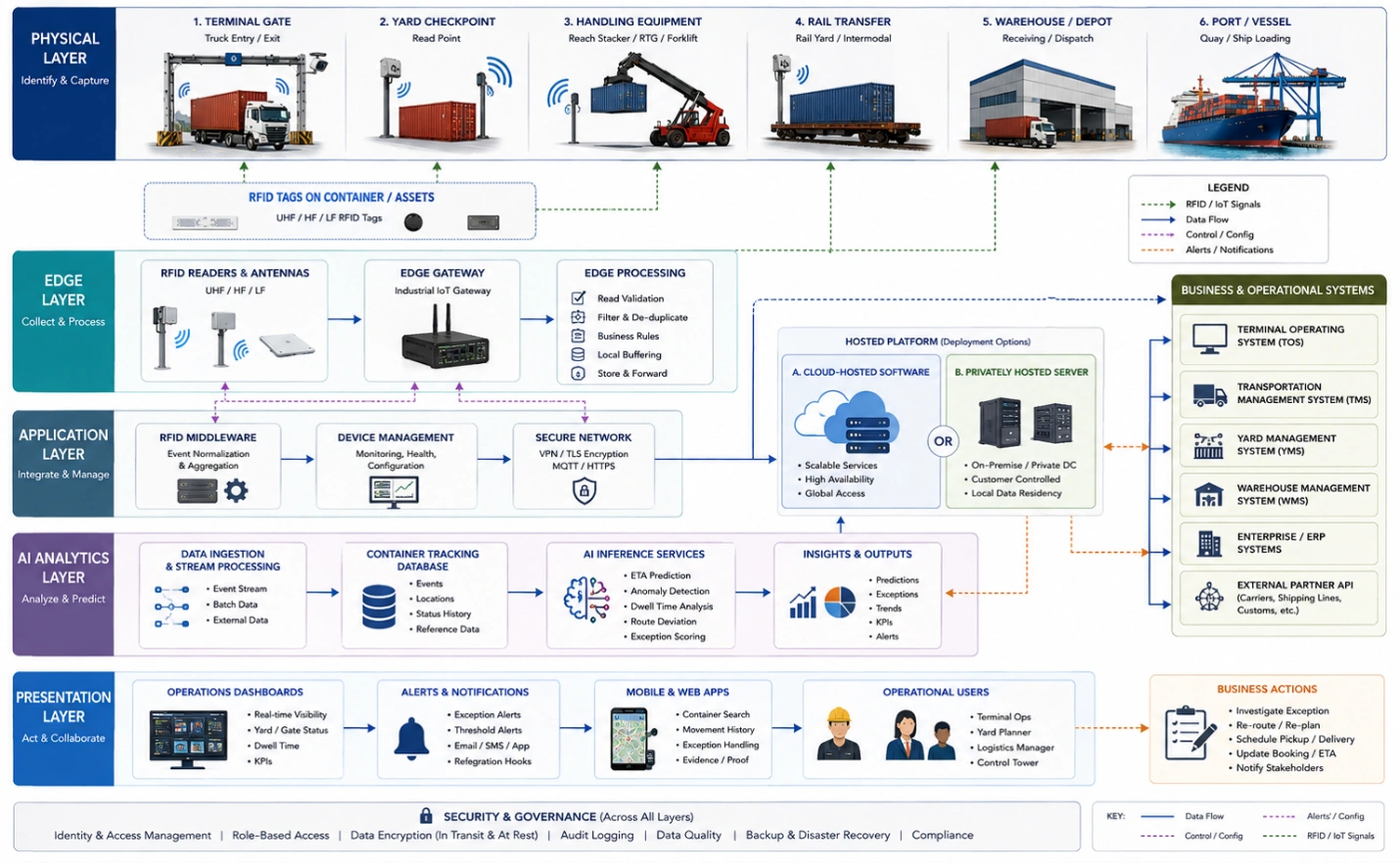
The diagram shows the complete technical data path from RFID-tagged containers and readers through edge gateways, middleware, secure networking, AI analytics, and container tracking databases. It also illustrates cloud-hosted and privately hosted deployment options, integration with logistics systems, dashboards, alerts, and operational actions.
RFID Hardware and AI Software for Container Tracking
RFID is an enabling identification technology within the broader container tracking solution. Its value depends heavily on how readers, tags, antennas, edge computing, middleware, communications, and business applications are engineered around the physical movement of containers.
UHF RFID for Container Identification
UHF RFID is particularly relevant to container tracking scenarios where identification must occur without requiring personnel to manually scan a tag. Gate lanes, controlled vehicle passages, yard checkpoints, warehouse receiving areas, and other defined read zones can use UHF RFID readers and antennas to capture container identifiers.
Metal containers present a significant RF engineering consideration. Tag selection, mounting location, antenna polarization, reader power, reader sensitivity, antenna placement, and the geometry of the read zone all affect performance.
A successful deployment therefore requires site testing rather than assuming that a nominal RFID read range will translate directly into reliable container identification.
HF and LF RFID in Controlled Identification Scenarios
HF RFID can be appropriate for shorter-range, controlled identification applications where close-proximity reads are preferred. LF RFID operates at a lower frequency and can also be useful in specific short-range identification environments.
The appropriate RFID frequency should be selected according to the physical container-tracking process, required read distance, environmental conditions, tag form factor, interference characteristics, and integration requirements.
AI Models and Operational Analytics
AI software can consume RFID-derived container events together with data from transportation and logistics systems.
Useful models and analytical functions include:
- Container arrival-time prediction
- Dwell-time prediction
- Movement anomaly detection
- Missing-event detection
- Route deviation analysis
- Gate congestion prediction
- Container flow forecasting
- Exception prioritization
- Yard movement optimization
- Operational trend analysis
Model performance should be measured against operational outcomes rather than AI accuracy alone. A technically accurate anomaly model is not necessarily useful if it generates too many alerts for terminal personnel to investigate.
Cloud and Privately Hosted Server Deployment
A cloud-hosted software deployment can be appropriate when container tracking spans multiple facilities and requires centralized data access, scalable analytics, remote system administration, and integration with distributed logistics operations.
A privately hosted server deployment can be preferable when operational requirements call for customer-controlled infrastructure, localized data processing, integration with existing data centers, or specific data governance requirements. Such software may run on an edge server, customer-managed server, private data center, or other privately controlled infrastructure.
Hybrid deployment can also be practical. RFID event processing may occur locally at a terminal while aggregated data and AI analytics are transmitted to centralized cloud services. This arrangement can reduce latency for local operations while retaining centralized visibility across facilities.
GAO’s experience supplying RFID, BLE, and IoT hardware products and systems can support organizations evaluating the physical identification layer alongside their broader container tracking requirements.
Engineering Considerations for Container Tracking Deployments
Container tracking deployments operate in environments where RF performance, vehicle movement, weather exposure, metal structures, network availability, and operational timing can all affect identification quality. Engineering decisions should therefore be based on the physical workflow rather than on RFID specifications alone.
Tag Placement and Container Materials
ISO shipping containers are predominantly metal structures, making tag selection and placement particularly important. RFID tags intended for ordinary plastic or cardboard assets may not perform as expected when attached directly to a steel container.
A deployment should evaluate:
- Tag construction and suitability for metal surfaces
- Mounting position and orientation
- Mechanical protection against impacts and abrasion
- Exposure to rain, dust, temperature changes, and washing operations
- Potential obstruction by container hardware
- Required service life
- Replacement and inspection procedures
Tag identifiers should also be associated with authoritative container records so that replacing a damaged tag does not create an ambiguous asset history.
Read-Zone Engineering
A container gate should be treated as a controlled identification zone. Antennas need to be positioned so the intended container is detected while reducing unwanted reads from adjacent containers, parked equipment, or vehicles traveling through neighboring lanes.
This becomes especially important in dense container yards where several tagged assets may be within RF range simultaneously.
Commissioning should include actual vehicle and container tests under representative operating conditions. Testing should cover different container orientations, truck speeds, container types, lane positions, weather conditions, and adjacent traffic.
Network and Edge Reliability
Container tracking systems should account for intermittent connectivity. A gate transaction should not necessarily be lost because a WAN connection is temporarily unavailable.
Local edge processing can buffer identification events and synchronize them with centralized software when connectivity returns. Timestamp synchronization is also important because AI analytics and event reconciliation depend on an accurate sequence of container movements.
Operational systems should define how duplicate events, delayed events, missing events, and conflicting records are handled.
Cybersecurity and Access Control
Container tracking data can reveal sensitive operational information, including shipment movements, facility activity, carrier relationships, and transportation schedules.
Security controls should therefore address the complete data path:
- Reader and gateway authentication
- Encrypted communications
- Role-based access control
- API authentication and authorization
- Secure software and firmware management
- Network segmentation where appropriate
- Audit logging
- Credential lifecycle management
- Data retention policies
- Backup and recovery procedures
- Monitoring for unauthorized access or abnormal system behavior
AI systems also require controls around model access, training data, inference services, and changes to production models.
Interoperability with Logistics Software
Container tracking rarely operates as an isolated application. A useful deployment must integrate with the software already used by terminal, transportation, warehouse, and logistics personnel.
The integration design should establish which system is authoritative for each data element. For example, an RFID reader can provide evidence that a tag was detected at a specific checkpoint, while a terminal operating system may remain authoritative for the container’s operational status.
This distinction prevents an identification event from being incorrectly treated as a complete business transaction.
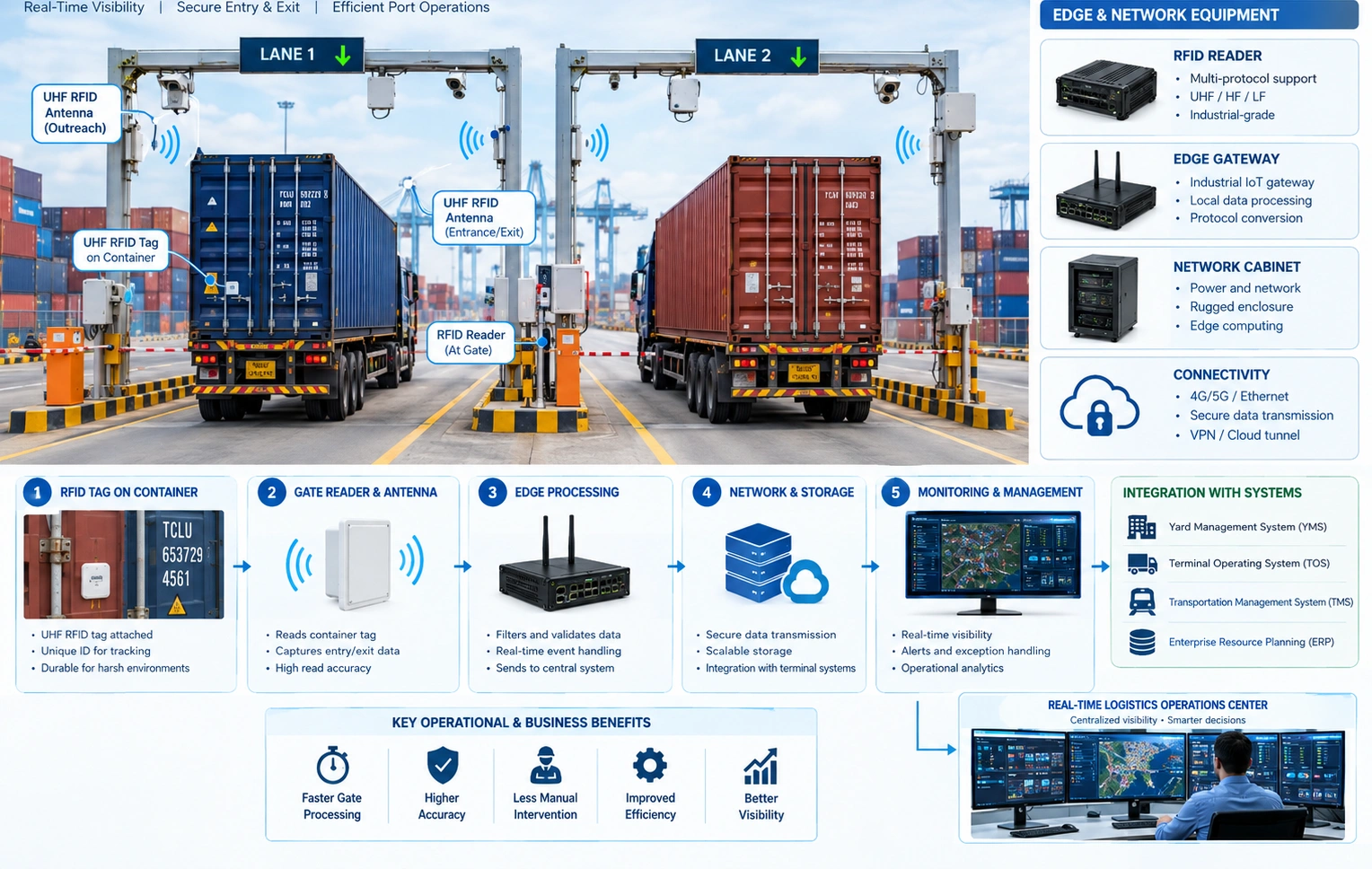
RFID Deployment at a Container Terminal Gate
The visual illustrates a practical UHF RFID deployment across two container terminal gate lanes. It shows RFID tags, antennas, rugged readers, edge gateways, network connectivity, middleware, container tracking software, and integration with terminal, yard, and transportation management systems.
AI Capabilities That Improve Container Movement Decisions
AI becomes most valuable when it addresses decisions that are difficult to make from individual tracking events.
Predictive ETA and Transit Analysis
Historical container movement records can be used to estimate expected transit times between facilities. Current events can then update those predictions.
For example, a system may determine that a container has departed an inland depot but has spent longer than normal reaching an intermodal terminal. The predicted arrival can be recalculated using historical route behavior and current operational information.
The resulting ETA should be presented as a prediction with appropriate confidence rather than as an unquestionable fact.
Predictive Dwell Management
Dwell prediction can help terminal operators identify containers likely to consume storage capacity beyond their expected window.
AI can evaluate historical dwell times together with container status, location, scheduled movement, facility conditions, and other relevant variables. Personnel can then prioritize containers requiring intervention rather than manually examining every record.
Anomaly Detection
Anomaly detection can identify movement sequences that differ from normal container flows.
Examples include:
- A container appearing at an unexpected facility
- A gate-out event without an expected preceding event
- A container remaining stationary unusually long
- Repeated reads inconsistent with the planned movement
- An unusual concentration of containers in a yard area
- Unexpected gaps between transportation milestones
Anomaly detection should be combined with operational rules. AI should augment established controls rather than replace deterministic checks that are already reliable.
Intelligent Exception Prioritization
A container tracking system can potentially generate thousands of events every day. Sending every irregularity to an operator creates alert fatigue.
AI can rank exceptions according to operational significance. A container approaching a vessel cutoff may warrant greater priority than an otherwise similar container with a later planned movement.
This changes the workflow from event monitoring to exception management.
Container Flow Forecasting
Historical RFID and logistics events can help estimate future container volumes at gates, yards, depots, and transfer facilities.
Forecasts can support staffing, yard planning, gate scheduling, transportation coordination, and equipment utilization. Forecasting becomes more useful as the system accumulates sufficiently consistent historical data across comparable operating conditions.
Implementation Lifecycle for AI-Enabled Container Tracking
A successful deployment normally progresses from operational requirements through site engineering, integration, commissioning, and continuous optimization.
Requirements and Site Assessment
The first stage should document the physical movement of containers and identify the checkpoints where reliable automated identification has the greatest operational value.
The assessment should examine:
- Container entry and exit points
- Yard blocks and storage areas
- Rail interfaces
- Warehouse interfaces
- Transfer and staging locations
- Truck routes
- Existing RFID or IoT equipment
- Network availability
- Electrical infrastructure
- Existing logistics software
- Data ownership
- Cybersecurity requirements
- Environmental conditions
The objective is to identify where an automated event can replace a manual transaction or provide information that existing systems cannot reliably capture.
RFID and IoT Hardware Selection
Hardware should be selected according to the physical application. UHF RFID may be suitable for longer-range gate identification, while HF or LF RFID can serve controlled short-range applications.
Reader selection should consider supported RFID standards, antenna interfaces, environmental rating, network connectivity, processing capabilities, management features, and integration requirements.
GAO can provide RFID, BLE, and IoT hardware products and systems for organizations developing these connected container-tracking workflows.
Pilot Deployment
A pilot should cover representative operational conditions rather than a single idealized read point.
Testing should include different containers, truck movements, lane positions, operating periods, and environmental conditions. The pilot should also test integration with the actual logistics software used by personnel.
AI functionality should initially operate alongside existing processes so that predictions and alerts can be evaluated without immediately making them responsible for irreversible operational decisions.
Commissioning and Acceptance Testing
Acceptance criteria should be established before deployment. Tests should verify identification performance, event processing, system availability, data integration, cybersecurity controls, exception handling, and recovery from communication failures.
Container movements should be traced end-to-end:
Physical container → RFID tag → RFID reader → edge processing → middleware → tracking database → AI analysis → operator alert → business action
This end-to-end test is more meaningful than validating the RFID reader independently.
Optimization and Scaling
After deployment, organizations can use operational data to refine read zones, event filters, AI thresholds, alert priorities, and integration logic.
Scaling to additional terminals or depots should not automatically mean duplicating every configuration. Site-specific RF conditions and operating procedures may require localized engineering while maintaining common data definitions and software interfaces.
Practical Design Recommendations for Container Tracking
Several implementation principles can reduce deployment risk.
- Start with high-value container movement events rather than attempting to instrument every physical location.
- Engineer RFID read zones around actual vehicle and container movement patterns.
- Use RFID as an identification and event technology, not as a substitute for every other location technology.
- Combine RFID events with transportation, terminal, yard, GPS, BLE, and other relevant operational data where appropriate.
- Process repetitive RFID observations at the edge before sending business events to central software.
- Establish authoritative data ownership for container identifiers, status, location, and transportation milestones.
- Design for network interruptions and delayed event synchronization.
- Validate RFID performance with actual metal containers and operational vehicles.
- Measure false positives and false negatives instead of reporting only aggregate read counts.
- Introduce AI progressively, beginning with decision-support use cases that can be validated against historical records.
- Keep human review in the loop for operational decisions where an incorrect prediction could cause significant disruption.
- Secure readers, gateways, APIs, databases, and AI services as parts of one connected system.
- Establish data retention, audit, and model-management procedures before production deployment.
- Use baseline KPIs to demonstrate measurable improvement after deployment.
Where AI and RFID Fit in the Container Tracking Technology Stack
The strongest container tracking implementations do not depend on one technology. They combine complementary layers according to the operational requirement.
RFID can establish discrete identification events. BLE can support proximity-oriented asset identification in suitable environments. GPS and cellular connectivity can provide broader outdoor location information. Computer vision can provide visual confirmation at selected checkpoints. Edge computing can process data close to the physical operation. Cloud or privately hosted servers can consolidate information across facilities. AI can interpret these combined data sources and prioritize decisions.
This layered approach is particularly useful for transportation and logistics organizations because containers can move through environments with very different technical conditions. A port gate, rail yard, inland depot, warehouse, and highway journey do not necessarily require the same tracking technology.
The engineering objective is therefore to select the appropriate sensing and identification method for each operational stage while maintaining a consistent container identity and event history.
Container Tracking Technology Decision Tree
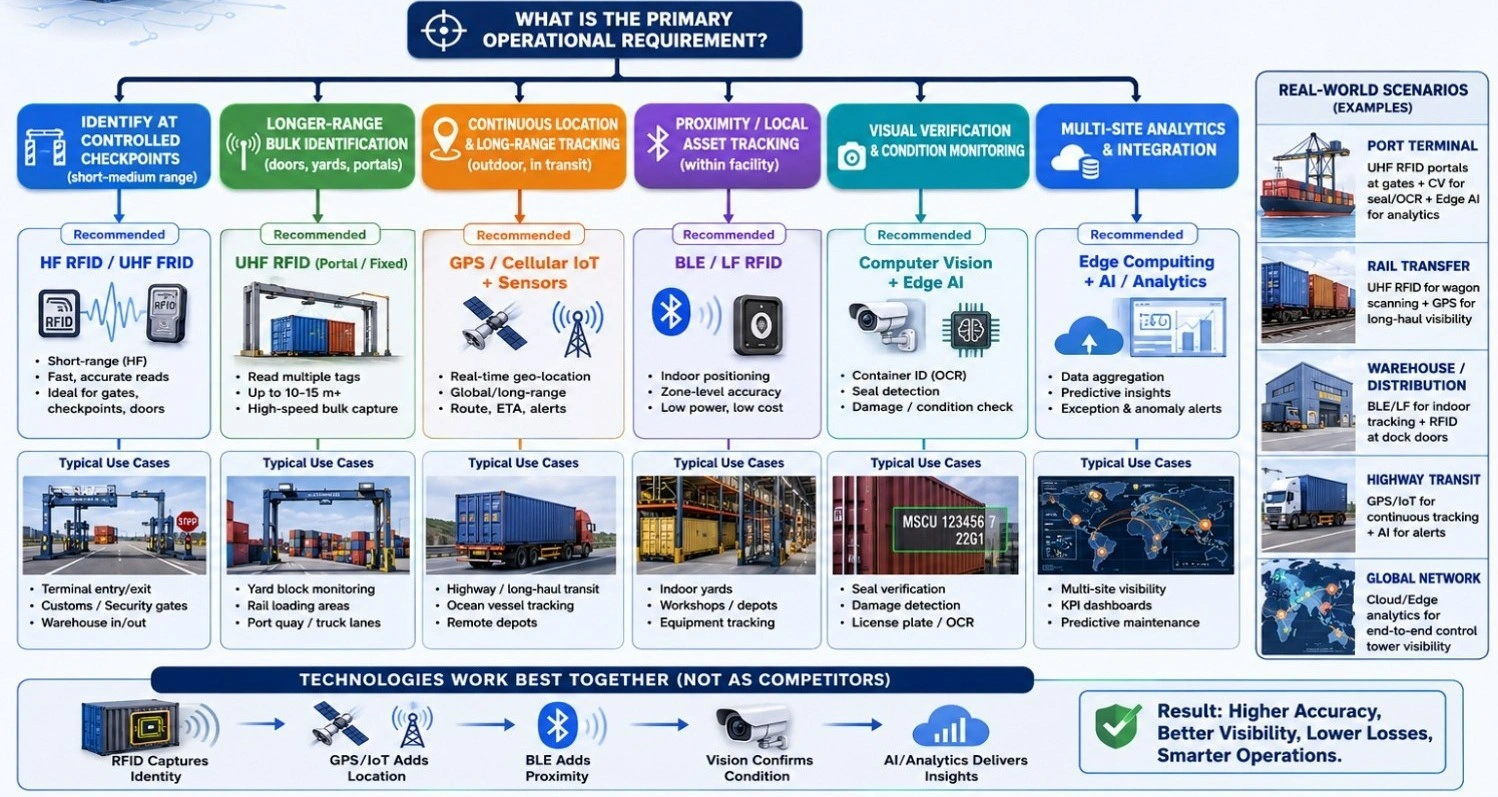
A professional decision tree showing how RFID, GPS/IoT, BLE, computer vision, edge computing, and AI can work together for end-to-end container tracking across gates, yards, warehouses, rail transfers, and highway transit.
Business Value of AI-Enabled Container Tracking
The business case for AI-enabled container tracking comes from improving operational decisions rather than simply increasing the number of data points collected.
Better event visibility can reduce manual reconciliation and provide logistics personnel with more reliable information about container movement. Predictive analytics can help identify developing dwell and transit problems before they become larger operational disruptions. Automated exception prioritization can allow personnel to concentrate on containers requiring intervention.
Improved container visibility can also support planning. More reliable historical movement data can improve estimates of terminal throughput, transportation demand, storage requirements, and recurring bottlenecks.
The economic value depends on the individual operation. A high-volume port terminal may prioritize gate throughput and yard utilization, while an inland depot may place greater emphasis on container dwell and handoff verification. A shipper with distributed facilities may prioritize cross-site visibility and exception management.
Consequently, an ROI analysis should connect each proposed tracking capability to a measurable operational outcome rather than treating RFID or AI adoption as an objective by itself.
GAO Support for AI-Enabled RFID Container Tracking
GAO provides RFID, BLE, and IoT hardware products and systems that can form part of container identification, asset tracking, and connected logistics solutions. Our engineering approach can support organizations evaluating readers, tags, antennas, gateways, connectivity, and system integration requirements for transportation and logistics environments.
GAO is headquartered in New York City and Toronto, Canada, and is recognized among the leading B2B and B2G suppliers of BLE and RFID technologies. GAO and its sister companies, GAO Research and GAO Tek, have served customers in the United States and Canada for three decades, including Fortune 500 companies, research organizations, universities, and government agencies.
Our product development emphasizes research and development, quality assurance, and technical support, including remote and onsite assistance where appropriate.
Key Takeaways for Container Tracking Decision-Makers
AI-enabled container tracking is most effective when it connects reliable physical identification with contextual logistics information and operational decision-making.
- RFID can provide automated container identification at controlled gates, transfer points, yards, depots, and other checkpoints.
- AI can transform accumulated container events into predictions, anomaly detection, prioritization, and operational recommendations.
- UHF, HF, and LF RFID should be selected according to the physical tracking requirement rather than treated as interchangeable technologies.
- Metal container construction makes tag selection, mounting, antenna positioning, and read-zone engineering especially important.
- Edge processing can reduce duplicate RFID events, improve local responsiveness, and provide resilience during network interruptions.
- Integration with terminal operating systems, transportation management systems, yard management software, and other logistics applications is essential for turning identification events into business value.
- Cloud-hosted and privately hosted server deployments can both be appropriate, depending on operational scale, data governance, connectivity, and infrastructure requirements.
- AI should be measured using operational KPIs such as ETA accuracy, dwell-time prediction, exception quality, event completeness, false-alert rate, and manual reconciliation.
- Pilot deployments should validate the complete path from physical container identification through software processing and business action.
- Security, interoperability, lifecycle management, and operational ownership should be designed before scaling beyond the initial deployment.
Organizations planning AI-enabled container tracking can evaluate their existing identification processes, define the highest-value movement events, and determine where RFID and complementary IoT technologies can improve visibility. GAO can provide technical guidance and RFID, BLE, and IoT hardware products and systems to support these evaluations and deployment requirements.
Building the Future of Industrial AI and IoT with Aperture Venture Studio and GAO RFID Inc.
For more than three decades, GAO has invested heavily in R&D for industrial RFID, BLE, and IoT. As AI became increasingly useful in industrial applications, we expanded our work in AI and IoT technologies, including RFID and BLE, and founded Aperture Venture Studio to develop AI and IoT solutions relevant to applications such as intelligent container tracking.
Aperture has attracted AI and IoT technical experts, entrepreneurial and operational executives, investors, and leading companies. We have also developed Aperture Ventures Summit and TekSummit to explore advanced AI and IoT topics.
We welcome you to participate as:
- Advisors, Co-founders, or Employees
- Investors
- Customers