
AI and RFID for Critical Infrastructure
AI-Enabled RFID and AIoT for Intelligent Critical Infrastructure Management
AI is changing how critical infrastructure operators monitor assets, detect abnormal conditions, manage maintenance, and coordinate security-sensitive operations. For power facilities, water treatment plants, transportation infrastructure, telecommunications sites, and other critical facilities, AI can combine information from connected equipment, sensors, inspection systems, access controls, and RFID-tagged assets to provide earlier warnings and more reliable operational decisions. RFID, including UHF, HF, and LF technologies, provides machine-readable identification and location-related data for equipment, tools, spare parts, containers, and other physical assets. AIoT solutions can then correlate this information with maintenance records, sensor telemetry, inspection results, and operational events. The result is a more complete view of infrastructure conditions, asset status, maintenance requirements, and potential security risks. GAO supplies RFID, BLE, and IoT hardware and systems that can support these data acquisition and operational workflows.
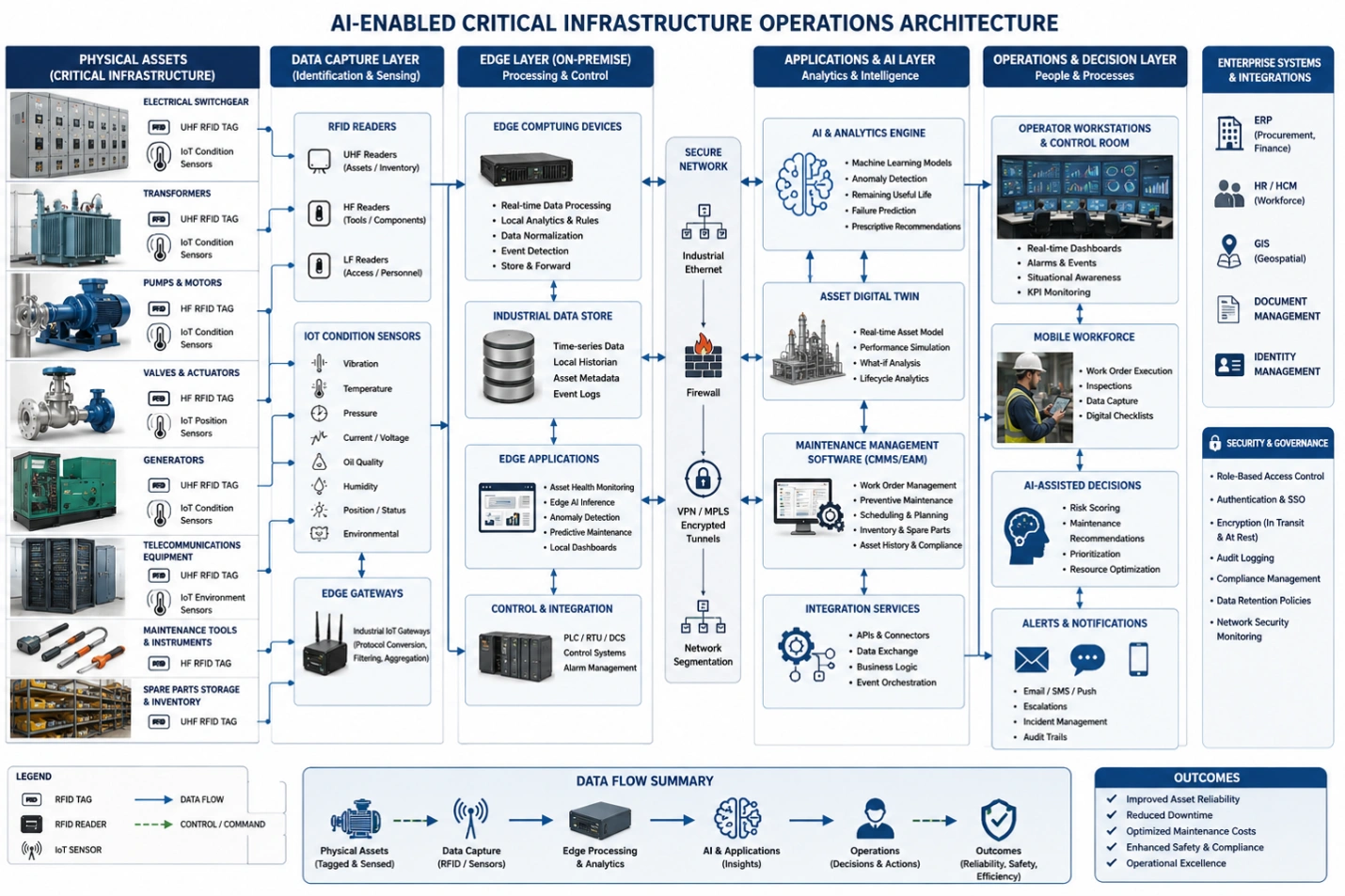
AI-Enabled Critical Infrastructure Operations Architecture: RFID, IoT, Edge Computing, and AI Integration
AI-enabled infrastructure diagram showing RFID, IoT sensors, edge computing, AI analytics, and operations.
How AI-Enabled Critical Infrastructure Operations Work
AI-enabled critical infrastructure management combines artificial intelligence with connected devices, sensors, industrial systems, inspection technologies, and operational software. This approach is commonly described as AIoT, or AI and IoT, when connected physical equipment supplies data for intelligent analysis.
Critical infrastructure operators can use machine learning to identify patterns in equipment behavior, anomaly detection to flag deviations from expected operating conditions, computer vision to analyze inspection imagery, and predictive analytics to estimate maintenance requirements. Edge AI can process time-sensitive information near the equipment, while centralized servers or cloud software can aggregate historical data across facilities.
RFID contributes primarily at the asset-identification layer. A UHF RFID tag can identify equipment, tools, containers, spare parts, or maintenance components without requiring direct line-of-sight. HF RFID can be appropriate for controlled identification tasks over shorter read ranges, while LF RFID can support specialized identification applications where its operating characteristics are appropriate.
The important engineering value comes from combining identification data with other operational information. Knowing that a technician moved a tagged replacement component into a substation is more useful when that event can be correlated with the work order, equipment condition, technician authorization, inspection results, and maintenance history. AI can then help identify missing information, unusual activity, maintenance patterns, or operational exceptions.
Critical Infrastructure Applications for AI and RFID
AI and RFID applications in critical infrastructure should be designed around specific operational risks rather than deployed simply to collect more data. The most useful systems connect physical asset information with maintenance, inspection, security, inventory, and operational processes.
AI Asset Tracking for Power Generation and Electrical Facilities
Power generation plants, substations, transmission facilities, and electrical distribution sites contain large inventories of high-value equipment, maintenance components, test instruments, personal protective equipment, and specialized tools. Manual asset records can become unreliable when equipment moves between storage areas, maintenance zones, substations, and field locations.
RFID can provide automated identification of tagged assets as they pass through controlled points. AI can analyze movement records alongside maintenance schedules, equipment histories, and work orders to identify discrepancies or operational patterns.
Relevant applications include:
- Tracking transformers, switchgear components, relays, circuit breakers, and other maintainable equipment.
- Monitoring the movement of specialized maintenance tools between facilities and field teams.
- Associating replacement components with work orders and maintenance activities.
- Detecting unexpected movement of tagged assets within controlled areas.
- Improving spare-parts availability for planned and corrective maintenance.
- Supporting audit trails for equipment inspections and maintenance activities.
GAO can supply RFID readers, tags, gateways, and related IoT hardware for asset identification workflows that need to operate within demanding facility environments.
AI Predictive Maintenance for Critical Equipment
Predictive maintenance is one of the strongest AI applications for critical infrastructure because unplanned equipment failure can affect safety, service availability, regulatory compliance, and operating costs.
Condition-monitoring systems can collect vibration, temperature, pressure, current, acoustic, or other equipment-specific measurements. Machine learning models can establish normal operating patterns and identify deviations that may indicate developing faults. RFID can supplement this process by associating physical equipment with the correct maintenance record, sensor data stream, inspection history, or replacement component.
For example, an AI system monitoring pumps at a water treatment facility may identify an abnormal vibration trend. The maintenance system can associate that alert with the specific pump asset, its service history, installed components, inspection records, and available replacement parts. This allows maintenance personnel to investigate the correct equipment and prepare the appropriate intervention.
AI-Enabled Predictive Maintenance Workflow for Critical Infrastructure
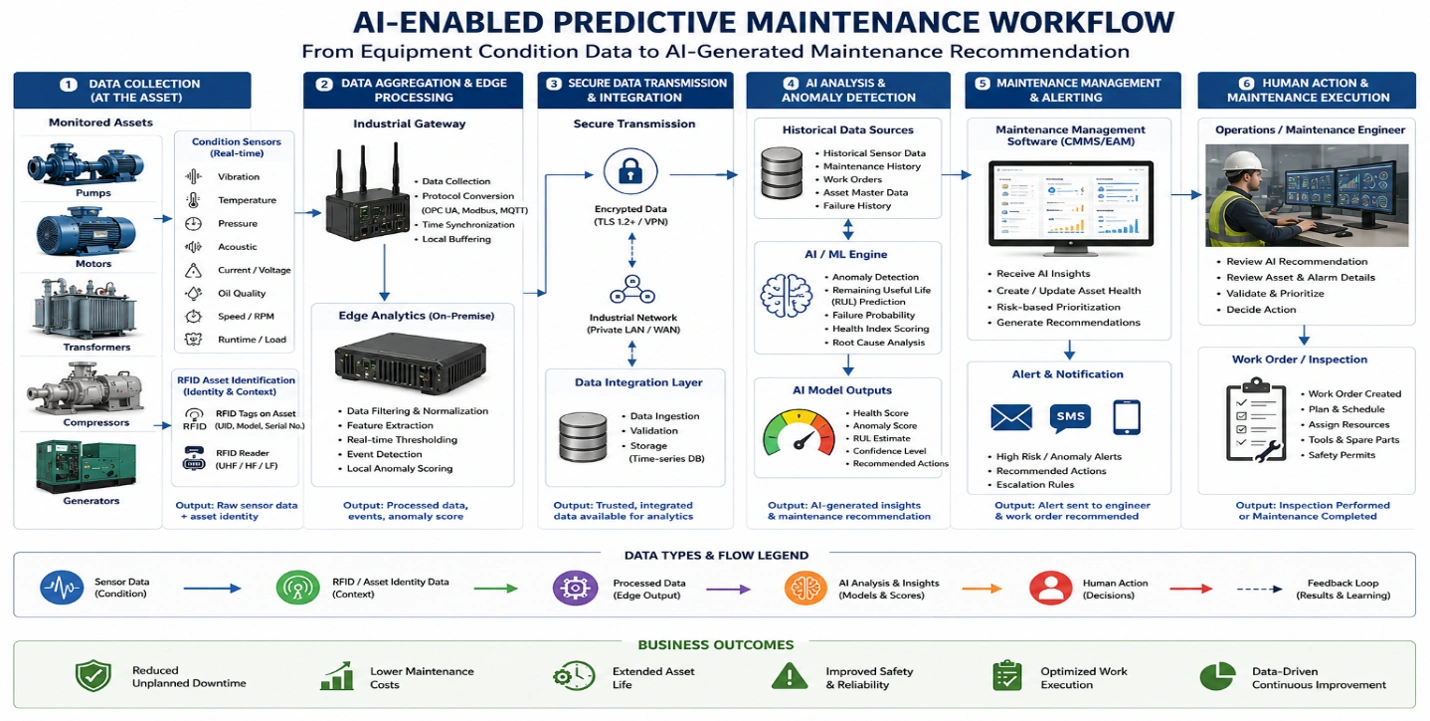
AI predictive maintenance workflow showing sensors, RFID, edge analytics, AI analysis, alerts, and maintenance actions.
AI Security and Unauthorized Asset Movement Detection
Critical infrastructure security extends beyond perimeter protection. Operators also need visibility into equipment, tools, access-controlled components, portable instruments, and other physical assets that may be moved within or outside restricted areas.
RFID event data can provide an additional source of information for detecting unusual asset movement. AI can compare asset movement against expected schedules, work orders, authorized personnel activity, facility zones, and historical patterns.
Potential applications include:
- Identifying movement of tagged equipment outside its expected operational zone.
- Detecting asset movements that do not correspond with scheduled maintenance.
- Correlating physical asset events with access-control records.
- Identifying unusual movement patterns involving high-value equipment.
- Supporting investigations through time-stamped asset-event records.
- Improving accountability for tools and equipment used in restricted areas.
RFID should not be treated as a standalone security control. Critical infrastructure security systems should combine asset identification with physical access controls, network security, video surveillance, authentication, and established security procedures.
AI Inventory Management for Critical Spare Parts
Critical infrastructure facilities frequently maintain spare parts that have different levels of operational importance. A missing common component may be inconvenient, while the absence of a specialized replacement component can extend equipment downtime for days or weeks.
RFID-based identification can automate inventory events for selected spare parts, containers, tools, and maintenance materials. AI can use inventory history, maintenance schedules, failure patterns, lead times, and consumption rates to improve replenishment planning.
Useful capabilities include:
- Identifying spare parts entering or leaving controlled storage areas.
- Linking components to equipment maintenance records.
- Detecting discrepancies between recorded and physically present inventory.
- Forecasting consumption for recurring maintenance activities.
- Prioritizing inventory based on equipment criticality and failure risk.
- Identifying potentially obsolete or underutilized maintenance stock.
This approach is particularly valuable where maintenance inventory must support high equipment availability and where replacement parts have long procurement lead times.
Critical Infrastructure Operational Workflow From Capture to Decision
An AI-enabled critical infrastructure solution generally begins with physical data acquisition. RFID readers identify tagged assets, while IoT sensors and industrial equipment generate condition and operational data. Inspection teams may contribute images, measurements, reports, and structured observations.
Communication gateways then transfer relevant information to edge computing resources, secure servers, or cloud-hosted software. Middleware can normalize asset identifiers and connect data from RFID readers, sensors, maintenance systems, security systems, and operational databases.
AI processing can occur at several points. Edge processing is useful where rapid response, limited connectivity, or data-locality requirements make local analysis preferable. Centralized processing is useful for historical analysis across multiple facilities and for models requiring larger datasets.
The resulting AI output should support an operational decision rather than exist as an isolated prediction. A detected anomaly may create a maintenance review. An unexpected asset movement may trigger a security investigation. A predicted spare-part shortage may generate a procurement action. A computer-vision inspection finding may create an engineering assessment.
AI-Enabled End-to-End Critical Infrastructure Data Flow and Business Action Diagram
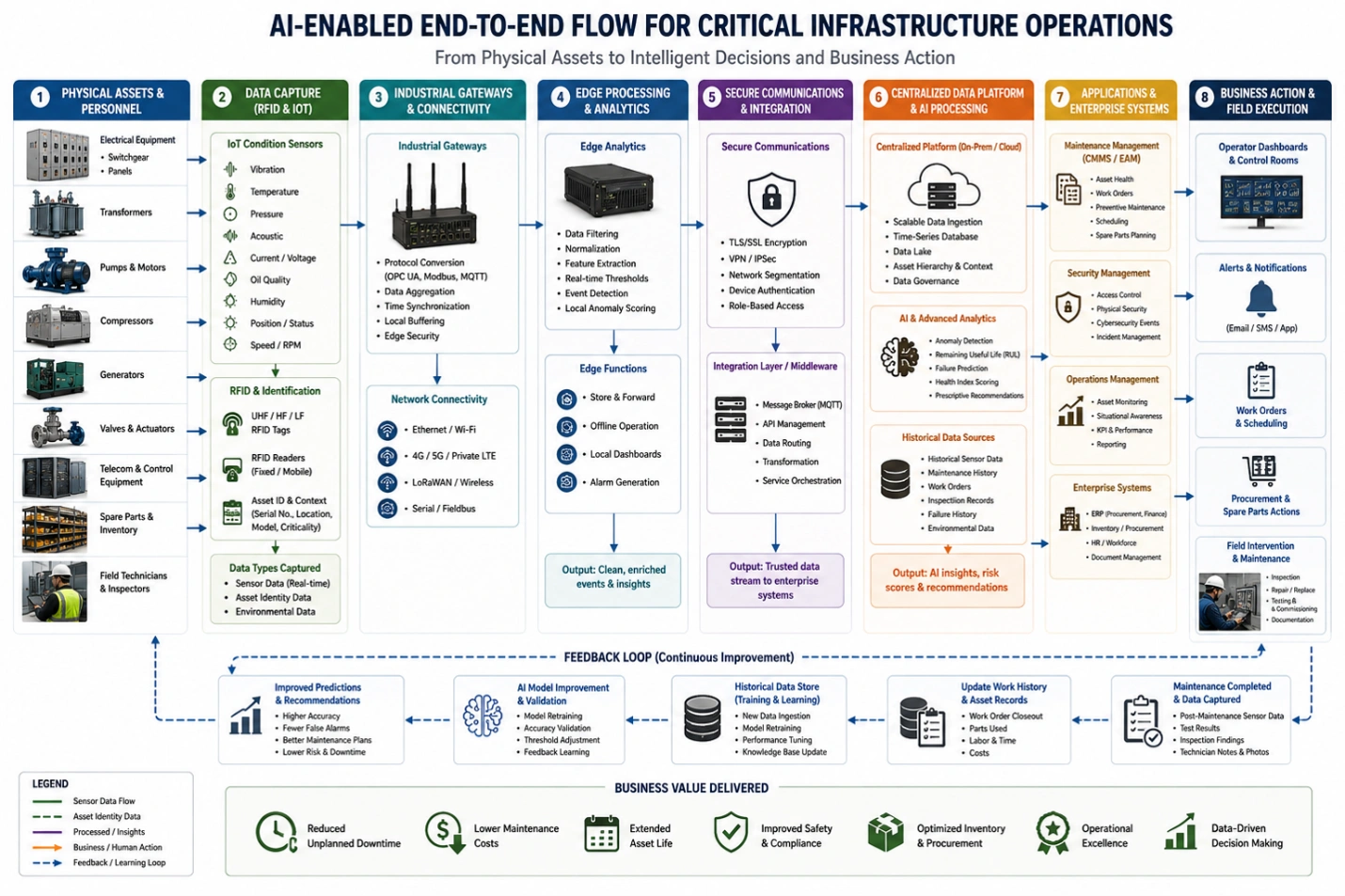
End-to-end AI infrastructure flow showing RFID, IoT, edge processing, AI analytics, work orders, and feedback.
AI Methods Used in Critical Infrastructure Management
Different AI methods are appropriate for different operational problems. Model selection should be based on the decision being supported, available data, response requirements, and consequences of incorrect predictions.
- Anomaly detection can identify equipment behavior or asset activity that differs from established operating patterns.
- Predictive maintenance models can estimate failure risk or identify developing equipment degradation.
- Time-series machine learning can analyze temperature, vibration, pressure, current, and other sequential measurements.
- Computer vision can support inspection of equipment, structures, safety conditions, and physical environments.
- Classification models can categorize inspection findings, equipment conditions, or operational events.
- Forecasting models can support spare-parts demand, maintenance workload, or equipment utilization planning.
- Natural language processing can help extract structured information from maintenance reports, inspection notes, and service documentation when appropriate.
- Edge AI can provide localized analysis where response time, connectivity, or data-handling requirements favor local processing.
Human review remains important for high-consequence infrastructure decisions. AI outputs should be traceable to source data, monitored for model degradation, and incorporated into established engineering and maintenance procedures rather than automatically overriding qualified personnel.
Comparison Table of AI Methods for Critical Infrastructure
| AI Method | Critical Infrastructure Use Case | Required Data | Processing Location | Typical Output | Human Decision Required | Key Engineering Consideration |
|---|---|---|---|---|---|---|
| Anomaly Detection | Detect abnormal equipment behavior, sensor readings, or operating conditions | Real-time sensor data, operational parameters, historical baseline data | Edge or centralized AI platform | Anomaly score, abnormal-condition alert, event classification | Yes — verify condition and determine response | Minimize false alarms and account for changing operating conditions |
| Predictive Maintenance | Predict equipment failures and optimize maintenance timing | Sensor trends, failure history, maintenance records, operating hours | Edge + centralized AI platform | Remaining useful life (RUL), failure probability, maintenance recommendation | Yes — validate recommendation and approve maintenance | Requires reliable historical failure and maintenance data |
| Computer Vision | Inspect equipment, safety conditions, leaks, corrosion, damage, or PPE compliance | CCTV/video, inspection images, labeled image datasets | Edge GPU or centralized AI platform | Defect detection, object classification, visual alert | Yes — confirm critical findings and initiate action | Lighting, camera placement, image quality, and model accuracy are critical |
| Time-Series Analysis | Monitor trends in temperature, vibration, pressure, voltage, current, and load | High-frequency sensor readings with timestamps | Edge or centralized analytics platform | Trends, patterns, deviations, health indicators | Yes — interpret trends and operating context | Requires synchronized, high-quality time-series data |
| Forecasting | Forecast energy demand, equipment load, resource requirements, or spare-parts demand | Historical operational data, weather/context data, demand patterns | Centralized AI platform or enterprise analytics | Future demand, load, consumption, or inventory forecast | Yes — use forecasts for planning and resource decisions | Forecast accuracy depends heavily on data quality and changing conditions |
| NLP | Analyze maintenance reports, inspection notes, incident reports, manuals, and work orders | Text documents, maintenance records, reports, manuals | Centralized AI platform or secure enterprise environment | Extracted information, summaries, classifications, recommended actions | Yes — review AI-generated interpretations before action | Protect sensitive information and maintain traceability of AI outputs |
Engineering Considerations for Critical Infrastructure Deployment
Successful deployment requires more than installing RFID readers or training an AI model. Critical infrastructure environments introduce constraints involving electromagnetic conditions, physical access, environmental exposure, network availability, cybersecurity, equipment interoperability, data quality, and operational safety.
Asset identity must remain consistent across RFID systems, computerized maintenance management systems, enterprise asset management software, inventory databases, and other operational applications. A tagged transformer component should not appear under different identifiers in separate systems.
RFID reader placement also requires site-specific testing. Metal equipment, dense machinery, electrical enclosures, liquids, and physical obstructions can affect RF performance depending on the RFID frequency and tag design. Critical assets should therefore be evaluated using the actual installation environment rather than relying solely on laboratory read-range specifications.
Network design should account for facility segmentation and security requirements. RFID readers and IoT gateways should not automatically receive unrestricted access to sensitive operational networks. Appropriate authentication, encryption, network segmentation, access control, logging, firmware management, and device lifecycle controls should be included in the design.
AI systems require reliable historical data. Incorrect asset identifiers, incomplete maintenance records, inconsistent timestamps, missing sensor readings, and poorly labeled inspection data can reduce model performance. Data validation should therefore be treated as an engineering requirement rather than an analytics afterthought.
GAO’s experience supplying RFID, BLE, and IoT hardware and systems can support organizations that need to connect physical asset identification with broader critical infrastructure data-collection requirements.
AI-Enabled RFID and IoT Deployment in a Modern Electrical Substation
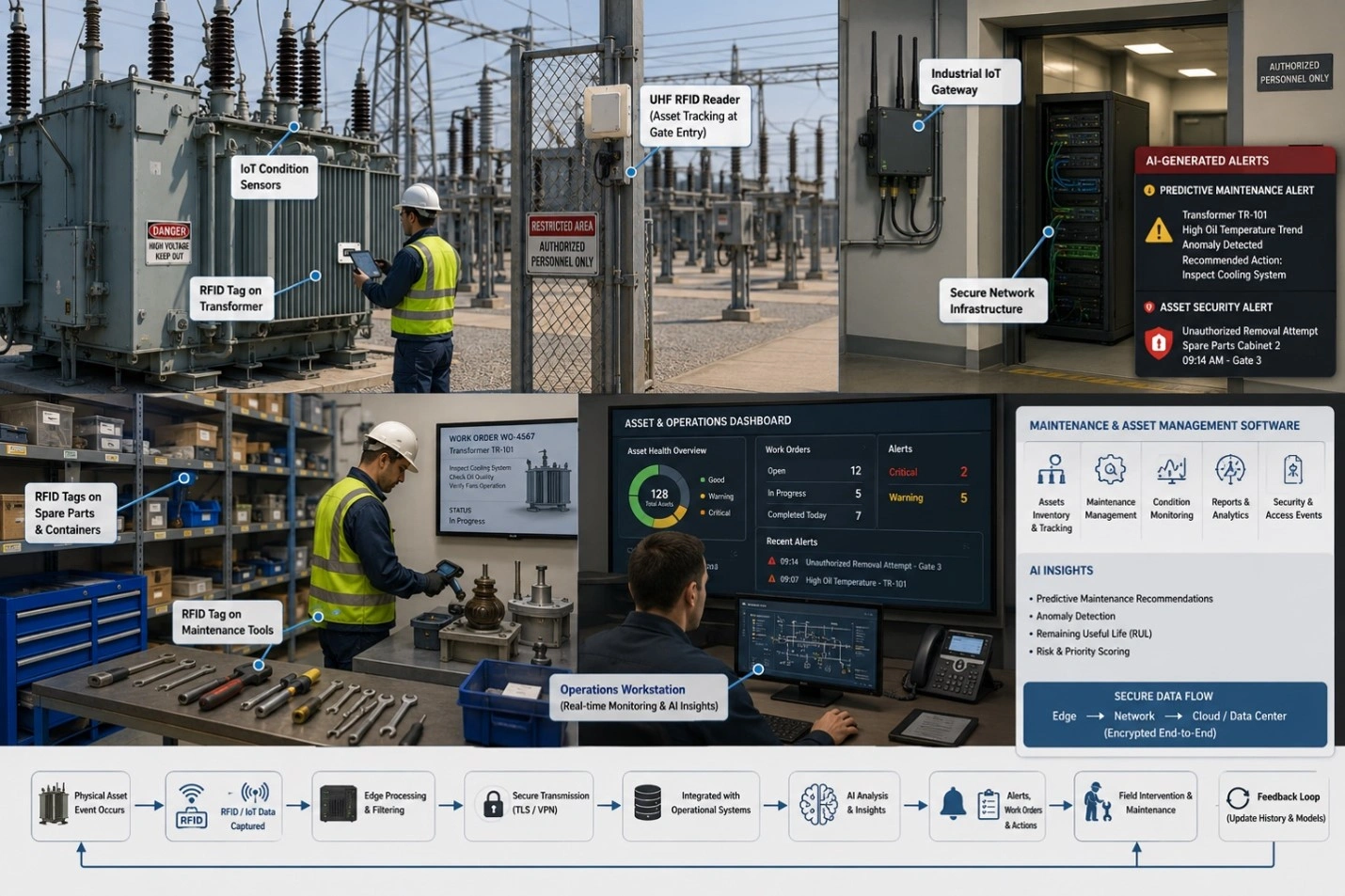
Photorealistic smart substation with RFID tags, IoT sensors, gateways, technicians, AI alerts, and secure asset monitoring.
RFID Hardware, AI Software, and Deployment Models for Critical Infrastructure
A practical critical infrastructure AI solution typically combines physical identification hardware, condition-monitoring devices, communications equipment, data-processing software, AI models, and operational applications. Each component should have a defined role in the workflow rather than being deployed independently.
RFID hardware can include fixed readers, handheld readers, antennas, tags, and RFID-enabled gateways. UHF RFID is generally useful for longer-range identification of tagged equipment, tools, containers, and inventory at controlled points. HF RFID can support shorter-range identification and controlled interactions, while LF RFID can be considered for specialized applications requiring its particular propagation characteristics.
IoT sensors extend the information available from physical infrastructure. Depending on the equipment, these can measure temperature, vibration, pressure, humidity, current, voltage, acoustic characteristics, flow, or other operating parameters. Industrial gateways collect information from these devices and can provide protocol conversion, buffering, local processing, and secure communications.
Middleware provides the connection between data-capture equipment and operational software. It can normalize device messages, map identifiers to asset records, filter duplicate events, manage device status, and route information to maintenance, inventory, security, or analytics applications.
AI software provides the analytical layer. Depending on the application, this can include anomaly detection, predictive maintenance, computer vision, forecasting, classification, or natural-language processing. Model outputs should be accompanied by appropriate confidence information, timestamps, asset identifiers, and source-data references so personnel can evaluate the recommendation.
Cloud Version
A cloud-hosted deployment can centralize data from multiple substations, treatment facilities, transportation locations, or telecommunications sites. This model is particularly useful when organizations need consolidated analytics, centralized model management, cross-site reporting, and scalable storage.
Cloud deployment can reduce the amount of infrastructure that individual sites must maintain, but critical infrastructure operators still need to evaluate network availability, cybersecurity requirements, data residency, latency, operational continuity, and integration with facility networks.
Time-sensitive controls should not depend exclusively on a remote cloud connection. Local gateways or edge computing can continue collecting and processing essential information if connectivity to centralized services is temporarily unavailable.
Server Version
A Server Version places software on edge servers, customer-managed servers, private data centers, facility servers, or other privately hosted computing infrastructure. This approach can be appropriate when critical infrastructure operators require greater control over data processing, network boundaries, system availability, or integration with existing operational technology.
Local processing can also reduce latency and limit the amount of raw data transmitted outside the facility. An edge server may process RFID events, sensor streams, inspection imagery, and AI models locally before forwarding selected results to centralized systems.
The choice between cloud and server deployment does not have to be absolute. A hybrid model can place time-sensitive processing at the facility while sending selected historical data, reports, and model results to centralized infrastructure.
| Deployment consideration | Cloud Version | Server Version |
|---|---|---|
| Multi-site analytics | Strong fit | Requires site-to-site integration |
| Local processing | Possible through edge components | Strong fit |
| Connectivity dependence | Higher for centralized functions | Lower |
| Centralized model management | Strong fit | Requires managed infrastructure |
| Local data control | Depends on cloud configuration | Greater direct control |
| Facility autonomy | Usually requires local fallback | Strong fit |
| Infrastructure responsibility | Shared with cloud provider | Primarily customer-managed |
Integrating AI Asset Data With Critical Infrastructure Software
AI-generated insights become operationally valuable when they are connected to the software already used by maintenance, engineering, security, inventory, and operations teams.
A computerized maintenance management system or enterprise asset management system can provide equipment hierarchies, preventive-maintenance schedules, work orders, failure history, inspection records, and spare-parts relationships. RFID events can help verify that the physical asset involved in a maintenance activity corresponds to the digital asset record.
Security systems can provide access-control events, badge activity, video information, and zone information. Correlating these records with tagged asset movement can help security teams investigate anomalies without relying on a single data source.
Inventory and procurement systems can contribute stock levels, purchase orders, supplier lead times, and historical consumption. AI can combine these records with maintenance forecasts to identify potential shortages of critical components.
Supervisory control and data acquisition systems, distributed control systems, building management systems, industrial gateways, and other operational systems may provide additional equipment information depending on the facility.
Integration should be based on well-defined interfaces and data ownership. Common integration mechanisms can include REST APIs, message brokers, database interfaces, industrial communication protocols, and standardized data-exchange methods. The appropriate method depends on the existing systems, security boundaries, latency requirements, and vendor capabilities.
Asset Identity as the Integration Link
A persistent asset identifier is one of the most important design elements. The same identifier should be mapped consistently across the physical tag, RFID middleware, asset database, maintenance software, inspection records, inventory records, and AI analytics.
Without reliable identity resolution, an AI model may detect an abnormal sensor reading but fail to associate it with the correct pump, transformer, motor, valve, or other physical asset. Asset master-data governance therefore directly affects AI usefulness.
Cybersecurity and Reliability for AI-Enabled Critical Infrastructure
Critical infrastructure deployments require cybersecurity controls that address both information technology and operational technology environments. RFID readers, IoT gateways, servers, sensors, and AI applications expand the number of connected components that require lifecycle management.
Important controls include:
- Strong authentication for administrative access and device management.
- Role-based authorization so users receive only the permissions required for their responsibilities.
- Network segmentation between RFID and IoT devices, business systems, and sensitive operational technology networks.
- Encryption for data transmitted across untrusted or shared networks.
- Secure configuration and controlled firmware updates for connected hardware.
- Centralized logging of important device, authentication, and application events.
- Monitoring for unusual network or device behavior.
- Asset inventories covering connected devices, software, firmware, and system dependencies.
- Backup and recovery procedures for operational databases and configuration information.
- Tested failover procedures for critical software and data services.
AI security also requires attention to the model itself. Operators should monitor model performance, data drift, unexpected inputs, false positives, and false negatives. A predictive-maintenance model trained on one equipment population may not perform identically after equipment modifications, operating-condition changes, or deployment at another facility.
For high-consequence decisions, AI should generally support qualified personnel rather than silently making irreversible operational decisions. Human approval, escalation thresholds, audit trails, and clearly defined fallback procedures are important engineering safeguards.
Operational Benefits and Critical Infrastructure KPIs
The value of AI-enabled asset and infrastructure management should be measured through operational outcomes rather than the number of connected devices.
Relevant KPIs can include:
- Unplanned equipment downtime.
- Mean time between failures.
- Mean time to repair.
- Preventive-maintenance completion rate.
- Predictive-maintenance alert precision.
- Maintenance backlog.
- Emergency work-order frequency.
- Critical spare-parts availability.
- Inventory record accuracy.
- Asset-location accuracy.
- Tool loss or misplacement rate.
- Time required to locate maintenance equipment.
- Inspection completion time.
- Security-event investigation time.
- Unauthorized asset movement incidents.
- False-positive alert rate.
- AI model precision and recall where measurable.
- Sensor data completeness.
- RFID read-event accuracy.
- System availability.
The appropriate KPI set depends on the facility and use case. A water-treatment operator may prioritize pump availability, chemical-process continuity, maintenance response, and inspection compliance. A telecommunications operator may emphasize field-asset availability, site maintenance response, spare-parts readiness, and equipment traceability. A power utility may place greater emphasis on equipment reliability, outage prevention, maintenance execution, and critical-component availability.
Implementation Roadmap for AI Asset and Infrastructure Management
A phased deployment is generally more practical than attempting to instrument an entire critical infrastructure organization at once.
Define the Operational Problem
Begin with a measurable operational problem. Examples include difficulty locating maintenance assets, recurring equipment failures, incomplete inspection records, critical spare-part shortages, or insufficient visibility into physical asset movement.
The initial use case should have identifiable data sources and a measurable baseline. A project should not begin with AI simply because AI is available.
Select Assets and Data Sources
Identify the equipment, tools, inventory, facilities, and processes involved. Determine which assets require RFID identification and which require condition sensors, inspection data, video, or other sources.
Document existing asset identifiers, maintenance records, communications networks, and software interfaces before selecting hardware.
Conduct a Site Survey
A physical survey should examine RF conditions, metal structures, equipment density, electromagnetic interference, reader locations, antenna orientation, environmental exposure, power availability, network connectivity, and access restrictions.
Critical infrastructure facilities can have substantially different conditions from laboratory environments. Pilot testing should therefore use representative equipment and operating conditions.
Build and Test the Data Pipeline
Connect RFID readers, sensors, gateways, middleware, databases, and AI software in a controlled pilot. Verify timestamps, asset identifiers, event ordering, duplicate handling, missing data, communication failures, and system recovery.
AI models should be evaluated against known historical or labeled events where available. Performance should be measured using operationally meaningful criteria rather than model accuracy alone.
Integrate With Operational Processes
An alert has limited value if personnel do not know what action to take. Define who receives each alert, what evidence accompanies it, what threshold triggers escalation, and how the resulting action is recorded.
For example, a predicted pump failure could generate an engineering review rather than an automatic shutdown. The workflow should specify the responsible maintenance role, required inspection, escalation conditions, and work-order process.
Commission, Monitor, and Scale
After pilot validation, commission the system under controlled operational conditions. Monitor RFID performance, sensor reliability, network availability, AI model behavior, user adoption, and KPI improvements.
Expansion should occur only after the initial use case demonstrates reliable technical performance and measurable operational value.
GAO can support organizations through the hardware and system components required for RFID and IoT-based data acquisition, including solutions used for asset identification, tracking, monitoring, and operational workflows.
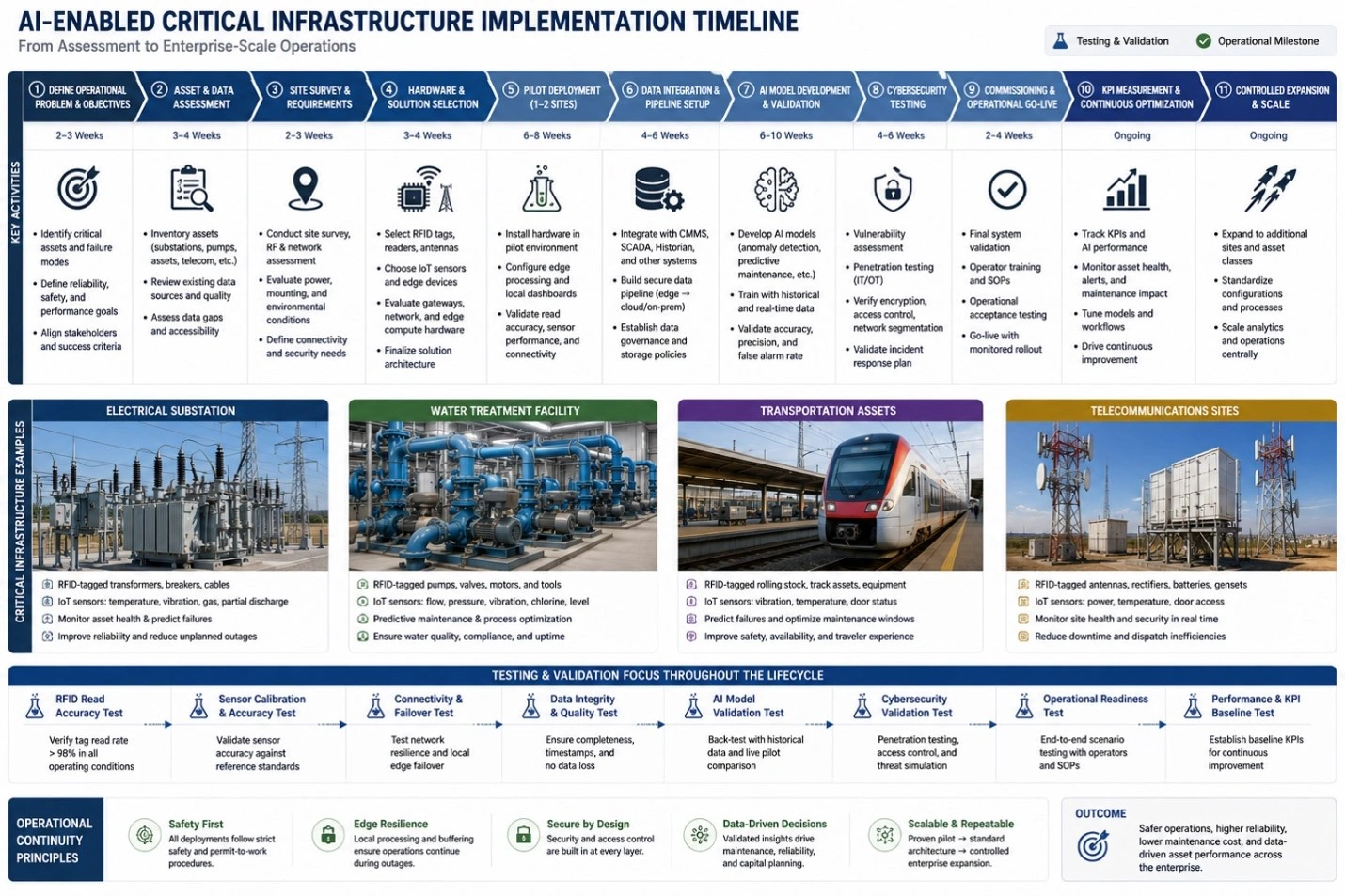
AI-Enabled Critical Infrastructure Implementation Timeline and Deployment Roadmap
AI infrastructure implementation timeline showing assessment, pilot deployment, AI validation, cybersecurity testing, and scale-up.
Practical Engineering Recommendations for Critical Infrastructure
Several design principles can improve the reliability and maintainability of AI-enabled critical infrastructure systems.
- Start with an operational decision, not with a technology purchase.
- Establish authoritative asset identifiers before integrating AI analytics.
- Use RFID where automated physical identification provides measurable operational value.
- Combine asset identity with condition, maintenance, inspection, and security data when the use case requires contextual analysis.
- Test RFID performance against the actual equipment, materials, enclosures, and environmental conditions at the facility.
- Keep time-sensitive operational functions capable of operating when centralized connectivity is unavailable.
- Separate connected identification and monitoring devices from sensitive operational networks using appropriate security controls.
- Validate AI predictions against real maintenance and inspection outcomes.
- Measure false positives because excessive alerts can reduce operator trust.
- Maintain human review for safety-critical or high-consequence decisions.
- Design device, software, and AI lifecycle management before large-scale deployment.
- Create documented procedures for firmware updates, model updates, backups, recovery, and replacement of failed devices.
- Treat cybersecurity, data quality, interoperability, and maintainability as core engineering requirements rather than later additions.
Why AI Matters for the Future of Critical Infrastructure Operations
Critical infrastructure is becoming increasingly data-intensive. Equipment generates more telemetry, inspection teams collect more digital information, and organizations operate larger inventories of distributed physical assets. The challenge is no longer simply collecting information. Operators need to determine which events matter, which assets require attention, and which actions should occur first.
AI can help convert large volumes of operational data into prioritized information. RFID strengthens this process by establishing a reliable relationship between digital records and physical objects. When asset identity, equipment condition, maintenance history, inspection results, inventory status, and security events can be correlated, infrastructure operators gain a more complete basis for operational decisions.
The most effective implementations will not necessarily be the ones with the greatest number of sensors or AI models. They will be the systems that improve measurable outcomes such as equipment availability, maintenance response, asset accountability, inspection efficiency, and operational resilience while remaining secure and maintainable.
GAO’s work supplying RFID, BLE, and IoT hardware and systems provides a foundation for organizations evaluating physical asset identification and connected monitoring requirements as part of broader AIoT initiatives.
Key Takeaways for AI-Enabled Critical Infrastructure
AI can improve critical infrastructure operations when it is connected to reliable physical and operational data. RFID is one enabling technology that can establish automated asset identity and movement information, while IoT sensors, industrial systems, inspection technologies, and enterprise software provide additional context.
For critical infrastructure organizations, the strongest use cases generally involve measurable operational challenges such as predictive maintenance, critical spare-parts management, asset accountability, inspection workflows, equipment monitoring, and security-related asset visibility.
Successful implementation depends on accurate asset master data, appropriate hardware selection, site-specific RF testing, secure connectivity, reliable integrations, validated AI models, human oversight, and measurable KPIs.
Organizations evaluating these applications can learn more about GAO’s RFID, BLE, and IoT hardware products and systems and work with technical specialists to determine appropriate data-capture and deployment approaches for their critical infrastructure requirements.
Building the Future of Industrial AI and IoT with Aperture Venture Studio and GAO RFID Inc.
For more than three decades, GAO Group of Companies has invested heavily in R&D covering industrial RFID, BLE, and IoT technologies. As generative AI has become increasingly useful in industrial applications, we have continued developing AIoT technologies that combine AI with connected devices, sensors, RFID, BLE, and industrial systems. We established <a href=”https://apertureventurestudio.com/”>Aperture Venture Studio</a> to support the development and scaling of AI and IoT solutions relevant to demanding industrial applications, including critical infrastructure.
Aperture has attracted technical experts, operational executives, investors, and leading companies interested in advancing AI and IoT applications. We have also developed the Aperture Ventures Summit and TekSummit as forums for discussing advanced AI and IoT topics.
GAO RFID Inc., GAO Research Inc., and GAO Tek Inc. form GAO Group, with operations based in New York City and Toronto, Canada. GAO has served organizations across the United States and Canada, including Fortune 500 companies, R&D organizations, universities, and government agencies. Our work includes supplying RFID, BLE, and IoT hardware and systems supported by established quality-assurance processes and technical assistance.
We welcome participation from:
- Advisors, co-founders, or employees.
- Investors.
- Customers.