
AI and RFID for Crop Farming
AI-Driven Crop Farming for Smarter Field and Supply Operations
AI is changing crop farming by turning field, equipment, inventory, environmental, and crop-handling data into actionable operational decisions. When AI software is supported by RFID identification, connected sensors, GPS, machine telemetry, and farm management systems, growers can improve visibility across seed handling, planting, crop monitoring, harvesting, post-harvest handling, and agricultural inventory management. RFID provides reliable identification of tagged seed lots, fertilizer containers, chemical inventories, reusable bins, pallets, tools, and other farm assets, while AI analyzes the resulting data alongside weather, soil, imagery, machinery, and production records. This combination can support crop traceability, inventory optimization, predictive maintenance, anomaly detection, labor planning, yield analysis, and automated exception alerts. For crop farming operations managing large fields, multiple crop varieties, seasonal inputs, and distributed storage locations, the resulting data can help connect physical agricultural activities with digital decision-making.
AI and RFID-Enabled Crop Farming: From Seed to Storage
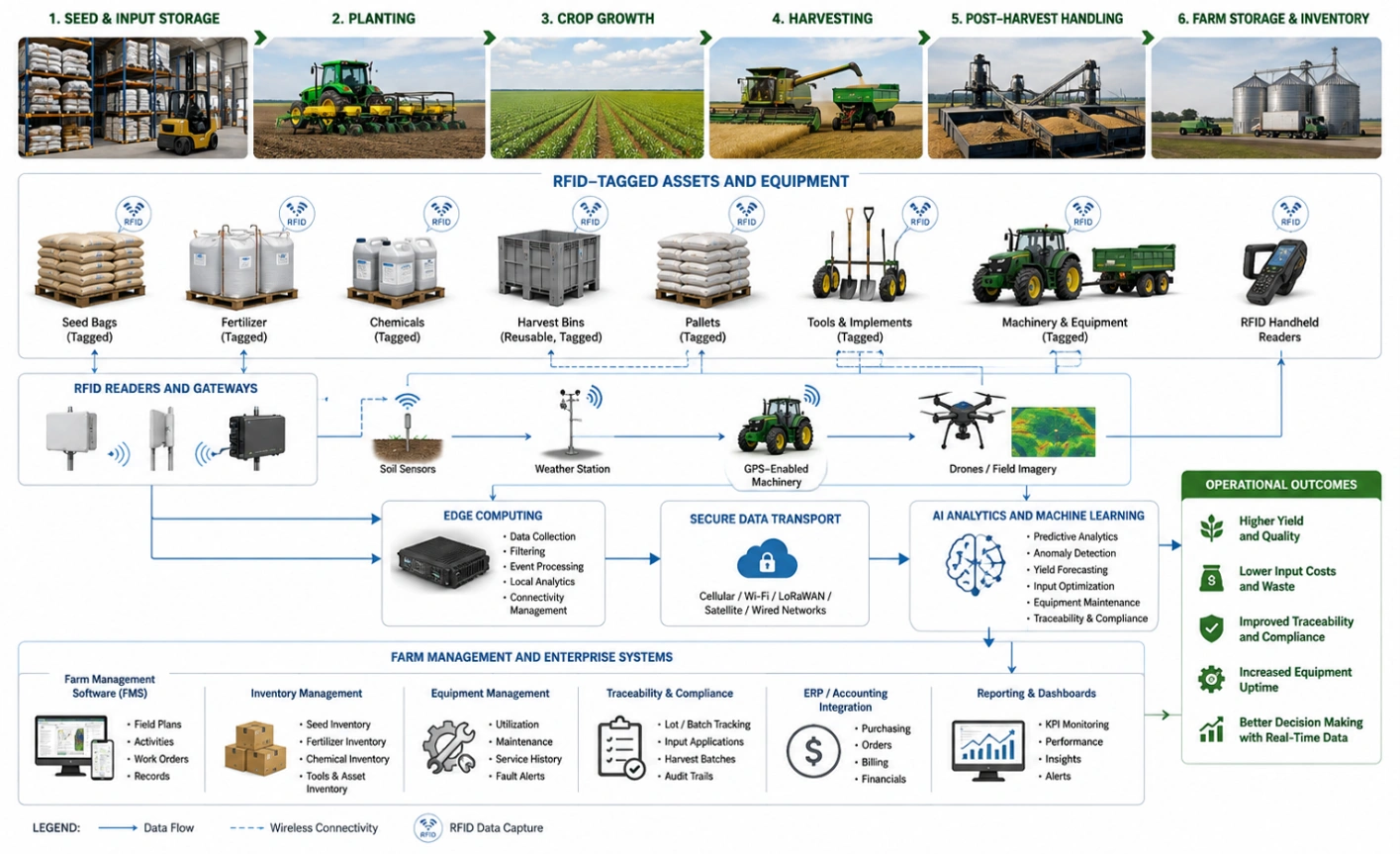
This infographic illustrates how RFID, IoT sensors, GPS-enabled machinery, edge computing, and AI analytics connect crop-farming activities from seed and input storage through planting, harvesting, post-harvest handling, and farm storage. It shows how agricultural data flows into farm management, inventory, traceability, equipment, and reporting systems to support higher productivity, better traceability, lower waste, and data-driven decisions.
What AI Means for Modern Crop Farming
AI in crop farming refers to software methods that analyze agricultural data to identify patterns, predict operational outcomes, detect exceptions, and recommend or automate actions. Machine learning can analyze historical yield, planting, weather, soil, irrigation, and input-consumption records. Computer vision can evaluate crop imagery for plant stress, disease symptoms, weed pressure, fruit or grain characteristics, and harvesting conditions. Predictive models can estimate irrigation requirements, forecast yield, identify machinery maintenance needs, and support agricultural inventory replenishment.
AI becomes more useful when it receives reliable information from the physical farm. RFID contributes this physical data layer by assigning machine-readable identities to materials and assets. A tagged seed lot, fertilizer pallet, pesticide container, harvest bin, or reusable agricultural asset can be associated with a specific crop, field, supplier, storage location, batch, or production activity.
The distinction is important: RFID does not determine whether a crop needs irrigation or whether a disease is present. Instead, it provides structured identification and movement information that AI can combine with agronomic and operational data. This creates an AIoT approach in which artificial intelligence works with IoT devices, RFID equipment, sensors, connected machinery, and agricultural software.
Where AI Delivers Value Across Crop Farming Operations
AI applications should be selected according to specific crop-farming decisions rather than deployed simply to collect more data. The most useful applications connect measurable agricultural problems with reliable operational data.
AI Seed and Agricultural Input Inventory Management
Seed varieties, fertilizer, crop-protection products, irrigation supplies, packaging materials, and other inputs must be available at the correct location and time. RFID identification can associate physical inventory with SKU, lot, variety, supplier, quantity, storage location, and expiration information.
AI can analyze consumption rates, planting schedules, historical usage, acreage, crop varieties, and seasonal demand to improve replenishment planning. An inventory model can identify that a particular seed variety will be depleted before a scheduled planting window, allowing procurement teams to act before the shortage affects field operations.
Practical deployment requires more than tagging containers. RFID read zones should be positioned at seed rooms, agricultural warehouses, receiving areas, chemical storage locations, and field dispatch points where inventory movement actually occurs.
AI Crop Traceability from Seed Lot to Harvest
Crop traceability becomes more complex when a farming operation manages multiple varieties, fields, planting dates, treatments, harvest batches, and storage locations. RFID can provide unique identification for seed lots, agricultural inputs, harvest containers, pallets, and batches.
AI software can correlate these identities with field records, machinery data, environmental measurements, harvest quantities, and quality observations. This supports faster investigation when a particular lot exhibits an abnormal yield, quality issue, treatment discrepancy, or downstream traceability requirement.
For example, a farm can associate a harvest batch with the field where it was produced, seed lot used during planting, relevant agricultural inputs, harvest date, storage location, and handling events. The resulting record can provide substantially stronger traceability than manually maintained spreadsheets.
AI Irrigation and Crop Stress Management
Irrigation decisions can incorporate soil moisture, temperature, humidity, rainfall, evapotranspiration estimates, crop growth stage, weather forecasts, and historical irrigation records. AI models can evaluate these variables to identify abnormal moisture conditions or predict irrigation requirements.
RFID has a supporting role rather than a direct agronomic sensing role. Tagged equipment, irrigation components, mobile water tanks, valves, maintenance tools, and field assets can be identified as they move between locations. AI can then combine asset information with sensor data and work orders to identify operational gaps, such as an irrigation asset assigned to the wrong field or a recurring maintenance requirement.
AI Agricultural Equipment and Asset Management
Modern crop farming depends on tractors, combines, planters, sprayers, seeders, irrigation equipment, trailers, harvest bins, pumps, implements, tools, and specialized attachments. Losing visibility into these assets can create delays during time-sensitive planting and harvesting windows.
RFID can identify selected equipment and reusable assets, while GPS and machine telemetry provide location and operating information. AI can analyze utilization, movement, maintenance records, operating hours, and historical failures to support predictive maintenance and equipment allocation.
The engineering objective should be to identify which assets actually require automated identification. High-value or frequently relocated assets generally provide greater return than attempting to RFID-tag every low-cost item.
AI Harvest and Post-Harvest Operations
Harvesting creates large volumes of physical material movement within short periods. Crop containers, bins, pallets, trailers, and intermediate storage locations may move continuously between fields, collection points, packing areas, drying facilities, cold storage, and warehouses.
RFID can automatically associate identified containers and pallets with movement events. AI can analyze harvest rates, equipment availability, storage capacity, field conditions, and historical throughput to identify bottlenecks.
For grain operations, the system can correlate harvested quantities with field and storage records. For produce operations, RFID can support identification of reusable crates, pallets, bins, and harvest batches. AI can then identify unusual dwell times, missing movements, or inventory discrepancies requiring investigation.
RFID-Enabled Crop Traceability from Seed Lot to Shipment
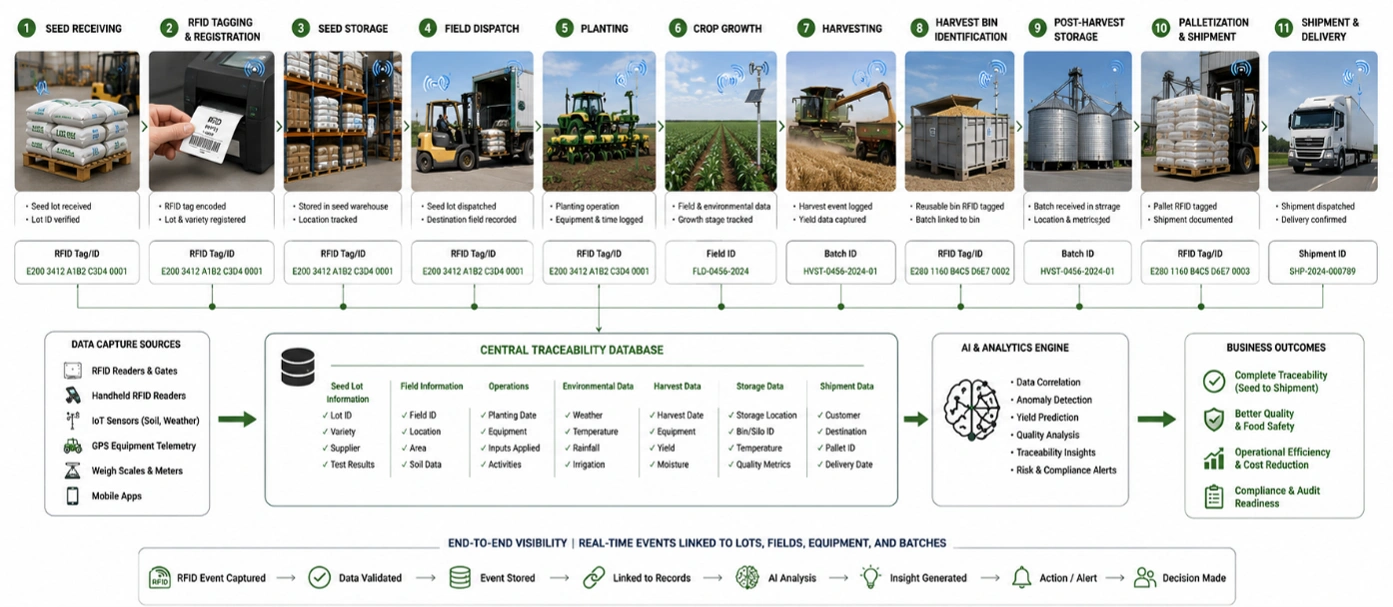
This workflow illustrates end-to-end crop traceability from seed receiving and RFID registration through planting, crop growth, harvesting, storage, palletization, and shipment. It shows how RFID events, field data, IoT sensors, GPS telemetry, weighing systems, and mobile records feed a centralized traceability system and AI analytics for quality, compliance, and operational visibility.
Crop Farming Data Flow from Field Capture to AI Decision
A practical AI-enabled crop farming solution starts with physical data acquisition and ends with an operational action. The data path should be designed around the decisions that farm managers, agronomists, equipment managers, warehouse personnel, and procurement teams need to make.
Data Acquisition at the Farm
Data can originate from UHF RFID portals, fixed RFID readers, handheld RFID readers, RFID antennas, HF or LF RFID devices where the application requires shorter-range identification, soil-moisture sensors, weather stations, irrigation controllers, GPS receivers, agricultural machinery telemetry, drones, cameras, weighing systems, and manual mobile applications.
UHF RFID is generally suited to longer-range identification of tagged agricultural inventory, containers, pallets, and assets. HF RFID can be appropriate for controlled short-range identification, while LF RFID can be useful for specialized identification environments where its operating characteristics are advantageous.
Edge Processing and Connectivity
RFID readers and agricultural sensors generate operational events that may require filtering before reaching centralized software. Edge gateways can remove duplicate reads, validate device messages, timestamp events, buffer information during network interruptions, and forward normalized data to higher-level systems.
Farm connectivity may use Ethernet, Wi-Fi, cellular networks, private wireless links, or other IoT connectivity depending on field conditions. Agricultural environments present particular challenges because fields, barns, machinery sheds, warehouses, and remote irrigation areas can have very different connectivity profiles.
A well-designed solution should tolerate temporary communication loss. Store-and-forward processing is particularly valuable for remote farm locations where cellular coverage is intermittent.
Middleware and Data Integration
Middleware receives RFID and IoT events and converts device-specific information into structured agricultural records. This layer can connect RFID readers with farm management software, inventory management systems, ERP software, warehouse management systems, maintenance applications, procurement records, and traceability databases.
Data normalization is important because an RFID reader event by itself has limited business meaning. The system needs to determine whether a tag represents a seed lot, chemical container, harvest bin, pallet, tractor attachment, or maintenance asset and associate the event with the correct agricultural workflow.
AI Analytics and Operational Actions
Once validated data reaches the AI processing layer, machine learning models can identify patterns and exceptions. Depending on the use case, models may support demand forecasting, anomaly detection, yield prediction, predictive maintenance, image classification, resource optimization, or risk scoring.
The final output should normally be an operational decision rather than simply another dashboard. Examples include:
- Replenish a seed variety before the planting schedule is affected.
- Investigate a missing harvest container.
- Reassign agricultural equipment to a field with an approaching work window.
- Inspect an irrigation asset associated with repeated abnormal readings.
- Review a harvest batch with an unusual quality or yield pattern.
- Escalate an inventory discrepancy between physical stock and system records.
Technical Components for AI-Enabled Crop Farming
A crop-farming solution normally combines identification hardware, environmental sensing, agricultural machinery data, connectivity, edge processing, enterprise software, and AI services. Component selection should follow the farm’s physical operating conditions rather than assuming that one RFID configuration fits every application.
RFID Hardware for Agricultural Identification
UHF RFID readers and antennas are useful for automated identification at farm warehouses, receiving docks, input storage areas, pallet handling points, and controlled vehicle or equipment movement zones. Handheld UHF readers can support inventory counts and exception investigations.
HF RFID can support short-range identification applications where controlled proximity and near-field operation are preferable. LF RFID can be considered for specialized agricultural asset-identification requirements where lower-frequency characteristics are appropriate.
Tag selection requires attention to substrate, mounting surface, read distance, environmental exposure, temperature, moisture, chemical exposure, and the presence of metal or liquids. Agricultural environments can be harsh, so a laboratory read test using the actual container, pallet, equipment surface, or asset is preferable to selecting tags solely from nominal specifications.
GAO supplies RFID hardware and related IoT systems that can be incorporated into agricultural identification and asset-tracking deployments, with engineering support for selecting components according to operating conditions.
Sensors, GPS, and Connected Farm Equipment
RFID should normally operate as one component of a larger agricultural data collection system. Soil and environmental sensors provide agronomic measurements, while GPS provides location context. Tractors, combines, sprayers, planters, and irrigation equipment can contribute telemetry such as position, operating hours, fuel consumption, engine status, and implement activity where supported.
Cameras and drones can add visual information for computer vision models. Weigh scales can provide harvest quantities, while barcode systems and mobile devices can supplement RFID where tagging every physical item is unnecessary.
AI Models and Agricultural Software
Different crop-farming decisions require different analytical approaches. Time-series models can analyze environmental and operational measurements. Classification models can categorize crop or equipment conditions. Computer vision models can process field imagery. Anomaly-detection models can identify unusual inventory movements or machine behavior. Forecasting models can estimate input requirements, production quantities, or equipment demand.
The AI software should integrate with farm management systems rather than becoming a disconnected analytical tool. Data governance should define ownership, retention, synchronization, model inputs, alert thresholds, and procedures for correcting inaccurate field records.
Cloud Version and Server Version for Crop Farming
A Cloud Version is appropriate when a farming organization operates geographically distributed fields, warehouses, storage facilities, and agricultural teams that need centralized access to RFID events, sensor data, analytics, and operational records. Cloud-hosted software can simplify centralized updates and provide scalable computing for AI workloads, provided reliable connectivity and appropriate data-security controls are available.
A Server Version can be preferable where agricultural operations require privately hosted software, local processing, tighter control over data, or continued operation when external connectivity is limited. A customer-managed server, private data center, farm server room, or edge server can process RFID and sensor events locally before synchronizing selected information with other systems.
A hybrid deployment can also be practical. For example, an edge server at a farm warehouse can process RFID reads locally, while centralized cloud software performs longer-term AI analysis across multiple farms. This reduces dependence on continuous wide-area connectivity while retaining centralized analytical capabilities.
Real-World RFID Deployment for AI-Enabled Crop Farming
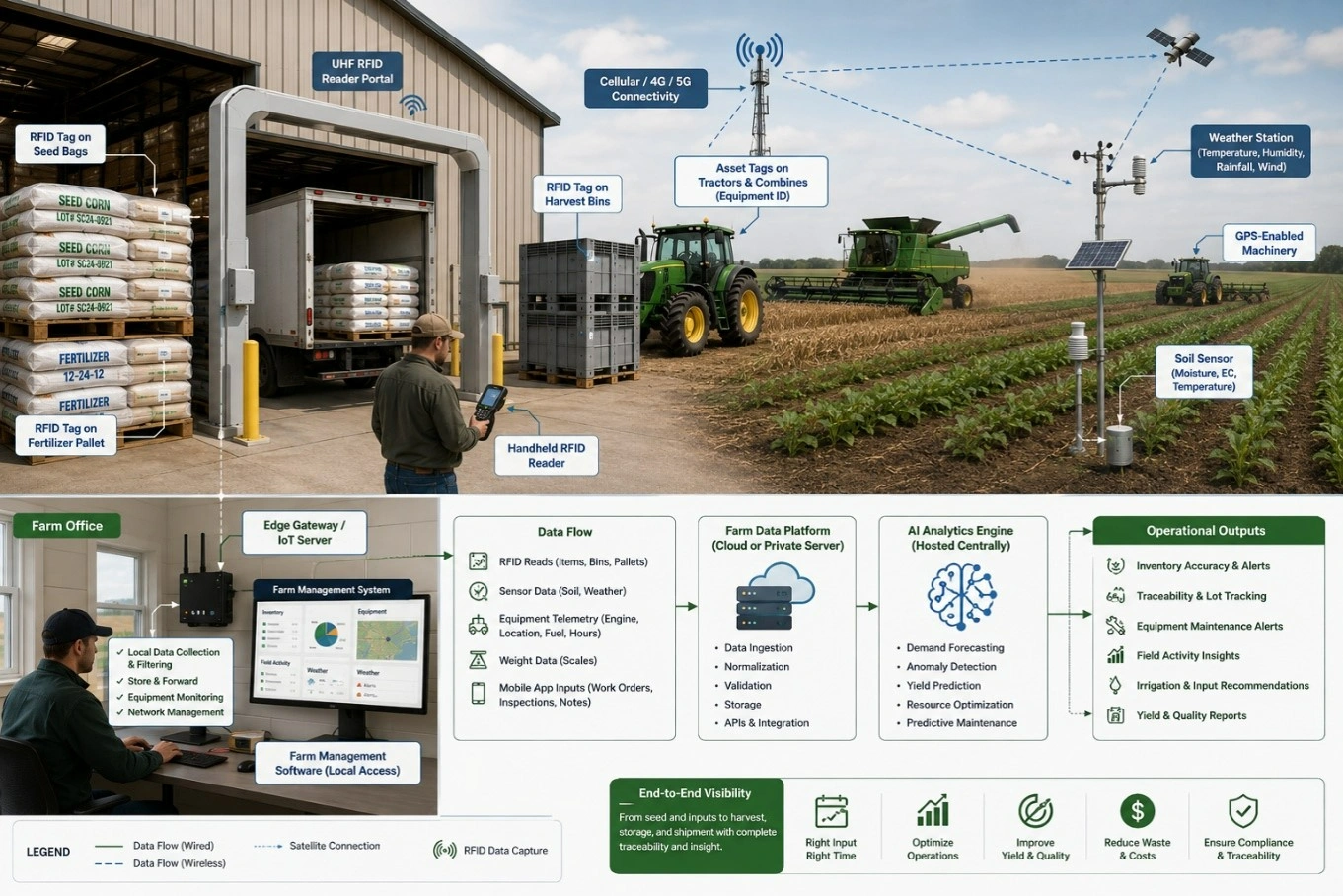
This visual shows a commercial crop farm using UHF RFID to identify seed bags, fertilizer pallets, harvest bins, and agricultural equipment. RFID readers, soil and weather sensors, GPS-enabled machinery, cellular connectivity, and an edge gateway feed farm software and centralized AI analytics for inventory, traceability, maintenance, irrigation, and crop-management decisions.
Security and Interoperability Considerations
Agricultural IoT systems can contain operationally sensitive information, including field locations, production records, equipment information, inventory quantities, supplier data, and farm management credentials. Security controls should therefore extend beyond the RFID reader itself.
Relevant controls include device authentication, encrypted communications, role-based access control, secure API integration, network segmentation, firmware management, audit logging, credential rotation, backup procedures, and monitoring for abnormal device activity.
Interoperability is equally important. RFID and IoT data should use documented interfaces and consistent identifiers so that farm management, ERP, inventory, maintenance, traceability, and AI software can exchange information without creating isolated data stores.
Engineering Priorities Before Deployment
Successful deployment depends on commissioning the physical identification system and validating the resulting data before relying on AI recommendations. Crop-farming organizations should first map the operational workflows where identification or prediction can materially change a decision.
Key engineering priorities include:
- Identify high-value workflows such as seed receiving, input inventory, field dispatch, harvest-bin movement, equipment allocation, and post-harvest traceability.
- Select RFID frequency and tag types according to actual materials, especially moisture-heavy produce, liquids, metal equipment, plastic containers, and agricultural packaging.
- Conduct read-range and interference testing using the exact tags and assets used on the farm.
- Define unique identifiers for seed lots, crop varieties, fields, harvest batches, containers, pallets, and equipment.
- Establish reliable connectivity and local buffering for remote agricultural locations.
- Validate RFID events against physical inventory before feeding them into AI models.
- Integrate with existing farm management, inventory, ERP, maintenance, and traceability software rather than duplicating core records.
- Establish cybersecurity, access control, audit, backup, and device-management procedures before production commissioning.
- Measure operational KPIs before deployment so that improvements can be demonstrated quantitatively.
Operational and Business Benefits of AI-Enabled Crop Farming
The value of AI-enabled crop farming comes from connecting agricultural data with decisions that affect yield, resource consumption, equipment availability, labor productivity, inventory accuracy, and traceability. RFID strengthens this process by providing dependable identity and movement events for physical items that are otherwise difficult to track automatically.
More Accurate Agricultural Inventory
AI inventory management can compare RFID-derived stock movements with procurement records, planting schedules, field requirements, and historical consumption. This helps identify discrepancies between recorded and physical inventory.
For seed, fertilizer, crop-protection products, irrigation components, and packaging materials, better inventory visibility can reduce emergency purchasing and improve seasonal procurement planning. RFID also reduces dependence on manual cycle counts when tagged inventory passes through controlled reading points.
The strongest results occur when RFID events are connected to business transactions. A reader detecting a tagged fertilizer pallet is more valuable when the event automatically updates the appropriate inventory record and provides context about the field or work order receiving the material.
Improved Crop and Harvest Traceability
AI-assisted traceability can connect seed lots, fields, agricultural inputs, harvest batches, containers, storage locations, and shipment records. RFID provides an automated identification mechanism for physical items, reducing manual transcription.
This is particularly useful where a crop-farming organization needs to investigate a production anomaly. Rather than searching through disconnected paper records, personnel can query the relevant crop lot or harvest batch and retrieve associated operational events.
Traceability data can also support quality analysis by allowing production outcomes to be compared across seed varieties, fields, planting periods, input applications, and harvesting conditions.
Better Equipment Utilization and Maintenance
AI predictive maintenance models can combine machinery telemetry, maintenance history, operating hours, fault information, and utilization data to estimate potential maintenance requirements. RFID can supplement these records by identifying implements, attachments, tools, trailers, bins, and other movable agricultural assets.
This combination helps distinguish between an equipment problem and an asset-location problem. If a required implement is unavailable because it is assigned to another field, the appropriate response may be scheduling or dispatch rather than maintenance.
For seasonal crop farming, this distinction matters because planting and harvesting equipment may have extremely narrow operational windows.
Faster Exception Detection
Manual agricultural operations often depend on personnel noticing discrepancies after they occur. AI can instead monitor data streams continuously and identify unusual patterns.
Potential exceptions include:
- A tagged harvest bin remaining at a collection point beyond its expected dwell time.
- Physical inventory diverging significantly from recorded seed or fertilizer quantities.
- An agricultural asset appearing at an unexpected location.
- A recurring equipment fault preceding a breakdown.
- An unusual harvest quantity compared with historical field performance.
- Environmental conditions deviating from expected crop requirements.
- A required agricultural input not reaching its assigned field before a scheduled activity.
The objective is not to automate every decision. High-quality exception detection should direct personnel toward the situations where human intervention has the greatest operational value.
Key AI and RFID Use Cases for Crop Farming
A mature deployment should prioritize use cases according to operational impact and data readiness.
| Crop Farming Use Case | AI Function | RFID Contribution | Primary KPI |
|---|---|---|---|
| Seed inventory management | Demand forecasting and anomaly detection | Seed lot identification and movement | Inventory accuracy |
| Fertilizer inventory | Consumption forecasting | Pallet and container identification | Stockout rate |
| Crop traceability | Relationship and anomaly analysis | Lot, bin, pallet and batch identification | Traceability completeness |
| Harvest logistics | Throughput and delay analysis | Harvest-bin and pallet movement | Harvest dwell time |
| Equipment management | Utilization analysis | Asset identification | Equipment utilization |
| Predictive maintenance | Failure-risk prediction | Asset identity and service association | Unplanned downtime |
| Agricultural input planning | Seasonal demand prediction | Physical consumption events | Forecast accuracy |
| Exception management | Anomaly detection | Automated movement events | Response time |
| Post-harvest inventory | Inventory optimization | Container and pallet tracking | Inventory discrepancy rate |
| Field operations | Scheduling optimization | Equipment and material identification | On-time field activity |
The table also illustrates an important engineering principle: RFID is not the AI application itself. RFID supplies identity and event information that becomes more valuable when AI combines it with agronomic, operational, environmental, and enterprise data.
Deployment, Testing, and Commissioning for Crop Farms
A production deployment should begin with an operational assessment rather than hardware installation. Farm managers, agronomists, warehouse personnel, equipment managers, IT teams, and system integrators should identify where data gaps currently affect decisions.
Workflow and Site Assessment
The assessment should document seed receiving, input storage, field dispatch, equipment movement, harvesting, container handling, storage, maintenance, and shipment processes.
For each process, identify:
- What physical item requires identification.
- Where the item enters and leaves the process.
- How frequently it moves.
- Whether it contains liquid, moisture, metal, or other materials affecting RFID performance.
- Whether automated identification or manual confirmation is preferable.
- Which software currently records the transaction.
- What decision should be triggered by the resulting data.
This prevents the common mistake of installing RFID readers in convenient locations that do not correspond to actual agricultural workflows.
RFID Site Survey and Pilot Testing
RFID performance should be tested with representative tags and actual agricultural materials. Moisture, metal, dense crop products, stacked containers, machinery, and outdoor conditions can all influence radio-frequency performance.
A pilot should measure:
- Read accuracy.
- Missed-read frequency.
- Duplicate-event frequency.
- Read-zone coverage.
- Tag orientation effects.
- Performance with stacked or moving assets.
- Reader performance under actual environmental conditions.
- Network availability.
- Event-processing latency.
Pilot results should be used to tune antenna placement, reader power, tag positioning, filtering logic, and read-zone configuration before broader deployment.
AI Model Validation
AI models require representative agricultural data rather than generic datasets. Historical field records, equipment events, inventory movements, weather information, crop imagery, and maintenance records should be evaluated for completeness and consistency.
Model validation should consider false positives and false negatives. For example, an anomaly-detection system that produces too many unnecessary equipment alerts can cause operators to ignore legitimate warnings.
Agricultural personnel should therefore participate in model validation. Domain experts can distinguish a genuine operational anomaly from a seasonal condition that appears unusual statistically but is normal agronomically.
Integration with Agricultural Software
AI and RFID systems create the greatest operational value when they exchange data with existing agricultural software.
Potential integration points include:
- Farm management information systems for field activities, crop records, and production planning.
- ERP systems for purchasing, suppliers, financial records, and inventory transactions.
- Warehouse management software for agricultural inputs and post-harvest materials.
- Maintenance management software for tractors, combines, implements, pumps, and irrigation equipment.
- Transportation management systems for harvest and outbound logistics.
- Quality management software for crop quality and inspection records.
- Laboratory information systems where agricultural testing data must be associated with production records.
- GIS and mapping software for field and asset location.
- Weather and environmental data services.
- Mobile applications used by field personnel.
APIs, message brokers, webhooks, database interfaces, or other documented integration mechanisms can transfer events between systems. Data models should use consistent identifiers so that a seed lot, harvest batch, field, asset, or container does not acquire different identities across applications.
GAO’s experience supplying RFID, BLE, and IoT hardware products and systems can support the physical identification layer while system integrators or customer IT teams connect those devices to existing agricultural software.
Scaling AI and RFID Across Crop Farming Operations
Scaling should occur after the initial workflow has demonstrated measurable value. Expanding hardware without validating the data model can create large volumes of inconsistent information that make AI models less reliable.
A practical scaling approach includes:
- Standardize RFID tag identifiers and naming conventions.
- Maintain a controlled device inventory for readers, antennas, gateways, sensors, and edge servers.
- Define common agricultural data models across farms and storage sites.
- Establish repeatable reader commissioning procedures.
- Maintain approved tag specifications for seed packaging, fertilizer containers, harvest bins, pallets, and equipment.
- Centralize device monitoring while retaining local operational capability where connectivity is unreliable.
- Establish model-monitoring procedures to detect declining prediction accuracy.
- Review RFID read performance periodically after equipment, shelving, storage layouts, or workflows change.
- Keep software interfaces documented and version-controlled.
- Introduce new AI use cases only after sufficient historical data has been accumulated.
A multi-farm deployment may also require regional configuration. Crop varieties, growing conditions, equipment, field sizes, storage processes, and connectivity can differ significantly between locations. A centralized system should therefore support local operational parameters rather than assuming identical workflows everywhere.
Cybersecurity and Data Governance for Connected Crop Farming
Connected farm systems introduce additional cybersecurity considerations because RFID readers, IoT gateways, sensors, mobile devices, agricultural machinery, servers, and cloud services become interconnected.
Security should include:
- Unique device identities and controlled credentials.
- Encrypted communication between devices, gateways, servers, and cloud services.
- Network segmentation between IoT equipment and critical business systems.
- Role-based access for agronomists, farm managers, warehouse personnel, maintenance teams, and IT administrators.
- Secure API authentication.
- Regular firmware and software updates.
- Audit logs for inventory, asset, and traceability changes.
- Backup and recovery procedures.
- Monitoring for abnormal device behavior.
- Controlled retention of field, production, equipment, and supplier information.
AI introduces additional governance requirements. Teams should understand which datasets feed a model, how frequently models are retrained, who can modify thresholds, and how personnel can override an automated recommendation.
For safety-critical agricultural machinery, AI recommendations should not automatically initiate physical actions unless the complete control system has been engineered, validated, and approved for that purpose.
KPIs for Measuring AI and RFID Performance
Technology deployment should be evaluated through operational metrics rather than the number of RFID tags installed or AI models deployed.
Important crop-farming KPIs include:
- Seed and agricultural input inventory accuracy.
- Stockout frequency.
- Inventory reconciliation time.
- Seed-lot traceability completeness.
- Harvest-batch traceability completeness.
- Harvest-bin dwell time.
- Equipment utilization.
- Unplanned equipment downtime.
- Mean time to repair.
- Predictive-maintenance precision.
- Agricultural input forecast accuracy.
- Field activity completion rate.
- Harvest throughput.
- Exception detection rate.
- Exception response time.
- Manual data-entry reduction.
- RFID read accuracy.
- RFID event-processing latency.
- System availability.
- Cost per tracked asset or transaction.
Baseline measurements should be recorded before implementation. A solution that increases data volume but does not improve one or more operational KPIs should be reassessed.
Practical Implementation Recommendations from Planning to Optimization
AI-enabled crop farming should be implemented as an operational improvement program rather than a standalone technology project.
Planning: Select a clearly defined problem such as seed inventory discrepancies, harvest-container visibility, equipment utilization, or traceability.
Design: Map the physical workflow, identify data sources, determine RFID requirements, and define how AI outputs will influence operational decisions.
Hardware selection: Test tags against actual agricultural materials and select reader, antenna, gateway, sensor, and enclosure specifications according to the environment.
Integration: Establish identifiers, APIs, event structures, and synchronization rules between RFID systems and farm management software.
Commissioning: Validate read zones, network connectivity, event filtering, data accuracy, user workflows, and exception handling.
Testing: Conduct functional testing, integration testing, cybersecurity testing, field validation, and user acceptance testing.
Optimization: Tune RFID configurations and AI thresholds based on operational results rather than laboratory assumptions.
Maintenance: Monitor device health, replace damaged tags or equipment, update software and firmware, and periodically review model performance.
Scaling: Expand to additional farms, warehouses, crop varieties, and asset categories only after the initial deployment produces measurable results.
AI & RFID Crop Farming Deployment Lifecycle
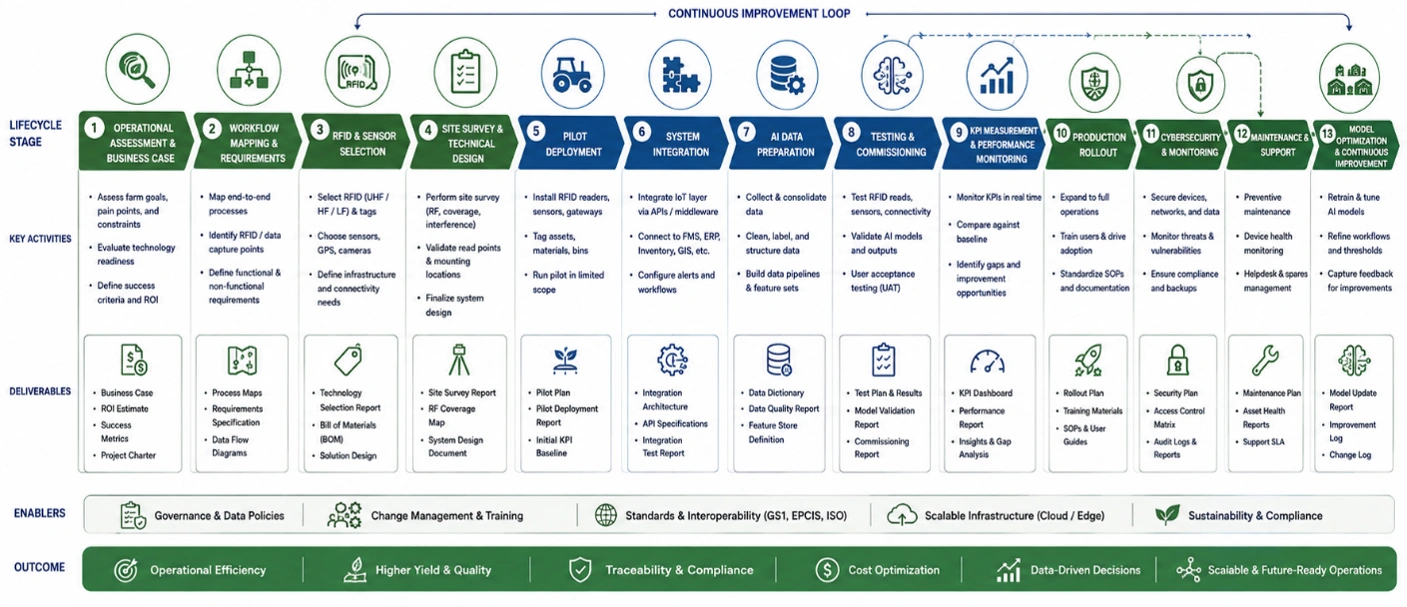
A horizontal lifecycle maps the complete deployment journey from business-case assessment and workflow mapping to RFID selection, pilot deployment, system integration, AI preparation, testing, rollout, cybersecurity, maintenance, and continuous optimization. It highlights practical deliverables at each stage and shows how KPI measurement feeds ongoing improvement and multi-farm scaling.
Key Takeaways for AI-Enabled Crop Farming
AI can improve crop-farming decisions when it has access to reliable operational data. RFID provides an effective method for identifying and tracking selected physical items such as seed lots, agricultural inputs, harvest containers, pallets, tools, implements, and other farm assets.
The strongest solutions combine several technologies rather than expecting RFID to solve every agricultural data problem. Soil and environmental sensors provide field conditions, GPS supplies location, machinery telemetry describes equipment activity, computer vision supplies visual information, and AI converts these data sources into predictions, classifications, and operational recommendations.
For crop-farming organizations evaluating deployment, the most important priorities are workflow selection, data quality, physical RFID testing, integration, cybersecurity, measurable KPIs, and operator validation. GAO provides RFID, BLE, and IoT hardware products and systems that can form part of these solutions, with remote or onsite technical support and engineering assistance for deployment requirements.
Advancing Crop Farming Operations with GAO Technology Solutions
GAO has supplied RFID, BLE, and IoT hardware products and systems to organizations across North America for applications requiring reliable identification, sensing, tracking, and connected operations. Headquartered in New York City and Toronto, Canada, GAO is ranked among the world’s top 10 leading B2B and B2G BLE and RFID suppliers, with B2B2C and B2D activities to a lesser degree.
GAO’s role in crop farming solutions can extend from RFID tags, readers, antennas, and handheld equipment to connected IoT components that system integrators can incorporate into broader agricultural solutions. Selecting the appropriate hardware requires attention to field conditions, tag materials, reading distances, network availability, data volumes, and integration requirements.
GAO’s sister companies, GAO Research and GAO Tek, together form GAO Group, with operations based in New York City and Toronto, Canada. For three decades, GAO Group has served customers in the United States and Canada, including Fortune 500 companies, leading R&D organizations, universities, and government agencies. Its product and system development has been supported by substantial R&D investment, stringent quality assurance processes, and expert remote or onsite support.
For organizations evaluating AI-enabled crop farming, the appropriate next step is to define the operational workflow, data requirements, and measurable KPI before selecting hardware. GAO’s RFID, BLE, and IoT expertise can help technical teams evaluate suitable products and deployment approaches for agricultural identification and connected-farm requirements.
Building the Future of Industrial AI and IoT with Aperture Venture Studio and GAO RFID Inc.
For more than three decades, GAO Group of Companies has invested heavily in R&D for industrial RFID, BLE, and IoT. As generative AI became useful for industrial applications, we expanded our work across AI and IoT, including technologies relevant to connected crop farming, and founded Aperture Venture Studio to build, launch, and scale next-generation AI and IoT companies for industry-specific applications.
Aperture attracts AI and IoT technical experts, entrepreneurial and operational executives, influential investors, and leading companies. We have also developed the Aperture Ventures Summit and TekSummit to discuss advanced AI and IoT topics.
These activities have helped establish technical communities around AI and IoT. We welcome participation as:
- Advisors, co-founders, or employees
- Investors
- Customers
For crop-farming organizations exploring AI, RFID, BLE, and IoT solutions, these capabilities provide opportunities to connect agricultural operational requirements with practical technology development and deployment expertise.