
AI and RFID for Cross-Dock Facilities
AI-Driven Shipment Visibility for Cross-Dock Facilities
Cross-dock facilities depend on rapid, accurate movement of inbound freight directly toward outbound transportation with minimal storage and handling. AI-driven inventory and shipment management can improve this process by combining item-level identification, shipment records, dock activity, order information, and operational events to detect exceptions and support faster decisions. RFID provides the identification layer, particularly UHF RFID for tagged cartons, pallets, totes, cases, returnable transport items, and selected high-value products. AI can then analyze those observations to identify unexpected routing, missing handling units, dock congestion, shipment discrepancies, and fulfillment risks. For cross-dock operators, the objective is not simply to know where a tagged item was detected. The greater value comes from connecting physical freight movement with transportation schedules, warehouse management, transportation management, order fulfillment, and exception-management workflows so dock personnel can act on reliable, timely information.
AI-Driven RFID Workflow for Cross-Dock Facilities
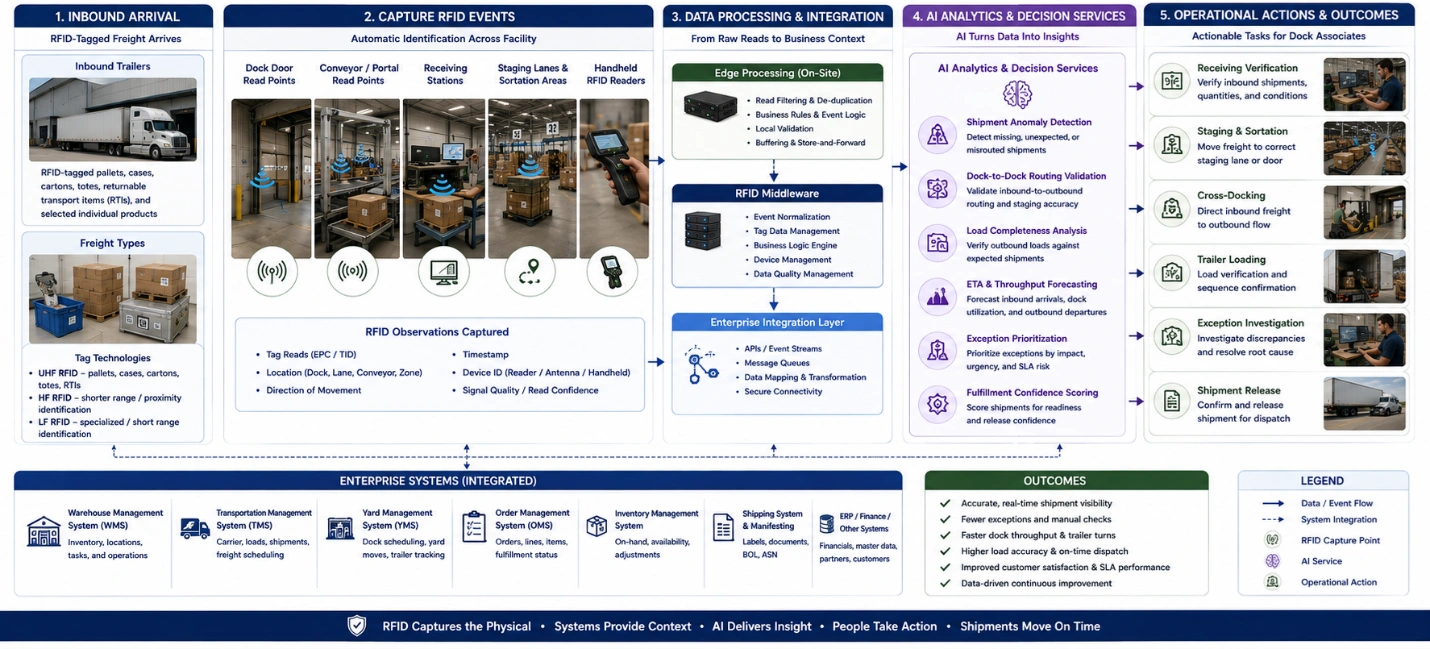
This workflow diagram illustrates how RFID-tagged freight moves through inbound and outbound cross-dock operations, from RFID event capture and edge processing to enterprise system integration and AI analytics. It shows how AI supports shipment verification, routing validation, load completeness, exception prioritization, and operational actions.
What AI-Driven RFID Means for Cross-Dock Operations
Cross-dock facilities differ from conventional distribution centers because freight may move through receiving, sortation, staging, and shipping areas within a short operating window. Inventory may not be intended for long-term storage. That makes event timing, shipment identity, dock assignment, and handling-unit relationships particularly important.
RFID enables automatic identification of tagged freight without requiring direct visual contact with every item. UHF RFID is generally the most relevant choice for dock-door, portal, conveyor, staging, and handling-unit applications where longer read ranges and multi-tag identification are useful. HF RFID can support shorter-range identification processes where controlled proximity is preferable. LF RFID can be relevant for specialized identification scenarios requiring short-range operation or particular tag characteristics.
The engineering objective is to convert RFID observations into trusted operational events. A reader detecting a pallet near a dock door does not by itself prove that the pallet has been received, loaded, or assigned to the correct outbound trailer. Middleware and business rules need to correlate tag reads with dock location, time, shipment identifiers, appointment information, order data, and expected routing.
AI adds another layer of interpretation. Machine learning and statistical models can identify abnormal movement patterns, estimate expected throughput, prioritize exceptions, and detect conditions that may affect outbound service. The result is a decision-support system that uses physical freight observations alongside conventional logistics data.
For GAO, this type of deployment builds on the practical role of RFID hardware and IoT systems in connecting physical operations with software applications. Our hardware products and systems can support identification, sensing, and data acquisition requirements that form part of broader cross-dock automation projects.
Cross-Dock Applications for AI-Enabled Inventory and Shipment Management
Cross-dock facilities contain several workflows where accurate item identification can reduce manual verification and provide better operational context.
Inbound Receiving and Shipment Verification
Inbound receiving is a critical control point because freight arriving at the wrong dock, in the wrong quantity, or without the expected shipment relationship can create downstream disruption.
RFID readers positioned at appropriate receiving points can automatically capture tagged handling units as they enter the facility. AI can compare observed items with advance shipment notices, purchase orders, transfer orders, appointment records, or expected inbound loads.
Potential exceptions include:
- A pallet expected on an inbound trailer is not detected at the receiving point
- A handling unit associated with another shipment enters the wrong receiving area
- An unexpected item appears in a shipment
- A shipment arrives with an incomplete set of expected handling units
- Freight moves toward staging without the expected receiving event
- Repeated movement patterns indicate a possible process or routing problem
The system should distinguish an RFID read from a confirmed business transaction. Physical observations become operationally useful when correlated with trusted logistics records.
Cross-Dock Routing and Staging
Cross-docking depends on directing inbound freight toward the correct outbound destination with limited dwell time. Staging lanes, dock doors, sortation areas, and temporary holding zones therefore become important operational locations.
AI can evaluate item movements against expected routing and identify freight that appears to be moving toward an incorrect destination. For example, a tagged pallet assigned to an outbound trailer can generate an exception if it remains in an unrelated staging lane or appears near a different dock.
RFID can also provide the event history needed to reconstruct how a handling unit moved through the facility. This can support root-cause analysis when a shipment is delayed or a pallet cannot be located.
Outbound Loading and Load Completeness
Outbound loading requires confidence that the correct freight has reached the correct trailer or dispatch location. Manual scanning can become difficult when handling units move rapidly through busy dock areas.
RFID read points can capture tagged freight as it approaches or enters an outbound loading zone. AI can compare observed handling units with the expected load and identify missing, unexpected, or incorrectly routed freight.
A load-completeness process can therefore provide an associate with a prioritized exception list rather than requiring manual verification of every handling unit.
Shipment Exception Management
Cross-dock exceptions can arise from missing freight, duplicate handling-unit identifiers, incorrect routing, late arrivals, unexpected dock activity, or mismatches between physical and system records.
AI can prioritize exceptions according to operational impact. A missing handling unit associated with an imminent outbound departure may require more urgent intervention than a discrepancy involving a shipment with a later dispatch window.
This approach allows supervisors to focus on exceptions that are most likely to affect transportation schedules, customer orders, or downstream distribution operations.
AI-Enabled Cross-Dock Use Cases and Operational Outcomes
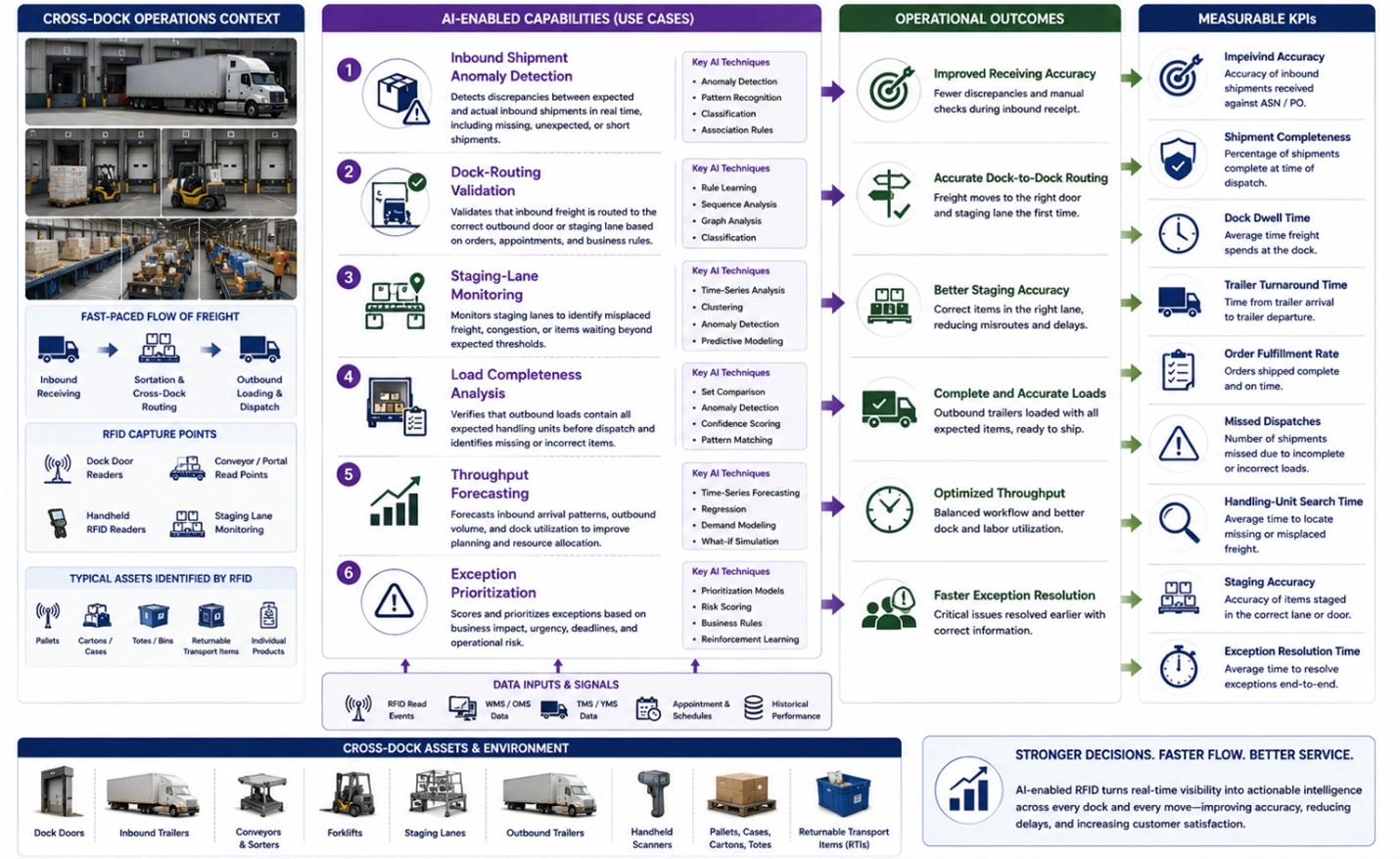
Short Description: This infographic connects six AI-enabled cross-dock capabilities, including shipment anomaly detection, dock-routing validation, staging monitoring, load completeness analysis, throughput forecasting, and exception prioritization, to measurable operational outcomes and KPIs. It also illustrates the RFID capture points, data inputs, and cross-dock assets supporting these capabilities.
Yard-to-Dock Visibility
The cross-dock process begins before freight reaches the receiving area. Trailer appointments, yard movements, dock assignments, and unloading sequences can influence downstream throughput.
RFID can complement yard and dock systems by providing additional identification events as tagged handling units move between transportation equipment and facility zones. AI can correlate these events with appointment schedules, expected arrivals, dock availability, and outbound requirements.
This can help identify conditions such as freight arriving without the expected appointment relationship, handling units waiting unusually long before processing, or outbound loads approaching departure while required freight remains unconfirmed.
H3: High-Value and Sensitive Freight
Certain cross-dock operations handle electronics, pharmaceuticals, industrial components, automotive parts, or other high-value goods. RFID can provide item-level or handling-unit visibility where loss, misrouting, or unexplained movement creates substantial operational risk.
AI-based anomaly detection can identify movement patterns that differ from expected workflows. Such systems should support investigation rather than automatically classify unusual activity as theft or misconduct.
From RFID Event Capture to AI-Driven Cross-Dock Decisions
A technically sound solution connects physical freight movement to enterprise software through several processing layers. Each layer has a distinct responsibility, and separating these responsibilities helps prevent raw reader activity from being treated as authoritative inventory or shipment transactions.
Data Acquisition at Dock Doors and Material-Handling Points
RFID data acquisition can occur at inbound and outbound dock doors, conveyor transition points, receiving stations, staging lanes, controlled access areas, and other locations where item identification has a defined operational purpose.
Fixed UHF RFID readers can provide repeatable read zones at selected locations. Handheld readers can support exception investigation, cycle verification, pallet searches, and manual confirmation when a fixed read event is insufficient.
Reader placement should account for dock-door geometry, antenna orientation, pallet composition, trailer structure, metal equipment, liquids, RF reflections, reader power, and the expected direction of freight movement.
Edge Processing and RFID Middleware
Raw RFID systems can generate repeated observations as a tagged item remains within a read zone. Edge processing can filter and normalize these observations before they reach centralized applications.
RFID middleware can apply rules that transform low-level reads into operational events. Examples include recognizing that a pallet entered a receiving zone, determining that a handling unit remained within a staging lane, or associating a sequence of reads with an outbound loading event.
This layer is particularly important in cross-dock environments because freight movement is fast and operational decisions may depend on accurate event sequencing.
Logistics Software Integration
Normalized events can be integrated with warehouse management systems, transportation management systems, yard management systems, order management software, inventory systems, shipping applications, and enterprise resource planning software.
Integration should establish consistent relationships among:
- RFID tag identifiers
- Pallet, case, carton, and tote identifiers
- Shipment and load identifiers
- Purchase and transfer orders
- Dock-door and staging locations
- Trailer and transportation identifiers
- Expected inbound and outbound events
- Actual movement events
- Exceptions and associate actions
APIs, message queues, event streams, database interfaces, and other integration methods can be selected according to the existing software environment.
AI Analytics and Operational Recommendations
AI models can analyze current RFID events together with historical movement data, shipment schedules, order requirements, dock utilization, and other available operational information.
Relevant methods may include anomaly detection, classification, forecasting, pattern recognition, and probabilistic scoring. A model might estimate the likelihood that an outbound load is incomplete, flag an unusual movement sequence, or forecast whether inbound activity will create a staging bottleneck.
The AI output should remain understandable to operations personnel. A useful alert can identify the affected handling unit or shipment, its last relevant location, the supporting evidence, the operational priority, and the recommended next action.
AI and RFID Deployment in a Cross-Dock Facility
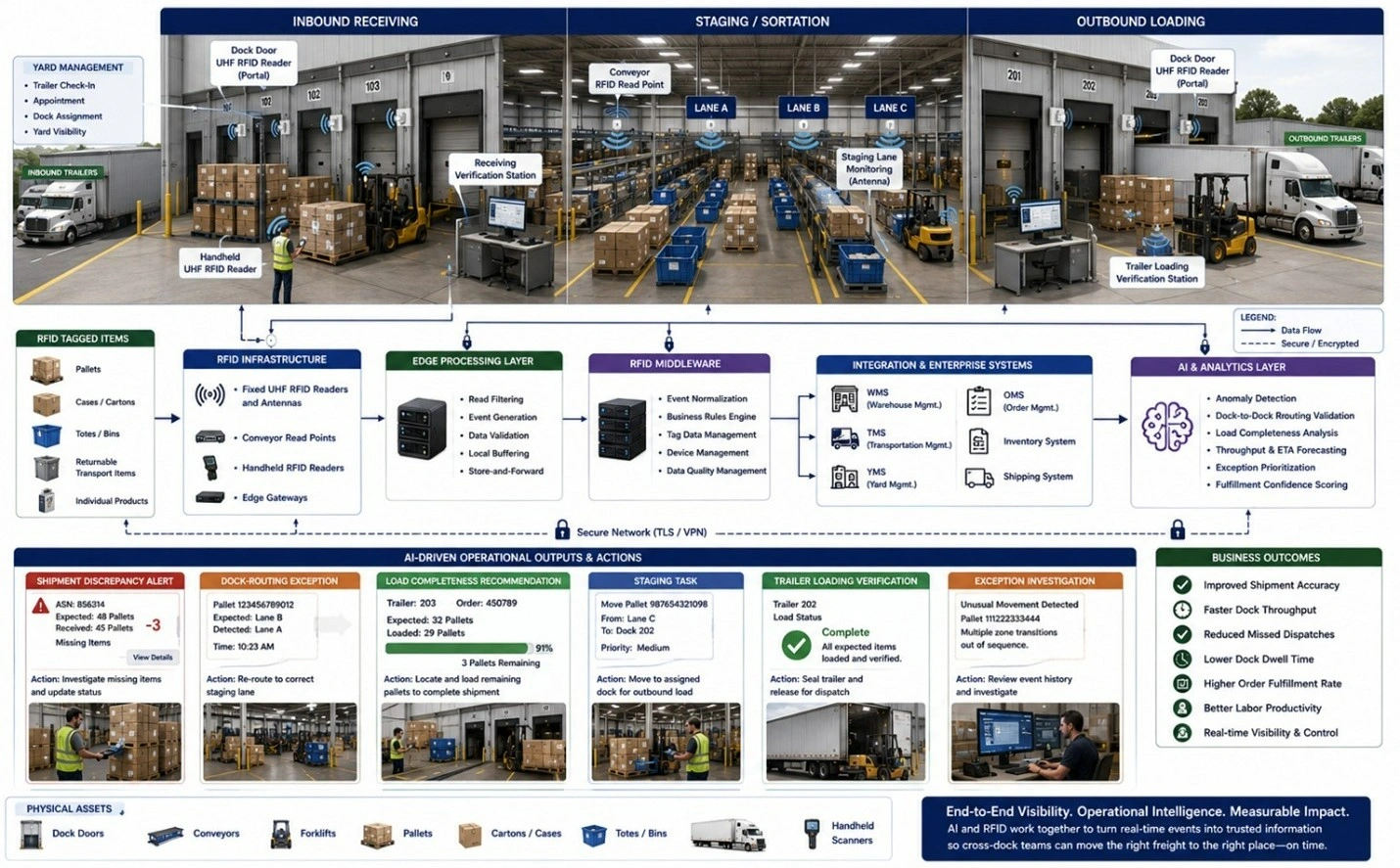
Short Description: This technical deployment illustration shows how UHF RFID infrastructure captures freight movement across inbound receiving, staging, and outbound loading operations. It traces RFID data through edge processing, middleware, enterprise systems, and AI analytics to support shipment discrepancy alerts, routing exceptions, load verification, staging tasks, and exception investigations.
RFID Hardware, Software, and AI Components for Cross-Dock Facilities
Cross-dock RFID deployments require coordinated hardware, software, connectivity, and analytics. The objective is not simply to capture more RFID reads. The objective is to produce reliable shipment and handling-unit events that can support receiving, routing, staging, loading, exception management, and fulfillment decisions.
RFID Tags and Handling-Unit Identification
RFID tags can identify pallets, cases, cartons, totes, reusable transport items, containers, and other handling units moving through cross-dock operations. UHF RFID is particularly applicable where facilities need read coverage across dock doors, conveyors, staging lanes, and outbound loading areas.
Tag selection should account for the material being identified and the operating environment. Metal surfaces, liquids, dense packaging, stacked freight, pallet construction, and tag orientation can affect RFID performance. Cross-dock operators should therefore validate tags against representative freight before standardizing a tag type.
HF RFID can support controlled proximity identification where shorter read ranges are appropriate. LF RFID can be considered for specialized identification requirements involving short-range detection. The technology selected should correspond to the physical movement and identification requirement rather than being selected independently of the workflow.
Fixed and Handheld RFID Readers
Fixed RFID readers can be installed at receiving doors, shipping doors, conveyor transitions, staging areas, controlled access points, and other locations where automatic event capture provides operational value. Antennas should be positioned according to the direction of freight movement and the physical characteristics of the dock or material-handling area.
Handheld RFID readers provide another layer of operational flexibility. Associates can use them to investigate exceptions, locate handling units, verify inventory relationships, perform targeted cycle checks, or resolve discrepancies identified by automated systems.
GAO provides RFID hardware products and systems that can be evaluated for cross-dock applications involving fixed readers, antennas, handheld equipment, tags, and connected identification workflows.
Edge Processing, Connectivity, and Event Normalization
Edge processing can reduce unnecessary data transmission by filtering duplicate reads, applying local rules, validating device status, and preparing RFID observations for downstream systems. This is particularly useful in cross-dock facilities where pallets, cases, cartons, and totes may pass rapidly through RFID read zones.
RFID middleware can transform raw observations into business-relevant events. A single tag read should not automatically be interpreted as a completed receiving, staging, or loading transaction. Event logic should consider tag identity, time, location, direction of movement, shipment association, appointment information, and expected workflow.
Cloud-Based and Privately Hosted Server Deployment
Cloud and server-based deployment approaches can both support AI-driven RFID operations. The appropriate choice depends on facility connectivity, data governance, existing IT resources, latency requirements, operational continuity requirements, and the number of facilities being connected.
A cloud deployment can centralize RFID event processing, analytics, dashboards, and software administration across multiple cross-dock facilities. It can simplify centralized updates and provide access to shared operational information without requiring every site to maintain substantial local computing resources. Cloud processing is particularly useful for enterprise-level analytics, historical trend analysis, and multi-facility performance monitoring when reliable network connectivity is available.
A privately hosted server deployment can place application and database services within a customer-controlled data center, private computing environment, or facility-level server environment. This approach can be appropriate when organizations require greater control over data location, already maintain private computing infrastructure, or have operational requirements that favor local processing and reduced dependence on external network connectivity.
A hybrid approach can combine edge processing with cloud or privately hosted services. RFID readers and local systems can continue capturing and processing operational events at the facility while selected information is transmitted to centralized AI analytics, reporting, or enterprise applications.
The decision should therefore be based on operational requirements rather than assuming that either cloud or server deployment is universally better.
Connectivity, Security, and Interoperability for Cross-Dock RFID
AI-driven RFID depends on reliable communication between physical identification equipment, local processing resources, enterprise software, and analytics systems. Poor connectivity or inconsistent data handling can reduce the value of otherwise capable RFID hardware.
Communication and Network Infrastructure
Cross-dock RFID installations can use Ethernet, Wi-Fi, private wireless networks, cellular connectivity, or other appropriate communication methods depending on facility requirements. Network planning should consider reader locations, dock-door traffic, conveyor areas, staging zones, handheld devices, edge gateways, and enterprise system connections.
Network segmentation can separate RFID devices and operational equipment from unrelated corporate traffic. Quality-of-service policies may be appropriate where RFID events must be delivered reliably during high-volume operating periods. Accurate time synchronization is also important because AI analytics and shipment reconstruction depend on reliable event timestamps.
Cybersecurity for RFID and AI Systems
Cybersecurity should be incorporated into RFID deployment from the beginning. Relevant controls include secure device provisioning, unique credentials, certificate management where appropriate, encrypted communications, network segmentation, access controls, software and firmware maintenance, audit logging, backup procedures, and controlled administrative access.
AI systems introduce additional governance considerations. Organizations should define who can access operational data, how long event records are retained, how model outputs are reviewed, and how automated recommendations are validated before being incorporated into business processes.
A cross-dock system should also account for operational continuity. Reader failures, network interruptions, server outages, or unavailable enterprise applications should not result in unexplained loss of critical shipment information. Local buffering, retry mechanisms, redundant connectivity, and reconciliation procedures can help maintain event continuity.
Interoperability with WMS, TMS, YMS, ERP, and Other Systems
RFID data becomes more valuable when it is connected to the software already used to manage cross-dock operations. Common integration targets include warehouse management systems, transportation management systems, yard management systems, order management systems, enterprise resource planning systems, inventory applications, shipping systems, and labor-management applications.
Integration should establish consistent relationships among:
- RFID tag identifiers
- Pallet, case, carton, tote, and container identifiers
- Shipment and load identifiers
- Purchase orders and transfer orders
- Dock and staging locations
- Trailer and transportation identifiers
- Expected and actual movement events
- Exceptions and corrective actions
APIs, message queues, event streams, database interfaces, or other integration methods can be selected according to the existing software environment.
Secure RFID-to-Enterprise Integration for Cross-Dock Operations
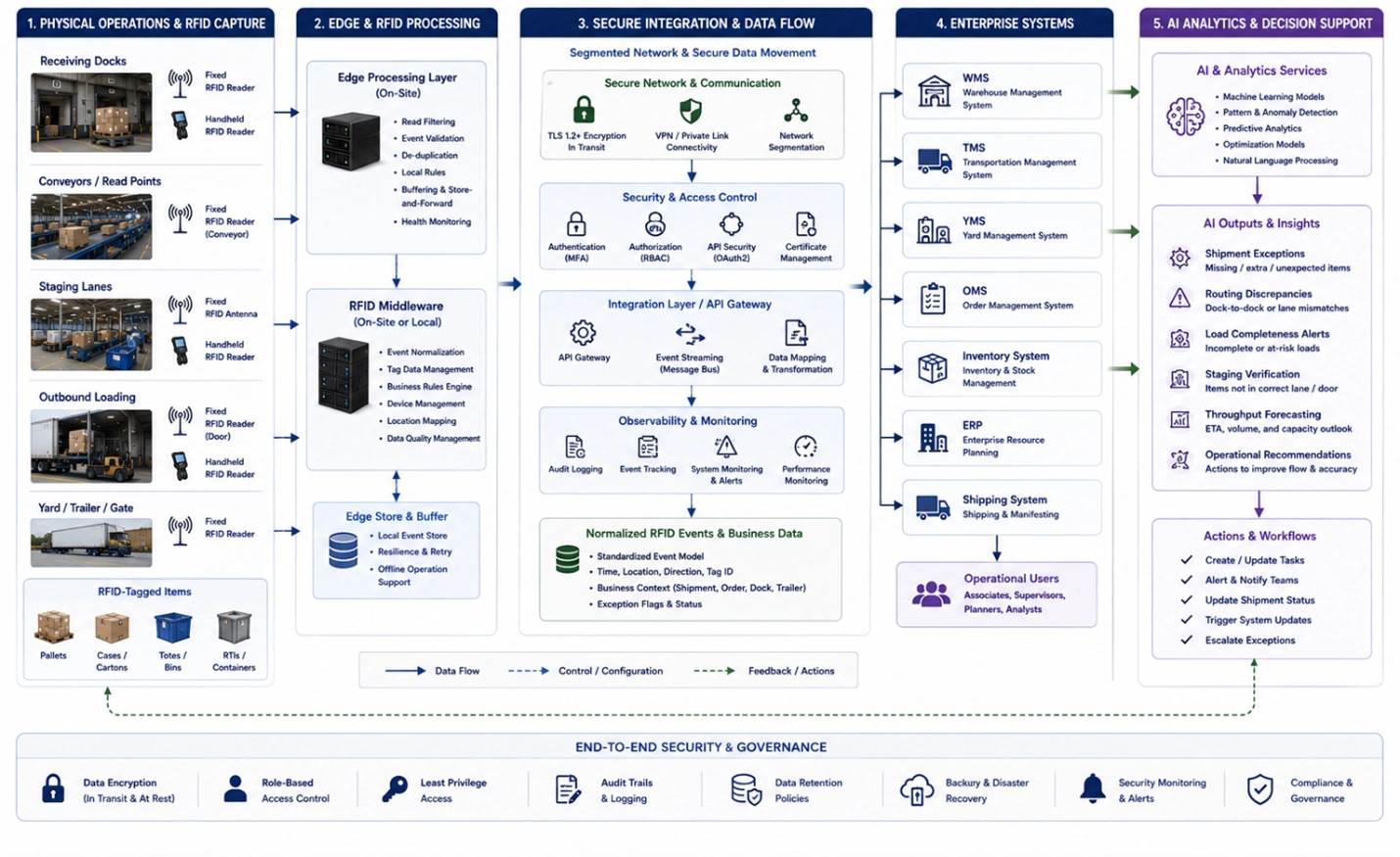
Short Description: This technical flow diagram shows how RFID data moves securely from physical cross-dock operations through edge processing, RFID middleware, network security controls, and enterprise systems into AI analytics. It highlights authentication, encryption, access control, monitoring, normalized RFID events, and AI-supported shipment and routing decisions.
AI Capabilities and Business Benefits for Cross-Dock Facilities
AI can provide value when it converts large volumes of operational events into useful decisions. Cross-dock facilities generate information from RFID, WMS transactions, transportation schedules, dock activity, inventory records, order data, and exception histories. AI can analyze these data sources to identify patterns that may be difficult to detect through manual monitoring alone.
Inventory and Shipment Accuracy
AI-driven RFID can compare physical handling-unit observations against expected shipment records. This can help identify missing freight, unexpected items, duplicate identification, incorrect shipment relationships, and incomplete loads.
The resulting workflow can move teams from manual searching toward exception-based investigation. Rather than checking every handling unit with equal priority, associates can focus attention on discrepancies that have the greatest operational impact.
Dock Throughput and Trailer Turnaround
Cross-dock throughput depends heavily on the timing of receiving, sorting, staging, and outbound loading. AI can analyze historical RFID events and operational schedules to identify recurring congestion patterns, unusual dwell times, or conditions associated with delayed trailer departures.
These insights can support better dock coordination and help operations teams investigate why particular loads or staging activities repeatedly fall outside expected processing patterns.
Exception Prioritization and Labor Efficiency
Not every exception has the same business consequence. A missing handling unit on a trailer departing shortly may require faster action than a discrepancy associated with a later shipment.
AI-based prioritization can consider shipment urgency, departure time, freight relationships, location, historical patterns, and other available operational information. This allows associates and supervisors to direct labor toward exceptions requiring immediate investigation.
Better Freight Traceability and Loss Investigation
RFID event histories can provide a chronological record of where tagged handling units were observed. AI can help reconstruct movement patterns and identify unusual sequences that warrant investigation.
The objective is to provide evidence for operational investigation, not to make unsupported assumptions about employee behavior, theft, or intent.
Scalable Multi-Facility Visibility
Organizations operating multiple cross-dock facilities can use standardized RFID event structures and AI analytics to compare operational conditions across locations. This can help identify differences in receiving accuracy, staging performance, shipment completeness, trailer turnaround, exception frequency, and dispatch adherence.
GAO’s RFID and IoT product and system capabilities can support organizations evaluating connected identification and operational visibility requirements across facilities.
Measuring AI-Driven RFID Performance in Cross-Dock Facilities
A successful RFID implementation should be measured against operational requirements established before deployment. Baseline measurements should be captured before or during the pilot so that changes can be evaluated objectively.
Relevant KPIs can include:
- RFID read accuracy
- Missed-read rate
- False-read rate
- RFID event latency
- Shipment verification accuracy
- Shipment completeness
- Receiving accuracy
- Staging accuracy
- Dock dwell time
- Trailer turnaround time
- Trailer loading verification accuracy
- Dispatch adherence
- Exception frequency
- Exception resolution time
- Freight search time
- Manual verification time
- Labor time per shipment
- Inventory record accuracy
- Order fulfillment rate
- Load processing time
- Unplanned shipment discrepancies
- Reconciliation time
- Handling-unit traceability
- Reader availability
- Network availability
- Integration transaction success rate
- Data synchronization accuracy
- AI alert precision
- AI alert response time
- Percentage of exceptions resolved through recommended actions
These metrics should be evaluated according to the facility’s baseline conditions and business requirements rather than relying on generic industry benchmarks. Pilot acceptance criteria should define what constitutes reliable RFID event capture, useful AI recommendations, acceptable latency, and successful integration.
Practical Implementation Recommendations for Cross-Dock Facilities
AI-driven RFID should be implemented as an operational improvement program rather than as a standalone hardware installation. The highest-value results generally depend on selecting the right workflows, validating physical RFID performance, integrating accurate business data, and establishing clear operational responses.
Define Business Requirements and Priority Use Cases
Start by identifying the operational problems that create the greatest cost, delay, risk, or customer-service impact. Common priorities include receiving discrepancies, incorrect staging, missing shipment units, outbound load verification, trailer turnaround, and freight search.
Each use case should define the expected event, required RFID coverage, associated business records, AI analysis, operational response, and KPI.
Conduct a Site Survey and RF Testing
A physical survey should examine dock construction, trailer types, pallet composition, conveyor configuration, staging layout, forklift movement, antenna placement, network availability, and potential sources of RF interference or reflection.
Testing should use representative freight rather than relying only on laboratory results. Metal containers, liquid products, dense cartons, mixed pallets, and different tag orientations can produce substantially different RFID behavior.
Test Tags Against Real Freight
Tag performance should be evaluated against the actual materials and handling units that will be processed. Testing should consider tag placement, orientation, read distance, pallet configuration, packaging materials, and movement speed.
The objective is to establish repeatable identification performance under real operating conditions.
Pilot the Complete Workflow
A pilot should follow the entire business process from RFID observation through operational action. Testing only the reader layer is insufficient.
A useful pilot can include:
- Inbound receiving verification
- Handling-unit association
- Routing and staging validation
- Outbound load verification
- Exception generation
- AI prioritization
- Associate investigation
- WMS/TMS/other system updates
- KPI measurement
- Exception reconciliation
Establish Data and Integration Governance
Organizations should define ownership for master data, tag identifiers, shipment relationships, location identifiers, event timestamps, exception codes, and integration rules.
Clear governance helps prevent a technically successful RFID deployment from producing inconsistent operational information.
Plan Cybersecurity and Operational Continuity
Security controls, access management, device maintenance, network segmentation, backups, monitoring, and recovery procedures should be established before production deployment.
Cross-dock operations also require contingency procedures for reader outages, network interruptions, unavailable enterprise applications, and equipment maintenance.
Scale After Validation
Once the pilot demonstrates reliable identification, useful event processing, effective AI analysis, and measurable operational value, the deployment can be expanded to additional docks, workflows, facilities, or shipment types.
Standardized installation procedures, device configuration, tag specifications, integration patterns, maintenance practices, and KPI definitions can simplify expansion.
Key Takeaways for Cross-Dock Operators
AI-driven RFID can help cross-dock operators connect physical freight movement with the digital information required to make faster and more accurate decisions.
Key considerations include:
- Use RFID to establish reliable physical identification and movement events.
- Apply business rules before interpreting individual RFID reads as completed transactions.
- Use AI to detect anomalies, analyze movement patterns, forecast throughput, and prioritize exceptions.
- Connect RFID events with WMS, TMS, YMS, ERP, order, inventory, and shipping information.
- Select cloud, server, or hybrid deployment according to operational and IT requirements.
- Design cybersecurity and operational continuity into the deployment.
- Measure performance against facility-specific baselines and acceptance criteria.
- Validate tags, readers, antennas, and workflows under actual cross-dock conditions.
- Start with high-value operational problems and expand after successful validation.
GAO’s Experience Supporting RFID and IoT Deployment
GAO, headquartered in New York City and Toronto, Canada, is ranked among the top 10 leading B2B and B2G, and to a lesser degree B2B2C and B2D, BLE and RFID suppliers in the world. GAO RFID Inc. and its sister companies, GAO Research Inc. and GAO Tek Inc., form GAO Group, with operations based in New York City and Toronto.
For three decades, GAO Group has served customers across the United States and Canada, including Fortune 500 companies, leading research and development organizations, prestigious universities, and U.S. and Canadian government agencies. The group has invested heavily in research and development, maintains stringent quality assurance practices, and provides expert technical support remotely or onsite.
For cross-dock organizations evaluating AI-driven RFID, GAO provides hardware products and systems that can support identification, connected operations, RFID event capture, and IoT-enabled workflows. Deployment decisions should be based on the customer’s specific facility conditions, workflows, integration requirements, security policies, and measurable business objectives.
AI-Driven RFID for Faster and More Accurate Cross-Dock Operations
Cross-dock facilities operate under tight timing constraints where shipment accuracy, rapid handling, dock coordination, and outbound execution directly affect fulfillment performance. RFID can provide the physical identification layer needed to observe handling-unit movement, while AI can analyze those events alongside shipment, transportation, inventory, and operational data.
The strongest implementations focus on specific business problems such as shipment verification, routing, staging, load completeness, exception management, and trailer turnaround. With appropriate hardware, integration, cybersecurity, deployment infrastructure, and measurable KPIs, AI-driven RFID can provide cross-dock teams with more timely operational information and a stronger basis for decision-making.
Building the Future of Industrial AI and IoT with Aperture Venture Studio and GAO
For more than three decades, GAO Group of Companies has invested heavily in R&D of industrial RFID, BLE, and IoT. As generative AI has become useful in industrial applications, we have expanded our work on AIoT solutions connecting AI with RFID, BLE, sensors, and operational systems. Through Aperture Venture Studio, we support practical AI and IoT initiatives relevant to industrial operations, including cross-dock visibility, asset identification, logistics intelligence, and automated decision support.
Aperture brings together technical experts, operational leaders, investors, and industry participants. Aperture Ventures Summit and TekSummit provide forums for advanced AI and IoT topics. We welcome you to join us as:
- Advisors or employees
- Investors
- Customers