
AI and RFID for Data Centers
AI and RFID Are Transforming Modern Data Center Operations
Modern data centers operate under relentless demands for uptime, capacity optimization, cybersecurity, regulatory compliance, and precise infrastructure management. Thousands of servers, storage arrays, network switches, power distribution units, cooling assets, cables, and spare components continuously move through receiving, staging, deployment, maintenance, and decommissioning processes. AI and RFID provide an intelligent method for identifying, locating, monitoring, and managing these critical assets with significantly greater speed and accuracy than manual inventory methods.
Combining AI with UHF RFID, HF RFID, and LF RFID enables automated asset visibility, predictive analytics, workflow optimization, anomaly detection, intelligent capacity planning, and operational decision support throughout the data center lifecycle. AI analyzes continuously collected RFID data to identify operational patterns, detect unauthorized asset movement, optimize maintenance scheduling, improve equipment utilization, and support regulatory audits.
Data center operators, colocation providers, cloud service providers, enterprise IT organizations, hyperscale facilities, and edge computing operators increasingly deploy AI and RFID to improve infrastructure reliability while reducing operational costs and human error. Organizations seeking highly accurate asset intelligence, automated infrastructure management, and improved operational resilience increasingly rely on AIoT technologies to support mission-critical digital infrastructure.
AI and RFID for Intelligent Data Center Asset Management and Infrastructure Monitoring
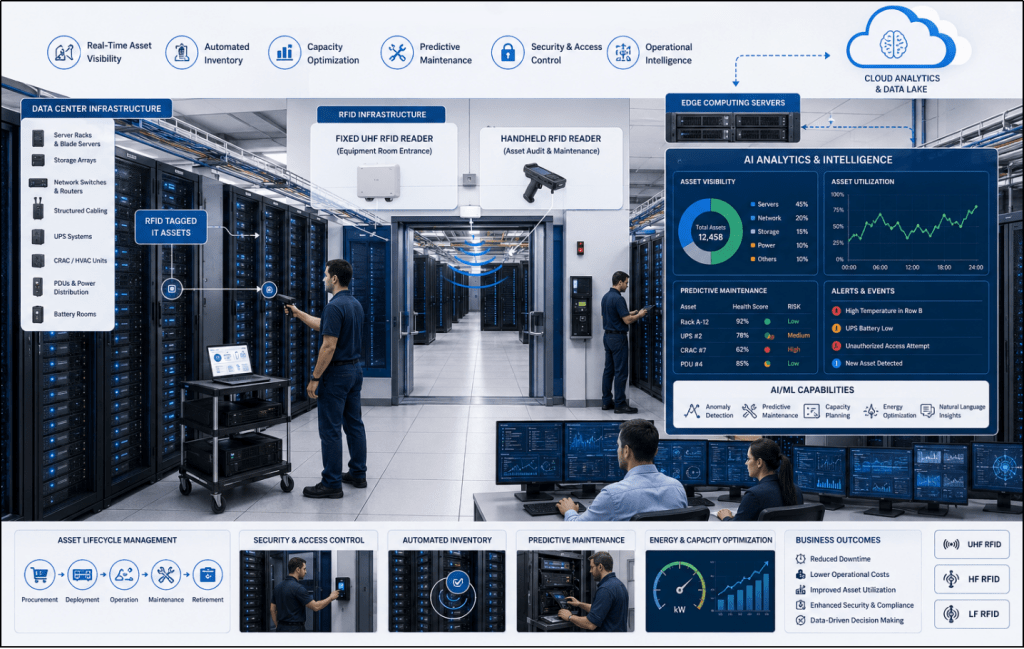
This illustration demonstrates how AI and RFID work together to provide intelligent asset tracking, automated inventory, predictive maintenance, security monitoring, and operational analytics across a modern hyperscale data center. It highlights RFID-tagged IT assets, fixed and handheld RFID readers, edge computing, AI analytics dashboards, and cloud intelligence, showing how continuous data collection improves infrastructure visibility, efficiency, and decision-making.
Understanding AI and RFID in Data Centers
Data centers depend on accurate physical asset management to support digital services. Every server, storage appliance, optical transceiver, rack-mounted switch, patch panel, power supply, cooling component, and spare part represents a valuable operational asset that must be tracked throughout its lifecycle.
RFID provides automatic identification by attaching electronic tags to physical equipment. Fixed readers installed at strategic locations, handheld readers used by technicians, and mobile readers integrated into maintenance workflows continuously capture asset identities without requiring direct line of sight.
Artificial intelligence transforms this continuous stream of RFID events into operational intelligence by recognizing movement patterns, detecting anomalies, forecasting infrastructure utilization, and supporting automated operational decisions.
Within data centers, AI and RFID commonly support:
- IT asset lifecycle management
- Rack-level inventory automation
- Server deployment verification
- Intelligent equipment location
- Unauthorized asset movement detection
- Maintenance scheduling
- Spare parts management
- Capacity planning
- Data center expansion planning
- Regulatory compliance reporting
- Configuration management
- Disaster recovery readiness
- Colocation asset management
- Cable and network equipment tracking
- Intelligent warehouse operations for replacement hardware
Unlike barcode-based inventories that require manual scanning, RFID continuously captures asset information across large equipment rooms with minimal technician intervention, providing AI models with high-quality operational data for continuous optimization.
GAO has supported organizations across North America by supplying RFID hardware, readers, antennas, tags, and integrated identification solutions used in demanding operational environments where reliable asset visibility is essential.
Why AI and RFID Matter for Modern Data Centers
Modern data centers contain enormous numbers of continuously changing assets.
Typical environments include:
- Multi-row server halls
- Colocation cabinets
- High-density compute clusters
- GPU infrastructure
- Network core equipment
- Optical transport systems
- Edge computing nodes
- Battery backup systems
- Precision cooling systems
- Fire suppression equipment
- Maintenance inventory rooms
- Spare equipment warehouses
Managing these assets manually creates several operational risks.
Common operational challenges include:
- Inaccurate asset inventories
- Missing or misplaced servers
- Manual audit delays
- Unauthorized equipment relocation
- Configuration drift
- Poor cable documentation
- Asset ownership confusion within colocation facilities
- Delayed maintenance activities
- Spare equipment shortages
- Capacity planning inaccuracies
- Rack utilization inefficiencies
- Human data entry errors
- Slow compliance audits
- Equipment retirement tracking errors
- Limited infrastructure visibility
AI enhances RFID by continuously learning from equipment movement, maintenance history, workload distribution, infrastructure utilization, and operational workflows to generate intelligent recommendations rather than simple inventory reports.
Data Center Challenges Solved with AI and RFID for Intelligent Infrastructure Management
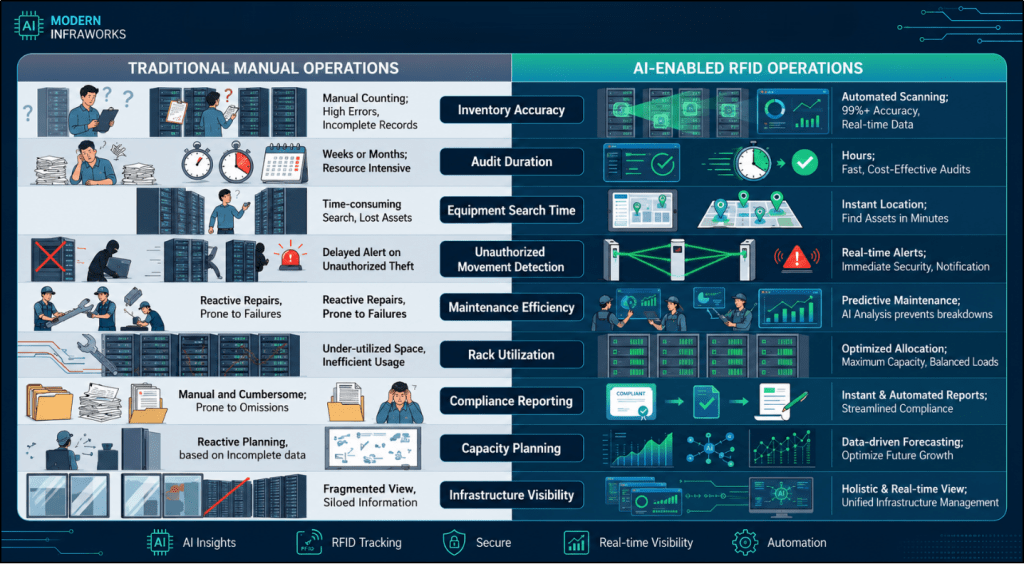
This infographic compares traditional manual data center operations with AI-enabled RFID workflows across key operational areas, including inventory accuracy, audit duration, equipment search, maintenance, compliance, and capacity planning. It demonstrates how AI-powered RFID solutions deliver real-time visibility, automation, predictive insights, and stronger security, enabling more efficient and resilient data center operations.
Primary AI and RFID Applications Across Data Centers
Different categories of data centers deploy AI and RFID differently depending on operational objectives, infrastructure complexity, and service models.
Hyperscale Data Centers
Hyperscale operators manage hundreds of thousands of servers distributed across multiple buildings.
AI and RFID support:
- Automated server inventory
- Rack occupancy monitoring
- Intelligent hardware deployment
- GPU cluster tracking
- Infrastructure utilization analysis
- Predictive maintenance
- Capacity forecasting
- Spare hardware optimization
Colocation Data Centers
Colocation providers must distinguish customer-owned assets from facility-owned infrastructure.
AI and RFID improve:
- Customer asset visibility
- Cage inventory validation
- Equipment relocation monitoring
- Service technician verification
- Compliance documentation
- Asset ownership tracking
- Customer audit reporting
Enterprise Data Centers
Corporate IT departments benefit from:
- Automated CMDB validation
- Hardware lifecycle management
- Intelligent refresh planning
- Software-to-hardware correlation
- Inventory reconciliation
- Maintenance automation
Edge Data Centers
Remote edge facilities often operate with limited onsite personnel.
AI and RFID support:
- Remote inventory verification
- Intelligent maintenance scheduling
- Asset utilization analysis
- Automated equipment auditing
- Remote compliance monitoring
Disaster Recovery Sites
Disaster recovery infrastructure requires accurate standby equipment inventories.
AI and RFID improve:
- Backup asset verification
- Readiness validation
- Equipment rotation planning
- Spare equipment availability
- Recovery preparedness
AI and RFID Applications Across Modern Data Center Operations
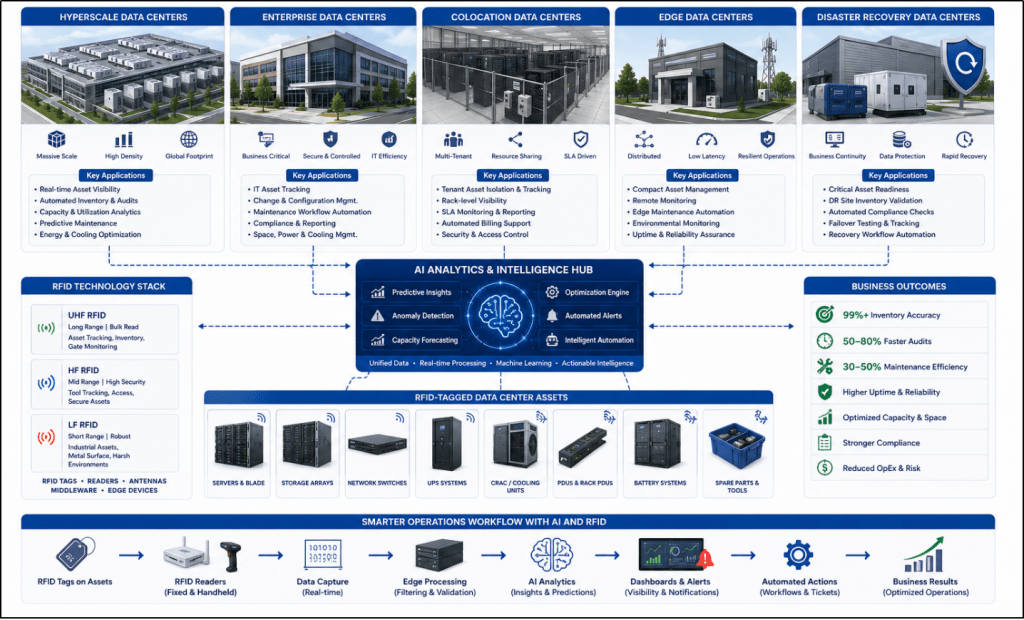
This infographic illustrates how AI and RFID technologies are deployed across hyperscale, enterprise, colocation, edge, and disaster recovery data centers. It highlights RFID-enabled asset tracking, AI analytics, infrastructure monitoring, maintenance automation, compliance management, and operational workflows, demonstrating how intelligent data capture improves visibility, efficiency, resilience, and decision-making throughout the data center lifecycle.
End-to-End Operational Workflow for AI and RFID in Data Centers
An effective AI and RFID solution supports the complete operational lifecycle of physical IT infrastructure.
Asset Identification
Every managed asset receives an RFID tag appropriate for its operational environment.
Common tagged assets include:
- Rack servers
- Blade chassis
- Storage systems
- SAN switches
- Ethernet switches
- Firewalls
- Load balancers
- Optical modules
- Patch panels
- UPS batteries
- PDUs
- Cooling equipment
- Portable maintenance tools
- Spare hard drives
- Network appliances
Tag selection depends on:
- Metal interference
- Reading distance
- Temperature
- Mounting surface
- Physical size
- Expected equipment lifespan
Receiving and Commissioning
Equipment arriving from manufacturers enters the receiving area.
During commissioning:
- RFID tags are associated with asset identifiers.
- Serial numbers are validated.
- Warranty information is recorded.
- Configuration data is imported.
- Rack assignments are planned.
- AI validates deployment schedules.
- Procurement information is linked.
Infrastructure Deployment
Technicians install equipment into designated racks.
Fixed RFID readers positioned throughout equipment staging areas verify:
- Correct server installation
- Correct rack location
- Correct customer allocation
- Correct maintenance status
- Asset movement history
AI compares deployment activity against planned work orders to identify discrepancies before production activation.
Continuous Asset Monitoring
Fixed RFID readers continuously monitor infrastructure movement.
Captured information includes:
- Asset location
- Rack movement
- Room transitions
- Maintenance activities
- Equipment removal
- Technician interactions
AI continuously analyzes these events to identify:
- Unexpected movement
- Missing assets
- Unauthorized equipment removal
- Unusual technician behavior
- Inventory inconsistencies
Enterprise Software Integration
RFID event data is integrated with business and operational software.
Common integrations include:
- Configuration Management Database (CMDB)
- IT Service Management (ITSM)
- Data Center Infrastructure Management (DCIM)
- Enterprise Asset Management (EAM)
- Enterprise Resource Planning (ERP)
- Security Information and Event Management (SIEM)
- Building Management Systems (BMS)
- Maintenance Management Systems
- Identity and Access Management (IAM)
AI correlates physical asset movement with operational records to maintain synchronized infrastructure data across multiple software systems.
AI and RFID Operational Workflow for Intelligent Data Center Asset Management
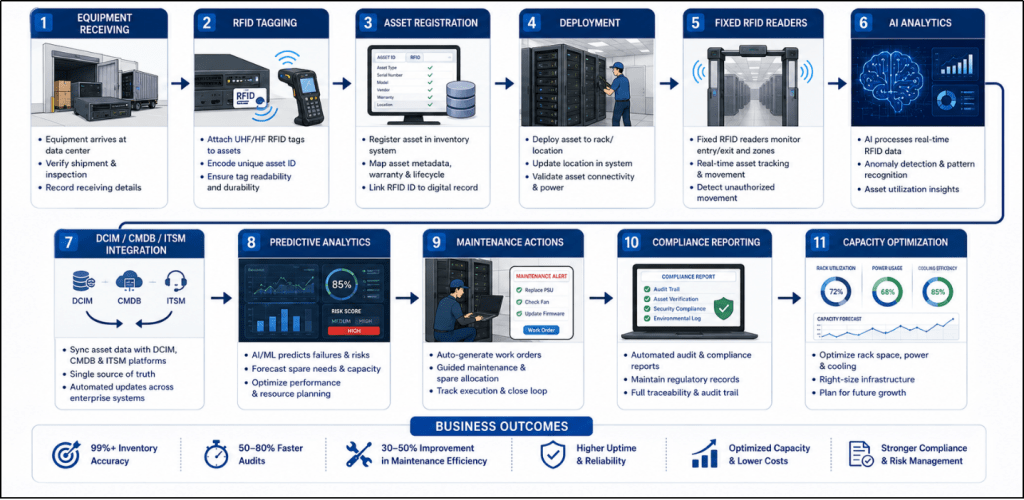
This workflow diagram illustrates the complete AI and RFID operational process for managing data center assets, from equipment receiving and RFID tagging to AI analytics, enterprise software integration, predictive maintenance, compliance reporting, and capacity optimization. It demonstrates how automated data capture and intelligent analytics streamline infrastructure management, improve operational efficiency, and support reliable, data-driven decision-making.
Core Technologies That Power AI and RFID Solutions for Data Centers
Delivering reliable AI and RFID capabilities across mission-critical data centers requires carefully selected hardware, intelligent software, robust communication methods, secure deployment models, and well-integrated operational systems. Successful implementations balance inventory accuracy, low operational overhead, electromagnetic compatibility, cybersecurity, and scalability while supporting continuous facility operations.
RFID Technologies
Different RFID frequencies address different operational requirements within data centers.
UHF RFID
UHF RFID is the primary technology for automated data center inventory because it provides long read distances and rapid identification of hundreds of tagged assets during a single scan. Specialized on-metal UHF tags enable reliable identification of metallic server chassis, storage appliances, network switches, and rack-mounted equipment while minimizing signal degradation.
HF RFID
HF RFID supports applications requiring short-range interaction and controlled authentication, such as technician identification, secure cabinet access, maintenance logging, and configuration verification.
LF RFID
LF RFID is generally used for personnel credentials, specialized access control systems, legacy infrastructure, and selected maintenance workflows where short-range, interference-resistant operation is preferred.
RFID Hardware Components
A complete solution typically includes:
- Fixed RFID readers installed at loading docks, staging areas, equipment room entrances, and secure zones
- Handheld RFID readers used during maintenance, audits, and equipment verification
- On-metal RFID tags designed for servers, switches, storage systems, and network appliances
- RFID antennas optimized for aisle coverage and choke-point monitoring
- RFID printers and encoding stations for commissioning new assets
- RFID middleware that filters, validates, and routes tag events to operational software
GAO supplies RFID readers, tags, antennas, and related hardware that support demanding identification requirements across IT infrastructure environments.
Software, AI Models, Communications, Security, and Deployment Options
Reliable AI and RFID deployments in data centers depend on far more than RFID readers and tags. The software stack, AI models, communications infrastructure, cybersecurity controls, and deployment strategy determine whether the solution delivers operational value while maintaining the availability requirements expected from mission-critical facilities.
RFID Middleware
RFID middleware serves as the intelligence layer between RFID hardware and operational software. Rather than forwarding every raw tag read, middleware validates, filters, aggregates, timestamps, and enriches RFID events before distributing them to downstream applications.
Typical middleware functions include:
- Duplicate read elimination
- Tag health monitoring
- Reader configuration management
- Device diagnostics
- Event filtering
- Location inference
- Business rule execution
- API management
- Data normalization
- Alert generation
- Event buffering during network outages
- Audit logging
This preprocessing significantly improves AI model accuracy by reducing noisy or redundant data.
AI Software and Machine Learning
AI continuously analyzes RFID-generated operational data together with infrastructure telemetry, maintenance records, workload history, environmental monitoring, and service management information.
Common AI techniques include:
- Supervised learning for asset classification
- Time-series forecasting for capacity planning
- Anomaly detection for unauthorized asset movement
- Predictive maintenance models
- Computer vision integration for rack verification
- Reinforcement learning for inventory optimization
- Clustering for infrastructure utilization analysis
- Natural language processing for maintenance ticket correlation
- Graph analytics for dependency mapping
- Bayesian inference for equipment risk assessment
Rather than generating simple inventory reports, AI identifies trends that support operational decisions, such as predicting rack space shortages, recommending hardware refresh schedules, or identifying recurring maintenance bottlenecks.
Enterprise Software Integration
AI and RFID solutions derive greater value when integrated with operational software already used by data center teams.
Typical integrations include:
- Data Center Infrastructure Management (DCIM)
- Configuration Management Database (CMDB)
- IT Service Management (ITSM)
- Enterprise Resource Planning (ERP)
- Enterprise Asset Management (EAM)
- Computerized Maintenance Management System (CMMS)
- Building Management System (BMS)
- Security Information and Event Management (SIEM)
- Identity and Access Management (IAM)
- Network monitoring software
- Capacity management tools
- Procurement systems
- Warehouse Management Systems (WMS)
Cross-system integration enables AI to correlate physical asset movement with configuration changes, maintenance activities, procurement records, and operational events.
Communication Infrastructure
Reliable communication is essential because RFID data must reach operational software with minimal delay while maintaining data integrity.
Typical communication technologies include:
- Ethernet
- Gigabit Ethernet
- Fiber optic backbone
- Wi-Fi 6
- Wi-Fi 6E
- Private 5G for large campuses
- VPN connectivity
- HTTPS
- MQTT
- AMQP
- REST APIs
- SNMP
- OPC UA where facility automation integration is required
Large hyperscale facilities frequently use redundant communication paths to eliminate single points of failure.
Cybersecurity Considerations
Because RFID systems become part of critical infrastructure, cybersecurity must be incorporated throughout deployment.
Important security controls include:
- Mutual device authentication
- TLS encryption
- Role-based access control
- Multi-factor authentication
- Secure API authentication
- Digital certificate management
- Network segmentation
- Zero Trust principles
- Secure firmware management
- Continuous vulnerability assessment
- Security event logging
- Hardware root of trust
- Secure boot
- Encrypted databases
- Audit trail retention
AI also contributes by identifying unusual access patterns, unexpected asset movement, and deviations from historical operational behavior that may indicate insider threats or unauthorized activity.
Cloud Version
Cloud-hosted deployments are appropriate when organizations require centralized visibility across multiple geographically distributed facilities.
Advantages include:
- Centralized fleet management
- Simplified software updates
- Elastic computing resources
- Enterprise-wide analytics
- Multi-site reporting
- Disaster recovery capabilities
- Faster deployment of AI models
- Lower infrastructure maintenance responsibilities
Cloud deployment is commonly selected by:
- Colocation providers
- Multi-region enterprises
- Managed service providers
- Cloud infrastructure operators
Server Version
Server deployments place software on customer-managed servers located within private data centers or other enterprise-controlled infrastructure.
Organizations often select this approach when they require:
- Complete control over operational data
- Compliance with internal security policies
- Low-latency processing
- Air-gapped environments
- Restricted external connectivity
- Custom software integration
- Regulatory compliance
- Local AI inference
This deployment model is frequently adopted by government facilities, financial institutions, healthcare organizations, defense environments, and highly regulated industries operating private data centers.
Successful deployments frequently combine both models by performing RFID processing and AI inference locally while synchronizing selected operational data with centralized management software for enterprise reporting.
Cloud Version vs. Server Version for AI and RFID in Data Centers
| Feature | Cloud Version | Server Version |
| Deployment Location | Software is hosted in a public or private cloud environment managed by a cloud provider. | Software is deployed on customer-managed servers located in private data centers, edge servers, or other enterprise-controlled infrastructure. |
| Ownership and Management | Cloud infrastructure, software updates, and underlying services are managed by the cloud provider or solution vendor. | The organization manages the servers, operating systems, applications, storage, backups, and supporting infrastructure. |
| Latency | Dependent on WAN or Internet connectivity; suitable for centralized monitoring where ultra-low latency is not critical. | Very low latency because processing occurs close to RFID readers and operational systems within the facility. |
| Scalability | Highly scalable with elastic computing resources that can accommodate additional data centers, RFID devices, and AI workloads. | Scalability depends on available server capacity and requires additional hardware investment as workloads increase. |
| Cybersecurity | Security is shared between the cloud provider and the customer, with built-in services for identity management, encryption, and threat detection. | Security is fully controlled by the organization, enabling implementation of internal cybersecurity policies and regulatory controls. |
| AI Processing | AI models can leverage virtually unlimited cloud computing resources for large-scale analytics, model training, and enterprise-wide optimization. | AI inference and analytics execute locally, providing fast decision-making while keeping operational data within enterprise-controlled infrastructure. |
| Maintenance Responsibility | Software patches, infrastructure maintenance, availability, and system monitoring are primarily handled by the cloud provider. | Internal IT teams or managed service providers are responsible for maintaining servers, databases, applications, and operating systems. |
| Software Updates | Automatic updates ensure rapid deployment of new features, AI models, and security improvements with minimal operational effort. | Updates are scheduled and controlled by the organization, allowing validation before deployment but requiring additional administrative effort. |
| Disaster Recovery | Cloud providers typically offer built-in redundancy, geographic replication, and automated disaster recovery capabilities. | Disaster recovery must be designed, implemented, and maintained by the organization through backup sites and recovery procedures. |
| Data Sovereignty | Data may be stored across multiple geographic regions depending on cloud configuration and organizational policies. | All operational and RFID data remain within enterprise-controlled infrastructure, simplifying compliance with strict data residency requirements. |
| Operational Flexibility | Easily supports geographically distributed data centers with centralized visibility, reporting, and management. | Ideal for facilities requiring customized workflows, isolated environments, or independent operation without external cloud connectivity. |
| CAPEX | Lower upfront capital investment because infrastructure is provided as a managed cloud service. | Higher initial capital expenditure due to investment in servers, storage, networking, and supporting infrastructure. |
| OPEX | Ongoing subscription-based operational expenses that scale with usage and cloud resources consumed. | Operating expenses primarily include hardware maintenance, software licensing, IT personnel, energy, and infrastructure support. |
| Customization | Customization options may be limited by cloud service system and vendor-supported features. | Extensive customization is possible because the organization has direct control over software configuration, integrations, and infrastructure. |
| Recommended Deployment Scenarios | Best suited for hyperscale operators, multi-site enterprises, colocation providers, managed service providers, and organizations seeking centralized management with minimal infrastructure maintenance. | Best suited for government agencies, defense organizations, financial institutions, healthcare providers, regulated industries, and enterprises requiring maximum control, low latency, and strict data governance. |
Technical Capabilities and Operational Benefits
Combining AI with RFID transforms physical asset identification into a continuous operational intelligence capability that improves reliability, efficiency, compliance, and infrastructure planning.
Automated Asset Visibility
Continuous RFID monitoring provides near real-time visibility into the location and status of servers, storage systems, network equipment, spare parts, and maintenance assets.
AI identifies inventory discrepancies without requiring manual audits.
Faster Infrastructure Audits
Manual inventory verification that previously required days can often be completed within hours using handheld or fixed RFID readers.
AI automatically reconciles collected inventory with CMDB and DCIM records, reducing administrative effort.
Improved Rack Utilization
AI evaluates historical equipment deployments, rack occupancy trends, power consumption, and cooling capacity to recommend more efficient rack allocation strategies.
This supports future expansion while avoiding localized resource constraints.
Predictive Maintenance
RFID data combined with maintenance history enables AI to identify equipment approaching service intervals or exhibiting recurring maintenance patterns.
This supports proactive maintenance scheduling that minimizes disruption to production workloads.
Unauthorized Asset Movement Detection
AI continuously analyzes asset movement patterns.
Potential security events include:
- Unexpected rack removal
- Unauthorized cabinet access
- Equipment relocation outside maintenance windows
- Unapproved technician activity
- Missing backup hardware
Automatic alerts enable security personnel to investigate potential incidents quickly.
Enhanced Compliance
Accurate RFID records simplify compliance reporting for internal governance and external audits.
Organizations can more efficiently demonstrate asset ownership, maintenance history, equipment lifecycle status, and physical inventory accuracy.
Capacity Planning
Historical RFID movement data enables AI to forecast:
- Future rack demand
- Spare inventory requirements
- Hardware refresh cycles
- Warehouse utilization
- Expansion timing
- Equipment retirement schedules
These forecasts improve budgeting and procurement planning.
Operational Efficiency
Routine activities become more efficient through:
- Reduced manual inventory work
- Automated asset verification
- Faster equipment searches
- Improved maintenance planning
- Better technician productivity
- Lower administrative workload
Scalability
Modern RFID systems support expansion from a single server room to globally distributed hyperscale facilities while maintaining centralized operational visibility.
GAO has supplied RFID hardware and identification solutions supporting organizations that require scalable, reliable asset tracking across complex operational environments.
Business Value of AI and RFID in Data Centers for Intelligent Infrastructure Management
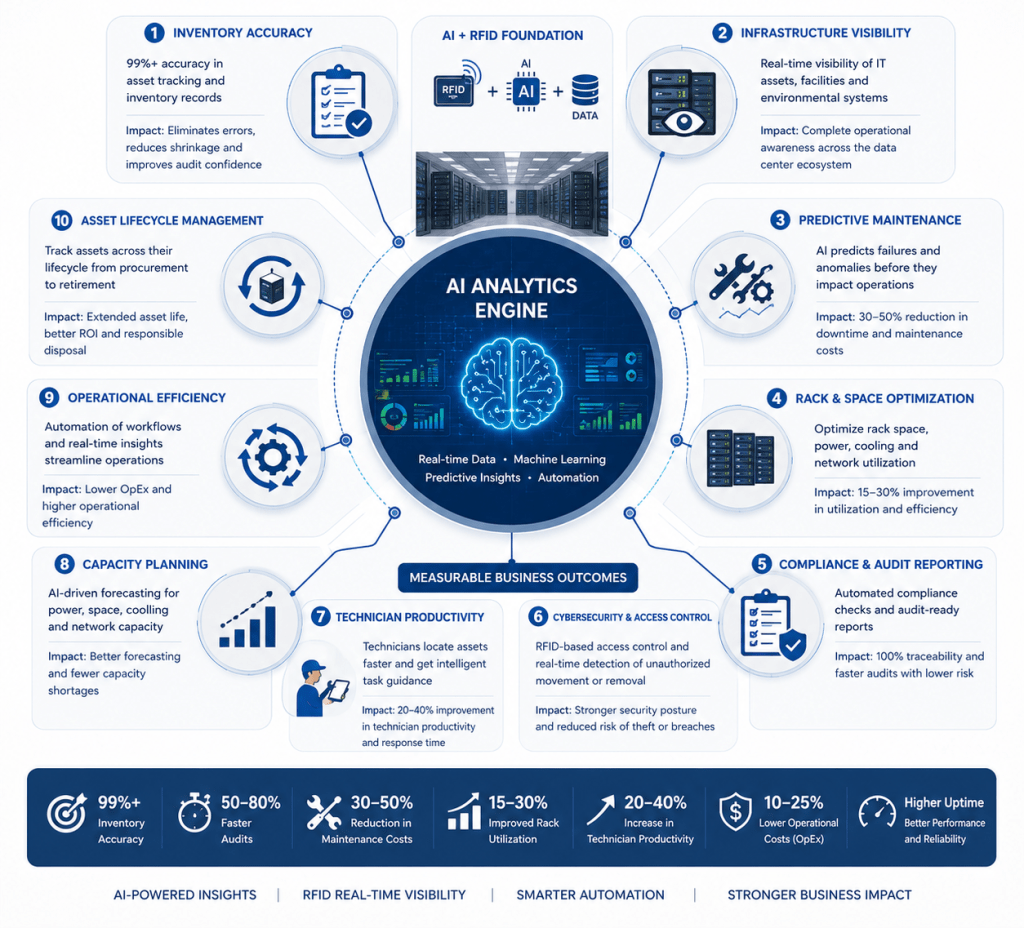
This infographic highlights the measurable business and operational benefits of combining AI and RFID in modern data centers. Centered around an AI analytics engine, it illustrates how intelligent asset tracking improves inventory accuracy, infrastructure visibility, predictive maintenance, rack optimization, compliance reporting, cybersecurity, technician productivity, capacity planning, operational efficiency, and asset lifecycle management, resulting in greater reliability, lower costs, and optimized performance.
Engineering Design Considerations and Implementation Best Practices
Organizations planning AI and RFID deployments should evaluate operational requirements before selecting hardware, software, and implementation strategies.
Recommended engineering practices include:
- Perform a comprehensive asset inventory before RFID tagging.
- Select RFID tags specifically designed for metallic IT equipment.
- Conduct RF site surveys to evaluate rack density and potential interference.
- Validate reader placement at loading docks, staging areas, equipment rooms, and secure exits.
- Integrate RFID data with DCIM, CMDB, ITSM, and EAM software to maintain synchronized operational records.
- Establish standardized asset naming, tagging, and lifecycle management procedures.
- Implement cybersecurity controls before connecting RFID infrastructure to production networks.
- Define governance policies for asset ownership, maintenance, and decommissioning.
- Continuously monitor AI model performance and retrain models using updated operational data.
- Validate system performance through acceptance testing, pilot deployments, and periodic operational reviews.
Organizations that treat AI and RFID as part of a broader infrastructure management strategy typically achieve higher long-term operational value than those deploying isolated inventory systems.
Why Organizations Choose GAO for AI and RFID Solutions
Organizations implementing AI and RFID for data centers require dependable hardware, experienced engineering support, and practical deployment knowledge.
Headquartered in New York City and Toronto, Canada, GAO is recognized among the world’s leading B2B RFID and BLE solution providers. Together with its sister companies, GAO Research and GAO Tek, GAO has supported customers throughout the United States and Canada for more than three decades, including Fortune 500 companies, leading research organizations, prestigious universities, and government agencies.
Our investment in research and development, rigorous quality assurance processes, and expert remote and onsite technical support enables organizations to deploy RFID solutions with confidence across demanding data center environments.
AI and RFID Will Continue Shaping the Future of Data Centers
AI and RFID are changing how data centers manage physical infrastructure by replacing periodic manual inventories with continuous operational intelligence. Automated identification, intelligent analytics, predictive maintenance, optimized capacity planning, and improved security enable operators to manage increasingly complex facilities with greater precision and efficiency.
As hyperscale computing, edge infrastructure, AI workloads, and high-density GPU clusters continue to expand, intelligent RFID-enabled asset management will become an increasingly important component of resilient, scalable, and secure data center operations. Organizations that combine robust RFID identification with AI-driven analysis will be better positioned to improve uptime, optimize capital investments, simplify compliance, and support long-term digital infrastructure growth.
Building the Future of AI and IoT
For more than 30 years, GAO Group has advanced RFID, BLE, sensing technologies, edge computing, testing and measurement, and enterprise IoT solutions that support mission-critical operations. AI and IoT are transforming these proven technologies into intelligent systems that deliver greater visibility, automation, and operational insight. Building on this foundation, Aperture Venture Studio develops and scales specialized AI and IoT ventures by leveraging GAO Tek and GAO RFID’s engineering expertise and established technologies. We welcome customers, strategic partners, industry experts, advisors, and investors to explore collaboration opportunities. Contact us to learn more about our AI and RFID solutions or discuss partnership opportunities.