
AI-Driven Defense Logistics with RFID Solutions & GAO
How AI is Transforming Defense Logistics Through RFID Intelligence
Modern defense logistics depends on the ability to accurately identify, monitor, secure, and distribute thousands of military assets across domestic bases, forward operating locations, naval facilities, airbases, maintenance depots, and multinational supply networks. Artificial intelligence significantly enhances defense logistics by transforming large volumes of RFID-generated operational data into actionable intelligence that improves readiness, asset visibility, maintenance planning, inventory optimization, and supply chain resilience.
Rather than functioning solely as an identification technology, RFID serves as the primary data acquisition layer that continuously captures the movement and status of weapons systems, repairable components, ammunition containers, tactical vehicles, aircraft parts, mission equipment, medical supplies, fuel assets, and mission-critical inventory. AI analyzes this operational data to identify logistics bottlenecks, predict shortages, detect abnormal asset movements, optimize transportation routes, forecast maintenance requirements, and automate resource allocation across defense supply chains.
Military organizations increasingly integrate AI, Industrial AI, AIoT, machine learning, Edge AI, and predictive analytics with RFID-enabled logistics systems to improve operational readiness while reducing manual inventory activities and improving decision-making throughout the defense sustainment lifecycle.
GAO has supplied RFID hardware products and intelligent identification systems for organizations requiring reliable asset visibility and industrial IoT deployments. Headquartered in New York City and Toronto, Canada, GAO is recognized among the world’s leading B2B and government-focused RFID and BLE suppliers, supporting customers that demand dependable identification technologies for mission-critical operations.
AI-Powered RFID Defense Logistics System for Military Asset Visibility and Predictive Supply Chain Intelligence
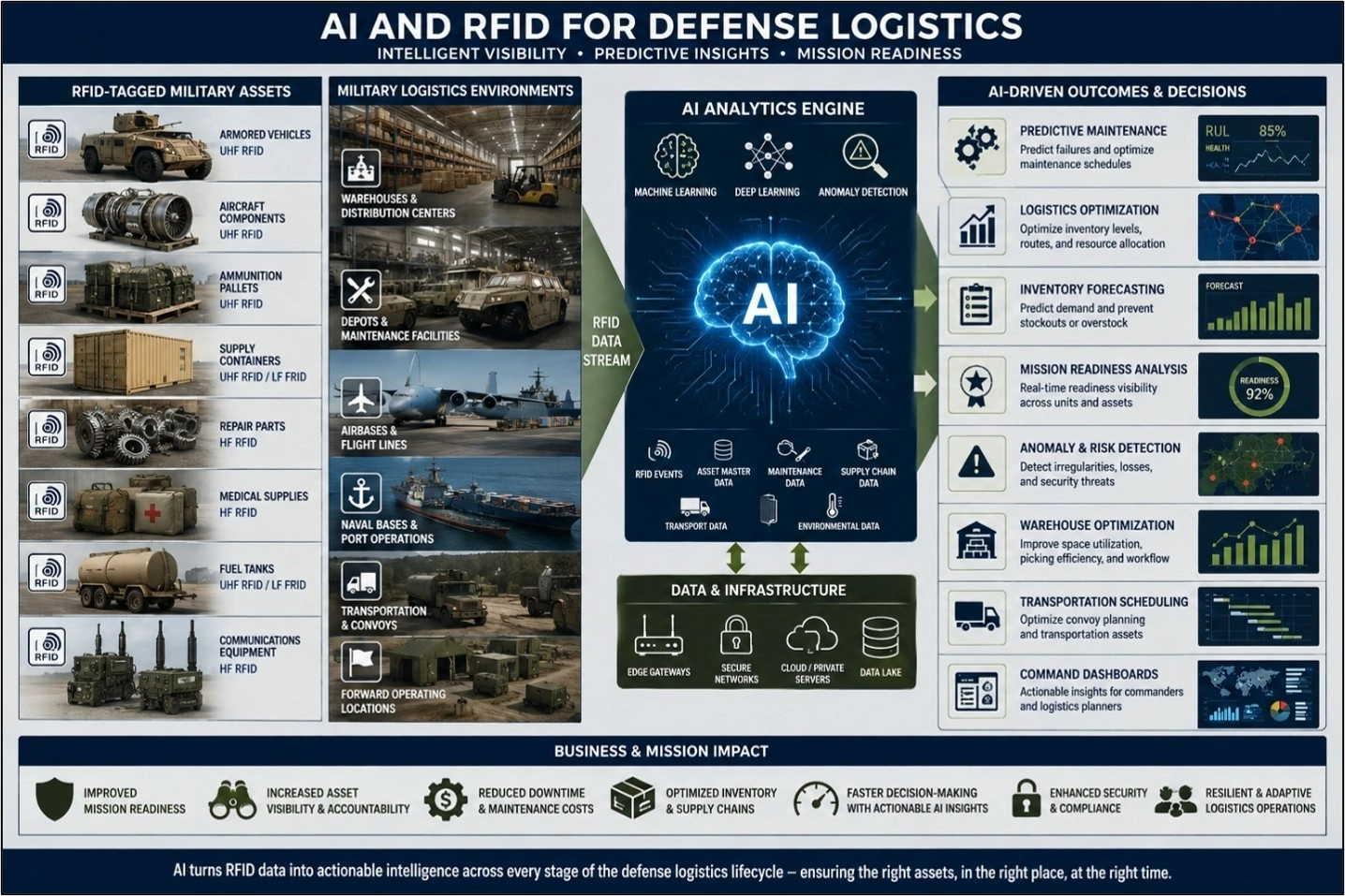
This infographic illustrates how RFID-tagged military assets generate operational data that is analyzed by an AI analytics engine to improve defense logistics. It demonstrates the complete flow from asset identification and logistics environments to AI-driven capabilities such as predictive maintenance, inventory forecasting, transportation optimization, mission readiness analysis, and command decision support. The visual highlights how AI transforms RFID data into actionable intelligence that enhances military logistics efficiency, asset accountability, and operational readiness.
Understanding AI-Driven Defense Logistics and RFID Systems
Defense logistics encompasses the planning, acquisition, storage, transportation, maintenance, distribution, recovery, and lifecycle management of military resources required to sustain operational forces. Unlike commercial logistics, defense logistics must operate under conditions involving contested environments, classified operations, multinational coordination, unpredictable mission requirements, strict accountability, and cybersecurity constraints.
Artificial Intelligence improves defense logistics by converting operational information into intelligent recommendations rather than relying solely on historical reporting. AI models continuously evaluate logistics data collected from RFID systems, maintenance records, enterprise resource planning software, transportation management systems, warehouse management software, condition monitoring sensors, and operational planning tools.
Within defense logistics, RFID technologies support automatic identification without requiring direct visual scanning.
Depending on operational requirements, deployments commonly utilize:
- UHF RFID for long-range pallet, container, vehicle, warehouse, and cargo identification
- HF RFID for secure maintenance activities, equipment servicing, technical documentation, and personnel authentication
- LF RFID for specialized military equipment operating near metal structures or harsh environmental conditions
AI continuously evaluates RFID event histories to answer operational questions such as:
- Which mission-critical assets are approaching maintenance deadlines?
- Which ammunition shipments have experienced unexpected routing deviations?
- Which repair parts should be repositioned before shortages occur?
- Which warehouses demonstrate declining inventory accuracy?
- Which transportation routes create excessive deployment delays?
- Which maintenance depots require additional repair capacity?
- Which logistics activities indicate potential security concerns?
Instead of merely locating equipment, AI enables commanders and logistics officers to understand why operational conditions change and how resources should be reallocated before readiness is affected.
GAO has assisted organizations by supplying RFID identification technologies that support reliable asset visibility across industrial, research, and government environments requiring dependable operational intelligence.
Defense Logistics Operations That Benefit from AI-Powered RFID
Military logistics consists of numerous interconnected activities where continuous identification and intelligent decision support significantly improve operational performance.
Strategic Inventory Management
Military inventories contain millions of serialized assets distributed across supply depots, maintenance facilities, prepositioned stock locations, ammunition storage areas, naval installations, and expeditionary logistics centers.
AI analyzes RFID-generated inventory events to:
- Predict inventory shortages
- Optimize stock positioning
- Reduce excess inventory
- Identify obsolete equipment
- Forecast replenishment requirements
- Improve inventory turnover
- Increase inventory accuracy
Depot Maintenance and Sustainment
Maintenance depots process aircraft engines, armored vehicle assemblies, naval equipment, radar systems, missile components, communications hardware, and countless repairable assemblies.
AI evaluates RFID movement histories together with maintenance records to:
- Predict maintenance workloads
- Optimize repair scheduling
- Balance technician utilization
- Forecast spare component demand
- Reduce maintenance cycle times
- Improve depot throughput
Military Transportation Management
Defense transportation involves:
- Strategic airlift
- Sealift
- Rail logistics
- Tactical ground transportation
- Multimodal cargo movement
- Cross-docking operations
RFID automatically records cargo movement throughout transportation networks while AI optimizes:
- Route planning
- Fleet utilization
- Shipment prioritization
- Delivery scheduling
- Port congestion mitigation
- Transportation risk assessment
Forward Operating Base Resupply
Forward operating bases depend upon reliable logistics support despite limited infrastructure and dynamic operational conditions.
AI combines RFID visibility with operational demand forecasts to determine:
- Critical resupply priorities
- Emergency shipment requirements
- Fuel consumption projections
- Medical inventory replenishment
- Ammunition redistribution
- Mission equipment allocation
Weapons System Lifecycle Management
Military organizations maintain long operational lifecycles for complex defense assets.
RFID provides lifecycle traceability for:
- Aircraft components
- Missile assemblies
- Radar equipment
- Tactical vehicles
- Naval systems
- Communications equipment
- Electronic warfare assets
AI identifies degradation patterns, maintenance trends, lifecycle costs, and replacement priorities using years of operational history.
End-to-End Operational Workflow for AI-Enabled Defense Logistics
Successful defense logistics solutions require far more than deploying RFID readers. Operational intelligence emerges from coordinated data acquisition, communications infrastructure, edge computing, AI processing, software integration, and automated decision support.
Military Asset Identification
Each defense asset receives an RFID identifier appropriate to its operating environment.
Assets commonly include:
- Tactical vehicles
- Aircraft parts
- Naval equipment
- Weapon assemblies
- Ammunition containers
- ISO cargo containers
- Fuel systems
- Medical equipment
- Repair parts
- Communications equipment
- Protective gear
Each RFID identifier maintains a persistent digital identity throughout the asset lifecycle.
Data Acquisition
RFID readers continuously capture movement events from:
- Depot receiving docks
- Warehouse portals
- Vehicle checkpoints
- Maintenance workshops
- Air cargo terminals
- Naval loading facilities
- Secure storage areas
- Distribution centers
Additional operational information may originate from:
- Environmental sensors
- GPS tracking
- Condition monitoring systems
- Industrial IoT sensors
- Maintenance software
- Operator terminals
Communication Infrastructure
Collected information traverses secure communications networks using technologies such as:
- Ethernet
- Fiber optic networks
- Secure Wi-Fi
- Private LTE
- 5G
- Tactical communications
- Satellite communications
- VPN infrastructure
Data encryption and authenticated communications protect operational information throughout transmission.
Edge Processing
Many defense organizations process operational information at secure edge servers located inside military installations.
Edge processing enables:
- Low-latency decision support
- Local AI inference
- Continued operation during communication disruptions
- Reduced external network dependency
- Improved classified information handling
Enterprise Software Integration
RFID event information integrates with operational software including:
- Enterprise Resource Planning (ERP)
- Warehouse Management Systems (WMS)
- Enterprise Asset Management (EAM)
- Maintenance Management Systems (CMMS)
- Logistics Information Systems
- Transportation Management Systems (TMS)
- Supply Chain Management software
- Digital twin applications
- Business intelligence software
This integrated operational picture enables AI to analyze logistics activities across multiple military organizations rather than isolated facilities.
End-to-End AI-Enabled RFID Defense Logistics Workflow for Military Asset Tracking and Decision Intelligence
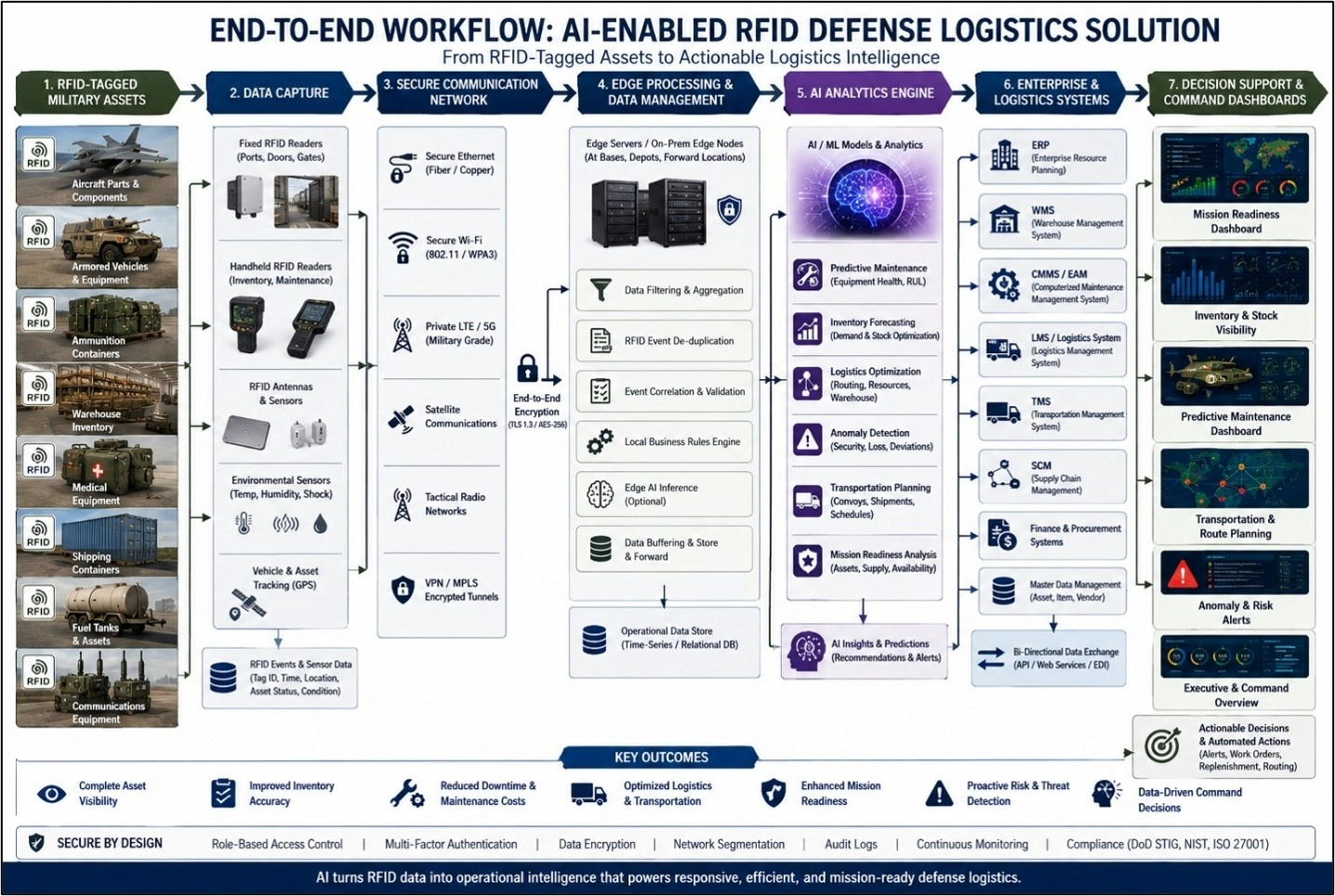
This workflow diagram illustrates the complete lifecycle of an AI-enabled RFID defense logistics solution, beginning with RFID-tagged military assets and progressing through data capture, secure communications, edge processing, AI analytics, enterprise logistics software, and command dashboards. It demonstrates how operational data is transformed into predictive maintenance insights, inventory optimization, transportation planning, anomaly detection, and mission readiness intelligence. The visual highlights the integrated data flow that enables secure, real-time decision support across military logistics operations.
Core Technologies Supporting AI-Powered Defense Logistics
An effective AI-enabled defense logistics solution combines identification hardware, intelligent software, secure communications, analytics, and operational management systems into a unified decision-support environment. Each component contributes distinct capabilities that collectively improve logistics visibility, readiness, and operational efficiency.
RFID Hardware
The physical identification layer includes UHF, HF, and LF RFID tags selected according to asset type, operating distance, environmental conditions, and security requirements. Fixed readers installed at warehouse portals, depot entrances, maintenance bays, and loading docks automate high-volume identification, while handheld readers support inspections, inventory audits, field logistics, and maintenance verification. Ruggedized antennas and military-grade enclosures ensure reliable performance in environments exposed to vibration, dust, moisture, electromagnetic interference, and temperature extremes.
AI Software and Analytics
Artificial intelligence transforms raw RFID event streams into operational intelligence. Common AI methods include supervised machine learning for demand forecasting, unsupervised learning for anomaly detection, reinforcement learning for logistics optimization, and time-series forecasting for inventory planning. Computer vision may complement RFID in automated receiving areas by validating pallet contents or identifying damaged containers. Large language models can assist logistics personnel by summarizing maintenance histories, generating reports, or answering questions using authorized operational data.
Middleware and Data Management
RFID middleware filters duplicate reads, validates tag events, associates asset identities with business records, and routes information to downstream software. Data normalization, event correlation, and rule-based processing reduce unnecessary traffic while improving data quality. Historical data repositories support long-term trend analysis, lifecycle management, and AI model training.
Communication Infrastructure
Reliable communications are essential for distributed defense logistics operations. Depending on the mission environment, deployments may use Ethernet, fiber optics, secure Wi-Fi, private LTE, 5G, tactical radio networks, or satellite communications. Message queuing, encrypted protocols, and resilient network design help maintain reliable data exchange even under constrained or intermittent connectivity.
Cloud Version
Cloud-hosted software is well suited for organizations managing geographically dispersed logistics centers, multinational operations, or collaborative sustainment programs where rapid scalability and centralized visibility are priorities. Cloud deployments simplify software updates, elastic computing, centralized AI model management, and disaster recovery while supporting secure role-based access controls and audit logging. Proper implementation requires compliance with defense cybersecurity policies, encrypted data storage, identity federation, and secure API integration.
Server Version
Many defense organizations prefer customer-managed server deployments hosted within private data centers, secure military networks, or edge computing facilities. This approach provides greater control over sensitive operational data, supports classified environments, minimizes dependence on external connectivity, and enables deterministic response times for mission-critical workflows. Server deployments are often selected for weapons maintenance facilities, defense manufacturing sites, naval bases, and command logistics centers where strict information assurance requirements apply.
Security Mechanisms
Security extends beyond encrypted RFID communications. A comprehensive solution incorporates:
- Role-based access control
- Multi-factor authentication
- Public key infrastructure
- Hardware security modules
- Secure boot
- Digital certificates
- Event logging
- Continuous security monitoring
- AI-assisted threat detection
- Network segmentation
- Zero Trust principles where appropriate
These controls protect logistics information from unauthorized access while maintaining operational continuity across distributed military supply chains.
Real-World AI-Enabled RFID Deployment in a Defense Logistics Depot for Military Asset Tracking and Operational Intelligence
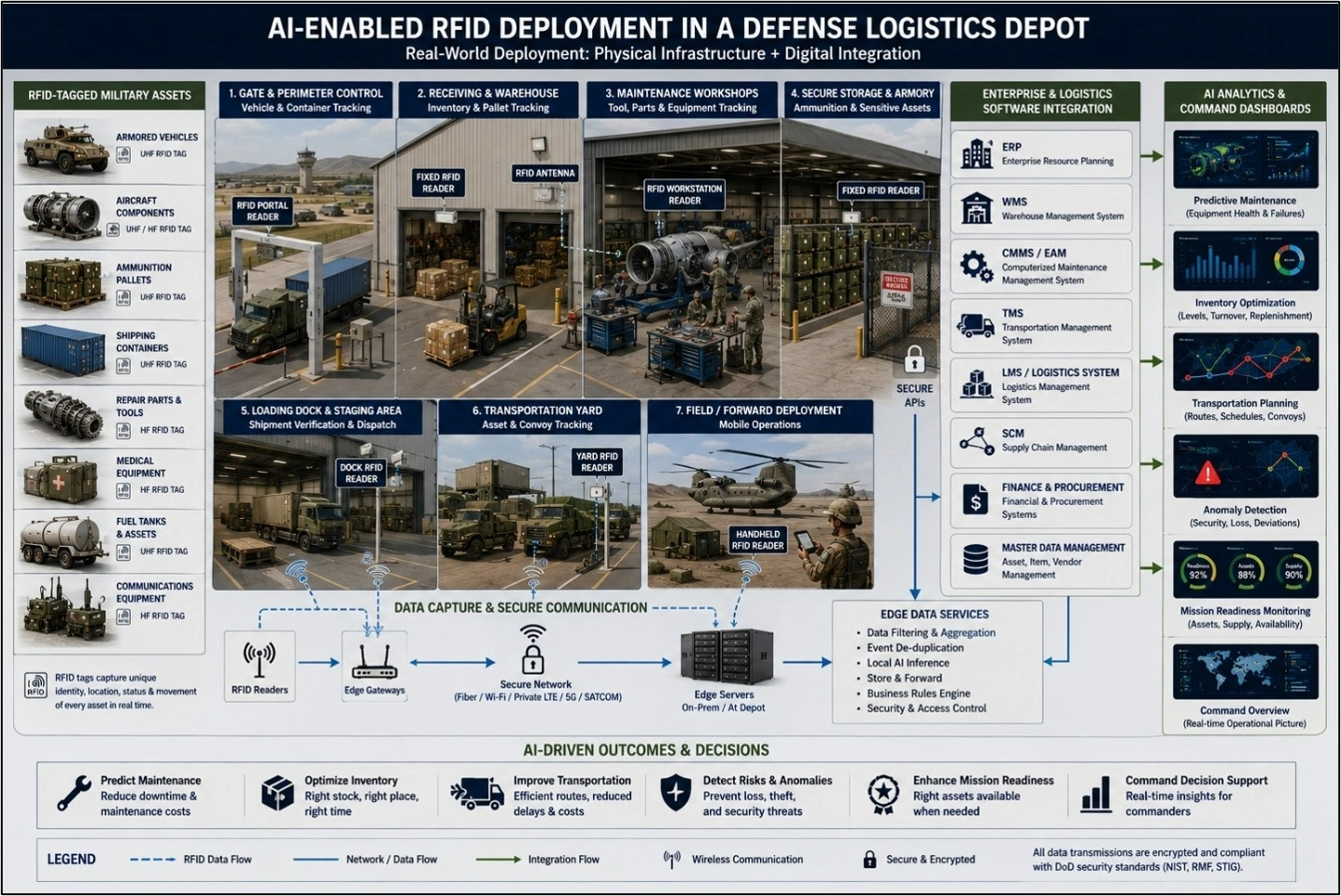
This deployment diagram illustrates how RFID-tagged military assets are tracked throughout a defense logistics depot, from receiving and maintenance to storage, transportation, and forward deployment. It shows the integration of RFID readers, secure communication networks, edge servers, AI analytics, and enterprise software such as ERP, WMS, CMMS, and transportation management systems. The visual demonstrates how operational data is transformed into predictive maintenance, inventory optimization, transportation planning, anomaly detection, and mission readiness intelligence for military decision-makers.
AI Capabilities Driving Modern Defense Logistics
Military logistics generates enormous volumes of operational data from supply depots, maintenance facilities, transportation assets, warehouses, distribution hubs, repair centers, and operational units. Artificial intelligence converts this continuous stream of RFID events and related operational information into timely decisions that improve readiness, sustainment efficiency, and resource utilization.
Predictive Logistics Planning
Traditional logistics planning often relies on historical consumption and manually updated inventory records. AI continuously analyzes RFID movement histories, maintenance schedules, operational tempo, mission plans, seasonal demand, transportation lead times, and supplier performance to forecast future logistics requirements.
Practical capabilities include:
- Predicting shortages before they affect mission readiness
- Forecasting depot repair workloads
- Estimating future spare parts consumption
- Optimizing safety stock levels
- Planning ammunition redistribution
- Identifying future transportation bottlenecks
- Supporting contingency logistics planning
These predictions enable logistics commanders to make informed resource allocation decisions rather than reacting after shortages occur.
Intelligent Military Asset Visibility
Military organizations manage thousands to millions of serialized assets distributed across multiple commands, installations, and operational theaters.
AI evaluates RFID-generated location histories to provide:
- Near real-time asset visibility
- Equipment availability forecasting
- Automatic asset utilization analysis
- Idle equipment identification
- Cross-base asset balancing
- Lost equipment detection
- High-value asset prioritization
Rather than simply displaying current locations, AI identifies operational patterns that improve fleet utilization and equipment readiness.
Predictive Maintenance Intelligence
Defense equipment maintenance represents one of the largest components of sustainment operations.
AI correlates RFID lifecycle information with:
- Maintenance histories
- Failure reports
- Environmental operating conditions
- Usage frequency
- Repair durations
- Technician availability
- Spare component inventories
The resulting recommendations support:
- Predictive maintenance scheduling
- Spare parts optimization
- Depot workload balancing
- Maintenance prioritization
- Reduced equipment downtime
- Extended equipment service life
AI-Based Transportation Optimization
Military transportation networks frequently operate under changing operational priorities.
AI continuously evaluates:
- Shipment priorities
- Transportation capacity
- Convoy scheduling
- Airlift availability
- Sealift schedules
- Route risks
- Weather impacts
- Fuel consumption
RFID checkpoints provide reliable movement confirmation while AI recommends transportation adjustments that improve delivery performance and mission support.
Supply Chain Risk Detection
Defense supply chains are exposed to disruptions caused by geopolitical events, transportation delays, supplier constraints, cyber incidents, weather conditions, and operational changes.
AI identifies:
- Delayed shipments
- Inventory anomalies
- Supplier performance degradation
- Unusual warehouse activity
- Unexpected inventory depletion
- Unauthorized asset movement
- Distribution bottlenecks
Early identification enables logistics organizations to implement corrective actions before operational readiness is affected.
AI Decision Intelligence for Defense Logistics Using RFID Data for Mission Readiness and Operational Optimization
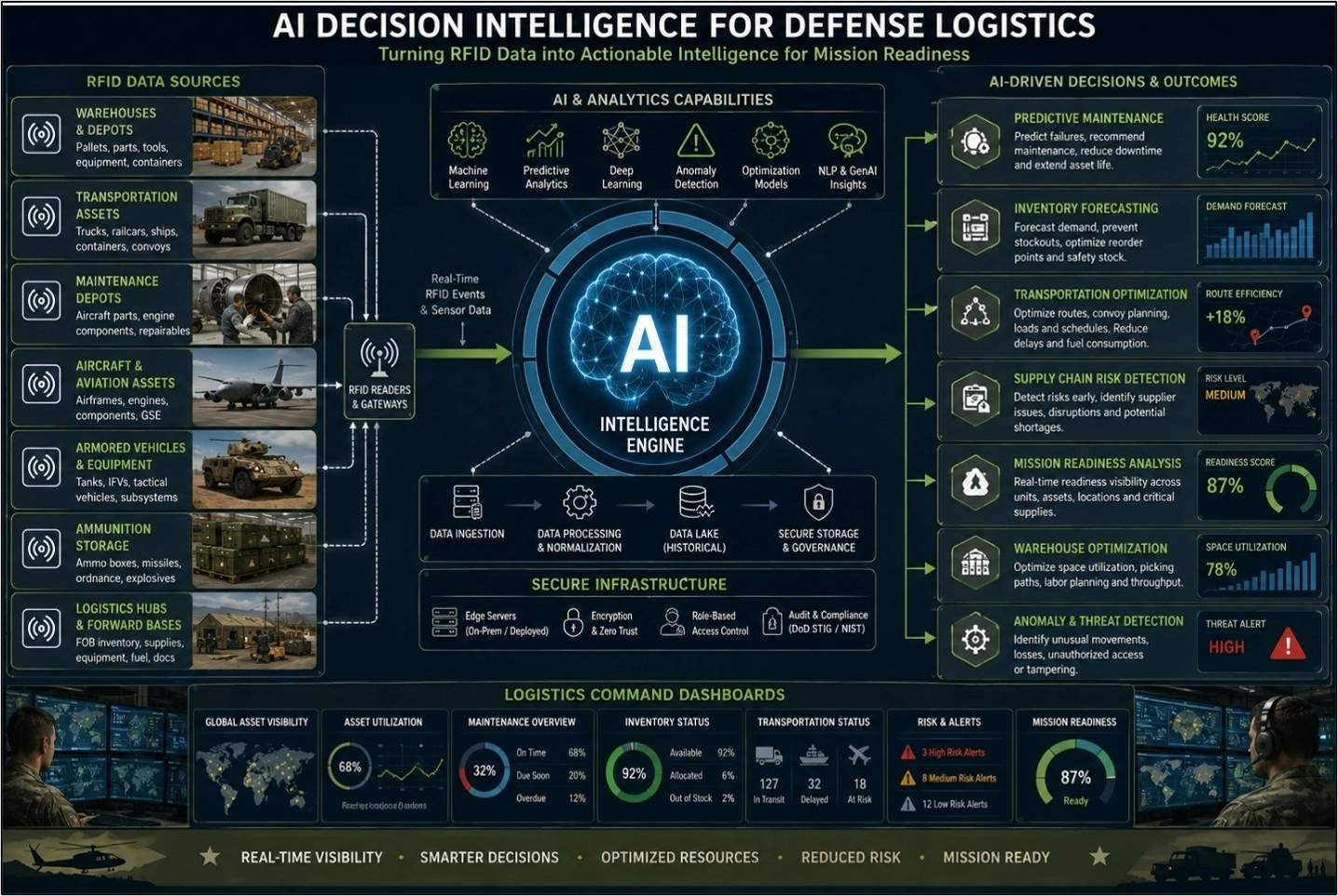
This infographic illustrates how RFID-generated data from military warehouses, transportation assets, maintenance depots, aircraft, armored vehicles, ammunition storage, and logistics hubs is consolidated into an AI intelligence engine. It shows how AI applies predictive analytics, anomaly detection, inventory forecasting, and transportation optimization to produce actionable insights through command dashboards. The visual demonstrates how AI transforms RFID operational data into informed decisions that improve mission readiness, supply chain resilience, maintenance planning, and defense logistics efficiency.
Operational Improvements Across Defense Logistics
Combining AI with RFID significantly enhances operational performance across every stage of the military logistics lifecycle.
Warehouse Operations
AI enables military warehouses to become intelligent fulfillment centers by improving receiving accuracy, storage optimization, inventory verification, and order fulfillment.
Operational improvements include:
- Automated receiving verification
- Faster inventory reconciliation
- Dynamic storage assignment
- Reduced manual counting
- Improved picking efficiency
- Better warehouse space utilization
- Continuous inventory accuracy monitoring
Depot Maintenance Operations
Maintenance depots benefit from AI-supported scheduling that balances workforce availability, repair priorities, tooling requirements, and spare component inventories.
Benefits include:
- Reduced maintenance backlog
- Faster equipment turnaround
- Improved technician productivity
- Optimized repair sequencing
- Better resource planning
- Higher maintenance throughput
Mission Readiness Monitoring
Military readiness depends upon equipment availability rather than inventory quantity alone.
AI continuously evaluates:
- Equipment readiness status
- Maintenance completion
- Component availability
- Transportation progress
- Supply sufficiency
- Repair completion rates
Commanders receive continuously updated readiness indicators instead of relying on periodic reports.
Ammunition Accountability
RFID enables automated identification of ammunition containers while AI monitors:
- Storage compliance
- Inventory aging
- Shipment verification
- Distribution priorities
- Lot traceability
- Security anomalies
This improves accountability while reducing manual inventory activities.
Fleet Sustainment
Vehicle fleets benefit from continuous visibility into maintenance status, operational utilization, and component availability.
AI assists logistics officers by recommending:
- Fleet rotation schedules
- Preventive maintenance timing
- Spare vehicle allocation
- Replacement prioritization
- Fuel logistics optimization
Business Benefits of AI-Powered Defense Logistics
Although defense logistics primarily focuses on operational readiness rather than commercial profitability, AI-supported RFID systems deliver measurable organizational value.
Key benefits include:
- Higher mission readiness
- Improved logistics responsiveness
- Increased inventory accuracy
- Reduced manual inventory labor
- Faster maintenance turnaround
- Better transportation utilization
- Enhanced asset accountability
- Lower lifecycle maintenance costs
- Reduced inventory carrying costs
- Improved warehouse productivity
- Better cross-command coordination
- Faster deployment preparation
- Improved operational transparency
- Increased decision-making confidence
- Greater resilience during supply chain disruptions
For organizations managing geographically dispersed defense assets, these improvements contribute directly to operational effectiveness and long-term sustainment capability.
GAO has helped organizations deploy RFID hardware products and intelligent identification solutions that improve operational visibility, asset accountability, and inventory management across demanding industrial and government environments. For more than three decades, GAO Group has served customers throughout the United States and Canada, including Fortune 500 companies, leading research institutions, prestigious universities, and U.S. and Canadian government agencies while maintaining rigorous quality assurance and expert technical support.
AI-Supported RFID Defense Logistics Performance Dashboard for Mission Readiness and Operational KPIs
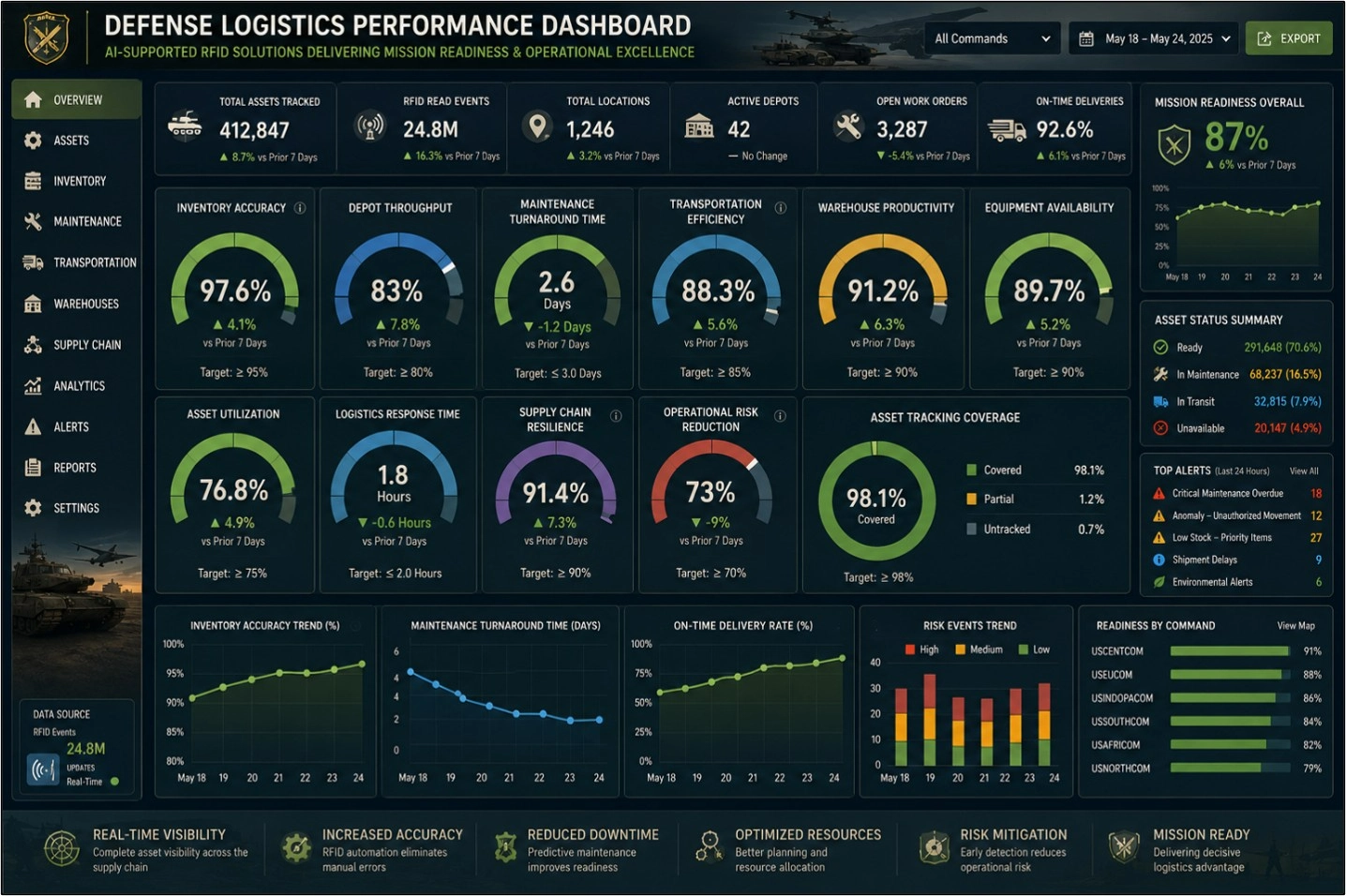
This executive dashboard visualizes the key performance indicators of an AI-supported RFID defense logistics system, providing real-time insights into inventory accuracy, mission readiness, depot throughput, transportation efficiency, warehouse productivity, equipment availability, and supply chain resilience. Interactive gauges, trend charts, and operational alerts demonstrate how AI transforms RFID-generated logistics data into measurable performance improvements and actionable command intelligence. The dashboard enables defense leaders to monitor logistics health, optimize resources, reduce operational risk, and support mission-critical decision-making.
Engineering Considerations and Deployment Best Practices
Successful AI-enabled defense logistics projects require careful planning beyond selecting RFID hardware. Engineering decisions should address operational workflows, cybersecurity, interoperability, environmental conditions, scalability, and lifecycle management.
Recommended practices include:
- Define measurable operational objectives before deployment.
- Select RFID tag types based on asset material, read distance, and environmental exposure.
- Conduct comprehensive RF site surveys to identify interference sources, metal structures, and antenna placement requirements.
- Implement standardized asset identification and serialization policies across logistics organizations.
- Integrate RFID event data with ERP, WMS, CMMS, transportation management, and maintenance software using secure APIs.
- Deploy edge processing where low latency, intermittent connectivity, or classified operations require local AI inference.
- Establish data governance procedures for RFID event quality, retention, and auditability.
- Validate AI models using representative logistics datasets before operational deployment.
- Continuously monitor system performance using logistics KPIs and retrain AI models as operational conditions evolve.
- Apply layered cybersecurity controls including Zero Trust principles, encryption, identity management, and continuous monitoring.
- Plan for future expansion to additional depots, operational commands, transportation hubs, and coalition logistics partners.
Organizations should also establish phased deployment programs beginning with pilot implementations, followed by validation, optimization, and broader operational rollout. This approach minimizes operational disruption while allowing engineering teams to refine reader placement, software integration, and AI decision models.
AI-Enabled RFID Defense Logistics Deployment Roadmap for Secure Military Logistics Implementation
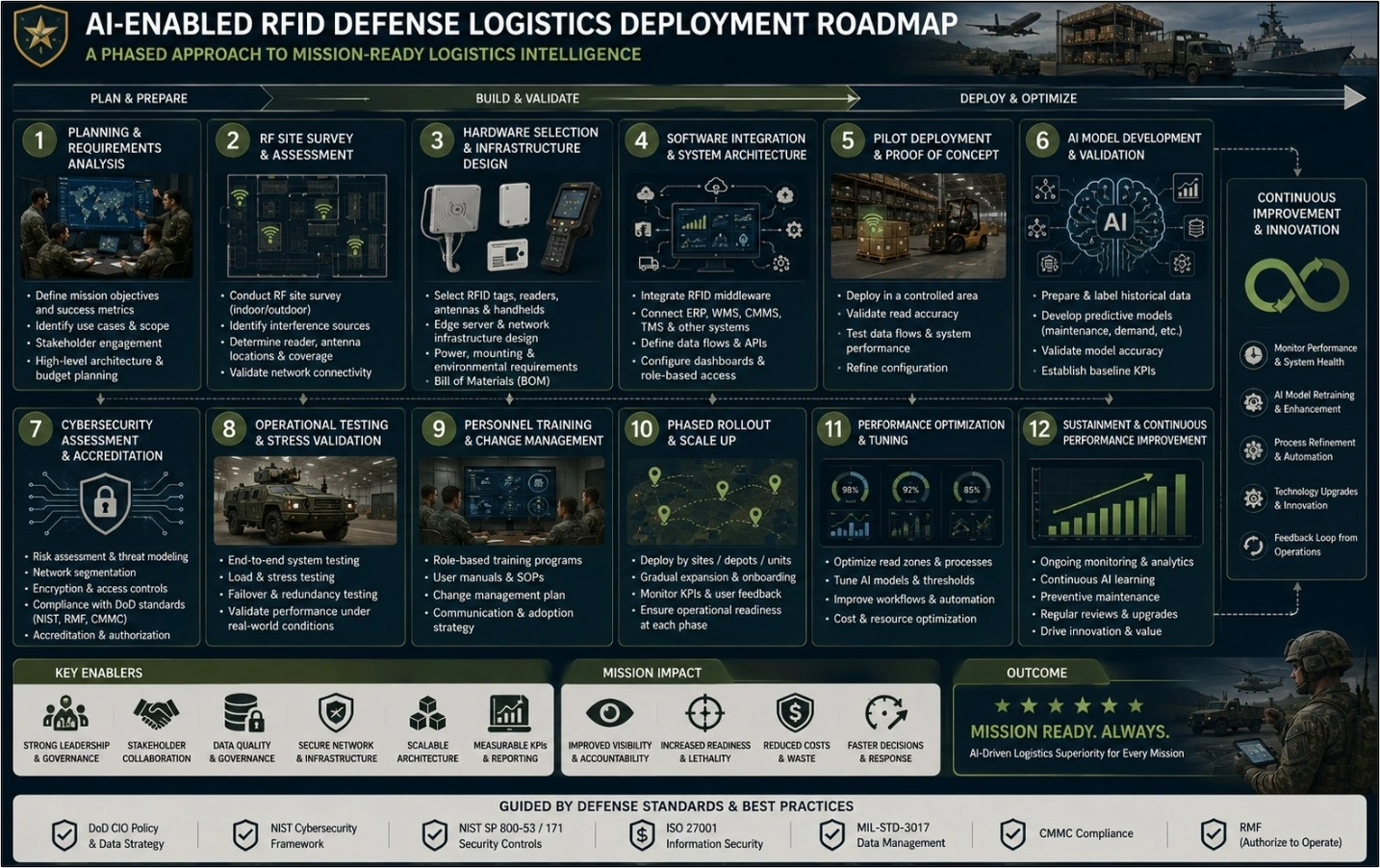
This roadmap infographic presents the recommended implementation lifecycle for deploying an AI-enabled RFID defense logistics solution, from planning and RF site assessment through hardware selection, software integration, pilot deployment, AI validation, cybersecurity assessment, operational testing, personnel training, phased rollout, and continuous optimization. It highlights the engineering best practices, governance, and security controls required to build a scalable, mission-ready logistics system. The visual emphasizes a structured deployment approach that improves operational readiness, asset visibility, and long-term sustainment performance.
Advancing Defense Logistics with AI-Powered RFID Solutions
AI-supported defense logistics represents a significant advancement in military sustainment by combining intelligent analytics with reliable automatic identification. RFID provides trusted visibility into the movement and status of mission-critical assets, while AI transforms operational data into predictive insights that improve inventory management, transportation coordination, maintenance planning, and mission readiness.
Successful implementations require careful integration with existing logistics software, secure communications, disciplined data governance, and well-defined operational objectives. Organizations that adopt a phased deployment strategy, validate AI recommendations against real-world logistics operations, and continuously optimize system performance are better positioned to improve supply chain resilience and sustainment effectiveness.
Drawing on decades of experience supplying RFID hardware products and intelligent identification systems, GAO supports organizations seeking dependable technologies for defense logistics, industrial IoT, and asset visibility applications through expert engineering guidance, quality-focused products, and responsive technical support.
Building the Future of Industrial AI and IoT with Aperture Venture Studio and GAO
For more than three decades, GAO Group of Companies has invested extensively in research and development for industrial RFID, BLE, and IoT technologies. As generative AI has demonstrated measurable value in mission-critical logistics, defense operations, and industrial automation, we have expanded our AI and IoT initiatives and established Aperture Venture Studio to accelerate the development and adoption of advanced AI and IoT solutions for defense logistics and other demanding industries.
Aperture has brought together leading AI and IoT technical experts, experienced operational executives, influential investors, and recognized technology organizations. Through initiatives such as the Aperture Ventures Summit and TekSummit, we foster collaboration on advanced AI, RFID, BLE, and Industrial IoT technologies while strengthening technical communities across North America.
We welcome you to engage with us as:
- Advisors, co-founders, or employees
- Investors
- Customers seeking advanced AI and IoT solutions
This collaborative approach enables us to continue advancing intelligent identification, Industrial AI, and connected technologies that support the evolving needs of defense logistics and other mission-critical sectors.