
AI and RFID for Department Stores
How AI Is Improving Department Store Inventory and Store Operations
AI for department stores combines machine learning, computer vision, analytics, and connected sensing with operational data to improve inventory accuracy, merchandise availability, loss prevention, and store execution. RFID, including UHF RFID for item-level identification and HF or LF RFID where shorter-range identification is appropriate, provides a high-value source of physical inventory data for these AI applications. Together, they help department stores move from periodic inventory checks toward continuous, data-driven visibility of merchandise and store assets.
For department stores, the value is not simply knowing whether an item exists. AI can analyze RFID events alongside point-of-sale transactions, replenishment activity, sales forecasts, employee workflows, and exception records to identify discrepancies and recommend actions. GAO supplies RFID, BLE, and other IoT hardware products and systems that can support these connected retail environments, including deployments requiring integration with existing store and inventory software.
What AI-Enabled RFID Means for Department Stores
Department stores manage a complex mix of apparel, footwear, cosmetics, home goods, accessories, seasonal merchandise, promotional displays, high-value products, and backroom inventory. Merchandise frequently moves between receiving docks, stockrooms, fitting rooms, sales floors, pickup areas, returns counters, and other controlled zones. Conventional barcode-based processes often require line-of-sight scanning and substantial employee involvement, making continuous inventory visibility difficult.
RFID changes the underlying data-capture process by giving tagged merchandise a machine-readable identity that can be detected by fixed readers, handheld readers, portals, and other RFID equipment. AI can then turn those events into operational insight.
For example, a department store can compare RFID inventory observations with point-of-sale records and expected stock levels. A machine-learning model can identify unusual shrinkage patterns, repeated stock discrepancies, unexpected merchandise movement, or products that remain in a backroom location despite strong sales demand. The resulting information can support inventory reconciliation, replenishment decisions, cycle counting, and investigations.
The strongest use cases are therefore AI applications that depend on reliable physical inventory and movement data, such as:
- AI inventory management for department-store merchandise
- AI-assisted stock replenishment and availability analysis
- AI-driven loss prevention and shrinkage investigation
- AI analysis of merchandise movement between backroom and sales floor
- AI-supported returns and inventory discrepancy detection
- AI forecasting using RFID-derived inventory history and sales data
- AI-assisted fitting-room and high-value merchandise monitoring
- AI analysis of receiving and put-away process exceptions
GAO’s RFID hardware can serve as the physical identification layer feeding these department-store workflows, while connected software processes and analyzes the resulting events.
AI-Enabled Department Store Operations with RFID
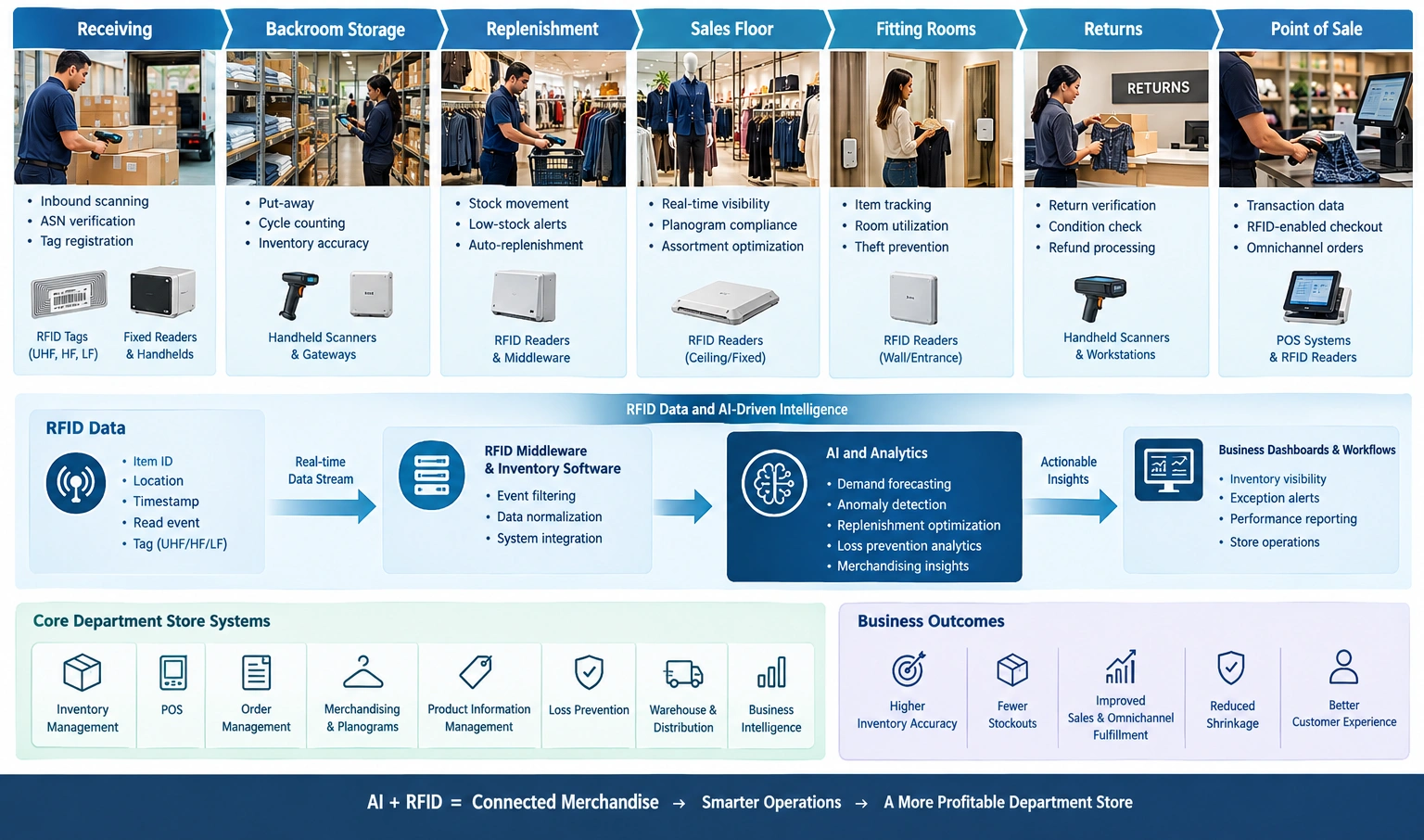
This enterprise infographic shows department-store merchandise moving through receiving, backroom storage, replenishment, sales floor, fitting rooms, returns, and point-of-sale. It illustrates how RFID data flows through middleware and AI analytics into core retail systems, dashboards, and operational outcomes including improved inventory accuracy, fewer stockouts, stronger fulfillment, and reduced shrinkage.
Department Store Use Cases for AI-Driven Inventory and Loss Prevention
AI becomes particularly useful when RFID data is connected to the department store’s existing operational processes rather than treated as an isolated inventory technology.
Inventory accuracy and shelf availability
Department stores can use RFID observations to maintain more accurate item-level inventory records. AI models can compare physical RFID counts with expected inventory and sales activity to prioritize locations requiring investigation. This can help distinguish a genuine out-of-stock condition from merchandise that is misplaced, waiting in the backroom, assigned to an incorrect location, or otherwise unavailable to shoppers despite being recorded in inventory.
Replenishment and merchandise availability
AI can use historical sales, current stock positions, seasonal demand, promotions, and RFID-based inventory observations to identify departments or stock keeping units that require replenishment. This is particularly useful for fast-moving apparel sizes, seasonal products, beauty items, and promotional merchandise where availability can change rapidly during the trading day.
Loss prevention and shrinkage analysis
Shrinkage is not always caused by a single identifiable event. Department stores can use RFID event histories with POS, returns, access-control, or security data to identify unusual patterns. An AI model might flag repeated discrepancies associated with particular products, departments, time periods, or movement routes for review by loss prevention personnel.
Receiving and put-away verification
RFID can capture merchandise as it enters a receiving area, while AI can compare expected shipment contents with observed items. Exceptions can be routed to receiving teams before products are distributed into backroom storage or sales-floor locations. This can reduce the operational impact of receiving discrepancies and incorrect put-away.
Returns and reverse merchandise flow
Returned merchandise creates another inventory-control challenge because products can move through customer service counters, inspection areas, stockrooms, and sales floors before becoming available for resale. RFID event histories can provide physical traceability, while AI can identify unusual return-related inventory discrepancies or products that fail to re-enter available stock within expected time windows.
High-value and controlled merchandise
Certain department-store categories require more intensive monitoring because of their value or shrinkage risk. AI can prioritize exceptions involving luxury accessories, premium electronics, designer goods, cosmetics, or other controlled merchandise using RFID observations and business rules.
Fitting-room and sales-floor operations
RFID can help department stores understand whether merchandise moves into fitting-room areas and whether products return to expected sales-floor or recovery locations. AI can analyze these movements alongside staffing and sales information to identify operational bottlenecks and unusual merchandise disappearance patterns.
AI-Enabled RFID Deployment Across Department Store Operations
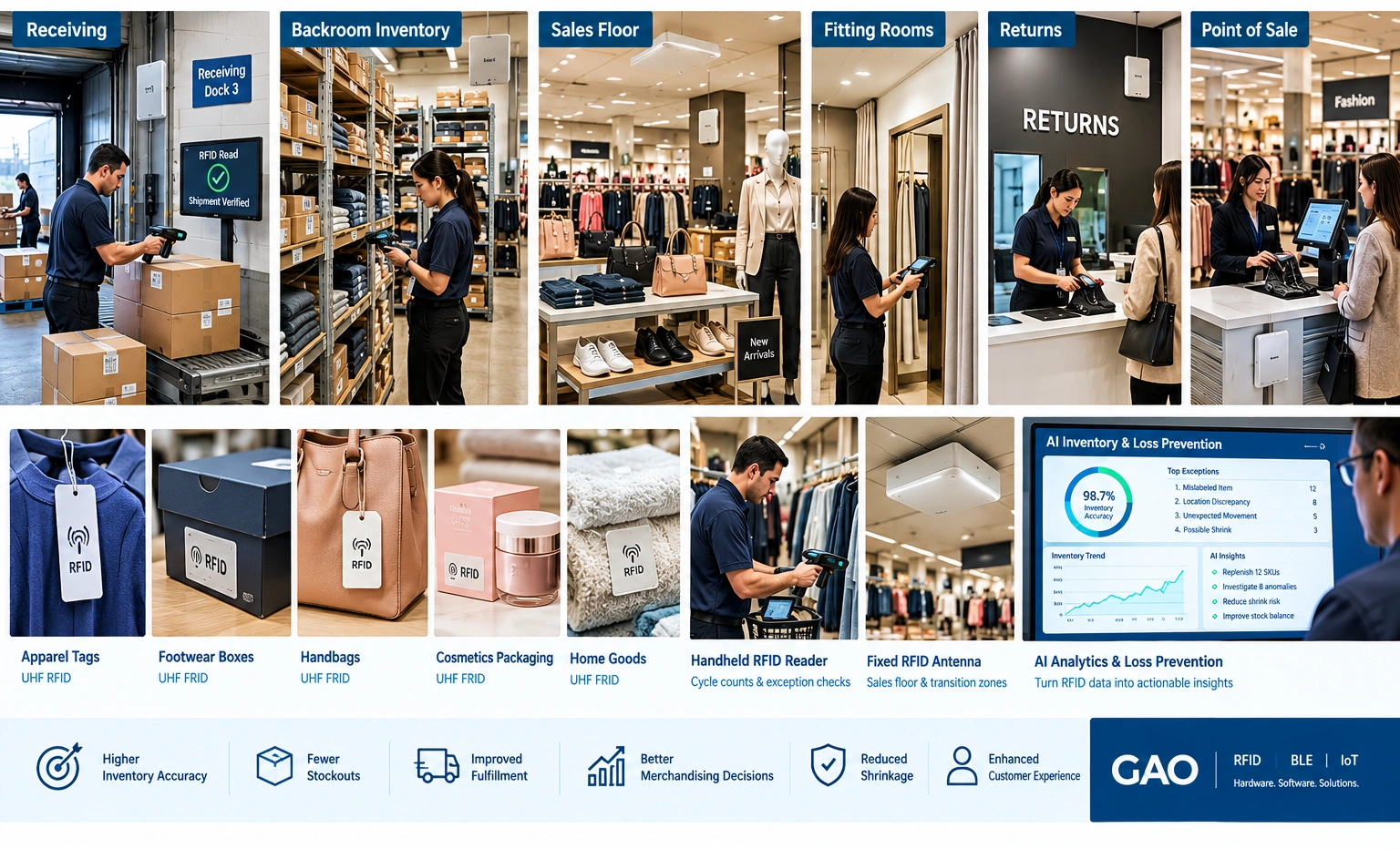
This visual presents a realistic department-store RFID deployment spanning receiving, backroom inventory, sales floor, fitting rooms, returns, and point of sale. It also shows RFID-tagged merchandise, handheld readers, fixed antennas, and an AI inventory and loss-prevention dashboard, emphasizing how physical inventory data supports operational decisions and improved retail performance.
RFID, AI Models, and the Department Store Data Flow
An AI-enabled RFID solution typically starts with physical merchandise identification and ends with an operational decision. The quality of that decision depends on more than the machine-learning model. Reader placement, tag selection, radio-frequency performance, event filtering, data normalization, network connectivity, software integration, and security controls all affect the quality of the information available to the AI system.
A typical department-store flow includes:
- RFID tags and tagged merchandise: Item-level identifiers are attached to products, packaging, hangtags, reusable containers, or other appropriate retail assets.
- RFID readers and antennas: Fixed readers, handheld readers, portal-style installations, or specialized configurations capture tag observations at relevant department-store locations.
- Edge processing: Local processing can filter duplicate reads, validate events, buffer information during network interruptions, and reduce unnecessary upstream traffic.
- Secure network transport: Validated RFID events can be transmitted over the store’s wired or wireless network to retail applications, servers, or cloud services.
- Middleware and data normalization: RFID observations are converted into structured events that can be associated with SKU, location, timestamp, transaction, employee workflow, or inventory records.
- AI and machine learning: Models can detect anomalies, forecast demand, prioritize exceptions, identify patterns, and generate operational recommendations.
- Department-store software integration: RFID and AI outputs can be connected with inventory management, POS, order management, warehouse or distribution systems, loss prevention software, workforce systems, and analytics tools.
- Business action: Store associates, inventory teams, loss prevention personnel, and managers receive alerts, tasks, recommendations, or reports that support a specific operational response.
Technical Components for AI-Powered Department Store Systems
Choosing the Right RFID Technology
UHF RFID is generally well suited to department-store item-level inventory because it supports longer read ranges and the simultaneous identification of multiple tagged products. This makes it useful for receiving, backroom counting, sales-floor inventory, stock movement, and selected transition points.
HF RFID can be appropriate where shorter-range identification and controlled proximity are preferred. LF RFID is typically suited to specialized applications where very short-range operation or particular tag and reader characteristics are required.
The technology selection should be driven by the physical environment and the required read performance rather than by selecting one RFID frequency for every department-store application.
Edge Processing and Store-Level Computing
Processing RFID events close to the store can reduce duplicate data, handle temporary connectivity failures, and support responsive workflows. Store-level computing can also provide a controlled point for protocol conversion, event buffering, filtering, and integration with local systems.
For department stores operating many locations, edge processing can become important where WAN connectivity varies between stores or where critical inventory workflows must continue during temporary upstream service interruptions.
Cloud Version and Server Version
A Cloud Version is appropriate when department stores need centralized analytics across multiple locations, consolidated inventory data, scalable AI model processing, and remote software administration. Cloud-hosted systems can make it easier to compare merchandise movement and inventory performance across stores while maintaining centralized analytics.
A Server Version can run on customer-managed servers, edge servers, private data centers, or other privately hosted infrastructure. This approach can be useful where department stores require greater control over data handling, integration with privately hosted retail systems, or specific internal security and governance requirements.
A hybrid arrangement can also be used, with local processing handling time-sensitive RFID events while centralized infrastructure performs broader analytics and machine-learning workloads.
AI Analytics and Machine Learning
AI models for department-store operations can include anomaly detection, demand forecasting, classification, clustering, time-series analysis, and predictive models. The model should match the operational question.
For example, an anomaly-detection model can identify unusual gaps between expected and observed inventory. A forecasting model can estimate future merchandise demand using sales history, seasonality, promotions, and observed inventory. Classification models can prioritize exceptions according to risk or operational importance.
AI should not replace deterministic retail controls. Business rules, inventory policies, transaction records, and human review remain important, particularly for high-impact loss-prevention decisions.
Security and Data Protection
Department-store RFID systems should use authenticated system access, role-based permissions, encrypted communications where appropriate, network segmentation, secure software configuration, logging, and controlled interfaces to connected retail systems.
Security controls should also account for the broader data flow. RFID event information may become linked with transaction, employee, customer-service, or loss-prevention records. Access should therefore be limited according to operational responsibility, with audit trails supporting incident investigation and system governance.
GAO’s experience supplying RFID and IoT hardware products and systems can support department stores that require practical integration between physical RFID deployments and their broader connected retail operations. GAO also emphasizes product R&D, quality assurance, and technical support across its North American customer base.
End-to-End AI-Powered RFID Workflow for Department Stores
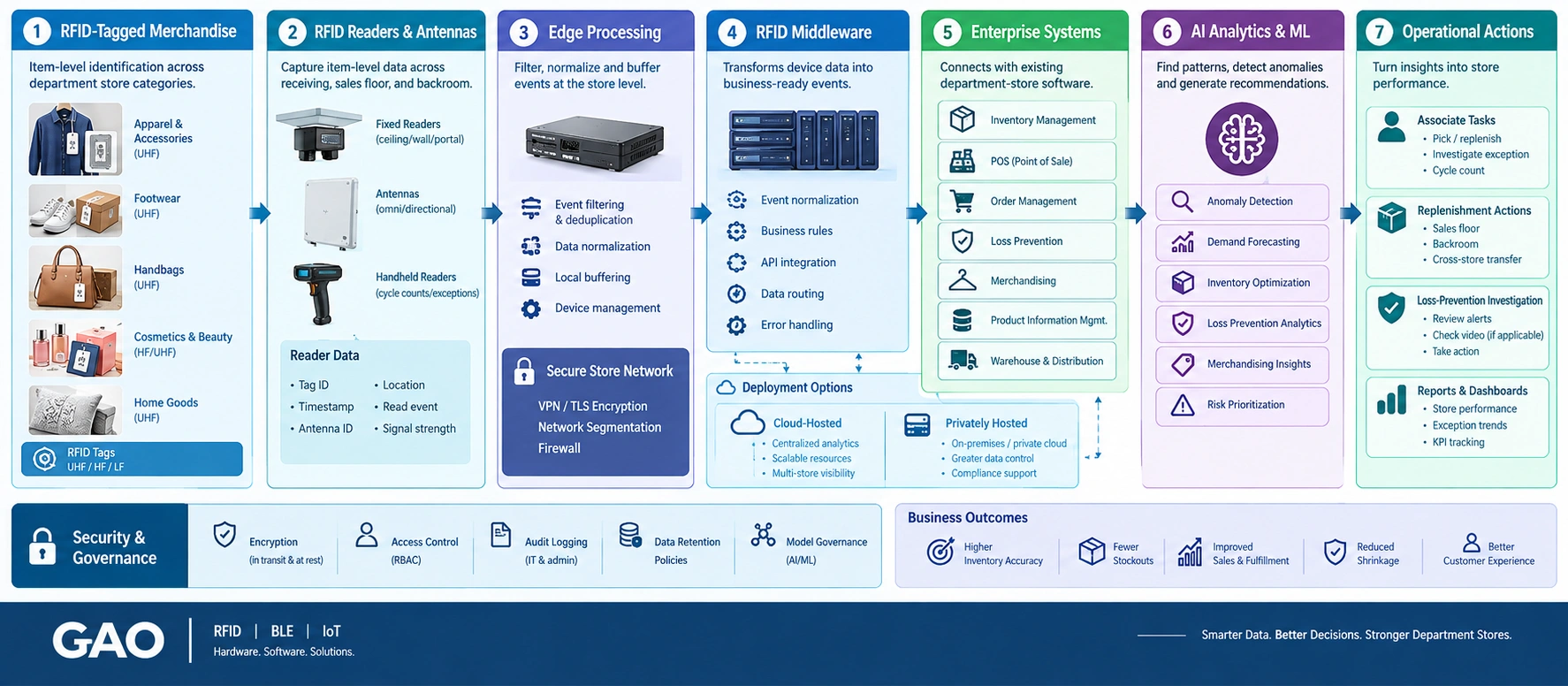
This workflow diagram shows how RFID-tagged department-store merchandise moves through readers, edge processing, middleware, retail systems, and AI analytics. It connects anomaly detection, demand forecasting, inventory optimization, and loss-prevention analysis to associate tasks, replenishment, investigations, reporting, security controls, and measurable business outcomes.
Department Store Integration with Retail Software
AI-driven inventory and store operations depend on integration with existing department-store software. RFID should provide trusted physical observations without attempting to replace core retail applications.
A practical integration design separates hardware data acquisition from business applications. RFID readers and handheld devices communicate with local software or middleware. Middleware converts device-specific events into normalized inventory events that downstream systems can consume.
Common integration points include:
- Inventory management: Receives validated inventory observations and supports reconciliation between system records and physical merchandise.
- Point of sale: Provides transaction data used by AI models to understand sales velocity, product movement, and availability.
- Order management: Supplies omnichannel demand and fulfillment requirements.
- Warehouse and distribution software: Provides shipment and replenishment context for merchandise moving between distribution centers and department stores.
- Merchandising systems: Provides product hierarchy, assortment, location, pricing, promotion, and planogram-related information.
- Loss prevention software: Receives exception data and supports investigation workflows.
- Product information management: Supplies product identifiers and attributes needed to associate RFID identities with merchandise records.
- Business intelligence systems: Consumes aggregated operational data for reporting and management analysis.
API-based integration is generally preferable to tightly coupling RFID hardware directly to individual applications. Message queues or event-streaming mechanisms can also be used when departments need near-real-time inventory events across multiple stores.
A department store should establish a canonical item identifier and consistent location identifiers before broad deployment. Without consistent master data, AI models may identify patterns correctly but still produce operationally incorrect recommendations.
Cybersecurity, Privacy, and Data Governance
A department-store AI and RFID deployment introduces additional connected devices, software interfaces, and operational data flows. Security should therefore be incorporated from initial design through maintenance rather than added after commissioning.
RFID itself generally identifies tagged objects rather than people, but department-store implementations can process data that becomes sensitive when combined with transaction, employee, or customer information. Organizations should define clear boundaries between merchandise telemetry and customer-identifying information.
Important controls include:
- Device authentication for RFID readers, gateways, handheld devices, and IoT equipment.
- Encryption for data transported between stores, servers, middleware, and cloud services.
- Role-based access controls for inventory, loss prevention, merchandising, and IT personnel.
- Network segmentation separating connected retail equipment from unrelated corporate resources.
- Secure API authentication and authorization.
- Logging of administrative actions, configuration changes, and sensitive data access.
- Software and firmware patch management.
- Credential rotation and controlled service accounts.
- Data-retention policies appropriate to each operational dataset.
- AI model governance, including access control for training data and model outputs.
Edge systems should continue to operate safely when cloud connectivity is interrupted. Store operations should have defined degraded modes so a temporary network failure does not prevent basic receiving, replenishment, inventory verification, or checkout processes.
AI recommendations should also be traceable. A loss-prevention alert or inventory exception should ideally preserve the source events and business rules that caused the model to generate the recommendation. This supports investigation, troubleshooting, and operational accountability.
Engineering Considerations for Department Store RFID Deployment
A successful implementation is strongly influenced by physical deployment conditions. Department stores contain varied construction materials, metal fixtures, shelving, glass, liquids, dense merchandise, escalators, elevators, narrow aisles, and constantly changing displays.
RFID reader placement should therefore be engineered around the specific business process.
Receiving areas may require controlled read zones designed to detect merchandise passing through a defined location. Stockrooms may benefit from handheld inventory surveys when merchandise density and rack configurations vary significantly. High-volume sales-floor environments may need carefully positioned fixed readers where continuous detection provides measurable operational value.
Tag selection also matters. Apparel, footwear, cosmetics, metallic packaging, boxed electronics, and merchandise containing liquids can have materially different RF characteristics. On-metal or specialized tag designs may be required for certain products.
Commissioning should include:
- RF site surveys.
- Reader and antenna placement verification.
- Tag-placement testing.
- Read-rate and false-read evaluation.
- Zone-boundary testing.
- Inventory reconciliation testing.
- Middleware event validation.
- API integration testing.
- AI output validation against known operational conditions.
- Store-associate workflow testing.
- Network failover and degraded-mode testing.
- Security and access-control verification.
One important implementation lesson is that a high raw read count does not necessarily indicate a high-quality inventory system. Repeated reads from the same item, reads outside the intended zone, missed products, or incorrect location attribution can produce misleading inventory events. Event filtering and business rules must therefore convert RF observations into reliable operational states.
AI Models for Department Store Decision Support
Different department-store use cases call for different AI methods. A single model should not be expected to handle inventory forecasting, anomaly detection, image interpretation, and fulfillment optimization equally well.
Forecasting Models
Demand forecasting models can use historical sales, seasonality, promotions, product lifecycle, local store behavior, and inventory availability. RFID-derived observations can provide additional evidence about physical availability and movement.
Forecast quality should be monitored separately from inventory accuracy because poor physical inventory data can contaminate otherwise useful demand models.
Anomaly Detection
Anomaly detection is particularly relevant to inventory discrepancies and loss prevention. Models can identify deviations from expected merchandise movement, unusual inventory adjustments, repeated discrepancies, or abnormal patterns across stores or departments.
Human review remains important for sensitive decisions. A model-generated anomaly should normally initiate an investigation rather than automatically trigger disciplinary or customer-facing action.
Computer Vision
Computer vision can complement item-level identification in selected department-store applications. Cameras may support shelf or fixture condition analysis, queue monitoring, visual merchandising verification, or product recognition where appropriate policies and technical controls exist.
Computer vision and RFID can provide different forms of evidence. RFID identifies tagged merchandise, while vision can provide information about visible product placement or physical conditions. Combining them can improve operational context, but it also increases data-governance and privacy considerations.
Optimization and Recommendation Models
Optimization methods can prioritize replenishment, fulfillment, transfer, or allocation decisions based on multiple constraints. Recommendations can incorporate inventory availability, sales demand, store capacity, service levels, and operational workload.
The most useful AI output is often not a complicated prediction but a ranked action list that helps store associates decide what should be done first.
Scaling from a Pilot to a Department Store Network
A department-store chain should normally validate the solution in an environment that represents actual operating complexity rather than selecting only the easiest store.
A useful pilot can include multiple merchandise categories, receiving activity, stockroom processes, sales-floor replenishment, cycle counting, and at least one omnichannel workflow. The pilot should collect both technical performance data and associate feedback.
Scaling decisions should consider:
- Whether item identification is sufficiently reliable for the targeted workflows.
- Whether inventory records become measurably more accurate.
- Whether associate tasks are practical within existing staffing models.
- Whether AI recommendations result in observable operational improvement.
- Whether existing retail software integrations remain stable.
- Whether store network connectivity supports required data flows.
- Whether cybersecurity controls remain manageable as device counts increase.
- Whether maintenance and support requirements are acceptable.
Standardized reader configurations, documented tag-placement rules, reusable middleware interfaces, and repeatable commissioning procedures can reduce deployment variability between stores.
GAO can provide RFID and related IoT hardware for organizations implementing these physical data-capture requirements. A structured deployment process is particularly important when the same department-store chain has materially different store layouts, fixtures, merchandise mixes, and network environments.
Practical Implementation Recommendations for Department Stores
The strongest results generally come from solving a clearly defined operating problem before expanding the technology footprint.
Begin with a process such as inventory accuracy, replenishment, receiving, fulfillment, or loss investigation where better physical data can directly improve a measurable business outcome.
Recommended engineering practices include:
- Define the business event before specifying RFID equipment.
- Establish accurate merchandise and location master data.
- Select UHF, HF, or LF RFID according to the required read distance, item characteristics, and workflow.
- Conduct RF testing using representative department-store merchandise rather than laboratory-only samples.
- Treat middleware as a data-quality layer, not merely a device connection mechanism.
- Integrate AI outputs into existing associate and management workflows.
- Keep humans in the loop for operationally sensitive recommendations.
- Validate AI models against real store conditions and seasonal changes.
- Design cybersecurity controls before readers and gateways are connected to production networks.
- Establish clear ownership between store operations, IT, loss prevention, merchandising, supply chain, and data teams.
- Measure business KPIs alongside RF and AI technical metrics.
- Create repeatable installation, commissioning, maintenance, and troubleshooting procedures.
Department stores should also avoid trying to instrument every process simultaneously. A focused deployment with a clearly measurable return can provide the operational evidence needed to justify broader adoption.
Department Store AI and RFID Deployment Roadmap
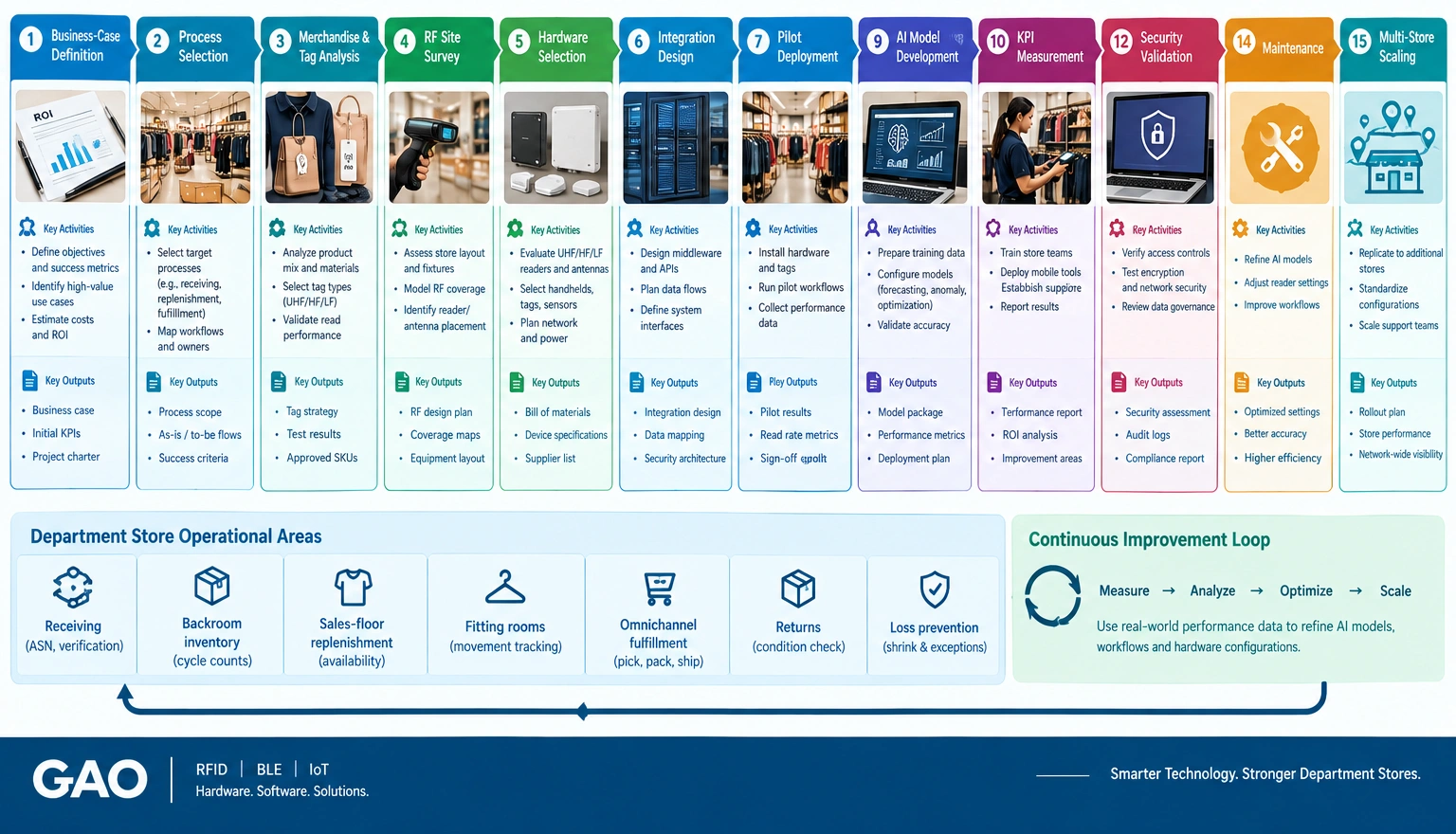
This roadmap visualizes the progression from business-case definition and process selection through RFID analysis, site surveying, hardware and integration design, pilot deployment, AI model development, KPI measurement, security validation, maintenance, and multi-store scaling. It also highlights key department-store operational areas, including receiving, backroom inventory, sales-floor replenishment, fitting rooms, omnichannel fulfillment, returns, and loss prevention, with a continuous measure-analyze-optimize-scale improvement loop.
Business Value of AI-Enabled Department Store Operations
AI becomes more valuable when department stores can give models trustworthy physical inventory information.
More accurate inventory can improve the reliability of replenishment and omnichannel fulfillment. Better exception detection can help associates focus on merchandise that requires attention instead of spending equal effort across all products. Forecasting can become more useful when the system can distinguish theoretical inventory from physically observed inventory.
The combination can also improve scalability. A multi-store operation cannot rely indefinitely on increasingly frequent manual counts and investigations. Automated data capture provides more frequent observations, while AI can help determine where human attention should be allocated.
Security and operational controls can also become stronger when event data, system actions, and AI recommendations are logged consistently. This creates a more auditable operating process.
The business case should nevertheless be evaluated against implementation costs, tagging labor, reader installation, integration work, network changes, software development, device maintenance, and organizational adoption. AI and RFID are most effective when the underlying business process is sufficiently defined to convert improved visibility into action.
Building AI-Enabled Department Store Operations
AI can help department stores move from static inventory records and periodic operational checks toward more continuous, data-driven decision support. RFID provides a practical method for capturing item-level merchandise observations, while AI can interpret those observations alongside sales, orders, product, and operational information.
The strongest deployments focus on concrete department-store problems such as inventory accuracy, replenishment, fulfillment reliability, receiving control, shrink investigation, and merchandising execution. Success depends on more than selecting readers or AI models. It requires reliable master data, carefully engineered RF deployment, effective middleware, secure integration, validated AI outputs, and workflows that store associates can act upon.
GAO provides RFID, BLE, and IoT hardware products and systems that can support these department-store applications. Organizations evaluating AI-enabled inventory and store operations can benefit from defining their highest-value workflow first, establishing baseline KPIs, and engineering the physical and software components around that measurable objective.
Building the Future of Industrial AI and IoT with Aperture Venture Studio and GAO
For more than three decades, GAO has invested heavily in R&D for industrial RFID, BLE, and IoT technologies. As generative AI has become useful for practical industrial and retail applications, we have continued developing AI and IoT solutions, including technologies that connect RFID and BLE data with intelligent software. We founded Aperture Venture Studio to build, launch, and scale next-generation AI and IoT companies and initiatives relevant to industries such as department-store operations.
Aperture has attracted AI and IoT technical experts, experienced executives, investors, and leading companies. We have also developed the Aperture Ventures Summit and TekSummit to facilitate discussion of advanced AI and IoT topics.
GAO welcomes participation from:
- Advisors, co-founders, or employees
- Investors
- Customers