
AI and RFID for Distribution Centers
AI and RFID for Distribution Centers
Distribution centers are under constant pressure to process more orders, maintain accurate inventory, shorten dock-to-stock time, and respond quickly to changing demand. AI-driven warehouse management can address these requirements by converting operational data into predictions, alerts, and automated decisions. RFID provides an important data-capture layer by identifying tagged pallets, cases, cartons, containers, and selected assets without requiring direct line-of-sight scanning. When RFID event data is combined with machine learning, computer vision, warehouse management software, and operational analytics, distribution centers can move from periodic inventory checks toward continuously informed decisions. GS1 standards provide established mechanisms for identification and event data exchange, including EPC-based RFID and EPCIS. GAO supplies RFID, BLE, and IoT hardware products and systems that can support these distribution-center workflows, from RFID readers and tags to connected data-capture infrastructure.
AI and RFID Distribution Center Operations Overview
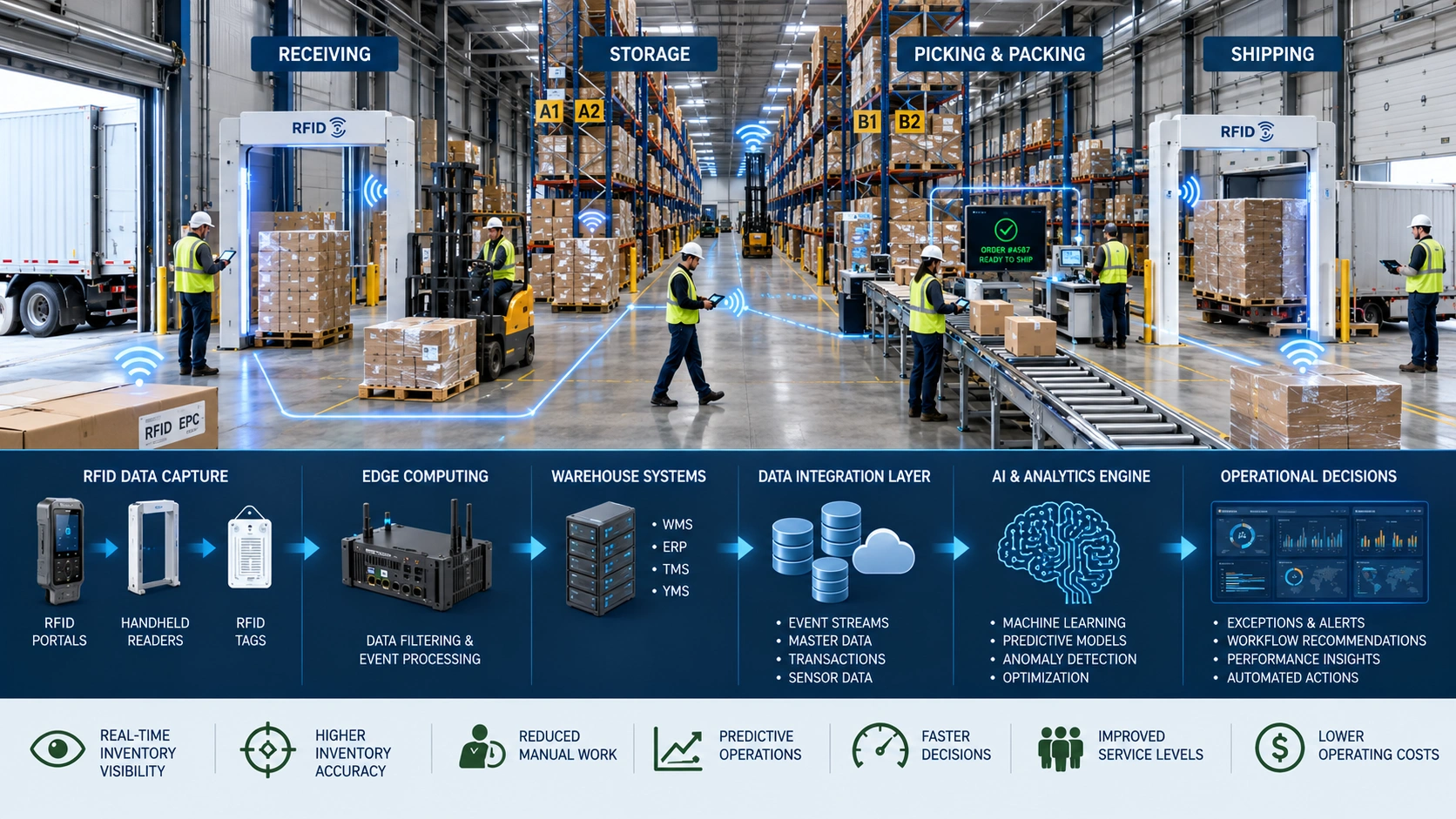
This visual illustrates how RFID-enabled inventory and warehouse operations connect with edge computing, WMS/ERP/TMS/YMS systems, and AI analytics. It shows the flow from physical inventory data capture to AI-driven predictions, alerts, optimization, and operational decisions.
How AI-Driven Distribution Centers Use RFID Data
AI in a distribution center is most valuable when it improves a specific operational decision. Examples include determining which inbound pallets should be prioritized, identifying inventory discrepancies, predicting replenishment requirements, detecting abnormal movement, allocating dock resources, and improving order fulfillment.
RFID contributes machine-readable identification and movement events. A reader can capture multiple tagged objects within an interrogation zone, allowing distribution-center processes such as receiving, staging, inventory verification, and shipping to collect identification data without requiring an operator to scan every individual barcode. GS1 identifies UHF passive RFID, commonly called RAIN RFID, as the most broadly implemented RFID form and notes its ability to capture unique identifiers without line-of-sight contact.
AI adds a decision layer above this operational data.
For example, a distribution center can combine:
- RFID reads from receiving dock portals
- Pallet and case identifiers
- Warehouse Management System inventory records
- Purchase orders and advance shipping notices
- Shipment and carrier information
- Historical receiving and picking times
- Order demand and fulfillment history
- Conveyor and material-handling equipment data
- Environmental or sensor data where relevant
- Worker and equipment activity data
Machine-learning models can then identify patterns that are difficult to detect through static rules alone. A system might flag an inbound shipment whose RFID contents do not match the expected advance shipping notice, identify an unusual dwell time in a staging area, or predict that a particular inventory location requires verification.
The result is not simply more RFID reads. The objective is better distribution-center decisions based on higher-quality operational data.
AI Applications Across Distribution Center Operations
AI Inventory Management and RFID-Based Inventory Visibility
Inventory accuracy directly affects fulfillment performance. When warehouse records do not reflect physical inventory, downstream processes can experience stockouts, misplaced inventory, unnecessary cycle counts, order substitutions, or delayed shipments.
RFID can automatically capture serialized identification from tagged inventory as it moves through designated read zones. GS1 describes RFID inventory management as a way to improve visibility into inventory levels and product locations while supporting more accurate cycle counting.
AI can use these events to identify inventory anomalies rather than simply recording movement.
Potential applications include:
- Predicting inventory discrepancies before they affect order fulfillment
- Identifying locations with unusually high adjustment rates
- Detecting repeated misplacement patterns
- Prioritizing cycle counts according to operational risk
- Estimating inventory confidence by location
- Detecting unexpected movement between warehouse zones
- Supporting dynamic replenishment decisions
- Identifying slow-moving or aging stock
- Correlating inventory discrepancies with specific process steps
This approach allows warehouse supervisors to focus physical verification efforts where the data indicates the greatest probability of an exception.
AI Receiving and Dock Operations
Receiving creates one of the first major data checkpoints in a distribution center. Conventional receiving may involve document verification, barcode scanning, physical inspection, quantity reconciliation, put-away decisions, and inventory-system updates.
RFID can capture tagged cases or pallets as they pass through receiving areas. For suitable deployments, an RFID portal or reader installation can identify multiple items during a single movement event rather than requiring every item to be individually presented to a scanner. GS1 documentation describes RFID use for capturing tagged logistics units and notes that entire pallets can be identified as they pass through a gantry without opening external boxes.
AI can analyze receiving events against expected shipment information.
Examples include:
- Detecting quantity mismatches
- Identifying unexpected pallet or case identifiers
- Predicting receiving bottlenecks
- Prioritizing inspection exceptions
- Estimating dock processing time
- Identifying abnormal dwell time
- Supporting labor allocation
- Predicting put-away requirements
- Detecting repeated supplier or shipment discrepancies
This creates an operational feedback loop between physical receiving activity and warehouse decision-making.
AI Warehouse Slotting and Put-Away Optimization
Warehouse slotting determines where products should be stored based on demand, dimensions, weight, handling requirements, order profiles, and warehouse constraints.
Static slotting rules can become inefficient as SKU velocity changes. AI can analyze historical order activity, seasonal demand, travel distances, inventory movements, replenishment frequency, and congestion patterns to recommend changes.
RFID adds physical movement evidence to the model.
For example, if RFID events show that specific high-velocity SKUs repeatedly travel long distances between storage and picking areas, the AI system can identify the operational pattern and recommend a revised location. Similarly, repeated movement through temporary staging areas may indicate that a put-away process is creating unnecessary handling.
Relevant operational inputs can include:
- SKU velocity
- Pick frequency
- Order-line frequency
- Case and pallet dimensions
- Storage-location capacity
- Forklift travel distance
- Replenishment frequency
- Congestion by warehouse zone
- RFID movement history
- Seasonal demand patterns
- Equipment availability
The AI recommendation should remain subject to warehouse safety rules, load limits, rack specifications, fire-code requirements, and supervisor approval where applicable.
Distribution Center Asset and Material-Flow Intelligence
Distribution centers contain many assets that influence throughput, including pallets, reusable containers, roll cages, totes, carts, forklifts, material-handling equipment, dock equipment, and specialized handling devices.
AI-based asset tracking can use identification events to understand where assets are located, how long they remain in specific zones, and how frequently they circulate.
RFID is particularly useful where passive identification is sufficient and assets regularly pass through defined read zones. For assets requiring longer-range or continuous location awareness, RFID may be combined with BLE, RTLS, cellular connectivity, or other sensing technologies rather than treated as a universal tracking method.
This distinction is important during system design. The correct technology depends on the asset, required location accuracy, read environment, movement pattern, cost constraints, and operational objective.
AI can use the resulting data to:
- Detect unusually long asset dwell times
- Identify bottlenecks in pallet or tote circulation
- Predict reusable-container shortages
- Improve asset allocation
- Detect unexpected asset movement
- Identify underutilized equipment
- Support maintenance planning when equipment telemetry is available
- Analyze congestion around staging and loading areas
GAO can support these deployments with RFID, BLE, and IoT hardware products and systems selected according to the distribution center’s operating environment and tracking requirements.
AI Order Fulfillment and Picking Intelligence
Order fulfillment combines inventory availability, picking efficiency, order priority, labor capacity, equipment availability, and shipping deadlines.
AI can evaluate these variables to improve wave planning, batch-picking decisions, replenishment timing, and exception management. RFID can provide additional evidence about whether inventory physically passed through relevant warehouse zones.
For example, a WMS may indicate that a pallet is available in a particular location, while RFID movement history can provide evidence that the pallet has recently moved or passed through another zone. AI can use these events to identify records requiring verification before a picker is directed to the location.
Potential applications include:
- Predicting picking delays
- Prioritizing urgent orders
- Identifying inventory-location conflicts
- Optimizing batch-picking groups
- Predicting replenishment requirements
- Detecting unusual order-processing patterns
- Improving labor allocation
- Identifying recurring fulfillment exceptions
The practical objective is to reduce the number of decisions that warehouse personnel must make using incomplete or outdated information.
The Technical Foundation for AI and RFID Distribution Center Systems
A production deployment normally consists of several interconnected layers rather than a single RFID device or AI application.
RFID Identification Layer
RFID tags provide electronic identification, while fixed readers, antennas, handheld readers, or integrated reader devices capture tag responses.
UHF RFID is generally the primary candidate for high-volume distribution-center identification because passive UHF systems can capture multiple tagged objects without direct line-of-sight scanning. HF RFID can be appropriate for different proximity and read-zone requirements, while LF RFID may be selected for specialized applications where its physical characteristics provide an advantage.
RFID selection should therefore follow the operational requirement rather than assuming one frequency is suitable for every warehouse process.
GS1’s RFID standards distinguish UHF and HF implementations, while EPC data standards define how Electronic Product Codes and related information are represented.
Reader Communication and Middleware
RFID readers generate raw tag observations that generally require processing before business applications consume them.
Middleware can perform functions such as:
- Reader configuration
- Antenna management
- Read filtering
- Duplicate suppression
- Event generation
- Device monitoring
- Reader health monitoring
- Data normalization
- Location or zone association
GS1 identifies Low Level Reader Protocol, or LLRP, as an interface between RFID readers and software that provides standardized control over reader operations.
Event and Business Data Layer
Raw reads are not automatically equivalent to meaningful business events.
A distribution-center system may transform repeated tag observations into events such as:
- Pallet received
- Case entered staging
- Asset moved to storage
- Inventory verified
- Shipment loaded
- Pallet departed
- Exception detected
GS1 EPCIS provides a standardized approach for sharing visibility event data describing what happened, when it happened, where it happened, why it happened, and related supply-chain context. EPCIS 2.0 also supports sensor data and REST-based integration mechanisms.
This event-oriented approach is valuable for AI because models require structured historical observations rather than an unfiltered stream of duplicate RFID reads.
AI and Analytics Layer
The AI layer can include machine-learning models, anomaly detection, forecasting, optimization algorithms, computer vision, or other Industrial AI methods.
Examples include:
- Demand forecasting
- Inventory anomaly detection
- Dwell-time prediction
- Slotting optimization
- Labor forecasting
- Shipment-risk prediction
- Asset utilization analysis
- Process anomaly detection
Model outputs should be connected to operational workflows. A prediction that does not lead to a useful warehouse action provides limited value.
Warehouse and Enterprise Software Integration
The AI and RFID system may exchange data with:
- Warehouse Management Systems
- Warehouse Control Systems
- Enterprise Resource Planning systems
- Transportation Management Systems
- Order Management Systems
- Labor Management Systems
- Yard Management Systems
- Manufacturing systems where distribution is connected to production
- Business intelligence and analytics software
Integration should define authoritative data ownership, event timing, identifier mapping, error handling, API behavior, and recovery procedures.
Cloud and Server Deployment for Distribution Centers
Distribution-center AI and RFID systems can use cloud-hosted software, privately hosted servers, or a hybrid model.
A Cloud Version can centralize RFID events, analytics, model management, dashboards, and multi-site visibility. This approach is useful for organizations operating multiple distribution centers that need consolidated analytics and centralized software management.
A Server Version can place software on an edge server, customer-managed server, private data center, or other privately hosted enterprise infrastructure. This approach can be appropriate where local processing, network independence, data-control requirements, or integration with existing warehouse systems are important.
A hybrid deployment is often practical. RFID reads can be processed locally to reduce unnecessary network traffic and maintain critical operational functions during temporary connectivity interruptions, while aggregated events and analytics can be synchronized with centralized systems.
Distribution-center deployment decisions should consider:
- Network reliability
- RFID read-event volume
- Latency requirements
- Data retention
- Cybersecurity policies
- Integration with existing WMS infrastructure
- Multi-site reporting requirements
- AI model-management requirements
- Local operational continuity
- IT administration capabilities
The system should also account for RFID-specific engineering factors. Metal racks, liquids, dense product configurations, reader antenna orientation, tag placement, reader power, interference, and portal geometry can affect read performance. GS1 notes that RFID read range varies according to environmental conditions and the presence of absorbing or shielding materials.
Consequently, successful deployment requires site surveys, representative tag testing, read-zone validation, commissioning, exception testing, and ongoing performance monitoring rather than simply installing readers at warehouse doors.
Engineering Considerations Before Deployment
A distribution center should define the business process before selecting RFID hardware or AI models.
Important questions include:
- Which inventory or assets require identification?
- Is item-level, case-level, or pallet-level identification required?
- Which physical locations need automated read zones?
- What constitutes a valid business event?
- What inventory discrepancy rate currently exists?
- Which decisions should AI improve?
- Which WMS or ERP system owns inventory status?
- What latency is acceptable for operational decisions?
- Which processes require local processing?
- What happens when a tag is not read?
- How will false reads and duplicate observations be handled?
- How will RFID read performance be measured?
- Which users can override AI recommendations?
- How will system health and cybersecurity events be monitored?
These questions help prevent a common implementation problem: generating large volumes of sensor data without defining how that data will change warehouse operations.
Technical Capabilities That Improve Distribution Center Performance
Combining AI with automated identification and connected warehouse data can improve distribution-center operations when the resulting information is tied to measurable decisions. The value is not simply the ability to locate a tagged pallet or record an RFID event. The larger opportunity is to use trustworthy physical-process data to identify exceptions, predict operational conditions, and prioritize actions.
Higher Inventory Accuracy and Exception Detection
AI can evaluate RFID-derived inventory events against WMS records, shipment documentation, expected quantities, and historical movement patterns.
This can help distribution-center teams:
- Detect inventory mismatches earlier
- Prioritize locations for cycle counting
- Identify repeated receiving discrepancies
- Detect unexpected inventory movement
- Reduce manual verification effort
- Improve confidence in inventory records
Exception-based inventory management is particularly useful in high-volume facilities where physically checking every location at the same frequency is impractical.
Predictive Warehouse Operations
Historical warehouse events can be used to estimate future operational conditions.
Potential predictive models include:
- Receiving workload forecasts
- Order-volume forecasts
- Picking workload predictions
- Replenishment forecasts
- Dock congestion predictions
- Asset shortage predictions
- Shipment-delay risk
- Inventory aging analysis
- Labor demand forecasting
RFID events can strengthen these models by providing observations of actual physical movement rather than relying exclusively on transaction records.
AI-Driven Anomaly Detection
Anomaly detection can identify warehouse behavior that differs significantly from established patterns.
Examples include an unusually long pallet dwell time, repeated movement between staging locations, unexpected inventory appearing at a shipping portal, or a sudden increase in reader-related exceptions.
The AI system should distinguish between an anomaly and a confirmed operational error. Human review can remain part of the workflow for high-impact decisions.
Computer Vision and RFID as Complementary Data Sources
RFID and computer vision solve different parts of the warehouse visibility problem.
Computer vision can analyze visual conditions such as pallet appearance, package orientation, loading activity, safety conditions, or visible damage. RFID provides electronic identity and movement information.
A distribution center can therefore combine:
- RFID identity data
- Camera-based visual observations
- WMS transactions
- Equipment telemetry
- Order information
- Environmental sensor data
AI can correlate these sources to create a more complete operational picture.
For example, RFID can identify a pallet while computer vision evaluates whether the pallet appears correctly configured for the next process. The appropriate combination depends on the process, lighting conditions, privacy requirements, tag-read environment, and required level of automation.
RFID and Computer Vision Data Fusion for Distribution Centers
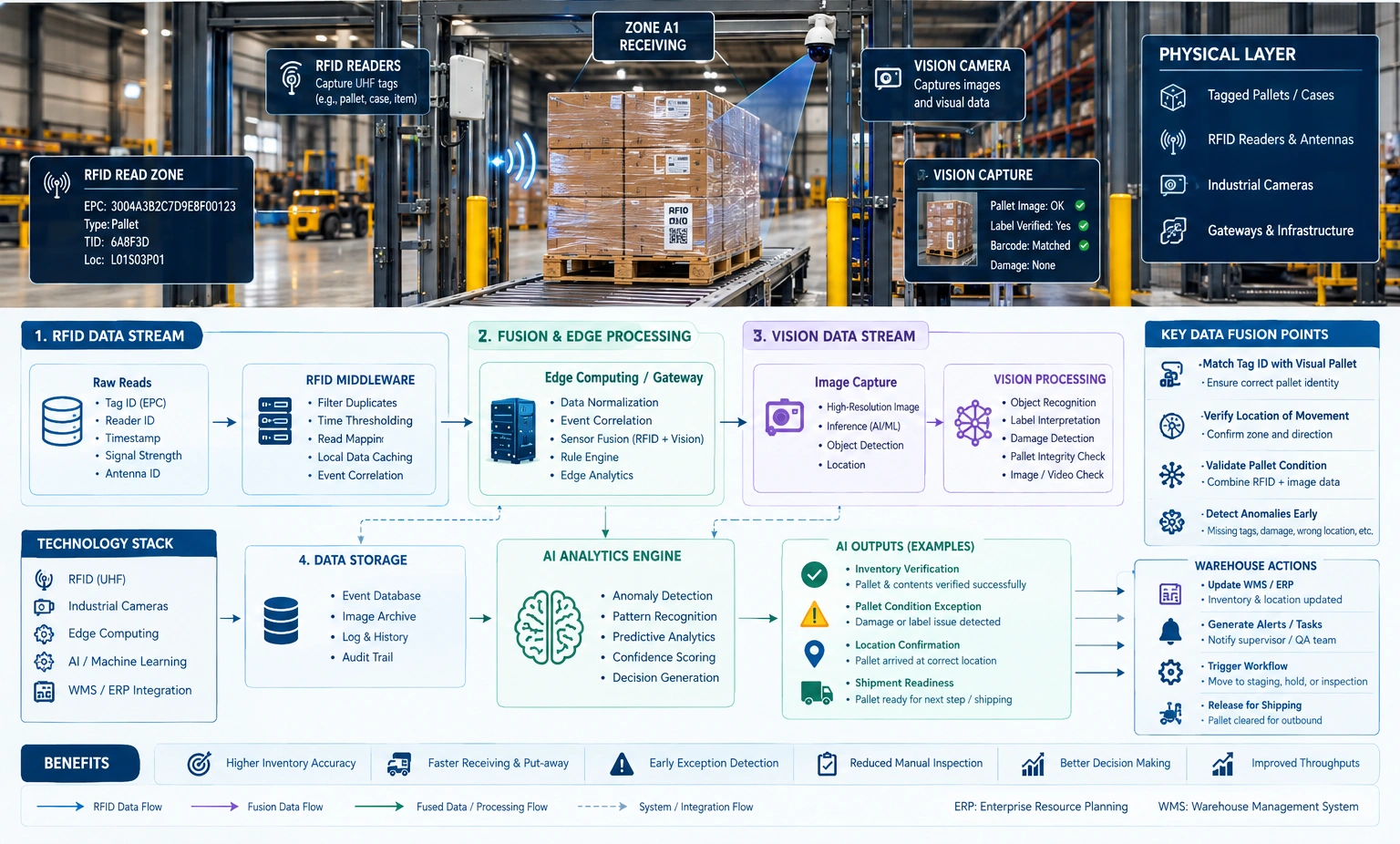
This visual shows how RFID and computer vision capture complementary warehouse data from tagged pallets. The data streams are processed at the edge and analyzed by AI to support inventory verification, pallet-condition checks, location confirmation, anomaly detection, and shipment readiness.
Implementation Lifecycle for AI-Enabled Distribution Centers
Process Assessment and Requirements Definition
The first stage should document the physical and digital workflow.
Engineering and operations teams should map:
- Receiving
- Inspection
- Staging
- Put-away
- Storage
- Replenishment
- Picking
- Packing
- Shipping
- Returns
- Cycle counting
- Asset circulation
- Yard or dock processes
Each workflow should identify where information is generated, where it becomes unavailable or unreliable, and which decisions currently depend on manual observation.
GAO’s experience supplying RFID, BLE, and IoT hardware products and systems can support organizations evaluating the physical data-capture requirements of these workflows.
RFID Site Survey and Hardware Selection
RFID performance depends heavily on the physical environment.
A site survey should examine:
- Rack construction
- Metal surfaces
- Liquid-containing products
- Tag orientation
- Pallet configuration
- Conveyor speed
- Portal dimensions
- Antenna placement
- Reader coverage
- Electrical infrastructure
- Network connectivity
- Adjacent RFID equipment
- Potential radio interference
- Worker movement
- Forklift traffic
Representative products and packaging should be tested before finalizing tag placement and reader configuration.
UHF RFID is often suitable for high-volume logistics processes, but the actual selection should be validated through a controlled pilot rather than assumed from theoretical read-range specifications.
Pilot Deployment and Commissioning
A pilot should represent actual operating conditions rather than a laboratory-only environment.
Testing should include:
- Normal pallet movement
- Different pallet orientations
- Dense tag populations
- Metal-intensive loads
- Liquid products where applicable
- Forklift movement
- Fast-moving objects
- Multiple simultaneous reads
- Reader failure
- Network interruption
- Duplicate observations
- Missed reads
- Incorrect tag placement
Acceptance criteria should be established before the pilot begins.
Data Integration and AI Model Development
Once reliable events are available, the system can integrate them with warehouse and business applications.
AI development should address:
- Data quality
- Missing events
- Duplicate observations
- Labeling requirements
- Historical data availability
- Model training
- Validation datasets
- Model drift
- Alert thresholds
- Human review
- Model monitoring
AI should not compensate for poor RFID deployment or inconsistent warehouse master data. Improving data quality is often a prerequisite for reliable AI outputs.
Cybersecurity and Operational Resilience
Connecting RFID readers, edge servers, warehouse applications, AI software, and cloud services expands the number of systems that require appropriate security controls.
A distribution-center implementation should consider:
- Network segmentation
- Device authentication
- Role-based access control
- Secure administrative interfaces
- Encrypted communications
- Credential management
- Software and firmware update procedures
- Security logging
- Audit trails
- Backup and recovery
- Endpoint protection for applicable servers
- Remote-access controls
- Incident response procedures
- Data-retention policies
RFID readers should not be treated as isolated devices simply because they primarily collect identification data. They can become connected network endpoints and should therefore be included in the organization’s device-management and cybersecurity processes.
Operational resilience is equally important. A temporary connection failure should not necessarily stop receiving or shipping operations. Where operational requirements justify it, local edge processing can retain essential events and synchronize them when connectivity is restored.
AI systems also require governance. High-impact automated decisions should have defined escalation procedures, confidence thresholds, and human override mechanisms.
Interoperability With Warehouse Systems
A distribution center rarely operates a single software application. RFID and AI systems must coexist with established warehouse software and operational equipment.
Interoperability considerations include:
- Identifier consistency
- SKU and item-master synchronization
- EPC or serialized identifier mapping
- Event timestamps
- Location identifiers
- API design
- Message queues
- Database integration
- EPCIS event exchange
- WMS transaction states
- Error handling
- Data reconciliation
- Interface monitoring
EPCIS can provide a standardized mechanism for sharing visibility events across systems, while APIs and other integration methods can connect RFID event processing with WMS, ERP, TMS, and analytics applications.
A practical integration design should establish which system is authoritative for each type of information.
For example, the WMS may remain authoritative for inventory status, while RFID middleware generates physical-observation events. The AI system can then analyze both sources without becoming the authoritative inventory database.
Scaling From One Distribution Center to Multiple Facilities
A successful pilot in one warehouse does not automatically guarantee identical performance elsewhere.
Distribution centers can differ substantially in:
- Building construction
- Rack configuration
- SKU mix
- Tag types
- Palletization practices
- Conveyor systems
- Network infrastructure
- WMS configuration
- Operating procedures
- Throughput
- Labor processes
A scalable deployment should therefore standardize the software and data model where practical while allowing site-specific RFID configuration.
Centralized analytics can compare facilities using common KPIs, while local edge systems can manage site-specific reader operations and operational continuity.
AI models may also require regional or facility-specific calibration. A model trained on one facility’s movement patterns may perform differently in another facility with different product mixes or process layouts.
Practical Trade-Offs When Deploying RFID and AI
Read Coverage vs. Read Isolation
Increasing reader coverage can improve detection probability but may also increase the possibility of unintended reads from adjacent zones.
Portal geometry, antenna positioning, shielding techniques where appropriate, reader configuration, and software filtering should be engineered together.
Automation vs. Human Verification
Automation can reduce repetitive work, but not every exception should be resolved automatically.
High-confidence events can update workflows automatically, while ambiguous events can be routed to warehouse personnel for verification.
Cloud Analytics vs. Local Processing
Cloud systems can simplify multi-site analytics and centralized management. Local processing can reduce latency and provide greater operational resilience.
Hybrid deployment is often appropriate where both requirements matter.
Data Volume vs. Data Quality
More sensor events do not necessarily create better AI.
The system should convert raw observations into meaningful events and remove duplicates, invalid observations, and irrelevant data before feeding operational models.
Item-Level Tracking vs. Pallet-Level Tracking
Item-level RFID can provide detailed visibility but increases tagging requirements and implementation complexity. Pallet-level or case-level identification may provide sufficient value for receiving, storage, and shipping processes.
The appropriate granularity should be determined by the operational decision being improved.
Why AI and RFID Matter for Modern Distribution Centers
AI-enabled distribution centers require reliable physical-world data. Warehouse software can only make useful decisions when its representation of inventory, assets, orders, and movements reflects actual conditions.
RFID can strengthen this physical data layer by automatically identifying tagged objects at defined warehouse checkpoints. AI can then use those observations alongside WMS transactions, order information, equipment data, and historical operational patterns.
The combined approach can support:
- More accurate inventory decisions
- Earlier detection of warehouse exceptions
- Predictive workload management
- Improved receiving visibility
- Better asset utilization
- More informed slotting decisions
- Reduced manual verification
- Improved fulfillment reliability
- More measurable warehouse performance
The most successful deployments start with a specific operational problem and measurable KPI, then select the appropriate sensing, integration, and AI technologies around that requirement.
GAO’s Role in AI-Enabled RFID Distribution Center Solutions
GAO provides RFID, BLE, and IoT hardware products and systems that can support distribution-center identification, tracking, and connected operational workflows. The technology selection can include fixed and handheld RFID readers, RFID tags, antennas, BLE equipment, gateways, and related data-capture hardware depending on the deployment requirements.
Headquartered in New York City and Toronto, Canada, GAO is part of GAO Group, alongside GAO Research and GAO Tek. The companies have served customers across the United States and Canada for approximately three decades, including Fortune 500 companies, research and development organizations, universities, and government agencies. The group emphasizes R&D, quality assurance, and technical support, including remote and onsite assistance.
For distribution centers, this experience is relevant because physical identification technology must operate within real warehouse constraints. Successful deployments depend on appropriate hardware selection, installation engineering, integration, commissioning, and operational support rather than on RFID specifications alone.
Implementation Recommendations for Distribution Center Decision-Makers
Organizations evaluating AI and RFID should avoid treating the project as an isolated technology installation.
A practical approach is to:
- Define the operational problem before selecting technology
- Establish measurable baseline KPIs
- Identify the physical events required for each business decision
- Select RFID frequency and hardware based on the warehouse environment
- Test representative products and packaging
- Validate read zones under actual operating conditions
- Normalize RFID observations into meaningful events
- Integrate events with the WMS and relevant business systems
- Establish data-quality controls
- Introduce AI only where sufficient historical and operational data exists
- Keep human verification for ambiguous or high-impact decisions
- Design cybersecurity controls before production deployment
- Validate local operational continuity requirements
- Monitor read accuracy, system availability, AI performance, and business KPIs
- Scale proven workflows gradually across facilities
The central engineering principle is straightforward: capture the right physical data, convert it into reliable operational events, and use AI to improve a defined warehouse decision.
Building More Intelligent Distribution Centers
AI and RFID can work together to improve how distribution centers understand inventory, assets, material movement, and operational exceptions. RFID supplies automated identification and movement observations, while AI can transform those observations into forecasts, anomaly detection, prioritization, and decision support.
The strongest results come from deployments that connect physical warehouse processes with WMS data, event processing, analytics, and clearly defined operational actions. Site-specific RFID engineering, reliable integration, cybersecurity, data quality, and KPI measurement remain essential.
GAO can help organizations evaluate and deploy RFID, BLE, and IoT hardware products and systems for these workflows. Organizations planning AI-enabled distribution-center initiatives can learn more about GAO’s technology solutions, engineering capabilities, products, and technical support to determine which approach fits their operational requirements.
Building the Future of Industrial AI and IoT with Aperture Venture Studio and GAO RFID Inc.
For more than three decades, GAO has invested heavily in R&D for industrial RFID, BLE, and IoT technologies. As AI has become increasingly useful for industrial applications, we have expanded our work in AI-enabled IoT solutions, including applications that combine AI with RFID and BLE for distribution-center operations. We have also founded Aperture Venture Studio to support the development and scaling of AI and IoT technologies relevant to industries such as warehousing and distribution.
Aperture brings together AI and IoT technical experts, entrepreneurial and operational executives, investors, and leading companies. Through initiatives such as the Aperture Ventures Summit and TekSummit, advanced AI and IoT topics can be explored with technical and industry communities.
We welcome qualified organizations and professionals to engage with us as:
- Advisors, co-founders, or employees
- Investors
- Customers