
AI and RFID for Electronics Retail
How AI Is Transforming RFID-Based Electronics Retail Operations
AI is changing electronics retail by turning item-level inventory data into actionable decisions for merchandising, replenishment, fulfillment, loss prevention, and store operations. When AI software analyzes data captured through UHF RFID, HF RFID, and LF RFID systems, retailers can move beyond periodic stock counts toward continuous visibility of high-value products such as smartphones, laptops, tablets, cameras, gaming consoles, wearables, networking equipment, and accessories. This combination supports AI inventory management, AI asset tracking, demand forecasting, anomaly detection, and intelligent replenishment. RFID provides the physical identification layer, while AI interprets large volumes of product movement and inventory data to identify patterns and operational exceptions. For electronics retailers managing fast product turnover, omnichannel orders, high-value merchandise, and frequent inventory discrepancies, this approach can improve inventory accuracy while reducing manual counting and enabling faster operational decisions.
AI-Driven Electronics Retail with RFID: Inventory, Fulfillment and Loss Prevention
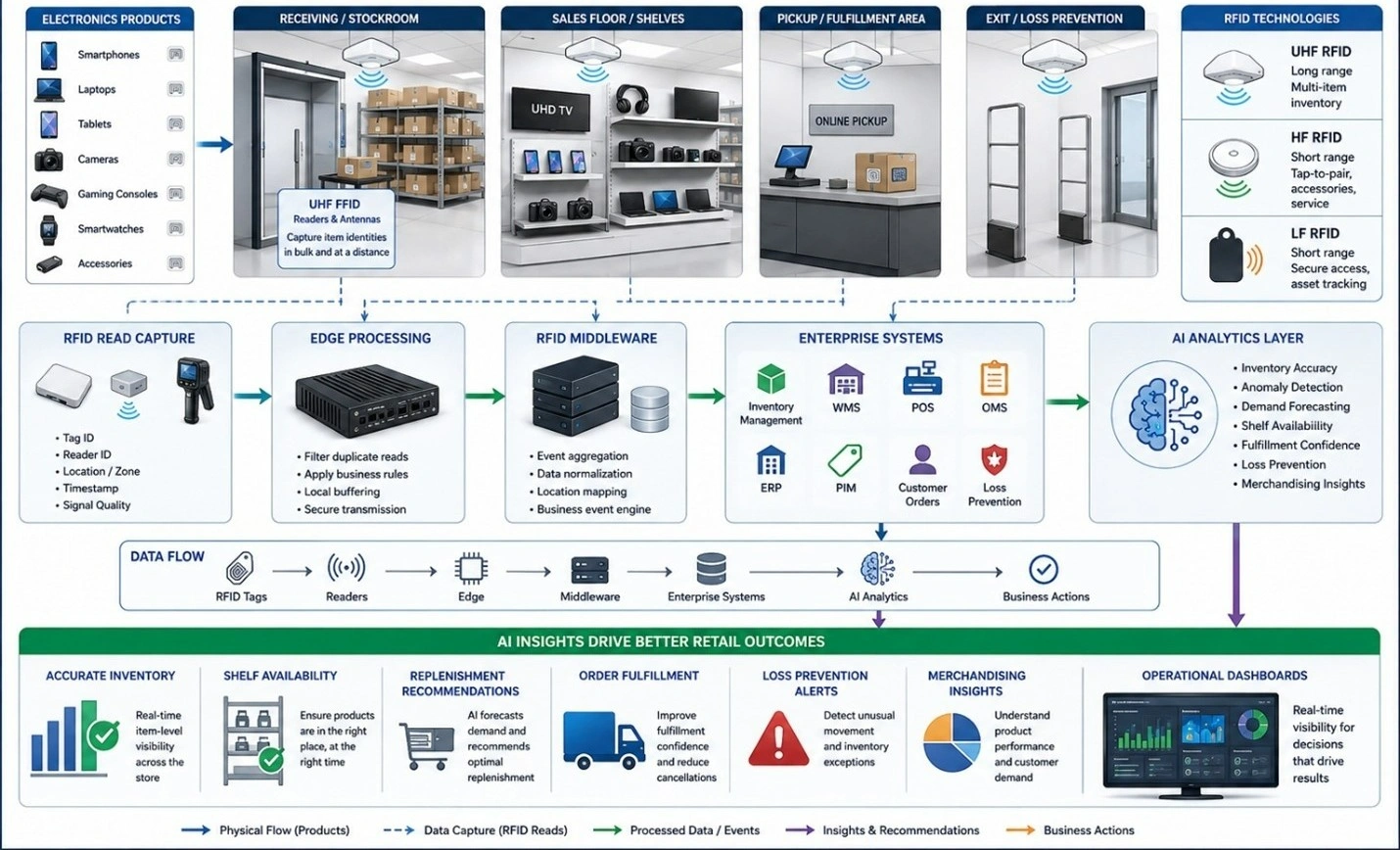
This infographic illustrates how RFID-tagged electronics move through receiving, stockrooms, sales floors, pickup areas, and store exits. It shows how UHF, HF, and LF RFID data flows through edge processing, RFID middleware, enterprise retail systems, and AI analytics to deliver inventory accuracy, shelf availability, replenishment recommendations, fulfillment improvements, loss prevention alerts, and merchandising insights.
What AI-Driven RFID Means for Electronics Retail
Traditional electronics retail inventory processes often depend on barcode scanning, manual cycle counts, point-of-sale transactions, receiving records, and employee observations. These sources remain important, but they can provide an incomplete picture of where an individual product is physically located and whether its digital inventory status reflects reality.
RFID changes the data acquisition process by allowing tagged products to be identified without requiring every item to be individually positioned in front of a barcode scanner. For electronics retailers, this can be particularly useful when large quantities of similar products are stored in stockrooms, placed in display areas, transferred between locations, staged for pickup, or prepared for shipment.
AI adds an analytical layer to these item-level events. Rather than treating each RFID read as an isolated transaction, AI software can evaluate historical movement, inventory positions, sales activity, replenishment patterns, product categories, store conditions, and operational events.
Potential AI applications include:
- AI inventory management: Detect inventory discrepancies and estimate the availability of products across sales floors, stockrooms, and fulfillment areas.
- AI asset tracking: Monitor the movement and status of high-value electronics, demonstration units, service equipment, and controlled inventory.
- AI demand forecasting: Combine historical sales, inventory movement, seasonality, promotions, and other available business data to improve replenishment decisions.
- AI anomaly detection: Identify unusual movement patterns, unexpected product disappearance, duplicate reads, prolonged inactivity, or discrepancies between physical and digital inventory.
- AI shelf availability analysis: Determine whether products expected to be available for customers are actually present in the appropriate retail location.
- AI order fulfillment: Use item-level inventory information to help determine whether a store can reliably fulfill a pickup, delivery, or ship-from-store order.
- AI loss prevention: Identify inventory movement patterns that warrant operational review, particularly for high-value products.
- AI merchandising analytics: Analyze product presence and movement to support assortment, display, and replenishment decisions.
For GAO, the engineering objective is not simply to add RFID readers to an existing retail environment. The more valuable objective is to create reliable item-level data that electronics retail software can use for operational decisions.
Electronics Retail Workflows Where AI Delivers the Most Value
AI-driven RFID solutions can support multiple points in the electronics retail lifecycle. The strongest applications usually occur where physical inventory movement has a direct relationship with revenue, customer experience, fulfillment performance, or shrink.
Receiving and Stockroom Inventory
Receiving is one of the first points where an electronics retailer can establish reliable item-level inventory information.
When products arrive from distribution centers or suppliers, RFID reads can help associate physical merchandise with purchase orders, shipment records, product identifiers, and expected quantities. AI can subsequently compare receiving information with historical discrepancies and identify unusual receiving patterns.
For example, a store receiving multiple cartons of laptops and tablets may use RFID to establish item-level visibility before merchandise reaches the sales floor. AI-based exception analysis can highlight differences between expected and observed quantities, allowing employees to investigate discrepancies rather than repeatedly recounting every product.
This is particularly useful where electronics have similar packaging and model variants. A traditional count can confirm quantity while still making it difficult to identify exactly which SKU or serialized product is missing.
Sales Floor and Shelf Availability
Electronics stores often have a complex relationship between displayed inventory and sellable inventory. A product may exist somewhere within the store while remaining unavailable to a customer because it is in a stockroom, misplaced in another department, reserved for an order, or incorrectly recorded as available.
RFID events can provide additional physical evidence, while AI can classify inventory conditions and prioritize exceptions.
For example, if a particular smartphone model has strong sales activity but repeated RFID observations indicate that the item is not present in its expected display or replenishment area, the system can generate a task for store personnel.
This moves the process from broad inventory reporting toward AI-assisted shelf availability.
Omnichannel Order Fulfillment
Ship-from-store, buy-online-pickup-in-store, and same-day fulfillment depend heavily on accurate inventory.
An electronics retailer may show a product as available online even though the physical item cannot be located. This can result in canceled orders, delayed fulfillment, substitutions, and customer dissatisfaction.
AI can evaluate RFID-derived inventory positions together with order information and other retail data to improve fulfillment confidence. A fulfillment system can prioritize locations where the physical presence of the requested item has recently been verified.
The result is not merely more inventory data. It is better decision support for selecting the appropriate store or inventory location.
High-Value Product Loss Prevention
Smartphones, laptops, cameras, gaming hardware, premium headphones, and other electronics have significant unit values and can create substantial exposure when inventory disappears without corresponding sales or transfer records.
AI anomaly detection can examine movement sequences and identify events that differ from expected operational behavior.
Examples include:
- A high-value product moving repeatedly between defined zones without a corresponding transaction.
- A product disappearing from expected RFID observation areas for an unusual period.
- Physical inventory counts diverging from point-of-sale records.
- Unexpected movement occurring outside normal operating processes.
- A group of products exhibiting unusual movement compared with historical store behavior.
AI should not automatically interpret every anomaly as theft. Environmental factors, reader coverage, tag performance, inventory transfers, and legitimate employee activity can create apparent anomalies. A properly designed system therefore uses AI to prioritize investigation rather than replace established loss-prevention procedures.
Returns, Repairs, and Demonstration Equipment
Electronics retailers also manage products that are no longer part of ordinary sellable inventory.
Returned devices may enter inspection, refurbishment, repair, quarantine, open-box, or resale workflows. Demonstration products may move between displays, storage areas, service desks, and replacement inventory.
RFID can establish item identity while AI helps identify products that remain in an operational state longer than expected.
For example, an AI workflow could flag demonstration equipment that has not been reconciled with a defined store process or identify returned products that remain in an inspection state beyond the expected processing interval.
From RFID Data Capture to AI-Driven Retail Decisions
A production electronics retail solution requires more than tags and readers. The complete workflow begins with physical identification and continues through communications, data processing, retail software integration, analytics, and employee action.
A typical workflow can be represented as:
RFID-tagged product → RFID reader → captured RFID event → edge or local processing → RFID middleware → inventory and retail systems → AI analytics → operational recommendation → employee or automated action → updated inventory state
The first stage is physical data acquisition. UHF RFID is generally suited to many electronics retail inventory applications because it can support longer-range item identification and simultaneous reading of multiple tagged products. HF RFID can be appropriate for shorter-range identification scenarios, while LF RFID is generally associated with lower-frequency, shorter-range applications where its characteristics fit the specific operational requirement.
Reader placement is an engineering consideration rather than a simple coverage exercise. Electronics stores contain metal shelving, electronic equipment, displays, packaging materials, power infrastructure, and other objects that can influence radio-frequency performance. Product packaging and device construction can also affect tag selection and read reliability.
The reader produces events containing information such as tag identity, reader identity, antenna or read point, timestamp, and potentially other contextual information. Middleware can filter duplicate reads, apply business rules, normalize data, and transform raw RFID observations into useful inventory events.
The resulting data can then be integrated with systems such as:
- Retail inventory management software
- Point-of-sale systems
- Warehouse management systems
- Order management systems
- Enterprise resource planning systems
- Product information systems
- Customer order and pickup systems
- Loss prevention software
- Business intelligence and analytics tools
- Maintenance and service systems
AI models operate on this structured data rather than simply analyzing raw radio-frequency observations. Depending on the application, methods can include anomaly detection, classification, time-series forecasting, pattern recognition, optimization, and machine learning.
The final stage is the business action. An AI system may recommend a cycle count, create a replenishment task, identify a fulfillment location, prioritize a discrepancy for investigation, or update an inventory confidence score.
AI-Driven Electronics Retail RFID Workflow: From Item Tracking to Intelligent Decisions
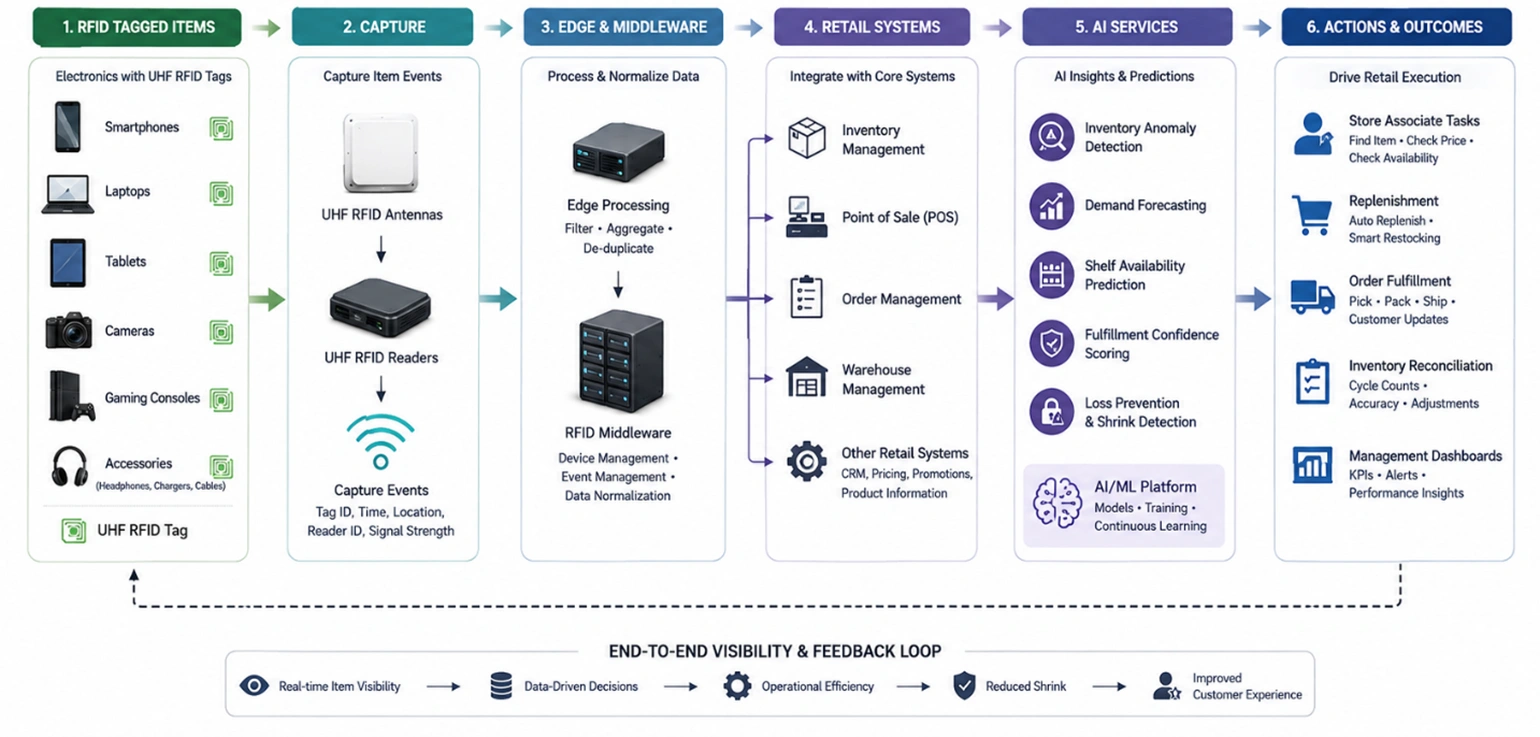
This workflow diagram illustrates how UHF RFID captures real-time electronics inventory data and moves it through edge processing, RFID middleware, retail systems, and AI services. It shows how AI-powered insights support anomaly detection, demand forecasting, shelf availability, fulfillment, loss prevention, replenishment, and inventory reconciliation.
AI, RFID Hardware, Software, and Retail Systems
A practical electronics retail deployment combines several technical layers. The selection of each component should reflect the physical environment, product characteristics, required read distance, inventory volume, integration requirements, and operational objectives.
RFID Hardware for Electronics Stores
UHF RFID readers, antennas, and tags can support item-level inventory visibility across stockrooms, sales areas, receiving zones, and controlled movement points. Tag selection requires particular attention because electronics frequently contain metal components, batteries, conductive surfaces, and specialized packaging.
HF RFID may be appropriate for applications requiring shorter read distances or controlled proximity. LF RFID can support specialized identification scenarios where its frequency characteristics and short-range behavior are appropriate.
Reader configuration should consider antenna polarization, mounting position, read zones, interference, tag orientation, product density, and the required distinction between adjacent operational areas.
Edge Processing and RFID Middleware
Edge processing can reduce unnecessary data transmission by filtering and normalizing RFID events close to the point of collection. This is useful when stores have multiple readers producing large quantities of repeated observations.
RFID middleware can convert raw reads into business-relevant events such as:
- Product entered stockroom
- Product moved to sales floor
- Product detected at pickup area
- Product observed at receiving station
- Product missing from expected location
- Product associated with an inventory discrepancy
This abstraction is important because retail applications generally require business events rather than thousands of raw reader observations.
AI Models for Electronics Retail
The AI layer should be selected according to the decision that needs to be improved.
Anomaly detection can identify unusual inventory movement or discrepancies.
Time-series forecasting can support demand prediction for products with changing sales patterns.
Classification models can categorize inventory conditions or operational exceptions.
Optimization models can support replenishment and fulfillment decisions when multiple constraints must be considered.
Computer vision, when deployed alongside RFID, can provide visual context for shelf conditions, product placement, or customer-facing displays. Combining visual data with RFID can be particularly useful when the retailer needs both product identity and physical scene information.
Cloud Version and Server Version
A Cloud Version can host AI analytics, dashboards, data services, and application software within managed cloud infrastructure. This model can be useful for retailers operating many stores that require centralized analytics, remote monitoring, software updates, and consolidated inventory visibility.
A Server Version can deploy relevant software on customer-managed servers, private data centers, edge servers, or other privately hosted infrastructure. This approach may be appropriate where electronics retailers require greater control over data location, integration boundaries, network availability, or internal security policies.
A hybrid deployment can also be appropriate. RFID event processing can occur locally at a store or regional facility, while aggregated data and AI analytics are transmitted to centralized infrastructure.
The correct deployment model depends on network reliability, latency requirements, data governance, existing retail IT systems, cybersecurity requirements, scale, and the retailer’s operational support model.
Engineering Considerations for Electronics Retail RFID Deployment
RFID performance should be validated against the actual electronics retail environment rather than assumed from laboratory specifications.
Product composition is one of the first considerations. Metal housings, batteries, cables, packaging, and dense product arrangements can affect tag performance. The same RFID tag may behave differently when attached to a laptop, smartphone package, camera, or accessory.
Reader placement also determines whether the system can distinguish meaningful operational zones. A stockroom reader should not inadvertently capture products from a neighboring sales area if the business logic interprets every read as a stockroom movement.
Commissioning should therefore include physical site surveys, tag testing, reader tuning, read-zone validation, event filtering, and integration testing.
Key deployment considerations include:
- RFID tag selection for specific electronics products and packaging.
- Read-zone design for receiving, stockrooms, sales floors, pickup areas, and controlled exits.
- Reader and antenna placement based on actual store construction.
- RF interference testing around electronic equipment and infrastructure.
- Middleware rules for duplicate-read suppression and event normalization.
- Integration with POS, inventory, order management, and other retail systems.
- AI model validation against historical inventory and transaction data.
- Exception-handling workflows for false positives and incomplete reads.
- Cybersecurity controls for connected readers, edge systems, APIs, and data services.
- Monitoring of reader health, tag performance, connectivity, and data quality.
GAO’s experience supplying RFID, BLE, and IoT hardware products and systems provides a practical foundation for organizations evaluating these physical data-capture requirements. GAO has served organizations in the United States and Canada for three decades, including Fortune 500 companies, research organizations, universities, and government agencies, with an emphasis on product R&D, quality assurance, and technical support.
Business Benefits of AI-Driven RFID for Electronics Retail
The value of AI-driven RFID in electronics retail comes from connecting physical product visibility with operational decisions. RFID provides item-level observations, while AI can interpret those observations alongside sales, order, inventory, and operational data.
Higher Inventory Accuracy
Inventory accuracy is particularly important for electronics because a relatively small number of high-value products can represent significant revenue. An inventory system may report that ten laptops are available, while only eight can actually be located by store personnel.
AI can identify recurring differences between system inventory and physical observations, allowing retailers to focus cycle counts and reconciliation activities where they are most needed.
The resulting process can move from broad manual counting toward risk-based inventory verification. Products, locations, or stores with persistent discrepancies receive greater attention, while stable inventory requires less manual intervention.
Improved Product Availability
Customer-facing availability depends on more than whether a SKU exists somewhere in the building. The product must be physically accessible and associated with the correct selling or fulfillment process.
AI can combine recent RFID observations with sales velocity, expected stock levels, and order demand to identify products that require replenishment.
For electronics retailers, this can help address situations such as:
- A popular smartphone remaining in the stockroom while the display area is empty.
- A laptop showing as available online but not recently observed in the expected fulfillment area.
- Gaming accessories accumulating in storage while customer-facing locations require replenishment.
- A product being physically present but incorrectly associated with another inventory state.
Faster Fulfillment and Fewer Canceled Orders
Accurate item-level information can improve confidence when selecting inventory for online orders.
AI can evaluate the recency and reliability of product observations before recommending a store for fulfillment. This creates an important distinction between system availability and confidence in physical availability.
A retailer can therefore use inventory confidence as an additional decision variable when routing orders.
More Targeted Loss Prevention
AI-driven anomaly detection can help loss-prevention teams focus on unusual inventory behavior rather than reviewing every movement manually.
For example, the system could assign a higher investigation priority to a serialized laptop that repeatedly moves through unexpected zones without corresponding transactions. Legitimate operational explanations can then be checked before further action is taken.
This approach can reduce unnecessary investigation while improving visibility into potentially significant discrepancies.
Better Labor Utilization
Manual inventory counting can consume substantial store labor, particularly when products are distributed across multiple stockrooms, displays, cages, service areas, and pickup locations.
RFID can automate much of the identification process, while AI can determine which exceptions deserve human attention.
Employees can consequently spend less time searching for products and more time on customer service, fulfillment, merchandising, receiving, and exception resolution.
AI and RFID Security for Electronics Retail
Connected retail infrastructure introduces cybersecurity considerations across RFID readers, edge computers, middleware, APIs, databases, cloud services, and enterprise applications.
RFID itself should not be treated as an isolated security component. The complete data path requires appropriate controls from the store environment to the applications consuming RFID-derived information.
Relevant controls can include:
- Device authentication for RFID readers and connected edge equipment.
- Network segmentation between RFID infrastructure and sensitive retail systems.
- Encryption for data transmitted between stores, edge systems, servers, and cloud services.
- Role-based access controls for inventory, loss-prevention, and operational applications.
- API authentication and authorization for retail system integrations.
- Audit logging for inventory changes and administrative actions.
- Secure software and firmware update procedures.
- Monitoring for unusual device behavior or communication patterns.
- Data retention policies appropriate to operational requirements.
- Backup and recovery procedures for critical inventory information.
AI models introduce additional considerations. Retailers should understand what data is used for model development, how predictions are generated, and how operational recommendations are validated.
An anomaly score should not automatically become an irreversible business action. Human review can remain important for sensitive decisions involving loss prevention, employee activity, customer orders, or inventory adjustments.
GAO can support the hardware and system side of these deployments by helping organizations select RFID, BLE, and IoT components appropriate to the physical environment and integration requirements. Technical design should always consider the retailer’s existing cybersecurity controls rather than treating RFID infrastructure as a separate operational island.
Data Quality Determines AI Performance
AI cannot compensate indefinitely for poor physical data.
If tags are poorly attached, readers are incorrectly positioned, read zones overlap, or middleware generates excessive duplicate events, AI models may learn from unreliable information.
For electronics retail deployments, data quality should therefore be treated as an engineering KPI.
Important measures can include:
- RFID read reliability by product category.
- False-positive event frequency.
- Duplicate event rate.
- Inventory reconciliation accuracy.
- Percentage of products with valid RFID association.
- Reader uptime.
- Communication availability.
- Event-processing latency.
- Percentage of AI alerts confirmed as operationally relevant.
- Model prediction or classification accuracy where applicable.
Tag performance should also be evaluated across representative electronics products. A tag that performs reliably on cardboard accessory packaging may behave differently when attached to a metal laptop enclosure or product containing a battery.
Pilot testing should therefore use actual merchandise rather than relying exclusively on generic RFID test objects.
Real-World RFID Deployment in an Electronics Retail Store
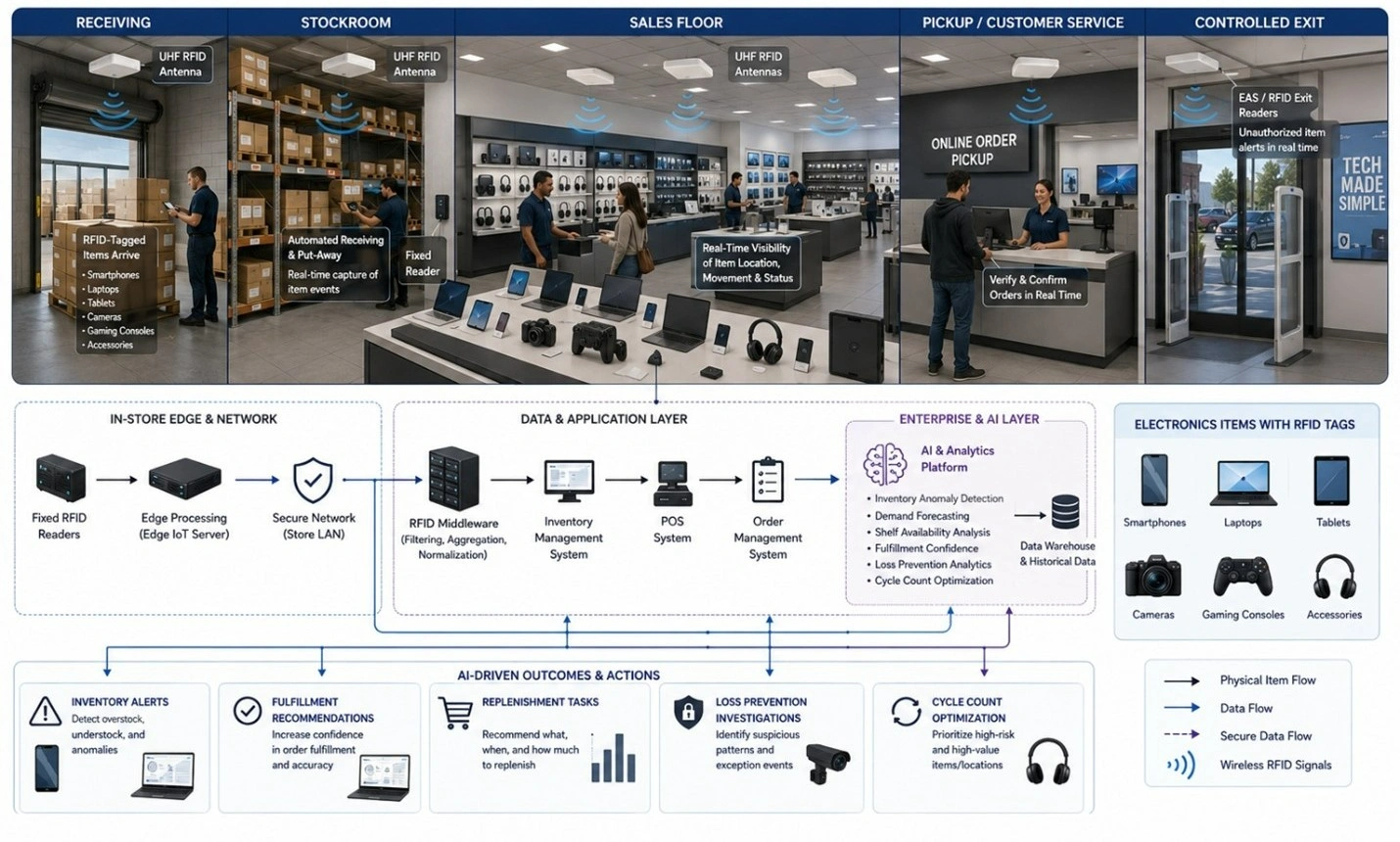
This technical cutaway illustrates how RFID is deployed across receiving, stockrooms, sales floors, pickup areas, and controlled exits in a modern electronics store. It connects RFID-tagged products and readers to edge processing, retail systems, AI analytics, and operational outcomes such as inventory alerts, fulfillment recommendations, replenishment, loss prevention, and cycle-count optimization.
Electronics Retail AI and RFID Implementation Lifecycle
A successful deployment should be treated as an operational transformation project rather than simply an RFID installation.
Requirements and Site Assessment
The first stage is identifying the business problem.
A retailer should establish whether the priority is inventory accuracy, product availability, fulfillment reliability, loss prevention, receiving efficiency, asset visibility, or another measurable objective.
The physical environment should then be assessed. Engineers should document store layouts, stockroom configurations, product materials, reader locations, network connectivity, existing software, and operational workflows.
RFID Tag and Reader Selection
Tag selection should be based on actual products and mounting locations.
Relevant variables include:
- Product material.
- Packaging construction.
- Metal content.
- Battery presence.
- Required read distance.
- Tag orientation.
- Product density.
- Environmental conditions.
- Expected tag attachment method.
- Required durability.
Reader and antenna selection should follow the desired read-zone behavior rather than simply maximizing read range.
Pilot Deployment
A controlled pilot can validate the technical and operational assumptions before multi-store deployment.
A useful pilot should include representative electronics, realistic employee workflows, actual receiving and replenishment processes, and integration with relevant retail software.
Testing should evaluate both successful reads and failure conditions.
AI Model Development and Validation
Historical inventory and transaction data can be used to establish baseline patterns. AI models can then be evaluated against known operational events.
For anomaly detection, validation should include legitimate exceptions so the system does not treat normal retail activity as abnormal.
Demand forecasting should likewise account for promotions, product launches, seasonality, stockouts, and rapidly changing electronics product lifecycles.
Integration and Commissioning
After the physical RFID deployment is validated, software integrations can be commissioned.
Testing should cover:
- Product identification.
- Receiving transactions.
- Inventory adjustments.
- Sales events.
- Returns.
- Transfers.
- Order fulfillment.
- Product relocation.
- Exception generation.
- User permissions.
- Data synchronization.
- Failure recovery.
Continuous Optimization
Electronics retail changes rapidly. New smartphone generations, gaming consoles, laptops, accessories, promotions, store layouts, and fulfillment models can alter the data patterns used by AI.
AI and RFID systems should therefore be monitored after deployment.
Model performance, reader health, data quality, tag behavior, and operational outcomes should be reviewed periodically.
Key KPIs for AI-Enabled Electronics Retail Inventory
Retailers should define measurable outcomes before deploying the solution.
Potential KPIs include:
- Inventory accuracy percentage.
- Item-level inventory visibility.
- Shelf availability.
- Stockout frequency.
- Order cancellation rate.
- Ship-from-store fulfillment success.
- Buy-online-pickup-in-store fulfillment accuracy.
- Inventory search time.
- Cycle-count labor hours.
- Receiving reconciliation time.
- Inventory discrepancy rate.
- Shrink or unexplained inventory loss.
- Product replenishment response time.
- RFID reader uptime.
- RFID event-processing latency.
- AI alert precision.
- Exception resolution time.
- Return-processing cycle time.
- Demonstration-unit reconciliation rate.
The appropriate KPI set depends on the original business problem. A retailer primarily concerned with fulfillment should not judge the project solely on reader coverage. Similarly, a loss-prevention project requires different success measures from a stockroom inventory project.
Practical Recommendations for Electronics Retailers
AI-driven RFID should be implemented around specific operational decisions rather than technology availability alone.
Start with a measurable retail problem such as inaccurate inventory, unreliable store fulfillment, high-value product discrepancies, or excessive manual counting.
Use actual electronics products during RFID testing. Product composition can have a significant effect on tag performance and read reliability.
Design read zones around business processes. Receiving, stockrooms, sales floors, pickup areas, and exits have different requirements and should not automatically share identical reader configurations.
Keep raw RFID processing separate from AI decision logic. Middleware should transform noisy physical observations into reliable business events before analytics consumes the data.
Integrate RFID-derived events with POS, inventory, order management, warehouse, and other relevant systems so AI has the contextual information required for useful decisions.
Use human-in-the-loop workflows for high-impact decisions. AI should prioritize exceptions and provide evidence rather than making unsupported conclusions.
Plan for cybersecurity from the beginning. RFID readers, edge computers, middleware, APIs, databases, and cloud services should be incorporated into the retailer’s existing security controls.
Finally, measure the deployment using operational KPIs. The goal is not simply to increase the number of RFID reads. The goal is to improve inventory accuracy, product availability, fulfillment reliability, loss prevention, labor efficiency, and other measurable electronics retail outcomes.
AI-Driven RFID as a Foundation for Smarter Electronics Retail
AI and RFID can give electronics retailers a more detailed understanding of how products move through receiving, stockrooms, sales floors, pickup areas, fulfillment operations, returns, service processes, and controlled-access areas.
RFID provides the physical identification mechanism. Middleware organizes observations into meaningful events. Retail software supplies business context. AI analyzes the resulting information and helps employees prioritize decisions.
The strongest implementations combine these components with disciplined site engineering, accurate product tagging, reliable integration, cybersecurity, data-quality monitoring, and continuous operational improvement.
GAO provides RFID, BLE, and IoT hardware products and systems that can be incorporated into these types of connected retail deployments. Our experience across product development, system engineering, and technical support can help organizations evaluate the physical and software requirements of RFID-based inventory and tracking applications.
Electronics retailers considering an AI inventory management or RFID asset tracking initiative should begin with a clearly defined workflow, measurable KPI, representative product testing, and an integration plan that connects physical inventory observations to retail decision-making.
AI and RFID Implementation Roadmap for Electronics Retail
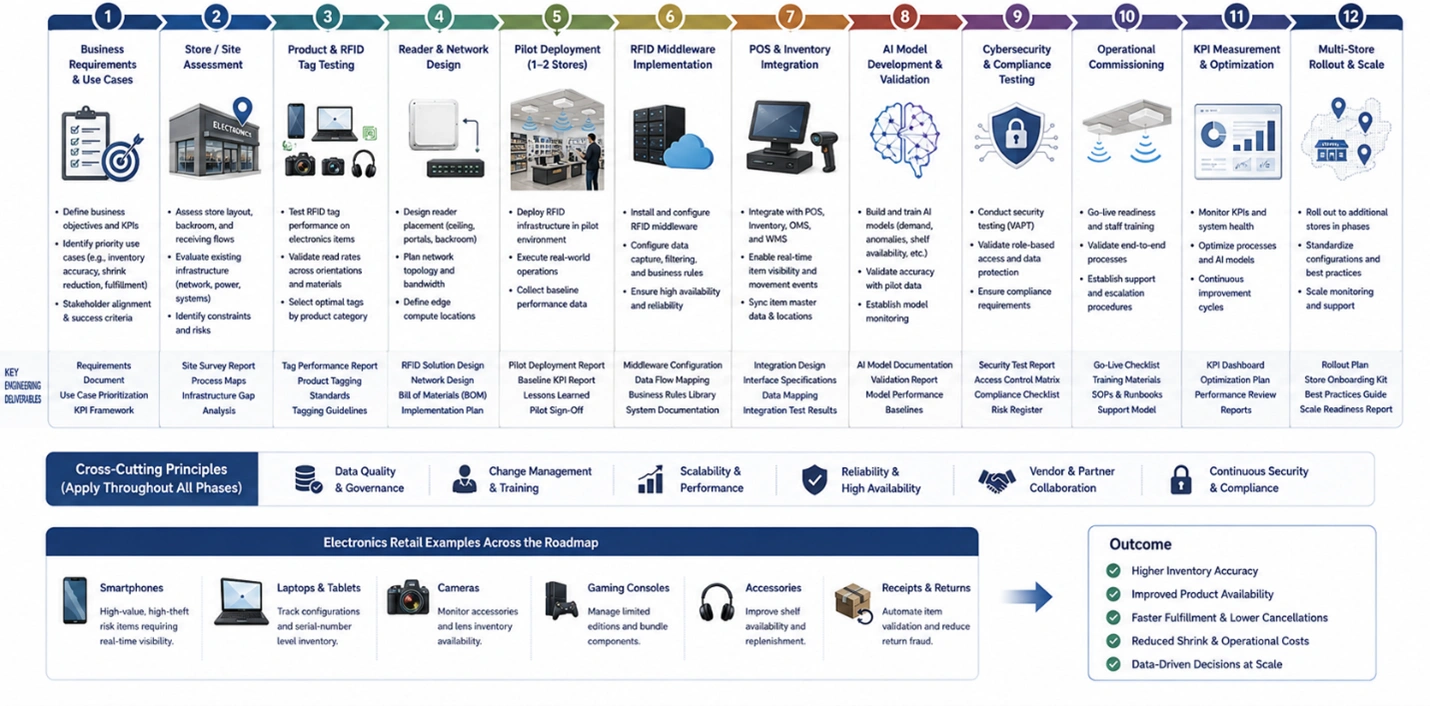
This 12-phase roadmap illustrates a practical lifecycle for deploying AI-driven RFID across electronics retail, from business requirements and RFID testing through pilot deployment, systems integration, AI validation, cybersecurity, commissioning, KPI optimization, and multi-store scaling. It highlights key engineering deliverables, cross-cutting implementation principles, and electronics retail use cases without implying fixed implementation timelines.
Building Smarter Electronics Retail Operations with AI and RFID
AI-driven RFID can help electronics retailers connect physical product visibility with inventory management, fulfillment, merchandising, and loss-prevention decisions. The technology is most effective when deployed as part of a complete system covering RFID data capture, middleware, retail software integration, AI analytics, cybersecurity, and operational workflows.
Retailers should prioritize measurable business problems, validate RFID performance against real products, establish data-quality controls, and use AI recommendations within appropriate human review processes. A well-engineered deployment can provide more reliable inventory information while reducing manual effort and improving the speed of operational decisions.
GAO can support organizations evaluating RFID, BLE, and IoT hardware products and systems for electronics retail applications, from physical identification requirements through deployment and technical support.
Building the Future of Industrial AI and IoT with Aperture Venture Studio and GAO RFID Inc.
For more than three decades, GAO has invested heavily in R&D for industrial RFID, BLE, and IoT technologies. As generative AI has become useful for practical industrial and retail applications, we have continued developing AI and IoT solutions, including technologies that connect RFID and BLE data with intelligent software. We founded Aperture Venture Studio to build, launch, and scale next-generation AI and IoT companies and initiatives relevant to industries such as department-store operations.
Aperture has attracted AI and IoT technical experts, experienced executives, investors, and leading companies. We have also developed the Aperture Ventures Summit and TekSummit to facilitate discussion of advanced AI and IoT topics.
GAO welcomes participation from:
- Advisors, co-founders, or employees
- Investors
- Customers