
AI and RFID for Emergency Services: Intelligent Response, Asset Visibility, and Operational Coordination
AI-Driven Emergency Services Management with RFID-Enabled Identification and Tracking
Emergency services organizations such as fire departments, emergency medical services, disaster response agencies, and public safety organizations rely on rapid decision-making, accurate resource availability, and coordinated field operations. AI and RFID for Emergency Services combines artificial intelligence, connected identification technologies, IoT systems, and operational data analytics to improve emergency preparedness, response coordination, equipment availability, and personnel safety.
AI-powered emergency services solutions analyze data from emergency vehicles, medical equipment, protective gear, response teams, facilities, and communication systems to support faster decisions during critical incidents. RFID enables automated identification and tracking of emergency assets, supplies, and personnel equipment, allowing agencies to maintain real-time visibility across stations, warehouses, ambulances, command centers, and disaster areas. Together, AI and RFID help emergency organizations improve readiness, reduce operational delays, optimize resource allocation, and strengthen mission-critical response capabilities.
GAO provides RFID, BLE, and IoT hardware products and systems that support organizations implementing intelligent emergency services solutions requiring reliable identification, tracking, sensing, and data collection capabilities.
Understanding AI and RFID Applications in Modern Emergency Services Operations
Emergency services operations depend on the ability to collect accurate information, evaluate changing conditions, and deploy resources efficiently. Traditional emergency management processes often rely on manual inventory checks, radio communication updates, paper-based records, and disconnected operational databases. These limitations can create challenges when emergency personnel need immediate visibility into available equipment, vehicle readiness, medical supplies, or responder locations.
AI and RFID for Emergency Services addresses these challenges by connecting physical emergency resources with intelligent software systems. Artificial Intelligence of Things (AIoT), which combines artificial intelligence with IoT devices, sensors, connected equipment, and operational systems, enables emergency organizations to transform real-world information into actionable insights.
Within emergency services environments, AI methods such as machine learning, computer vision, predictive analytics, natural language processing, and anomaly detection can analyze operational data generated from:
- Emergency vehicle fleets including ambulances, fire engines, rescue vehicles, and mobile command units
- Medical equipment such as defibrillators, ventilators, trauma kits, and emergency treatment supplies
- Firefighting equipment including breathing apparatus, protective clothing, hoses, thermal imaging equipment, and rescue tools
- Emergency warehouses storing medicines, consumables, replacement equipment, and disaster response materials
- Personnel resources including firefighters, paramedics, emergency coordinators, and specialized rescue teams
- Incident response systems collecting information from dispatch centers, field teams, and public safety networks
RFID supports these AI-driven workflows by providing automated identification and location-related information for physical assets. UHF RFID is commonly used for tracking large volumes of equipment, vehicles, and supplies over longer ranges. HF RFID is suitable for controlled identification environments such as equipment cabinets, medical supply stations, and access points. LF RFID can support specialized identification applications where shorter-range detection and reliability near certain materials are required.
The combination of AI analytics and RFID-enabled data collection allows emergency agencies to move from reactive operations toward predictive and data-driven emergency management.
Emergency Services AIoT Operational Overview: AI, RFID, and IoT Architecture for Intelligent Emergency Response
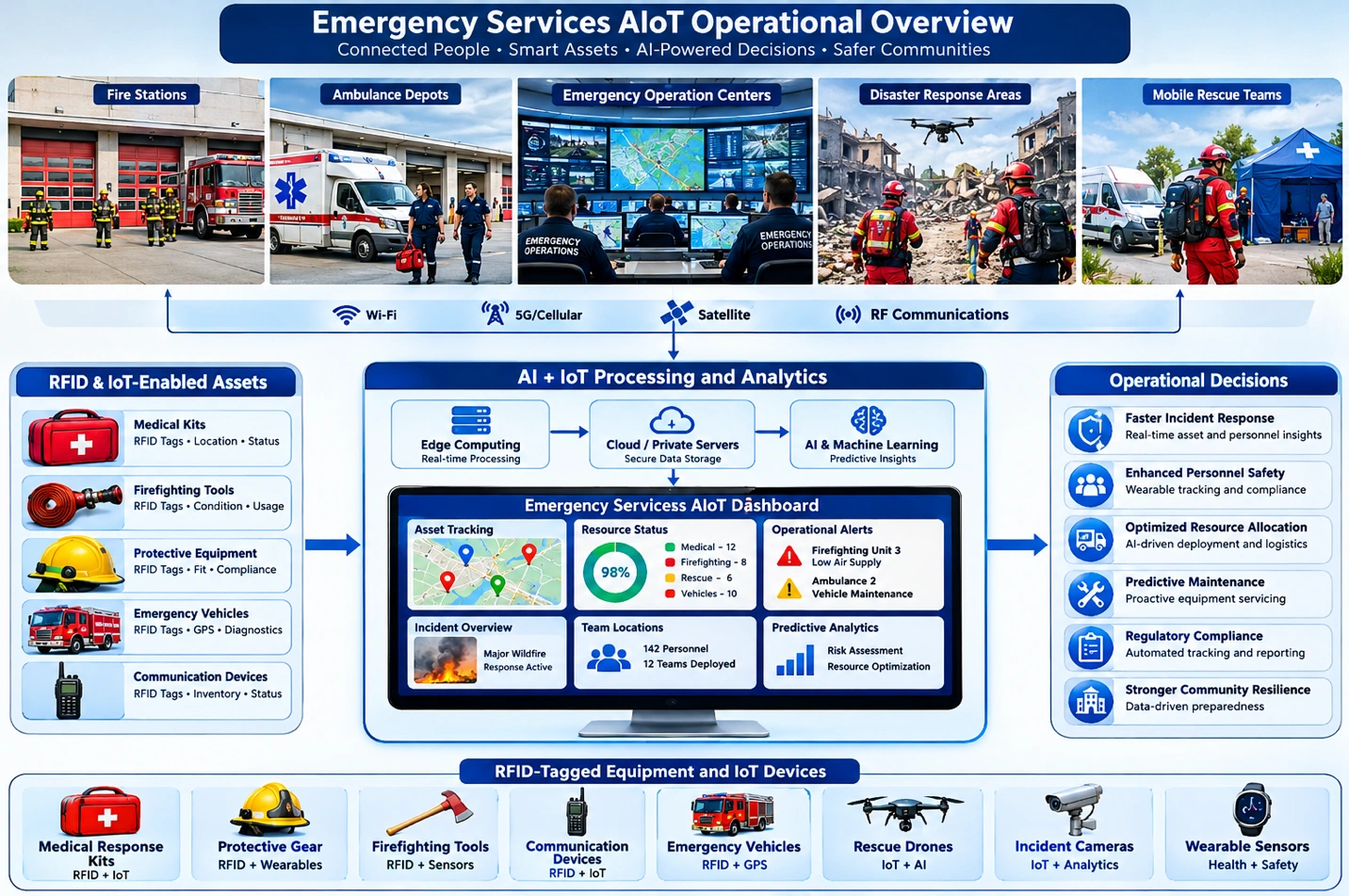
This infographic illustrates how AI, RFID, and IoT technologies work together across modern emergency services operations, including fire stations, ambulance depots, emergency operation centers, disaster response areas, and mobile rescue teams. It demonstrates how RFID-tagged assets and connected IoT devices transmit operational data through edge computing and cloud platforms into AI-powered analytics dashboards. The visual highlights how real-time intelligence improves incident response, personnel safety, asset visibility, predictive maintenance, and resource allocation for emergency management organizations.
Emergency Services Applications Enabled by AI and RFID Solutions
Intelligent Emergency Equipment Tracking and Readiness Management
Emergency response organizations maintain thousands of critical assets distributed across fire stations, ambulance bases, emergency warehouses, and temporary response locations. Equipment availability directly affects response performance, making accurate asset tracking an essential operational requirement.
AI-powered equipment management systems use RFID-generated data to maintain visibility into:
- Fire suppression equipment readiness
- Medical device availability and maintenance status
- Rescue equipment inspection schedules
- Personal protective equipment allocation
- Emergency supply consumption rates
- Replacement and replenishment requirements
Machine learning algorithms can identify usage patterns and predict when equipment inspections, replacements, or restocking activities may be required. For example, an emergency medical services organization can analyze ambulance supply usage trends to predict demand for trauma supplies during high-volume periods.
GAO supplies RFID hardware products and systems that help organizations capture equipment identification data and integrate physical assets with digital management systems.
AI-Assisted Emergency Vehicle and Fleet Operations
Emergency vehicle availability is a critical factor in response time. Fire departments, ambulance services, and disaster response agencies must continuously monitor vehicle readiness, onboard equipment status, maintenance requirements, and deployment locations.
AI and RFID solutions support fleet operations by connecting vehicle information with operational software systems.
Common applications include:
- Automated verification of ambulance medical equipment before deployment
- Tracking firefighting tools assigned to specific vehicles
- Monitoring vehicle-mounted emergency supplies
- Supporting preventive maintenance scheduling
- Improving fleet utilization analysis
- Identifying missing or incorrectly assigned equipment
AI models can analyze historical dispatch records, maintenance data, geographic response patterns, and equipment usage information to recommend operational improvements. These insights help emergency managers improve resource positioning and reduce delays caused by unavailable equipment.
Emergency Personnel Safety and Accountability
During fires, natural disasters, hazardous material incidents, and large-scale emergencies, maintaining accurate awareness of personnel status is essential. Emergency commanders require reliable information about team assignments, protective equipment availability, and responder movements.
AI-enabled personnel management systems can analyze information from:
- RFID-enabled identification badges
- Protective equipment records
- Entry and exit checkpoints
- Incident command systems
- Location monitoring technologies
- Communication networks
Applications include:
- Firefighter accountability systems
- Search and rescue team coordination
- Emergency shelter workforce management
- Disaster response personnel allocation
- Safety compliance monitoring
AI analytics can identify unusual operational patterns, such as missing equipment assignments or unexpected personnel movement during an active incident. These insights support command decisions while improving responder safety.
RFID Deployment in Modern Emergency Services: Real-Time Asset Tracking and Personnel Accountability
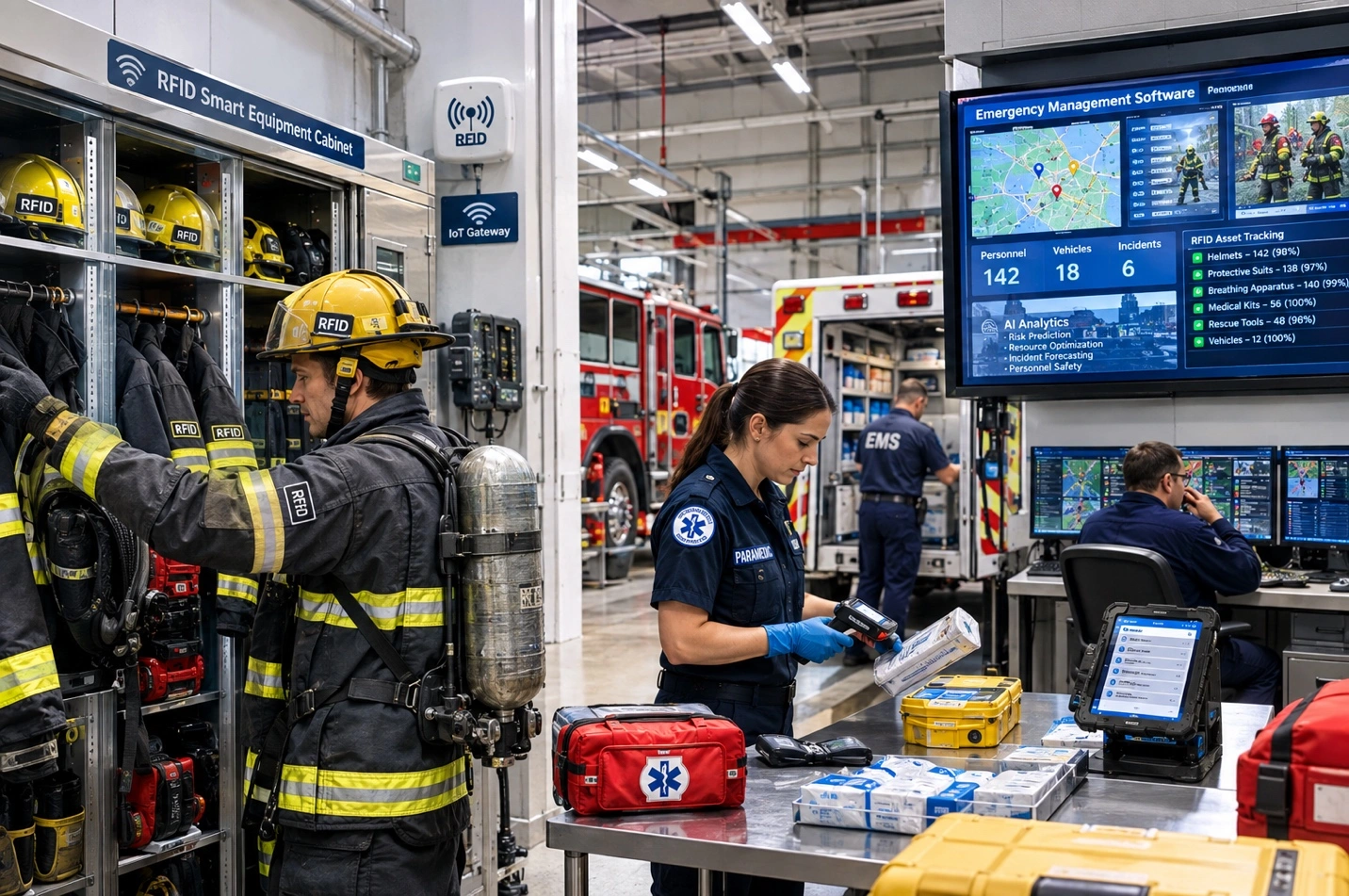
This realistic illustration depicts RFID technology integrated into a modern fire and emergency response facility, where firefighters and paramedics prepare equipment using RFID-enabled smart cabinets, handheld readers, and automated inventory systems. Operational data from tagged protective gear, rescue tools, medical supplies, and emergency vehicles is transmitted to emergency management software and AI-powered dashboards. The visual demonstrates how RFID improves equipment readiness, personnel accountability, inventory accuracy, and real-time operational awareness across emergency response operations.
Disaster Response Inventory and Resource Allocation
Emergency management agencies must coordinate large volumes of resources during hurricanes, floods, wildfires, earthquakes, and humanitarian response operations. Resource shortages or inaccurate inventory information can negatively affect emergency outcomes.
AI-powered inventory management systems supported by RFID identification improve visibility into:
- Emergency medical supplies
- Temporary shelter equipment
- Food and water distribution materials
- Rescue equipment
- Communication devices
- Portable power systems
- Protective equipment
AI forecasting models analyze historical emergency events, seasonal risks, consumption rates, and inventory movement patterns to improve preparedness planning.
RFID-enabled inventory processes allow emergency warehouses and mobile response units to automatically capture asset movements, reducing manual counting and improving accountability during rapidly changing situations.
Emergency Services Operational Workflow from Data Capture to AI Decision Support
A complete AI and RFID emergency services solution connects physical resources, communication infrastructure, software systems, and operational decision-making processes. The workflow typically includes multiple stages:
- Data acquisition from RFID tags, sensors, IoT devices, emergency vehicles, equipment systems, and operational databases
- Wireless communication through RFID readers, IoT gateways, cellular networks, Wi-Fi, private networks, and public safety communication infrastructure
- Edge processing near emergency facilities or field locations for rapid filtering, validation, and local decision support
- Cloud or private server processing for advanced analytics, machine learning models, reporting, and long-term data management
- Integration with emergency dispatch systems, computer-aided dispatch (CAD), computerized maintenance management systems (CMMS), inventory systems, fleet management software, and public safety databases
- AI analysis of equipment availability, resource demand, maintenance requirements, and operational risks
- Automated alerts, recommendations, and dashboards supporting emergency coordinators, incident commanders, logistics managers, and field responders
End-to-End Emergency Services AI and RFID Workflow: From Asset Identification to Intelligent Response
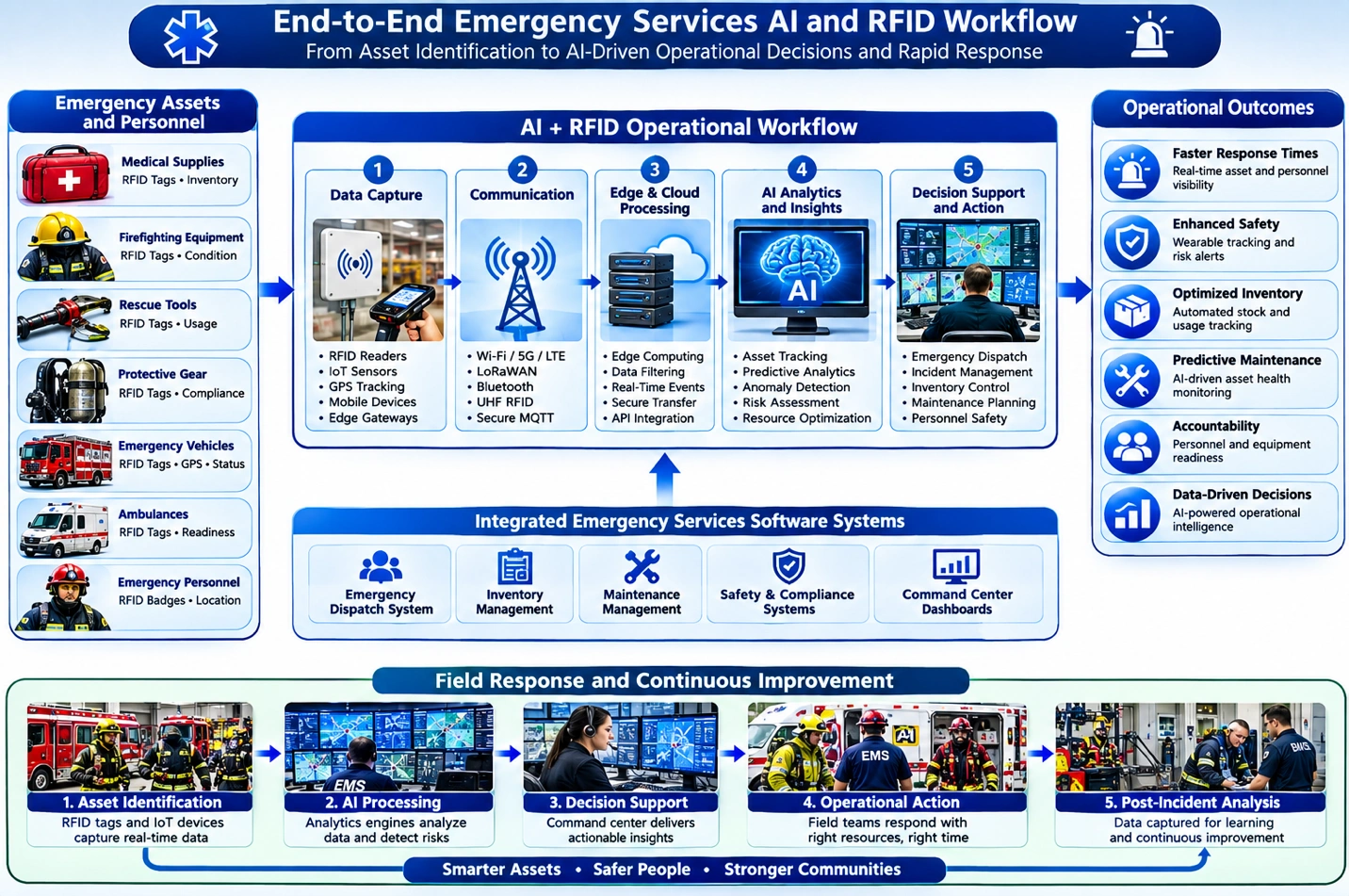
This enterprise workflow diagram illustrates the complete emergency services information lifecycle, beginning with RFID-tagged assets, emergency personnel, and vehicles, and continuing through RFID readers, IoT gateways, edge computing, cloud infrastructure, and AI analytics. It demonstrates how operational data is transformed into actionable intelligence for emergency dispatch, inventory management, maintenance planning, command center dashboards, and field response. The visual highlights how AI and RFID together improve operational visibility, resource readiness, personnel safety, and faster emergency decision-making.
Technology Components Supporting AI-Enabled Emergency Services Solutions
AI and RFID for Emergency Services solutions require coordinated hardware, software, communication technologies, and security mechanisms to support reliable emergency operations. The most effective deployments combine physical identification technologies with AI analytics, IoT connectivity, and emergency management software.
The solution components typically include:
- RFID tags and identification devices attached to emergency equipment, vehicles, medical supplies, protective gear, and operational resources
- Fixed RFID readers installed at emergency stations, equipment storage areas, warehouses, vehicle bays, and controlled access locations
- Handheld RFID readers used by emergency personnel for mobile inventory verification, inspections, and field operations
- IoT sensors collecting environmental, equipment, and operational data where additional monitoring is required
- Edge computing devices processing critical information locally when rapid response decisions are required
- Cloud-hosted or privately deployed server software managing data storage, analytics, reporting, and system integration
- AI software using machine learning, predictive analytics, computer vision, and anomaly detection to identify patterns and support decision-making
- Integration interfaces connecting emergency solutions with CAD systems, emergency management systems, fleet management software, CMMS solutions, asset management databases, and logistics applications
GAO provides RFID, BLE, and IoT hardware products and systems that support emergency organizations requiring dependable identification, monitoring, and operational data collection capabilities.
RFID Hardware and IoT Devices for Emergency Response Environments
RFID hardware selection depends on the operational environment, asset type, required reading distance, deployment conditions, and security requirements.
UHF RFID solutions are commonly used for:
- Tracking large inventories of emergency supplies
- Monitoring equipment distributed across multiple locations
- Managing firefighting tools and rescue equipment
- Identifying assets during warehouse receiving and dispatch processes
- Supporting vehicle equipment verification
HF RFID solutions are often suitable for:
- Controlled access equipment cabinets
- Medical equipment identification
- Smart storage areas
- Personnel identification points
LF RFID solutions may be selected for:
- Specialized short-range identification requirements
- Environments requiring consistent detection near challenging materials
- Specific access control and identification applications
Additional IoT devices can extend emergency services visibility through:
- Temperature sensors for medicine storage monitoring
- Environmental sensors for emergency facilities
- Equipment condition sensors
- Vehicle monitoring devices
- Location-related sensors for field operations
Engineering considerations include environmental durability, electromagnetic interference, reading accuracy, network availability, power requirements, and compliance with operational safety procedures.
AI Models and Analytics Software for Emergency Management
Artificial intelligence transforms collected operational data into insights that support faster and more informed emergency decisions.
Common AI methods used in emergency services include:
- Machine learning models for predicting equipment demand, maintenance requirements, and resource consumption
- Computer vision systems for analyzing images or video from emergency facilities, drones, and inspection environments
- Natural language processing for analyzing incident reports, communication records, and operational documentation
- Predictive analytics for emergency resource planning and readiness optimization
- Anomaly detection for identifying unusual equipment usage, missing assets, or operational risks
Examples of AI-driven emergency services applications include:
- Predicting ambulance supply consumption based on historical emergency call patterns
- Identifying equipment maintenance risks before failures occur
- Optimizing emergency vehicle readiness based on deployment history
- Detecting inventory discrepancies in emergency warehouses
- Supporting command centers with real-time operational insights
AI systems should be designed with human oversight because emergency decisions require professional judgment, regulatory compliance, and situational awareness.
Cloud Version and Server Version Deployment Models for Emergency Services
Emergency organizations can deploy AI and RFID solutions using cloud-hosted software or privately managed server environments depending on operational requirements, security policies, and infrastructure capabilities.
Cloud Version Deployment
Cloud-hosted solutions operate through managed cloud infrastructure and are suitable for organizations seeking scalable computing resources, centralized management, and easier multi-location deployment.
Common use cases include:
- Regional emergency agencies managing multiple stations
- Organizations requiring centralized asset visibility
- Disaster response networks coordinating resources across locations
- Agencies needing rapid expansion during emergency events
Advantages include:
- Flexible computing capacity for AI analytics
- Easier software updates and maintenance
- Centralized access across authorized locations
- Reduced requirements for local IT infrastructure
- Support for large-scale data analysis
Cloud deployments require careful consideration of cybersecurity controls, network availability, data governance requirements, and integration with government information systems.
Server Version Deployment
Server-based deployments involve installing software on customer-managed servers, private data centers, edge servers, or other privately hosted infrastructure.
This approach is often appropriate for:
- Government agencies with strict data control requirements
- Emergency organizations operating critical infrastructure
- Facilities requiring local processing during network interruptions
- Organizations with existing private computing environments
Advantages include:
- Greater control over data storage and processing
- Local operation when external connectivity is limited
- Custom integration with existing government systems
- Support for specialized security requirements
Emergency services organizations should evaluate deployment models based on response requirements, cybersecurity policies, operational geography, available IT resources, and regulatory obligations.
Cloud vs Private Server Deployment for Emergency Services AI and RFID Systems
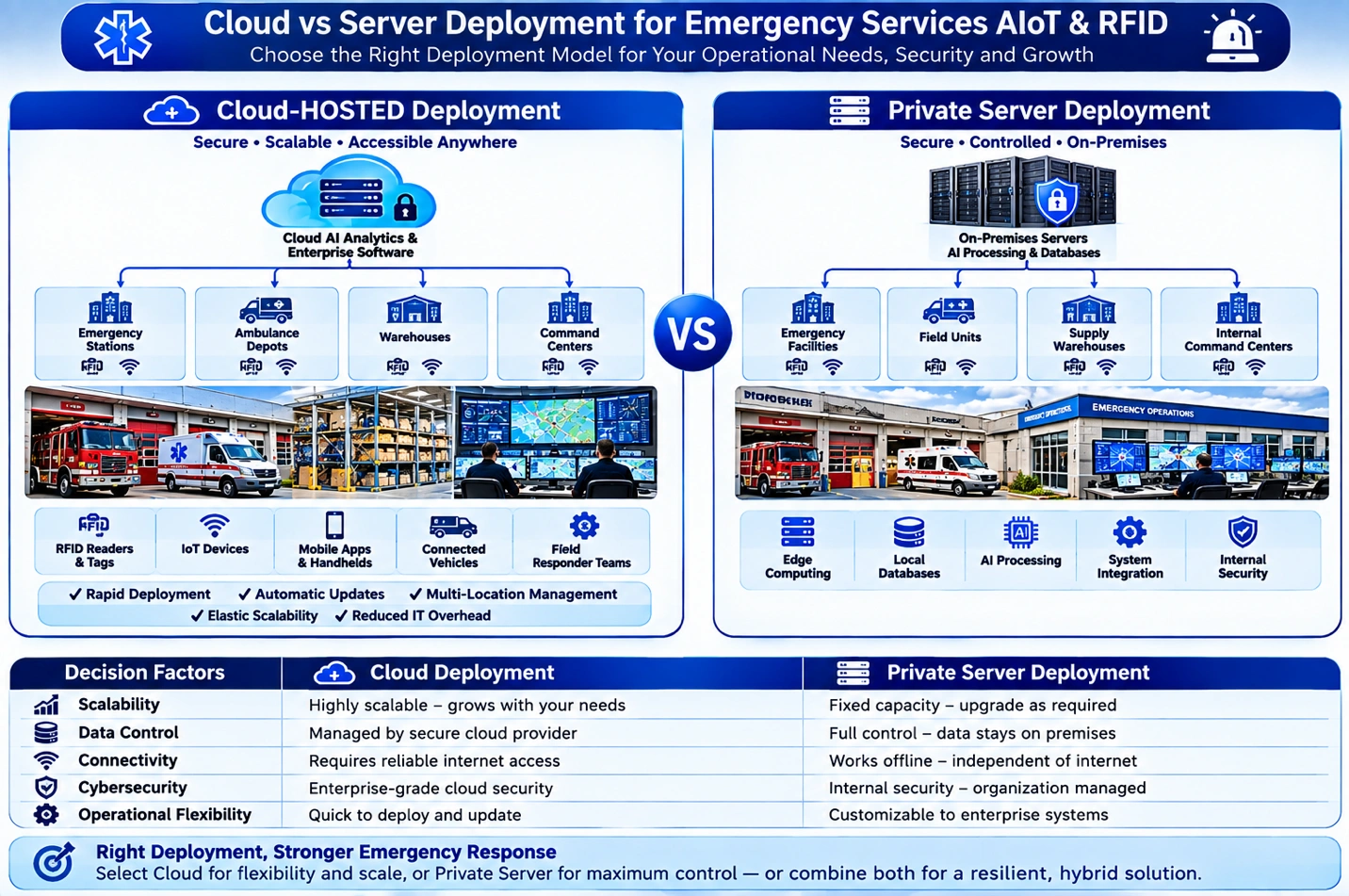
This comparison diagram illustrates two deployment models for emergency services AI and RFID solutions: a cloud-hosted architecture and an on-premises private server environment. It compares how emergency stations, ambulances, RFID readers, IoT devices, AI analytics, and command center software integrate under each approach while highlighting key decision factors such as scalability, data control, cybersecurity, connectivity, and operational flexibility. The visual helps emergency service organizations evaluate the most appropriate deployment model based on their operational and security requirements.
AI and RFID Benefits for Emergency Services Organizations
Combining AI analytics with RFID-enabled identification improves emergency service operations by creating better visibility, reducing manual processes, and supporting faster decisions.
Improved Emergency Preparedness and Resource Availability
Emergency organizations must ensure that critical equipment and supplies are available before incidents occur. AI-driven resource analysis helps agencies understand readiness conditions across stations, vehicles, warehouses, and response locations.
Benefits include:
- Faster identification of missing or unavailable emergency equipment
- Improved inspection scheduling for critical assets
- Better forecasting of supply requirements
- Reduced risk of equipment shortages during emergencies
- Improved accountability for distributed resources
Faster Incident Response and Operational Coordination
Emergency response performance depends on rapid coordination between dispatch centers, field teams, logistics personnel, and command staff.
AI and RFID solutions improve coordination by providing:
- Real-time equipment visibility
- Automated asset verification
- Faster resource allocation
- Improved communication between operational teams
- Better understanding of available response capabilities
Emergency commanders can use AI-generated insights to support decisions regarding equipment deployment, personnel assignment, and resource prioritization.
Predictive Maintenance and Lifecycle Management
Emergency equipment failures can create operational risks. Predictive maintenance systems analyze equipment usage patterns, inspection records, and operational history to identify maintenance requirements.
Applications include:
- Fire apparatus maintenance optimization
- Ambulance equipment lifecycle tracking
- Rescue tool inspection management
- Protective equipment replacement planning
- Medical device maintenance monitoring
This approach helps organizations move from scheduled maintenance alone toward condition-based and predictive maintenance practices.
Enhanced Security, Accountability, and Compliance
Emergency organizations must maintain accurate records of equipment handling, personnel access, inspections, and operational procedures.
AI and RFID solutions support:
- Automated audit trails
- Equipment custody tracking
- Controlled access to critical supplies
- Compliance reporting
- Improved accountability during emergency events
Security design should include authentication controls, encrypted communication where applicable, access management, data protection procedures, and cybersecurity monitoring.
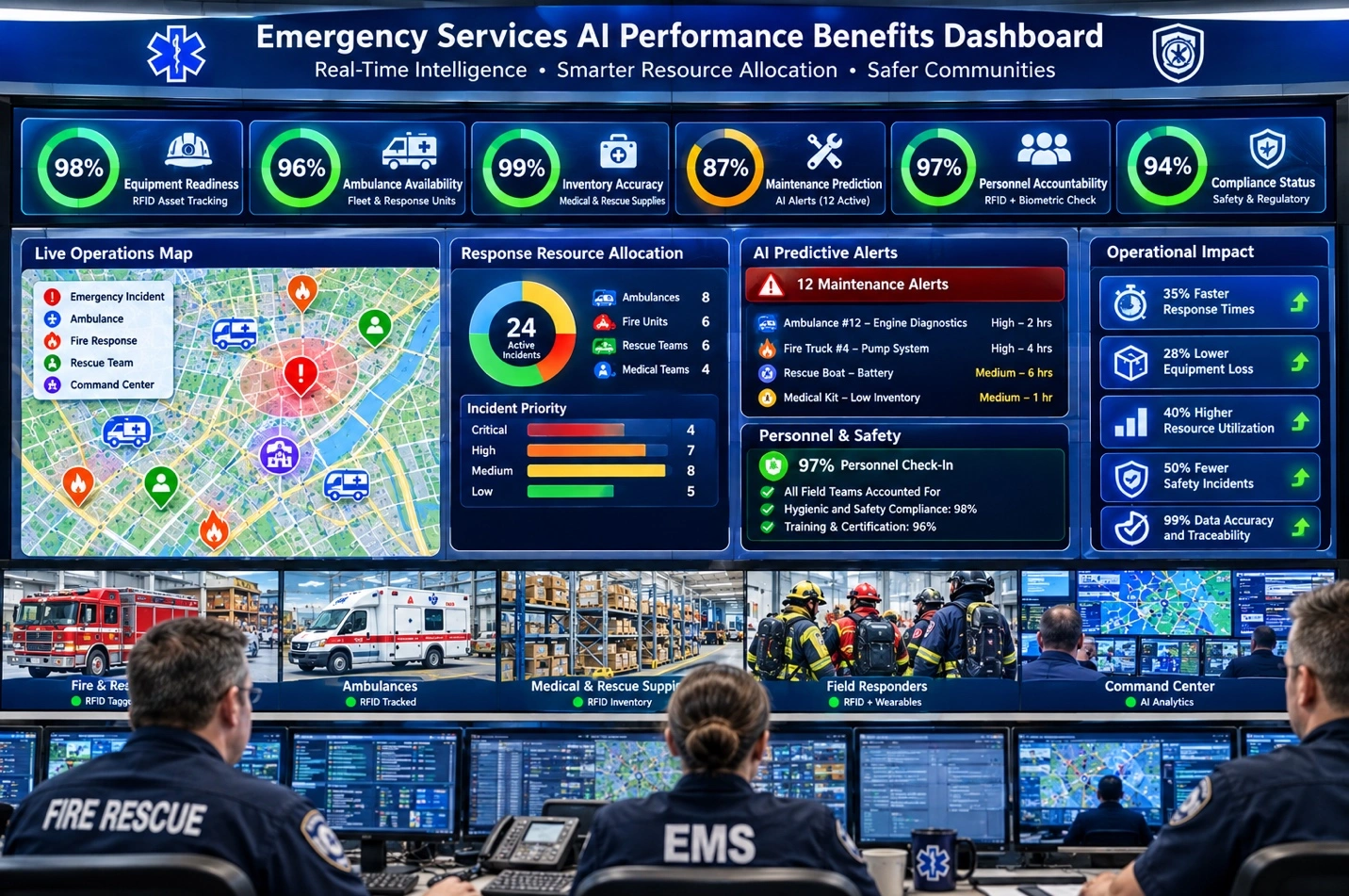
Emergency Services AI Performance Dashboard: RFID-Driven Operational Intelligence and Real-Time KPI Monitoring
This dashboard visualization showcases how AI and RFID technologies deliver real-time operational intelligence across emergency services by monitoring key performance indicators such as equipment readiness, ambulance availability, inventory accuracy, predictive maintenance, personnel accountability, and resource allocation. Data collected from RFID-tagged assets, emergency vehicles, warehouses, and field responders is transformed into actionable insights through AI-powered analytics and command center dashboards. The visual demonstrates how intelligent monitoring improves emergency preparedness, operational efficiency, compliance, and response effectiveness.
Implementation Considerations for AI and RFID Emergency Services Projects
Successful deployment requires careful planning across technology selection, operational processes, cybersecurity, and organizational adoption.
Key engineering considerations include:
- Defining operational objectives such as asset readiness, emergency inventory visibility, personnel accountability, or predictive maintenance
- Selecting RFID technologies based on equipment type, environment, reading distance, and workflow requirements
- Integrating with existing emergency dispatch, fleet, inventory, maintenance, and reporting systems
- Testing RFID performance in real emergency environments before large-scale deployment
- Establishing cybersecurity controls for connected devices and operational data
- Training emergency personnel on updated workflows and digital tools
- Monitoring system performance using operational KPIs
Recommended KPIs include:
- Emergency equipment availability rate
- Inventory accuracy percentage
- Asset search time reduction
- Preventive maintenance compliance rate
- Emergency vehicle readiness percentage
- Supply replenishment accuracy
- Equipment inspection completion rate
- Incident response preparation time
GAO has supported organizations in the United States and Canada, including government agencies, research organizations, universities, and large companies, by providing RFID, BLE, and IoT products and systems supported by quality assurance processes and technical expertise. Headquartered in New York City and Toronto, Canada, GAO is recognized among the leading B2B and B2G suppliers of BLE and RFID technologies worldwide.
Key Insights and Future Directions for AI-Enabled Emergency Services
AI and RFID for Emergency Services represents a shift toward intelligent emergency management where operational resources, response teams, and decision-support systems are connected through reliable data flows.
Organizations implementing these solutions should focus on practical deployment priorities:
- Start with high-value workflows such as emergency equipment tracking, vehicle readiness, or inventory management
- Build reliable data collection processes before expanding AI capabilities
- Select hardware and software components designed for emergency operating conditions
- Integrate AI insights with existing command and operational procedures
- Maintain human oversight for safety-critical decisions
GAO continues to develop RFID, BLE, and IoT solutions that help organizations improve asset visibility, operational efficiency, and connected system capabilities. Organizations seeking to modernize emergency services operations can explore GAO’s technology solutions, engineering expertise, and technical support resources.
Building the Future of Industrial AI and IoT with Aperture Venture Studio and GAO RFID Inc.
GAO Group of Companies has invested heavily for more than three decades in research and development of industrial RFID, BLE, and IoT technologies. As AI becomes increasingly valuable for emergency operations, we continue developing AIoT solutions that combine intelligent analytics with connected identification technologies for public safety applications.
Aperture Venture Studio supports the advancement of AI and IoT initiatives by bringing together technical experts, operational leaders, investors, and organizations focused on practical technology innovation.
GAO Group has built active AI and IoT communities through initiatives such as Aperture Ventures Summit and TekSummit, creating opportunities to exchange knowledge on emerging technologies.
We welcome collaboration with:
- Advisors, co-founders, and employees
- Investors
- Customers