
AI-Driven Engine Manufacturing with RFID Traceability and Industrial Intelligence
Engine manufacturing is undergoing a significant transformation as artificial intelligence, industrial IoT, and RFID-enabled asset visibility converge to improve quality, traceability, throughput, and operational efficiency. Modern engine production facilities manage thousands of components, machining operations, assembly processes, testing procedures, and compliance requirements across complex manufacturing environments.
AI-powered manufacturing intelligence supported by RFID technology enables real-time visibility into engine blocks, crankshafts, cylinder heads, pistons, connecting rods, turbochargers, tooling assets, work-in-process inventory, and finished engines. By combining machine learning with RFID-generated operational data, engine manufacturers can improve production scheduling, reduce bottlenecks, enhance quality assurance, optimize inventory management, and strengthen traceability throughout the manufacturing lifecycle.
Engine manufacturers increasingly rely on AIoT systems that integrate artificial intelligence with connected production equipment, sensors, RFID readers, manufacturing software, and enterprise systems to support data-driven decision making. Organizations seeking greater production consistency, regulatory compliance, and operational efficiency are adopting these technologies as strategic manufacturing enablers.
AI-Driven RFID Engine Manufacturing Facility with Real-Time Production Intelligence
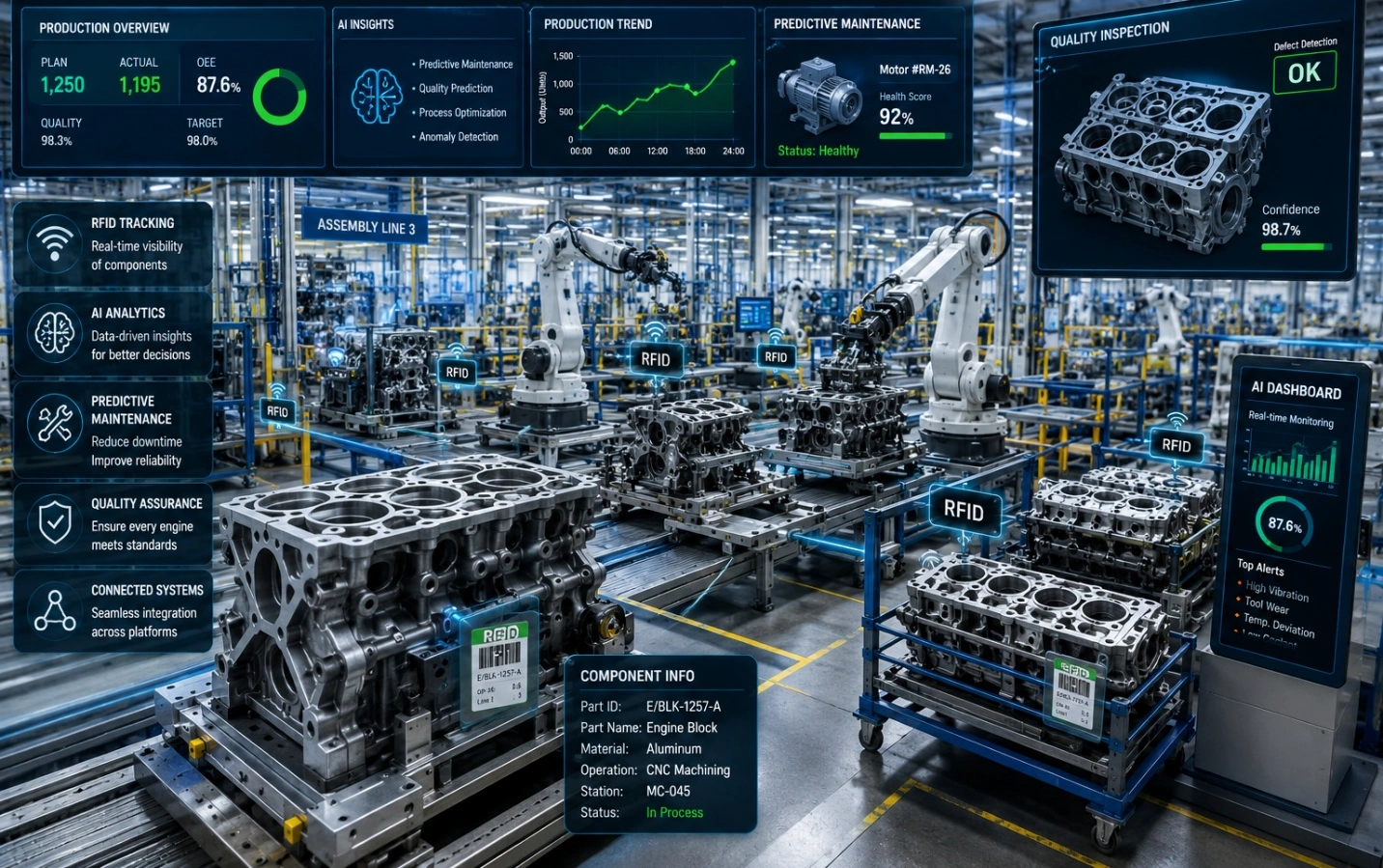
This visual illustrates a modern automotive engine manufacturing facility where RFID-tagged engine components are tracked throughout production and monitored through AI-powered analytics. Robotic assembly stations, quality inspection systems, predictive maintenance monitoring, and real-time production dashboards work together to improve traceability, quality, and operational efficiency. The key takeaway is how AI and RFID technologies enable intelligent, data-driven engine manufacturing operations with enhanced visibility across the production lifecycle.
Understanding AI-Powered RFID Solutions in Engine Manufacturing
Engine manufacturing involves highly coordinated machining, assembly, inspection, testing, logistics, and quality assurance activities. Every engine consists of hundreds of components that must be manufactured, tracked, assembled, tested, and documented according to strict engineering specifications.
RFID technology provides automated identification and tracking of manufacturing assets, components, tooling, fixtures, pallets, containers, and finished products. AI transforms the collected operational data into actionable insights that improve production performance.
Within engine manufacturing environments, RFID systems support:
- Engine block traceability
- Cylinder head tracking
- Crankshaft inventory visibility
- Tool management
- Work-in-process monitoring
- Production sequencing
- Assembly verification
- Quality control documentation
- Finished engine tracking
- Logistics optimization
Machine learning models analyze manufacturing data generated from RFID systems, CNC machines, coordinate measuring machines (CMMs), torque tools, assembly stations, engine dynamometers, and enterprise software systems. These analyses enable predictive decision-making that improves operational outcomes.
GAO has supported organizations requiring industrial RFID hardware and tracking systems that help improve manufacturing visibility, inventory accuracy, and production traceability across demanding industrial environments.
Why AI Is Becoming Critical in Engine Manufacturing Operations
Engine manufacturing faces several operational challenges:
- High component complexity
- Tight machining tolerances
- Traceability requirements
- Supply chain variability
- Production scheduling constraints
- Quality assurance demands
- Equipment downtime risks
- Tool calibration management
- Work-in-process inventory visibility gaps
- Increasing cost pressures
Traditional manufacturing systems often generate large amounts of operational data without delivering actionable intelligence. AI bridges this gap by transforming operational information into recommendations and automated decisions.
Key AI capabilities include:
- Predictive maintenance
- Production forecasting
- Defect prediction
- Demand planning
- Automated anomaly detection
- Computer vision inspection
- Process optimization
- Digital quality management
- Inventory optimization
- Manufacturing throughput analysis
Engine manufacturing facilities increasingly combine RFID-generated traceability data with machine learning algorithms to create highly responsive production environments.
Key Applications of AI-Enabled RFID Systems in Engine Manufacturing
Engine Component Traceability
Modern engines require complete lifecycle traceability of critical components.
RFID tags attached to engine blocks, cylinder heads, camshafts, pistons, connecting rods, turbochargers, and fuel system components provide continuous visibility throughout manufacturing operations. AI analyzes historical production patterns to identify bottlenecks, quality trends, and process deviations.
Benefits include:
- Complete genealogy tracking
- Faster recall management
- Improved compliance reporting
- Reduced manual documentation
- Better production visibility
Smart Work-in-Process Management
Engine production lines frequently contain thousands of partially assembled components moving between machining, washing, inspection, balancing, assembly, and testing operations.
RFID automatically captures component movement while AI continuously evaluates:
- Queue lengths
- Production bottlenecks
- Resource utilization
- Station efficiency
- Material availability
This intelligence supports dynamic production scheduling and throughput optimization.
Tooling and Fixture Management
Engine manufacturing relies heavily on precision tooling, fixtures, cutting tools, torque tools, and specialized gauges.
RFID tracking improves visibility into tooling location and usage while AI predicts:
- Tool wear
- Calibration schedules
- Replacement requirements
- Maintenance intervals
- Utilization rates
The result is improved machining consistency and reduced production interruptions.
AI-Powered Quality Assurance
Quality defects in engine manufacturing can result in costly warranty claims and production disruptions.
AI systems analyze data from:
- RFID records
- CMM inspections
- Surface finish measurements
- Torque verification systems
- Dynamometer testing
- Leak testing stations
- Machine sensor data
These systems identify defect patterns before failures become widespread.
RFID-Enabled Engine Component Lifecycle Tracking Workflow with AI Manufacturing Analytics
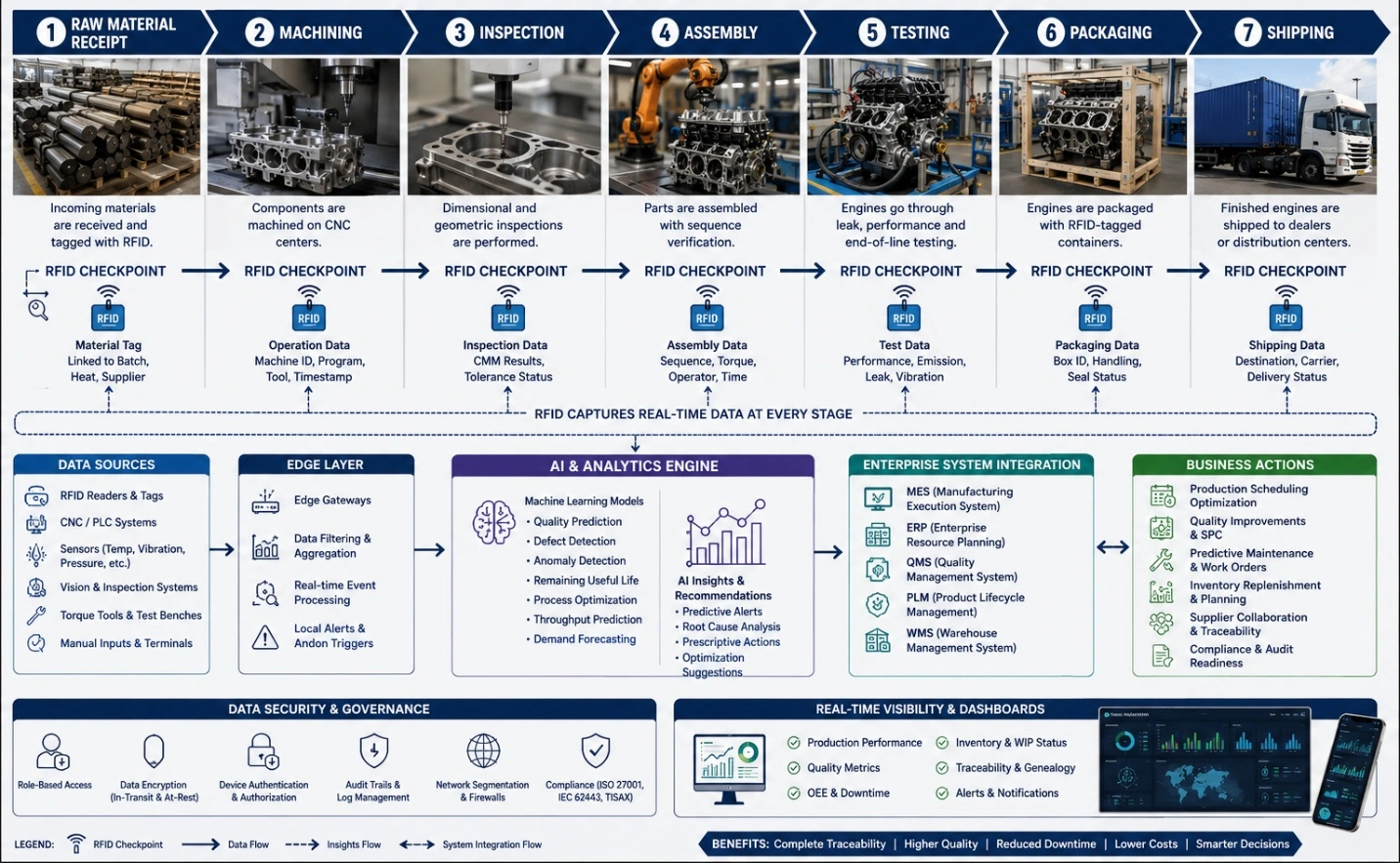
This workflow diagram illustrates the complete lifecycle of engine components from raw material receipt through machining, inspection, assembly, testing, packaging, and shipping. RFID checkpoints capture real-time operational data at every stage, while AI analytics transform production data into actionable insights for quality improvement, predictive maintenance, inventory optimization, and manufacturing efficiency. The visual demonstrates how intelligent traceability and enterprise software integration support end-to-end visibility across modern engine manufacturing operations.
Operational Workflow of AI-Driven RFID Engine Manufacturing Systems
A successful AI-enabled engine manufacturing solution requires coordinated interaction among RFID infrastructure, industrial equipment, software systems, and machine learning services.
Data Acquisition Layer
Operational data originates from multiple manufacturing sources:
- RFID readers
- Fixed RFID portals
- Handheld RFID devices
- CNC machining centers
- PLC controllers
- Industrial sensors
- Machine vision systems
- Torque tools
- Engine test benches
- Environmental monitoring devices
RFID technology continuously captures movement and status information for components, containers, tooling assets, and finished engines.
Communication and Connectivity Layer
Collected manufacturing data is transmitted through industrial communication infrastructure such as:
- Ethernet/IP
- PROFINET
- Modbus TCP
- OPC UA
- MQTT
- Industrial Wi-Fi
- Private 5G networks
Reliable communications ensure production data remains synchronized across manufacturing operations.
Edge Processing Layer
Edge computing systems located near production lines perform:
- Data filtering
- Event processing
- Local analytics
- Equipment monitoring
- Latency-sensitive decision making
Edge processing reduces response times and minimizes bandwidth requirements.
Manufacturing Software Integration Layer
Operational data is integrated with:
- Manufacturing Execution Systems (MES)
- Enterprise Resource Planning (ERP)
- Product Lifecycle Management (PLM)
- Warehouse Management Systems (WMS)
- Quality Management Systems (QMS)
- Computerized Maintenance Management Systems (CMMS)
This integration enables enterprise-wide visibility and coordination.
AI Analytics and Decision Intelligence Layer
Machine learning engines process operational information to generate:
- Predictive maintenance alerts
- Production forecasts
- Inventory recommendations
- Quality risk assessments
- Resource allocation guidance
- Throughput optimization recommendations
These insights help manufacturing teams respond proactively to emerging issues.
AI-Enabled RFID Architecture for Engine Manufacturing and Enterprise System Integration
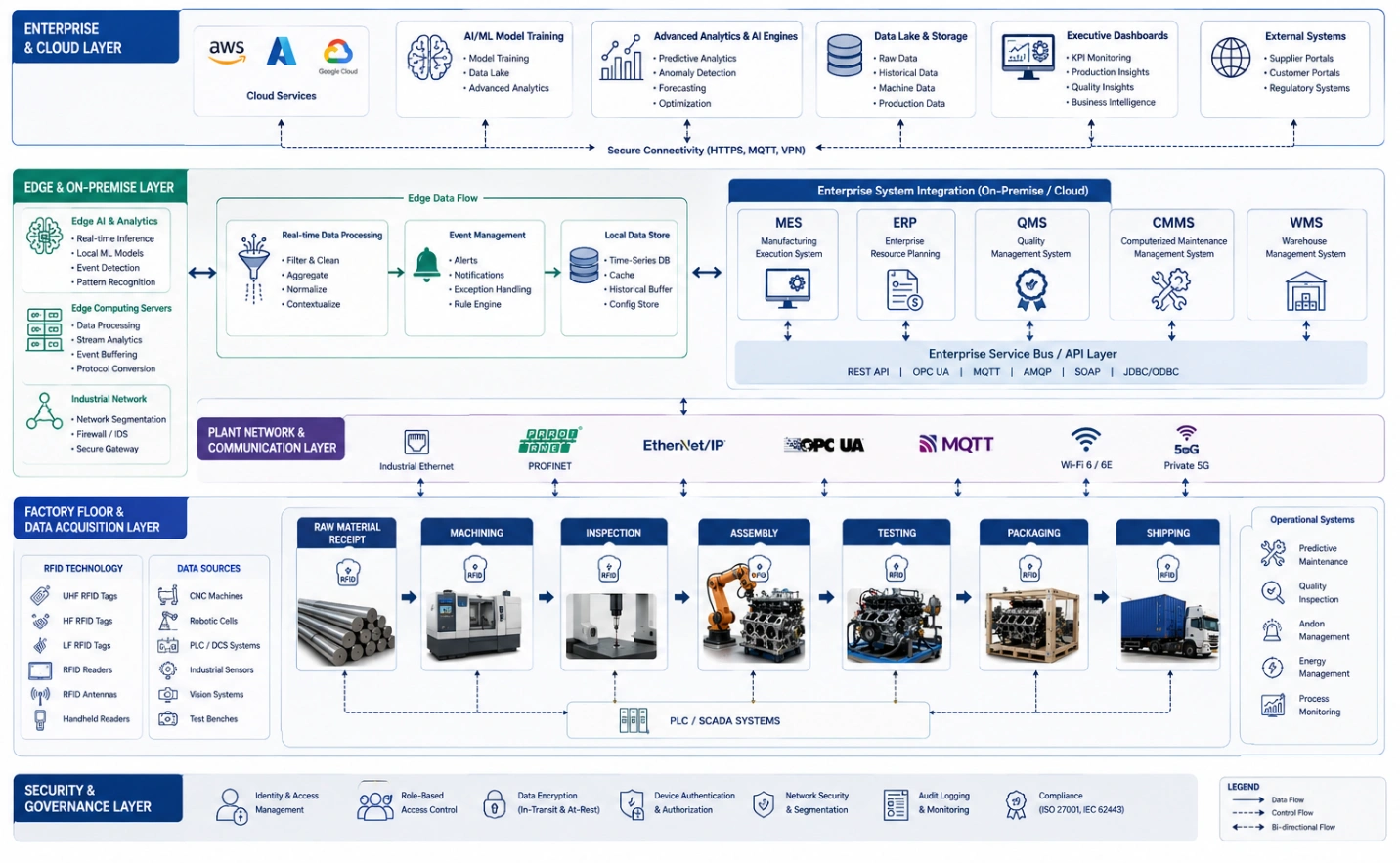
This technical architecture diagram illustrates how RFID-enabled data collection, industrial equipment, edge computing, AI analytics, enterprise software, and cloud services interact within a modern engine manufacturing facility. The visual demonstrates the complete flow of production data from factory-floor operations through predictive analytics, quality management, maintenance systems, and executive dashboards. The key takeaway is how integrated AI and RFID technologies create real-time visibility, intelligent decision-making, and end-to-end operational optimization across engine manufacturing processes.
Core Technologies Supporting AI-Powered Engine Manufacturing
Engine manufacturing solutions combine several interconnected technologies to create intelligent production environments.
RFID Hardware Infrastructure
RFID deployments commonly utilize:
- UHF RFID tags for long-range tracking
- HF RFID tags for controlled manufacturing processes
- LF RFID tags for specialized industrial applications
- Fixed RFID readers
- Handheld RFID readers
- Industrial RFID antennas
- RFID-enabled production stations
Selection depends on environmental conditions, read distance requirements, metal interference challenges, and manufacturing process design.
Industrial AI Technologies
Common AI methods include:
- Supervised machine learning
- Deep learning
- Predictive analytics
- Computer vision
- Time-series forecasting
- Reinforcement learning
- Anomaly detection algorithms
- Digital twin analytics
These technologies help transform manufacturing data into operational intelligence.
Cloud and Server Deployment Models for AI-Driven Engine Manufacturing
Engine manufacturers deploy AI-enabled RFID solutions using cloud-hosted software, privately managed server environments, or hybrid deployments depending on operational requirements, cybersecurity policies, latency constraints, and regulatory considerations.
Cloud Deployment
Cloud-hosted deployments are commonly selected when organizations require:
- Multi-factory visibility
- Centralized reporting
- Global supplier collaboration
- Scalable analytics resources
- Reduced infrastructure management
- Faster implementation timelines
Cloud environments support advanced AI model training using large manufacturing datasets collected from multiple production facilities. Engineering teams can compare production performance, quality metrics, equipment utilization, and inventory trends across geographically distributed manufacturing operations.
Typical cloud-connected applications include:
- Enterprise production dashboards
- Supply chain visibility
- Predictive quality analytics
- Corporate KPI monitoring
- Multi-site inventory optimization
- Global maintenance planning
Server-Based Deployment
Many engine manufacturing facilities prefer privately managed server deployments due to operational control, cybersecurity requirements, intellectual property protection, and real-time performance needs.
Server-based solutions are commonly used for:
- Proprietary engine programs
- Defense-related manufacturing
- High-speed production lines
- Latency-sensitive operations
- Factory-level process control
- Sensitive engineering data management
Locally managed infrastructure enables rapid response times for manufacturing decisions while maintaining full control over operational data.
Hybrid Deployment Strategy
Hybrid deployments often provide the most practical balance between operational performance and enterprise-wide visibility.
Common hybrid implementations include:
- Edge servers managing production operations
- Local AI models supporting immediate decisions
- Cloud analytics supporting long-term optimization
- Factory data retained locally
- Enterprise reporting aggregated centrally
This approach allows engine manufacturers to benefit from both localized operational control and large-scale AI analytics.
Cloud vs. Server vs. Hybrid Deployment Models for AI-Driven RFID Engine Manufacturing
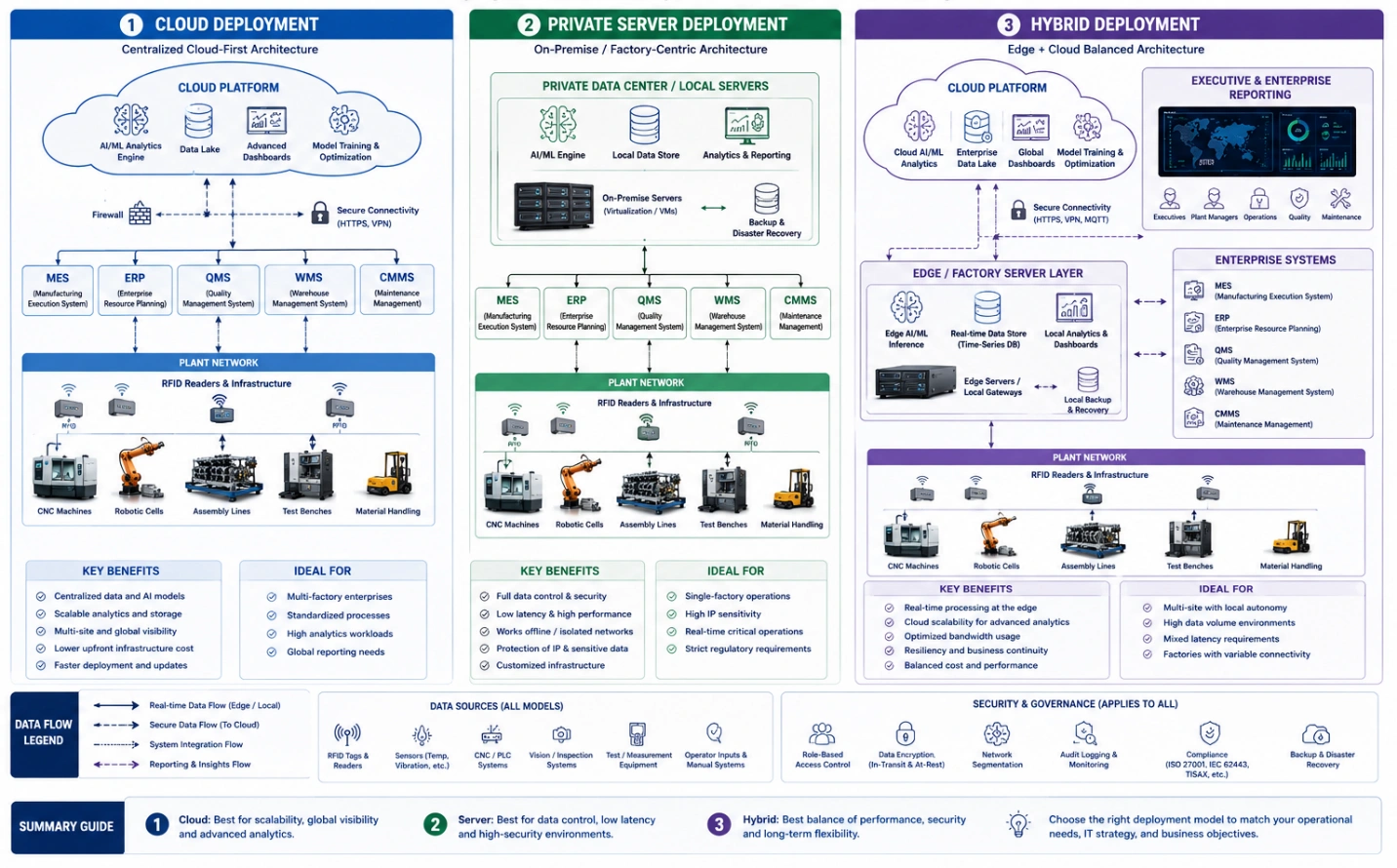
This diagram compares three deployment strategies for AI-enabled RFID engine manufacturing systems: cloud deployment, private server deployment, and hybrid deployment. It illustrates how production data flows between RFID infrastructure, manufacturing equipment, AI analytics engines, MES and ERP software, cloud services, and executive reporting tools under each model. The key takeaway is that organizations can select the deployment approach that best aligns with their requirements for scalability, latency, cybersecurity, operational control, and multi-site visibility.
Cybersecurity and Data Protection for Connected Engine Manufacturing
As engine manufacturing becomes increasingly connected, cybersecurity becomes a critical operational requirement.
AI-enabled RFID solutions generate and process large volumes of manufacturing intelligence that must be protected from unauthorized access, manipulation, and disruption.
Important security controls include:
- Multi-factor authentication
- Role-based access control
- Network segmentation
- Secure API integrations
- Device authentication
- Data encryption at rest
- Data encryption in transit
- Continuous security monitoring
- Security information and event management (SIEM)
- Vulnerability management programs
Manufacturing environments commonly align cybersecurity initiatives with recognized frameworks such as:
- NIST Cybersecurity Framework
- IEC 62443
- ISO 27001
- ISO 21434
- TISAX
- Automotive SPICE
Engine manufacturers increasingly integrate cybersecurity monitoring into production systems to protect manufacturing continuity and intellectual property.
GAO has supported customers implementing industrial RFID systems where reliability, security, and operational continuity are essential requirements.
Technical Capabilities Delivered by AI-Enabled RFID Engine Manufacturing
The combination of RFID-generated operational visibility and AI-driven intelligence delivers several important capabilities.
Predictive Maintenance Intelligence
Engine manufacturing facilities rely on CNC machining centers, robotic assembly systems, balancing machines, washing systems, leak testing equipment, and engine dynamometers.
AI models analyze equipment behavior to predict:
- Bearing failures
- Tool degradation
- Vibration abnormalities
- Lubrication issues
- Motor performance degradation
- Temperature anomalies
Predictive maintenance reduces unplanned downtime and improves production availability.
Production Throughput Optimization
AI continuously evaluates production conditions to identify inefficiencies such as:
- Equipment bottlenecks
- Material shortages
- Workforce constraints
- Queue accumulation
- Unbalanced workloads
Manufacturing teams can make proactive adjustments before throughput losses occur.
Advanced Quality Prediction
Quality-related machine learning models evaluate manufacturing variables associated with:
- Bore machining accuracy
- Surface finish quality
- Torque compliance
- Assembly sequencing
- Leak testing results
- Dynamometer performance
Potential quality risks can be identified before products reach downstream operations.
Inventory and Material Flow Intelligence
RFID visibility combined with AI forecasting supports:
- Safety stock optimization
- Inventory reduction
- Material replenishment planning
- Supplier coordination
- Production sequencing improvements
These capabilities help reduce carrying costs while maintaining manufacturing continuity.
Workforce Productivity Enhancement
AI-generated recommendations help manufacturing personnel prioritize activities based on operational conditions.
Applications include:
- Maintenance task prioritization
- Quality inspection scheduling
- Material movement planning
- Production rescheduling
- Resource allocation decisions
Human expertise remains critical while AI improves decision speed and consistency.
AI-Driven RFID Engine Manufacturing KPI Dashboard for Production, Quality, and Maintenance Performance
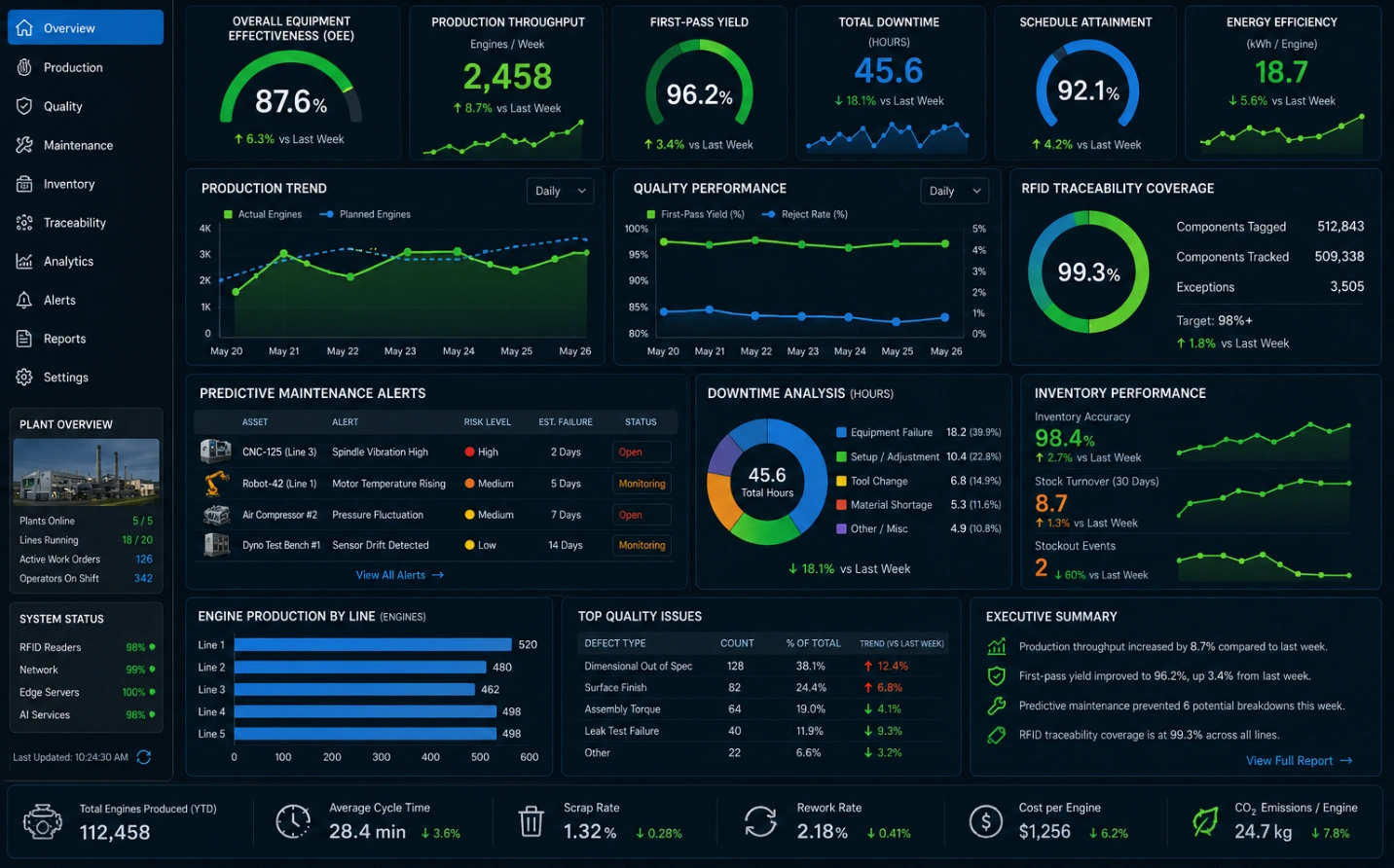
This dashboard visual demonstrates how AI-powered RFID manufacturing systems provide real-time visibility into critical engine production metrics, including overall equipment effectiveness (OEE), production throughput, first-pass yield, inventory accuracy, downtime analysis, and RFID traceability coverage. Integrated predictive maintenance alerts, quality analytics, and executive reporting help manufacturing teams identify risks, optimize operations, and improve production efficiency. The key takeaway is that AI and RFID technologies transform operational data into actionable intelligence that supports continuous improvement across engine manufacturing facilities.
Key Performance Indicators for AI-Powered Engine Manufacturing
Organizations implementing AI-enabled RFID systems typically monitor operational performance through measurable KPIs.
| KPI Category | Example Metrics |
|---|---|
| Production Efficiency | Overall Equipment Effectiveness (OEE), Throughput Rate, Cycle Time |
| Quality | First Pass Yield, Scrap Rate, Rework Rate |
| Maintenance | Mean Time Between Failures (MTBF), Mean Time To Repair (MTTR) |
| Inventory | Inventory Accuracy, Stock Turnover, Material Availability |
| Traceability | Component Genealogy Completeness, Recall Response Time |
| Logistics | Material Movement Efficiency, Work-in-Process Visibility |
| Workforce | Labor Productivity, Task Completion Efficiency |
| Compliance | Audit Readiness, Documentation Accuracy |
Successful implementations often achieve improvements in multiple categories simultaneously because operational data becomes more visible, accurate, and actionable.
Engineering Considerations for Successful Deployment
Engine manufacturing environments present unique operational challenges that require careful planning.
Key implementation considerations include:
- Metal-rich production environments
- High-temperature machining areas
- Cutting fluid exposure
- Electromagnetic interference
- High-speed conveyor systems
- Precision assembly operations
- Legacy equipment integration
- Supplier interoperability requirements
- Regulatory documentation requirements
- Future scalability objectives
Engineering teams should conduct comprehensive site assessments before selecting RFID tags, reader placement strategies, communication infrastructure, and AI workloads.
Practical deployment lessons learned include:
- Begin with clearly defined business objectives.
- Validate RFID read performance under actual production conditions.
- Integrate manufacturing data sources early.
- Establish data governance policies.
- Measure baseline KPIs before deployment.
- Expand deployment incrementally.
- Continuously retrain AI models using production data.
- Include operations personnel throughout implementation.
Business Outcomes of AI-Driven RFID Engine Manufacturing
Organizations implementing intelligent manufacturing solutions commonly pursue the following outcomes:
- Higher production throughput
- Improved engine quality consistency
- Reduced manufacturing costs
- Enhanced component traceability
- Faster root-cause investigations
- Lower inventory carrying costs
- Improved maintenance effectiveness
- Better production forecasting
- Increased operational visibility
- Stronger compliance readiness
Beyond operational improvements, AI-enabled manufacturing intelligence supports strategic decision-making by providing deeper insight into production performance and long-term manufacturing trends.
As one of the recognized suppliers of RFID, BLE, and industrial IoT technologies, GAO has worked with organizations requiring advanced tracking, monitoring, and operational visibility solutions across complex industrial environments throughout North America.
Strategic Recommendations for Engine Manufacturers
Organizations evaluating AI-enabled RFID solutions should prioritize initiatives that provide measurable operational value.
Recommended focus areas include:
- Component genealogy tracking
- Smart work-in-process visibility
- Predictive maintenance programs
- AI-driven quality analytics
- Inventory optimization
- Production scheduling intelligence
- Tool lifecycle management
- Real-time manufacturing dashboards
Engine manufacturers that combine operational visibility with AI-powered decision support are better positioned to improve productivity, quality, traceability, and manufacturing resilience.
Advancing Intelligent Engine Manufacturing with AI, RFID, and Industrial IoT
Engine manufacturing continues to evolve toward highly connected, data-driven production environments. RFID technology provides the visibility required to track critical components, materials, tooling assets, and finished engines throughout complex manufacturing processes. Artificial intelligence transforms this operational data into predictive insights that improve maintenance planning, production scheduling, quality assurance, inventory management, and manufacturing performance.
By combining AI, RFID, industrial sensors, manufacturing software, and connected equipment, organizations can create intelligent manufacturing systems that support greater efficiency, higher quality, stronger traceability, and improved operational decision-making. Companies seeking long-term competitiveness increasingly view AI-enabled manufacturing intelligence as a strategic capability rather than a standalone technology initiative.
Building the Future of Industrial AI and IoT with Aperture Venture Studio and GAO
For more than three decades, GAO Group of Companies has invested heavily in research and development involving RFID, BLE, industrial IoT, and intelligent monitoring technologies. As artificial intelligence continues transforming engine manufacturing and industrial production, we have expanded our focus on AI-powered industrial visibility, manufacturing intelligence, predictive analytics, and connected factory solutions while establishing Aperture Venture Studio to help accelerate the development and adoption of advanced AI and IoT technologies across industrial sectors.
Aperture has attracted leading AI specialists, IoT experts, operational executives, influential investors, and technology-focused organizations. Through initiatives such as Aperture Ventures Summit and TekSummit, advanced discussions surrounding industrial AI, RFID, digital manufacturing, and intelligent automation continue to foster technical collaboration and knowledge sharing. Together, these efforts have helped build vibrant technical communities dedicated to the future of AI and IoT innovation.
We welcome you to join us as:
- Advisors, co-founders, or employees
- Investors
- Customers
GAO, headquartered in New York City and Toronto, Canada, together with its sister companies GAO Research and GAO Tek, continues to support organizations across the United States and Canada, including Fortune 500 companies, leading research institutions, universities, and government agencies through extensive R&D investment, stringent quality assurance practices, and expert technical support.