
AI and RFID for Equipment Rental & Leasing
AI-Driven Equipment Rental Management with RFID
AI and RFID are helping equipment rental companies improve how construction machinery, tools, attachments, and other rental assets are identified, dispatched, monitored, maintained, and returned. By combining artificial intelligence with connected RFID identification, rental operators can turn asset-level data into actionable decisions across equipment yards, branches, service facilities, transportation operations, and customer job sites.
For equipment rental and leasing companies, the value extends beyond knowing where an asset is. AI can analyze rental histories, utilization patterns, inspection records, maintenance events, return conditions, customer demand, and RFID-generated asset data to support fleet allocation, preventive maintenance, loss reduction, and revenue optimization. RFID provides an automated identification layer, while AI interprets operational data and identifies patterns that would be difficult to detect manually.
GAO supplies RFID, BLE, and IoT hardware products and systems that can support these equipment rental workflows. Its experience serving organizations across the United States and Canada provides a foundation for addressing practical requirements such as asset identification, data capture, integration, and deployment support.
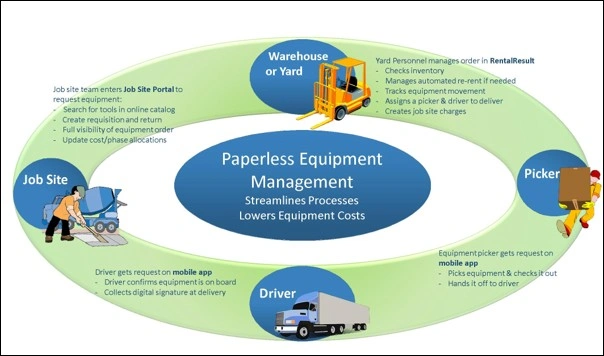
AI and RFID Equipment Rental Workflow Diagram for End-to-End Fleet Visibility
Why AI Matters to Equipment Rental & Leasing
Equipment rental companies manage assets with very different operating profiles. A 30-ton excavator, scissor lift, concrete saw, light tower, generator, trench roller, telehandler, and hydraulic attachment can have different utilization patterns, inspection requirements, maintenance intervals, transport requirements, and revenue potential.
AI helps rental operators analyze these differences rather than treating every asset as an identical inventory record.
Key applications include:
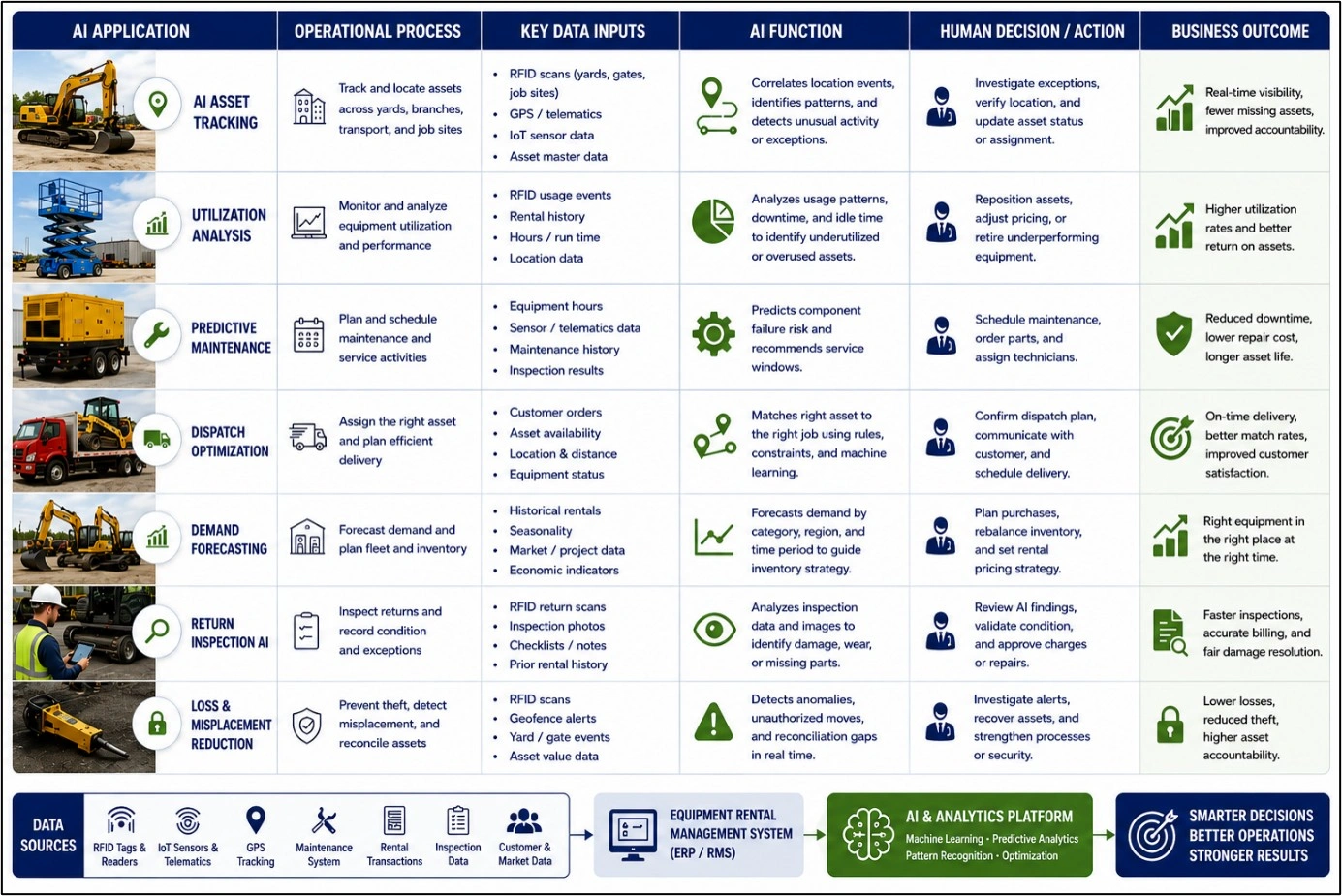
- AI asset tracking: Combines RFID identification with other location and operational data to improve visibility across yards, branches, service areas, transportation processes, and customer locations.
- AI fleet utilization analysis: Identifies underutilized equipment and compares utilization against rental demand, branch inventory, and historical rental activity.
- Predictive maintenance: Uses operating history, maintenance records, inspection results, sensor information, and equipment usage patterns to identify assets that may require service.
- AI-assisted dispatch: Helps rental coordinators match available equipment with customer requirements, branch inventory, delivery schedules, and equipment status.
- AI return inspection: Supports the review of return information and identifies unusual conditions that may require technician attention.
- AI demand forecasting: Analyzes rental history, seasonal demand, project activity, geographic requirements, and equipment categories to support fleet planning.
- Loss and misplacement reduction: Uses automated asset identification to reduce manual reconciliation and improve accountability for high-value equipment.
- Rental lifecycle optimization: Connects acquisition, preparation, rental, transportation, maintenance, inspection, and retirement decisions through accumulated operational data.
The resulting system can provide rental managers with a more complete view of each asset’s lifecycle instead of relying on disconnected spreadsheets, manual yard counts, handwritten inspection records, and isolated maintenance databases.
Equipment Rental Operations That Benefit from AI
AI applications are most useful where rental businesses repeatedly make decisions based on asset availability, condition, location, utilization, or customer demand.
Yard and Branch Inventory Management
Equipment yards may contain hundreds or thousands of assets, including construction machinery, attachments, generators, compressors, pumps, temporary power equipment, material handling equipment, and small tools. RFID identification can automate asset recognition while AI analyzes movement patterns and inventory discrepancies.
The system can help answer operational questions such as:
- Which assets are physically available for rental?
- Which assets are awaiting inspection or maintenance?
- Which machines have remained idle for unusually long periods?
- Which assets are assigned to another branch or customer?
- Which equipment categories are experiencing increased demand?
- Which assets require preparation before dispatch?
Rental Dispatch and Equipment Allocation
Dispatch personnel need accurate information about equipment status, customer requirements, delivery timing, and branch inventory. AI can evaluate these variables and recommend suitable assets while RFID provides reliable identification during preparation and handoff.
This can reduce the risk of dispatching equipment that is unavailable, awaiting maintenance, incorrectly identified, or already allocated to another rental agreement.
Maintenance and Service Operations
Maintenance represents a major operational component of equipment rental. Rental assets may undergo frequent inspections, preventive maintenance, repairs, cleaning, component replacement, and safety checks.
AI can analyze maintenance histories and utilization patterns to prioritize service work. RFID can associate physical equipment with digital service records, helping technicians retrieve the correct maintenance history during inspection or repair.
Equipment Return and Inspection
Returned assets must often be identified, checked, cleaned, inspected, serviced, and prepared for the next customer. Automated identification can reduce manual data entry during intake.
AI can support exception detection by comparing current return information against previous inspection records and expected equipment conditions. Human technicians remain responsible for final inspection and safety decisions.
AI Use-Case Matrix for Equipment Rental & Leasing Operations
How AI and RFID Work Across the Equipment Rental Lifecycle
An effective equipment rental solution begins with physical asset identification and ends with an operational decision. The complete workflow can connect RFID tags, readers, gateways, edge processing, software, AI models, rental management applications, maintenance records, and human workflows.
Asset Identification and Data Capture
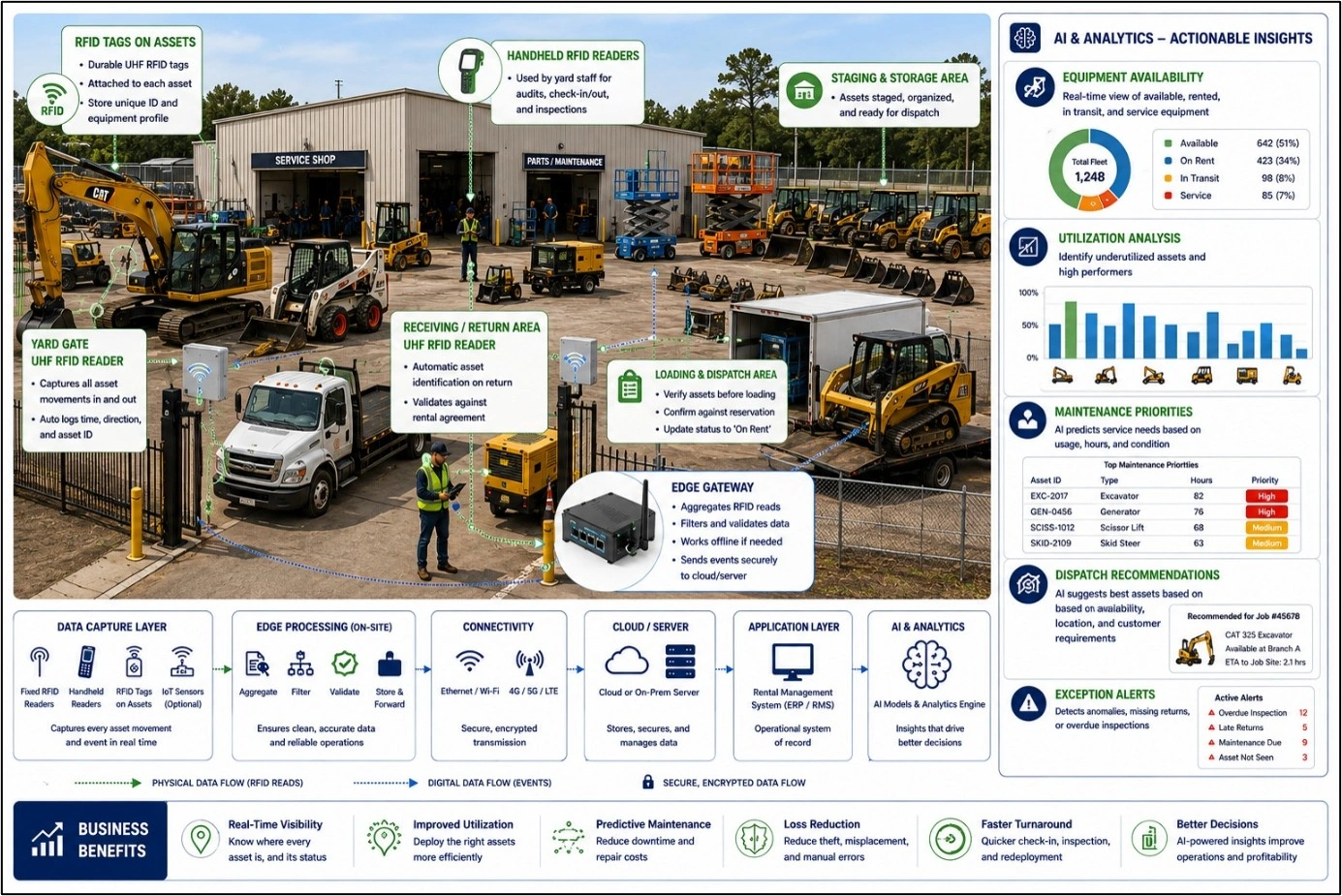
Rental assets receive appropriately selected RFID tags based on material, mounting surface, environmental exposure, read distance, and required durability. UHF RFID can be useful for longer-range identification in equipment yards and warehouse-like environments, while HF or LF RFID may be appropriate for specific short-range identification requirements.
Readers installed at gates, work areas, service points, receiving stations, or mobile inspection equipment capture tag information. RFID should not be treated as a replacement for every other sensing technology. Equipment rental operators may combine RFID with BLE, GPS, telematics, barcode identification, cameras, or machine sensors depending on the operational requirement.
Communication and Edge Processing
Reader data can be transmitted through Ethernet, Wi-Fi, cellular networks, or other suitable communication infrastructure. Edge devices can filter duplicate reads, validate tag events, timestamp transactions, and perform preliminary processing before sending information to centralized software.
This is particularly useful in equipment yards where thousands of RFID observations could otherwise generate unnecessary data traffic. Edge processing can also allow selected workflows to continue when network connectivity is temporarily unavailable.
Software and AI Processing
Middleware converts raw RFID observations into meaningful equipment events. A rental management system can then associate the event with an asset record, rental contract, branch, customer, inspection status, or maintenance history.
AI software can analyze this structured information together with historical rental transactions, maintenance records, utilization information, equipment specifications, and demand patterns.
Depending on the use case, models may include:
- Classification models for identifying operational conditions or exceptions
- Regression models for estimating utilization or maintenance requirements
- Time-series models for rental demand forecasting
- Anomaly detection for unusual asset movement or operating patterns
- Computer vision for selected inspection and equipment-condition workflows
- Optimization algorithms for fleet allocation and dispatch decisions
The AI output should generally support a human operational decision rather than automatically making safety-critical decisions without appropriate validation.
Enterprise System Integration
Integration is critical because equipment rental businesses already depend on software for rental contracts, inventory, accounting, customer management, maintenance, dispatch, transportation, and workforce management.
RFID and AI data can be connected to:
- Rental management software
- Enterprise resource planning systems
- Computerized maintenance management systems
- Fleet management software
- Customer relationship management systems
- Warehouse and inventory systems
- Transportation management software
- Business intelligence tools
- Mobile inspection applications
- Identity and access management systems
APIs, message queues, webhooks, database integration, and middleware can be used according to the customer’s existing IT environment.
Cloud and Server Deployment for Equipment Rental
A Cloud Version can host the equipment rental software and AI processing within managed cloud infrastructure. This approach is useful for rental organizations operating multiple branches because centralized data can be made available to authorized personnel across locations without requiring every branch to maintain its own application infrastructure.
Cloud deployment is particularly suitable when rental companies need centralized analytics, cross-branch fleet visibility, scalable storage, remote administration, and integration with cloud-based business software.
A Server Version can operate on customer-managed servers, private data centers, edge servers, or other privately hosted enterprise infrastructure. This approach can be appropriate where equipment rental organizations have strict data governance requirements, existing private IT infrastructure, specialized network controls, or operational environments where selected processing must remain locally hosted.
A hybrid implementation can also place time-sensitive processing close to RFID readers while sending consolidated information to centralized software.
Realistic Equipment Rental Yard RFID Deployment with AI Analytics and Dispatch Visibility
Engineering Considerations for Reliable Equipment Identification
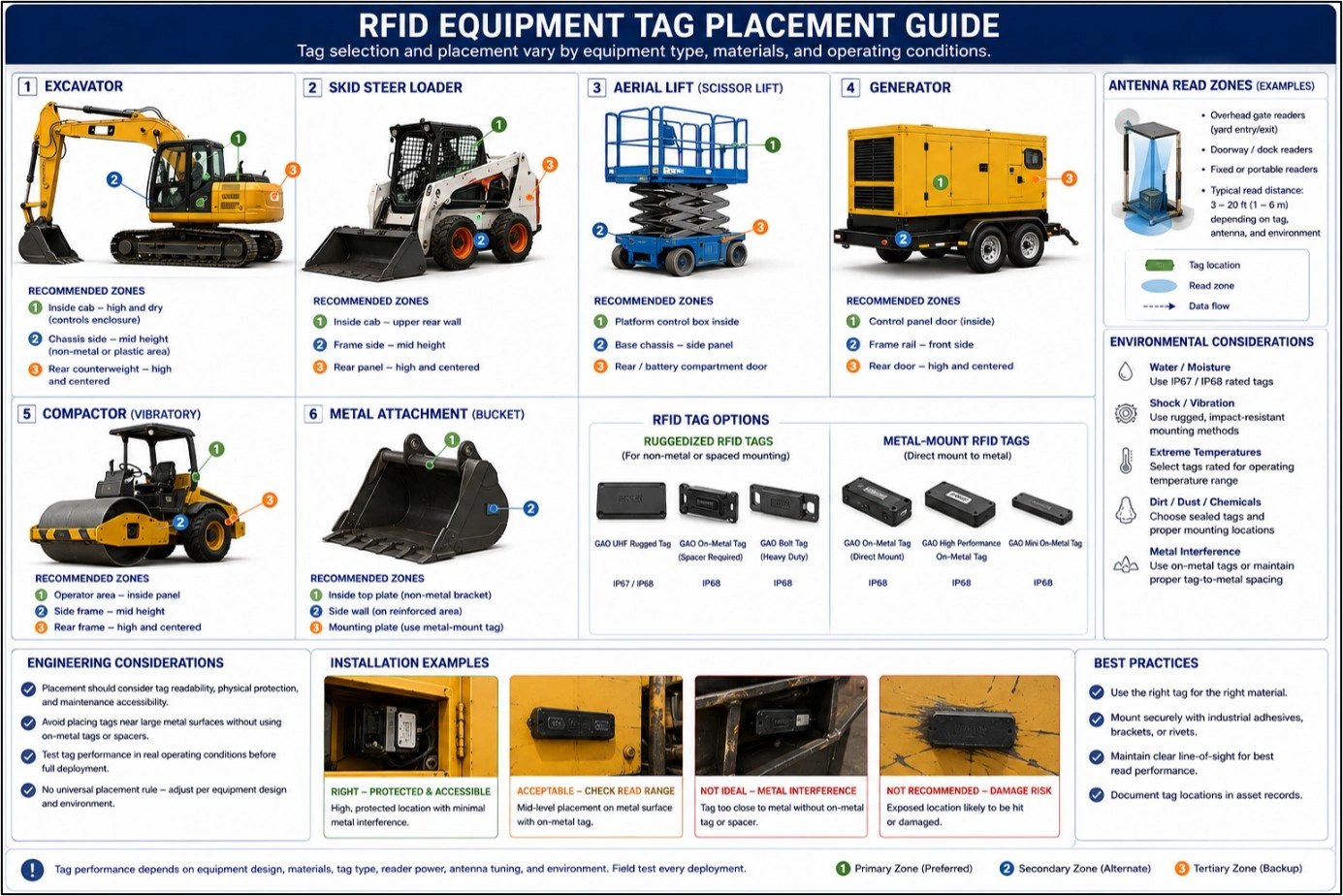
RFID performance depends on more than selecting a tag and reader. Equipment rental assets present challenging materials and environments, including metal surfaces, hydraulic components, engines, outdoor exposure, mud, vibration, weather, and physical handling.
Engineering considerations include:
- Tag placement and orientation
- Metal-compatible RFID tag selection
- Read-zone design
- Reader antenna positioning
- Read-range requirements
- Interference and multipath effects
- Environmental protection
- Duplicate-read filtering
- Reader density
- Network availability
- Equipment identification hierarchy
- Mobile versus fixed RFID reading
- Tag replacement and commissioning procedures
A practical deployment should begin with a representative equipment sample. Testing excavators, lifts, generators, tools, attachments, and other asset categories under actual yard conditions can expose RF performance problems before full deployment.
RFID Equipment Tag Placement Engineering Guide for Construction and Rental Assets
Business and Technical Benefits for Equipment Rental
The combination of AI analytics and automated asset identification can improve equipment rental operations because decisions are based on more complete and timely information.
Higher Equipment Utilization
AI can identify assets that remain idle while comparable equipment categories experience demand. Rental managers can use these insights to rebalance inventory, transfer assets between branches, adjust rental availability, or reconsider fleet composition.
Better Maintenance Planning
Predictive and condition-based approaches can prioritize equipment that requires attention based on usage patterns and historical records. This can help reduce avoidable downtime while preventing maintenance teams from treating every asset as equally urgent.
Improved Rental Asset Accountability
Automated identification creates a more consistent record of asset movements through defined read points and inspection workflows. This can reduce manual reconciliation and improve visibility into equipment transfers, dispatch, returns, and service movements.
Faster Yard Operations
Employees can identify multiple tagged assets without manually entering every serial number or asset identifier. This can accelerate receiving, staging, inventory checks, dispatch preparation, and return processing when the RFID deployment is correctly engineered.
Better Fleet Planning
Demand forecasting can help rental operators evaluate which equipment categories should be purchased, transferred, retained, or retired. AI can consider historical demand, utilization, seasonal patterns, geography, and asset economics rather than relying exclusively on intuition.
Scalable Multi-Branch Operations
Centralized data allows equipment rental companies to compare branch-level utilization, inventory availability, maintenance activity, and demand. Standardized asset identifiers and integration rules are important for maintaining data consistency as deployments expand.
KPIs for AI-Enabled Equipment Rental Operations
A deployment should be evaluated against measurable operational outcomes rather than RFID read counts alone.
Relevant KPIs include:
- Equipment utilization rate
- Rental revenue per asset
- Asset availability rate
- Fleet downtime
- Preventive maintenance compliance
- Mean time between failures
- Mean time to repair
- Rental turnaround time
- Return processing time
- Dispatch preparation time
- Inventory reconciliation accuracy
- Asset loss or shrinkage rate
- Branch transfer cycle time
- Equipment idle days
- Rental contract fulfillment rate
- Maintenance backlog
- Equipment inspection completion rate
- Demand forecast accuracy
- RFID identification accuracy
- Exception detection rate
RFID read accuracy is important, but it should be connected to business outcomes. A technically successful RFID deployment that does not improve asset availability, maintenance coordination, inventory accuracy, or rental turnaround may not deliver sufficient operational value.
Cybersecurity and Data Governance
Equipment rental systems contain operational information that can include asset locations, customer assignments, maintenance records, employee activities, rental contracts, and business performance information. Security therefore needs to cover the entire data path rather than only the RFID reader.
Recommended controls include:
- Role-based access control
- Strong authentication
- Network segmentation
- Encryption for data in transit
- Encryption for sensitive stored information
- Secure API authentication
- Device identity management
- Reader and gateway hardening
- Audit logging
- Software patch management
- Backup and recovery procedures
- Security monitoring
- Data retention policies
- Controlled administrative privileges
AI models also require governance. Rental organizations should document the source and quality of training data, monitor model performance, investigate false positives, and maintain human oversight for decisions involving safety, maintenance, compliance, or customer service.
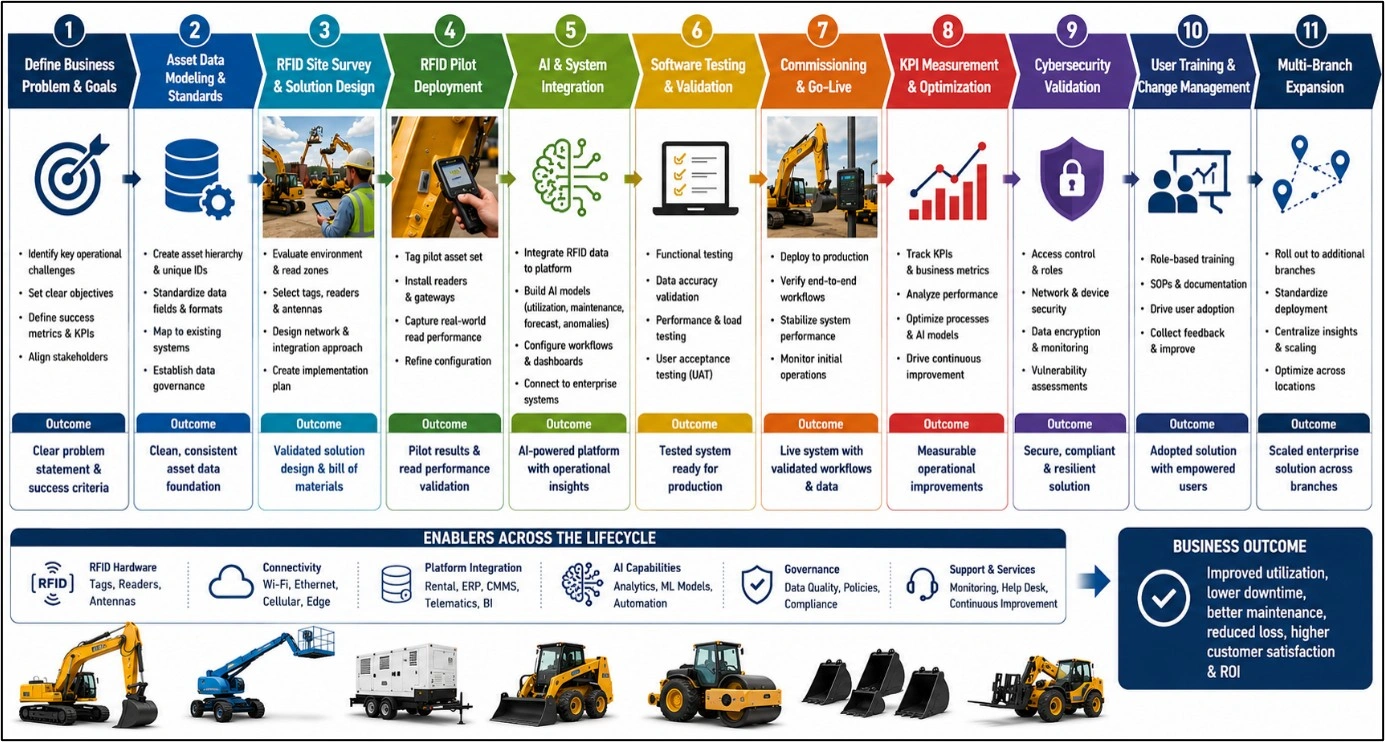
Implementation Roadmap for Equipment Rental Companies
A successful implementation should start with an operational problem rather than with RFID hardware.
Define the Business Process
Identify whether the priority is yard inventory, equipment dispatch, maintenance, return processing, loss reduction, utilization, or another measurable problem.
Establish the Asset Data Model
Create consistent records for equipment IDs, serial numbers, categories, branches, status, rental assignments, maintenance history, and ownership.
Conduct an RFID Site Survey
Evaluate metal surfaces, reader locations, antenna orientation, environmental conditions, network connectivity, read zones, and expected asset movement.
Run a Controlled Pilot
Select representative equipment categories and test the complete workflow from tagging through identification, software integration, AI processing, and operational action.
Validate Integration
Confirm that asset events correctly update rental, inventory, maintenance, and reporting software without creating duplicate or conflicting records.
Measure KPIs
Compare operational performance before and after deployment. Use measured improvements to determine whether the system should be expanded.
Commission and Scale
Document installation standards, tag replacement procedures, reader configurations, user training, cybersecurity controls, maintenance responsibilities, and support processes before expanding across additional branches.
Equipment Rental AI and RFID Implementation Lifecycle
Where GAO Supports Equipment Rental Technology Programs
GAO provides RFID, BLE, and IoT hardware products and systems that can be incorporated into equipment identification, asset tracking, inventory management, maintenance, and connected operational workflows.
Headquartered in New York City and Toronto, Canada, GAO has served customers across the United States and Canada, including Fortune 500 companies, research and development organizations, universities, and government agencies. GAO Group companies have invested substantially in research and development and maintain quality assurance and technical support capabilities.
For equipment rental organizations, practical support can include technology selection, RFID hardware considerations, system integration requirements, deployment guidance, and technical support for connected asset workflows.
Key Takeaways for AI-Enabled Equipment Rental
AI-driven equipment rental management becomes more valuable when physical asset identification is connected to the software and operational processes that rental businesses already use.
The most important implementation principles are:
- Start with a measurable equipment rental problem such as utilization, maintenance, dispatch, inventory accuracy, or return processing.
- Select RFID hardware according to equipment material, mounting conditions, read distance, environmental exposure, and workflow requirements.
- Combine RFID with BLE, telematics, GPS, barcode, computer vision, or other technologies when those technologies provide information RFID cannot.
- Treat middleware and data integration as critical components rather than secondary implementation tasks.
- Use AI to identify patterns, forecast demand, prioritize maintenance, detect anomalies, and support operational decisions.
- Keep human oversight for safety-sensitive maintenance, inspection, and equipment decisions.
- Measure deployment success through utilization, availability, downtime, turnaround time, maintenance, and inventory KPIs.
- Design cybersecurity and data governance into the solution from the beginning.
- Pilot the solution on representative equipment before expanding across branches.
- Standardize asset identification and deployment procedures so additional locations can be added without creating fragmented data.
AI and RFID can therefore form an important part of a broader AIoT approach to equipment rental. AIoT combines artificial intelligence with IoT devices, sensors, connected equipment, and industrial systems. For rental operations, this allows physical equipment activity to become structured operational information that can support better decisions.
GAO can help equipment rental organizations evaluate RFID, BLE, and IoT hardware and system requirements according to their specific operating environments. Organizations interested in improving equipment visibility, rental asset management, fleet utilization, or maintenance workflows can explore GAO’s technology solutions and technical support capabilities.
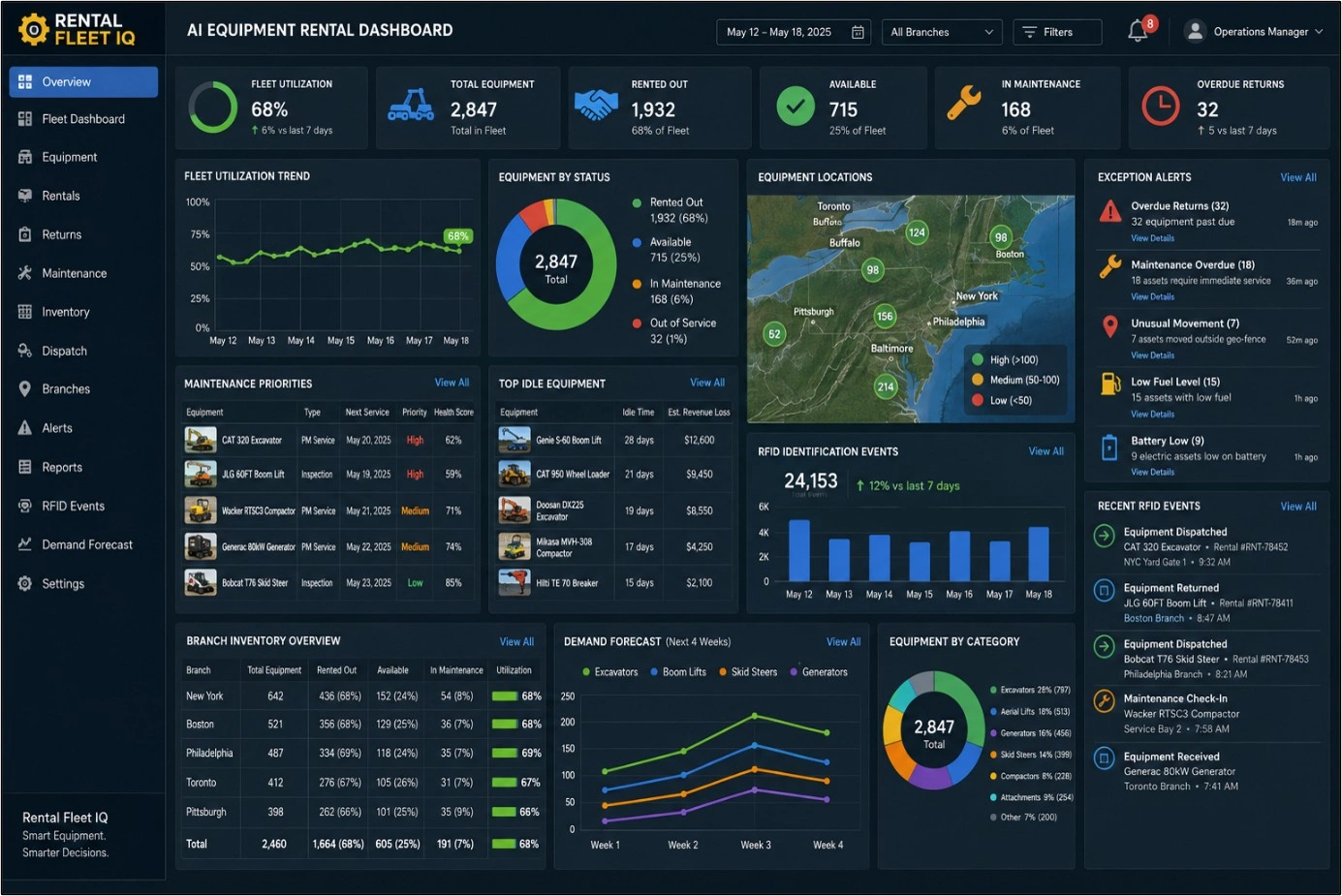
AI Equipment Rental Management Dashboard for Fleet Utilization and RFID Tracking
Building the Future of Industrial AI and IoT with Aperture Venture Studio and GAO RFID Inc.
For more than three decades, GAO Group of Companies has invested heavily in R&D of industrial RFID, BLE, and IoT. As generative AI became increasingly useful for industrial applications, we expanded our work in AI and IoT, including RFID and BLE, and founded Aperture Venture Studio to advance practical AI and IoT solutions for industries such as equipment rental and construction.
Aperture has attracted AI and IoT technical experts, entrepreneurial and operational executives, influential investors, and leading companies. We have also developed Aperture Ventures Summit and TekSummit to discuss advanced AI and IoT topics.
We welcome you to join us as:
- Advisors, Co-founders, or Employees
- Investors
- Customers