
AI and RFID for Event Venues
AI-Enabled RFID Solutions for Event Venues
Modern event venues are evolving into intelligent, data-driven environments where artificial intelligence and RFID work together to improve visitor experiences, strengthen security, optimize venue operations, and provide real-time operational visibility. AI-powered RFID solutions enable event organizers, venue operators, security teams, facility managers, concession operators, and technical staff to monitor people, equipment, inventory, and venue activities with greater accuracy while generating predictive insights that support better operational decisions.
Whether managing concerts, sports arenas, convention centers, exhibition halls, trade shows, festivals, performing arts venues, or multi-purpose entertainment complexes, AI-driven RFID systems help organizations automate visitor authentication, monitor crowd movement, optimize staffing, protect valuable assets, improve concession operations, reduce operational bottlenecks, and enhance safety. Artificial Intelligence of Things (AIoT) combines RFID infrastructure with intelligent analytics, edge computing, machine learning, and enterprise software to transform operational data into actionable intelligence throughout the entire event lifecycle.
For more than three decades, GAO has supplied RFID, BLE, and IoT hardware products and systems to organizations throughout North America. Headquartered in New York City and Toronto, Canada, GAO has supported Fortune 500 companies, leading research institutions, government agencies, and commercial organizations by providing reliable identification technologies backed by extensive engineering expertise and technical support.
AI-Enabled RFID Deployment in a Modern Event Venue
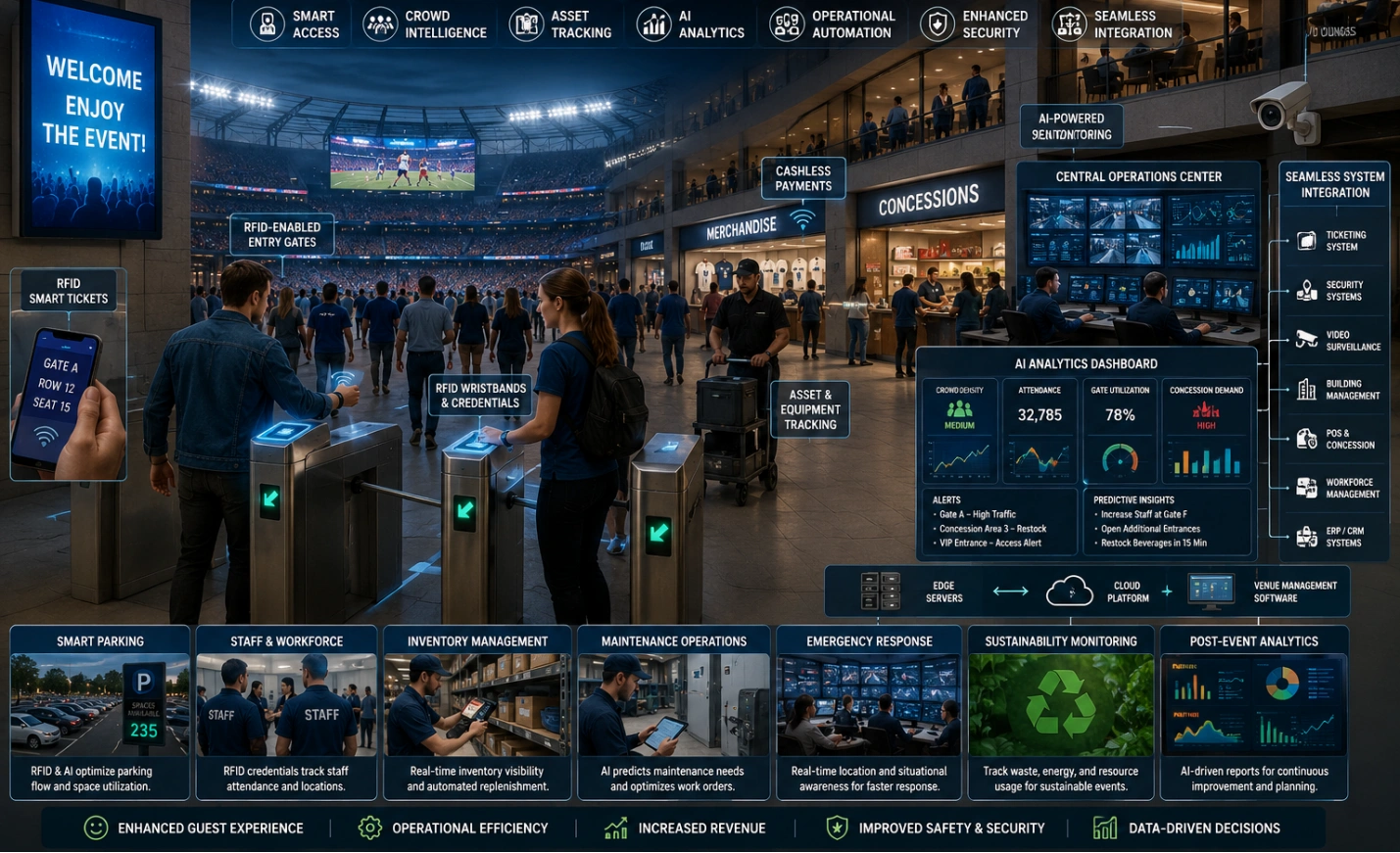
This illustration demonstrates how AI-enabled RFID technologies support intelligent event venue operations by connecting RFID-enabled entry gates, smart tickets, AI-powered security monitoring, concession management, and venue management software. It highlights the end-to-end flow of operational data that enables real-time decision-making, improved visitor experiences and greater operational efficiency.
How AI and RFID Transform Modern Event Venue Operations
AI-powered RFID solutions combine automatic identification technologies with intelligent software capable of learning operational patterns across event venues. RFID readers continuously capture data from tickets, wristbands, credentials, equipment tags, merchandise, reusable assets, and operational inventory. AI algorithms process these large datasets to identify trends, predict operational demands, detect anomalies, and automate routine decisions.
Unlike conventional RFID deployments that primarily identify tagged objects or people, AI-enhanced RFID solutions analyze operational behavior across the entire venue. This enables event managers to understand crowd movement, improve visitor flow, predict concession demand, optimize staffing, identify unusual security events, and improve overall venue utilization.
For event venues hosting thousands or even hundreds of thousands of visitors, AI significantly improves operational responsiveness by converting millions of RFID events into meaningful recommendations that support security teams, venue operations, guest services, and executive management.
Modern deployments also integrate RFID data with numerous operational systems including:
- Ticketing software
- Venue management systems
- Building management systems
- Physical security systems
- Video surveillance
- Digital signage
- Parking management
- Point-of-sale software
- Workforce management systems
- Maintenance management software
- ERP systems
- CRM systems
- Business intelligence dashboards
Rather than operating independently, RFID becomes one component within a broader AI-enabled operational intelligence solution.
Business Challenges Facing Modern Event Venues
Large event venues operate under demanding conditions where thousands of visitors, vendors, performers, contractors, volunteers, and staff interact simultaneously. Managing these dynamic environments presents operational challenges that extend far beyond simple ticket validation.
Common challenges include:
- Long visitor entry queues
- Ticket fraud and credential misuse
- Crowd congestion
- Unauthorized access to restricted zones
- Equipment loss
- Vendor coordination
- Asset visibility
- Slow emergency response
- Staff scheduling inefficiencies
- Merchandise inventory inaccuracies
- Concession stock shortages
- Parking congestion
- Difficult visitor flow analysis
- Limited operational visibility
- Manual reporting processes
Large concerts, conventions, exhibitions, festivals, and sporting events create highly dynamic environments where conditions may change within minutes. Traditional manual monitoring often cannot react quickly enough.
AI continuously evaluates RFID-generated operational data to recognize emerging conditions before they become major operational problems. Venue operators can proactively redirect staff, open additional entrances, replenish concessions, increase security presence, or reroute visitor traffic based on predictive recommendations.
Organizations deploying intelligent RFID solutions frequently experience improvements in:
- Visitor throughput
- Operational efficiency
- Security response
- Asset utilization
- Inventory accuracy
- Workforce productivity
- Maintenance scheduling
- Revenue optimization
- Customer satisfaction
- Decision-making speed
These improvements become increasingly valuable as venues host larger and more complex events throughout the year.
Operational Challenges in Event Venues Before AI-Enabled RFID Deployment
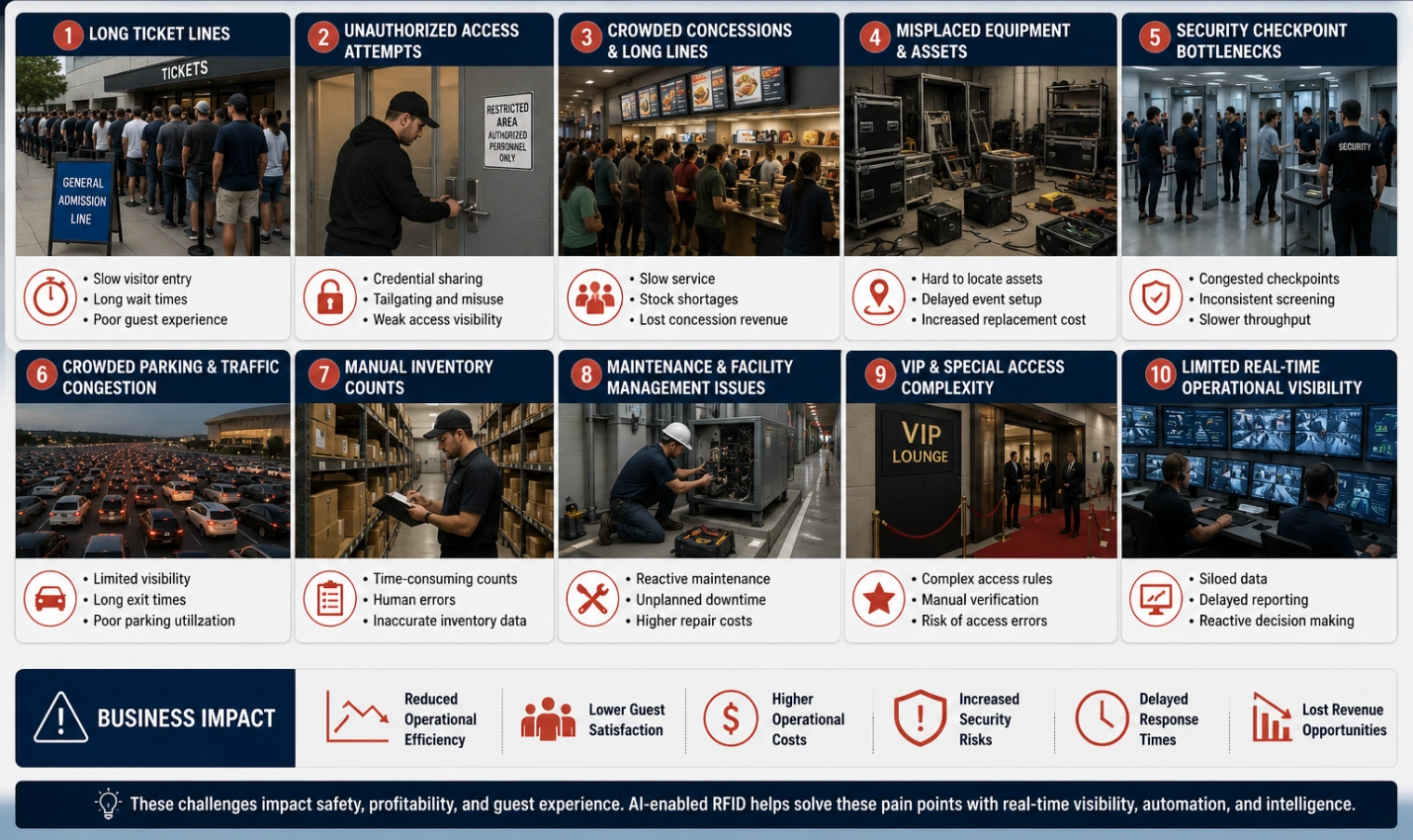
This infographic illustrates the most common operational challenges faced by modern event venues before implementing AI-enabled RFID solutions. It highlights issues such as long ticket queues, unauthorized access, crowded concessions, misplaced equipment, security bottlenecks, parking congestion, manual inventory counts, maintenance inefficiencies, complex VIP access management, and limited operational visibility, demonstrating why intelligent RFID systems are essential for improving venue efficiency, security, and guest experiences.
AI-Driven RFID Applications Across Event Venues
Event venues consist of numerous operational areas, each with unique workflows, security requirements, and performance objectives. AI-enabled RFID solutions support nearly every stage of venue operations while improving coordination among multiple departments.
Intelligent Visitor Entry Management
RFID-enabled tickets, smart cards, or wearable wristbands allow rapid visitor authentication at entry gates. AI analyzes historical attendance, entrance utilization, ticket scan rates, and crowd density to predict congestion before queues become excessive.
Operational improvements include:
- Faster admission processing
- Reduced ticket fraud
- Dynamic gate allocation
- Visitor flow balancing
- Real-time occupancy monitoring
- Reduced waiting times
Security personnel receive immediate alerts when unusual ticket activity or unauthorized credentials are detected.
VIP and Restricted Area Access Control
Large venues frequently contain multiple controlled-access zones including:
- VIP suites
- Media centers
- Broadcast facilities
- Performer backstage areas
- Equipment rooms
- Server rooms
- Production offices
- Loading docks
- Control rooms
- Executive offices
RFID credentials authenticate authorized personnel while AI continuously monitors access behavior.
The system can identify unusual access attempts, abnormal movement patterns, repeated failed authentication events, or unexpected occupancy levels that may require security investigation.
Crowd Flow Intelligence
Understanding visitor movement has become one of the most valuable applications of AI-enabled RFID.
Anonymous RFID movement data enables AI to identify:
- Congested corridors
- Underutilized entrances
- Popular attractions
- Queue formation
- Seating occupancy
- Restroom demand
- Retail traffic
- Emergency evacuation routes
Venue operators use these insights to improve facility layouts, staffing plans, event scheduling, concession placement, and emergency preparedness.
Equipment and Asset Tracking
Large event venues manage thousands of valuable operational assets, including:
- Audio equipment
- Video production systems
- Broadcast equipment
- Lighting fixtures
- Cameras
- Maintenance tools
- Cleaning equipment
- Portable barriers
- Medical equipment
- IT assets
- Network hardware
- Rental equipment
- Portable staging
- Event furniture
RFID tags provide continuous visibility into asset locations while AI predicts equipment utilization, identifies idle assets, recommends redistribution, and detects unusual movement that may indicate theft or operational errors.
By reducing manual equipment searches, venue staff spend more time supporting events rather than locating missing assets.
Intelligent Concession Operations
Food and beverage operations generate significant revenue during large events.
AI analyzes RFID-based inventory movements alongside historical sales, event schedules, weather conditions, attendance forecasts, and concession traffic to predict inventory demand.
Benefits include:
- Reduced stock shortages
- Lower food waste
- Faster replenishment
- Improved staffing allocation
- Better vendor coordination
- Increased concession revenue
RFID also improves inventory accuracy for beverages, packaged foods, merchandise, uniforms, reusable containers, and high-value consumables.
Real-World AI-Enabled RFID Deployment in a Modern Event Venue
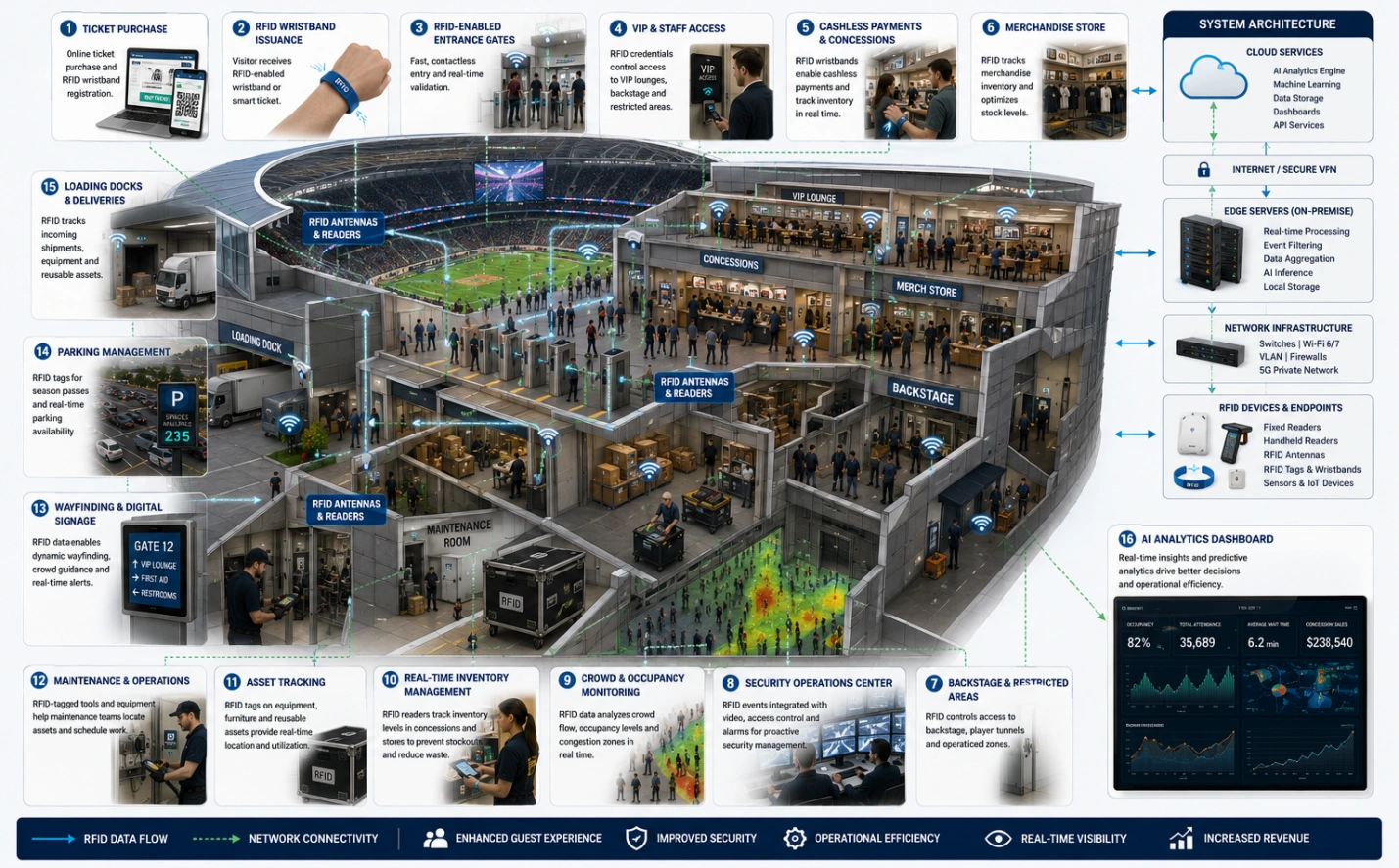
This cutaway illustration presents a complete AI-enabled RFID deployment throughout a modern event venue. It shows RFID-enabled entrance gates, visitor wristbands, VIP access control, concession inventory tracking, merchandise stores, maintenance asset tracking, loading docks, parking management, security operations, edge servers, networking infrastructure, cloud software, and AI analytics dashboards.
Operational Workflow from RFID Data Capture to AI Decision Making
Large event venues generate enormous volumes of operational data every second. AI transforms this continuous stream of RFID events into actionable operational intelligence by processing information through multiple interconnected stages.
Large event venues generate millions of RFID events throughout the lifecycle of every concert, sporting event, exhibition, conference, or festival. AI transforms these continuous RFID observations into operational intelligence by processing data through multiple coordinated stages that support venue management, security, guest services, maintenance, and executive decision-making.
A typical AI-enabled RFID workflow includes:
- RFID-tagged tickets, wristbands, credentials, merchandise, equipment, and reusable assets generate identification events.
- Fixed RFID readers at entrances, exits, loading docks, concession areas, storage rooms, backstage zones, parking facilities, and restricted areas capture RFID data.
- Mobile RFID readers used by security personnel, maintenance teams, inventory managers, and event staff supplement fixed infrastructure.
- RFID middleware validates, filters, timestamps, and normalizes captured events while removing duplicate reads.
- Edge computing servers perform low-latency processing for time-critical functions such as admission control, security alerts, occupancy monitoring, and emergency response.
- AI models analyze historical and real-time operational data to identify crowd congestion, abnormal movement, inventory shortages, asset utilization trends, credential anomalies, and equipment availability.
- Venue management software integrates RFID intelligence with ticketing systems, building management systems, physical security software, video surveillance, concession management, ERP, CRM, workforce scheduling, and business intelligence dashboards.
- Automated business rules trigger operational actions such as opening additional entrances, reallocating staff, replenishing concession inventory, dispatching maintenance teams, or notifying security personnel.
- Executive dashboards provide operational KPIs, predictive analytics, trend reports, and post-event performance analysis to support continuous improvement.
This operational workflow enables venue operators to respond proactively rather than reactively, improving guest experiences while optimizing resource utilization and operational efficiency.
AI-Enabled RFID Operational Workflow for Event Venues
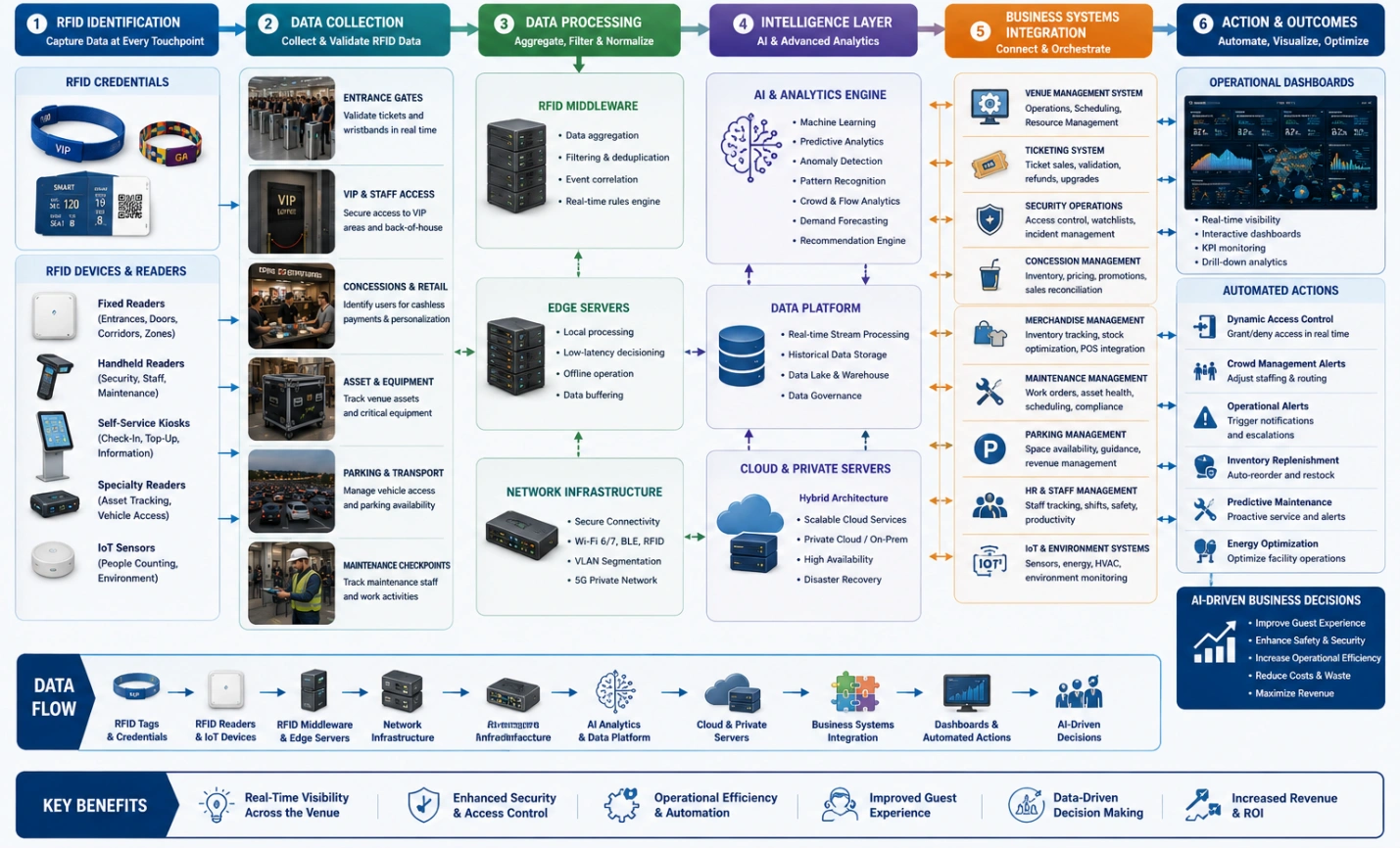
This workflow diagram illustrates the complete end-to-end AI-enabled RFID operational process for a modern event venue. It shows how RFID wristbands, smart tickets, fixed and handheld readers, middleware, edge servers, AI analytics, cloud and private servers, venue management software, ticketing systems, security operations, concession management, maintenance systems, dashboards, and automated business actions work together to transform RFID data into intelligent operational decisions.
Technologies Supporting AI-Powered RFID Event Venue Solutions
Successful deployments require coordinated integration between RFID infrastructure, AI software, communication networks, enterprise applications, and operational technologies. Rather than functioning as isolated components, these technologies collectively support intelligent venue operations.
RFID Hardware
Depending on operational requirements, event venues commonly deploy:
- UHF RFID readers for long-range identification of equipment, inventory, and logistics assets.
- HF RFID readers for contactless ticketing, credential validation, and payment applications.
- LF RFID readers for specialized identification scenarios where shorter read distances are advantageous.
- RFID wristbands for visitors, VIP guests, performers, staff, contractors, and volunteers.
- RFID-enabled smart tickets and access credentials.
- Fixed readers at entry gates, loading docks, concession storage areas, and restricted access points.
- Handheld RFID readers for inventory audits, maintenance operations, and security inspections.
- RFID antennas designed for high-density visitor environments.
- Industrial RFID printers and encoders for credential issuance and asset tagging.
GAO has supplied organizations across North America with RFID readers, tags, antennas, and supporting hardware for applications requiring reliable identification under demanding operational conditions.
AI Software
AI software enhances RFID data by applying intelligent analytics rather than simple event logging. Common AI techniques include:
- Machine learning for attendance forecasting and demand prediction.
- Predictive analytics for staffing, maintenance, and concession optimization.
- Computer vision integrated with RFID for security validation and occupancy analysis.
- Anomaly detection for credential misuse, suspicious movement, and asset protection.
- Natural language processing for operational reporting and management queries.
- Reinforcement learning for optimizing crowd flow and gate allocation.
These AI capabilities enable venue operators to identify operational trends that may not be apparent through manual analysis.
Communication Infrastructure
Reliable communications are essential for large venues with thousands of simultaneous RFID events. Supporting infrastructure commonly includes:
- Ethernet
- Wi-Fi 6 and Wi-Fi 7
- Fiber optic backbone networks
- Industrial Ethernet switches
- VLAN segmentation
- VPN connectivity
- 5G private wireless networks
- TCP/IP networking
- HTTPS
- MQTT
- REST APIs
Network redundancy and quality-of-service policies help ensure reliable operation during peak attendance periods.
Cloud Version
Cloud-hosted deployments are well suited for organizations operating multiple venues or requiring centralized management. Typical characteristics include:
- Centralized software management.
- Automatic software updates.
- Elastic computing resources for major events.
- Simplified multi-site reporting.
- Disaster recovery services.
- Remote administration.
- AI model updates managed within cloud infrastructure.
Cloud deployments are often appropriate for convention center operators, entertainment companies, venue management firms, and organizations hosting geographically distributed events.
Server Version
Privately managed server deployments provide organizations with greater operational control and may be preferred where latency, regulatory, or organizational policies require local processing.
Typical characteristics include:
- Edge AI processing.
- Customer-managed servers.
- Private data centers.
- Local integration with physical security systems.
- Direct connectivity with venue operational software.
- Reduced external network dependency.
- Greater customization opportunities.
- Support for hybrid cloud strategies.
Organizations frequently combine edge servers with centralized reporting to balance operational responsiveness and long-term analytics.
Cybersecurity Considerations
Because event venues manage sensitive visitor, operational, and business information, cybersecurity should be incorporated throughout deployment planning.
Recommended practices include:
- Role-based access control.
- Multi-factor authentication.
- Network segmentation.
- Device authentication.
- Encryption of RFID communications where applicable.
- Secure API authentication.
- Continuous vulnerability management.
- Security logging.
- Audit trails.
- Backup and disaster recovery procedures.
- Compliance with organizational security policies.
Benefits of AI-Driven RFID for Event Venues
When properly designed and integrated, AI-enabled RFID solutions provide measurable operational, financial, and guest experience improvements.
Operational Benefits
- Faster visitor admission.
- Reduced queue lengths.
- Improved crowd distribution.
- Better workforce utilization.
- Higher equipment visibility.
- Faster maintenance response.
- Improved inventory management.
- Automated operational reporting.
- Increased venue utilization.
Security Benefits
- Reduced ticket fraud.
- Improved credential management.
- Better restricted-area monitoring.
- Faster incident response.
- Improved asset protection.
- Enhanced emergency coordination.
- Better auditability.
Business Benefits
- Higher concession revenue through optimized inventory.
- Lower operational costs.
- Reduced equipment replacement expenses.
- Better staffing efficiency.
- Improved event profitability.
- Greater visitor satisfaction.
- Better executive decision-making through predictive analytics.
These benefits are realized through thoughtful planning, quality hardware selection, reliable software integration, and continuous operational optimization rather than through technology alone.
Traditional Event Venue Operations vs. AI-Enabled RFID Event Venue Operations
Traditional vs. AI-Enabled RFID Event Venue Operations
| Operational Area | Traditional Event Venue Operations | AI-Enabled RFID Event Venue Operations |
|---|---|---|
| Visitor Entry Speed | Manual ticket validation, barcode scanning, and slower admission during peak periods. | RFID wristbands and smart tickets enable rapid, contactless entry with AI-optimized gate allocation and real-time throughput monitoring. |
| Queue Management | Staff manually monitor queues and react after congestion occurs. | AI analyzes RFID movement data to predict congestion, recommend alternate entrances, and dynamically balance visitor flow. |
| Security & Access Control | Security personnel manually verify credentials with limited real-time visibility. | RFID credentials combined with AI continuously monitor access permissions, detect unauthorized entry attempts, and generate instant security alerts. |
| Asset Tracking | Equipment locations are tracked manually using spreadsheets or periodic audits. | RFID provides real-time location tracking while AI predicts asset utilization, detects anomalies, and helps prevent equipment loss. |
| Concession Inventory Management | Inventory checks are performed manually, increasing the risk of stock shortages or overstocking. | RFID automatically tracks inventory while AI forecasts demand, optimizes replenishment, and minimizes waste. |
| Maintenance Coordination | Maintenance is largely reactive and relies on manual work orders and inspections. | RFID identifies equipment locations while AI predicts maintenance requirements and prioritizes work orders proactively. |
| Staffing Optimization | Staff schedules are based on historical estimates and manual observations. | AI analyzes attendance patterns and RFID movement data to optimize staffing levels across entrances, concessions, security, and guest services. |
| Operational Reporting | Reports are generated manually after events using multiple disconnected data sources. | AI automatically consolidates RFID data into real-time dashboards, performance reports, and operational insights. |
| Operational Visibility | Limited visibility into visitor movement, asset status, and venue activities during live events. | Real-time RFID data provides complete operational visibility across entrances, VIP areas, concessions, parking, backstage, and maintenance operations. |
| Predictive Analytics | Decisions are primarily reactive and based on historical experience. | AI continuously analyzes historical and live RFID data to forecast attendance, crowd behavior, concession demand, staffing needs, and operational risks. |
| Decision Making | Managers rely on manual communication and delayed information. | AI-driven dashboards provide actionable recommendations that support faster, data-driven operational decisions. |
| Guest Experience | Visitors often experience longer wait times, inconsistent service, and limited personalization. | Faster entry, reduced queues, personalized services, efficient concessions, and improved security enhance the overall visitor experience. |
| Business Outcomes | Higher operating costs, lower efficiency, and limited operational insight. | Improved operational efficiency, enhanced security, increased revenue opportunities, optimized resource utilization, and better business intelligence. |
This comparison table contrasts traditional event venue operations with AI-enabled RFID operations across key operational areas, including visitor entry, queue management, security, asset tracking, concession inventory, maintenance, staffing, reporting, operational visibility, and predictive analytics.
Engineering Best Practices and Implementation Recommendations
Organizations planning AI-enabled RFID deployments for event venues should evaluate operational objectives before selecting hardware, software, and deployment models.
Recommended engineering practices include:
- Conduct comprehensive venue surveys to identify RFID read zones, interference sources, and visitor movement patterns.
- Define measurable KPIs such as admission throughput, asset utilization, inventory accuracy, security response times, and concession performance.
- Select RFID technologies appropriate for each operational scenario rather than applying a single technology across all applications.
- Design redundant communication infrastructure to support uninterrupted event operations.
- Validate interoperability with ticketing, security, ERP, CRM, maintenance, and building management software before production deployment.
- Implement pilot projects during smaller events to validate system performance under realistic conditions.
- Establish preventive maintenance procedures for readers, antennas, edge servers, and networking equipment.
- Continuously refine AI models using operational feedback and historical event data.
- Perform periodic cybersecurity assessments and software updates.
- Train operational staff, security teams, and maintenance personnel on system capabilities and incident response procedures.
GAO has supported customers with RFID hardware, engineering guidance, and technical expertise for projects ranging from asset identification to complex AIoT deployments requiring integration across multiple operational systems.
Transforming Event Venue Operations with AI-Enabled RFID
AI-powered RFID solutions are transforming event venues by improving visitor experiences, strengthening operational awareness, enhancing security, and supporting data-driven decision-making throughout the event lifecycle. By combining RFID identification technologies with artificial intelligence, edge computing, enterprise software, and intelligent analytics, venue operators gain greater visibility into people, assets, inventory, and operational activities while reducing manual processes and improving responsiveness.
As attendance volumes continue to increase and operational complexity grows, intelligent RFID systems will play an increasingly important role in helping venues improve efficiency, safety, sustainability, and business performance. Organizations that carefully plan deployments, integrate operational systems, and continuously optimize AI models will be better positioned to deliver reliable, secure, and engaging experiences for visitors while maintaining efficient venue operations.
End-to-End AI-Enabled RFID Lifecycle for Modern Event Venues
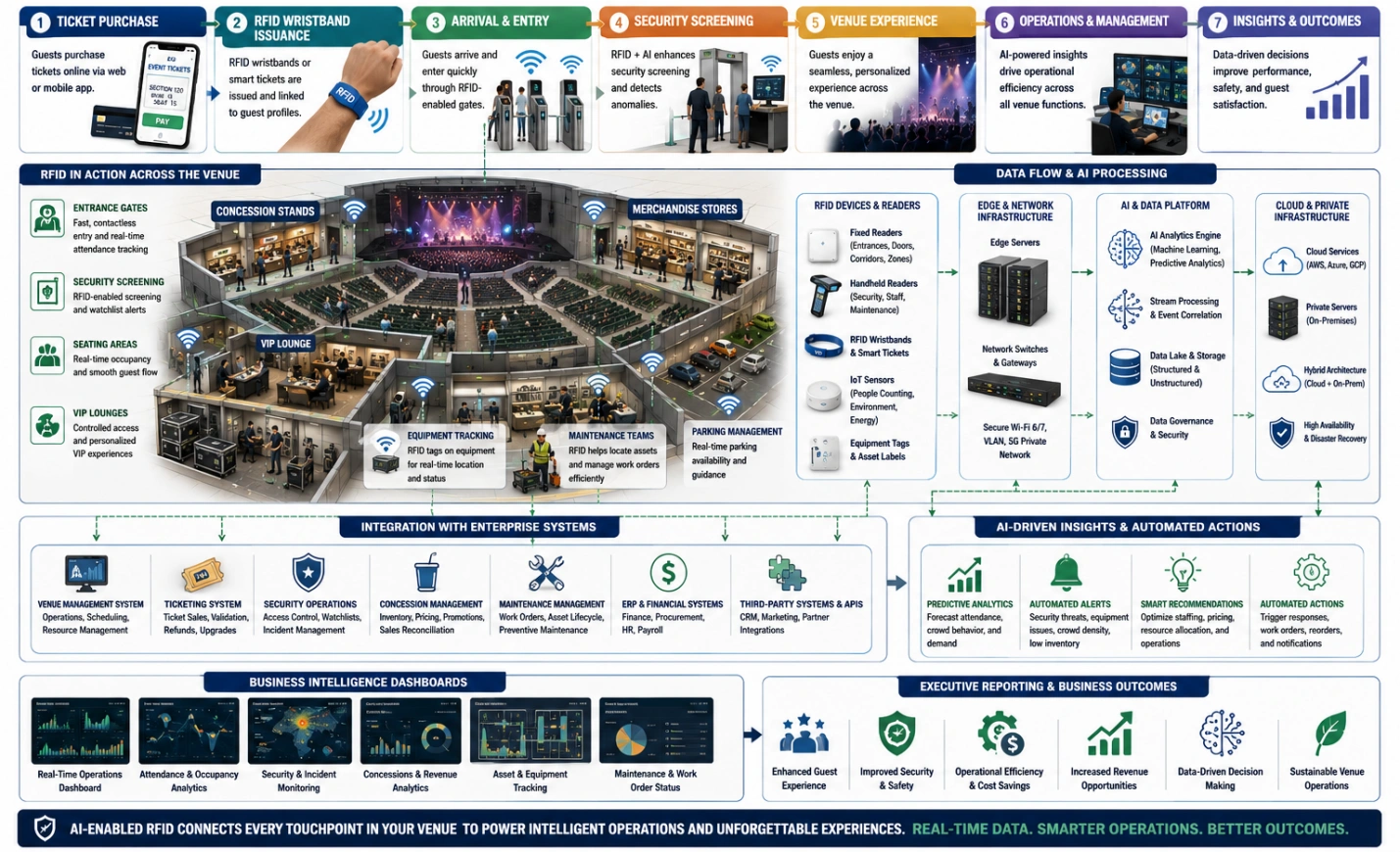
This enterprise infographic illustrates the complete lifecycle of an AI-enabled RFID solution for a modern event venue, from online ticket purchase and RFID wristband issuance to visitor entry, security screening, seating, VIP access, concession operations, merchandise management, equipment tracking, maintenance, parking, and backstage activities.
Building the Future of Industrial AI and IoT with Aperture Venture Studio and GAO RFID Inc.
For more than three decades, GAO Group of Companies has invested extensively in research and development of industrial RFID, BLE, and IoT technologies that support demanding operational environments, including intelligent event venues. As AI has become an essential component of industrial IoT solutions, we have expanded our work in AI-enabled RFID and IoT systems while establishing Aperture Venture Studio to accelerate the development and commercialization of advanced AI and IoT innovations across numerous industries. Aperture has attracted experienced AI and IoT experts, operational leaders, investors, and industry collaborators. Through initiatives such as Aperture Ventures Summit and TekSummit, we continue to foster technical collaboration and knowledge sharing. We welcome advisors, employees, investors, and customers who are interested in advancing the future of AI, RFID, and intelligent IoT solutions with GAO.