
AI-Driven Fleet Management with RFID
AI-Driven Fleet Management for Connected Vehicle Operations
AI-driven fleet management uses machine learning, edge computing, telematics, computer vision, and connected vehicle data to improve how fleets are dispatched, maintained, monitored, and serviced. RFID serves as an enabling identification technology for vehicles, trailers, containers, tools, spare parts, maintenance assets, driver equipment, and other physical items associated with fleet operations. Together, these technologies can connect physical asset identity with telematics, maintenance records, work orders, fuel activity, inspections, route information, and depot transactions. AI can then analyze these data streams to identify maintenance anomalies, forecast service requirements, detect asset mismatches, improve depot workflows, and support operational decisions. For fleet managers, the objective is not simply to locate vehicles. It is to establish reliable relationships between vehicles, assets, personnel, service events, and operational records so that fleet decisions are based on timely physical and digital information.
What AI-Enabled Fleet Management Means for Transportation Operations
AI-enabled fleet management combines operational data from vehicles, drivers, depots, maintenance facilities, fuel systems, cargo equipment, and physical fleet assets. The objective is to turn fragmented operational records into actionable information for dispatch, maintenance, utilization, safety, and compliance decisions.
RFID contributes a physical identity layer. A tagged trailer, tool, spare component, battery, safety device, or maintenance asset can be associated with a unique identifier. RFID read events can then be correlated with vehicle assignments, depot locations, maintenance work orders, inspection records, and fleet transactions. UHF RFID is particularly useful where multiple tagged assets must be identified quickly at depot entrances, maintenance areas, loading zones, or inventory points. HF RFID can support shorter-range identification and controlled interaction points, while LF RFID can be appropriate for selected proximity-based identification requirements.
AI adds analytical capabilities that conventional fleet databases do not provide by themselves. Machine learning can examine historical maintenance events, vehicle diagnostic data, mileage, engine hours, utilization, environmental conditions, and service intervals to identify patterns associated with future maintenance requirements. Anomaly detection can identify unusual asset movements, unexpected vehicle activity, inconsistent maintenance records, or abnormal depot transactions.
GAO supplies RFID hardware products and systems that can be incorporated into fleet tracking, asset identification, inventory control, and operational data-capture workflows. The engineering objective is to connect those physical identification events with the fleet software already used by an organization rather than creating an isolated RFID process.
Fleet Management Problems Addressed by AI
Fleet operations generate large volumes of heterogeneous data. A typical fleet may contain hundreds or thousands of vehicles, trailers, tools, batteries, tires, components, and safety assets distributed across multiple depots.
Common operational problems include:
- Unplanned vehicle downtime caused by maintenance issues that are detected too late
- Difficulty reconciling vehicle assignments, trailer assignments, and depot movements
- Inaccurate or delayed records for tools and maintenance equipment
- Manual inspection and service documentation
- Spare-parts shortages that delay vehicle repairs
- Excess inventory caused by poor visibility into component consumption
- Missed preventive maintenance intervals
- Inconsistent inspection records across multiple fleet locations
- Difficulty identifying abnormal asset movement between depots
- Limited visibility into utilization and idle equipment
- Manual verification of vehicles, trailers, and maintenance assets before dispatch
- Fragmented information across fleet management, ERP, CMMS, telematics, fuel, and inventory software
AI can address these problems when the underlying data is sufficiently accurate, timely, and connected to identifiable physical assets.
Fleet Management Applications for AI and RFID
AI-Driven Vehicle and Trailer Identification
Fleet operators frequently need to associate a vehicle or trailer with a specific depot transaction, maintenance event, dispatch record, cargo assignment, or service activity. RFID can automate identification at controlled locations instead of relying entirely on manual barcode scans or key-entry procedures.
A UHF RFID reader positioned near a depot gate or service entrance can capture tagged trailer or equipment identities as assets pass through a defined read zone. Middleware can filter duplicate reads and associate the resulting event with a facility, timestamp, reader zone, and operational transaction.
AI can then evaluate the event against expected fleet activity. For example, an unexpected trailer appearing at a maintenance facility can generate an exception for review when the fleet management system indicates that the trailer was assigned elsewhere.
Predictive Fleet Maintenance
Predictive maintenance is one of the most valuable AI applications for vehicle fleets because maintenance decisions depend on both historical and real-time information.
Relevant data can include:
- Odometer readings and engine hours
- Engine diagnostic trouble codes
- Oil pressure, coolant temperature, battery voltage, and other sensor measurements
- Brake and tire service history
- Preventive maintenance schedules
- Work orders and repair descriptions
- Parts replacement records
- Vehicle utilization patterns
- Driver-reported defects
- Inspection results
- Environmental and operating conditions
AI models can identify relationships between these variables and maintenance outcomes. RFID strengthens this process when physical components, tools, spare parts, batteries, tires, or maintenance kits require reliable identification.
A maintenance technician can associate an RFID-identified component with a vehicle and work order. The resulting record gives the AI system additional context for analyzing component history, replacement frequency, inventory consumption, and recurring service events.
AI Fleet Inventory and Spare-Parts Management
Fleet maintenance depends on the availability of filters, belts, brake components, tires, batteries, lubricants, tools, diagnostic equipment, and other service materials. Inventory inaccuracies can create delays even when vehicles and technicians are available.
RFID can capture movements of tagged maintenance assets and selected parts through receiving, storage, kitting, maintenance issue, return, and replenishment processes. AI can analyze consumption patterns and historical work orders to support demand forecasting.
A fleet inventory system can use these insights to distinguish between frequently consumed components and slow-moving stock. Forecasting can also account for fleet age, vehicle models, preventive maintenance schedules, seasonal utilization, and planned fleet expansion or retirement.
AI-Assisted Fleet Inspection and Compliance Workflows
Vehicle inspections generate structured operational information that can feed AI analysis. Inspection results can be associated with vehicle identity, inspection station, technician, timestamp, mileage, and previous defects.
RFID can automate physical identification before an inspection begins. This helps prevent inspection records from being attached to the wrong vehicle or equipment asset.
Computer vision can supplement inspection processes where cameras are suitable for detecting visible conditions such as tire appearance, body damage, lighting conditions, leaks, or missing external components. AI-generated exceptions should remain subject to appropriate human verification, particularly where inspection findings have safety or regulatory consequences.
Fleet Depot and Yard Operations
Depot operations involve continuous movement of vehicles, trailers, tools, fuel equipment, maintenance assets, and personnel. Manual yard checks can consume substantial staff time and may provide only periodic visibility.
RFID read zones can capture physical asset movements at selected gates, parking areas, maintenance entrances, storage locations, or dispatch staging points. AI can correlate those events with scheduled dispatches, maintenance status, vehicle availability, and expected asset locations.
This creates a more operationally useful view of fleet readiness. A vehicle shown as available in fleet software can be cross-checked against recent physical events and maintenance records before dispatch.
RFID Deployment in a Fleet Maintenance Depot
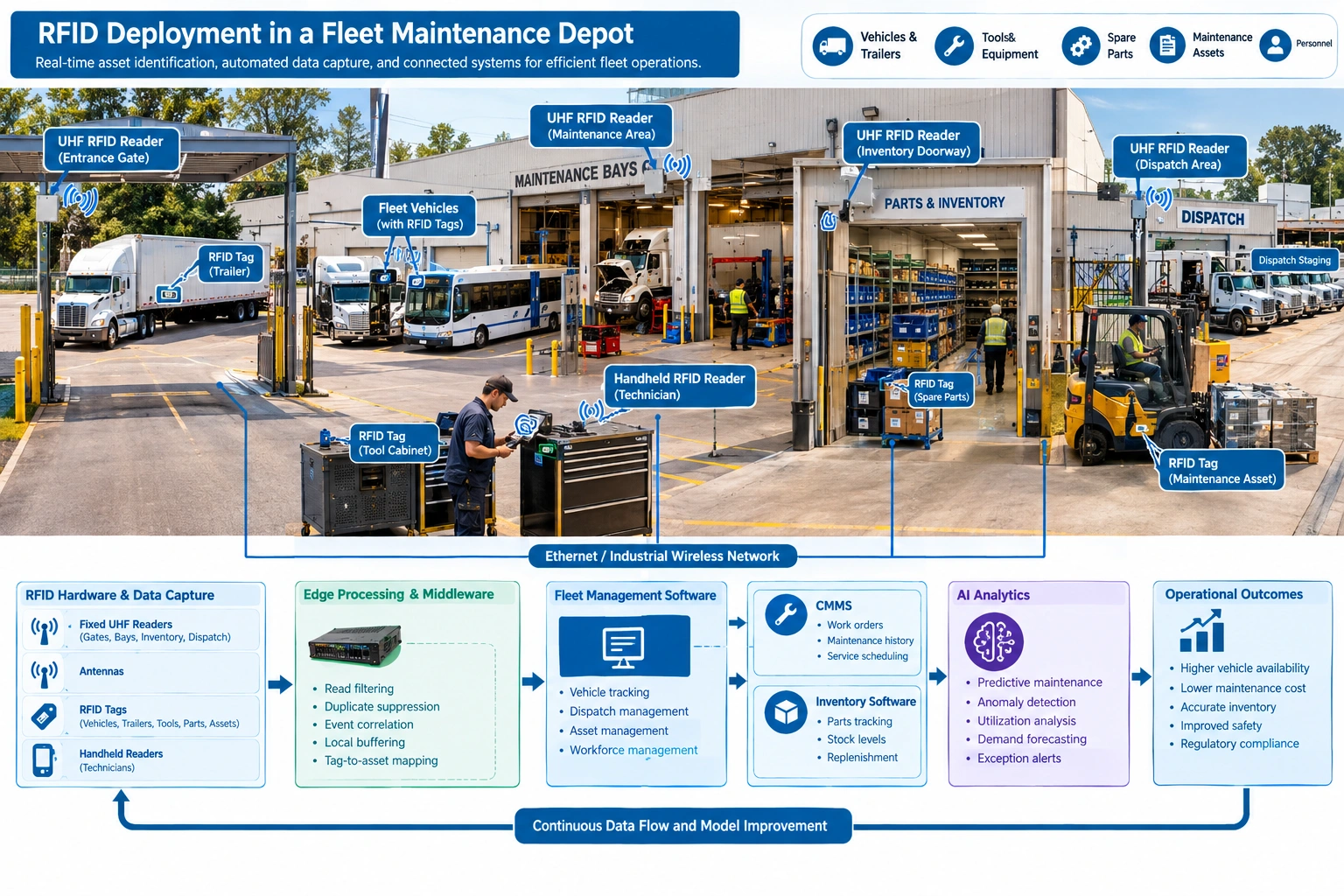
The visual shows a realistic fleet depot with UHF RFID readers, tagged vehicles, tools, spare parts, and maintenance assets. It connects RFID data capture to edge middleware, fleet management software, CMMS, inventory systems, and AI analytics.
Fleet Management Workflow from Physical Events to AI Decisions
A practical AI-enabled fleet management solution should treat data acquisition, event processing, analytics, and operational action as a connected workflow.
Physical Data Acquisition
The process begins with physical and digital observations from fleet operations. RFID readers identify tagged assets, while telematics units provide vehicle position and diagnostic information. Other data sources may include GPS, CAN bus data, OBD interfaces, tire-pressure monitoring systems, fuel systems, cameras, handheld computers, inspection applications, and environmental sensors.
RFID event data should normally contain fields such as:
- RFID tag identifier
- Reader identifier
- Antenna or read-zone identifier
- Timestamp
- Facility or depot
- Read confidence or signal-related information where available
- Associated vehicle, trailer, asset, or inventory identifier
- Transaction or work-order context
- Event classification
- Exception status
Separating a raw RFID observation from a confirmed business transaction is an important engineering practice. A tag being detected near a gate does not automatically prove that a trailer was dispatched, received, or assigned. Middleware and business rules should establish that relationship.
Edge Processing and Event Middleware
RFID readers can generate repeated observations as tagged assets remain within a read zone. Middleware therefore performs functions such as duplicate suppression, filtering, read-zone logic, temporal correlation, and event classification.
Edge processing is particularly useful at fleet depots where connectivity may be intermittent or where local operational response is important. Local buffering can preserve events during temporary network interruptions and forward them when connectivity is restored.
Typical event states may include:
- Asset detected
- Asset received
- Asset entering maintenance
- Asset inspected
- Asset assigned
- Asset staged for dispatch
- Asset dispatched
- Asset returned
- Asset transferred
- Asset exception
AI Processing and Fleet Decisions
The processed events can be combined with telematics, CMMS, ERP, inventory, dispatch, and historical maintenance data.
AI services can apply:
- Anomaly detection to unusual vehicle, trailer, or equipment activity
- Time-series forecasting to maintenance demand and parts consumption
- Classification models to categorize maintenance and operational exceptions
- Predictive models to identify patterns associated with component failure
- Optimization methods to support maintenance scheduling and asset allocation
- Computer vision for selected vehicle inspection tasks
- Natural-language interfaces for querying fleet operational information
The final decision should remain connected to an operational workflow. A maintenance anomaly can create a review task for a fleet supervisor. A spare-parts forecast can inform procurement. A vehicle-location discrepancy can trigger a physical verification request rather than an automatic assumption that the asset is missing.
RFID, AI Software, and Connected Fleet Infrastructure
RFID should be selected according to the physical operating environment rather than treated as a universal identification method. UHF RFID is generally suited to longer-range identification and multi-item reads around fleet depots, maintenance inventory areas, and controlled vehicle or trailer movement points. HF RFID can support shorter-range identification where intentional proximity-based interaction is preferred. LF RFID can be considered for specific proximity and environmental requirements.
RFID readers, antennas, tags, handheld devices, edge computers, network equipment, and middleware form the physical data-capture layer. Their configuration depends on tag placement, vehicle construction, metal surfaces, read-zone geometry, asset density, reader power, antenna orientation, and movement speed.
Fleet deployments also commonly involve:
- GPS and GNSS positioning
- Cellular connectivity
- Wi-Fi and Ethernet
- CAN bus and vehicle diagnostic interfaces
- OBD-based data acquisition
- Telematics gateways
- CMMS and maintenance management software
- Fleet management and dispatch software
- ERP and procurement systems
- Inventory databases
- REST APIs and webhooks
- SQL databases
- Message queues
- Mobile technician applications
- Identity and access management systems
Cloud Version and Server Version for Fleet Management
A Cloud Version hosts fleet RFID event processing, databases, AI services, dashboards, and integration services within cloud infrastructure. This model can be appropriate for fleets operating across many depots because centralized software can support multi-location data access, centralized model management, and scalable computing resources. Network connectivity, data residency, integration security, and offline operating requirements should be evaluated before deployment.
A Server Version runs software on customer-managed servers, private data centers, facility servers, private hosting environments, or other privately controlled infrastructure. This approach can suit fleet operators that require greater control over data location, internal network boundaries, local processing, or integration with existing private systems.
A hybrid design can combine local RFID event processing with centralized AI services. This allows a depot to continue collecting and buffering operational events locally while transmitting validated data to centralized software when connectivity is available.
Security and Data Governance
Fleet systems can contain sensitive operational information, including vehicle locations, maintenance records, employee-related information, facility data, and transportation schedules. Security therefore needs to extend from RFID readers and edge gateways through APIs, databases, AI services, and user applications.
Relevant controls include:
- Role-based access control
- Strong authentication and credential management
- Encryption for data in transit and at rest
- Network segmentation between operational and business systems
- Secure API authentication
- Device identity and certificate management
- Audit logging
- Software patching and vulnerability management
- Backup and disaster recovery procedures
- Retention policies for RFID and telematics events
- Monitoring for unauthorized device or account activity
GAO’s RFID hardware and systems can serve as components within a broader fleet data-capture design, while the surrounding security controls should be aligned with the fleet operator’s IT, operational technology, and cybersecurity requirements.
Technical Capabilities and Operational Improvements
AI-enabled fleet management becomes more useful when RFID events are combined with vehicle telemetry, maintenance history, dispatch information, inventory records, and inspection data. The resulting system can move fleet operations from periodic manual checks toward continuously updated operational information.
Predictive Maintenance and Vehicle Availability
AI models can analyze vehicle operating conditions alongside maintenance history to identify patterns that precede service events. This can help maintenance planners prioritize inspections and schedule work around expected vehicle availability rather than relying exclusively on fixed intervals.
RFID can provide additional physical context by identifying the vehicle, trailer, component, tool, or maintenance asset involved in a service event. This is particularly useful when several similar vehicles or components are processed simultaneously.
The practical objective is not to have AI automatically authorize repairs. A more controlled workflow is to use AI to generate a maintenance recommendation, provide the supporting evidence, and allow a qualified maintenance professional to validate the action.
Fleet Utilization and Asset Availability
Fleet utilization analysis can combine GPS history, engine hours, dispatch records, maintenance status, RFID location events, and vehicle assignment data. AI can identify recurring periods of underutilization, unexpected idle time, or differences between planned and observed fleet activity.
For example, a trailer may appear available in fleet software while RFID events indicate that it remains in a maintenance or staging area. Correlating these records can expose data-quality problems before they affect dispatch planning.
Useful measurements include:
- Vehicle utilization rate
- Fleet availability
- Unscheduled downtime
- Average idle time
- Maintenance turnaround time
- Trailer utilization
- Asset dwell time at depots
- Dispatch readiness
- Preventive maintenance compliance
- Mean time between failures
- Mean time to repair
Maintenance Inventory Optimization
AI-assisted inventory management can forecast demand for frequently consumed fleet components by combining historical withdrawals, work orders, vehicle populations, service intervals, and seasonal operating patterns.
RFID can improve physical inventory accuracy for tagged maintenance equipment and selected parts. Receiving, storage, issue, return, and transfer events can be associated with inventory records, reducing dependence on manual reconciliation.
This can support more precise decisions concerning reorder points, safety stock, slow-moving inventory, and depot-level stock allocation.
Automated Exception Detection
Fleet operations produce exceptions that are difficult to identify through static reports. AI can continuously evaluate operational events against expected patterns.
Examples include:
- A trailer appearing at an unexpected depot
- A maintenance asset moving without a corresponding work order
- Repeated vehicle visits to a maintenance location
- A vehicle remaining in a service area longer than expected
- A component being associated with an unexpected vehicle
- A discrepancy between RFID movement and fleet software status
- Unusual parts consumption for a vehicle class
- Repeated inspection defects associated with a particular asset
- Unexpected gaps in telemetry or RFID event sequences
An exception should be treated as a signal for investigation. RFID read uncertainty, tag placement, reader coverage, network interruptions, and data synchronization issues can all produce false exceptions.
Fleet Management Integration with Enterprise Software
AI and RFID deployments should integrate with existing fleet processes rather than create a parallel operational database that staff must maintain manually.
A typical integration sequence can connect RFID middleware with:
- Fleet management software
- Computerized maintenance management systems
- Enterprise resource planning software
- Transportation management software
- Dispatch systems
- Telematics systems
- GPS and vehicle tracking applications
- Fuel management systems
- Inventory management software
- Procurement applications
- Driver and inspection applications
- Business intelligence and reporting databases
REST APIs and webhooks are useful for event-driven integrations. SQL interfaces can support approved database integration where appropriate. Message queues can be useful when large numbers of vehicle, RFID, or telemetry events must be processed asynchronously.
A normalized event model should preserve the relationship between the physical asset and the business transaction. A useful record may include the asset identifier, vehicle or trailer identifier, facility, timestamp, reader zone, event type, work order, dispatch transaction, and processing status.
This distinction is important because an RFID reader observes a physical identifier, while the fleet management system interprets that observation in an operational context.
Interoperability and Data Quality
Interoperability problems often occur when fleet software, RFID middleware, telematics applications, and maintenance systems use different identifiers or event definitions.
A deployment should establish:
- A consistent asset identification scheme
- Mapping between RFID tag IDs and fleet asset IDs
- Standard event definitions
- Timestamp synchronization
- Facility and reader-zone identifiers
- API authentication requirements
- Error-handling and retry procedures
- Duplicate-event handling
- Offline data buffering rules
- Data ownership and retention requirements
GAO can provide RFID hardware products and systems that supply physical identification data for these workflows. The surrounding integration layer should be designed around the fleet operator’s existing software and operating procedures.
Engineering Considerations for RFID Fleet Deployment
RFID performance in fleet environments depends heavily on physical conditions. Vehicles contain metal surfaces, batteries, fluids, electronics, cargo, and other materials that can affect radio-frequency performance. A tag that works reliably on a plastic inventory container may perform differently when mounted directly against a metal trailer or vehicle component.
Tag Selection and Placement
Tag selection should consider:
- Metal and non-metal mounting surfaces
- Outdoor exposure
- Temperature variation
- Moisture and chemicals
- Mechanical impact
- Cleaning processes
- Required read distance
- Asset dimensions
- Expected tag orientation
- Required service life
Durable UHF RFID tags can be appropriate for many fleet and depot applications where longer-range automated identification is required. HF and LF RFID can be selected where shorter-range or proximity-oriented identification provides a better operational fit.
Tag placement should be validated under actual operating conditions rather than determined only from laboratory specifications.
Reader and Antenna Design
Reader placement should reflect vehicle movement and the physical geometry of the read zone. A gate reader may need multiple antennas to establish coverage across different vehicle heights and orientations. Maintenance-area readers may require tighter zones to prevent unintended reads from adjacent assets.
Testing should examine:
- Vehicle speed
- Tag orientation
- Reader-to-tag distance
- Antenna polarization
- Adjacent tagged assets
- Metal interference
- Reader cross-talk
- Read-zone boundaries
- Environmental conditions
- Reader coverage during peak traffic
A useful deployment separates identification zones physically wherever possible. This reduces ambiguity when a vehicle passes near multiple tagged assets or when several maintenance transactions occur simultaneously.
Fleet AI and RFID Implementation Lifecycle
A successful implementation normally begins with the operational problem rather than the technology.
Planning and Site Assessment
Fleet operators should first identify measurable problems such as maintenance downtime, trailer visibility, parts discrepancies, depot congestion, inspection delays, or asset reconciliation.
A site survey can then document:
- Depot entrances and exits
- Maintenance bays
- Parking and staging areas
- Parts rooms
- Tool storage
- Inspection lanes
- Dispatch areas
- Network availability
- Existing telematics infrastructure
- Environmental conditions
- Expected RFID read zones
Hardware Selection and Pilot Testing
The pilot should use representative vehicles, trailers, maintenance assets, and operating conditions. RFID tags should be tested on their actual mounting surfaces.
Testing should measure identification reliability rather than simply confirming that a tag can be read. Important measurements include read success rate, missed reads, unintended reads, event latency, transaction accuracy, and behavior during peak operational periods.
Commissioning and Software Integration
Each RFID tag should be commissioned and linked to the correct fleet asset record. Reader IDs, antenna IDs, facilities, and read zones should also be registered.
Middleware should convert raw reader observations into meaningful fleet events before those events reach AI services or operational software.
Integration testing should verify:
- Correct asset-to-tag association
- Correct facility identification
- Correct event timestamps
- Duplicate suppression
- Offline buffering
- API retry behavior
- Work-order association
- Exception generation
- User notification
- Audit logging
AI Model Development and Validation
AI models should be developed using representative fleet data. Historical maintenance records can provide training information for predictive-maintenance models, while validated RFID and telematics events can support anomaly-detection models.
Model performance should be measured against operational outcomes rather than generic accuracy alone.
Relevant measurements may include:
- False-positive alert rate
- False-negative rate
- Maintenance prediction lead time
- Alert resolution time
- Forecast error
- Exception detection rate
- Human validation rate
- Downtime avoided or reduced
- Parts forecast accuracy
AI recommendations should remain explainable enough for maintenance and fleet personnel to understand the underlying evidence, particularly when recommendations affect vehicle availability or safety-related work.
Fleet Management KPIs for AI-Enabled Operations
KPIs should connect technology activity with measurable fleet outcomes. RFID read counts alone do not demonstrate operational value.
Useful measurements include:
| Fleet Area | Example KPI | AI/RFID Contribution |
|---|---|---|
| Vehicle availability | Fleet availability rate | Correlates physical status with maintenance records |
| Maintenance | Unscheduled downtime | Identifies patterns preceding service events |
| Maintenance | Preventive maintenance compliance | Links vehicle identity, service records, and schedules |
| Depot operations | Asset dwell time | Measures time spent in staging or maintenance areas |
| Trailer management | Trailer utilization | Correlates movement and assignment records |
| Inventory | Parts inventory accuracy | Improves physical identification and transaction capture |
| Inventory | Stockout frequency | Supports AI demand forecasting |
| Inspection | Inspection completion rate | Automates asset identification at inspection points |
| Exceptions | Alert resolution time | Measures operational response to AI findings |
| Data quality | Event reconciliation rate | Measures agreement between physical and software records |
| Dispatch | Dispatch readiness | Combines maintenance and physical asset status |
| Operations | Vehicle utilization | Combines telematics and operational events |
Baseline measurements should be captured before deployment so improvements can be compared against the original operating condition.
Practical Recommendations for Fleet Operators
A technically sound deployment should prioritize operational reliability over the number of RFID readers or AI models deployed.
- Start with a clearly measurable fleet problem such as maintenance downtime, trailer visibility, parts accuracy, or depot readiness.
- Define the business event that an RFID observation is expected to support before installing readers.
- Select RFID tags according to mounting surface, environmental exposure, required range, and asset lifecycle.
- Use UHF RFID for appropriate automated longer-range identification scenarios, while considering HF or LF for shorter-range proximity applications.
- Perform RFID testing on actual vehicles, trailers, tools, and maintenance assets rather than relying solely on laboratory performance.
- Separate raw RFID observations from validated fleet transactions.
- Use edge middleware to filter duplicate reads and establish meaningful read-zone events.
- Integrate RFID data with fleet management, CMMS, inventory, telematics, dispatch, and ERP systems where operationally justified.
- Keep AI recommendations traceable to the underlying vehicle, asset, maintenance, or telemetry records.
- Require human validation for safety-critical or financially significant decisions.
- Monitor false alerts and missed events as part of ongoing AI model governance.
- Protect RFID readers, gateways, APIs, databases, and AI services through appropriate cybersecurity controls.
- Establish consistent asset identifiers across RFID, fleet management, maintenance, inventory, and telematics systems.
- Pilot the solution at a representative depot before expanding across multiple fleet locations.
- Measure operational KPIs before and after deployment to determine whether the system is producing measurable improvements.
Building a Connected Future for Fleet Management
AI-enabled fleet management is most effective when physical fleet activity can be reliably connected with operational software and historical records. RFID can provide that physical identification for selected vehicles, trailers, tools, components, inventory, and maintenance assets, while telematics and IoT sensors contribute continuous vehicle and operating information.
AI then provides the analytical layer needed to identify patterns, forecast maintenance requirements, detect operational exceptions, and support fleet planning. The resulting system can connect depot operations, maintenance teams, dispatch personnel, inventory managers, and fleet leadership around a more consistent view of fleet activity.
GAO has supplied RFID, BLE, and IoT hardware products and systems to organizations in the United States and Canada, including Fortune 500 companies, research and development organizations, universities, and government agencies. Headquartered in New York City and Toronto, Canada, GAO is ranked among the top 10 leading B2B and B2G BLE and RFID suppliers globally. Its engineering approach includes product R&D, quality assurance, remote technical assistance, and onsite support where required.
Organizations evaluating AI-driven fleet management can use GAO’s RFID hardware and system capabilities as part of a broader solution for asset identification, depot operations, maintenance workflows, inventory control, and connected transportation processes.
Fleet AI Decision Layer with Human Validation
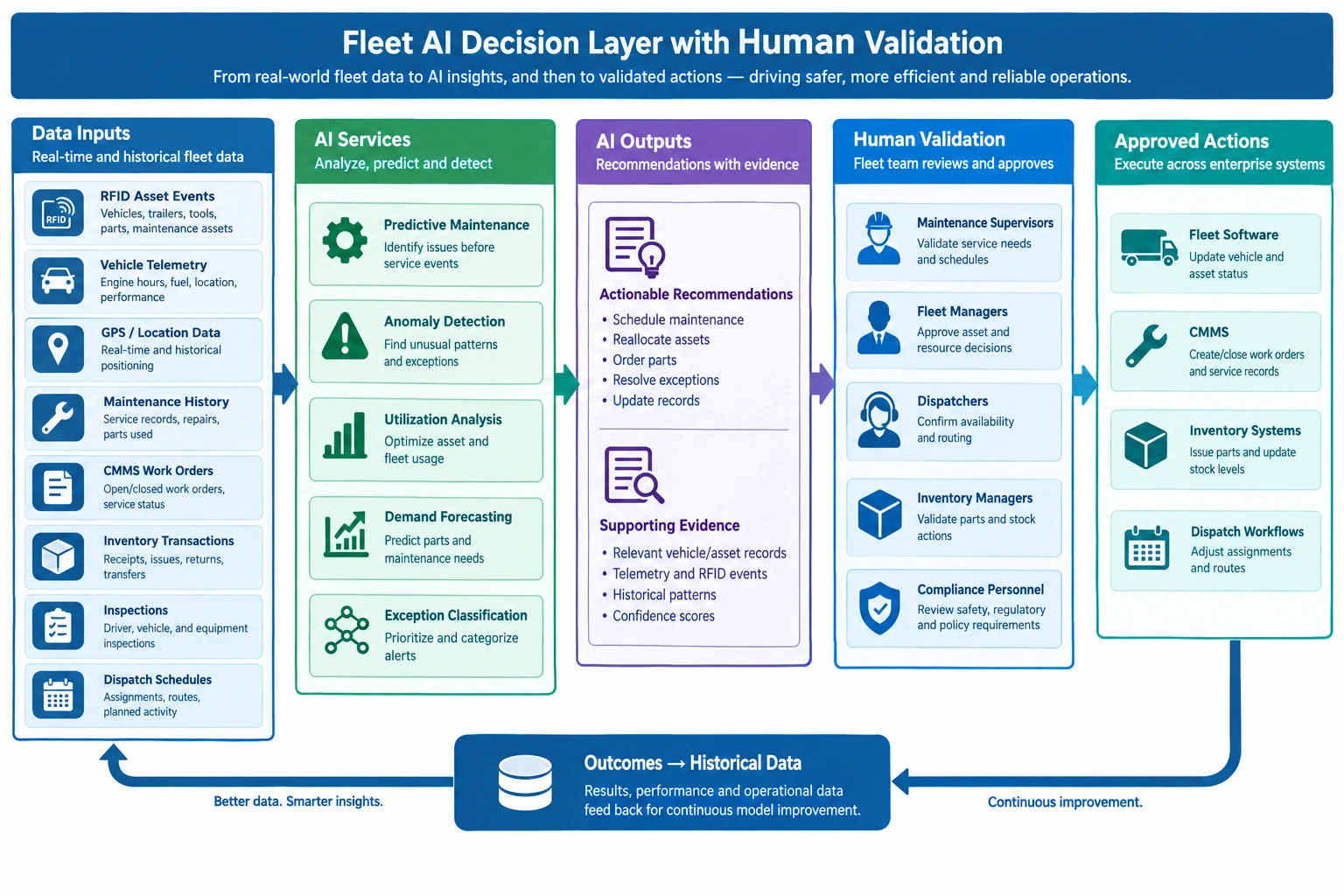
The diagram shows how RFID, telematics, GPS, maintenance, inventory, inspection, and dispatch data feed AI services. AI-generated recommendations are supported by evidence and reviewed by fleet personnel before approved actions are executed across fleet, CMMS, inventory, and dispatch systems.
Building the Future of Industrial AI and IoT with Aperture Venture Studio and GAO RFID Inc.
For more than three decades, GAO Group of Companies has invested heavily in R&D covering industrial RFID, BLE, and IoT. As generative AI became useful for industrial applications, we expanded our work in AI and IoT to address connected transportation, fleet operations, asset identification, and intelligent maintenance. We have also founded Aperture Venture Studio to advance AI and IoT solutions relevant to operational domains such as fleet management and transportation technology.
Aperture has attracted AI and IoT technical experts, entrepreneurial and operational executives, investors, and leading companies. We have also developed Aperture Ventures Summit and TekSummit to discuss advanced AI and IoT topics.
We welcome you to join us as:
- Advisors, Co-founders, or Employees
- Investors
- Customers