
AI and RFID for Food Testing Laboratories
AI-Driven Food Testing Laboratory Operations with RFID
AI and RFID are increasingly being used in food testing laboratories to improve sample traceability, laboratory inventory control, chain-of-custody management, instrument utilization, and testing workflow visibility. AI analyzes laboratory data to identify anomalies, predict delays, prioritize work, and support quality decisions, while RFID provides automated identification and location data for samples, containers, reagents, reference materials, equipment, and other laboratory assets. For food testing laboratories handling microbiological, chemical, allergen, nutritional, environmental, and molecular testing, the combination can reduce manual data entry and strengthen traceability from sample receipt through result release. GAO supplies RFID hardware products and systems that can support these laboratory workflows, including RFID readers, tags, antennas, and related identification technologies. When integrated with LIMS, ELN, QMS, inventory software, and laboratory instruments, RFID-generated events can become structured operational data for AI-driven analysis and decision support.
AI and RFID Workflow for Food Testing Laboratories
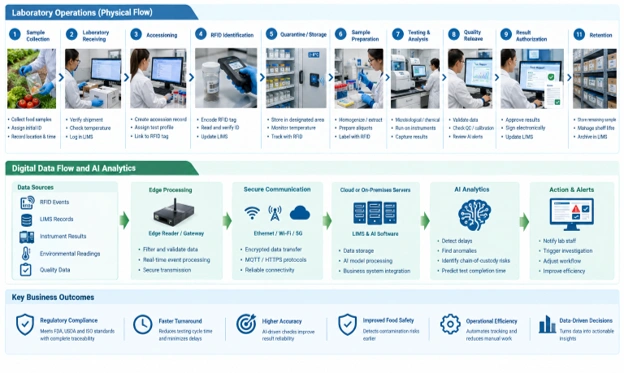
This workflow illustrates how food samples move from collection and laboratory receiving through RFID identification, storage, preparation, testing, quality review, result authorization, and retention. It also shows how RFID events, LIMS records, instrument results, environmental data, and quality information flow through edge processing and AI analytics to generate laboratory alerts and operational decisions.
What AI Means for Food Testing Laboratories
AI in food testing laboratories refers to the use of machine learning, statistical learning, computer vision, natural language processing, anomaly detection, predictive analytics, and related methods to analyze laboratory information and assist operational or scientific decisions.
The most valuable applications are not necessarily fully autonomous testing. Food laboratories generate large volumes of structured and unstructured information across sample accessions, test methods, instrument outputs, analyst observations, environmental monitoring, quality-control records, reagent lots, reference materials, corrective actions, and certificates of analysis. AI can connect these data sources and identify relationships that are difficult to detect through manual review.
For example, an AI model can evaluate historical turnaround times by test method, sample type, laboratory section, instrument, analyst workload, and sample priority. The resulting prediction can help laboratory managers identify samples that are likely to miss service-level targets before the delay occurs.
AI can also support analytical quality. A model trained on validated laboratory data may identify unusual result patterns, unexpected instrument behavior, duplicate-test discrepancies, control-chart deviations, or combinations of conditions associated with failed quality-control runs. Such models should support qualified laboratory personnel rather than bypass validated analytical methods or established approval procedures.
Food testing laboratories can apply AI across several major testing environments:
- Microbiology laboratories: Predict workflow delays, flag unusual colony-count patterns, identify recurring contamination conditions, and prioritize samples approaching holding-time limits.
- Chemical testing laboratories: Detect anomalous analytical results, correlate instrument performance with reagent or calibration conditions, and identify patterns across contaminants, residues, additives, nutrients, or composition testing.
- Allergen testing laboratories: Improve sample traceability and identify unusual result combinations or workflow conditions requiring additional review.
- Molecular testing laboratories: Analyze workflow and instrument data associated with PCR, sequencing, or other molecular assays while maintaining method-specific validation requirements.
- Environmental food laboratories: Correlate sample locations, collection conditions, storage history, and analytical results to identify recurring contamination patterns.
- Contract food testing laboratories: Predict turnaround performance, balance workloads, monitor sample status, and improve customer-facing reporting.
- Quality-control laboratories: Combine QC results, reference material information, instrument history, analyst activity, and environmental conditions to identify emerging process deviations.
GAO can support the physical identification layer by supplying RFID hardware and related IoT components that provide machine-readable events to laboratory information systems. The value comes from connecting those events to laboratory decisions rather than treating RFID identification as an isolated tracking function.
Priority AI Applications for Food Testing Laboratory Operations
AI Sample Tracking and Chain-of-Custody Control
Sample traceability is one of the strongest use cases for AI-supported RFID systems in food testing laboratories. A sample may move through receiving, accessioning, storage, preparation, extraction, analysis, retesting, review, and disposal. Each transition creates an opportunity for manual recording errors or unexplained delays.
RFID can automatically associate a tagged sample or container with a reader location or workstation. AI can then analyze the sequence of events and identify abnormal movement patterns.
Examples include:
- Detecting a sample that remains in receiving substantially longer than comparable accessions.
- Identifying an unexpected movement from a preparation area to storage.
- Flagging missing chain-of-custody events.
- Predicting which samples are likely to exceed required holding periods.
- Identifying repeated manual handling patterns associated with transcription errors.
- Comparing actual sample movement with the expected workflow for a particular analytical method.
The AI system does not replace the laboratory’s documented chain-of-custody procedure. Instead, it creates an additional layer of operational visibility that can help laboratory personnel investigate exceptions.
AI Laboratory Inventory Management
Food testing laboratories maintain inventories of reagents, culture media, standards, certified reference materials, sample containers, extraction supplies, PPE, consumables, and other materials. Inventory errors can interrupt testing and increase waste.
AI-supported inventory management can combine RFID observations with LIMS, laboratory inventory software, purchasing records, expiration dates, consumption history, and test schedules.
Useful functions include:
- Predicting reagent consumption from scheduled testing volume.
- Identifying materials approaching expiration before they become unusable.
- Detecting discrepancies between recorded and physically observed inventory.
- Predicting stockout risks for high-use microbiology media and analytical consumables.
- Identifying slow-moving inventory.
- Associating reagent lots with analytical results or QC events.
- Supporting laboratory purchasing decisions based on forecast demand.
For materials with strict storage requirements, RFID events can also be combined with temperature and humidity sensor data. AI can evaluate the combined history to identify materials exposed to conditions that may require investigation.
AI Laboratory Scheduling and Turnaround-Time Prediction
Turnaround time is a critical operational KPI for commercial and regulatory food testing laboratories. Delays can originate from sample receiving, preparation capacity, instrument availability, analyst workload, reagent shortages, repeat testing, QC failures, or review queues.
AI can analyze these variables to predict bottlenecks before they affect reporting commitments.
A laboratory scheduling system can use:
- Sample priority and due dates
- Test method requirements
- Instrument availability
- Analyst qualifications
- Preparation capacity
- Current queue length
- Reagent availability
- Historical test duration
- QC status
- Retest probability
- Sample holding-time requirements
RFID contributes physical status information when tagged samples, carts, containers, or laboratory assets pass designated checkpoints. This provides a more reliable view of actual work progression than relying solely on manually updated status fields.
AI Decision Support for Food Testing Laboratory Operations
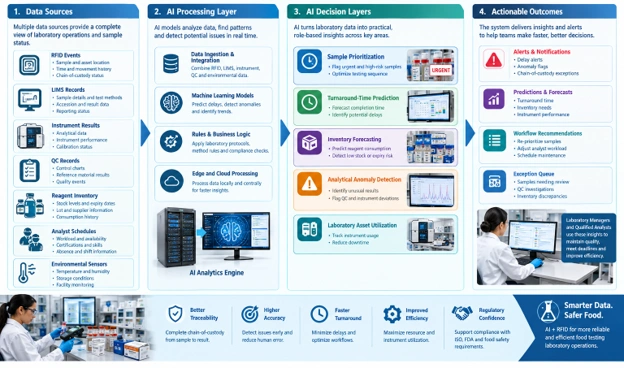
This infographic shows how RFID events, LIMS records, instrument results, QC data, inventory, analyst schedules, and environmental readings feed AI processing for food testing laboratories. It illustrates five decision areas: sample prioritization, turnaround-time prediction, inventory forecasting, analytical anomaly detection, and laboratory asset utilization, leading to actionable alerts and workflow recommendations.
AI Analytical Anomaly Detection
AI can assist food testing laboratories by identifying results or operating conditions that differ from established historical patterns.
A useful model may consider:
- Test method
- Sample matrix
- Instrument
- Calibration history
- Reagent or reference-material lot
- Analyst
- Laboratory section
- QC results
- Environmental conditions
- Historical analytical distribution
- Replicate or duplicate results
For example, an unexpected cluster of results from one instrument may indicate a need for technical investigation. Similarly, repeated deviations associated with a particular reagent lot may justify additional quality review.
Such systems require careful validation. An AI-generated anomaly should be treated as an investigation signal rather than automatically classified as a failed test or incorrect result. Final technical decisions remain governed by the laboratory’s validated methods, quality procedures, technical competence requirements, and authorized personnel.
AI Computer Vision for Food Sample and Laboratory Inspection
Computer vision can support visual inspection tasks where appropriate, particularly when laboratories perform standardized assessments involving physical sample characteristics.
Potential applications include:
- Detecting visible sample abnormalities.
- Classifying packaging or sample-condition images.
- Verifying sample-container labels.
- Identifying damaged containers at receiving.
- Monitoring laboratory workstation conditions.
- Supporting colony or particle image analysis where the analytical method permits image-based interpretation.
- Comparing images against validated reference criteria.
Computer vision can become more reliable when image acquisition is standardized through controlled lighting, camera position, calibration, background conditions, and image quality checks. A food testing laboratory should establish validation and acceptance criteria appropriate to the intended use rather than treating a general-purpose vision model as a validated analytical method.
RFID-Enabled Data Capture Across the Food Testing Laboratory
RFID is most valuable when it removes repetitive identification steps from laboratory workflows. The appropriate RFID frequency depends on the physical environment, read range, item size, tag geometry, liquids, metals, containment materials, and required identification distance.
UHF RFID for Laboratory Movement and Inventory Visibility
UHF RFID is generally suited to applications requiring longer read ranges and rapid identification of multiple tagged items. Food testing laboratories can consider UHF RFID for tagged sample containers, transport bins, carts, reagent cases, laboratory consumables, equipment, and storage locations when the surrounding materials permit reliable RF performance.
UHF can be particularly useful at controlled transition points such as receiving, sample storage entrances, preparation areas, and internal material-transfer locations.
HF RFID for Controlled Identification and Workstation Processes
HF RFID can be useful where shorter-range, deliberate identification is preferred. A food testing laboratory may use HF identification at workstations where an analyst intentionally presents a tagged sample, container, document carrier, or other object to a reader.
The shorter read range can reduce unintended reads in environments where multiple tagged items are nearby.
LF RFID for Specialized Identification Requirements
LF RFID operates at lower frequencies and can be appropriate for certain specialized identification requirements. Its applicability to modern food testing laboratory workflows depends heavily on the required read distance, tag availability, environmental conditions, and integration requirements.
Frequency selection should therefore be based on the laboratory workflow rather than selecting an RFID technology solely because of its nominal read range.
Food Testing Laboratory Data Flow from Sample Receipt to AI Decision
A practical AI and RFID implementation begins with the physical laboratory workflow rather than with the AI model.
Sample Receipt and Accessioning
A food sample arrives with associated customer, collection, product, lot, location, temperature, collection-time, and chain-of-custody information. Laboratory personnel inspect the submission and create or confirm the accession record in the LIMS.
An RFID tag can be associated with the accession or physical sample container. The tag should reference a unique identifier rather than storing sensitive analytical information directly on the RFID tag.
RFID Data Capture
Readers positioned at carefully selected laboratory checkpoints detect tagged objects. Depending on the application, readers may be fixed, handheld, or integrated into workstations.
Reader events can include:
- Tag identifier
- Reader identifier
- Timestamp
- Read location
- Antenna
- Signal information where supported
- Associated sample, asset, or inventory identifier
The RFID middleware filters duplicate reads and transforms raw reader events into meaningful laboratory events such as “sample entered microbiology preparation” or “reagent container observed in controlled storage.”
LIMS and Laboratory Software Integration
The middleware can exchange validated event data with LIMS, ELN, QMS, inventory management software, instrument interfaces, ERP systems, or laboratory scheduling applications.
Integration should avoid creating a second source of truth. The LIMS should remain authoritative for appropriate sample and analytical records, while RFID provides automated physical-event information that can enrich those records.
Edge Processing and Secure Data Transmission
Edge computing can process RFID events near the laboratory readers before forwarding relevant information to centralized software. Local processing can reduce unnecessary network traffic, filter duplicate reads, buffer events during temporary network outages, and provide faster responses for local workflow alerts.
Where laboratory operations span multiple facilities, centralized servers or cloud services can aggregate data for cross-site analytics.
AI Analysis and Laboratory Action
AI services analyze structured laboratory data to generate predictions, anomaly alerts, workload forecasts, inventory recommendations, or workflow exceptions.
A typical decision loop is:
- Physical laboratory event occurs.
- RFID or another sensor captures the event.
- Middleware validates and contextualizes the event.
- LIMS or laboratory software associates the event with the correct record.
- AI evaluates the event against historical and current laboratory data.
- The system generates a prediction, alert, or recommendation.
- Authorized laboratory personnel investigate or act.
- The resulting action is recorded for traceability and future model improvement.
This closed operational loop is more valuable than simply installing RFID readers because it connects physical laboratory activity with measurable laboratory outcomes.
Engineering Considerations for Food Testing Laboratory RFID Deployment
RF performance inside food testing laboratories can be affected by stainless-steel benches, refrigerators, freezers, liquid-filled containers, foil packaging, metallic equipment, dense sample storage, and tightly packed tagged objects. These factors make site surveys and pilot testing important before committing to a large deployment.
Tag placement is equally important. A tag attached to a plastic sample container may perform differently from one attached to a metal instrument or a container containing a high percentage of water. The selected tag should therefore be tested using the actual container, sample matrix, storage condition, and operating environment.
Reader placement should correspond to meaningful workflow checkpoints rather than simply covering as much physical space as possible. Excessive read zones can generate ambiguous events and make it difficult to determine whether a sample actually entered a particular process area.
GAO’s RFID hardware products and systems can be evaluated according to these laboratory-specific conditions, with the objective of producing reliable identification data that can feed food testing laboratory software and AI workflows.
Security and Data Integrity
Food testing laboratories handle commercially sensitive sample information and, in some environments, regulated electronic records. RFID deployments should therefore be designed alongside the laboratory’s cybersecurity and data-integrity requirements.
Important controls can include:
- Role-based access control
- Unique user authentication
- Encrypted communications
- Network segmentation
- Secure device configuration
- Audit logging
- Controlled software updates
- Reader and gateway inventory
- Backup and recovery procedures
- Data retention policies
- Integration validation
- AI model access controls
- Change management
Electronic records used for regulated laboratory processes may also require controls appropriate to applicable regulatory and quality requirements. Standards such as ISO/IEC 17025 and electronic-record requirements such as FDA 21 CFR Part 11 may be relevant depending on the laboratory’s jurisdiction, scope, and intended use.
RFID-Enabled Food Testing Laboratory Deployment
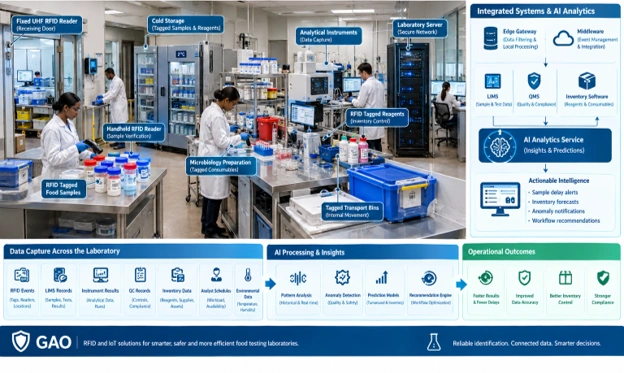
This visual shows a realistic food testing laboratory where RFID-tagged samples, reagents, consumables, and transport bins are tracked across receiving, storage, preparation, and analysis. It also illustrates how RFID events and laboratory data flow through edge processing, middleware, LIMS, QMS, inventory software, and AI analytics to generate operational insights and alerts.
AI, RFID, LIMS, and Laboratory Systems Integration
A successful implementation depends on interoperability between the physical identification layer and the software already used by food testing laboratories.
Common systems that may participate include:
- Laboratory Information Management Systems (LIMS)
- Electronic Laboratory Notebooks (ELN)
- Laboratory Execution Systems (LES)
- Quality Management Systems (QMS)
- Laboratory inventory management software
- Enterprise resource planning systems
- Customer portals
- Instrument data systems
- Chromatography data systems
- Laboratory scheduling software
- Environmental monitoring systems
- Calibration management software
- Document management systems
- Business intelligence and analytics software
Integration may use REST APIs, webhooks, database interfaces, message queues, OPC UA where appropriate for connected equipment, or other supported enterprise interfaces. The selected integration mechanism should reflect the software vendor’s supported interfaces and the laboratory’s validation requirements.
The central engineering principle is to preserve data lineage. A food testing laboratory should be able to determine which physical sample generated an event, which workflow step occurred, which instrument or analyst processed it, what analytical data resulted, what AI signal was generated, and who authorized the resulting laboratory action.
Relevant Food Laboratory Standards and Quality Requirements
AI and RFID do not replace laboratory accreditation, validated analytical methods, quality-control procedures, or regulatory obligations. They should strengthen the laboratory’s ability to execute and document those processes.
Depending on the laboratory’s scope and jurisdiction, relevant frameworks and standards may include:
- ISO/IEC 17025 for testing and calibration laboratory competence
- FDA requirements applicable to food testing and regulated operations
- FDA 21 CFR Part 11 where applicable to electronic records and electronic signatures
- Food Safety Modernization Act requirements where applicable
- Codex Alimentarius standards and guidance
- AOAC Official Methods of Analysis
- ISO microbiological testing standards applicable to specific food matrices and organisms
- Laboratory-specific method validation and verification requirements
- Good Laboratory Practice principles where applicable
- Customer-specific chain-of-custody and reporting requirements
The precise compliance impact depends on what the laboratory tests, which methods it uses, whether results support regulatory decisions, and the jurisdiction in which the laboratory operates. Technology should be incorporated into the laboratory’s quality-management and validation processes rather than treated as a separate compliance mechanism.
GAO Support for Food Testing Laboratory RFID and IoT Systems
Headquartered in New York City and Toronto, Canada, GAO is recognized among the leading global B2B and B2G suppliers of BLE and RFID technologies. GAO’s RFID products and systems can support food testing laboratories that require automated identification, asset visibility, inventory tracking, and connected laboratory workflows.
GAO, together with its sister companies GAO Research and GAO Tek, forms GAO Group, with operations based in New York City and Toronto. For three decades, the group has served organizations across the United States and Canada, including Fortune 500 companies, leading R&D organizations, universities, and government agencies.
For food testing laboratory deployments, the practical focus is not simply RFID tag detection. The objective is to create reliable operational data that can be connected to LIMS, laboratory quality systems, inventory records, instruments, and AI-driven decision support. GAO’s investment in R&D, quality assurance processes, and remote or onsite technical support provides a foundation for evaluating and deploying such connected laboratory systems.
Building the Future of Industrial AI and IoT with Aperture Venture Studio and GAO RFID Inc.
For more than three decades, GAO Group of Companies has invested heavily in R&D for industrial RFID, BLE, and IoT. As AI has become increasingly useful for operational applications, we have continued developing AI and IoT technologies and founded Aperture Venture Studio to support the development and scaling of AI and IoT solutions relevant to areas such as security operations, asset intelligence, and connected infrastructure.
Aperture has attracted AI and IoT technical experts, entrepreneurial and operational executives, investors, and leading companies. We also developed the Aperture Ventures Summit and TekSummit to discuss advanced AI and IoT topics and build strong technical communities.
We welcome you to join us as:
- Advisors, Co-founders, or Employees
- Investors
- Customers