
AI Applications and RFID Solutions for Footwear Manufacturing
Intelligent Footwear Manufacturing with AI-Driven Identification and Traceability
AI and RFID for Footwear Manufacturing combine automatic product identification with machine learning, computer vision, analytics, and connected manufacturing systems to improve visibility from material receiving through production, warehousing, shipment, and returns. RFID provides machine-readable identity and movement events for lasts, molds, cutting bundles, work-in-process footwear, cartons, pallets, tools, and finished pairs, while AI converts those events into operational decisions. This enables AI inventory management, production tracking, demand-aware replenishment, anomaly detection, quality analysis, and predictive maintenance tailored to footwear factories. UHF RFID is particularly useful for high-volume item and carton identification, while HF or LF RFID can be appropriate for specific close-range identification requirements. GAO supplies RFID readers, tags, antennas, peripherals, software, and connected systems that can be integrated with manufacturing and business applications.
AIoT and RFID Smart Footwear Manufacturing Solution Overview
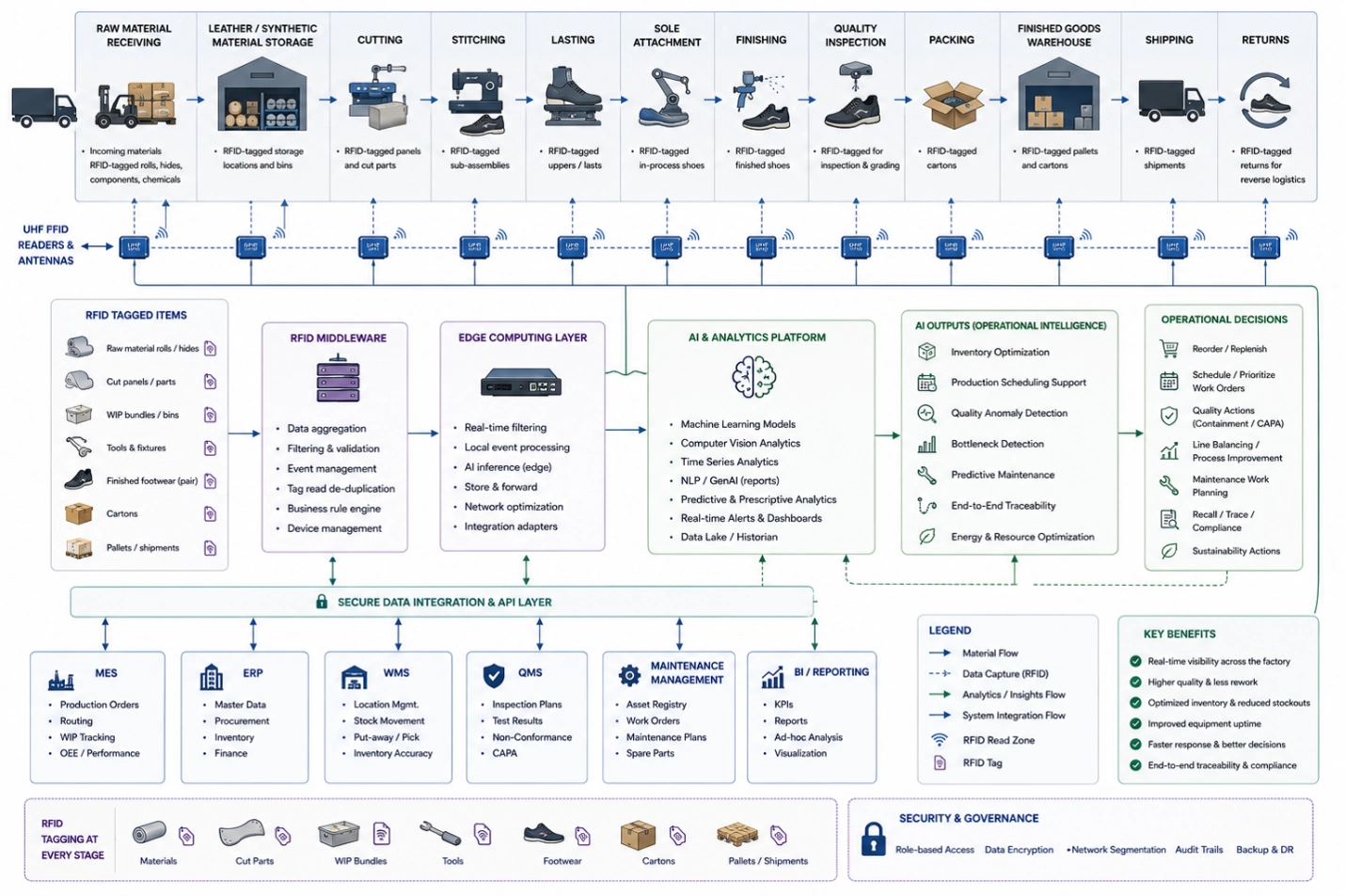
This enterprise diagram illustrates how RFID-tagged materials, work-in-process items, footwear, cartons, and shipments move through the complete footwear manufacturing lifecycle. It connects UHF RFID readers with middleware, edge computing, AI analytics, and factory systems such as MES, ERP, WMS, QMS, and maintenance software to support traceability, quality, inventory, production, and operational decisions.
What AI Means for Footwear Manufacturing Operations
AI in footwear manufacturing is most valuable when it converts large volumes of production, inventory, quality, and movement data into decisions that supervisors and planners can act upon. RFID can provide the identity, location, timestamp, and movement context required by those models, but the business value comes from connecting that information with manufacturing processes and other operational data.
A footwear factory has unusually varied material and product flows. A single finished shoe may depend on material rolls, leather or synthetic uppers, insoles, outsoles, laces, labels, adhesives, lasts, molds, tooling, work orders, production batches, size-color combinations, and quality inspections. Manufacturing execution therefore depends on knowing not simply whether inventory exists, but whether the correct material, component, size, color, style, and production order are available at the correct workstation at the correct time.
AI can correlate RFID events with production schedules, work orders, machine states, quality results, labor information, warehouse transactions, and historical production patterns. This creates opportunities for AI production monitoring, AI inventory management, AI quality control, AI demand and replenishment analysis, and AI-assisted production scheduling.
GS1 standards are particularly relevant when footwear manufacturers need identification and visibility information to move between internal systems and supply-chain partners. EPCIS provides a standardized approach for sharing visibility events describing what happened, when and where it happened, and the relevant business context.
Footwear Manufacturing Processes Where AI Creates the Most Operational Value
AI Inventory Management for Footwear Materials and Components
Footwear factories manage large numbers of SKUs differentiated by style, size, color, material, season, customer, and production order. Inventory errors can therefore create production interruptions even when the overall warehouse appears sufficiently stocked.
RFID-enabled identification can provide more frequent inventory observations for cartons, component bins, finished pairs, and selected high-value materials. AI can then compare actual movement patterns against production requirements, historical consumption, open work orders, and replenishment schedules.
The practical objective is not simply a higher inventory count accuracy. The more useful objective is identifying which inventory discrepancy can affect production next.
AI can prioritize exceptions such as:
- Missing components required for an active production order
- Unexpected consumption of uppers, soles, insoles, or packaging materials
- Inventory located in the wrong production area
- Repeated discrepancies associated with a particular workstation or process
- Slow-moving footwear components occupying constrained storage locations
- Imbalances between component availability and planned size-color production
- Finished footwear accumulated because downstream shipping or order allocation has changed
AI Production Tracking Across Footwear Work-in-Process
Footwear production involves multiple sequential and sometimes parallel operations. A work-in-process unit can move from cutting to stitching, assembly, lasting, sole attachment, finishing, inspection, and packing, with intermediate queues between operations.
RFID can establish automated checkpoints at selected process boundaries. AI can use those events to identify abnormal dwell times, recurring bottlenecks, queue accumulation, skipped process steps, and production orders that are deviating from expected cycle times.
A useful implementation does not require RFID readers at every workstation. Strategic read points can provide enough process visibility when they are selected according to the production flow and the decisions that need to be made.
For example, if a production supervisor needs to know why a style is missing its shipment target, the AI system should correlate RFID movement events with workstation cycle times, WIP queues, machine availability, quality holds, and material shortages rather than simply displaying the latest tag location.
AI Quality Management for Footwear Production
Quality problems in footwear can originate from material variation, cutting errors, stitching defects, bonding problems, dimensional inconsistencies, improper finishing, or incorrect component combinations.
RFID contributes product and process identity, while computer vision, inspection systems, machine data, and quality records provide additional evidence. AI can associate a detected defect with the production order, material batch, workstation, machine, operator shift, tooling, and process history.
This enables more useful root-cause analysis than a standalone defect count.
Computer vision can inspect characteristics such as stitching patterns, surface defects, component placement, color consistency, and selected assembly conditions where appropriate cameras and lighting are engineered for the application. AI models should be trained and validated against representative footwear materials because leather, synthetic materials, textiles, rubber, foam, and reflective or textured surfaces can produce very different visual signatures.
AI Predictive Maintenance for Footwear Manufacturing Equipment
Production interruptions can originate from sewing machines, cutting equipment, presses, conveyors, compressors, motors, pumps, molding equipment, HVAC equipment, or other factory machinery.
AI-based predictive maintenance can combine machine condition data with production context and RFID-derived utilization information. For example, equipment usage associated with particular production batches can help explain why maintenance requirements change over time.
The strongest implementations use multiple evidence sources rather than assuming RFID alone can predict mechanical failure. Sensor data such as vibration, temperature, current, pressure, runtime, and cycle count may be combined with maintenance records and production schedules.
AI Warehouse and Finished Footwear Management
Finished footwear warehouses must manage high SKU counts, size-color combinations, cartons, pallets, customer orders, allocation requirements, and shipping deadlines.
AI can identify unusual dwell times, inventory imbalances, picking exceptions, shipment risks, and warehouse congestion. RFID can automate selected movement events and reduce dependence on manual barcode scans where read conditions support reliable operation.
GS1 notes that EPC/RFID can improve visibility as products move from factories through distribution centers and retail environments, while EPCIS provides a standardized mechanism for capturing and sharing visibility events.
Real-World AI and RFID Deployment Scenarios in Footwear Manufacturing
Component Receiving and Material Verification
A practical deployment can begin at receiving, where incoming cartons, material lots, or selected components are identified and associated with purchase orders, supplier information, material specifications, and inspection status.
The system can compare expected and received quantities and flag discrepancies before material reaches production. AI can prioritize discrepancies according to production urgency rather than treating every exception equally.
For materials requiring special handling or traceability, the software can retain the relationship between material identity and downstream production orders. Regulatory and product compliance information should remain connected to the appropriate business records. For U.S. operations, footwear manufacturers may encounter requirements involving textile and leather labeling, product safety, testing, certification, and chemical restrictions depending on product type and market. FTC guidance specifically covers labeling matters involving leather products, including footwear, while CPSC requirements can apply to consumer products and certain children’s products.
Work-in-Process Tracking
A realistic WIP deployment can use RFID-tagged bins, trays, bundles, racks, or other reusable production carriers rather than attempting to place a tag on every individual manufacturing step.
A fixed reader at a process transition can automatically register that a tagged WIP carrier has entered or exited an area. Handheld RFID readers can support exception handling, cycle counts, locating, and investigation when a normal automated event is missing.
The AI layer can compare expected process progression against actual events. If a production order normally moves from stitching to lasting within an expected operating range but repeatedly accumulates in a specific area, the system can identify the pattern for supervisor review.
Finished Goods Verification and Shipping
At packing, RFID can associate finished footwear with cartons, orders, shipment destinations, or pallet structures. AI can compare the actual shipping configuration with order requirements and identify potential mismatches before dispatch.
This is particularly valuable when many visually similar footwear products differ only by size, color, style, or customer-specific configuration.
Realistic UHF RFID Deployment in Footwear Manufacturing
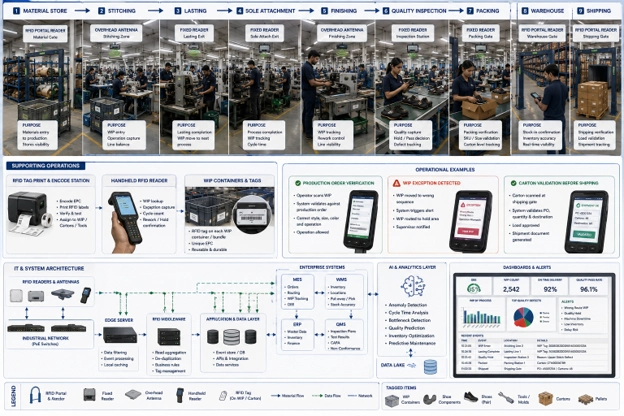
This deployment visual illustrates UHF RFID across a footwear factory, showing tagged WIP containers moving through stitching, lasting, sole attachment, finishing, inspection, packing, warehousing, and shipping. It connects physical RFID infrastructure with edge computing, middleware, enterprise systems, AI analytics, and operational examples such as production-order verification and WIP exception handling.
Engineering Challenges in AI-Enabled Footwear Manufacturing
RFID Read Reliability Around Footwear Materials
RFID performance depends on tag construction, reader power, antenna orientation, tag placement, material composition, reader configuration, interference, and the physical geometry of the read zone.
Footwear manufacturing introduces additional considerations because leather, textiles, rubber, foam, adhesives, packaging, metal equipment, liquids, and densely packed products can affect RF performance differently. A tag that performs well on an empty carton may not perform identically when placed close to certain materials or packed tightly with other tagged products.
Engineering validation should therefore use representative footwear products, packaging, production carriers, and factory conditions rather than relying only on laboratory specifications.
GAO provides RFID readers and tags across UHF, HF, and LF technologies, along with antennas, RFID printers, peripherals, and software that can be adapted to different identification requirements.
Data Quality Before AI Model Development
AI cannot compensate reliably for poor event data. A footwear factory should establish data-quality controls before deploying complex models.
Important controls include:
- Unique identification of relevant products, carriers, equipment, locations, and production orders
- Consistent product master data for style, size, color, material, and SKU relationships
- Accurate association between RFID identifiers and business objects
- Reliable timestamps and reader-location information
- Duplicate-read filtering and event normalization
- Detection of missing or contradictory process events
- Clear definitions for production states, quality holds, rework, scrap, and completed operations
GS1’s EPCIS guidance emphasizes modeling visibility events around the business meaning of what happened, rather than simply exposing raw RFID reader output to consuming applications.
Choosing UHF, HF, or LF RFID
UHF RFID is generally the strongest candidate when footwear manufacturers need non-line-of-sight identification of multiple items, cartons, bins, or products across relatively open read zones. GS1 identifies UHF passive RFID, also known as RAIN RFID, as the most broadly implemented RFID approach in its relevant supply-chain applications.
HF RFID can be useful where short-range, controlled interaction is preferred, including specific workstation, authentication, or close-proximity identification scenarios.
LF RFID is appropriate for specialized short-range identification requirements where its characteristics fit the equipment and operating environment.
Technology selection should therefore begin with the footwear manufacturing process and required read behavior rather than choosing a frequency simply because it is widely used.
Technical Foundation for AI-Enabled RFID Footwear Systems
A reliable AI-enabled footwear manufacturing system normally contains several technical layers. RFID readers and antennas capture identification events, edge devices or servers process and normalize those events, RFID software manages reader communication and business rules, and AI services analyze structured operational data. The resulting information can then be exchanged with MES, ERP, WMS, QMS, CMMS, production planning software, databases, and operational dashboards.
RFID Hardware and Identification Layer
The hardware layer may include fixed UHF RFID readers, handheld readers, antennas, RFID printers and encoders, desktop readers, embedded readers, tags, gateways, and related peripherals.
For footwear applications, tag selection should consider the final attachment location and the surrounding materials. Tag durability, adhesive performance, printing requirements, read sensitivity, environmental exposure, and encoding workflow should be validated before production deployment.
GAO’s RFID hardware portfolio includes readers and tags covering UHF EPC Gen2, HF, LF, and other RFID configurations, with form factors ranging from handheld and USB devices to embedded, desktop, portal, and multiport readers.
RFID Software and Event Processing
RFID software should convert raw reader activity into meaningful footwear manufacturing events. Typical functions include reader management, tag filtering, duplicate suppression, location association, event generation, exception handling, device monitoring, and integration APIs.
GAO describes its RFID software as customizable and capable of integrating with existing systems or supporting industry-specific reports and data tracking.
The software should prevent raw reads from overwhelming manufacturing applications. For example, a tag remaining inside a portal’s RF field can generate multiple observations. The business system generally needs one meaningful event such as “carton entered finished goods warehouse,” not hundreds of identical radio observations.
AI Models for Footwear Manufacturing
Different footwear processes require different AI approaches.
Relevant methods can include:
- Time-series models for production cycle and equipment data
- Classification models for production or quality anomalies
- Regression models for demand, throughput, or process-performance estimation
- Clustering for identifying recurring operational patterns
- Computer vision models for selected visual inspection tasks
- Forecasting models for material and finished-goods demand
- Optimization algorithms for production sequencing, replenishment, and resource allocation
- Anomaly detection for unexpected RFID movement or process behavior
- Generative AI for controlled operational knowledge retrieval, reporting, and technician assistance
Generative AI should not be allowed to invent production facts or automatically override safety-critical manufacturing decisions. Its role should be bounded by governed data sources, access controls, validation rules, and human review where operational consequences are significant. NIST’s AI Risk Management Framework emphasizes trustworthy characteristics including validity and reliability, safety, security and resilience, accountability, transparency, explainability, privacy, and fairness.
Communication and Integration Infrastructure
RFID readers may communicate with edge computers, industrial PCs, servers, or software through Ethernet, USB, serial interfaces, Wi-Fi, or other supported networking methods depending on the device and installation.
Enterprise integration can use REST APIs, databases, message queues, standardized event interfaces, or other approved integration mechanisms. GS1’s EPCIS standard provides standardized interfaces for capturing and querying visibility events and supports interoperability between applications.
A footwear manufacturer should also consider network segmentation, device authentication, encrypted communication where supported, least-privilege access, credential management, logging, software patching, backup procedures, and monitoring of reader and server activity.
NIST identifies security and resilience as core characteristics of trustworthy AI and notes that AI systems must account for confidentiality, integrity, and availability across both software and hardware.
Cloud Version and Server Version
A Cloud Version can be appropriate when footwear manufacturers operate multiple factories, warehouses, or geographically distributed operations and need centralized software management, consolidated analytics, and remote access. Cloud deployment can also simplify centralized model updates and cross-site reporting when network connectivity and corporate policies support it.
A Server Version can be more appropriate when manufacturing data must remain within customer-managed infrastructure, when factory operations require local processing, or when network connectivity to external cloud services is restricted. The server can operate on an edge server, factory server, private data center, or other customer-controlled infrastructure.
A hybrid design can place latency-sensitive RFID event processing and selected AI inference close to the production floor while sending governed operational data to centralized cloud or private servers for broader analytics.
The correct choice depends on production continuity requirements, data governance, network availability, cybersecurity policy, integration constraints, model-processing requirements, and the organization’s ability to maintain infrastructure.
From RFID Visibility to AI-Driven Footwear Operations
The greatest value of an AI-enabled RFID system comes from connecting physical footwear operations with decisions that improve production performance. RFID provides structured visibility into movement and identity, while AI interprets patterns across production, inventory, quality, equipment, and fulfillment data.
For footwear manufacturers, this combination can transform isolated operational events into actionable information. A production manager can identify a growing WIP queue before it becomes a shipment problem. A warehouse manager can locate missing cartons without relying entirely on manual searches. A quality team can correlate defects with production batches and process conditions. A maintenance team can prioritize equipment inspections based on machine behavior and production impact.
The important engineering principle is to design the solution around operational decisions rather than around the RFID reader count. Each reader should exist because the data it produces supports a defined business or manufacturing decision.
Production Visibility and Bottleneck Detection
AI can analyze RFID process events together with work-order data and historical cycle times to identify abnormal production delays.
Useful signals include:
- Excessive WIP dwell time between stitching and lasting
- Repeated queues before sole attachment
- Production orders that remain in a process longer than expected
- Unusual differences between planned and actual throughput
- Rework or quality-hold patterns associated with particular production areas
- Material shortages delaying otherwise available production capacity
The resulting system can prioritize exceptions instead of forcing supervisors to manually examine every production record.
Inventory Accuracy and Material Availability
AI inventory management becomes more useful when inventory data is connected to production requirements.
For example, an inventory system can identify that a factory has sufficient total outsole inventory but insufficient quantities for a particular combination of style, size, color, and production order. The distinction is operationally important because aggregate inventory availability does not guarantee production readiness.
RFID movement events can provide additional evidence for inventory location and movement. AI can then estimate which discrepancies are most likely to affect upcoming production.
Quality Traceability and Root-Cause Analysis
A footwear traceability system can connect a finished product with relevant production records, component information, inspection results, and process events.
AI can search these relationships for recurring patterns. If a defect occurs disproportionately within products associated with a particular material lot, machine, production line, or process stage, the system can flag the relationship for investigation.
This does not mean AI automatically establishes causality. Engineering teams should distinguish between correlation and verified root cause. The model should therefore support investigation rather than replace established quality-control procedures.
Predictive Maintenance and Production Continuity
Predictive maintenance becomes more valuable when equipment condition is interpreted alongside actual production utilization.
For example, a machine operating under unusually high cycle demand during a major production run may have a different maintenance priority from an identical machine with low utilization. AI can combine equipment telemetry, maintenance history, production schedules, and operational events to help maintenance teams prioritize interventions.
RFID can contribute contextual information when tagged tooling, molds, dies, containers, or other reusable production assets are involved.
Enterprise Integration for Footwear Manufacturing Systems
An AI and RFID deployment should not become another isolated application used alongside existing factory software. Its operational value increases when information can move reliably between identification systems and the applications already used by production, warehouse, quality, planning, and maintenance teams.
MES Integration
A manufacturing execution system can provide production orders, routing information, process states, quantities, and production performance data.
RFID events can supplement MES records by providing automated evidence that a WIP carrier, production batch, or finished product passed through a designated process point.
The integration should define clear ownership for each data element. For example, the RFID system may own the physical observation event while MES owns the official production status.
ERP Integration
ERP software commonly contains purchasing, inventory, sales-order, supplier, financial, and product-master information.
Connecting RFID and AI data to ERP can help footwear manufacturers relate production and inventory observations to purchase orders, customer requirements, material availability, and finished-goods allocation.
Data synchronization should be carefully controlled because high-frequency RFID observations generally do not need to be written individually into an ERP database.
WMS Integration
Warehouse management software can use RFID events to improve receiving, put-away, inventory verification, picking, packing, and shipping processes.
For finished footwear, RFID can help distinguish cartons with similar packaging but different style, size, color, or customer allocation. AI can analyze warehouse movement patterns to identify congestion, abnormal dwell time, and fulfillment risks.
QMS and CMMS Integration
Quality management software can retain inspection results, nonconformance records, corrective actions, and quality-hold information.
Computerized maintenance management systems can manage maintenance schedules, work orders, asset history, spare parts, and technician activities.
Connecting these systems with AI and RFID creates richer operational context. A production anomaly may be related to a quality hold, while a recurring process delay may correspond to equipment maintenance history.
Footwear Manufacturing RFID and AI System Integration Map
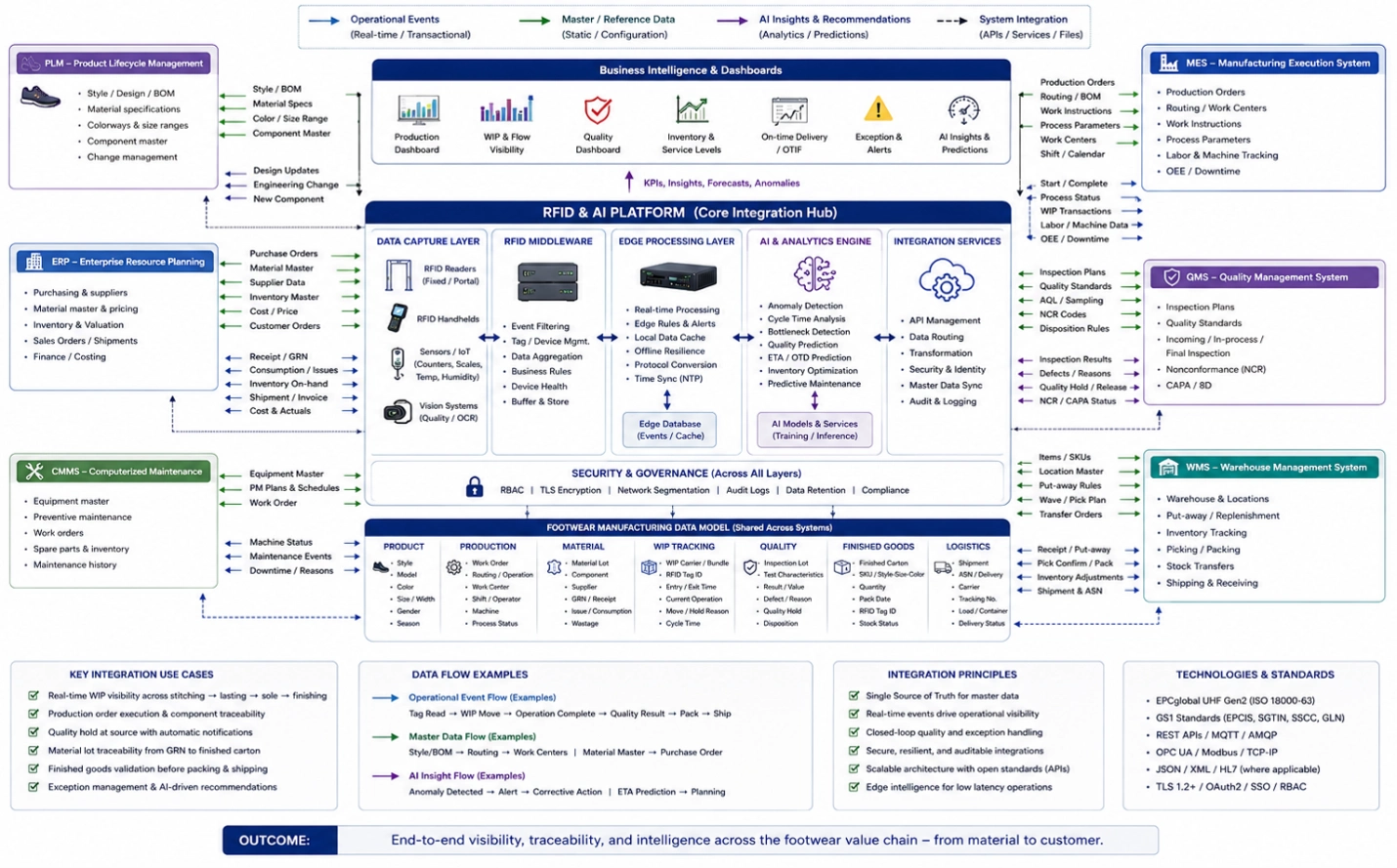
This enterprise integration diagram shows RFID readers, handheld devices, edge processing, middleware, and AI analytics connecting with MES, ERP, WMS, QMS, CMMS, PLM, and BI systems. It maps operational events, master data, and AI-generated insights using footwear-specific information such as work orders, material lots, WIP carriers, finished cartons, quality holds, and shipments.
Cybersecurity and Data Governance for Connected Footwear Factories
Connected production systems introduce additional cybersecurity considerations because RFID readers, edge computers, servers, databases, applications, and factory networks become interconnected.
A practical deployment should establish security controls across the entire data path.
Device and Network Security
Important controls include:
- Unique credentials for RFID readers and connected devices
- Network segmentation between production equipment and corporate systems
- Restricted management interfaces
- Secure remote access mechanisms
- Controlled firewall rules
- Regular firmware and software updates
- Centralized logging and monitoring
- Device inventory and configuration management
- Backup and recovery procedures
Production continuity should remain a major consideration. Security controls should not unintentionally create a single point of failure that prevents operators from continuing essential manufacturing processes.
AI Data Governance
AI models should operate on governed datasets with known sources, ownership, quality, and retention requirements.
Footwear manufacturers should define:
- Which production data can be processed by AI
- Which users can access model outputs
- How long operational data should be retained
- Which information can leave factory-controlled infrastructure
- How AI model changes are approved
- How model performance is monitored after deployment
- How incorrect predictions are reported and investigated
NIST’s AI Risk Management Framework provides a useful reference for managing AI risks throughout design, deployment, operation, and evaluation.
Implementation Priorities for AI and RFID in Footwear Manufacturing
Successful deployment usually starts with a narrowly defined operational problem rather than attempting to digitize the entire factory at once.
Define the Manufacturing Decision First
Before selecting RFID hardware or AI models, identify the decision that needs improvement.
Examples include:
- Where is a delayed production order?
- Which WIP batches are approaching a production deadline?
- Which component shortages could stop today’s production?
- Which finished cartons are ready for shipment?
- Which quality defects are recurring?
- Which equipment requires maintenance attention?
- Which inventory records require physical verification?
The answer determines what data needs to be captured.
Select the Correct RFID Configuration
UHF RFID is generally suitable for automated identification across warehouses, portals, cartons, bins, and selected WIP flows.
HF RFID may be better suited to controlled short-range interactions, while LF RFID can support specialized identification requirements.
Tag placement should be tested with actual footwear products and materials. Reader and antenna placement should be validated under realistic factory conditions, including metal structures, machinery, dense product accumulation, and operator movement.
Establish a Controlled Pilot
A pilot should cover one clearly defined production or warehouse workflow.
Useful pilot measurements can include:
- RFID read reliability
- Inventory accuracy
- WIP location accuracy
- Process-event completeness
- Reduction in manual scanning
- Exception detection time
- Production delay identification time
- Quality traceability coverage
- System availability
- Integration latency
The pilot should establish a baseline before deployment so that improvements can be measured objectively.
Validate Before Scaling
Scaling RFID across a footwear facility without validating read zones can create large volumes of unreliable events.
Commissioning should include:
- Antenna positioning tests
- Tag placement validation
- Read-zone boundary testing
- Multi-tag performance testing
- Reader interference testing
- Network connectivity testing
- Middleware event validation
- MES/ERP/WMS transaction testing
- AI data-quality validation
- Exception-handling tests
- Backup and recovery tests
- Cybersecurity verification
- Operator acceptance testing
GAO’s experience supplying RFID hardware and systems to organizations in the United States and Canada supports an engineering-oriented approach in which hardware selection, integration, and deployment requirements are considered together. GAO Group companies have served Fortune 500 companies, research organizations, universities, and government agencies while maintaining substantial investment in product and system R&D and quality assurance.
KPIs for AI-Enabled Footwear Manufacturing
The most useful KPIs should connect directly to production and supply-chain objectives rather than simply measuring the number of RFID reads.
Relevant measures include:
- Inventory record accuracy
- WIP location accuracy
- Production order cycle time
- Manufacturing lead time
- WIP dwell time
- First-pass yield
- Defect rate
- Rework rate
- Material shortage incidents
- Production schedule adherence
- Throughput per production line
- Machine downtime
- Mean time between failures
- Mean time to repair
- Warehouse order accuracy
- Picking accuracy
- Packing accuracy
- Shipment verification accuracy
- Finished-goods dwell time
- Inventory turnover
- Stockout frequency
- RFID event completeness
- RFID read-zone reliability
- Exception detection time
- Traceability coverage
- Manual scanning reduction
- AI prediction accuracy
- False-positive rate
- Model response latency
- System availability
The KPI framework should be customized to the footwear factory’s production model. A high-volume athletic footwear facility may prioritize throughput and WIP cycle time differently from a factory producing smaller volumes of highly customized footwear.
Engineering Priorities for Scalable Footwear Manufacturing
A scalable AI and RFID implementation should treat identification, data quality, integration, AI governance, cybersecurity, and operational adoption as interconnected engineering requirements.
The following principles provide a practical foundation:
- Start with a measurable footwear manufacturing problem rather than deploying RFID solely for visibility.
- Select UHF, HF, or LF RFID according to the physical process and required identification behavior.
- Validate tags using actual footwear materials, carriers, cartons, and operating conditions.
- Use RFID middleware to transform raw reads into meaningful manufacturing events.
- Keep master data and business ownership clearly defined across RFID, MES, ERP, WMS, QMS, and other systems.
- Use AI to prioritize exceptions and discover patterns rather than replacing established engineering controls.
- Keep humans responsible for safety-critical, quality-critical, and high-impact production decisions.
- Apply cybersecurity controls to readers, networks, edge systems, databases, APIs, and AI services.
- Establish measurable KPIs before scaling the deployment.
- Design for maintenance, software updates, device replacement, data backup, and future production expansion from the beginning.
GAO can support footwear manufacturers with RFID readers, tags, antennas, printers, handheld devices, software, and customized systems that can form part of broader AIoT implementations. AIoT combines AI with connected sensors, equipment, devices, and industrial systems, allowing physical manufacturing data to become usable intelligence for operational decisions.
Moving from Production Visibility to Intelligent Footwear Operations
AI and RFID for Footwear Manufacturing are most effective when they are implemented as part of a clearly defined operational system rather than as standalone technologies. RFID can provide reliable identification and movement information, while AI can interpret production, inventory, quality, equipment, and fulfillment data to identify exceptions and support better decisions.
For footwear manufacturers, the strongest opportunities include AI inventory management, WIP tracking, production bottleneck detection, quality traceability, predictive maintenance, warehouse optimization, and shipment verification. The implementation should begin with a measurable operational requirement, validate RFID performance in the actual factory environment, establish clean event data, integrate with existing manufacturing software, and then scale based on demonstrated results.
GAO’s engineering and product capabilities can help organizations evaluate RFID hardware and software requirements, design appropriate identification systems, and integrate RFID into broader IoT and AI-enabled manufacturing processes.
AI-Enabled Smart Footwear Manufacturing Factory Future-State
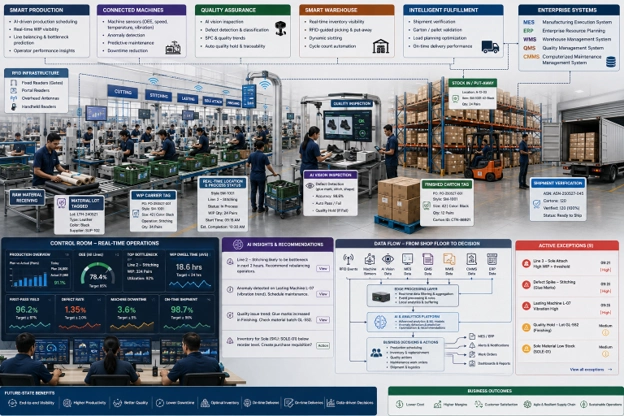
This future-state illustration shows how AI-supported decision-making connects footwear production, quality inspection, maintenance, warehouse operations, and fulfillment. It visualizes RFID-tagged WIP and finished cartons, machine and vision data, edge processing, enterprise systems, and an operations control room working together to support practical manufacturing decisions.
GAO’s Footwear Manufacturing Technology and Engineering Support
Headquartered in New York City and Toronto, Canada, GAO is recognized among the top 10 leading B2B and B2G BLE and RFID suppliers globally. GAO and its sister companies, GAO Research and GAO Tek, form GAO Group, with operations based in New York City and Toronto.
Our organizations have served customers across the United States and Canada, including Fortune 500 companies, leading R&D organizations, universities, and government agencies. GAO has invested substantially in R&D, maintains stringent quality assurance processes, and provides expert technical support remotely or onsite.
For footwear manufacturers evaluating AI inventory management, RFID production tracking, automated traceability, intelligent warehouse operations, or broader AIoT initiatives, the practical starting point is to define the production or supply-chain decision that requires better data. From there, RFID hardware, edge processing, AI analytics, integration, cybersecurity, and deployment models can be engineered around the actual footwear manufacturing workflow.
Building the Future of Industrial AI and IoT with Aperture Venture Studio and GAO RFID Inc.
For more than three decades, GAO Group of Companies has invested heavily in R&D for industrial RFID, BLE, and IoT. As AI became increasingly useful in industrial applications, we expanded our work across AI and IoT technologies and founded Aperture Venture Studio to develop and scale AI and IoT solutions relevant to areas such as footwear manufacturing, industrial traceability, and intelligent operations.
Aperture has attracted AI and IoT technical experts, entrepreneurial and operational executives, investors, and leading companies.
We have also developed Aperture Ventures Summit and TekSummit to discuss advanced AI and IoT topics and foster technical communities.
We welcome you to join us as:
- Advisors, co-founders, or employees
- Investors
- Customers