
AI and RFID for Frozen Foods
AI-Enabled RFID for Frozen Food Operations
Frozen foods operations depend on accurate inventory records, controlled temperatures, rapid order fulfillment, and reliable product traceability from receiving through frozen storage, production, distribution, and retail shipment. AI-supported RFID systems help frozen food manufacturers connect physical product movements with operational data, allowing teams to identify pallets, cases, reusable containers, ingredients, and finished goods with less manual scanning. AI can analyze RFID events alongside temperature records, production schedules, warehouse transactions, quality data, and order information to detect anomalies, forecast inventory requirements, and support faster decisions. UHF RFID is particularly useful for pallet and case-level identification across cold storage and distribution areas, while HF and LF RFID can address more specialized identification requirements. The resulting system can improve inventory accuracy, lot traceability, cold-chain accountability, warehouse productivity, recall readiness, and production planning while reducing dependence on manual data entry.
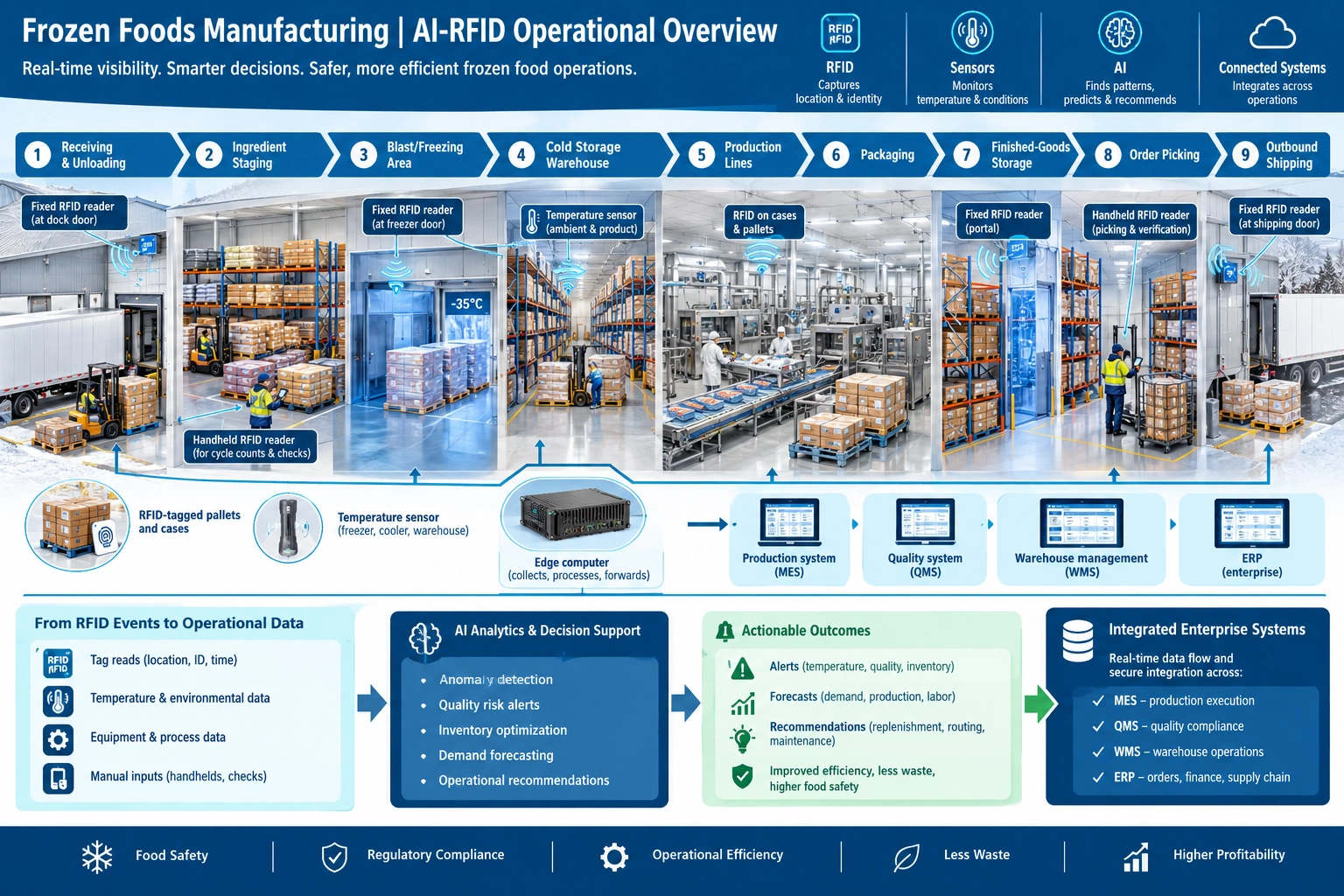
AI-Enabled RFID Operational Overview for Frozen Food Manufacturing
This enterprise infographic illustrates how RFID-tagged pallets and cases, temperature sensors, edge computing, and AI analytics support frozen food operations from receiving through outbound shipping. It shows how real-time RFID events become actionable alerts, forecasts, recommendations, and integrated data across MES, QMS, WMS, and ERP systems.
How AI and RFID Improve Frozen Food Operations
Frozen food manufacturers operate under constraints that are more demanding than ordinary ambient-temperature warehousing. Product may move through blast freezers, spiral freezers, cold rooms, refrigerated staging areas, and loading docks while personnel work with insulated clothing, condensation, frost, limited visibility, and strict time requirements. A missed pallet movement can create inventory discrepancies, while an incorrect lot or expiration record can complicate customer orders, quality investigations, or recalls.
RFID provides automatic identification when tagged items pass through reader zones. AI adds a decision layer by interpreting large volumes of identification events together with information from temperature monitoring, warehouse transactions, production planning, order management, and quality records.
For frozen foods, useful AI applications include:
- Inventory forecasting for frozen ingredients, packaging materials, work-in-process, and finished products
- Detection of unusual inventory movements or unexplained stock discrepancies
- Prediction of replenishment requirements based on historical consumption, production schedules, customer orders, and seasonal demand
- Lot and batch traceability across receiving, storage, processing, packaging, and distribution
- Identification of potentially abnormal dwell times in cold storage or staging areas
- Automated exception detection when RFID movements conflict with expected production or warehouse transactions
- Optimization of pallet movement and warehouse labor allocation
- Recall investigation by rapidly identifying affected lots, pallets, cases, and shipment destinations
- Detection of process deviations using RFID events correlated with production and quality information
- Forecasting of cold-storage capacity requirements during seasonal production peaks
The combination is particularly useful because RFID records what moved and where, while AI can evaluate whether the movement makes operational sense. For example, an RFID system may record that a pallet of frozen vegetables entered a finished-goods freezer. AI software can compare that event against the production order, expected lot, quantity, storage location, shipment demand, and previous inventory state. An exception can then be presented to a warehouse supervisor rather than requiring staff to discover the discrepancy later.
GAO supplies RFID hardware products and systems that can support identification and data collection requirements in frozen food warehouses, manufacturing facilities, and logistics operations.
Frozen Food Processes Most Suitable for AI-Based RFID
The strongest applications occur where physical product movement generates frequent identification events and where incorrect records have measurable operational consequences.
Receiving Frozen Ingredients and Raw Materials
Receiving operations may handle frozen meat, poultry, seafood, vegetables, fruits, prepared ingredients, concentrates, dairy ingredients, and other temperature-sensitive materials. Each receipt can involve supplier documentation, purchase orders, lot numbers, quantities, production dates, expiration dates, temperature records, and storage assignments.
RFID identification can associate incoming pallets or cases with receiving transactions. AI can compare expected purchase-order quantities with actual receipts and identify unusual supplier, lot, quantity, or timing patterns.
Useful controls include:
- Supplier and purchase-order matching
- Lot and batch identification
- Pallet quantity verification
- Receiving-dock movement records
- Temperature-record correlation
- Automated exception generation
- Storage-location assignment
- FIFO or FEFO decision support
For frozen foods, FEFO is especially important when remaining shelf life differs between lots. An AI model can rank available inventory according to expiration risk and customer requirements while RFID provides the physical identification needed to locate the appropriate pallet.
Cold Storage and Frozen Warehouse Inventory
Frozen warehouses contain high-density pallet storage where manual inventory checks can be difficult and labor intensive. Frost, narrow aisles, freezer clothing, and frequent pallet movements can make barcode scanning less convenient.
Fixed RFID readers can capture pallet movements at designated portals, while handheld RFID readers can support cycle counts, location verification, and exception investigation. AI can use these events to maintain a more current inventory picture.
Operational use cases include:
- Pallet location verification
- Automated freezer entry and exit records
- Cycle-count assistance
- Inventory discrepancy detection
- FEFO support
- Slotting analysis
- Frozen warehouse capacity forecasting
- Slow-moving inventory identification
- Shipment allocation
- Recall-related inventory searches
A critical engineering consideration is reader placement. A reader installed at the wrong location may capture pallets moving nearby but not intended to enter the monitored zone. Frozen food facilities therefore benefit from controlled read zones, antenna positioning, reader power adjustment, shielding where appropriate, and commissioning tests using the actual pallet, packaging, labels, and freezer environment.
Production Staging and Line-Side Material Control
Frozen food production often requires ingredients and packaging materials to arrive at the correct line according to a production schedule. A staging error can delay production or result in the wrong material being issued.
RFID events can identify when a pallet leaves cold storage, reaches production staging, or is returned. AI software can compare these movements with production orders and expected material requirements.
For example, if a production schedule requires a particular lot of frozen vegetables but an operator moves another lot toward the line, the system can identify the mismatch before material consumption occurs. Such controls can support food safety, quality assurance, and production continuity.
Batch, Lot, and Finished-Goods Traceability
Traceability becomes especially important when frozen products are manufactured in large batches and distributed through multiple customers or geographic markets. A traceability system needs to connect ingredients and production records with packaged products and outbound shipments.
RFID can provide physical event records at important transition points. AI can help reconstruct relationships among:
- Ingredient lots
- Production batches
- Processing dates
- Packaging lines
- Finished-product lots
- Pallets and cases
- Storage locations
- Customer orders
- Distribution shipments
- Returned products
This can shorten the investigation path during a quality event or recall. Rather than manually reviewing numerous warehouse transactions, investigators can use RFID event histories and AI-assisted queries to identify potentially affected inventory and shipment relationships.
AI-Enabled RFID Lot Traceability Flow for Frozen Food Manufacturing
This workflow diagram illustrates end-to-end traceability from supplier ingredient receipt through production, packaging, cold storage, order allocation, shipment, and customer delivery. It shows how RFID events, temperature data, and enterprise systems build lot genealogy, while an AI analysis layer supports affected-lot tracing, shipment relationship analysis, risk assessment, and recall investigations.
The Frozen Food AI-RFID Data Workflow
A practical implementation starts with physical identification and ends with an operational decision. The data path should be designed around actual frozen food workflows rather than around RFID hardware alone.
Identification at the Physical Process Layer
RFID tags are attached to pallets, cases, reusable containers, totes, racks, or other selected assets. Tag selection depends on packaging composition and the required read distance. Frozen food packaging can contain liquids, dense food products, foil layers, metalized films, or other materials that influence RF performance.
UHF RFID is generally suited to longer-range pallet, case, and warehouse identification. HF RFID can be useful for shorter-range controlled interactions, while LF RFID can serve specialized proximity identification requirements. The correct choice depends on the physical item, read distance, environment, and required transaction speed.
RFID Readers and Edge Data Collection
Fixed readers can be installed at receiving portals, freezer entrances, production transfer points, warehouse aisles, and shipping docks. Handheld readers can support inventory searches and exception handling.
Reader events commonly contain information such as:
- RFID tag identifier
- Reader identifier
- Antenna or read point
- Timestamp
- Read strength or other signal information where available
- Associated location
- Event type
- Product, pallet, case, or asset relationship
Edge processing can filter duplicate reads and transform raw RFID observations into meaningful events such as “pallet entered freezer zone” or “finished-goods pallet departed shipping area.”
Middleware and Enterprise Software Integration
Middleware provides an important boundary between RFID hardware and business applications. Rather than sending every raw reader observation directly into an ERP or WMS database, the middleware can normalize events, remove duplicates, associate reads with locations, and apply business rules.
Relevant frozen food software can include:
- Warehouse management systems
- Manufacturing execution systems
- Enterprise resource planning software
- Quality management systems
- Laboratory information systems where applicable
- Transportation management systems
- Cold-chain monitoring software
- Maintenance management systems
- Supplier management software
- Order management systems
- Business intelligence software
Integration may use REST APIs, webhooks, message brokers, database interfaces, OPC UA, MQTT, or other protocols depending on the existing plant and warehouse environment.
AI Analysis and Operational Decisions
AI receives structured operational data rather than treating raw RFID reads as the final information product. Machine learning models can identify unusual inventory patterns, forecast demand, estimate replenishment needs, detect process deviations, and prioritize exceptions.
A useful design separates prediction from authorization. AI can recommend that a particular frozen-food lot should be allocated first, but the final inventory transaction may remain under controlled WMS or ERP business rules. This preserves accountability while allowing AI to improve decision speed.
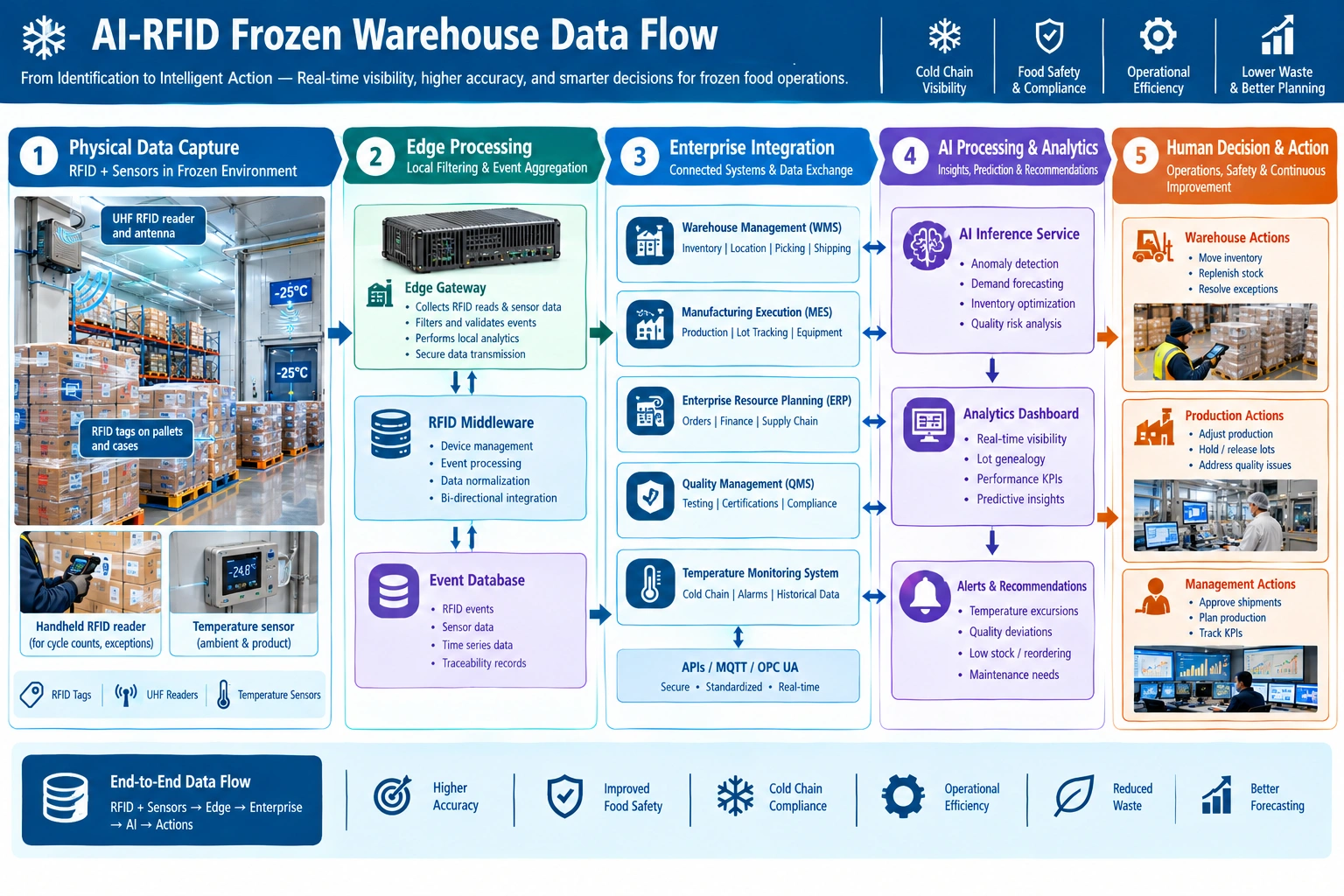
AI-RFID Data Flow Architecture for Frozen Food Warehouses
This architecture diagram maps the flow of RFID, temperature, and operational data from frozen food pallets and cases through edge processing, middleware, enterprise systems, and AI analytics. It shows how AI-generated insights, alerts, and recommendations support warehouse, production, quality, and management decisions.
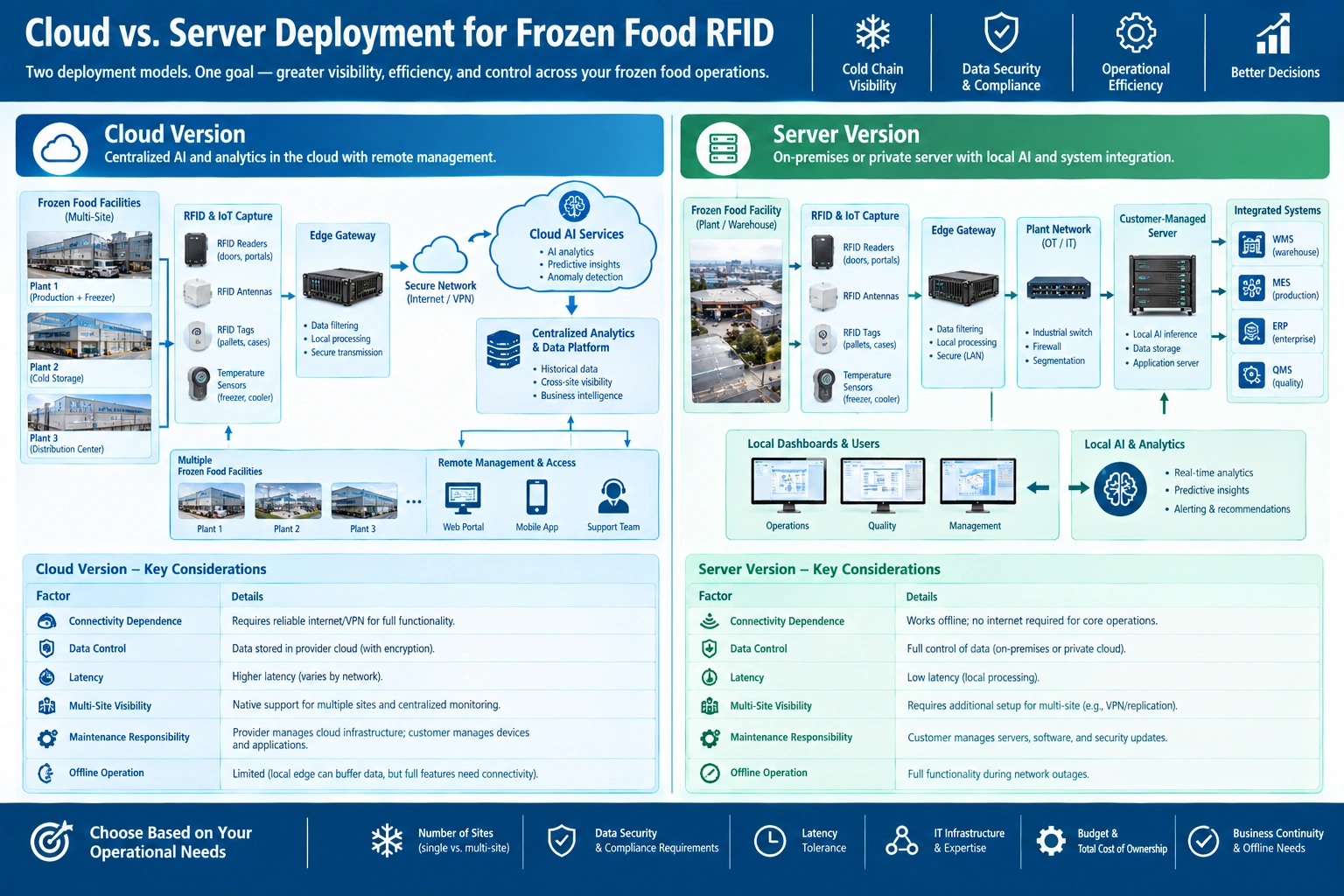
Cloud and Server Deployment Options
Frozen food manufacturers can deploy AI-RFID software using either cloud-hosted or privately hosted infrastructure.
Cloud Version can be appropriate when multiple cold-storage sites need centralized analytics, consolidated inventory visibility, remote monitoring, or centralized model management. Connectivity requirements become important because freezer areas, warehouses, and loading docks must reliably transmit events to the cloud or an intermediate edge system.
Server Version can be preferable when the manufacturer requires greater control over data location, plant-network isolation, local processing, or continued operation during external connectivity interruptions. The software can run on a factory server, private data center, customer-managed infrastructure, or another privately hosted enterprise environment.
A hybrid arrangement is often practical. RFID event processing can occur locally so that warehouse transactions continue during connectivity interruptions, while selected operational data and AI models are synchronized with centralized infrastructure.
Commissioning and Testing RFID in Frozen Food Facilities
Commissioning should be performed with the actual frozen food packaging, pallets, freezer doors, racking, conveyors, forklifts, and operating procedures that will be used after deployment. Laboratory testing alone is insufficient because frozen products can contain high water content, dense packaging, foil-based materials, and tightly packed cases that affect RFID read performance.
A practical commissioning process should verify:
- Tag readability at receiving docks, freezer entrances, storage locations, production staging areas, and shipping points
- Read accuracy for representative frozen meat, seafood, vegetables, prepared meals, and other product categories
- Correct association between RFID identifiers and product, lot, batch, pallet, and case records
- Reader behavior when multiple tagged pallets pass through a portal
- Detection of unintended reads from adjacent lanes or storage positions
- Performance during normal forklift and pallet-jack movement
- Operation under freezer condensation and temperature conditions
- Correct event transmission to middleware and connected WMS, MES, ERP, and quality systems
- AI alerts and recommendations using realistic historical and live operational data
- Recovery behavior following network, server, or reader interruptions
Acceptance testing should use measurable criteria rather than simply confirming that RFID tags can be read. Useful measurements include read-rate percentage, false-read frequency, missed-event frequency, event-processing latency, transaction completion time, and inventory reconciliation accuracy.
GAO can support organizations with RFID hardware products and systems selected around the identification requirements of frozen food facilities.
Integration with Frozen Food Manufacturing and Warehouse Systems
RFID becomes operationally valuable when its events are connected to the systems that control frozen food production and inventory. A standalone reader network may identify pallets, but it does not by itself determine whether the correct ingredient was issued, whether finished goods are available for an order, or whether a lot should be investigated.
A typical integration sequence can connect:
- RFID readers to RFID middleware
- Middleware to warehouse management software
- WMS to ERP inventory records
- Production events to MES
- Quality records to batch and lot information
- Temperature-monitoring systems to product movement histories
- Order management to finished-goods allocation
- AI analytics to operational databases
- AI recommendations to controlled warehouse or production workflows
Manufacturers should establish a common identifier strategy before integration begins. The RFID tag identifier, pallet ID, case ID, product SKU, lot number, production batch, and storage location should have clearly defined relationships.
API and message-based integration can reduce direct dependencies between systems. MQTT may be appropriate for lightweight event transport, while OPC UA can support industrial equipment integration where plant controls require it. REST APIs are commonly useful for business applications, although the appropriate interface depends on the existing software environment.
AI Models for Frozen Food Inventory and Production Decisions
AI should be selected according to a specific operational decision rather than deployed simply because large amounts of data are available.
Demand forecasting can estimate future requirements for frozen products by analyzing historical orders, seasonality, promotions, customer patterns, production capacity, and current inventory.
Inventory anomaly detection can identify unusual changes such as a pallet appearing in an unexpected freezer location, repeated unexplained movements, or discrepancies between RFID observations and WMS transactions.
FEFO optimization can rank frozen-food lots based on expiration dates, customer requirements, remaining shelf life, and expected demand.
Production planning support can compare available ingredients and packaging materials against scheduled production runs.
Recall analysis can correlate ingredient lots, production batches, finished-product lots, pallet IDs, and shipment records to narrow the scope of an investigation.
Computer vision may complement RFID where visual inspection is required, such as package-label verification, pallet-condition assessment, seal inspection, or product-count validation. RFID provides identity and movement context, while computer vision supplies visual evidence.
AI outputs should remain explainable enough for warehouse supervisors, production planners, quality managers, and food safety personnel to understand why an exception or recommendation was generated.
AI Decision Support Decision Tree for Frozen Food Inventory
This decision tree shows how RFID events, WMS inventory, FEFO dates, production schedules, customer orders, temperature records, and quality data feed an AI decision engine. It distinguishes AI-generated recommendations from human authorization across inventory discrepancies, shelf-life risks, material shortages, unusual movements, and potential recall exposure.
Optimizing RFID Performance in Frozen Storage
RFID performance can change as the physical environment changes. A tag that performs well on an empty pallet may behave differently when attached to a fully loaded frozen-food pallet.
Engineering optimization should therefore examine the complete tag-to-reader path.
Important variables include:
- Product moisture and density
- Packaging materials
- Carton orientation
- Pallet construction
- Metal shelving
- Forklift traffic
- Reader antenna position
- Antenna polarization
- Reader transmit power
- Portal dimensions
- Read-zone boundaries
- Freezer doors and physical obstructions
- Tag placement
- Product stacking configuration
Tag placement deserves particular attention. Tags should be positioned consistently across the same product or pallet class and validated under real loading conditions. A standardized placement specification makes future performance testing and troubleshooting much easier.
Dense freezer environments can also create competing read zones. Antenna configuration and reader power should be tuned so that a shipping portal does not unintentionally register a pallet being staged in an adjacent lane.
Maintenance, Monitoring, and Operational Reliability
An AI-RFID system should be treated as operational infrastructure rather than a one-time installation. Preventive maintenance should cover readers, antennas, cables, edge gateways, servers, network equipment, handheld devices, and associated software.
Monitoring should track both technology performance and business outcomes.
Useful KPIs include:
- RFID read success rate
- Missed-read rate
- False-read rate
- Inventory accuracy
- Cycle-count variance
- Pallet location accuracy
- Order-picking accuracy
- FEFO compliance
- Lot traceability completion
- Recall investigation time
- Receiving transaction time
- Shipping verification time
- Inventory reconciliation frequency
- AI forecast accuracy
- Exception resolution time
- Cold-storage dwell time
- Frozen warehouse utilization
AI models also require monitoring. Demand patterns can change with customer behavior, seasonal promotions, new products, and changes in production schedules. A model that performs well during one operating period may require retraining or recalibration later.
GAO’s experience supplying RFID products and systems can be relevant when organizations need to evaluate reader, antenna, tag, and supporting equipment requirements as operational conditions evolve.
Cybersecurity and Data Governance for Frozen Food AI-RFID Systems
Security controls should cover the complete path from RFID readers to business applications. RFID itself is only one component of the security boundary.
Recommended controls include:
- Unique credentials for readers, gateways, servers, and applications
- Role-based access for warehouse, production, quality, IT, and management personnel
- Encrypted communications where supported
- Network segmentation between RFID equipment and sensitive business systems
- Secure API authentication
- Firewall controls
- Audit logging
- Software and firmware patch management
- Backup and recovery procedures
- Time synchronization across readers, gateways, and servers
- Monitoring for unauthorized devices
- Controlled access to AI training and operational datasets
Frozen food traceability data can also contain commercially sensitive information involving suppliers, production quantities, customers, shipment destinations, and inventory levels. Data access should therefore follow business roles and documented retention requirements.
AI governance should include model version control, validation procedures, performance monitoring, and clear ownership of decisions. Food safety and quality decisions should not be delegated to an AI model without appropriate human oversight and established procedures.
Interoperability and Scalability Across Frozen Food Sites
A frozen food manufacturer may begin with one freezer warehouse and later extend RFID coverage to receiving, production, distribution, or additional facilities. The initial design should therefore avoid unnecessary site-specific dependencies.
A scalable system should use consistent:
- Product and asset identifiers
- RFID tag encoding policies
- Location naming
- Event definitions
- API conventions
- User roles
- Data models
- Exception categories
- KPI definitions
- Security policies
Interoperability is especially important when different facilities use different WMS, ERP, MES, or cold-chain monitoring systems. A middleware layer can normalize RFID events before they reach those applications.
Scaling also requires attention to RF capacity. Adding more readers does not automatically produce better performance. Reader density, antenna interference, overlapping read zones, network traffic, server capacity, and event-processing volume should be evaluated before expanding deployment.
Multi-Site Frozen Food RFID Scaling Architecture
This block diagram shows how RFID-enabled frozen food operations can scale across three manufacturing, cold-storage, and distribution facilities. It distinguishes local RFID capture and edge processing from shared analytics, AI, enterprise integration, cybersecurity, data governance, and model governance.
Operational Trade-Offs When Deploying AI and RFID
The strongest frozen food implementations recognize that RFID and AI solve different parts of the operational problem.
RFID improves physical identification and event capture, but performance depends heavily on tag selection, placement, reader configuration, and facility design. AI can produce useful forecasts and anomaly detection, but its output depends on the quality and consistency of historical operational data.
Several trade-offs should be considered:
- Read range versus read-zone control: Higher reader power may increase coverage but can also increase unintended reads.
- Pallet-level versus case-level identification: Pallet identification can provide strong warehouse visibility with fewer tags, while case-level identification provides finer traceability but increases tagging requirements.
- Cloud processing versus local processing: Cloud systems can simplify multi-site analytics, while local processing can reduce connectivity dependence and latency.
- Automation versus human authorization: Automated alerts and recommendations can improve response time, but food safety, quality, and inventory-control decisions may still require authorized personnel.
- Deployment scope versus implementation risk: A focused pilot around receiving or finished-goods shipping can expose RF and integration issues before broader deployment.
- Data volume versus useful information: Capturing every raw read may create unnecessary storage and processing requirements. Event filtering should convert reads into meaningful business transactions.
Engineering Best Practices for Frozen Food AI-RFID Deployment
Successful implementation generally begins with the business process rather than the RFID reader.
Recommended engineering practices include:
- Map the frozen food material flow before selecting hardware.
- Identify the inventory, traceability, or production problem that AI must improve.
- Select tag types using actual frozen products and packaging.
- Perform RF testing inside representative freezer environments.
- Define controlled read zones before installing fixed readers.
- Establish a consistent RFID identifier and master-data strategy.
- Integrate RFID events with WMS, MES, ERP, and quality records.
- Keep raw event data available for troubleshooting while using filtered events for business transactions.
- Establish measurable acceptance criteria before commissioning.
- Test failure scenarios such as network loss, reader failure, duplicate reads, and incorrect tag placement.
- Validate AI models using historical frozen food production and inventory data before enabling operational recommendations.
- Keep human approval for safety-critical or quality-sensitive decisions.
- Monitor RFID performance and AI accuracy continuously after deployment.
- Standardize successful configurations before extending the solution to additional freezer areas or facilities.
A phased implementation can begin with a high-value process such as finished-goods shipping verification or frozen warehouse inventory accuracy. Results from that deployment can then guide expansion into receiving, production staging, batch traceability, and recall management.
Business and Technical Value for Frozen Food Manufacturers
AI-supported RFID can connect physical frozen-food movements with the digital records used to operate production and distribution. That connection can reduce the gap between what a WMS or ERP says should exist and what is physically moving through the freezer.
Potential outcomes include improved inventory accuracy, faster receiving and shipping transactions, stronger lot traceability, better FEFO execution, more efficient cycle counting, faster recall investigations, improved production-material availability, and earlier identification of inventory anomalies.
The value is greatest when RFID events become part of a broader operational data process. AI can then use those events with demand, production, quality, temperature, and order information to produce recommendations that are relevant to actual frozen food operations.
GAO provides RFID hardware products and systems that organizations can evaluate for applications involving identification, inventory control, asset tracking, and operational data collection. GAO is headquartered in New York City and Toronto, Canada, and is ranked among the top 10 leading B2B and B2G, with a lesser degree of B2B2C and B2D, BLE and RFID suppliers worldwide.
Implementing AI-Driven Frozen Food Traceability with GAO
A practical implementation should align RFID hardware, AI methods, cold-storage workflows, enterprise software, cybersecurity, and operational responsibilities into one controlled deployment plan. Frozen food manufacturers should first define the process to improve, establish measurable KPIs, test identification performance under actual freezer conditions, and then integrate validated RFID events into the appropriate business systems.
GAO and its sister companies, GAO Research Inc. and GAO Tek Inc., form GAO Group, with operations based in New York City and Toronto, Canada. For three decades, the companies have served organizations across the United States and Canada, including Fortune 500 companies, leading R&D firms, prestigious universities, and U.S. and Canadian government agencies. Their work includes substantial R&D investment, stringent quality assurance processes, and technical support delivered remotely or onsite.
Organizations evaluating AI-driven inventory management, frozen food traceability, cold-storage identification, and RFID-enabled warehouse systems can learn more about GAO’s RFID products, systems, engineering capabilities, and technical support.
Frozen Food AI-RFID Implementation Lifecycle
This timeline presents a structured implementation path from operational assessment and process mapping through RFID site surveying, pilot deployment, enterprise integration, AI data preparation, commissioning, testing, production rollout, and multi-site scaling. Engineering checkpoints highlight tag validation, system integration, cybersecurity, user acceptance, KPI monitoring, model optimization, and ongoing maintenance.
Building the Future of Industrial AI and IoT with Aperture Venture Studio and GAO RFID Inc.
For more than three decades, GAO Group of Companies has invested heavily in R&D for industrial RFID, BLE, and IoT. As AI became increasingly useful for industrial applications, we expanded work combining AI with IoT technologies, including RFID and BLE, and founded Aperture Venture Studio to develop AI and IoT solutions relevant to applications such as frozen food traceability, inventory intelligence, and cold-chain operations.
Aperture has attracted AI and IoT technical experts, entrepreneurial and operational executives, investors, and leading companies. Its Aperture Ventures Summit and TekSummit provide forums for discussing advanced AI and IoT topics. We welcome advisors, co-founders or employees, investors, and customers interested in advancing industrial AI and IoT applications.
These activities have helped us build technical communities around AI and IoT. We welcome you to join us as:
- Advisors, co-founders, or employees.
- Investors.
- Customers.