
AI and RFID for Furniture Manufacturing
AI-Driven Furniture Manufacturing with Intelligent Identification and IoT
Furniture manufacturers increasingly need precise visibility across lumber, engineered wood panels, veneers, hardware, upholstery materials, work-in-progress assemblies, finished furniture, and outbound shipments. AI for furniture manufacturing can turn production, inventory, quality, and equipment data into operational decisions, while RFID provides an automated identification layer for physical materials and products.
A practical AIoT solution combines RFID readers and tags with machine data, sensors, manufacturing software, edge computing, analytics, and AI models. This allows manufacturers to associate physical components with production orders, identify process deviations, predict equipment problems, detect inventory discrepancies, and improve production scheduling. UHF RFID is particularly useful for automated identification across receiving, WIP, warehouse, and shipping operations, while HF and LF RFID can address more specialized identification requirements.
For furniture manufacturers, the value is not simply knowing where an item is. The objective is to connect what the item is, where it is, what production operation it has completed, what condition it is in, and what should happen next.
AIoT and RFID Workflow for Furniture Manufacturing
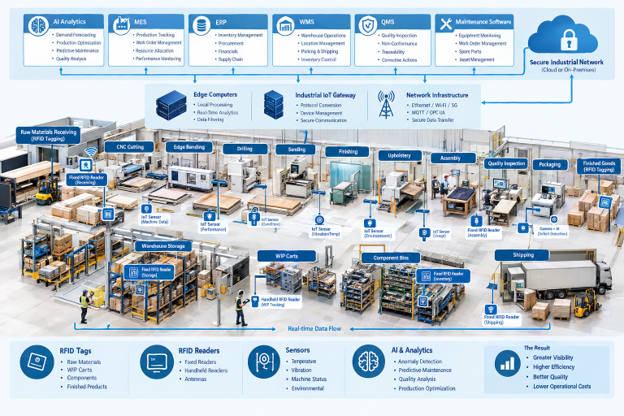
This visual shows how RFID-tagged materials, WIP carts, finished products, IoT sensors, and factory equipment connect with edge computing and AI analytics across a furniture manufacturing facility. It illustrates how manufacturing data flows into MES, ERP, WMS, QMS, and maintenance software to support production visibility, inventory control, quality management, and predictive maintenance.
What AI Means for Furniture Manufacturing Operations
AI in furniture manufacturing is most useful when it solves specific operational problems rather than being introduced as a standalone technology initiative. Production environments generate large quantities of information from CNC equipment, production orders, inspection stations, inventory transactions, machine sensors, warehouse movements, and operator activities. AI can analyze those data streams to identify patterns that are difficult to detect through manual review.
Furniture production is particularly suitable for this approach because manufacturing processes often combine high SKU variety, configurable products, multiple material types, batch production, manual assembly, automated machining, finishing operations, and variable customer orders.
AI applications can include:
- AI production scheduling that evaluates orders, material availability, machine capacity, setup requirements, and process dependencies.
- AI inventory management that detects unusual consumption patterns, missing components, inventory discrepancies, and replenishment risks.
- AI quality inspection using computer vision to identify surface defects, edge damage, color inconsistencies, machining errors, assembly problems, or finishing abnormalities.
- AI predictive maintenance using vibration, current, temperature, runtime, and production-cycle information from CNC machines, sanders, compressors, conveyors, dust collectors, and other equipment.
- AI work-in-progress tracking that combines RFID events with production-order information to identify stalled or misplaced assemblies.
- AI material-flow optimization that identifies recurring bottlenecks between cutting, machining, finishing, assembly, packaging, and shipping.
- AI demand and production analysis that helps planners evaluate historical production patterns and current order requirements.
RFID provides an important source of ground-truth information for these applications. Instead of asking an AI model to infer the identity of an untracked physical item, the system can associate an RFID event with a known work order, material lot, component, cart, pallet, or finished product.
GAO supplies RFID, BLE, and IoT hardware products and systems that can be incorporated into such manufacturing workflows, allowing identification and sensing functions to become part of broader production and operational systems.
Where AI Creates Value Across Furniture Production
Furniture manufacturing consists of interconnected processes rather than one continuous operation. A dining table, office workstation, upholstered chair, cabinet, or modular storage system may pass through multiple production cells before reaching packaging.
Raw Material Receiving and Inventory
Receiving operations may handle lumber, plywood, MDF, particleboard, veneer, laminates, hardware, fasteners, foam, fabrics, leather, adhesives, coatings, and packaging materials.
AI can compare expected receipts with actual material movement and consumption. RFID can associate incoming pallets, containers, material bins, or selected individual components with purchase orders and inventory records.
Operational value includes:
- Faster receiving verification
- Better visibility of material location
- Identification of inventory discrepancies
- Improved material availability data for production planning
- Reduced manual inventory counting
- Better traceability between material lots and finished products
The engineering challenge is choosing the correct identification level. Tagging every individual screw may be unnecessary, while tagging a high-value component kit, hardware bin, upholstery roll, or production container can provide substantially greater operational value.
CNC Cutting, Routing, Drilling, and Machining
CNC routers, panel saws, beam saws, edge banders, boring machines, drilling systems, and machining centers create large amounts of production data.
AI can correlate machine-cycle information with work orders and RFID-based WIP events. This enables manufacturers to identify unusual cycle times, recurring machine bottlenecks, excessive rework, and production orders that remain at a machining cell longer than expected.
A practical implementation should avoid treating RFID as the only source of production truth. Machine controllers, PLCs, MES transactions, operator inputs, and RFID events should be correlated through timestamps, work-order identifiers, equipment identifiers, and process states.
Sanding, Finishing, and Coating
Finishing operations introduce different engineering considerations. Furniture may move through sanding, staining, painting, coating, curing, drying, inspection, and rework.
AI can analyze process conditions and inspection data to identify relationships between process parameters and defects. Computer vision can assist with surface inspection, while RFID can preserve product or batch identity as pieces move between process areas.
Wood dust and finishing chemicals also make facility conditions important. OSHA identifies machine hazards, wood dust, chemicals, noise, vibration, electrical hazards, and fire and explosion risks among the major hazards associated with woodworking operations. (OSHA)
RFID hardware therefore needs to be selected and installed with the actual environmental conditions in mind rather than simply maximizing read range.
Assembly and Work in Progress
Assembly is often where furniture manufacturing becomes highly variable. Different orders can require different components, hardware kits, upholstery configurations, or assembly sequences.
An AI-enabled WIP system can combine RFID identification with manufacturing-order data to answer questions such as:
- Which work order is currently at assembly?
- Which components have arrived?
- Which assemblies are waiting for missing hardware?
- Which orders have exceeded their expected cycle time?
- Which production cells have accumulating WIP?
- Which products require rework?
This turns RFID events into operational context rather than simply producing a list of tag reads.
Quality Inspection and Finished Goods
Finished furniture can undergo dimensional checks, structural inspection, visual inspection, surface inspection, packaging verification, and order-specific quality checks.
Computer vision can support inspection where image-based defects are measurable. RFID can associate inspection results with the correct product or production order.
The combination is particularly useful for configurable furniture because a finished product can contain many components that must remain associated with one order throughout production.
AI-Enabled Furniture Manufacturing Production Workflow
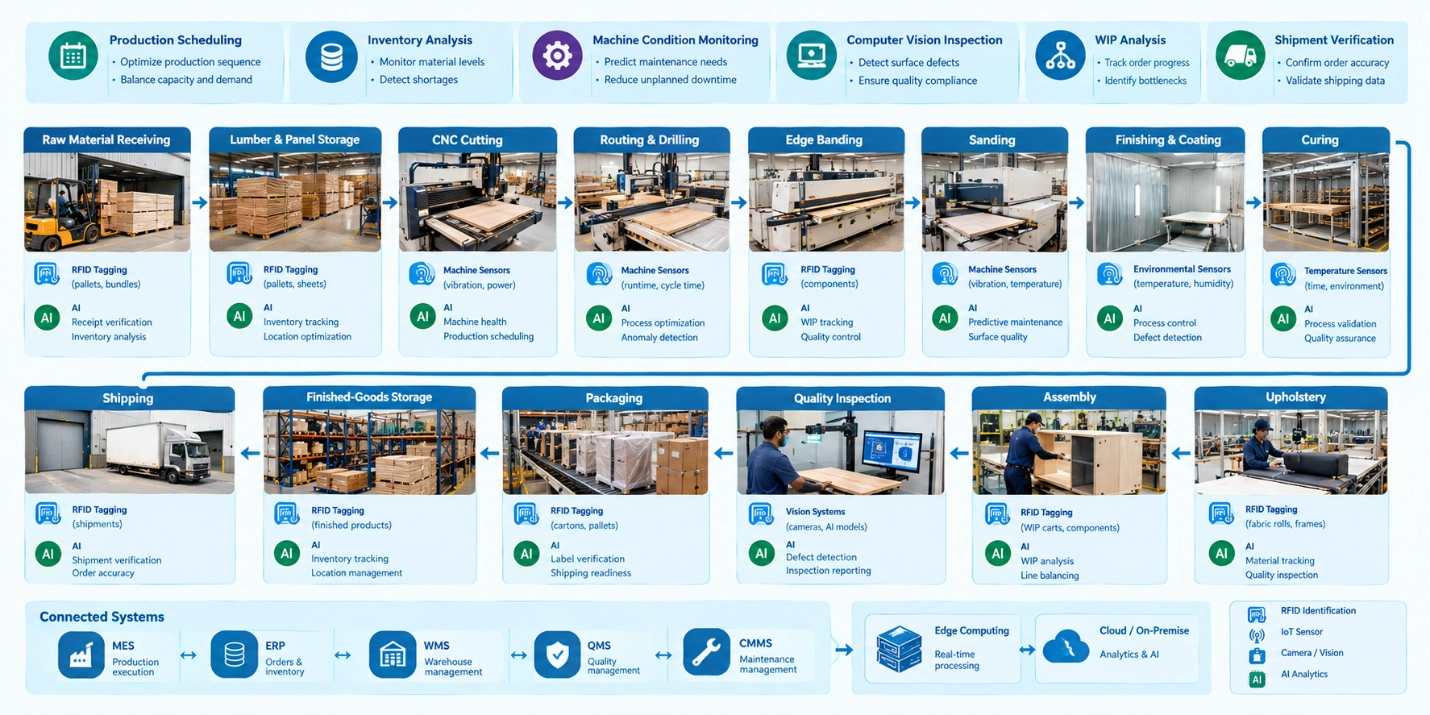
This workflow illustrates the complete furniture manufacturing journey from raw material receiving and lumber storage through CNC machining, finishing, upholstery, assembly, quality inspection, packaging, and shipping. It shows where AI, RFID, machine sensors, computer vision, and connected manufacturing systems support production scheduling, WIP tracking, quality control, maintenance, inventory management, and shipment verification.
Furniture Manufacturing Challenges That AI Can Address
Furniture manufacturers face a combination of discrete manufacturing, material-handling, quality, and supply-chain problems. The most important AI opportunities usually emerge where production data is fragmented or where physical material movement cannot be reliably reconciled with production records.
High SKU and Configuration Complexity
A furniture manufacturer may produce many product families with variations in dimensions, finishes, fabrics, colors, hardware, and customer configurations. Traditional inventory systems can show that a component exists without providing sufficient information about its physical location or production status.
AI can analyze historical consumption, current orders, WIP status, and inventory movement to identify material shortages before they disrupt production.
WIP Visibility and Production Bottlenecks
A work order may physically exist somewhere in the factory while its status in software remains unchanged. RFID events provide additional evidence of physical movement.
AI can use these events to identify abnormal dwell time, repeated movement between process areas, accumulating WIP, and process cells where orders regularly wait.
Quality Variation
Furniture quality can be affected by raw-material variation, machining accuracy, assembly methods, finishing conditions, and operator-dependent processes.
AI-based inspection does not eliminate human quality expertise. Instead, it can prioritize inspection, identify repeatable visual patterns, and provide structured defect information for root-cause analysis.
Equipment Downtime
Unexpected failure of a CNC router, edge bander, compressor, dust collector, sander, or finishing system can disrupt an entire production sequence.
Predictive maintenance models can evaluate sensor and machine data for changes in vibration, temperature, current draw, runtime, or cycle behavior. RFID contributes by associating maintenance events with the correct equipment, tooling, mobile assets, or service history.
Material Traceability
Traceability becomes more important when manufacturers need to investigate defects, warranty claims, supplier issues, or production deviations.
An RFID-linked production record can associate a finished product with relevant work orders, production stages, material batches, inspection events, and shipping transactions.
AI and RFID Deployment Model for Furniture Manufacturing
A production-ready solution should be designed around the factory’s physical process and existing software rather than starting with RFID readers or AI models in isolation.
Data Acquisition at the Factory Floor
The data layer can include:
- UHF RFID fixed readers at receiving docks, production transitions, WIP staging areas, warehouse zones, and shipping points
- Handheld RFID readers for exception handling, inventory audits, and locating individual assets
- HF or NFC identification for selected close-range identification tasks
- LF RFID for specialized proximity or legacy identification requirements
- Vibration and temperature sensors for machinery
- Machine-controller and PLC data
- Barcode and scanner data where RFID is not economical
- Computer-vision cameras for quality inspection
- Environmental sensors for relevant production conditions
UHF RFID is generally well suited to furniture manufacturing where tagged materials, carts, pallets, or finished goods need to be identified without requiring every item to be manually scanned. HF or NFC can be preferable for short-range interactions, while LF can be appropriate for specialized proximity applications.
GS1 notes that ISO/IEC 18000-63 is the RFID air-interface standard associated with the former ISO/IEC 18000-6 Type C and incorporates optional security commands through ISO/IEC 29167. (GS1 GO Customer Service Portal)
The correct frequency and tag design still depend on materials, mounting location, reader geometry, required read distance, interference, metal content, liquid content, and process conditions.
Edge Processing and RFID Middleware
Raw RFID reads should not automatically become business transactions. Middleware should filter duplicate reads, apply reader-zone logic, associate tag identities with master data, and generate meaningful events.
For example, a sequence of reads around a finishing-area portal could be converted into a business event such as:
WIP item entered finishing → production order updated → finishing process started → AI model receives new process-state information.
Edge computing can also perform local filtering and selected AI inference when low latency, network resilience, or data-locality requirements make centralized processing unsuitable.
AI Analytics and Manufacturing Software
AI models can consume normalized data from RFID middleware, sensors, machine systems, MES, ERP, WMS, QMS, CMMS, and other applications.
Typical models include:
- Time-series anomaly detection
- Predictive maintenance models
- Computer vision classification and defect detection
- Demand forecasting
- Production-delay prediction
- Inventory anomaly detection
- Optimization models for scheduling and material flow
- Natural-language interfaces for querying manufacturing data
The important engineering principle is to preserve the original operational event. AI recommendations should be traceable back to the underlying RFID read, machine measurement, inspection result, or transaction that influenced the model.
Enterprise Integration
Furniture manufacturers commonly need integration with:
- ERP for purchasing, orders, inventory, and financial information
- MES for production execution and WIP status
- WMS for warehouse inventory and movement
- QMS for inspection and nonconformance records
- CMMS or EAM for maintenance
- PLM for product and engineering information
- SCM systems for supply-chain planning
- CRM and order-management systems where customer configuration data influences production
GAO’s experience with RFID and IoT hardware products and systems is relevant where manufacturers need the physical identification layer to work alongside existing software rather than replace established manufacturing applications.
Real-World RFID Deployment in Furniture Manufacturing
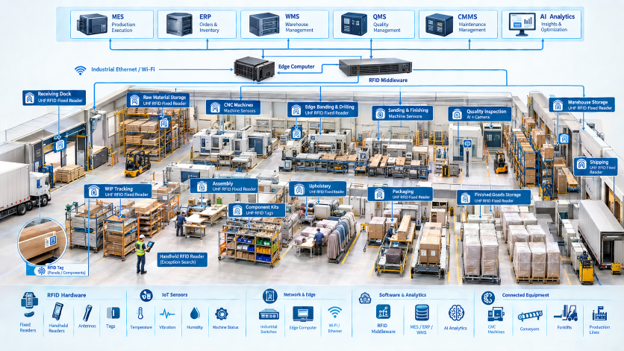
This visual shows how UHF RFID readers, tags, handheld devices, IoT sensors, and edge computing can be deployed across receiving, raw-material storage, CNC processing, WIP tracking, assembly, finishing, quality inspection, packaging, finished-goods storage, and shipping. It also illustrates how RFID middleware connects factory-floor data with MES, ERP, WMS, QMS, CMMS, and AI analytics.
Cloud and Server Software for Furniture Manufacturing AI
Furniture manufacturers can choose between cloud-hosted software and privately hosted server deployments depending on connectivity, cybersecurity, data governance, latency, existing IT standards, and operational requirements.
Cloud Version
A cloud-hosted SaaS deployment can centralize RFID events, manufacturing data, AI models, dashboards, analytics, and multi-site reporting.
This approach is useful when a furniture manufacturer operates multiple factories or warehouses and wants consolidated visibility without maintaining extensive application infrastructure at every site.
Cloud deployment can also simplify centralized model management and software updates. However, factory operations should not depend entirely on continuous Internet connectivity for time-sensitive local functions.
Server Version
A Server Version can run on factory servers, customer-managed infrastructure, private data centers, edge servers, or other privately hosted enterprise environments.
This model can be appropriate when manufacturing data must remain within controlled infrastructure, when local processing is required, or when existing IT policies favor privately hosted applications.
A hybrid arrangement is often practical. RFID filtering, critical event processing, and selected AI inference can operate locally while aggregated analytics and multi-site reporting run in cloud infrastructure.
The choice should be based on operational requirements rather than assuming that either cloud or private hosting is inherently superior.
Engineering Considerations for Furniture Manufacturing RFID
RFID performance can change significantly depending on how tags interact with furniture materials and factory equipment.
Wood, MDF, particleboard, metal hardware, liquids, adhesives, paint containers, foil-backed materials, and dense stacked products can all affect RF behavior differently. Finished furniture can also create changing tag orientations and shielding conditions.
A deployment assessment should therefore evaluate:
- Tag placement and orientation
- Reader antenna position
- Read-zone geometry
- Material composition
- Metal interference
- Dense product stacking
- Conveyor and forklift movement
- Portal throughput
- False-read suppression
- Reader power and regional RF requirements
- Network availability
- Environmental conditions
- Tag durability
- Required read accuracy
- Exception-handling procedures
Furniture manufacturing also presents safety considerations around machinery, dust, finishing chemicals, and fire hazards. OSHA specifically identifies woodworking machine hazards, wood dust, chemicals, and fire and explosion risks, reinforcing the need to install connected equipment without interfering with guarding, ventilation, housekeeping, or safe operating procedures. (OSHA)
Furniture Manufacturing Data Flow from RFID Events to AI Decisions
A robust implementation should establish a clear chain from physical activity to business action.
The process typically begins when a tagged material, WIP cart, component container, equipment asset, or finished product is identified. The reader captures the tag identifier and associated signal information. Middleware then filters duplicate observations and determines whether the event represents a meaningful transition.
The resulting event can be matched with production orders, SKU information, material master data, employee workflows, equipment records, or shipment information.
AI analytics can then evaluate the accumulated operational data.
For example, repeated delays between CNC machining and assembly may reveal a bottleneck that is not obvious from production reports alone. If the system also has machine-cycle data, inventory information, and work-order priorities, an AI model can determine whether the bottleneck is related to machine availability, material shortages, scheduling, rework, or capacity constraints.
The final step is operational action. A system might alert a production supervisor, recommend schedule changes, trigger an inventory investigation, create a maintenance work request, prioritize an inspection, or update a manufacturing dashboard.
The objective is therefore not simply RFID tracking. It is a closed operational loop:
physical event → trusted data → contextual analysis → AI decision support → manufacturing action → measurable outcome.
AI Decision Loop for Furniture Manufacturing Operations
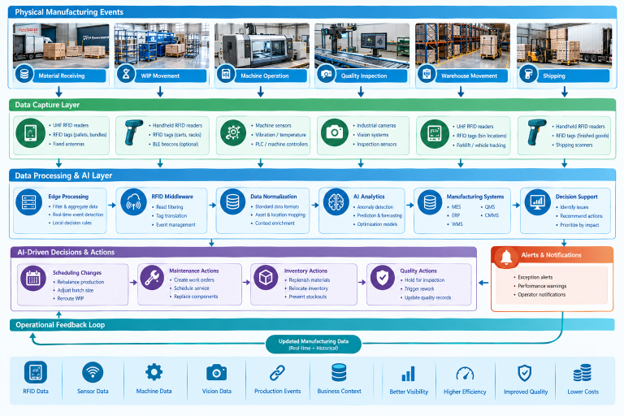
This flow diagram shows how physical furniture manufacturing events are captured through RFID readers, sensors, machine controllers, and cameras, then processed through edge computing, RFID middleware, data normalization, and AI analytics. It illustrates how AI insights integrate with MES, ERP, WMS, QMS, and CMMS to drive scheduling, maintenance, inventory, quality actions, alerts, and continuous operational feedback.
Implementing AI-Enabled RFID Solutions in Furniture Manufacturing
Successful deployment begins with the manufacturing problem, not the RFID hardware. A furniture manufacturer should first identify where inaccurate inventory, WIP delays, quality variation, equipment downtime, or material traceability creates measurable operational cost.
Define the Operational Use Case
The initial assessment should map the physical movement of materials and products against existing digital transactions.
Important questions include:
- Which materials require automatic identification?
- Which WIP stages generate the most uncertainty?
- Which production cells create recurring delays?
- Which assets are frequently misplaced?
- Which quality problems require better traceability?
- Which equipment failures have the greatest production impact?
- Which manufacturing transactions are currently manual?
- Which AI decisions require more reliable physical-world data?
A focused pilot is generally easier to validate than attempting to instrument an entire furniture factory simultaneously.
Select the Appropriate RFID Hardware
Hardware selection should reflect the physical characteristics of the furniture operation.
UHF RFID can support longer-range identification at receiving docks, WIP transitions, warehouse locations, and shipping areas. Handheld UHF readers can support cycle counting, locating WIP, and exception investigations.
HF RFID or NFC can be considered for short-range operator interactions where deliberate identification is preferable to hands-free portal reading. LF RFID can serve specialized proximity-identification requirements.
Tag selection requires equal attention. A tag that performs well on a cardboard carton may behave differently when attached to metal hardware, machinery, dense wood products, or packaging containing foil.
GAO can supply RFID readers, tags, antennas, handheld equipment, and related IoT hardware for organizations designing these identification and sensing systems.
Commission and Test the Read Zones
RFID commissioning should take place under realistic production conditions rather than in an empty factory.
Testing should include:
- Full and partially loaded carts
- Different furniture materials and packaging
- Forklift movement
- Normal production speeds
- Multiple tags in the same read zone
- Different tag orientations
- Metal-containing products
- High-density inventory
- Adjacent reader zones
- Normal network conditions
- Expected exception scenarios
Read performance should be measured using defined acceptance criteria. A successful pilot should demonstrate that the system identifies the intended objects while minimizing duplicate, missed, and unintended reads.
Integrate RFID Events with Manufacturing Systems
RFID data becomes substantially more valuable when it is connected to production context.
A furniture manufacturer could associate an RFID-tagged WIP cart with a production order, product configuration, routing step, workstation, and expected completion time. The resulting event can then update MES or another manufacturing application.
Integration can use APIs, database interfaces, message brokers, industrial gateways, or other supported interfaces depending on the existing software environment.
The integration layer should also define what happens when data conflicts occur. For example, an RFID event may indicate that a cart entered assembly while the MES still shows the order as being in machining. Such exceptions should be surfaced for investigation rather than silently overwriting one system with another.
AI Models, Data Quality, and Operational Decision Support
AI performance depends heavily on the quality and context of the manufacturing data supplied to the model. RFID can improve physical traceability, but it does not automatically produce clean analytical data.
A production system should distinguish between observations and business events.
A reader may observe the same tag dozens of times. The business system may only need one event stating that the tagged cart entered a defined production zone.
Similarly, a furniture assembly cart may remain stationary for two hours. The absence of new RFID movement does not necessarily mean production has stopped. The system needs production-order state, expected cycle time, workstation information, and other contextual data before AI can reliably identify an abnormal delay.
Predictive Maintenance
Furniture plants contain equipment with measurable operating conditions, including:
- CNC routers and machining centers
- Panel saws
- Edge banders
- Drilling and boring equipment
- Sanders
- Compressors
- Dust collectors
- Conveyors
- Finishing and curing equipment
- Upholstery machinery
Vibration, temperature, electrical current, runtime, cycle counts, alarm states, and maintenance history can feed predictive-maintenance models.
RFID can provide complementary asset identification, helping associate maintenance activity with specific machines, mobile equipment, tools, replacement components, or service records.
AI-Powered Quality Control
Computer vision can analyze images captured at controlled inspection stations. Depending on the application, models may detect surface defects, machining abnormalities, dimensional deviations, finish inconsistencies, assembly errors, or packaging problems.
The strongest implementations establish controlled lighting, camera positioning, image quality, product orientation, and defect-labeling procedures before model training.
AI should also provide confidence information and escalation rules. Low-confidence cases can be routed to experienced inspectors rather than automatically accepted or rejected.
Production and Material Optimization
AI can evaluate:
- Current production orders
- Material availability
- Machine capacity
- WIP location
- Historical cycle times
- Setup requirements
- Quality holds
- Maintenance availability
- Delivery priorities
The resulting recommendations can help production planners identify potential bottlenecks and material conflicts.
RFID contributes physical-state information, allowing AI models to distinguish between inventory that exists in the warehouse and material that is actually available at the required production location.
Cybersecurity and Data Governance for Connected Furniture Factories
Connecting RFID readers, IoT sensors, production equipment, and AI software expands the number of systems that exchange manufacturing data. Cybersecurity should therefore be included during system design rather than added after commissioning.
A practical security design can include:
- Network segmentation between production equipment, IoT devices, corporate systems, and external services
- Role-based access controls
- Strong authentication for administrative access
- Encryption for data transmission where supported and appropriate
- Secure API authentication
- Controlled device provisioning
- Firmware and software patch management
- Audit logging
- Backup and recovery procedures
- Monitoring for unusual device or network behavior
- Defined retention policies for production and operational data
AI systems introduce additional governance considerations. Manufacturing organizations should know which data is being used for model training, which data is retained, where processing occurs, and who can access model outputs.
Production decisions with safety or significant quality implications should maintain appropriate human oversight. AI recommendations should be treated according to their operational risk rather than automatically converted into machine commands.
For furniture factories, cybersecurity must also coexist with production availability. A security control that unnecessarily interrupts a CNC cell or manufacturing system can itself become an operational risk. IT, OT, engineering, and production teams should therefore jointly define security requirements.
KPIs for Measuring AI and RFID Results
Technology deployment should be evaluated against manufacturing outcomes rather than the number of readers installed or RFID tags deployed.
Useful KPIs include:
- Inventory record accuracy
- WIP location accuracy
- Material shortage frequency
- Production schedule adherence
- Manufacturing cycle time
- WIP dwell time
- First-pass yield
- Defect rate
- Rework rate
- Quality escape rate
- Equipment availability
- Overall equipment effectiveness
- Unplanned downtime
- Mean time between failures
- Mean time to repair
- Changeover duration
- Order fulfillment time
- On-time shipment rate
- Warehouse picking accuracy
- Inventory turnover
- Material consumption variance
- Production throughput
- Labor hours per finished unit
- RFID read accuracy
- RFID exception rate
- Maintenance response time
- AI prediction precision and recall where measurable
- Manual transaction reduction
The baseline should be recorded before deployment. Otherwise, improvements can be difficult to attribute to the new system.
A useful business case might compare the cost of RFID tags, readers, antennas, installation, integration, software, training, and maintenance against measurable reductions in inventory discrepancies, downtime, labor-intensive counting, rework, or shipment errors.
Scaling AI-Enabled Manufacturing from Pilot to Multiple Production Areas
A successful pilot should establish reusable engineering standards before additional production areas are connected.
The next deployment phase can extend identification and analytics from receiving to WIP, assembly, finished goods, and shipping. Equipment monitoring and computer vision can then be introduced where their data provides measurable operational value.
Standardization is particularly important for manufacturers operating multiple facilities. Tag naming conventions, asset identifiers, production-zone definitions, event schemas, API interfaces, security policies, and KPI definitions should remain consistent wherever practical.
GAO has served organizations in the U.S. and Canada for three decades through RFID, BLE, and IoT products and systems, with customers including Fortune 500 companies, R&D organizations, universities, and government agencies. The company combines product R&D with remote and onsite technical support, which can be relevant when connected manufacturing projects require both hardware expertise and deployment assistance.
GAO RFID Inc., GAO Research Inc., and GAO Tek Inc. operate as sister companies within GAO Group, with operations based in New York City and Toronto, Canada. GAO RFID Inc. is also recognized among the leading B2B and B2G RFID and BLE suppliers globally.
Practical Design Priorities for Furniture Manufacturing
The most effective AI and IoT deployments tend to follow several practical principles.
- Start with a measurable furniture manufacturing problem rather than a technology-first deployment.
- Identify the physical process and data dependencies before selecting RFID hardware.
- Tag assets at the level that provides useful operational information without creating unnecessary cost.
- Validate RFID performance against real furniture materials, packaging, metal components, and factory conditions.
- Use middleware to convert raw RFID observations into meaningful manufacturing events.
- Correlate RFID events with MES, ERP, WMS, QMS, CMMS, machine, and inspection data.
- Keep latency-sensitive and production-critical processing close to the factory when required.
- Use AI where historical or real-time data can support a defensible operational decision.
- Establish human review for high-impact AI recommendations.
- Measure results against predeployment manufacturing KPIs.
- Design cybersecurity, data governance, maintenance, and recovery procedures before commissioning.
- Build standardized interfaces and identification conventions before expanding to additional plants or production cells.
Turning Manufacturing Data into Actionable Production Intelligence
AI for furniture manufacturing becomes most valuable when it connects the digital production record with the physical condition of materials, WIP, equipment, and finished products.
RFID can provide reliable identification and location events, while sensors, machine controllers, cameras, and manufacturing applications contribute additional context. AI then helps interpret these combined signals for production planning, inventory management, quality control, predictive maintenance, material flow, and operational decision support.
The technical objective is not to automate every manufacturing decision. It is to give production, quality, maintenance, warehouse, and supply-chain teams better information at the point where decisions are made.
GAO’s RFID, BLE, and IoT hardware products and systems can provide part of this physical data-acquisition layer. Organizations evaluating an implementation can work with GAO to assess suitable identification technologies, hardware configurations, deployment requirements, and technical support needs for their furniture manufacturing environment.
Building the Future of Industrial AI and IoT with Aperture Venture Studio and GAO RFID Inc.
For more than three decades, GAO Group of Companies has invested heavily in R&D for industrial RFID, BLE, and IoT. As generative AI became increasingly useful for industrial applications, we expanded our work across AI and IoT technologies and founded Aperture Venture Studio to build, launch, and scale AI and IoT companies addressing practical industry challenges, including manufacturing automation and intelligent production. Aperture brings together AI and IoT technical experts, operational leaders, investors, and industry participants. Through Aperture Ventures Summit and TekSummit, we also discuss advanced AI and IoT topics and foster technical communities. We welcome advisors, co-founders, employees, investors, and customers to participate in these efforts.