
AI and RFID for Gold Mining Operations
AI-Powered RFID Solutions for Smarter Gold Mining Operations
Gold mining operations rely on continuous visibility into personnel, mobile equipment, ore movement, consumable inventory, safety systems, and production assets operating across complex open-pit and underground environments. Artificial intelligence, supported by RFID technologies, is transforming how gold mines collect operational data, optimize production workflows, reduce equipment downtime, strengthen worker safety, and improve regulatory compliance. Rather than depending on fragmented manual inspections or isolated tracking systems, AI continuously analyzes RFID-generated operational data to provide actionable intelligence for supervisors, maintenance teams, production engineers, and mine planners.
RFID technologies including UHF RFID, HF RFID, and LF RFID provide reliable identification of equipment, tools, personnel, samples, and materials throughout extraction, haulage, processing, storage, maintenance, and transportation processes. AI converts these continuous data streams into predictive insights that improve production efficiency, reduce operational risks, optimize maintenance scheduling, minimize ore losses, and strengthen decision-making across gold mining operations.
Organizations implementing intelligent RFID-based mining systems benefit from improved operational transparency, higher equipment utilization, enhanced workforce accountability, and faster responses to production disruptions. Drawing upon decades of experience supplying RFID and IoT hardware products and systems throughout North America, GAO helps mining organizations implement technically sound identification and tracking solutions designed for demanding industrial environments.
AI-Enabled RFID Solution for Modern Gold Mining Operations
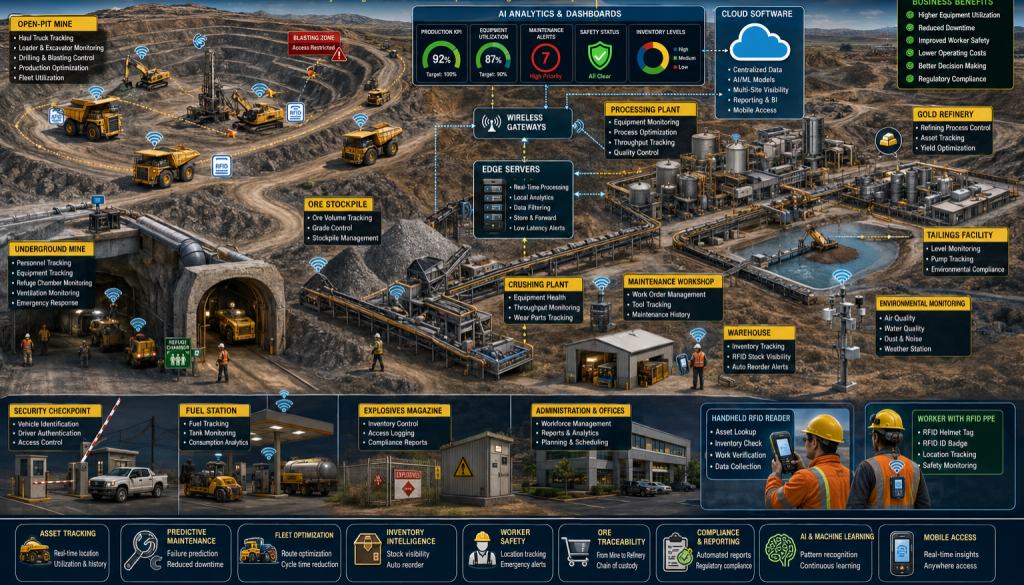
This illustration presents a comprehensive AI-enabled RFID solution for modern gold mining operations, integrating open-pit and underground mining, mineral processing, maintenance, inventory management, workforce safety, and environmental monitoring into a unified operational view. It demonstrates how RFID-tagged assets, AI analytics, edge computing, wireless communications, and cloud software work together to deliver real-time visibility, predictive maintenance, production optimization, and improved operational decision-making across the entire mining lifecycle.
Intelligent Gold Mining Operations Powered by AI and RFID
Gold mining is one of the world’s most asset-intensive industrial sectors. Large mining sites often operate hundreds of heavy mobile assets, thousands of maintenance tools, millions of replacement components, hazardous materials, explosives, geological samples, production inventory, and a geographically dispersed workforce working around the clock.
Maintaining accurate visibility across these assets presents significant engineering challenges because operations extend across multiple kilometers, include harsh environmental conditions, and involve continuous equipment movement. Traditional barcode systems and manual record keeping frequently become unreliable due to dust, vibration, mud, moisture, abrasive materials, and limited operator availability.
RFID addresses these limitations by enabling automatic identification without direct line of sight. Depending on operational requirements, different RFID technologies serve distinct purposes:
- UHF RFID supports long-range identification of haul trucks, loaders, drilling rigs, fuel tanks, maintenance equipment, pallets, containers, and warehouse inventory.
- HF RFID provides secure identification for maintenance documentation, laboratory samples, refinery workflows, and access-controlled operational records.
- LF RFID performs reliably around metal-rich environments, underground equipment, and applications exposed to moisture, dirt, or challenging electromagnetic conditions.
Artificial intelligence extends RFID capabilities well beyond simple identification. Instead of only recording asset locations, AI continuously analyzes operational patterns, predicts future events, identifies anomalies, recommends maintenance actions, optimizes equipment utilization, and supports production planning.
Gold mining organizations increasingly deploy AI because production performance depends upon hundreds of interconnected operational variables including:
- Ore grade variability
- Equipment availability
- Fleet utilization
- Maintenance efficiency
- Fuel consumption
- Worker productivity
- Shift scheduling
- Ventilation performance
- Processing plant throughput
- Inventory availability
- Environmental monitoring
- Regulatory compliance
RFID continuously captures operational events while AI transforms those events into predictive operational intelligence.
Modern gold mining operations increasingly integrate RFID-generated operational data with production planning software, computerized maintenance management systems, enterprise resource planning software, fleet management software, geological information systems, laboratory information management systems, environmental monitoring systems, warehouse management software, and business intelligence applications. This connected approach enables production engineers and mine managers to evaluate operational performance from a unified data environment rather than disconnected spreadsheets and isolated databases.
Because GAO supplies RFID hardware products and supporting technologies to organizations requiring reliable identification under demanding industrial conditions, our engineering teams understand the importance of selecting RFID readers, antennas, tags, and communication infrastructure appropriate for mining environments where durability and long-term operational reliability are essential.
UHF, HF, and LF RFID Technology Comparison for Gold Mining Operations
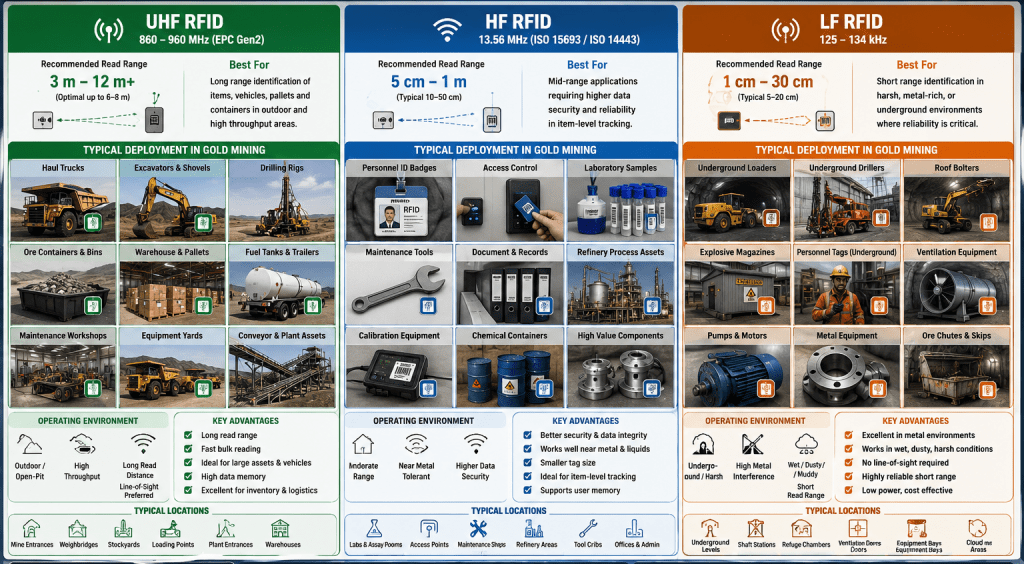
This comparison diagram illustrates how UHF, HF, and LF RFID technologies are deployed across modern gold mining operations. It highlights the recommended read ranges, operating environments, key advantages, and typical applications for each RFID technology, helping engineers and mining professionals select the most appropriate solution for asset tracking, workforce identification, inventory management, laboratory sample tracking, and underground mining operations.
AI-Driven RFID Applications Across Gold Mining Operations
Successful RFID implementation begins with understanding operational workflows rather than focusing solely on technology selection. Gold mining facilities contain multiple operational domains, each presenting unique engineering requirements, environmental constraints, regulatory obligations, and performance objectives.
Mobile Equipment Tracking
Large mining operations depend on fleets of haul trucks, articulated dump trucks, hydraulic excavators, wheel loaders, bulldozers, graders, water trucks, explosive transport vehicles, service trucks, and light vehicles. RFID automatically identifies each asset at fueling stations, maintenance workshops, dispatch areas, weighbridges, loading zones, and production areas. AI analyzes utilization rates, idle time, travel patterns, maintenance intervals, and operational bottlenecks to improve fleet productivity.
Mine Workforce Safety and Access Control
Gold mining personnel frequently transition between restricted operational zones including blasting areas, underground declines, processing facilities, laboratories, maintenance workshops, and confined spaces. RFID-enabled identification integrated with AI helps monitor authorized access, verify personnel accountability during emergencies, automate mustering procedures, and detect unauthorized movement into hazardous locations.
Ore and Material Traceability
RFID tagging supports end-to-end tracking of ore batches, concentrate containers, metallurgical samples, assay materials, and transport bins. AI correlates identification records with geological models, production schedules, laboratory results, and processing performance to improve ore reconciliation, reduce material losses, and strengthen chain-of-custody documentation.
Maintenance Operations
Mining maintenance departments manage thousands of replacement parts, lubricants, consumables, specialized tools, hydraulic components, tires, and critical spares. RFID automates inventory identification while AI forecasts spare-parts demand, predicts maintenance requirements, optimizes inventory levels, and reduces unexpected equipment downtime.
Environmental and Regulatory Monitoring
Environmental compliance requires continuous monitoring of tailings facilities, water treatment systems, hazardous chemical storage, emissions control equipment, and waste management activities. RFID identifies monitored assets, inspection equipment, and sampling containers, while AI evaluates historical trends to identify compliance risks before regulatory thresholds are exceeded.
Gold Mining Deployment Scenarios, Engineering Considerations, and Operational Challenges
Deploying AI-enabled RFID solutions in gold mining requires careful engineering because operating conditions differ significantly between open-pit mines, underground mines, mineral processing plants, maintenance facilities, laboratories, and logistics yards. Environmental factors such as metallic infrastructure, abrasive dust, vibration, high humidity, water ingress, electromagnetic interference, explosive atmospheres, and extreme temperatures influence RFID hardware selection, reader placement, communication reliability, and AI model performance.
Successful deployments begin with a comprehensive operational assessment that identifies high-value assets, production bottlenecks, safety-critical processes, and data collection requirements. Rather than attempting to tag every object, mining organizations typically prioritize assets that deliver measurable operational improvements.
Common deployment scenarios include:
- RFID-enabled haul truck identification at loading zones, dump points, fuel stations, and weighbridges.
- Automated tracking of underground loaders, drilling rigs, roof bolters, and utility vehicles.
- Personnel identification at underground portals, refuge chambers, shaft stations, and restricted blasting areas.
- Tool crib automation for maintenance workshops using RFID-tagged tools and calibrated instruments.
- Warehouse inventory visibility for spare parts, hydraulic hoses, pumps, bearings, electrical components, tires, and consumables.
- Laboratory sample tracking throughout crushing, pulverizing, assaying, and metallurgical testing.
- Explosives inventory management with secure RFID identification and access logging.
- Ore container and concentrate shipment traceability from extraction through processing and transport.
- Asset lifecycle management for mobile equipment, fixed processing equipment, and critical infrastructure.
Each deployment should include engineering validation to confirm read accuracy, antenna coverage, interference tolerance, and environmental durability before expanding across the mining operation.
Engineering Considerations for Open-Pit Gold Mining
Open-pit operations cover large geographical areas with continuously moving equipment. RFID readers installed at dispatch points, loading zones, crusher entrances, maintenance bays, fuel islands, and security checkpoints provide dependable identification without requiring operators to manually scan assets.
Key design considerations include:
- Long-range UHF RFID readers for vehicle identification.
- Rugged IP-rated RFID tags resistant to dust, UV exposure, vibration, and impact.
- Directional antennas to reduce cross-lane tag reads.
- Integration with fleet dispatch software and GPS positioning systems.
- AI models that correlate RFID events with production schedules and haul cycle efficiency.
Engineering Considerations for Underground Gold Mining
Underground environments introduce additional technical challenges including confined tunnels, metallic structures, moisture, rock dust, limited communications, and strict safety regulations.
Engineering best practices include:
- LF RFID tags for challenging metallic environments where reliable close-range identification is required.
- Fixed RFID readers positioned at shaft stations, declines, refuge chambers, maintenance bays, and ventilation checkpoints.
- Edge computing servers installed underground to maintain operational continuity during temporary communication interruptions.
- Redundant communication paths to improve system availability.
- AI-assisted personnel accountability during emergency evacuation procedures.
Common Operational Challenges Solved by AI Using RFID Data
Gold mining organizations frequently encounter operational inefficiencies that are difficult to detect through manual reporting alone. AI continuously evaluates RFID-generated operational events to identify patterns that indicate emerging problems.
Examples include:
- Haul trucks spending excessive time waiting at loading points.
- Critical drilling equipment remaining idle despite scheduled production.
- Maintenance tools not returned after shift completion.
- Spare parts inventory falling below operational thresholds.
- Unauthorized movement into blasting exclusion zones.
- Delayed laboratory sample processing.
- Repeated conveyor maintenance caused by recurring component failures.
- Fuel usage exceeding historical operating patterns.
- High-value assets remaining unused in remote work areas.
- Ore batches deviating from planned processing routes.
Rather than generating isolated alarms, AI correlates these RFID events with production schedules, maintenance histories, shift reports, equipment telemetry, and operational KPIs to recommend corrective actions before productivity is affected.
Operational Workflow from RFID Data Acquisition to AI-Driven Decision Making
A successful AI-enabled RFID solution for gold mining depends on an end-to-end operational workflow that transforms physical events into actionable intelligence. Every stage contributes to improving production efficiency, equipment reliability, worker safety, regulatory compliance, and operational decision-making.
Asset Identification and RFID Data Capture
The process begins with RFID tags attached to critical assets, equipment, tools, personnel badges, ore containers, laboratory samples, fuel tanks, maintenance parts, and transport vehicles. Fixed RFID readers installed at strategic locations automatically detect tagged assets as they move through mining operations. Handheld readers supplement fixed infrastructure by supporting inventory verification, maintenance inspections, and field audits.
RFID events typically include:
- Asset identifier.
- Reader location.
- Operator identification.
- Operational status.
- Movement direction.
- Event type.
These records establish a continuous digital history of operational activities without relying on manual data entry.
Communication Infrastructure
Captured RFID events are transmitted through resilient communication networks designed for demanding mining environments. Depending on the operational area, communication technologies may include:
- Industrial Ethernet.
- Fiber optic backbone.
- Industrial Wi-Fi.
- Private LTE or 5G networks.
- LoRaWAN for long-range environmental monitoring.
- MQTT messaging.
- OPC UA for industrial interoperability.
- Modbus TCP for equipment integration.
- REST APIs for enterprise software connectivity.
Redundant networking paths help maintain operational continuity if individual communication links become unavailable.
Edge Processing
Rather than transmitting every RFID event directly to centralized software, edge servers positioned near mining operations preprocess incoming data.
Edge processing performs functions such as:
- Data filtering.
- Duplicate event removal.
- Temporary storage during communication outages.
- Local analytics.
- Reader health monitoring.
- Device synchronization.
- Immediate safety notifications.
- Low-latency operational decisions.
This approach reduces communication bandwidth while ensuring safety-critical applications continue operating even during temporary network interruptions.
AI Analytics and Operational Intelligence
After preprocessing, RFID events are combined with operational data from fleet management systems, geological databases, maintenance records, environmental monitoring systems, laboratory software, and production reporting systems.
AI applies multiple analytical techniques including:
- Machine learning for production optimization.
- Predictive maintenance models for heavy equipment.
- Computer vision integration where imaging systems are available.
- Time-series forecasting for equipment utilization.
- Anomaly detection for unauthorized asset movement.
- Pattern recognition for operational bottlenecks.
- Optimization algorithms for haulage scheduling.
- Natural language processing to correlate maintenance reports with RFID activity logs.
The resulting insights help mine supervisors prioritize maintenance, optimize fleet dispatching, improve inventory planning, and reduce production interruptions.
Business Actions and Continuous Improvement
The final stage converts AI-generated insights into operational actions across the mine.
Typical automated or assisted actions include:
- Scheduling preventive maintenance.
- Reassigning underutilized equipment.
- Triggering inventory replenishment requests.
- Updating maintenance work orders.
- Issuing safety notifications.
- Verifying personnel accountability.
- Optimizing haul routes.
- Supporting production scheduling.
- Improving ore reconciliation.
- Generating compliance documentation.
Operational outcomes are continuously monitored so AI models can refine predictions using newly collected RFID data, improving decision accuracy over time.
Because GAO has supported industrial organizations for more than three decades with RFID hardware products, IoT technologies, and engineering expertise, we recognize that dependable operational intelligence depends on reliable data collection at the source. Selecting durable RFID hardware, properly positioning readers, validating read performance, and integrating operational data with AI software are all essential for achieving long-term success in demanding gold mining environments.
End-to-End AI and RFID Operational Workflow for Gold Mining
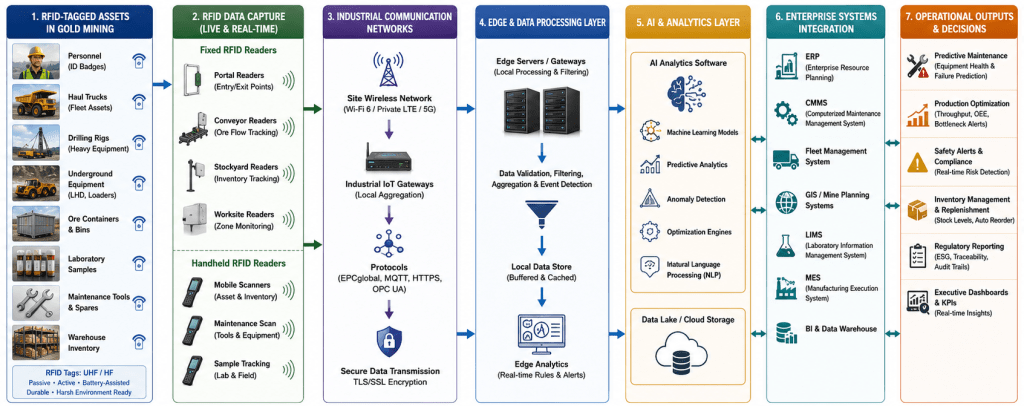
This workflow diagram illustrates how RFID-tagged personnel, equipment, ore, laboratory samples, maintenance tools, and inventory are tracked throughout a gold mining operation. It shows the flow of data from RFID readers through industrial communication networks, edge computing, AI analytics, and enterprise systems to support predictive maintenance, production optimization, safety monitoring, inventory management, regulatory compliance, and executive decision-making.
Technical Components Supporting AI-Enabled RFID Solutions for Gold Mining
Reliable AI-enabled RFID systems for gold mining depend on coordinated interaction between rugged RFID hardware, industrial communications, AI software, enterprise applications, cybersecurity controls, and resilient computing infrastructure. Every component must withstand harsh mining conditions while delivering accurate, low-latency operational data. Selecting appropriate technologies for each operational area significantly influences read accuracy, system availability, maintenance requirements, and long-term return on investment.
GAO has supplied RFID and IoT hardware products and systems to organizations operating in demanding industrial environments. Our experience has shown that reliable RFID data collection begins with selecting equipment that matches the environmental conditions, operational workflows, and performance objectives of each mining site.
RFID Tags for Gold Mining Assets
RFID tags provide the digital identity for physical assets throughout the mining lifecycle. Different tag designs are selected based on read distance, environmental exposure, mounting surface, and operational requirements.
Common RFID-tagged assets include:
- Haul trucks
- Hydraulic excavators
- Underground loaders
- Drilling rigs
- Roof bolters
- Dozers
- Motor graders
- Conveyor components
- Pumps
- Electric motors
- Gearboxes
- Crushers
- SAG and ball mill components
- Process piping
- Mobile fuel tanks
- Explosive transport containers
- Maintenance tools
- Calibrated instruments
- Personal protective equipment
- Laboratory sample containers
- Core trays
- Ore bins
- Concentrate containers
- Spare parts inventory
- Warehouse pallets
- High-value mobile equipment
Recommended RFID technologies include:
- UHF RFIDfor long-range vehicle identification, warehouse inventory, ore logistics, and mobile asset tracking.
- HF RFIDfor laboratory sample management, secure documentation, maintenance records, and controlled access applications.
- LF RFIDfor underground equipment, metallic environments, and applications requiring reliable short-range identification despite moisture and metal interference.
Mining-grade RFID tags typically feature rugged housings resistant to abrasion, vibration, chemicals, UV exposure, water ingress, and mechanical impact. Tag selection should consider ingress protection ratings, operating temperature ranges, mounting methods, and expected service life.
Fixed RFID Readers
Fixed readers automate continuous asset identification without operator intervention. Proper reader placement is essential for achieving consistent read performance while minimizing false reads.
Typical installation locations include:
- Mine entrance gates
- Underground portals
- Shaft stations
- Haul road checkpoints
- Crusher feed stations
- Conveyor transfer points
- Processing plant entrances
- Maintenance workshops
- Fuel stations
- Explosives magazines
- Warehouse receiving docks
- Warehouse dispatch areas
- Tool cribs
- Laboratory entrances
- Refinery access points
- Security checkpoints
Reader selection depends on antenna configuration, read range, environmental enclosure ratings, communication interfaces, and processing capabilities. Mining deployments commonly use industrial readers with IP65, IP67, or higher protection ratings to withstand dust, moisture, vibration, and temperature fluctuations.
Handheld RFID Readers
Handheld readers provide operational flexibility where fixed infrastructure is impractical or where manual verification is required.
Mining personnel use handheld readers for:
- Inventory audits
- Spare parts verification
- Tool tracking
- Equipment inspections
- Mobile maintenance activities
- Laboratory sample verification
- Core sample identification
- Warehouse cycle counts
- Emergency asset verification
- Temporary project deployments
Modern handheld readers often integrate barcode scanning, GPS, cameras, Wi-Fi, Bluetooth, and cellular communications, enabling field personnel to capture multiple data types during a single inspection.
Gold Mining RFID Hardware Solution Diagram
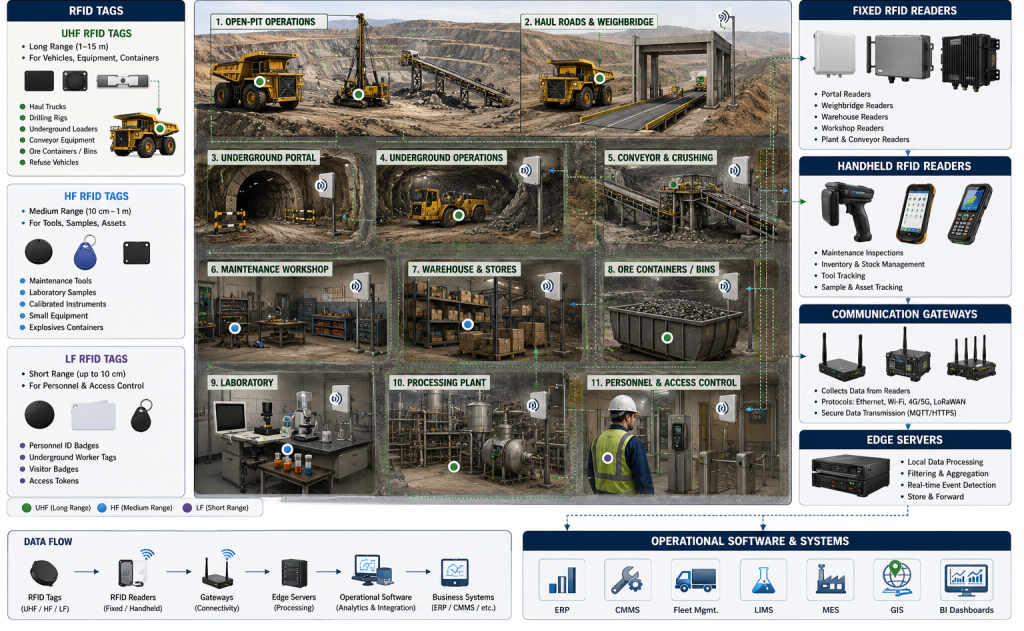
This diagram illustrates the RFID hardware infrastructure used across a gold mining operation, including UHF, HF, and LF RFID tags, fixed and handheld RFID readers, communication gateways, edge servers, and operational software that enable real-time asset, personnel, and inventory tracking.
Artificial Intelligence Software Supporting Gold Mining Operations
Artificial intelligence transforms RFID event data into operational intelligence by continuously analyzing historical trends, real-time activities, equipment performance, maintenance records, production schedules, and workforce movements.
Depending on operational objectives, mining organizations may deploy several AI models simultaneously.
Predictive Maintenance
Predictive maintenance models analyze RFID equipment history alongside sensor measurements, maintenance work orders, operating hours, and inspection records to estimate component degradation before failures occur.
Typical prediction targets include:
- Hydraulic pump failures
- Bearing wear
- Conveyor roller degradation
- Gearbox failures
- Electric motor faults
- Tire replacement intervals
- Lubrication scheduling
- Filter replacement
- Component fatigue
- Battery replacement
Maintenance teams can prioritize repairs based on predicted equipment condition instead of relying solely on fixed maintenance intervals.
Fleet Optimization Models
Machine learning evaluates haul cycle durations, equipment utilization, loading delays, idle time, dispatch efficiency, fuel consumption, and maintenance availability.
AI recommendations may include:
- Fleet redistribution
- Route optimization
- Reduced queue times
- Improved loader allocation
- Optimized fuel scheduling
- Shift balancing
- Maintenance coordination
Inventory Intelligence
AI evaluates RFID inventory events together with historical consumption patterns and production forecasts to improve warehouse operations.
Typical outputs include:
- Spare parts forecasting
- Automatic reorder recommendations
- Safety stock optimization
- Slow-moving inventory identification
- Obsolete inventory detection
- Critical spare prioritization
These recommendations help minimize inventory carrying costs while maintaining operational readiness.
Worker Safety Analytics
AI continuously evaluates RFID personnel movements to strengthen workplace safety.
Common applications include:
- Restricted-area monitoring
- Lone worker detection
- Emergency mustering verification
- Shift attendance analysis
- Evacuation accountability
- Fatigue trend analysis
- High-risk exposure monitoring
These capabilities improve emergency response while supporting regulatory compliance and workforce protection.
Enterprise Software Integration
RFID-generated operational data delivers the greatest value when integrated with existing mining software rather than operating as an isolated identification system.
Common software integrations include:
- Enterprise Resource Planning (ERP)
- Computerized Maintenance Management Systems (CMMS)
- Fleet Management Systems (FMS)
- Manufacturing Execution Systems (MES) for mineral processing
- Warehouse Management Systems (WMS)
- Laboratory Information Management Systems (LIMS)
- Geographic Information Systems (GIS)
- Supervisory Control and Data Acquisition (SCADA)
- Distributed Control Systems (DCS)
- Building Management Systems (BMS)
- Business Intelligence (BI) software
- Environmental Monitoring Information Systems (EMIS)
- Human Resource Management Systems (HRMS)
This integration enables mine managers, maintenance planners, warehouse supervisors, metallurgists, and executive leadership to access consistent operational data across multiple business functions.
Communication Protocols Supporting RFID and AI Systems
Reliable communication is essential for transporting RFID events between readers, edge servers, AI software, and enterprise applications.
Frequently used communication technologies include:
- MQTT
- OPC UA
- REST APIs
- HTTPS
- TCP/IP
- UDP
- Modbus TCP
- EtherNet/IP
- PROFINET
- Fiber Ethernet
- Private LTE
- Private 5G
- Industrial Wi-Fi
- LoRaWAN
- Bluetooth Low Energy for local device communication
Protocol selection depends on network topology, latency requirements, security policies, and interoperability with existing mining infrastructure.
Cybersecurity and Data Protection
Gold mining operations increasingly rely on connected operational technology, making cybersecurity an essential element of RFID-enabled AI solutions.
Recommended security measures include:
- Device authentication
- Role-based access control
- Multi-factor authentication
- Encrypted communications using TLS
- VPN connectivity for remote access
- Network segmentation between IT and OT environments
- Secure firmware management
- Continuous vulnerability assessments
- Security event monitoring
- Backup and disaster recovery planning
- Audit logging for RFID transactions
- Zero Trust security principles where appropriate
Protecting operational data helps maintain production continuity while reducing the risk of unauthorized access, ransomware, or operational disruption.
Cloud Version and Server Version Deployment Models
Selecting the appropriate deployment model depends on operational scale, connectivity, regulatory requirements, cybersecurity policies, and IT management capabilities.
| Feature | Cloud Version | Server Version | |
| Hosting | Cloud-hosted software managed within cloud infrastructure | Customer-managed servers, private data centers, edge servers, or privately hosted enterprise infrastructure | |
| Scalability | Rapid expansion across multiple mining sites | Controlled expansion within customer infrastructure | |
| Maintenance | Software updates managed centrally | Updates managed by customer IT teams | |
| Accessibility | Secure access from multiple locations | Access controlled by organizational network policies | |
| Connectivity | Requires reliable internet connectivity | Can continue operating during limited external connectivity | |
| Data Governance |
|
Suitable for organizations adopting cloud-first strategies | Preferred where internal data governance policies require private hosting |
| Multi-Site Management |
|
Simplifies centralized monitoring across geographically dispersed mines | Suitable for organizations operating independently managed mining sites |
| Typical Applications |
|
Corporate reporting, fleet benchmarking, enterprise analytics | Underground operations, isolated mine sites, latency-sensitive operational control |
Cloud deployments are often selected for organizations operating multiple gold mines requiring centralized visibility, enterprise reporting, and simplified software management.
Server deployments are frequently preferred where mining sites experience intermittent external connectivity, maintain strict cybersecurity requirements, require low operational latency, or operate within privately managed computing environments. Edge servers positioned close to mining activities further improve response times by processing RFID events locally before synchronizing with centralized software when communication links become available.
Mining organizations also increasingly adopt hybrid deployments, combining local edge servers for operational continuity with cloud-based analytics and executive reporting. This approach balances resilience, scalability, and centralized visibility while accommodating the realities of remote mining operations.
Technical Capabilities of AI-Enabled RFID Solutions for Gold Mining
Artificial intelligence powered by RFID-generated operational data enables gold mining organizations to transition from reactive decision-making to continuous operational intelligence. RFID captures trusted identification events from personnel, equipment, inventory, ore movements, laboratory samples, and maintenance activities, while AI evaluates millions of operational records to identify patterns that are difficult to recognize manually.
Rather than operating as an isolated identification solution, RFID becomes a foundational data source that supports production optimization, equipment reliability, workforce safety, inventory management, environmental compliance, and strategic mine planning.
Key technical capabilities include:
- Continuous visibility of mobile and fixed mining assets.
- Automated identification without manual scanning.
- Real-time personnel accountability.
- Intelligent equipment lifecycle management.
- Automated ore batch and concentrate traceability.
- Dynamic warehouse inventory visibility.
- Laboratory sample chain-of-custody monitoring.
- Maintenance history consolidation.
- RFID event correlation with operational telemetry.
- Automated exception detection and operational alerts.
When combined with AI software, these capabilities allow mining organizations to respond proactively rather than reactively, reducing operational uncertainty across extraction, processing, maintenance, and logistics.
Predictive Operational Intelligence
Traditional mining operations often depend on historical reporting, operator observations, and scheduled inspections. AI continuously evaluates RFID-generated events together with production, maintenance, and operational data to anticipate future conditions before they affect production.
Examples include:
- Predicting equipment failures before production interruptions occur.
- Forecasting spare parts demand based on equipment utilization.
- Identifying abnormal haul cycle durations.
- Detecting underutilized production assets.
- Anticipating warehouse inventory shortages.
- Predicting maintenance workload by shift.
- Forecasting equipment replacement schedules.
- Detecting unusual personnel movement patterns.
- Estimating ore processing bottlenecks.
This predictive capability supports more effective production planning while reducing unexpected downtime.
Operational Automation
RFID-triggered AI workflows automate repetitive operational processes that traditionally required manual intervention.
Common automated activities include:
- Equipment check-in and check-out.
- Tool issue and return verification.
- Warehouse inventory updates.
- Maintenance work order generation.
- Fuel usage recording.
- Personnel access authorization.
- Sample tracking updates.
- Compliance reporting.
- Equipment inspection scheduling.
- Inventory replenishment requests.
Automation improves operational consistency while reducing administrative workload for supervisors and maintenance personnel.
AI Operational Intelligence Dashboard for Gold Mining
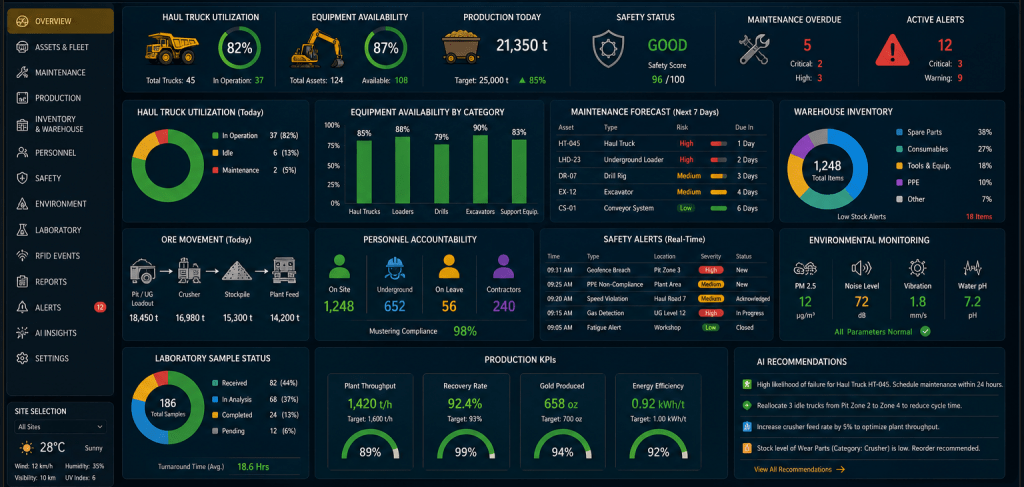
Executive AI dashboard displaying real-time RFID data, mining KPIs, equipment performance, inventory, safety, and predictive operational insights.
Operational Improvements Across Gold Mining Activities
AI-supported RFID solutions improve operational performance throughout every stage of the gold mining value chain. Improvements extend beyond asset tracking by enhancing production coordination, maintenance planning, safety management, inventory control, and resource utilization.
Mining Production
RFID continuously identifies equipment movement, ore transportation, loading activities, and production assets. AI analyzes these events to optimize mining operations by reducing idle time, balancing fleet utilization, and improving material flow.
Operational improvements include:
- Reduced truck queue times.
- Improved loading efficiency.
- Better dispatch coordination.
- Enhanced crusher utilization.
- Improved ore reconciliation.
- Reduced production delays.
- Increased equipment availability.
- Improved production scheduling.
Maintenance Operations
Maintenance organizations benefit significantly from RFID-based asset identification combined with AI analysis.
Benefits include:
- Accurate maintenance history.
- Automated equipment identification.
- Reduced lost tools.
- Improved spare parts availability.
- Optimized maintenance scheduling.
- Better technician productivity.
- Reduced emergency repairs.
- Extended equipment service life.
Warehouse and Inventory Management
Warehouse operations become more accurate through automated RFID identification.
AI helps optimize:
- Spare parts inventory.
- Tire management.
- Lubricant inventory.
- Critical component availability.
- Consumable forecasting.
- Inventory turnover.
- Procurement planning.
- Warehouse labor allocation.
Worker Safety
Personnel identification supported by AI contributes to a safer mining environment.
Safety improvements include:
- Faster emergency evacuation verification.
- Improved restricted-area control.
- Automated shift attendance.
- Better contractor accountability.
- Enhanced lone worker monitoring.
- Reduced unauthorized equipment operation.
- Improved incident investigation.
- Faster emergency response coordination.
Because GAO has supplied RFID technologies supporting industrial asset identification for many years, we understand that dependable worker safety begins with accurate personnel identification, reliable hardware deployment, and properly validated operational workflows.
Business Benefits for Gold Mining Organizations
Although technical performance is essential, AI-enabled RFID investments ultimately support measurable business objectives. Operational intelligence improves decision-making while reducing unnecessary costs across mining operations.
Major business benefits include:
- Higher equipment utilization.
- Reduced unplanned downtime.
- Improved production efficiency.
- Lower maintenance costs.
- Better inventory accuracy.
- Reduced equipment losses.
- Faster operational reporting.
- Improved workforce productivity.
- Stronger regulatory compliance.
- Enhanced operational transparency.
Executive management gains improved visibility into mining performance using operational dashboards that consolidate information previously distributed across multiple software systems.
Financial Performance
Improved operational visibility contributes to stronger financial performance by reducing operational inefficiencies.
Potential improvements include:
- Lower inventory carrying costs.
- Reduced overtime expenses.
- Better capital equipment utilization.
- Fewer production interruptions.
- Reduced fuel consumption.
- Lower maintenance expenditures.
- Reduced asset replacement costs.
- Improved production recovery.
Rather than focusing solely on labor savings, AI supports more informed resource allocation throughout mining operations.
Scalability and Long-Term Operational Growth
Gold mining operations often expand through new pits, underground development, processing plant upgrades, acquisitions, or additional exploration projects. RFID-supported AI solutions should accommodate future growth without requiring complete system redesign.
Scalability considerations include:
- Additional RFID readers.
- Expanded warehouse facilities.
- New underground production levels.
- Additional processing plants.
- Multi-site mining operations.
- Expanded communication infrastructure.
- Increased AI processing capacity.
- Additional operational dashboards.
- Integration with future enterprise software.
Modular deployment strategies allow mining organizations to begin with high-priority operational areas before expanding across the complete operation.
Hybrid deployments combining edge servers with centralized reporting also simplify expansion across geographically distributed mining assets.
Performance Monitoring and KPIs
Continuous performance measurement allows organizations to verify operational improvements after implementation.
Common KPIs include:
- Equipment utilization.
- Fleet availability.
- Mean Time Between Failures (MTBF).
- Mean Time to Repair (MTTR).
- Maintenance compliance.
- Inventory accuracy.
- Spare parts availability.
- Tool return rates.
- Personnel accountability.
- Haul cycle time.
- Crusher throughput.
- Processing recovery.
- Ore reconciliation accuracy.
- Warehouse order fulfillment.
- Fuel consumption per ton.
- RFID read accuracy.
- Reader availability.
- AI prediction accuracy.
- Operational response time.
- Safety incident frequency.
These KPIs enable continuous optimization while supporting long-term operational planning.
Engineering Best Practices for Successful Deployment
Successful RFID-enabled AI projects require disciplined engineering rather than technology installation alone. Careful planning, commissioning, testing, and ongoing optimization improve long-term system reliability.
Recommended engineering practices include:
- Conduct detailed operational workflow analysis before hardware selection.
- Prioritize high-value assets and critical production processes.
- Select RFID tags appropriate for metallic, dusty, and high-vibration environments.
- Perform comprehensive RFID site surveys before installation.
- Validate reader coverage using real operational scenarios.
- Implement redundant communications for safety-critical applications.
- Test system performance during both normal and peak production periods.
- Integrate RFID events with existing mining software rather than creating isolated data repositories.
- Monitor hardware health continuously.
- Calibrate AI models using operational mining data instead of generic datasets.
- Establish cybersecurity governance before production deployment.
- Train operators, maintenance teams, warehouse personnel, and supervisors on revised operational procedures.
- Review KPIs regularly to identify opportunities for continuous improvement.
Organizations adopting phased implementation strategies typically experience smoother deployments because lessons learned during initial phases can be incorporated into later expansions.
GAO supports customers by providing RFID hardware products, technical guidance, and engineering expertise that help organizations deploy reliable identification solutions aligned with operational objectives rather than isolated technology installations.
Gold Mining AI-RFID Deployment Lifecycle
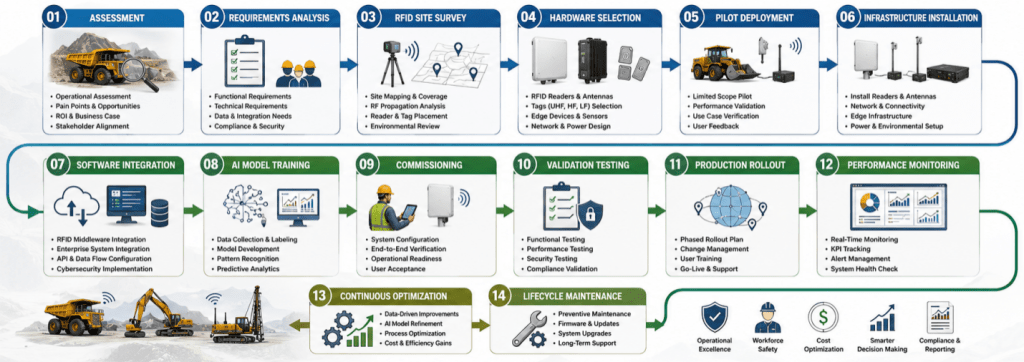
This lifecycle diagram illustrates the complete deployment process for AI and RFID in gold mining, from assessment and site surveys through implementation, AI integration, production rollout, performance monitoring, and continuous optimization.
Implementation Recommendations for AI-Enabled RFID in Gold Mining
Successful AI-enabled RFID implementations are achieved through structured planning, phased deployment, and continuous optimization rather than attempting a mine-wide rollout from the outset. Gold mining operations contain diverse environments, including open-pit mines, underground workings, processing plants, maintenance facilities, warehouses, laboratories, and administrative areas, each requiring tailored engineering decisions.
Recommended implementation practices include:
- Establish measurable business objectives before selecting RFID hardware or AI software.
- Prioritize high-value use cases such as mobile equipment tracking, maintenance automation, worker safety, or ore traceability.
- Perform comprehensive RFID site surveys to identify environmental constraints, metallic interference, and optimal reader locations.
- Select rugged RFID tags and readers designed for dust, vibration, moisture, and extreme temperatures.
- Integrate RFID data with existing ERP, CMMS, FMS, LIMS, GIS, SCADA, and business intelligence software to maximize operational value.
- Deploy edge servers where low latency and operational continuity are critical, particularly for underground mining.
- Validate RFID read accuracy, communication performance, and AI model outputs before expanding deployment.
- Establish cybersecurity policies covering device authentication, encrypted communications, access control, firmware management, and continuous monitoring.
- Train production, maintenance, warehouse, laboratory, and IT personnel on updated workflows and system usage.
- Continuously review KPIs and operational feedback to refine AI models and improve long-term performance.
A phased implementation strategy allows mining organizations to achieve measurable improvements while minimizing operational disruption and supporting future expansion.
Advancing Gold Mining Through AI-Powered RFID Intelligence
Gold mining organizations are under increasing pressure to improve operational efficiency, maximize equipment utilization, strengthen workforce safety, maintain regulatory compliance, and reduce production costs while operating in challenging environments. AI supported by RFID technologies enables mining companies to replace fragmented manual processes with intelligent, data-driven operations that provide continuous visibility across personnel, equipment, inventory, ore movement, laboratory samples, and maintenance activities.
Reliable RFID data forms the foundation for AI-driven predictive maintenance, fleet optimization, inventory intelligence, operational automation, and safety monitoring. When integrated with existing mining software and supported by robust communication infrastructure, these technologies help organizations improve decision-making, reduce operational risk, and increase production performance throughout the mining lifecycle.
Organizations evaluating AI-enabled RFID solutions should focus on clearly defined operational objectives, engineering-led deployment strategies, rigorous testing, and continuous optimization. Selecting durable RFID hardware, validating read performance, integrating operational data, and applying AI to meaningful business challenges are essential steps toward long-term success.
GAO, headquartered in New York City and Toronto, Canada, is recognized among the world’s leading B2B suppliers of RFID and BLE technologies. Together with its sister companies, GAO Research Inc. and GAO Tek Inc., GAO Group has served Fortune 500 companies, leading research institutions, universities, and government organizations across the United States and Canada for more than three decades. Through continued investment in research and development, stringent quality assurance, and expert technical support delivered remotely and onsite, GAO helps organizations deploy reliable RFID and IoT hardware products and systems designed to meet demanding operational requirements.
If your organization is exploring intelligent asset tracking, workforce safety, inventory visibility, maintenance optimization, or production monitoring for gold mining operations, we invite you to learn more about GAO’s RFID technologies, engineering expertise, and technical support services to help design and implement reliable AI-enabled identification solutions.
Executive Benefits of AI-Enabled RFID in Gold Mining
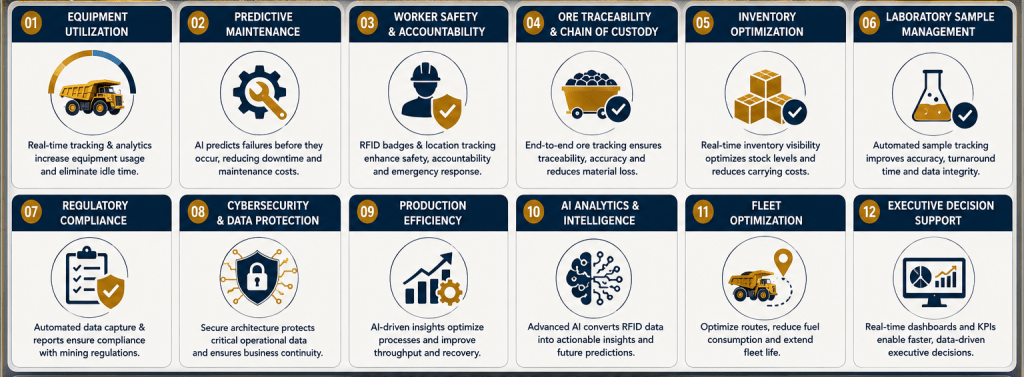
This executive infographic summarizes the strategic, operational, and technical advantages of AI-enabled RFID in gold mining, highlighting improvements in asset visibility, worker safety, predictive maintenance, inventory control, production efficiency, regulatory compliance, and AI-driven decision-making.
Building the Future of Industrial AI and IoT with Aperture Venture Studio and GAO RFID Inc.
For more than three decades, GAO Group of Companies has invested extensively in research and development of industrial RFID, BLE, and IoT technologies. As artificial intelligence has become an increasingly valuable capability for mining automation, operational intelligence, and industrial decision support, we have expanded our work in AI-driven RFID and IoT solutions to address the evolving needs of gold mining and other resource-intensive industries. This commitment naturally led to the establishment of Aperture Venture Studio to accelerate the development and advancement of practical AI and IoT solutions that solve real industrial challenges.
Aperture has brought together highly accomplished AI researchers, IoT specialists, engineering professionals, experienced business leaders, influential investors, and leading industry organizations to collaborate on advanced industrial technologies. Through initiatives such as Aperture Ventures Summit and TekSummit, we foster technical knowledge sharing and professional collaboration focused on emerging AI, RFID, BLE, and IoT innovations.
These ongoing efforts have helped cultivate strong technical communities dedicated to advancing intelligent industrial solutions. We welcome opportunities to collaborate with:
- Advisors, co-founders, and employees who share our passion for industrial innovation.
- Investors interested in advancing practical AI and IoT technologies.
- Customers seeking trusted engineering expertise, RFID hardware products, and intelligent IoT solutions for complex industrial environments.
By combining decades of RFID experience with modern AI capabilities, GAO and Aperture continue supporting the future of intelligent, data-driven gold mining operations and the broader industrial sector.